
Juan N. Pava
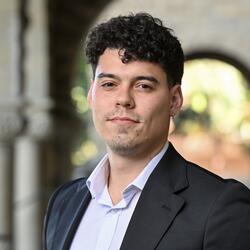
Juan N. Pava
- Master's in International Policy Class of 2028
Biography
Juan N. Pava is pursuing the Ford Dorsey Master’s in International Policy at Stanford University, specializing in Governance and Development. His work brings normative political theory to bear on questions of political economy and global development, asking how power concentrated in states and firms shapes the prospects of those who depend on it, and when that dependence produces exploitation or neglect.
Juan joins MIP after three years as a Tech Ethics & Policy Research Fellow at the Stanford Institute for Human-Centered Artificial Intelligence (HAI), first at the McCoy Family Center for Ethics in Society as a Rising Scholar and then at HAI, where he worked at the intersection of AI governance, international development, and the Global South. He is a core research-team member for the AI Index, HAI’s flagship annual report, and has written on AI sovereignty — states’ bid to control their own AI — including “The Commercial Landscape of AI Sovereignty Offerings,” which maps the market that has grown up to sell it to them. He also led “Mind the (Language) Gap,” on the obstacles to building language models for the world’s under-resourced languages, and its companion study on language digitization, work he has presented at TETHICON and at Mexico’s Institute of Innovation, Science & Entrepreneurship for Competitiveness.
Alongside this research, Juan helped launch HAI’s program with the d.school training social-sector leaders on AI, and the AI for Accessibility Collective, a Google.org-funded partnership between Stanford, UCL, MIT, and the University of Washington. He is also a research collaborator at Stanford’s Human Trafficking Data Lab, where he co-authors work with faculty on the legal and statistical frameworks used to measure labor exploitation.
Before Stanford, Juan earned dual B.A. degrees in Economics and Philosophy from New York University, graduating cum laude with High Honors in Philosophy and minors in Mathematics and French. His undergraduate research ranged across political philosophy and development economics, from civil disobedience and the limits of political obligation to the effects of U.S. foreign aid on welfare and political rights, and the question of which outcomes should count.