Security

FSI scholars produce research aimed at creating a safer world and examing the consequences of security policies on institutions and society. They look at longstanding issues including nuclear nonproliferation and the conflicts between countries like North and South Korea. But their research also examines new and emerging areas that transcend traditional borders – the drug war in Mexico and expanding terrorism networks. FSI researchers look at the changing methods of warfare with a focus on biosecurity and nuclear risk. They tackle cybersecurity with an eye toward privacy concerns and explore the implications of new actors like hackers.

Along with the changing face of conflict, terrorism and crime, FSI researchers study food security. They tackle the global problems of hunger, poverty and environmental degradation by generating knowledge and policy-relevant solutions. 

0
narayan_headshot_-_ashray_narayan.jpg

Ashray Narayan is an M.A. candidate in International Policy at Stanford’s Freeman Spogli Institute whose work bridges technology policy, media, and democracy. He previously managed programs at Stanford’s Center for International Security and Cooperation with Professor Andrew Grotto, led marketing and launch strategy for the Sequoia‑backed startup Rox, and held senior creative roles at Buck Mason and Bode. Earlier experiences include the U.S. Department of State’s Bureau of Economic and Business Affairs and research at UC Berkeley. Ashray earned a B.A. in Economics from USC. 

Master's in International Policy Class of 2027
Date Label
-
Livestream event on March 1, 2022 at 6:30pm PST: "What's Next for Ukraine and Russia?"

This panel discussion will analyze the most recent developments in the conflict between Ukraine and Russia, and what may lay ahead.

It will be moderated by Francis Fukuyama, director of Stanford’s Ford Dorsey Masters of International Policy Program and Olivier & Nomellini Senior Fellow in International Studies at the Freeman Spogli Institute for International Studies (FSI), with panelists Rose Gottemoeller, the Steven C. Házy Lecturer at FSI’s Center for International Security and Cooperation and deputy secretary general of NATO from 2016 to 2019, and Steve Pifer, the William J Perry Fellow at FSI and former U.S. ambassador to Ukraine.


PANELISTS:

Woman smiling

Rose Gottemoeller

Steven C. Házy Lecturer at the Center for International Security and Cooperation
Full Profile
Man smiling

Steven Pifer

WIlliam J. Perry Fellow at the Center for International Security and Cooperation
Full Profile


MODERATOR:

Francis Fukuyama

Francis Fukuyama

Olivier Nomellini Senior Fellow at the Freeman Spogli Institute for International Studies
Full Profile
Francis Fukuyama
Francis Fukuyama

Join via YouTube livesteam

Center for International Security and Cooperation
Encina Hall
616 Jane Stanford Way
Stanford University
Stanford, CA 94305-6165

0
William J. Perry Lecturer, Freeman Spogli Institute for International Studies
Research Fellow at the Hoover Institution
dsg_gottemoeller.jpg

Rose Gottemoeller is the William J. Perry Lecturer at Stanford University's Freeman Spogli Institute for International Studies and Research Fellow at the Hoover Institute.

Before joining Stanford, Gottemoeller was the Deputy Secretary General of NATO from 2016 to 2019, where she helped to drive forward NATO’s adaptation to new security challenges in Europe and in the fight against terrorism.  Prior to NATO, she served for nearly five years as the Under Secretary for Arms Control and International Security at the U.S. Department of State, advising the Secretary of State on arms control, nonproliferation and political-military affairs. While Assistant Secretary of State for Arms Control, Verification and Compliance in 2009 and 2010, she was the chief U.S. negotiator of the New Strategic Arms Reduction Treaty (New START) with the Russian Federation.

Prior to her government service, she was a senior associate with the Carnegie Endowment for International Peace, with joint appointments to the Nonproliferation and Russia programs. She served as the Director of the Carnegie Moscow Center from 2006 to 2008, and is currently a nonresident fellow in Carnegie's Nuclear Policy Program.  

At Stanford, Gottemoeller teaches and mentors students in the Ford Dorsey Master’s in International Policy program and the CISAC Honors program; contributes to policy research and outreach activities; and convenes workshops, seminars and other events relating to her areas of expertise, including nuclear security, Russian relations, the NATO alliance, EU cooperation and non-proliferation. 

Date Label
Rose Gottemoeller Steven C. Házy Lecturer at CISAC
Steven Pifer WIlliam J. Perry Fellow at CISAC
Panel Discussions

Image
Facebook's Faces event flyer on blue and red background with photo of Chinmayi Arun
Join us on Tuesday, March 1 from 12 PM - 1 PM PT for a panel discussion on “Facebook’s Faces” featuring Chinmayi Arun, Resident Fellow at the Yale Law School in conversation with Nate Persily of the Stanford Cyber Policy Center. This weekly seminar series is jointly organized by the Cyber Policy Center’s Program on Democracy and the Internet and the Hewlett Foundation’s Cyber Initiative.

About The Seminar: 

Scholarship about social media platforms discusses their relationship with states and users. It is time to expand this theorization to account for differences among states, the varying influence of different publics and the internal complexity of companies. Viewing Facebook’s relationships this way includes less influential states and publics that are otherwise obscured. It reveals that Facebook engages with states and publics through multiple, parallel regulatory conversations, further complicated by the fact that Facebook itself is not a monolith. Arun argues that Facebook has many faces – different teams working towards different goals, and engaging with different ministries, institutions, scholars and civil society organizations. Content moderation exists within this ecosystem.
 
This account of Facebook’s faces and relationships shows that less influential publics can influence the company through strategic alliances with strong publics or powerful states. It also suggests that Facebook’s carelessness with a seemingly weak state or a group, may affect its relationship with a strong public or state that cares about the outcome.

To be seen as independent and legitimate, the Oversight Board needs to show its willingness to curtail Facebook’s flexibility in its engagement with political leaders where there is a real risk of harm. This essay hopes to show that Facebook’s fear of short-term retaliation from some states should be balanced out by accounting for the long-term reputational gains with powerful publics and powerful states who may appreciate its willingness to set profit-making goals aside in favor of human flourishing.

About the Speakers:

Image
Chinmayi Arun
Chinmayi Arun is a resident fellow of the Information Society Project at Yale Law School, and an affiliate of the Berkman Klein Center of Internet & Society at Harvard University. She has served on the faculties of two of the most highly regarded law schools in India for over a decade, and was the founder Director of the Centre for Communication Governance at National Law University Delhi. She has been a Human Rights Officer with the United Nations and is a member of the United Nations Global Pulse Advisory Group on the Governance of Data and AI, and of UNESCO India’s Media Freedom Advisory Group.

Chinmayi serves on the Global Network Initiative Board, and is an expert affiliated with the Columbia Global Freedom of Expression project. She has been consultant to the Law Commission of India and member of the Indian government’s multi stakeholder advisory group for the India Internet Governance Forum in the past.

Image
Nate Persily
Nathaniel Persily is the James B. McClatchy Professor of Law at Stanford Law School, with appointments in the departments of Political Science, Communication, and FSI.  Prior to joining Stanford, Professor Persily taught at Columbia and the University of Pennsylvania Law School, and as a visiting professor at Harvard, NYU, Princeton, the University of Amsterdam, and the University of Melbourne. Professor Persily’s scholarship and legal practice focus on American election law or what is sometimes called the “law of democracy,” which addresses issues such as voting rights, political parties, campaign finance, redistricting, and election administration. He has served as a special master or court-appointed expert to craft congressional or legislative districting plans for Georgia, Maryland, Connecticut, New York, North Carolina, and Pennsylvania.  He also served as the Senior Research Director for the Presidential Commission on Election Administration. His current work, for which he has been honored as a Guggenheim Fellow, Andrew Carnegie Fellow, and a Fellow at the Center for Advanced Study in the Behavioral Sciences, examines the impact of changing technology on political communication, campaigns, and election administration.  He is codirector of the Stanford Cyber Policy Center, Stanford Program on Democracy and the Internet, and the Stanford-MIT Healthy Elections Project, which supported local election officials in taking the necessary steps during the COVID-19 pandemic to provide safe voting options for the 2020 election. He is also a member of the American Academy of Arts and Sciences, and a commissioner on the Kofi Annan Commission on Elections and Democracy in the Digital Age.

 

Seminars
-

 All CISAC events are scheduled using the Pacific Time Zone. 
 

SEMINAR RECORDING

Virtual only.

Sylvie Kauffmann
Seminars
-

Image
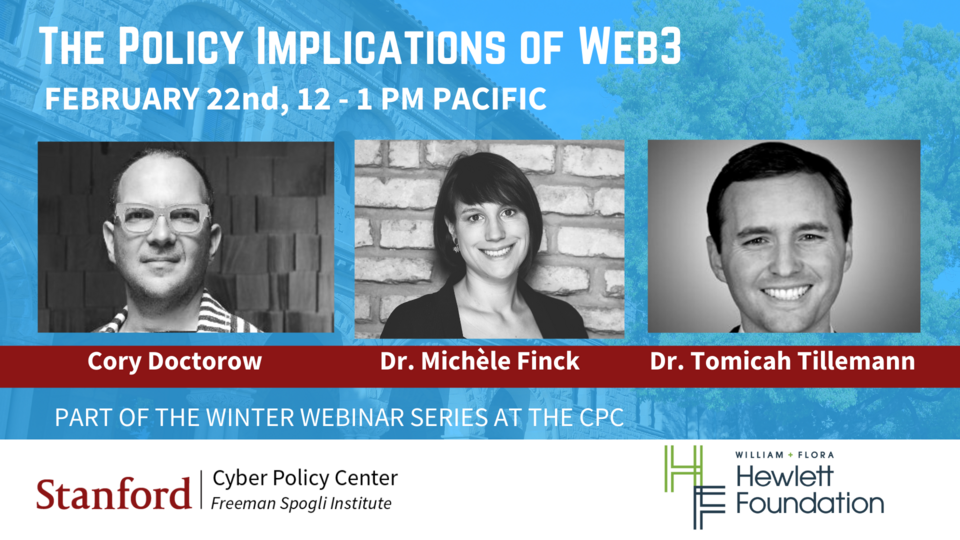
collage showing cory doctorow, Dr. Tomicah Tillemann and Michelle Finck

Join us on Tuesday, February 22 from 12 PM - 1 PM PT for a panel discussion on “The Policy Implications of Web3”, featuring Tomicah Tillemann of KRH Partners, Cory Doctorow of Craphound.com, and Michèle Finck of the University of Tübinge in conversation with Marietje Schaake of the Stanford Cyber Policy Center. This weekly seminar series is jointly organized by the Cyber Policy Center’s Program on Democracy and the Internet and the Hewlett Foundation’s Cyber Initiative.

The year 2021 marked an important moment for web3. Proponents believe the potential of web3 to democratize, decentralize and improve the internet is huge. Others argue that evangelists have yet to deliver results, and that web3 will inevitably tend towards centralization. Few however have explored the policy and political implications of the concept: how should regulators approach a potential web3 explosion? How should lawmakers think about the wider internet infrastructure? Is web3 an opportunity to reimagine the internet, or will it present even more challenges to policymakers? This webinar will explore these angles and foster a reflection on public policy by leading technologists and academics. The session is open to the public, but registration is required.

ABOUT THE SPEAKERS:


Image
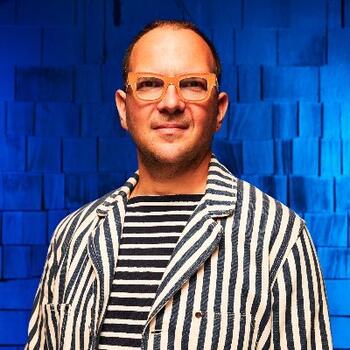
cory doctorow
Cory Doctorow (craphound.com) is a science fiction author, activist and journalist. He is the author of many books, most recently Radicalized and Walkaway. He maintains a daily blog at Pluralistic.net. He works for the Electronic Frontier Foundation, is a MIT Media Lab Research Affiliate, a Visiting Professor of Computer Science at Open University, a Visiting Professor of Practice at the University of North Carolina’s School of Library and Information Science and co-founded the UK Open Rights Group. In 2020, he was inducted into the Canadian Science Fiction and Fantasy Hall of Fame.

Image
Michele Finck
Dr. Michèle Finck is Professor of Law and Artificial Intelligence at the University of Tübingen, an Affiliated Fellow at the Max Planck Institute for Innovation and Competition in Munich and the Centre for Blockchain Technologies at University College London as well as a Visiting Professor at LUISS University in Rome. She previously worked at the University of Oxford and the London School of Economics.


Image
tomicah tillemann
Dr. Tomicah Tillemann is a partner and Global Chief Policy Officer at KRH Partners, a new crypto venture fund led by former a16z General Partner Katie Haun, where he builds public policy architecture to support the next generation of the Internet. Until recently, he was the Global Head of Policy for an arm of Andreessen Horowitz. He worked in collaboration with the Rockefeller Foundation, the World Bank, MIT, and governments around the world to develop a new generation of open source technology platforms to power the public sector. He also oversaw the work of the Blockchain Trust Accelerator and the Responsible Asset Allocator Initiative.

Image
Marietje Schaake
Marietje Schaake (Moderator) is international policy director at Stanford University Cyber Policy Center and international policy fellow at Stanford’s Institute for Human-Centered Artificial Intelligence. Between 2009 and 2019, Marietje served as a Member of European Parliament for the Dutch liberal democratic party where she focused on trade, foreign affairs, and technology policies. Marietje is an (Advisory) Board Member with a number of nonprofits including MERICS, ECFR, ORF and AccessNow. She writes a monthly column for the Financial Times and a bi-weekly column for the Dutch NRC newspaper.

Seminars
0
ryu_23_headshot_1.JPG

Mi Jin is a Master’s in International Policy candidate at Stanford, where she specializes in International Security. Prior to Stanford, she has been working at the Ministry of Foreign Affairs of the Republic of Korea for six years. In 2016, she dealt with the North Korea’s 5th nuclear test. Working at the South Korean Embassy to Hungary in 2019, she was responsible for handling the ferry accident in which thirty-three South Koreans involved. From 2020 to 2021, she was in charge of inter-Korean exchange and cooperation program as well as the implementation of the UN Security Council resolutions on the DPRK. She holds a B.A. in Chinese Culture and in Economics from Sogang University, Seoul, Korea. She speaks English, Korean, and Mandarin. At Stanford, she hopes to reinforce her ability and expertise to approach the complicated and ever-changing landscape of international politics. Her academic interests include North Korean issues, arms control and disarmament, cyber security, and emerging technologies. In her free time, she loves playing golf and hiking.


Master's in International Policy Class of 2023
0
shala_arelena_headshot.jpg

Arelena Shala, from Prizren, Kosovo, is pursuing a Master's in International degree with a focus on international security as a Knight-Hennessy Scholar. She comes to Stanford after graduating from the United States Military Academy at West Point, the first in her country. Her background is in geospatial science and Arabic language studies. During her undergraduate research, Arelena explored commercial-based methods of three-dimensional reconstruction of environments to improve military intelligence capabilities. Her current research interest is the intersection of geospatial science and international security, mainly the use of open-source imagery intelligence as a method of verification of nuclear-nonproliferation and promotion of transparency in global security. Her research resulted in the identification of a new nuclear-related facility in Iran and was published in Janes Intelligence Review. Arelena is currently a research assistant for LTG(R) H. R. McMaster at the Hoover Institution, and after graduation, she will serve as a military intelligence officer in the Kosovo Army. In her free time, Arelena enjoys learning about different cultures and languages through travel. Besides her native Albanian, Arelena is conversant in Spanish, Turkish, and Arabic.

Master's in International Policy Class of 2022
Subscribe to Security