Authors
Noa Ronkin
News Type
News
Date
Paragraphs

In countries far along in the demographic transition, rapidly aging populations are colliding with a severe shortage of health care and elder care workers. Japan may be the most pertinent case study of this and other impacts of demographic disruption. The country’s fertility rate is decreasing faster than projected, and as of 2025, 30% of its population was aged 65 or older. These trends have contributed to a persistent gap between surging demand for elder care and a shrinking care workforce.

To cope with this crisis, the Japanese government has implemented several programs to promote the use of robots in nursing home care. These care robots (or “kaigo robots”) assist care workers and support residents with daily needs. But how does their adoption affect workflows, staff retention, and overall staffing of long-term care facilities? Few studies have empirically examined these questions.

Shedding light on the debate surrounding new automation technologies and their impact on workers, a recent study, published on August 6 in the inaugural issue of the journal Health Affairs Review, finds that care robots help address challenges posed by population aging and care-labor shortages without necessarily displacing workers or lowering care quality.

The study, titled Robots and Labor in the Service Sector: Evidence from Nursing Homes, is part of a collaborative effort driven by the Asia Health Policy Program (AHPP) at the Walter H. Shorenstein Asia-Pacific Research Center. The study’s co-authors are Stanford health economist Karen Eggleston, the director of AHPP; Toshiaki Iizuka of the University of Tokyo’s Graduate School of Economics, a former AHPP visiting scholar; Yong Suk Lee of the University of Notre Dame’s Keough School of Global Affairs, formerly the SK Center Fellow at Stanford’s Freeman Spogli Institute for International Studies; and Ellie Xi, a rising junior at Stanford studying biomedical computation on the pre-med track and a former research assistant to Dr. Eggleston.

“One of the aspects of the paper that I found most interesting is its attempt to move beyond simply documenting where robots are being adopted and instead ask what their adoption may actually do to the long-term care workforce, especially given the sector’s high turnover rates and physically demanding working conditions,” says Xi.

Sign up for APARC's newsletters to receive our scholars’ research updates > 

Overall, this empirical evidence from Japan suggests that robot adoption can augment the care workforce and improve retention, potentially improving continuity and quality of care while mitigating careworker shortages.
Eggleston, Iizuka, Lee, and Xi

Lessons from Early Diffusion of Robotics in the Long-Term Care Sector


The researchers grouped the robots prevalent in Japanese nursing homes into three main categories:

  • Transfer aids: Wearable and non-wearable devices that assist staff with lifting frail residents from beds to wheelchairs, significantly reducing back strain, a leading cause of caregiver burnout.
  • Mobility robots: Assistive systems that help residents move, use the restroom, or bathe more independently.
  • Monitoring and communication systems: Sensors that alert staff when a resident has slipped out of bed or fallen, as well as social robots designed to offer companionship and cognitive stimulation.


To examine early diffusion of these robots, the researchers used 2017 survey data on long-term care work across approximately 860 Japanese nursing homes. A second source of data is their compilation of prefecture-level care robot subsidy availability, using regional variation in robot subsidies as an instrumental variable. Think of this as a natural experiment driven by a “geographic nudge.” Starting in 2015, Japan’s central government began providing prefectural governments with funds to subsidize the cost of adopting care robots. Because different prefectures introduced these subsidies at different times and with varying levels of generosity, nursing homes in some regions had a much easier path to acquiring and deploying robots than those in neighboring areas.

By comparing staffing trends between nursing homes that received this external, subsidy-driven "nudge" to adopt robots and those that did not, the researchers could confidently isolate the technology’s causal effects on the caregiving workforce.

The results indicate that nursing homes that adopted robots saw a significant decrease in staffing retention problems. Robot adoption was also associated with a 28% increase in care workers and a 39% increase in nurses, resulting in approximately 26% higher total employment at the facility level. Importantly, this employment growth occurred entirely among non-regular employees – that is, staff members on flexible, often part-time, contracts. The findings also suggest that robot adoption may improve continuity and quality of care while mitigating careworker shortages.

“Using nationally representative data from Japan and an instrumental-variable strategy, the study provides evidence suggesting that robots can complement rather than simply replace care workers, including by alleviating retention difficulties in a sector facing persistent labor shortages and potentially supporting quality of care,” explains Xi. “The paper’s central finding is that robot adoption is associated with reduced retention difficulties and increased employment of care workers and nurses under flexible contracts.”

Given recent debates about AI use in healthcare and the future of work, I found it especially interesting that this research highlights the potential for technology to augment caregivers.
Ellie Xi

A Human-Robot Collaborative Future for Elder Care


Caregiving is a physically demanding and high-stress occupation. The study’s findings indicate that, by introducing robots to ease staff burdens and monitor residents, nursing homes were able to promote more flexible work, either by increasing the tasks performed by non-regular employees or potentially encouraging part-time work. This type of work structure is encouraged by the Japan Nursing Association as a means for reducing stress, preventing burnout, and promoting a healthier work-life balance.

“Given recent debates about AI use in healthcare and the future of work, I found it especially interesting that this research highlights the potential for technology to augment caregivers, particularly by supporting physically demanding or indirect tasks, while preserving the human aspects of care that are more difficult to reproduce,” says Xi.

The study's findings are relevant for policymakers seeking evidence on the social value of collaborative robots and their impacts on staffing and care delivery, particularly as aging societies facing demographic pressures similar to Japan consider how to meet growing demand for long-term care.

A Mentorship Story


The study is part of Eggleston’s Innovation for Healthy Aging research track, which investigates how East Asian economies adopt and adapt to emerging technologies, design incentives, and adjust their workforces to support older adults. It builds on an earlier research project focused on the impact of robots on nursing home care in Japan.

For Xi, co-authoring the paper represents an academic milestone. "As someone deeply interested in geriatrics, I first began working with Dr. Karen Eggleston as a research assistant during the summer after my freshman year," Xi recalls. "Last spring, we decided to continue working together through a directed reading."

During that directed reading, Xi was invited to help revise and update a project that had previously circulated as an Asia Health Policy Program working paper. She worked to update the research, framing the original findings within the rapidly shifting landscape of care robotics and artificial intelligence in long-term care.

"I worked on situating the original findings within more recent research and developments in care robotics and considering what Japan’s experience can tell us about the role of these technologies in aging societies today," Xi says. "It was an incredible opportunity to work closely with Dr. Eggleston, Professor Toshiaki Iizuka, and Professor Yong Suk Lee. I was especially grateful to see firsthand how a collaborative project evolves and to contribute to that process as the paper moved from a working paper toward publication.”

Read More

Logo of the New South Wales Ministry of Health's podcast Future Health
News

Robotics and the Future of Work: Lessons from Nursing Homes in Japan

On the Future Health podcast, Karen Eggleston discusses the findings and implications of her collaborative research into the effects of robot adoption on staffing in Japanese nursing homes.
Robotics and the Future of Work: Lessons from Nursing Homes in Japan
Elderly woman's hand touching a robot's hand. Photo from a summit on AI's potential for empowering humanity.
News

Six Lessons from Asia on Using AI for Aging in Place

Top aging and healthy policy experts from China, Singapore, and South Korea agree that helping older adults age at home requires addressing systemic health care bottlenecks rather than racing to build smarter AI models.
Six Lessons from Asia on Using AI for Aging in Place
Four elderly Chinese people sitting outdoors.
News

Asia's Aging Populations Drive Surging Disease Burden, Although Individual Health Improves

Across five Asian health care systems, rapid population aging drives up disease burden, particularly for chronic conditions, even as medical advancements improve outcomes for individual patients, according to a study co-authored by Stanford health economist Karen Eggleston.
Asia's Aging Populations Drive Surging Disease Burden, Although Individual Health Improves
Hero Image
A service robot is displayed during the Japan Robot Week 2022 event, in Tokyo, Japan.
A service robot is displayed during the Japan Robot Week 2022 event on October 19, 2022, in Tokyo, Japan. | Tomohiro Ohsumi/Getty Images
All News button
1
Subtitle

The study, one of the first to use institution-level data to examine service-sector robots, indicates that the adoption of care robots in Japanese nursing homes improves staffing retention, increases employment of care workers and nurses under flexible contracts, and may enhance care quality.

Terms
Image
A service robot is displayed during the Japan Robot Week 2022 event, in Tokyo, Japan.
Caption A service robot is displayed during the Japan Robot Week 2022 event on October 19, 2022, in Tokyo, Japan. | Photo credit Tomohiro Ohsumi/Getty Images
Title
Robots in Japan Ease Elder Care Shortages Without Displacing Workers or Diminishing Care Quality
Date Label
Display Hero Image Wide (1320px)
Yes
Authors
News Type
News
Date
Paragraphs
Image
Report cover page with icons and title

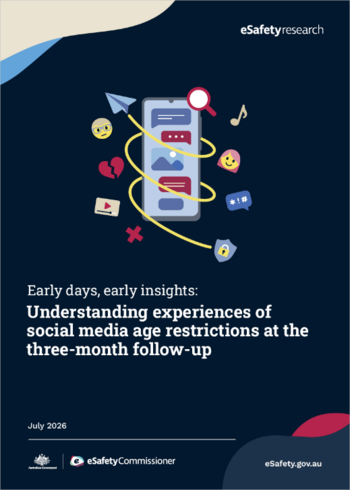
The Tech Impact and Policy Center's Social Media Lab (SML) serves as the Lead Academic Partner on the Australian eSafety Commissioner's two-year evaluation of the policy, working alongside an independent Academic Advisory Group to help design the study, advise on analysis, and peer-review the findings. The Commissioner's first follow-up report, Early days, early insights, is now out, drawing on a nationally representative baseline survey of over 4,000 families collected before the law took effect, and a three-month follow-up with roughly 1,000 of those same families.

If there's one number worth remembering from this report and it's not about kids, it's about platforms. Among children who still held an account on an age-restricted platform three months in, half (50.2%) said the reason was simple: the platform had never asked them to verify their age. Not a workaround. Not a VPN. Not a clever teenager outsmarting the system, just no prompt at all.

That single stat reframes the debate. The law targets platforms, not children or parents, and there are no penalties for under-16s who keep an account. So when the report also finds that overall account ownership on age-restricted platforms dropped from 52.4% at baseline to 42.1% at three months, the honest read is: real, but partial. Many children who had accounts before the law simply kept them.

A second finding deserves more attention than it's gotten: parental awareness of their child's social media use actually declined after the restrictions took effect. At baseline, 23.3% of parents didn't know their child had used social media in the past four weeks; by three months, that had risen to 33.3%, with the shift concentrated among parents of girls and children aged 10–12. This is the kind of unintended consequence a longitudinal evaluation is designed to catch early, and it's worth asking why: are kids disclosing less, are parents checking in less, or both?

Third, there are early signs of redistribution rather than disengagement. Children's daily-or-more use of messaging platforms rose from 40.5% to 52.3%, alongside increases in online gaming and use of a handful of platforms not currently classified as age-restricted, including Pinterest and BeReal. Kids aren't necessarily logging off, some appear to be moving elsewhere.

What this report gives us, ultimately, is a first look at how children and parents are experiencing these restrictions just three months in. Its value isn't in telling us whether the policy has worked; it's too early for that. Instead, it lets us start checking whether the early changes the policy anticipated are actually beginning to show up, and whether the foundations for real, longer-term outcomes are being laid. 

SML will continue as Lead Academic Partner through the full two-year evaluation, with the next survey wave due at six months. 

All News button
1
Subtitle

Three months after Australia's Social Media Minimum Age (SMMA) restrictions took effect, the first wave of evidence is in, and it complicates the story we've all been telling ourselves about kids and compliance.

Terms
Image
Report cover page with icons and title
Title
Australia's Social Media Age Ban, Three Months In: What We're Learning
Date Label
Display Hero Image Wide (1320px)
No
Authors
Heather Rahimi
News Type
News
Date
Paragraphs

The United States cannot match China's scale alone and pretending otherwise is a strategic mistake. That was the central message Rush Doshi delivered as keynote speaker at the Stanford Center on China's Economy and Institutions' 2026 annual China Conference, where he called on the U.S. to reimagine its alliance system as a platform for building shared capacity across military, economic, and technological domains.

Rush Doshi, the C.V. Starr Senior Fellow for Asia Studies at the Council on Foreign Relations and an assistant professor at Georgetown's Walsh School of Foreign Service, previously served as Deputy Senior Director for China and Taiwan on the National Security Council (2021-24), where, for a portion of his tenure, he was the U.S. government’s lead action officer coordinating the negotiations that launched AUKUS, a trilateral security partnership for the Indo-Pacific region between Australia, the United Kingdom, and the United States. He is also the author of The Long Game: China's Grand Strategy to Displace American Order (Oxford University Press, 2021).

Doshi grounded his address in a historical argument: scale, which Doshi defined as “the ability to generate efficiency and productivity and thereby outcompete rivals,” has been the decisive factor in the rise and fall of great powers. Great Britain's eclipse by larger industrializing rivals in the late nineteenth century, he argued, offers a cautionary parallel for the U.S. today. "Today, that sense of daunting scale belongs to China," Doshi said, "and the United States appears to be in the position that Great Britain was in a century ago."

China's Scale Is Not Abstract
China's economy, measured in purchasing power, is now roughly 30 percent larger than that of the United States, and its share of global manufacturing quintupled in the two decades after joining the WTO, while the U.S. share fell by half. China has two to three times U.S. industrial capacity, 13 times U.S. steel production, and roughly 500 times U.S. shipbuilding capacity. It produces two-thirds of the world's electric vehicles, three-quarters of its batteries, and 90 percent of its solar panels and refined rare earths, and is at the leading edge of six of the ten industries expected to define the next industrial revolution.
That industrial strength is now translating into direct geopolitical leverage. Doshi pointed to China's weaponization of its rare earths dominance in 2025, which effectively forced the U.S. to walk back elements of its own trade and export control policies. "That marked the first time that an export control was used to force open market access," he said. "That's a massive moment in the history of trade.

The Case for Allied Scale
The answer, Doshi argued, is not to retreat into fortress America, a sphere-of-influence arrangement, or a China-led order, but to build what he calls "allied scale." A coalition of the U.S. and its key allies and partners would represent three times China's nominal GDP, twice its defense spending, and one and a half times its share of global manufacturing.

That advantage is entirely theoretical, unlocking its potential, though, is the central task of American statecraft in this century."
Rush Doshi

"That advantage is entirely theoretical," Doshi conceded. "Unlocking its potential, though, is the central task of American statecraft in this century." In practice, that might mean Japan and South Korea investing in American shipbuilding; Taiwan building semiconductor plants in the U.S.; allies co-producing advanced weapons systems; and all parties maintaining a shared tariff or regulatory wall against China's excess industrial capacity. On the economic side, Doshi called for common investment screening, coordinated industrial policy, and an "economic Article 5" ensuring that when China uses economic coercion against one ally, all respond together.

Addressing the Skeptics
Doshi acknowledged "the new pessimism," the view that Trump-era damage to U.S. alliances has made allied scale impossible. The strain is real, he said, but not terminal, for three reasons:

  1. The alternatives are worse. Spheres of influence, unrestrained multipolarity, and a China-led order all leave the U.S. and its partners poorer and less secure. 
  2. Alliances have absorbed serious shocks before and survived. For example, France's withdrawal from NATO's unified command, Nixon's opening to China, the Plaza Accord. 
  3. The underlying logic of interdependence persists. Allied economies are growing more dependent on U.S. markets as China buys less from them, allies are purchasing record numbers of American weapons, and even the Trump administration has not escaped the pull of allied scale, with Vice President Vance publicly calling for a trading bloc among allies to break China's chokehold on critical minerals.
Allied scale can't just be about balancing China, it has to be about building the kind of world that we want to see and live in.
Rush Doshi

Eight Principles to Achieve Allied Scale
Doshi closed with a practical blueprint — eight principles for building allied scale.

  1. Turn the page on the Trump era. Persuade allies that the most damaging recent policies were products of individual leadership rather than durable features of the American political system.

  2. Begin with humility. Start with small, achievable projects: a joint shipbuilding effort, a critical minerals offtake agreement, a co-production line. Build from there.

  3. Build mutually beneficial bargains. Allies invest in America; America invests in allies. All extend each other more preferential terms than they do to non-market economies like China.

  4. Pay attention to domestic politics. “The danger of the ‘Trump Approach’ is alienation and polarization of allied politics that makes diplomacy impossible.” Any allied scale strategy must be first grounded in domestic politics.

  5. Build ad hoc coalitions. Allied scale does not mean doing everything with everyone. It means assembling the right groupings for specific challenges and opportunities.

  6. Bolster credibility through congressional legislation. Executive orders are too easily reversed. Durable commitments to allies require legislative backing that is harder to undo with a change in administration.

  7. Build on existing platforms. Frameworks like the Quad, AUKUS, the U.S.-Japan-South Korea trilateral, and the G7 already exist. Allied scale should strengthen what works, not start from scratch.

  8. Articulate an affirmative vision. "Allied scale can't just be about balancing China," Doshi said. "It has to be about building the kind of world that we want to see and live in."


“That work is hard,” Doshi concluded, but “it's not impossible. And the alternatives are far more concerning than the future that I’m outlining.” Doshi ended his address on a note of optimism: a call to action for the U.S. to reforge our alliances and rebalance the world order to create a better world for not just the U.S., but for nations across the globe.


A full recording of Dr. Rush Doshi’s talk is available on YouTube and below.


This article was supported by research using Claude. All outputs were reviewed by humans and the final expression was produced by the author.

Read More

A panel of men sit at a long table on a stage.
News

China's Innovative Capacity Is Underestimated — and the Stakes Are Growing

SCCEI brought together leading China scholars this spring for its third annual China Conference under the theme “Understanding ‘DeepSeek Moments’ and China’s Innovation Ecosystem.” Conversation centered around the idea that the world’s prevailing frameworks for assessing China’s innovative capacity often underestimate it, and the consequences of that blind spot are growing.
China's Innovative Capacity Is Underestimated — and the Stakes Are Growing
Sean Stein addresses the audience during a keynote speech.
News

The High Cost of Miscalculation: Sean Stein on U.S.-China Trade Fallout

In a keynote address during the 2025 SCCEI China Conference, U.S.-China Business Council President Sean Stein cautioned that strategic miscalculations and trade tensions have left the U.S. economy with lasting setbacks—and few clear gains.
The High Cost of Miscalculation: Sean Stein on U.S.-China Trade Fallout
Elizabeth Economy speaks during a Fireside Chat.
News

Strategic Shifts: Understanding China’s Global Ambitions and U.S.-China Dynamics with Elizabeth Economy

At the 2025 SCCEI China Conference, Elizabeth Economy, Hargrove Senior Fellow at the Hoover Institution, outlined China’s ambitious bid to reshape the global order—and urged the U.S. to respond with vision, not just rivalry, during a Fireside Chat with Professor Hongbin Li, Senior Fellow and SCCEI Faculty Co-Director.
Strategic Shifts: Understanding China’s Global Ambitions and U.S.-China Dynamics with Elizabeth Economy
Hero Image
Rush Doshi speaks behind a podium at the SCCEI China Conference
Rod Searcey
All News button
1
Subtitle

Rush Doshi, keynote speaker at the 2026 SCCEI China Conference, laid out an eight-point blueprint for transforming U.S. alliances into an engine of shared economic and industrial capacity.

Terms
Image
Rush Doshi speaks behind a podium at the SCCEI China Conference
Photo credit Rod Searcey
Title
To Counter China's Scale, the U.S. Must Build Allied Scale
Date Label
Display Hero Image Wide (1320px)
No
Subscribe to Asia-Pacific