
Anthropologist Gerhard Hoffstaedter Explores How Refugees Build Lives Amid Exclusion in Malaysia
Anthropologist Gerhard Hoffstaedter Explores How Refugees Build Lives Amid Exclusion in Malaysia
In his new book, 'Lives in Limbo: Refugee Place-Making and Survival in Malaysia,' Hoffstaedter draws on nearly two decades of research to examine how Chin and Rohingya refugees build communities, find belonging, and navigate legal exclusion.
Malaysia is a primary destination for displaced people in Southeast Asia, yet its absence from international refugee protection frameworks leaves refugees navigating profound insecurity and uncertainty in their daily lives. For nearly two decades, anthropologist Gerhard Hoffstaedter has studied how refugees in the country navigate lives shaped by legal exclusion, economic insecurity, and social discrimination. His new book, Lives in Limbo: Refugee Place-Making and Survival in Malaysia, explores how Chin and Rohingya refugees create meaningful lives despite these constraints. Published by APARC, the book is now out and distributed by Stanford University Press.
Hoffstaedter, an associate professor of anthropology at the University of Queensland, was a Lee Kong Chian NUS-Stanford Fellow on Southeast Asia at APARC in 2024. We spoke with him about his book, the changing landscape of refugee studies, and the lessons long-term ethnographic research offers for understanding displacement. Watch the interview on our YouTube channel.
Sign up for APARC newsletters to receive our news and research updates >
Beyond Victimhood
Hoffstaedter began his research during his doctoral studies in Malaysia, where he encountered Chin and Rohingya refugees while studying Malay Muslim identity. He initially understood their experiences primarily through their lack of legal status. Over the course of his fieldwork, however, he came to recognize the many ways refugees build livelihoods, sustain cultural traditions, and establish communities despite structural barriers.
“I came to see how they themselves make place, make a home for themselves, even in very difficult situations and in, you know, sometimes horrendous situations,” he explains.
This is a key insight from Lives in Limbo. Rather than portraying refugees exclusively as victims or exceptional figures who overcome extraordinary adversity, Hoffstaedter focuses on the everyday practices through which people create meaning and pursue better lives. “I think the majority inhabit that middle part. And that's what I wanted to write about,” he says.
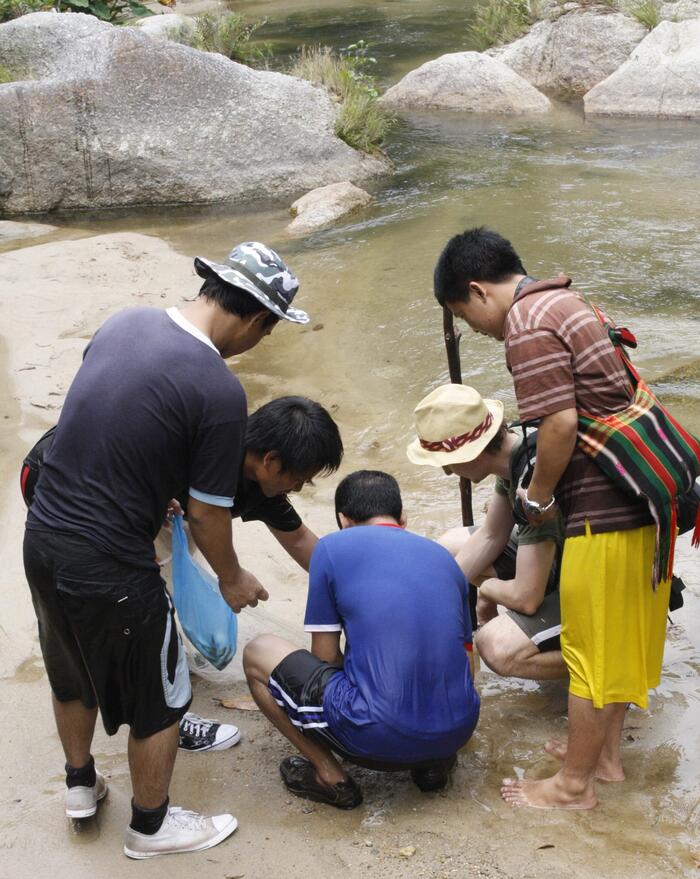 Hoffstaedter while building rapport through shared activities, such as a fishing trip with Chin refugee community members.
His research documents how work, religious gatherings, cultural celebrations, farming, and sports help refugees cultivate belonging in a country where they lack formal recognition. One example is a Rohingya Football Club Hoffstaedter was involved with. Competing against local teams gave Rohingya players opportunities to demonstrate their skills and gain recognition beyond their own communities.
As Hoffstaedter explains, “So they can't be citizens here. They don't have a legal standing, but they can for a moment be soccer stars and kind of, you know, win the game ten-nil, and celebrate and be really good at something, and be recognized by other people for that skill that they have.”
These experiences illustrate how seemingly ordinary activities can become meaningful ways to assert identity and belonging in precarious environments where legal avenues for recognition are unavailable.
Understanding the Polycrisis of Refugee Life
The book employs the notion of “polycrisis” to examine how legal exclusion, economic insecurity, health risks, and discrimination compound one another. The COVID-19 pandemic amplified these overlapping pressures in Malaysia, where Rohingya refugees were increasingly scapegoated and subjected to restrictions on movement.
For Hoffstaedter, such developments show how broader political and social crises can intensify the vulnerability of already marginalized communities.
“[W]e could see the coming together of multiple crises that were accelerating and making life much, much harder for certain populations because of that compounding of multiple crises acting on particular populations.”
Hoffstaedter also examines Malaysia’s inconsistent approach to refugee protection. Although the country has periodically provided sanctuary and work authorization to displaced populations, it lacks a comprehensive legal framework recognizing refugees. Comparing Chin and Rohingya experiences, he shows how religion, cultural affinity, international advocacy, and geopolitical interests can influence who receives protection. The differences in treatment reveal how refugee protection depends on arbitrary political priorities rather than consistent rights.
What Anthropology Can Contribute to Refugee Policy
In discussing the book, Hoffstaedter argues that understanding displacement requires looking beyond border crossings and dramatic humanitarian emergencies to examine how migration policies shape everyday life. Long-term ethnographic research can reveal the historical and political forces behind these policies, as well as the realities that broad categories such as “refugee” and “economic migrant” often obscure.
“The things that anthropology can bring to the table are things that policy and politics often ignore. And it's that depth of time, and it's that engagement with people on the ground over a long period of time to see the history and the importance of that history and how some of these things are arbitrary and very recent and are driven by their own logics that are not logical at all, but they have an internal logic.”
His research highlights an ongoing contradiction in Malaysia and elsewhere: the economy depends on migrant labor, yet undocumented workers remain excluded from the protections associated with legal status. Hoffstaedter calls for a broader reconsideration of how governments approach migration and the people whose labor sustains their economies.
The time he spent as a fellow at APARC provided him with opportunities to engage with policymakers and consider how ethnographic research can inform practical responses to displacement. As he explains, “It really brought home to so many ex-politicians or State Department officials how to translate all that knowledge that we amass over long periods of fieldwork. How do we make that digestible?”
By focusing on Chin and Rohingya refugees’ everyday experiences, Lives in Limbo reconsiders existing narratives of displacement and offers readers a more nuanced understanding of how people create community and pursue belonging amid precarity. Hoffstaedter invites readers and policymakers alike to look beyond legal categories and humanitarian crises to recognize the people building meaningful lives within them.
Learn more about the book and purchase it from Stanford University Press.


