


<i>The Act of Killing (Director's Cut)</i> Film Screening and Panel Discussion
-
*This event is free and open to the public.*
PANELISTS
Don Emmerson - Director of the Southeast Asia Forum, Shorenstein Asia-Pacific Research Center; Affiliated Scholar, Abbasi Program in Islamic Studies; Affiliated Faculty, CDDRL
Erik Jensen - Professor of the Practice of Law, Stanford Law School; Senior Advisor for Governance and Law, The Asia Foundation; Senior Research Scholar, CDDRL; Director, Rule of Law Program, Stanford Law School
Norman Naimark - Director of the Stanford Global Studies Division; Professor of History
Diane H. Steinberg (Panel Chair) - Visiting Scholar at Stanford's Program on Human Rights, Center on Democracy, Development, and the Rule of Law (CDDRL)
Image

The Act of Killing visits former Indonesian death squad killers who wreaked havoc in 1965 and 1966 in the aftermath of Indonesia's military coup and yet have never been held accountable for slaughtering between 200,000 to 2 million people in a genocide often forgotten. The dramatic reenactments of the murders in the documentary catalyze an unexpected emotional journey for Anwar Congo from arrogance to regret as he confronts for the first time in his life the full implications of what he has done.
The Act of Killing is an award-winning documentary film directed by Joshua Oppenheimer with co-director Christine Cynn and and an anonymous co-director from Indonesia. It is a Danish-British-Norwegian co-production, presented by Final Cut for Real in Denmark and produced by Signe Byrge Sørensen. It was recently nominated for an Academy Award for Best Documentary Feature.
"Director Joshua Oppenheimer has made a documentary in which he interviews the leaders of Indonesian death squads, who were responsible, collectively, for the deaths of millions of Communists, leftists and ethnic Chinese in 1965 and 1966. But he doesn't just interview them. He has them re-enact their crimes and even invites them to write, perform and film skits dramatizing their murders." Mick LaSalle, San Francisco Chronicle, 8/8/2013
"Director Joshua Oppenheimer has made a documentary in which he interviews the leaders of Indonesian death squads, who were responsible, collectively, for the deaths of millions of Communists, leftists and ethnic Chinese in 1965 and 1966. But he doesn't just interview them. He has them re-enact their crimes and even invites them to write, perform and film skits dramatizing their murders." Mick LaSalle, San Francisco Chronicle, 8/8/2013
"The Act of Killing is a bold reinvention of the documentary form, as well as an astounding illustration of man's infinite capacity for evil." Rene Rodriguez, The Miami Herald, 8/15/2013
After the screening of the Director's Cut of The Act of Killing (160 minutes), there will be a thirty-minute panel discussion.
For more information regarding the film, please visit: http://theactofkilling.com/.
This event is presented and sponsored by Stanford Global Studies, CDDRL's Program on Human Rights, and the Vice Provost of Undergraduate Education.
Cubberley Auditorium
Conferences
The Mexico Initiative
OVERVIEW • PARTNERSHIPS • EVENTS • STUDENT ENGAGEMENT • BOOKS
Staff Contact:
Aberto Díaz-Cayeros
Freeman Spogli Institute for International Studies
Encina Hall
Stanford University
Stanford, CA 94305-6055
Redistribution and Group Participation: Comparative Experimental Evidence from Africa and the UK
-
Abstract:
We design an original laboratory experiment to investigate whether redistributive actions hinder the formation of Pareto-improving groups. We test, in an anonymous setting with no feedback, whether people choose to destroy or steal the endowment of others and whether they choose to give to others, when granted the option. We then test whether subjects join a group that increases their endowment but exposes them to redistribution. We conduct the experiment in three very different settings with a priori different norms of pro-social behavior: a university town in the UK, the largest slum in Nairobi, Kenya and rural Uganda. We find a lot of commonality but also large differences between sites. UK subjects behave in a more selfish and strategic way -- giving less, stealing more. Kenyan and Ugandan subjects behave in a more altruistic and less strategic manner. However, pro-social norms are not always predictive of joining behavior. African subjects are less likely to join a group when destruction or stealing is permitted. It is as if they are less trusting even though they are more trustworthy. These findings contradict the view that African underdevelopment is due to a failure of generalized morality.
Speaker Bio:
Marcel Fafchamps is senior fellow at the Freeman Spogli Institute for International Studies and member of the Center on Democracy, Development and the Rule of Law. Before joining FSI, he served as Professor of Development Economics at Oxford University and as Deputy Director of the Center for the Study of African Economies. Before that he taught at Stanford University. He also worked for the International Labour Organization in Africa. His research focuses on market institutions and social networks, writ large. Fafchamps holds a PhD from UC Berkeley and degrees in Law and in Economics from the Catholic University of Louvain.

Encina Ground Floor Conference Room
Marcel Fafchamps
Encina Hall
616 Jane Stanford Way
Stanford, CA 94305-6055
0
fafchamp@stanford.edu
Senior Fellow Emeritus at the Freeman Spogli Institute for International Studies
Professor, by courtesy, of Economics
Marcel Fafchamps is a Senior Fellow Emeritus at the Freeman Spogli Institute for International Studies (FSI) and a member of the Center on Democracy, Development and the Rule of Law. Previously, he was the Satre Family Senior Fellow at FSI. Fafchamps is a professor (by courtesy) for the Department of Economics at Stanford University. His research interests include economic development, market institutions, social networks, and behavioral economics — with a special focus on Africa and South Asia.
Prior to joining FSI, from 1999-2013, Fafchamps served as professor of development economics in the Department of Economics at Oxford University. He also served as deputy director and then co-director of the Center for the Study of African Economies. From 1989 to 1996, Fafchamps was an assistant professor with the Food Research Institute at Stanford University. Following the closure of the Institute, he taught for two years at the Department of Economics. For the 1998-1999 academic year, Fafchamps was on sabbatical leave at the research department of the World Bank. Before pursuing his PhD in 1986, Fafchamps was based in Addis Ababa, Ethiopia, for 5 years during his employment with the International Labour Organization, a United Nations agency that oversees employment, income distribution, and vocational training in Africa.
He has authored two books: Market Institutions in Sub-Saharan Africa: Theory and Evidence (MIT Press, 2004) and Rural Poverty, Risk, and Development (Elgar Press, 2003), and has published numerous articles in academic journals.
Fafchamps served as the editor-in-chief of Economic Development and Cultural Change until 2020. Previously, he had served as chief editor of the Journal of African Economies from 2000 to 2013, and as associate editor of the Economic Journal, the Journal of Development Economics, Economic Development and Cultural Change, the American Journal of Agricultural Economics, and the Revue d'Economie du Développement.
He is a research associate of the National Bureau of Economic Research, an affiliated professor with J-PAL, a senior fellow with the Bureau for Research and Economic Analysis of Development, a research fellow with IZA, Germany, and with the Center for Economic and Policy Research, UK, and an affiliate with the University of California’s Center for Effective Global Action.
Fafchamps has degrees in Law and in Economics from the Université Catholique de Louvain. He holds a PhD in Agricultural and Resource Economics from the University of California, Berkeley.
Hide publication sections
On
Seminars
The Limits of Counterinsurgency Doctrine in Afghanistan
-
Speaker bio:
Karl Eikenberry is the William J. Perry Fellow in International Security at the Center for International Security and Cooperation and a faculty member of the Shorenstein Asia-Pacific Research Center at Stanford University. He is also an affiliated faculty member with the Center for Democracy, Development, and Rule of Law, and researcher with The Europe Center.
Prior to his arrival at Stanford, he served as the U.S. Ambassador to Afghanistan from May 2009 until July 2011, where he led the civilian surge directed by President Obama to reverse insurgent momentum and set the conditions for transition to full Afghan sovereignty.
Before appointment as Chief of Mission in Kabul, Ambassador Eikenberry had a thirty-five year career in the United States Army, retiring in April 2009 with the rank of Lieutenant General. His military operational posts included commander and staff officer with mechanized, light, airborne, and ranger infantry units in the continental U.S., Hawaii, Korea, Italy, and Afghanistan as the Commander of the American-led Coalition forces from 2005-2007.
He has served in various policy and political-military positions, including Deputy Chairman of the North Atlantic Treaty Organization (NATO) Military Committee in Brussels, Belgium; Director for Strategic Planning and Policy for U.S. Pacific Command at Camp Smith, Hawaii; U.S. Security Coordinator and Chief of the Office of Military Cooperation in Kabul, Afghanistan; Assistant Army and later Defense Attaché at the United States Embassy in Beijing, China; Senior Country Director for China, Taiwan, Hong Kong and Mongolia in the Office of the Secretary of Defense; and Deputy Director for Strategy, Plans, and Policy on the Army Staff.
He is a graduate of the U.S. Military Academy, has master’s degrees from Harvard University in East Asian Studies and Stanford University in Political Science, and was a National Security Fellow at the Kennedy School of Government at Harvard.
Ambassador Eikenberry earned an Interpreter’s Certificate in Mandarin Chinese from the British Foreign Commonwealth Office while studying at the United Kingdom Ministry of Defense Chinese Language School in Hong Kong and has an Advanced Degree in Chinese History from Nanjing University in the People’s Republic of China.
His military awards include the Defense Distinguished and Superior Service Medals, Legion of Merit, Bronze Star, Ranger Tab, Combat and Expert Infantryman badges, and master parachutist wings. He has received the Department of State Distinguished, Superior, and Meritorious Honor Awards, Director of Central Intelligence Award, and Chairman of the Joint Chiefs of Staff Joint Distinguished Civilian Service Award. He is also the recipient of the George F. Kennan Award for Distinguished Public Service and Harvard University Graduate School of Arts and Sciences Centennial Medal. His foreign and international decorations include the Canadian Meritorious Service Cross, French Legion of Honor, Afghanistan’s Ghazi Amir Amanullah Khan and Akbar Khan Medals, and the NATO Meritorious Service Medal.
Ambassador Eikenberry serves as a Trustee for the International Institute for Strategic Studies, The Asia Foundation, and the National Committee on American Foreign Policy, and is a Fellow of the American Academy of Arts and Sciences. He is a member of the Council on Foreign Relations, the American Academy of Diplomacy, and the Council of American Ambassadors, and was previously the President of the Foreign Area Officers Association. His articles and essays on U.S. and international security issues have appeared in Foreign Affairs, The Washington Quarterly, American Foreign Policy Interests, The New York Times, The Washington Post, Foreign Policy, and The Financial Times. He has a commercial pilot’s license and instrument rating, and also enjoys sailing and scuba diving.
Reuben W. Hills Conference Room
Karl Eikenberry
William J. Perry Fellow in International Security at CISAC, CDDRL, TEC, and Shorenstein APARC Distinguished Fellow; and Former U.S. Ambassador to Afghanistan and Retired U.S. Army Lt. General
Speaker
FSI
Seminars
Development Aid Confronts Politics: The Almost Revolution
-
Speaker bio:
Thomas Carothers is vice president for studies at the Carnegie Endowment for International Peace. He is the founder and director of the Democracy and Rule of Law Program and oversees Carnegie Europe in Brussels.
Carothers is a leading authority on international support for democracy, rights, and governance and on comparative democratization as well as an expert on U.S. foreign policy. He has worked on democracy-assistance projects for many public and private organizations and carried out extensive field research on international aid efforts around the world. In addition, he has broad experience in matters dealing with human rights, the rule of law, civil society building, and think tank development in transitional and developing countries.
He is the author of six critically acclaimed books as well as many articles in prominent journals and newspapers. Carothers has also worked extensively with the Open Society Foundations (OSF), including currently as chair of the OSF Think Tank Fund and previously as chair of the OSF Global Advisory Board. He is an adjunct professor at the Central European University in Budapest and was previously a visiting faculty member at Nuffield College, Oxford University, and Johns Hopkins SAIS.
Prior to joining the Endowment, Carothers practiced international and financial law at Arnold & Porter and served as an attorney adviser in the Office of the Legal Adviser of the U.S. Department of State.
Carothers is the co-author (with Diane de Gramont) of Development Aid Confronts Politics: The Almost Revolution (Carnegie, 2013) and author of Confronting the Weakest Link: Aiding Political Parties in New Democracies (Carnegie, 2006); Promoting the Rule of Law Abroad: In Search of Knowledge (Carnegie, 2006); Uncharted Journey: Promoting Democracy in the Middle East, co-edited with Marina Ottaway (Carnegie, 2005); Critical Mission: Essays on Democracy Promotion (Carnegie, 2004); Funding Virtue: Civil Society Aid and Democracy Promotion, co-edited with Marina Ottaway (Carnegie, 2000); Aiding Democracy Abroad: The Learning Curve (Carnegie, 1999); and Assessing Democracy Assistance: The Case of Romania (Carnegie, 1996).
Image
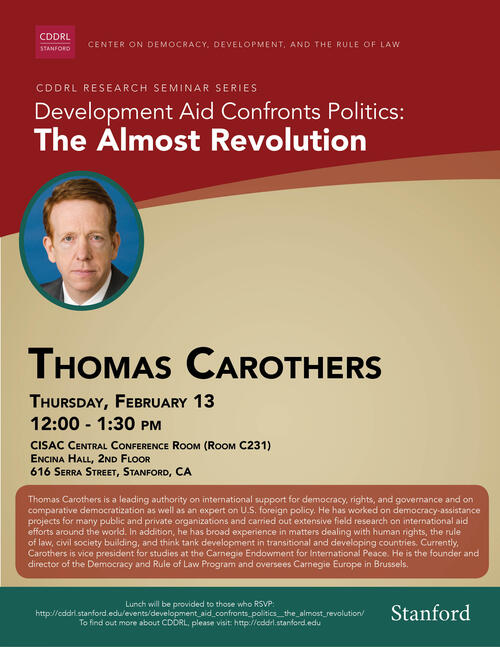
CISAC Conference Room
Thomas Carothers
Vice President for Studies
Speaker
Carnegie Endownment for International Peace
Seminars
Marcel Fafchamps
Encina Hall
616 Jane Stanford Way
Stanford, CA 94305-6055
0
fafchamp@stanford.edu
Senior Fellow Emeritus at the Freeman Spogli Institute for International Studies
Professor, by courtesy, of Economics
Marcel Fafchamps is a Senior Fellow Emeritus at the Freeman Spogli Institute for International Studies (FSI) and a member of the Center on Democracy, Development and the Rule of Law. Previously, he was the Satre Family Senior Fellow at FSI. Fafchamps is a professor (by courtesy) for the Department of Economics at Stanford University. His research interests include economic development, market institutions, social networks, and behavioral economics — with a special focus on Africa and South Asia.
Prior to joining FSI, from 1999-2013, Fafchamps served as professor of development economics in the Department of Economics at Oxford University. He also served as deputy director and then co-director of the Center for the Study of African Economies. From 1989 to 1996, Fafchamps was an assistant professor with the Food Research Institute at Stanford University. Following the closure of the Institute, he taught for two years at the Department of Economics. For the 1998-1999 academic year, Fafchamps was on sabbatical leave at the research department of the World Bank. Before pursuing his PhD in 1986, Fafchamps was based in Addis Ababa, Ethiopia, for 5 years during his employment with the International Labour Organization, a United Nations agency that oversees employment, income distribution, and vocational training in Africa.
He has authored two books: Market Institutions in Sub-Saharan Africa: Theory and Evidence (MIT Press, 2004) and Rural Poverty, Risk, and Development (Elgar Press, 2003), and has published numerous articles in academic journals.
Fafchamps served as the editor-in-chief of Economic Development and Cultural Change until 2020. Previously, he had served as chief editor of the Journal of African Economies from 2000 to 2013, and as associate editor of the Economic Journal, the Journal of Development Economics, Economic Development and Cultural Change, the American Journal of Agricultural Economics, and the Revue d'Economie du Développement.
He is a research associate of the National Bureau of Economic Research, an affiliated professor with J-PAL, a senior fellow with the Bureau for Research and Economic Analysis of Development, a research fellow with IZA, Germany, and with the Center for Economic and Policy Research, UK, and an affiliate with the University of California’s Center for Effective Global Action.
Fafchamps has degrees in Law and in Economics from the Université Catholique de Louvain. He holds a PhD in Agricultural and Resource Economics from the University of California, Berkeley.
Hide publication sections
On
HUNGER, PEACE & JUSTICE CONVERSATION WITH KAVITA SRIVASTAVA
-
Kavita Srivatsava, one of India's leading activists will be joining us for an informal conversation on activism around hunger, peace and justice in India. Kavita is Secretary of People's Union for Civil Liberties, that has been at the forefront of the struggle for civil, political and socio-economic justice in India. She is the petitioner in the internationally renowned ‘Right to food’ litigation in the Supreme Court of India, one of the most impactful socio-economic litigations in India. She has also played a prominent role in women's movements in Rajasthan and has worked on numerous cases of violence against women.
In addition these core issues, Kavita has also worked on issues such as communal violence, landmines in the Indo-Pak border, election monitoring in Kashmir, supporting Dalits networks an on practically every major social issue in North India. Come join us for an informal conversation on hunger, peace and justice with this versatile activist.
Time: 3 pm
Date: 12 Nov, 2013 (Tuesday)
Location: E008 Encina Hall (East)
Supported by:
Center on Democracy, Development and the Rule of Law
Center for South Asia
San Jose Peace and Justice Center
E 008, Encina Hall (East)
616 Serra St., Stanford University
Kavita Srivastava
Secretary
Speaker
People's Union for Civil Liberties
Seminars
Christian E. Ollano
Encina Hall
616 Serra Street
Stanford, CA 94305-6055
0
chriseo9@stanford.edu
Communications and Program Associate
Christian Ollano joined the Center on Democracy, Development, and The Rule of Law (CDDRL) in October 2013. As a communications and program associate, he will help manage digital and social media communications between CDDRL, Stanford, and the broader international community.
Christian will bring in his skills in communication and cultural competency to increase CDDRL visibility to a wide network of alumni, faculty, and professionals. As a student, Christian was heavily involved in the Asian American community, serving in a number of capacities to strengthen community ties. From April - August 2010, Christian studied abroad in Japan as part of the Bing Overseas Studies Program where he interned at Mitsubishi Motors as a public relations intern. From 2012-2013, he worked at the Stanford Office of Undergraduate Admission on the diversity team, engaging in a number of diversity outreach initiatives aimed at increasing representation of under-served communities in the applicant pool. Most recently, Christian served as an intern for the Draper Hills Summer Fellows Program at the CDDRL assisting with logistical and programmatic efforts.
Christian holds a Bachelor of Arts in urban studies and a Masters of Arts in sociology.
Ties That Bind: Cultural Identity, Class, and Law in Vietnam's Labor Resistance
-
Vietnamese news accounts of labor-management conflicts, including strikes, and even reports of owners fleeing their factories raise potent questions about labor activism in light of this self-proclaimed socialist country’s engagement in the global market system since the late 1980s. In explaining Vietnamese labor resistance, how important are matters of cultural identity (such as native-place, gender, ethnicity, and religion) in different historical contexts? How does labor mobilization occur and develop? How does it foster “class moments” in times of crisis? What types of "flexible protests" have been used by workers to fight for their rights and dignity, and how effective are they?
Based on her just-published book, Ties that Bind: Cultural Identity, Class, and Law in Vietnam's Labor Resistance, Prof. Trần will highlight labor activism since French colonial rule in order to understand labor issues and actions in Vietnam today. Her analysis will focus on labor-management-state relations, especially with key foreign investors/managers (such as from Korea, Taiwan, and Hong Kong) and ethnic Chinese born and raised in Vietnam. She will convey the voices and ideas of workers, organizers, journalists, and officials and explain how migrant workers seek to empower themselves using cultural resources and appeals to state media and the rule of law. Copies of her book will be available for sale at her talk.
Prof. Trần's current research on global south-south labor migration focuses on Vietnamese migrants working in Malaysia and returning to Vietnam. In 2008 she was a Lee Kong Chian NUS-Stanford Distinguished Fellow on Southeast Asia. Her co-authored 2012 book, Corporate Social Responsibility and Competitiveness for SMEs in Developing Countries: South Africa and Vietnam, compared the experiences of small-and-medium enterprises in these two countries. Her many other writings include (as co-editor and author) Reaching for the Dream: Challenges of Sustainable Development in Vietnam (2004). She earned her PhD in Political Economy and Public Policy at the University of Southern California in 1996 and an MA in Developmental Economics at USC in 1991.
Copies of Ties that Bind: Cultural Identity, Class, and Law in Vietnam's Labor Resistance will be available for signing and sale by the author following her talk.
Daniel and Nancy Okimoto Conference Room
Angie Ngoc Trần
Shorenstein APARC
Stanford University
Encina Hall E301
Stanford, CA 94305-6055
0
angie_tran@csumb.edu
Lee Kong Chian NUS-Stanford Distinguished Fellow on Southeast Asia
Angie Ngoc Trần is a professor in the Division of Social and Behavioral Sciences and Global Studies at California State University, Monterey Bay (CSUMB). Her plan as the 2008 Lee Kong Chian National University of Singapore-Stanford University Distinguished Fellow is to complete a book manuscript on labor-capital relations in Vietnam that highlights how different identities of investors and owners—shaped by government policies, ethnicity, characteristics of investment, and the role they played in global flexible production—affect workers’ conditions, consciousness, and collective action differently.
Tran spent May-July 2008 at Stanford and will return to campus for the second half of November 2008. She will share the results of her project in a public seminar at Stanford under SEAF auspices on November 17 2008.
Prof. Trần’s many publications include “Contesting ‘Flexibility’: Networks of Place, Gender, and Class in Vietnamese Workers’ Resistance,” in Taking Southeast Asia to Market (2008); “Alternatives to ‘Race to the Bottom’ in Vietnam: Minimum Wage Strikes and Their Aftermath,” Labor Studies Journal (December 2007); “The Third Sleeve: Emerging Labor Newspapers and the Response of Labor Unions and the State to Workers’ Resistance in Vietnam,” Labor Studies Journal (September 2007); and (as co-editor and author) Reaching for the Dream: Challenges of Sustainable Development in Vietnam (2004). She received her Ph.D. in Political Economy and Public Policy at the University of Southern California in 1996 and an M.A. in Developmental Economics at USC in 1991.
Seminars