Governance

FSI's research on the origins, character and consequences of government institutions spans continents and academic disciplines. The institute’s senior fellows and their colleagues across Stanford examine the principles of public administration and implementation. Their work focuses on how maternal health care is delivered in rural China, how public action can create wealth and eliminate poverty, and why U.S. immigration reform keeps stalling. 

FSI’s work includes comparative studies of how institutions help resolve policy and societal issues. Scholars aim to clearly define and make sense of the rule of law, examining how it is invoked and applied around the world. 

FSI researchers also investigate government services – trying to understand and measure how they work, whom they serve and how good they are. They assess energy services aimed at helping the poorest people around the world and explore public opinion on torture policies. The Children in Crisis project addresses how child health interventions interact with political reform. Specific research on governance, organizations and security capitalizes on FSI's longstanding interests and looks at how governance and organizational issues affect a nation’s ability to address security and international cooperation.

Paragraphs

THE 2020 ELECTION IN THE UNITED STATES will take place on November 3 in the midst of a global pandemic, economic downturn, social unrest, political polarization, and a sudden shift in the balance of power in the U.S Supreme Court. On top of these issues, the technological layer impacting the public debate, as well as the electoral process itself, may well determine the election outcome. The eight-week Stanford University course, “Technology and the 2020 Election: How Silicon Valley Technologies Affect Elections and Shape Democracy,” examines the influence of technology on America’s democratic process, revealing how digital technologies are shaping the public debate and the election.

The eight-week Stanford University course, “Technology and the 2020 Election: How Silicon Valley Technologies Affect Elections and Shape Democracy,” examines the influence of technology on America’s democratic process, revealing how digital technologies are shaping the public debate and the election...


All Publications button
1
Publication Type
Policy Briefs
Publication Date
Authors
Marietje Schaake
Rob Reich
-

ABSTRACT

This talk is based on the speaker's recently released book Archive Wars The Politics of History in Saudi Arabia (Stanford University Press, 2020). The production of history is premised on the selective erasure of certain pasts and the artifacts that stand witness to them. From the elision of archival documents to the demolition of sacred and secular spaces, each act of destruction is also an act of state building. Following the 1991 Gulf War, political elites in Saudi Arabia pursued these dual projects of historical commemoration and state formation with greater fervor to enforce their postwar vision for state, nation, and economy. Seeing Islamist movements as the leading threat to state power, they sought to de-center religion from educational, cultural, and spatial policies. With this book, Rosie Bsheer explores the increasing secularization of the postwar Saudi state and how it manifested in assembling a national archive and reordering urban space in Riyadh and Mecca. The elites' project was rife with ironies: in Riyadh, they employed world-renowned experts to fashion an imagined history, while at the same time in Mecca they were overseeing the obliteration of a thousand-year-old topography and its replacement with commercial megaprojects. Archive Wars shows how the Saudi state's response to the challenges of the Gulf War served to historicize a national space, territorialize a national history, and ultimately refract both through new modes of capital accumulation.

SPEAKER BIO

Image
Rosie Bsheer
Rosie Bsheer is Assistant Professor of History at Harvard University, where she teaches graduate and undergraduate courses on oil and empire, social and intellectual movements, urban history, historiography, and the making of the modern Middle East. Rosie’s publications include Archive Wars: The Politics of History in Saudi Arabia (Stanford University Press, 2020) and “A Counterrevolutionary State: Popular Movements and the Making of Saudi Arabia,” Past and Present (2018). She is Associate Producer of the 2007 Oscar-nominated film My Country, My Country and a co-editor of Jadaliyya E-zine.

Online, via Zoom: REGISTER

Rosie Bsheer Assistant Professor of History Harvard University
Seminars
Authors
Gi-Wook Shin
News Type
Commentary
Date
Paragraphs

This podcast conversation with Gi-Wook Shin was originally produced by CSIS.

South Korea may seem to be a mature democracy from the outside, but Gi-Wook Shin, director of APARC and the Korea Program, warns that internally, democratic norms in the ROK are starting to weaken and crumble. He joins Victor Cha and Andrew Schwartz on The Impossible State, a podcast by the Center for Strategic and International Studies (CSIS), to further discuss his recent Journal of Democracy article, "South Korea's Democratic Decay," and how democratic backsliding in the Moon administration is part of a broader trend of the global decline of democracy. Listen above to the full conversation.

[Subscribe to APARC's newsletters to stay updated on our latest research.]

Read More

President Moon Jae In of South Korea during his inauguration proceedings.
Commentary

Democracy in South Korea is Crumbling from Within

South Korea is following global trends as it slides toward a “democratic depression,” warns APARC’s Gi-Wook Shin. But the dismantling of South Korean democracy by chauvinistic populism and political polarization is the work of a leftist government, Shin argues in a ‘Journal of Democracy’ article.
Democracy in South Korea is Crumbling from Within
Opposing political rallies converge in South Korea
Commentary

Korean Democracy Is Sinking Under the Guise of the Rule of Law

Korean Democracy Is Sinking Under the Guise of the Rule of Law
(From left to right) Siegfried Hecker, Victor Cha, Oriana Mastro, Gi-Wook Shin, Robert Carlin
News

Experts Discuss Future U.S. Relations with North Korea Amid Escalations

Led by APARC, a panel of scholars hosted by the Freeman Spogli Institute weighs in on the implications of recent events on the Korean peninsula and the ongoing uncertainties in charting a future course with the DPRK.
Experts Discuss Future U.S. Relations with North Korea Amid Escalations
Hero Image
[Left] The Impossible State by CSIS; [Right] Director Gi-Wook Shin
[Left] The Impossible State by CSIS; [Right] Director Gi-Wook Shin
All News button
1
Subtitle

Gi-Wook Shin discusses the state of democracy in South Korea, and how democratic backsliding there fits into larger patterns of democratic decline underway across the globe.

-

* Please note all CISAC events are scheduled using the Pacific Time Zone.


Seminar Recording:  https://youtu.be/lxMWuFvq2NU


About the Event: It has become increasingly clear that the Kremlin poses a security challenge to the West, with relations between the United States and Europe, on the one hand, and Russia, on the other, having fallen to their lowest point since the end of the 1980s.  In particular, Moscow seeks to overturn the post-Cold War European security order, which it believes disadvantages Russian interests.  The Russian challenge includes both foreign and domestic policy aspects, as the Kremlin augments traditional political and military tools with more sophisticated efforts to exploit and widen divides within Western societies.

Fiona Hill, a senior fellow at the Brookings Institution, will discuss the challenge posed by Russia and the motives behind it.


About the Speaker: 

Fiona Hill is a senior fellow in the Center on the United States and Europe in the Foreign Policy program at Brookings. She recently served as deputy assistant to the president and senior director for European and Russian affairs on the National Security Council from 2017 to 2019. From 2006 to 2009, she served as national intelligence officer for Russia and Eurasia at The National Intelligence Council. She is co-author of “Mr. Putin: Operative in the Kremlin” (Brookings Institution Press, 2015).

Prior to joining Brookings, Hill was director of strategic planning at The Eurasia Foundation in Washington, D.C. From 1991 to 1999, she held a number of positions directing technical assistance and research projects at Harvard University’s John F. Kennedy School of Government, including associate director of the Strengthening Democratic Institutions Project, director of the Project on Ethnic Conflict in the Former Soviet Union, and coordinator of the Trilateral Study on Japanese-Russian-U.S. Relations.

Hill has researched and published extensively on issues related to Russia, the Caucasus, Central Asia, regional conflicts, energy, and strategic issues. Her book with Brookings Senior Fellow Clifford Gaddy,“The Siberian Curse: How Communist Planners Left Russia Out in the Cold,” was published by Brookings Institution Press in December 2003, and her monograph, “Energy Empire: Oil, Gas and Russia’s Revival,” was published by the London Foreign Policy Centre in 2004. The first edition of “Mr. Putin: Operative in the Kremlin” was published by Brookings Institution Press in December 2013, also with Clifford Gaddy.

Hill holds a master’s in Soviet studies and a doctorate in history from Harvard University where she was a Frank Knox Fellow. She also holds a master’s in Russian and modern history from St. Andrews University in Scotland, and has pursued studies at Moscow’s Maurice Thorez Institute of Foreign Languages. Hill is a member of the Council on Foreign Relations.

Virtual Seminar

Fiona Hill Senior Fellow in the Center on the United States and Europe in the Foreign Policy program The Brookings Institution
Seminars
-

Image
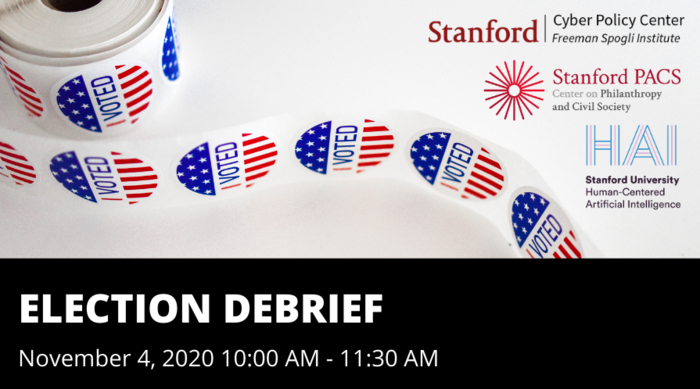
election debrief event stanford

The US 2020 elections have been fraught with challenges, including the rise of "fake news” and threats of foreign intervention emerging after 2016, ongoing concerns of racially-targeted disinformation, and new threats related to the COVID-19 pandemic. Digital technologies will have played a more important role in the 2020 elections than ever before.

On November 4th at 10am PST, join the team at the Stanford Cyber Policy Center, in collaboration with the Freeman Spogli Institute, Stanford’s Institute for Human-Centered Artificial Intelligence, and the Stanford Center on Philanthropy and Civil Society, for a day-after discussion of the role of digital technologies in the 2020 Elections.  Speakers will include Nathaniel Persily, faculty co-director of the Cyber Policy Center and Director of the Program on Democracy and the Internet, Marietje Schaake, the Center’s International Policy Director and International Policy Fellow at Stanford’s Institute for Human-Centered Artificial Intelligence, Alex Stamos, Director of the Cyber Center’s Internet Observatory and former Chief Security Officer at Facebook and Yahoo, Renee DiResta, Research Manager at the Internet Observatory, Andrew Grotto, Director of the Center’s Program on Geopolitics, Technology, and Governance, and Rob Reich, Faculty Director of the Center for Ethics in Society, in conversation with Kelly Born, the Center’s Executive Director.

Please note that we will also have a YouTube livestream available for potential overflow or for anyone having issues connecting via Zoom: https://youtu.be/H2k62-JCAgE


0
renee-diresta.jpg

Renée DiResta is the former Research Manager at the Stanford Internet Observatory. She investigates the spread of malign narratives across social networks, and assists policymakers in understanding and responding to the problem. She has advised Congress, the State Department, and other academic, civic, and business organizations, and has studied disinformation and computational propaganda in the context of pseudoscience conspiracies, terrorism, and state-sponsored information warfare.

You can see a full list of Renée's writing and speeches on her website: www.reneediresta.com or follow her @noupside.


Former Research Manager, Stanford Internet Observatory

CISAC
Stanford University
Encina Hall, C428

Stanford, CA 94305-6165

(650) 723-9866
0
Andrew Grotto

Andrew J. Grotto is a research scholar at the Center for International Security and Cooperation at Stanford University.

Grotto’s research interests center on the national security and international economic dimensions of America’s global leadership in information technology innovation, and its growing reliance on this innovation for its economic and social life. He is particularly interested in the allocation of responsibility between the government and the private sector for defending against cyber threats, especially as it pertains to critical infrastructure; cyber-enabled information operations as both a threat to, and a tool of statecraft for, liberal democracies; opportunities and constraints facing offensive cyber operations as a tool of statecraft, especially those relating to norms of sovereignty in a digitally connected world; and governance of global trade in information technologies.

Before coming to Stanford, Grotto was the Senior Director for Cybersecurity Policy at the White House in both the Obama and Trump Administrations. His portfolio spanned a range of cyber policy issues, including defense of the financial services, energy, communications, transportation, health care, electoral infrastructure, and other vital critical infrastructure sectors; cybersecurity risk management policies for federal networks; consumer cybersecurity; and cyber incident response policy and incident management. He also coordinated development and execution of technology policy topics with a nexus to cyber policy, such as encryption, surveillance, privacy, and the national security dimensions of artificial intelligence and machine learning. 

At the White House, he played a key role in shaping President Obama’s Cybersecurity National Action Plan and driving its implementation. He was also the principal architect of President Trump’s cybersecurity executive order, “Strengthening the Cybersecurity of Federal Networks and Critical Infrastructure.”

Grotto joined the White House after serving as Senior Advisor for Technology Policy to Commerce Secretary Penny Pritzker, advising Pritzker on all aspects of technology policy, including Internet of Things, net neutrality, privacy, national security reviews of foreign investment in the U.S. technology sector, and international developments affecting the competitiveness of the U.S. technology sector.

Grotto worked on Capitol Hill prior to the Executive Branch, as a member of the professional staff of the Senate Select Committee on Intelligence. He served as then-Chairman Dianne Feinstein’s lead staff overseeing cyber-related activities of the intelligence community and all aspects of NSA’s mission. He led the negotiation and drafting of the information sharing title of the Cybersecurity Act of 2012, which later served as the foundation for the Cybersecurity Information Sharing Act that President Obama signed in 2015. He also served as committee designee first for Senator Sheldon Whitehouse and later for Senator Kent Conrad, advising the senators on oversight of the intelligence community, including of covert action programs, and was a contributing author of the “Committee Study of the Central Intelligence Agency’s Detention and Interrogation Program.”

Before his time on Capitol Hill, Grotto was a Senior National Security Analyst at the Center for American Progress, where his research and writing focused on U.S. policy towards nuclear weapons - how to prevent their spread, and their role in U.S. national security strategy.

Grotto received his JD from the University of California at Berkeley, his MPA from Harvard University, and his BA from the University of Kentucky.

Research Scholar, Center for International Security and Cooperation
Director, Program on Geopolitics, Technology, and Governance
Date Label
Stanford Law School Neukom Building, Room N230 Stanford, CA 94305
650-725-9875
0
James B. McClatchy Professor of Law at Stanford Law School
Senior Fellow, Freeman Spogli Institute
Professor, by courtesy, Political Science
Professor, by courtesy, Communication
headshot_3.jpg

Nathaniel Persily is the James B. McClatchy Professor of Law at Stanford Law School, with appointments in the departments of Political Science, Communication, and FSI.  Prior to joining Stanford, Professor Persily taught at Columbia and the University of Pennsylvania Law School, and as a visiting professor at Harvard, NYU, Princeton, the University of Amsterdam, and the University of Melbourne. Professor Persily’s scholarship and legal practice focus on American election law or what is sometimes called the “law of democracy,” which addresses issues such as voting rights, political parties, campaign finance, redistricting, and election administration. He has served as a special master or court-appointed expert to craft congressional or legislative districting plans for Georgia, Maryland, Connecticut, New York, North Carolina, and Pennsylvania.  He also served as the Senior Research Director for the Presidential Commission on Election Administration. In addition to dozens of articles (many of which have been cited by the Supreme Court) on the legal regulation of political parties, issues surrounding the census and redistricting process, voting rights, and campaign finance reform, Professor Persily is coauthor of the leading election law casebook, The Law of Democracy (Foundation Press, 5th ed., 2016), with Samuel Issacharoff, Pamela Karlan, and Richard Pildes. His current work, for which he has been honored as a Guggenheim Fellow, Andrew Carnegie Fellow, and a Fellow at the Center for Advanced Study in the Behavioral Sciences, examines the impact of changing technology on political communication, campaigns, and election administration.  He is codirector of the Stanford Program on Democracy and the Internet, and Social Science One, a project to make available to the world’s research community privacy-protected Facebook data to study the impact of social media on democracy.  He is also a member of the American Academy of Arts and Sciences, and a commissioner on the Kofi Annan Commission on Elections and Democracy in the Digital Age.  Along with Professor Charles Stewart III, he recently founded HealthyElections.Org (the Stanford-MIT Healthy Elections Project) which aims to support local election officials in taking the necessary steps during the COVID-19 pandemic to provide safe voting options for the 2020 election. He received a B.A. and M.A. in political science from Yale (1992); a J.D. from Stanford (1998) where he was President of the Stanford Law Review, and a Ph.D. in political science from U.C. Berkeley in 2002.   

CV
Date Label
Rob Reich
0
marietje.schaake

Marietje Schaake is a non-resident Fellow at Stanford’s Cyber Policy Center and at the Institute for Human-Centered AI. She is a columnist for the Financial Times and serves on a number of not-for-profit Boards as well as the UN's High Level Advisory Body on AI. Between 2009-2019 she served as a Member of European Parliament where she worked on trade-, foreign- and tech policy. She is the author of The Tech Coup.


Non-Resident Fellow, Cyber Policy Center
Fellow, Institute for Human-Centered Artificial Intelligence
Date Label
-


Populist radical right parties are more successful in some areas than others. However, when trying to explain geographical patterns of support for the populist radical right, similar outcomes in otherwise different contexts and different outcomes in otherwise similar contexts can be observed. In this paper, we show that this paradox can be understood when we examine how citizens are affected differently by the context in which they live. Using a unique dataset containing geocoded survey data and contextual data from four countries (DE, FR, NL and UK), we demonstrate that mediating and moderating variables, such a perceptions of local decline and education level shape the relationship between contextual development such as the increasing presence of immigrants, on the one hand, and populist and nativism attitudes and PRR support, on the other hand.
 

A draft copy of this research paper may be downloaded by using the link provided below under "Event Materials".

Image
Sarah L. de Lange


Sarah L. de Lange is Professor by special appointment at the Department of Political Science at the University of Amsterdam, where she holds the Dr. J.M. Den Uyl chair. Her research interests include societal cleavages, political parties, and extremism, populism, and radicalism. Her recent research projects focus on the emergence of new political oppositions in Europe on that basis of, amongst others, geographical, generational, and educational divides. She has recently concluded the collaborative international project Sub-National Context and Radical Right Support in Europe (supported by an ORA grant) and is currently co-directing the research project Generational Differences in Determinants of Party Choice (supported by an NWO grant). Her co-edited volume Radical Right-Wing Populist Parties in Western Europe: Into the Mainstream?, which appeared with Routledge in 2016, analyses the extent to which radical right-wing populist parties have become part of mainstream politics, as well as the factors and conditions which facilitate this trend.


Co-Sponsored by the Global Populisms Project.

A Cross-National Investigation into Contextual Effects and Populist Radical Right Support. A mediated and moderated relationship?
Download pdf

Online via Zoom: REGISTER

Sarah L. de Lange University of Amsterdam
Seminars
1
PhD Student, Health Policy
amandasu_photo.jpg

Amanda Su is a Health Policy PhD candidate specializing in health economics. Her research interests include healthcare access, delivery, financing, and utilization.

Before Stanford, Amanda was a data scientist at Nuna Health, where she used econometric, statistical, and machine learning techniques to develop and improve an offline patient-PCP matching system. Prior, at Analysis Group, Amanda helped conduct economic analyses, market power studies, and survey experiments to study firm and consumer behavior. Amanda obtained her bachelor's degrees in Economics and Business Administration from the University of California, Berkeley.

Date Label
-


This talk investigates how unemployment risk within households affects voting for the radical right. Recent advances in the literature demonstrate the role of latent economic threats for understanding the support of radical right parties. We build on these studies and analyze economic risks as a determinant of radical right voting. Crucially, we do not treat individuals as atomistic but investigate households as a crucial context moderating economic risks. Combining large-scale labor market data with comparative survey data, we confirm the relationship between economic risk and support for radical right parties but demonstrate that this direct effect is strongly conditioned by household risk constellations. Voting for the radical right is not only a function of a voters' own but also their partner's risk. We provide additional evidence on the extent to which these effects are gendered and on the mechanisms linking household risk and party choice. Our results imply that much of the existing literature on individual risk exposure underestimates the impact on political behavior due to the neglect of multiplier effects within households. 
 
 
Tarik Abou-Chadi

Tarik Abou-Chadi is Assistant Professor at the department of political science at the University of Zurich. His research focuses on electoral competition, political parties and democratic representation. He is currently the principal investigator of a research project on social status and the tranformation of electoral behavior in Europe. He also hosts the political science teaching and research podcast Transformation of European Politics.


Co-Sponsored by the Global Populisms Project.

Online via Zoom

Tarik Abou-Chadi University of Zurich
Seminars
-

Image
Digital Trade Wars

Please join the Cyber Policy Center, Wednesday, October 21, from 10 a.m. –11 a.m. pacific time, with host Marietje Schaake, International Policy Director of the Cyber Policy Center, in conversation with Dmitry Grozoubinski, founder of ExplainTrade.com, and visiting professor at University of Strathclyde, along with Anu Bradford, Henry L. Moses Professor of Law and International Organizations at Columbia Law School and author of How the European Union Rules the World, for a discussion and exploration of the digital trade war. 

This event is free and open to the public, but registration is required.


0
marietje.schaake

Marietje Schaake is a non-resident Fellow at Stanford’s Cyber Policy Center and at the Institute for Human-Centered AI. She is a columnist for the Financial Times and serves on a number of not-for-profit Boards as well as the UN's High Level Advisory Body on AI. Between 2009-2019 she served as a Member of European Parliament where she worked on trade-, foreign- and tech policy. She is the author of The Tech Coup.


Non-Resident Fellow, Cyber Policy Center
Fellow, Institute for Human-Centered Artificial Intelligence
Date Label
Marietje Schaake
Anu Bradford
Dmitry Grozoubinski
Panel Discussions
-

This event is being held virtually via Zoom. Please register for the webinar via the below link.

Registration Link: https://bit.ly/3n4NMpJ


This event is part of the Shorenstein Asia-Pacific Research Center's Shifting Geopolitics and U.S.-Asia Relations webinar series.
 
For Japan’s new Prime Minister Yoshihide Suga, foreign policy might pose a most significant challenge as he faces a shifting geopolitical landscape with a more assertive China, an emboldened North Korea, an ever more ambivalent South Korea, and a seemingly less committed US in the region. In this international environment, what foreign policy options does Japan have and what can we expect from the Suga administration? To answer these questions, panelists Shinichi Kitaoka, President of the Japan International Cooperation Agency, and Susan Thornton, former US assistant secretary for East Asian and Pacific Affairs, will discuss key diplomatic challenges for Japan including its management of the US-China-Japan trilateral relations, its handling of important neighboring countries such as North and South Korea and Russia, its larger strategies in the Indo-Pacific region, and its engagement with global institutions. This event will be moderated by Japan Program Director Kiyoteru Tsutsui.
 

SPEAKERS

Image
Headshot of Shinichi Kitaoka
Dr. Shinichi Kitaoka is President of the Japan International Cooperation Agency. Before assuming the present post, he was President of the International University of Japan. Dr. Kitaoka’s career includes Professor of National Graduate Institute for Policy Studies (GRIPS) (2012-), Professor ofGraduateSchools for Law and Politics, the University of Tokyo(1997-2004, 2006-2012), Ambassador Extraordinary and Plenipotentiary, Deputy Permanent Representativeof Japan to the United Nations (2004-2006), Professor of College of Law and Politics, Rikkyo University (1985-1997). Dr. Kitaoka’s specialty is modern Japanese politics and diplomacy. He obtained his B.A. (1971) and his Ph.D. (1976) both from the University of Tokyo. He is Emeritus Professor of the University of Tokyo. He has numerous books and articles in Japanese and English including A Political History of Modern Japan: Foreign Relations and Domestic Politics (Tokyo: Yuhikaku,2011), Political Dynamics of the United Nations: Where Does Japan Stand? (Tokyo: Chuokoron-Shinsha, 2007) and Japan as a Global Player (Tokyo: NTT Publishing, 2010). He received many honors and awards including the Medal with Purple Ribbon for his academic achievements in 2011.


Image
Headshot of Susan Thornton
Susan A. Thornton is a retired senior U.S. diplomat with almost 30 years of experience with the U.S. State Department in Eurasia and East Asia. She is currently a Senior Fellow and Research Scholar at the Yale University Law School Paul Tsai China Center, Director of the Forum on Asia-Pacific Security at the National Committee on American Foreign Policy, and a Non-Resident Fellow at the Brookings Institution. Until July 2018, Thornton was Acting Assistant Secretary for East Asian and Pacific Affairs at the Department of State and led East Asia policy making amid crises with North Korea, escalating trade tensions with China, and a fast-changing international environment. In previous State Department roles, she worked on U.S. policy toward China, Korea and the former Soviet Union and served in leadership positions at U.S. embassies in Central Asia, Russia, the Caucasus and China. Thornton received her MA in International Relations from Johns Hopkins SAIS and her BA from Bowdoin College in Economics and Russian. She serves on several non-profit boards and speaks Mandarin and Russian.

Via Zoom Webinar.

Registration Link: https://bit.ly/3n4NMpJ

Dr. Shinichi Kitaoka, President Japan International Cooperation Agency
Susan A. Thornton Former US Assistant Secretary for East Asian and Pacific Affairs
Panel Discussions
Subscribe to Governance