Governance

FSI's research on the origins, character and consequences of government institutions spans continents and academic disciplines. The institute’s senior fellows and their colleagues across Stanford examine the principles of public administration and implementation. Their work focuses on how maternal health care is delivered in rural China, how public action can create wealth and eliminate poverty, and why U.S. immigration reform keeps stalling. 

FSI’s work includes comparative studies of how institutions help resolve policy and societal issues. Scholars aim to clearly define and make sense of the rule of law, examining how it is invoked and applied around the world. 

FSI researchers also investigate government services – trying to understand and measure how they work, whom they serve and how good they are. They assess energy services aimed at helping the poorest people around the world and explore public opinion on torture policies. The Children in Crisis project addresses how child health interventions interact with political reform. Specific research on governance, organizations and security capitalizes on FSI's longstanding interests and looks at how governance and organizational issues affect a nation’s ability to address security and international cooperation.

-

About the Seminar: Nick surveyed the universe of recent applicants to the Indonesian civil service to study the effects of high-stakes examinations on political attitudes. Leveraging applicants' scores on the civil service examination, he employs a regression discontinuity design to compare the attitudes of applicants who narrowly failed against those who narrowly passed. Nick shows that the simple fact of failure on the civil service examination negatively affects applicants’ belief in the legitimacy of the process, some attitudes towards outgroups, and national identification. Next, Nick found that applicants who were offered – and accepted – employment in the civil service reported higher satisfaction with the process, greater amity towards outgroups, and higher national identification. Since more applicants fail than pass, these results suggest that civil service examination outcomes may have unintended consequences for social cohesion – particularly in contexts where successful applicants disproportionately hail from specific ethnic, racial, or religious groups.


For Fall Quarter 2021, we will be hosting a hybrid weekly Research Seminar Series. All events will be open to the public online via Zoom, and a limited-capacity in-person element for Stanford affiliates may be added in accordance with the County's health and safety guidelines.
 

About the Speaker: Nick is a Ph.D. candidate in political science at the University of California, Berkeley, studying comparative politics. Most of his research is interested in identifying whether and when certain political institutions worsen group-based antagonisms. He has a particular regional interest in Southeast Asia.

Image
Nicholas Kuipers

Online, via Zoom

1
CDDRL Predoctoral Scholar, 2021-22
nick_kuipers.jpg

Nicholas Kuipers is a Ph.D. candidate in political science at the University of California, Berkeley, studying comparative politics and political economy. Nicholas’ research has been supported by the Institute for International Studies, the National Science Foundation (NSF), the Southeast Asia Research Group (SEAREG), and the Weiss Family Fund. His research has been published in Asian Survey, British Journal of Political Science, Journal of Politics, and Journal of Experimental Political Science. A graduate of Oberlin College, he previously worked in Jakarta at Saiful Mujani Research & Consulting, a political consultancy specializing in public opinion surveys.

Nick Kuipers Ph.D. Candidate, UC Berkeley CDDRL Predoctoral Fellow
Seminars
All Publications button
1
Publication Type
Conference Memos
Publication Date
Subtitle
The Project on Middle East Political Science partnered with Stanford University’s Center for Democracy, Development and the Rule of Law and its Global Digital Policy Incubator for an innovative two week online seminar to explore the issues surrounding digital activism and authoritarianism. This workshop was built upon more than a decade of our collaboration on issues related to the internet and politics in the Middle East, beginning in 2011 with a series of workshops in the “Blogs and Bullets” project supported by the United States Institute for Peace and the PeaceTech Lab. This new collaboration brought together more than a dozen scholars and practitioners with deep experience in digital policy and activism, some focused on the Middle East and others offering a global and comparative perspective. POMEPS STUDIES 43 collects essays from that workshop, shaped by two weeks of public and private discussion.
Authors
Larry Diamond
Eileen Donahoe
Shelby Grossman
Authors
Melissa Morgan
News Type
News
Date
Paragraphs

On August 9, 2020 citizens in the Republic of Belarus went to the polls to vote for their next president. The incumbent was Alexander Lukashenko, a 67-year-old military officer who has kept an iron grip on the presidency for the entire 26 years Bealrus has held elections. But the challenger was an unexpected, new face. Sviatlana Tsikhanouskaya is a 38-year-old English teacher, mother and pro-democracy activist who stepped into a campaign following her husband's arrest and imprisonment in May 2020 for political dissension. In four short months, she galvanized the nation with a message of democracy, freedom and fair elections that reached across opposition factions and gained enough momentum to become a serious contender for the presidency.

On election day, projections estimated an initial win for Tsikhanouskaya at 60%. But when the country's Central Elections Commission announced the election results, Lukashenko carried 80% of the vote, and Tsikhanouskaya a mere 10%. Given the long history of election engineering in Belarus, the results were expected. But what happened next was not. Outraged by the fraud, Tsikhanouskaya's supporters poured into city centers in Brest and Minsk by the tens of thousands, instigating the largest public protests in the history of post-Soviet Belarus. Caught off-guard, the regime hit back with a ruthless wave of violence and political imprisonments, prompting the European Union, NATO and other countries to impose sanctions and condemn Lukashenko as an illegitimate leader.

While Tsikhanouskaya's presidential campaign ended last August, her role as a democratic leader in Eastern Europe has not. In the year since the election, she has traveled the globe to meet with lawmakers, policy experts and heads of state to speak out against the ongoing repression of Lukashenko's regime and advocate for support of Belarus by the international community. The Freeman Spogli Institute for International Studies (FSI) was honored to host Tsikhanouskaya and her delegation at Stanford for a roundtable discussion on the challenges that lay ahead in preparing Belarus for a democratic transition. Director Michael McFaul hosted the discussion, which brought together scholars from across FSI, the Hoover Institute and the Belarusian expatriate community. The full recording is below.

Rather than holding a typical press conference, Tsikhanouskaya's visit at FSI gave members of the Belarusian delegation an opportunity to engage in back-and-forth dialogue with an interdisciplinary panel of experts on governance, history and policy. Tsikhanouskaya and her senior advisors shared their perspectives on the challenges they are facing to build and maintain pro-democracy efforts, while Stanford scholars offered insights from their extensive research and scholarship.

Presidents, Protests and Precedent in Belarus


As leader of the delegation, Sviatlana Tsikhanouskaya gave an overview of the brutality of Lukashenko's regime and the lawlessness that has enveloped the country. But she also reaffirmed the commitment of everyday Belarusians to defending their independence and continuing the work of building new systems to push back against the dictatorship, and encouraged the support of the international democratic community.

"Belarusians are doing their homework. But we also understand that we need the assistance and help of other democratic countries," said Tsikhanouskaya. "That support is vital, because our struggle relates not just to Belarusians, but to all countries who share these common values."

Speaking to the work that Belarusians have already undertaken, Franak Viačorka, a senior advisor to Sviatlana Tsikhanouskaya, described how citizens are creating new means of protesting and organizing. Though they learned some tactics from recent protests in Hong Kong and classic theories by political scientists like Gene Sharp, organizers in Belarus quickly realized that they needed to innovate in order to keep ahead of Lukashenko's crack-downs. Today the opposition is a tech-driven movement that spreads awareness and support quickly through digital spaces and underground channels while avoiding large in-person gatherings that attract government brutality.

By Tanya Bayeva's assessment, these methods of organizing have been effective in capturing widespread support amongst people. A member of the Belarusian diaspora, Bayeva described the sense of empowerment she felt in coming together in a common cause with like-minded people.

"By coming out like this, people have started realizing that it is up to us, the people, and our individual willpower to make a difference," said Bayeva. "We are realizing that the king has no clothes, and that working together we can forward the process of democratization."

But there is still plenty of work ahead. In order to facilitate a more peaceful future transition to a democratic system, there will need to be frameworks in place to bridge the divide between old systems and new. Valery Kavaleuski, the representative on foreign affairs in Sviatlana Tsikhanouskaya's delegation, is focusing extensively on these issues, such as reconciliation processes and plans for future investments between Belarus and the European Union.

"These are political moves that reinforce hope among Belarusians and tells that that they are not alone and that when the change comes, they will have friends by their side to overcome the challenges of the transition period," said Kavaleuski.

Advice from Stanford Scholars: Focus on Processes and People


Responding to the Belarusian delegation's questions and comments, the faculty from FSI and the broader Stanford community offered insights and considerations from a variety of perspectives and disciplines on 'next steps' for the pro-democracy movement.

Francis Fukuyama, the Olivier Nomellini Senior Fellow at FSI and Mosbacher Director at the Center on Democracy, Development and the Rule of Law (CDDRL), cautioned against the impulse to immediately take down the state and bureaucratic systems of the existing regime. While dismantling the mechanisms from the old state may feel emotionally satisfying, examples from history such as post-Nazi Germany and post-invasion Iraq illustrate the crippling effect on efficiency, functionality and the ability of the new order to govern in a vacuum of bureaucratic expertise.

FSI's Deputy Director, Kathryn Stoner, gave similar advice in regard to drafting and implementing a new constitution and conventions.

"People care to a great degree [about a new constitution], but not to months and months of debate and politicians yelling at one another. People can't eat constitutions," said Stoner. "You have to demonstrate that your system is going to be better than what was. When things have not gone well in transitioning countries, it's been because people don't see concrete change. So have a constitutional convention, but make it fast."

Amr Hamzawy, a senior research scholar for the Middle East Initiative at the Center for Democracy, Development and the Rule of Law, also pointed to the importance of engaging the public and building alliances within both the old and new political systems. Based on his observations of the failed Egyptian and Tunisian efforts at democratic transition, he cautioned against discussions of impunity, arguing that while politically and morally symbolic, this practice often backfires and alienates important factions of the state apparatus which are vital for the function and success of a new government.

Hamzawy similarly encouraged carefully blending nationalism and populism to keep divisions within the public sector in check. Imbuing such narratives with pro-democracy rhetoric, he believes, can create a powerful tool for unifying the population around the new government and emerging national identity.  

The advice from the Europe Center's director, Anna Grzymala-Busse, succinctly brought together many of the points made by the faculty panel: "No post-transitional government can achieve all the promises they've made right away," said Grzymala-Busse. "So make the transition about processes rather than specific outcomes, about ensuring the losers are heard along with the winners, and about making sure all people can participate."

Additional participants in the roundtable discussion not noted above include Hanna Liubakova, a journalist and non-resident fellow at the Atlantic Council, Dmytro Kushneruk, the Consul General of Ukraine in San Francisco, and Stanford scholars Larry Diamond, David Holloway, Norman Naimark, Erik Jensen, Kiyoteru Tsutsui and John Dunlop.

Read More

Protesters in Minsk, Belarus on 8/16/20
News

'In Being Together, We Had the Power' - A Belarusian Activist Describes Life on the Front Lines of Minsk Protests

On the World Class Podcast, Belarusian scholar and activist Aleś Łahviniec explains why people are protesting, and what it feels like to be out on the streets in Minsk.
'In Being Together, We Had the Power' - A Belarusian Activist Describes Life on the Front Lines of Minsk Protests
Tatiana Kouzina
News

CDDRL Statement Regarding the Arrest of Tatiana Kouzina by Belarusian Authorities

The faculty and staff of Stanford's Center on Democracy, Development and the Rule of Law, as well as the undersigned alumni of the Draper Hills Summer Fellows Program, wish to protest the completely unjustified arrest and pending trial of the researcher Tatiana Kouzina on June 28 by Belarusian authorities.
CDDRL Statement Regarding the Arrest of Tatiana Kouzina by Belarusian Authorities
Hero Image
Sviatlana Tsikhanouskaya discusses the future of democracy in Belarus with a roundtable of Stanford scholars.
Sviatlana Tsikhanouskaya, Michael McFaul, Franak Viačorka, and Francis Fukuyama participate in a roundtable discussion on democracy in Belarus.
Office of Sviatlana Tsikhanouskaya
All News button
1
Subtitle

Democratic leader Sviatlana Tsikhanouskaya and her delegation joined an interdisciplinary panel of Stanford scholars and members of the Belarusian community to discuss the future of democracy in Belarus.

Authors
News Type
Blogs
Date
Paragraphs

At first, I almost didn’t apply to the Reischauer Scholars Program (RSP). As someone with primarily Eastern European heritage, I doubted that I had a unique perspective to add to a coalition of students dedicated to learning more about Japan’s rich culture, economics, history, and society. In my mind, my personal experience couldn’t have been further from the course’s content. However, as a recent graduate of the RSP, my experience has completely shattered my previous misconceptions. Stanford’s RSP isn’t just an online program that gives students a comprehensive, in-depth view of Japan—it brings together a community of academically and socially diverse individuals from across the United States, along with their manifold perspectives, to build future leaders in the U.S.–Japan relationship. 

My experience has completely shattered my previous misconceptions.

My path to the RSP began in Model United Nations (MUN) and my tenth-grade world history class that encouraged me to delve deeper into the political and ideological theories that govern and shape our society. Japan was a major focus for multiple of my MUN conferences, where I descended into multiple Wikipedia rabbit-holes on a wide range of topics, from Japan’s stance on sustainable development to socio-political effects on Japanese gender equality quotas. Furthermore, throughout my dual enrollment in a MicroMasters program in international jurisprudence and a course on East Asian culture and law, I learned more about the intricacies of Japan’s Eurocentric depiction in the geo-political sphere. In the international law resources I was exposed to, Japan was often portrayed as “lawless,” while the Western legal system was presented as the “key” to maintaining a proper rule of law in East Asia. Through the latter course which focused on the intersection between Japanese culture and law, Japanese law was accurately shown as an extension of the rich Japanese culture I had learned about in my history classes; in this regard, each cultural facet needed to be taken into account with the legal theory of the state. Since then, I’ve been hooked on understanding the role of implicit motives in shaping international policy and cultural precedent in jurisprudence. At the RSP, I have been able to pursue my passions alongside like-minded peers.

At the RSP, I have been able to pursue my passions alongside like-minded peers. 

From the first week of the RSP, the diversity of students was evident. Each of my fellow peers offered their own outlook on topics ranging from “Religions in Japan” to “The Power of Popular Culture.” Across online forums and virtual classrooms, complex concepts were thoroughly discussed through witty back-and-forth banter, new ideas were buttressed by comprehensive research, and interconnected themes were explored via collaboration. The RSP’s inclusive and dynamic environment was one of my favorite aspects of the program. Weekly Zoom meetings with our instructor, Ms. Naomi Funahashi, and my peers allowed me to grasp unfamiliar concepts and take a deep dive into the things I didn’t previously know through active engagement. Moreover, at each virtual classroom, we had the opportunity to meet government officials, business leaders, and scholars at the forefront of U.S.–Japan relations. Each speaker’s ideas will forever retain importance to my understanding of the Japanese American experience, which remains equally relevant in the modern day.

The RSP’s commitment to educating the future leaders of the U.S.–Japan relationship is shown in its culmination. Near the final months of the 20-week RSP, students are given the opportunity to explore a topic of their choosing related to Japan or the U.S.–Japan dynamic. In my final paper, titled “The Rite of Rights: An Examination of Socio-Cultural Precedent in Japanese Law,” I coalesced my RSP education with my interest in international and Japanese jurisprudence. Even after its conclusion, the RSP continues the discussion on U.S.–Japan relations for the years to come by compiling and sharing all the research papers written within that year’s program. 

Ultimately, I am grateful to the Reischauer Scholars Program for creating a mosaic of different experiences and cultures by bringing together my peers. Throughout my involvement in the RSP, I have strengthened my belief in the cross-cultural intersections that bind us all together. It is through these bonds, along with empathy and compassion, that the RSP helps students weave themselves into the U.S.–Japan international tapestry, shaping the world. 


The next session of the Reischauer Scholars Program will run from February to June 2022. The application will open September 6, 2021.

Read More

Brandon Cho at Todaiji Temple, Nara
Blogs

A Journey Through Time: The RSP as a Gateway from the Past to My Future

The following reflection is a guest post written by Brandon Cho, an alumnus of the Reischauer Scholars Program.
A Journey Through Time: The RSP as a Gateway from the Past to My Future
George Takei, Hosato Enterprises, Inc., Los Angeles
Blogs

Live Long and Prosper… and Stand Back

In his March 15, 2021 lecture for SPICE’s Reischauer Scholars Program, actor George Takei—who played Hikaru Sulu, helmsman of the USS Enterprise in Star Trek—added “and Stand Back” to the iconic Star Trek words, “Live Long and Prosper,” as he was greeting students.
Live Long and Prosper… and Stand Back
Hero Image
high school girl standing amidst park greenery
Kristine Pashin at the Farnam Memorial Gardens in New Haven, CT; photo courtesy Kristine Pashin
All News button
1
Subtitle

The following reflection is a guest post written by Kristine Pashin, an alumna of the Reischauer Scholars Program, which will begin accepting student applications on September 6, 2021.

-

THIS EVENT HAS MOVED TO THURSDAY, JULY 29, 2021 from 12:00 PM - 1:00 PM

This event will be held via Zoom: REGISTER HERE

Image
S. Tsikhanouskaya

The Freeman Spogli Institute (FSI) is honored to host Sviatlana Tsikhanouskaya for a roundtable discussion on the future of democracy in Belarus. Tsikhanouskaya is a human rights and pro-democracy activist who ran as an independent presidential candidate for Belarus in 2020. Her campaign attracted a wide range of support from across Belarus’s political opposition, and her loss to sitting president Alexander Lukashenko spurred allegations of wide-spread voting fraud and led to the largest public protests in the history of post-Soviet Belarus.


Tsikhanouskaya continues to advocate for the democratic future of Belarus despite her self-exile to Lithuania following her election loss. Her remarks at FSI are in conjunction with her July tour of the United States to spread awareness of the pro-democracy cause and lobby the Biden administration to impose additional sanctions against Belarusian industry. She will share her experiences as a leader and organizer for change and  discuss the challenges she sees for Belarus moving forward. FSI Director Michael McFaul will moderate the discussion.


Sviatlana Tsikhanouskaya <I>Leader of democratic Belarus</i>
Workshops
-

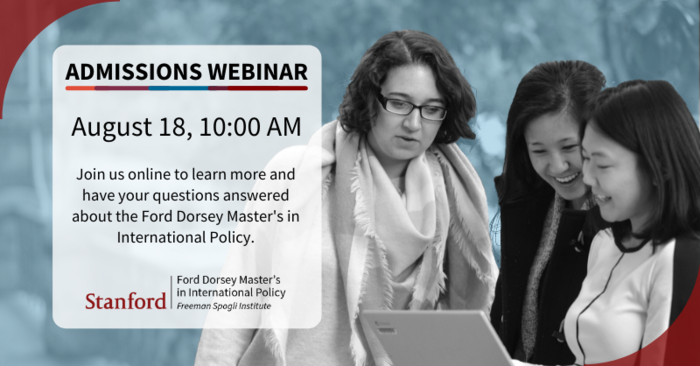
Join Recruitment and Admissions Manager Meghan Moura to learn more about the Master's in International Policy program and how to apply. Please register in advance.

The Ford Dorsey Master's in International Policy (MIP) is a two year, full-time, professional graduate degree program. The M.A. degree is earned through completion of core and elective coursework, an area of specialization, and a capstone project. The program is interdisciplinary in nature, and students are encouraged to pursue coursework that spans academic fields at Stanford. Specializations within the program include: Cyber Policy and Security (CYBER); Energy, Natural Resources, and the Environment (ENRE); Global Health (GH) [incorporated into the GOVDEV specialization as of Septemeber 2020]; Governance and Development (GOVDEV); and International Security (ISEC).

Workshops
0
James X. Dempsey large headshot

Jim Dempsey is senior policy advisor to the Stanford Program on Geopolitics, Technology and Governance and a lecturer at the UC Berkeley School of Law, where he teaches a course on cybersecurity law in the LLM program. Until May 2021, Jim was Executive Director of the Berkeley Center for Law & Technology. In 2012, after Senate confirmation, he was appointed by President Barack Obama as a part-time member of the U.S. Privacy and Civil Liberties Oversight Board, an independent agency within the federal government charged with advising senior policymakers and overseeing the nation’s counterterrorism programs. He served in that position until January 2017, while also running BCLT.

From 1997 to 2014, Dempsey was at the Center for Democracy & Technology (CDT), a non-profit public policy organization focused on privacy and other issues affecting the internet, where he held a number of leadership positions. Prior to that he was deputy director of the Center for National Security Studies (1995-1997) and assistant counsel to the House Judiciary Committee (1985-1995), focusing on privacy, FBI oversight, and surveillance issues. 

Jim graduated from Yale College and Harvard Law School.

BOOKS:


ARTICLES AND PAPERS


COMMENTARY

Senior Policy Advisor, Geopolitics, Technology, and Governance at CISAC
Lecturer at the UC Berkeley School of Law
Date Label
-

Please join our partners at APSIA for their 2021 online grad school fair. Representatives from across the Freeman Spogli Institute for International Studies and other top-line graduate programs in international studies at leading universities will be online to answer your questions and provide resources on the application process.

Whether you are an undergrad student trying to decide what comes next in your academic journey or a professional looking to advance your career, this is an excellent opportunity to network and gain insight into reaching your goals.

Workshops
News Type
News
Date
Paragraphs

POLITICO has announced their annual ranking of the 28 power players behind Europe’s tech revolution. In addition to an overall No. 1, the list is divided into three categories — rulemakers, rulebreakers and visionaries — each representing a different type of power. The Cyber Policy Center's Marietje Schaake is included on the list as a visionary and "voice to listen to on both sides of the Atlantic."

From the announcement:

The 42-year-old Dutch native has become a leading voice of European philosophy on how to regulate technology, especially in the U.S., where she’s been teaching at Stanford University’s Cyber Policy Center since leaving European politics.

Her message — that the internet’s early leaders have grown into all-too-dominant behemoths unable to subdue their own vices and are violating human rights — might have seemed out of whack in the U.S. a few years ago. But it has since become mainstream, in part thanks to Schaake’s work to reshape the American conversation on technology and inject some of Europe’s criticism on the sector.

In Europe, too, Schaake’s star keeps rising and rising. Once one of Brussels’ most visible politicians, she has now turned her attention to taming algorithms and the growing issue of cyber threats. In 2019, she launched the CyberPeace Institute in Geneva, a group focused on getting European policymakers to care about the human victims of cyberattack.

READ MORE

Marietje Schaake

Marietje Schaake

International Policy Director at the Cyber Policy Center
FULL BIO

Read More

cyber turns two graphic
News

The Cyber Policy Center Turns Two

A look back at the launch of the CPC and the work of our programs
The Cyber Policy Center Turns Two
Hero Image
illustration of Marietje Schaake Politico
All News button
1
Subtitle

POLITICO’s annual ranking of the 28 power players behind Europe’s tech revolution includes the Cyber Policy Center's Marietje Schaake. The list is divided into three categories — rulemakers, rulebreakers and visionaries — each representing a different type of power.

Paragraphs

The first COVID-19-related death in the United States was announced on February 29, 2020, the day of the South Carolina primary. International news about the early spread of the coronavirus and the initial reaction from American public health professionals to its quick spread in this country made it clear that the presidential election was facing an existential threat. Election officials who held primaries in early- and mid-March found themselves increasingly making public health decisions to guard both their voters and their staff. The larger societal challenges quickly overwhelmed the ability of states to hold primaries at all, leading to hastily canceled and postponed elections. The one early primary that was not postponed, Wisconsin, provided cautionary tales in the form of closed polling places, poll worker shortages, and massive transitions to mail balloting.


Nate Persily

Nathaniel Persily

James B. McClatchy Professor of Law at Stanford Law School | Senior Fellow, Freeman Spogli Institute | Professor, by courtesy, Political Science | Professor, by courtesy, Communication | Co-director, Cyber Policy Center
FULL BIO
All Publications button
1
Publication Type
Working Papers
Publication Date
Subtitle
A Compendium of Research from the Stanford-MIT Healthy Elections Project
Authors
Nathaniel Persily
Subscribe to Governance