Governance

FSI's research on the origins, character and consequences of government institutions spans continents and academic disciplines. The institute’s senior fellows and their colleagues across Stanford examine the principles of public administration and implementation. Their work focuses on how maternal health care is delivered in rural China, how public action can create wealth and eliminate poverty, and why U.S. immigration reform keeps stalling. 

FSI’s work includes comparative studies of how institutions help resolve policy and societal issues. Scholars aim to clearly define and make sense of the rule of law, examining how it is invoked and applied around the world. 

FSI researchers also investigate government services – trying to understand and measure how they work, whom they serve and how good they are. They assess energy services aimed at helping the poorest people around the world and explore public opinion on torture policies. The Children in Crisis project addresses how child health interventions interact with political reform. Specific research on governance, organizations and security capitalizes on FSI's longstanding interests and looks at how governance and organizational issues affect a nation’s ability to address security and international cooperation.

-

For Fall Quarter 2021, FSI will be hosting hybrid events. Many events will be open to the public online via Zoom, and limited-capacity in-person attendance for Stanford affiliates may be available in accordance with Stanford’s health and safety guidelines.

                                                Register for Zoom                                                         Register for In-Person
                                                           (Open to all)                                                                    (Stanford affiliates only)          


Retired U.S. Army Lieutenant Colonel Alexander Vindman, who found himself at the center of a firestorm for his decision to report the phone call between former U.S. President Donald Trump and Ukrainian President Volodymyr Zelensky that led to presidential impeachment, tells his own story for the first time.


Here, Right Matters is a stirring account of Vindman's childhood as an immigrant growing up in New York City, his career in service of his new home on the battlefield and at the White House, and the decisions leading up to the moment of truth he faced for his nation.

Alexander Vindman, a retired U.S. Army Lieutenant Colonel, was most recently the director for Eastern Europe, the Caucasus, and Russia on the White House’s National Security Council. Previously, he served as the Political-Military Affairs Officer for Russia for the Chairman of the Joint Chiefs of Staff and as an attaché at the U.S. Embassy in Moscow, Russia. While on the Joint Staff, he co-authored the National Military Strategy Russia Annex and was the principal author for the Global Campaign for Russia. He is currently a doctoral student and fellow of the Foreign Policy Institute at the Johns Hopkins School of Advanced International Studies (SAIS), Pritzker Military Fellow at the Lawfare Institute, and a visiting fellow at the University of Pennsylvania Perry World House. Follow him on Twitter @AVindman.

Alexander Vindman | Retired U.S. Army Lieutenant Colonel
Lectures
-

For Fall Quarter 2021, FSI will be hosting hybrid events. Many events will be open to the public online via Zoom, and limited-capacity in-person attendance for Stanford affiliates may be available in accordance with Stanford’s health and safety guidelines.

                                                Register for Zoom                                                         Register for In-Person
                                                           (Open to all)                                                                    (Stanford affiliates only)              


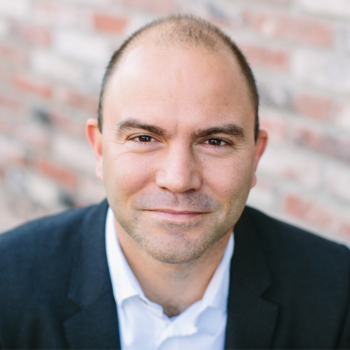
Why is democracy so threatened in America and around the world? And what can we do about it? Join Ben Rhodes to explore the answers to these questions and discuss his recent book, After the Fall.

Image
Ben Rhodes

In 2017, as Ben Rhodes was helping Barack Obama begin his next chapter, the legacy they had worked to build for eight years was being taken apart. To understand what was happening in America, Rhodes decided to look outward. Over the next three years, he traveled to dozens of countries, meeting with politicians, activists, and dissidents confronting the same nationalism and authoritarianism that was tearing America apart. Part memoir and part reportage, After the Fall investigates how much America’s fingerprints are on a world we helped to shape, through our post–Cold War embrace of unbridled capitalism and our post-9/11 nationalism and militarism; our mania for technology and social media; and the racism that fueled the backlash to America’s first Black president. At the same time, Rhodes learns from stories of a diverse set of characters—from Barack Obama himself to Cuban rebels to a rising generation of international leaders—that looking squarely at where America has gone wrong makes clear how essential it is to fight for what America is supposed to be, for our own country and the entire world.

Ben Rhodes is a writer, political commentator, and national security analyst. He is currently a contributor for NBC News and MSNBC; co-host of Pod Save the World; a senior advisor to former President Barack Obama; and chair of National Security Action, which he co-founded with Jake Sullivan in 2018. From 2009-2017, Ben served as a Deputy National Security Advisor to President Obama. In that capacity, he participated in all of President Obama’s key decisions, and oversaw the President’s national security communications, speechwriting, and public diplomacy.

Writer, political commentator, and national security analyst
Ben Rhodes | Writer, political commentator, and national security analyst
Seminars
0
Visiting Student Researcher at The Europe Center, 2021
photo.stanford_-_aleksandra_dziegielewska.jpg

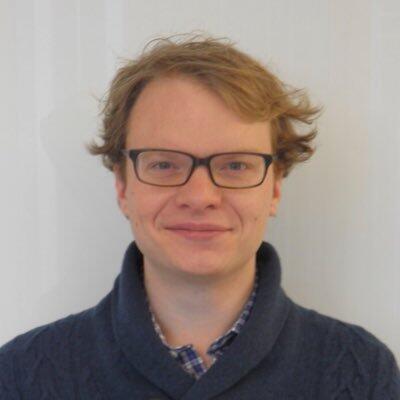
Aleksandra Dzięgielewska is a Fulbright Visiting Scholar. She holds a master's degree in law from the University of Warsaw, Poland and is a PhD candidate at the Max Planck Institute of Social Law and Social Policy in Munich, Germany. Her PhD thesis concerns social rights in Poland analyzed against the backdrop of the currently ongoing rule of law crisis. Her doctoral research aims to redefine the role of social rights in the Polish context and establish their significance for the strong liberal democracy. As part of her Fulbright Junior Research Award, prior to visiting TEC, she conducted research at the University of Chicago Law School. Aleksandra's primary academic interests concern European human rights, with a focus on social rights, as well as the rule of law and constitutional law.


Authors
Melissa Morgan
News Type
News
Date
Paragraphs

In 2015, Volodymyr Zelenskyy was at the height of a successful career as an entertainer. Though trained as a lawyer at the Kryvyi Rih Institute of Economics in Eastern Ukraine, the then 37 year old Zelenskyy was a successful comedian and public personality. As the star of the popular TV show, Servant of the People, he played a local history teacher who inadvertently becomes the president of Ukraine following a viral video rant about corruption.

No one watching comedic President Zelenskyy then could have possibly imagined the real-life plot twist that would follow. In an incredible act of life imitating art, in April 2019, Volodymyr Zelenskyy once again stood on stage in front of a cheering crowd, but this time as the actual president of Ukraine.

He won in a landslide election against incumbent president Petro Poroshenko on a platform of systemic change and progress using an almost exclusively virtual campaign. Speaking from his headquarters on election night, he affirmed the exuberance and hope of his supporters: “I can say as a citizen of Ukraine to all countries of the post-Soviet Union: Look at us — everything is possible.”

This same message shaped the theme of President Zelenskyy’s remarks at his historic address from the Freeman Spogli Institute for International Studies (FSI) at Stanford University on September 2. The first Ukrainian president to ever visit California, President Zelenskyy, First Lady Olena Zelenska and their delegation joined a group of FSI faculty members led by FSI Director Michael McFaul at an outdoor event held in the Encina Courtyard.

In his remarks, Zelenskyy drew inspiration from Steve Jobs’ famous "How to Live Before You Die" commencement address given at Stanford in 2005.

"This is one of the most famous speeches ever given at Stanford,” he said. “It's about believing in dreams and overcoming the impossible. This is the same as my story. I am just a common guy from a common family from a common industrial town in Eastern Ukraine. Yet here I am today at Stanford, because everything is possible."

He continued, “It is the same for Ukraine. Many people look at us and think that it will be impossible to achieve the goals we hope for. But we know that our critics are wrong. The people of our country love democracy and freedom and will not let threats take those things away. We know that anything is possible."

Looking to the future, Zelenskyy outlined the steps his administration is undertaking to bring increased digitization to Ukraine. These efforts include launching fully electronic passports, moving business and legal services online and expanding the scope of e-goverance. The hope is that this meld of new technology will help curb corruption while simultaneously creating more equitable opportunities and better access to public services for more Ukranians.

Speaking on the ambitious scope of these plans, the president acknowledged, “There will be resistance to the changes and innovations that we are going to make.” Nonetheless, he remains committed to the work ahead of strengthening democratic institutions in Ukraine and building on the progress that has already been made.  “We do not have a ‘Ukrainian Dream,’ yet,” he said. “But we have a ‘Ukrainian Goal’ and a ‘Ukrainian Mission’ to make the future we want for our country.” An edited recording of his remarks is below.

Keeping with Stanford tradition, Zelenskyy took questions from the audience after his prepared remarks. A variety of students and Stanford community members from Russia, Burma, Belarus and beyond had the opportunity to engage the president on a range of issues including U.S.-Ukraine relations, armament sales abroad and concerns over Russian aggression in Crimea and influence Eastern Ukraine. Of particular meaning was Zelensky’s affirmation and support for the democratic movement in Belarus led by Svaitlana Tsikhanouskaya, whom FSI hosted earlier this summer at a faculty roundtable.

Image
Tweet from Franak Viačorka

Students and faculty alike were appreciative of the president’s candor and good nature in addressing difficult topics.

Image
Tweet from Rose Gottemoeller
Image
Tweet from Graham Webster
Image
Tweet from Me Me Khant
Image
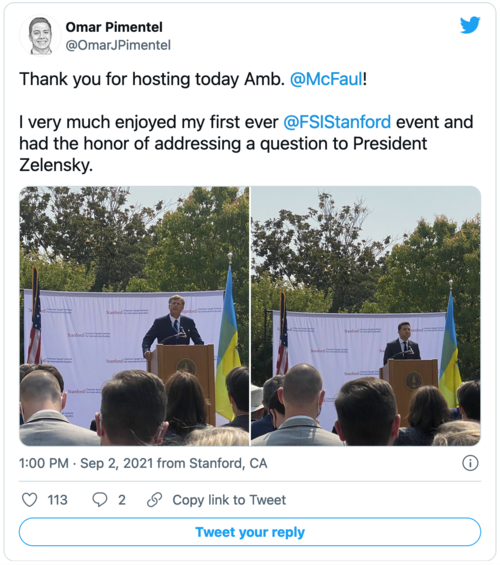
Tweet from Omar Pimentel

Following the formal remarks, President Zelenskyy and First Lady Zelenska had an opportunity to meet with Stanford President Marc Tessier-Lavigne in the Memorial Church Courtyard. Prior to leaving, the First Lady also sat down with leaders and students from Stanford's Office of Accessible Education (OAE), an area of interest she would like to support and better develop in Ukraine.

For FSI, the president’s visit was another affirmation of the special connection between Ukraine and the Stanford community. Since 2016, the Center on Democracy, Development and the Rule of Law has hosted the Ukrainian Emerging Leaders Program, which provides a 10-month academic training fellowship in support of mid-career practitioners working actively as policy-makers, legal professionals, entrepreneurs and leaders of civil society organizations in Ukraine.

Speaking to this shared history in his opening introductions, FSI Director Michael McFaul emphasized the crucial need for ongoing support and intellectual investment into Ukraine. “The fight for democracy and independence in Ukraine is one of the most important causes in the world today,” he affirmed. “Not just for Ukrainians, but for all who cherish the ideals of democracy, liberty and sovereignty.”

To President Zelenskyy, McFaul extended a future invitation: “You are always welcome back, either as president or in retirement as a professor.”

“With the classes you offer, I will think about it,” Zelenskyy replied with a smile.

Read More

President Zelenskky addresses Stanford students and community members via a live video address in the CEMEX auditorium.
News

President Volodymyr Zelenskyy Calls on Students to Lead as Future Ambassadors in a Special Video Address at Stanford

Ukraine’s President Volodymyr Zelenskyy spoke to the Stanford community in a special video address about his country’s war against Russia for independence, freedom, and global democracy, which he said requires the continued support of all the people of the free world.
President Volodymyr Zelenskyy Calls on Students to Lead as Future Ambassadors in a Special Video Address at Stanford
Larry Diamond speaking in the Bechtel Conference Center in Encina Hall
Commentary

"We Have Entered a New Historical Era": Larry Diamond on the Future of Democracy

Speaking at the April 2022 meeting of the FSI Council, Larry Diamond offered his assessment of the present dangers to global democracy and the need to take decisive action in support of liberal values.
"We Have Entered a New Historical Era": Larry Diamond on the Future of Democracy
Sviatlana Tsikhanouskaya discusses the future of democracy in Belarus with a roundtable of Stanford scholars.
News

Belarusian Leader Sviatlana Tsikhanouskaya Meets with Stanford Scholars for Roundtable on Democracy in Belarus

Democratic leader Sviatlana Tsikhanouskaya and her delegation joined an interdisciplinary panel of Stanford scholars and members of the Belarusian community to discuss the future of democracy in Belarus.
Belarusian Leader Sviatlana Tsikhanouskaya Meets with Stanford Scholars for Roundtable on Democracy in Belarus
Hero Image
President Volodymyr Zelenskyy of Ukraine speaks at the Freeman Spogli Institute for International Studies Rod Searcey
All News button
1
Subtitle

President Zelenskyy outlined the steps his administration is undertaking to bring increased digitization to Ukraine, curb corruption and create more equitable access to public services for more Ukrainians.

-

This is a virtual event. Please click here to register and generate a link to the talk. 
The link will be unique to you; please save it and do not share with others.

Co-sponsored by the Stanford Center at Peking University.

In honor of its release, contributors Mary Bullock, Thomas Fingar, and David M. Lampton will join editor Anne Thurston for a panel discussion of their volume Engaging China: Fifty Years of Sino-American Relations (Columbia University Press, 2021).

Recent years have seen the U.S.-China relationship rapidly deteriorate. Engaging China brings together leading China specialists—ranging from academics to NGO leaders to former government officials—to analyze the past, present, and future of U.S.-China relations. Bullock, Fingar, Lampton, and Thurston will reflect upon the complex and multifaceted nature of American engagement with China since the waning days of Mao’s rule. What initially motivated U.S.’ rapprochement with China? Until recent years, what logic and processes have underpinned the U.S. foreign policy posture towards China? What were the gains and the missteps made during five decades of America’s engagement policy toward China? What is the significance of our rapidly deteriorating bilateral relations today? Speakers will tackle these questions and more at this critical time when tensions between the U.S. and China continue to intensify.

For more information about Engaging China or to purchase a copy, please click here.


Image
Portrait of Mary Bullock
Mary Bullock, president emerita of Agnes Scott College, is an educator and scholar of U.S. – China relations. She served as the founding executive vice-chancellor of Duke Kunshan University from 2012-2015. Previous positions include distinguished visiting professor at Emory University, director of the Asia Program of the Woodrow Wilson Center, and director of the Committee on Scholarly Communication with the People’s Republic of China. She is vice-chair of the Asia Foundation, a trustee of the Henry Luce Foundation, and a member of the Schwarzman Academic Advisory Committee and the Council on Foreign Relations. She received her M.A. and Ph.D. in Chinese history from Stanford University. Her most recent publications include The Oil Prince’s Legacy: Rockefeller Philanthropy in China (2011) and, as co-editor, Medical Transitions in Twentieth Century China (2014).
 

Image
Portrait of Tom Fingar
Thomas Fingar is a Shorenstein APARC Fellow in the Freeman Spogli Institute for International Studies at Stanford University. He was the inaugural Oksenberg-Rohlen Distinguished Fellow from 2010 through 2015 and the Payne Distinguished Lecturer at Stanford in 2009. From 2005 through 2008, he served as the first deputy director of national intelligence for analysis and, concurrently, as chairman of the National Intelligence Council. Fingar served previously as assistant secretary of the State Department’s Bureau of Intelligence and Research (2000-01 and 2004-05), principal deputy assistant secretary (2001-03), deputy assistant secretary for analysis (1994-2000), director of the Office of Analysis for East Asia and the Pacific (1989-94), and chief of the China Division (1986-89). Between 1975 and 1986 he held a number of positions at Stanford University, including senior research associate in the Center for International Security and Arms Control.

Fingar's most recent books are The New Great Game: China and South and Central Asia in the Era of Reform, editor (Stanford, 2016), Uneasy Partnerships: China and Japan, the Koreas, and Russia in the Era of Reform (Stanford, 2017), and Fateful Decisions: Choices that will Shape China’s Future, co-edited with Jean Oi (Stanford, 2020).
 

Image
Portrait of David M. Lampton
David M. Lampton is Senior Fellow at the SAIS Foreign Policy Institute and Professor Emeritus at Johns Hopkins--SAIS. Immediately prior to his current post he was Oksenberg-Rohlen Fellow at Stanford University’s Asia-Pacific Research Center from 2019-2020. For more than two decades prior to that he was Hyman Professor and Director of China Studies at the Johns Hopkins University School of Advanced International Studies. Lampton is former Chairman of the The Asia Foundation, former President of the National Committee on United States-China Relations, and former Dean of Faculty at SAIS. Among many written works, academic and popular, his most recent book (with Selina Ho and Cheng-Chwee Kuik) is Rivers of Iron: Railroads and Chinese Power in Southeast Asia (University of California Press, 2020). He received his B.A., M.A., and Ph.D. degrees from Stanford University in political science where, as an undergraduate student, he was a firefighter. Lampton has an honorary doctorate from the Russian Academy of Sciences’ Institute of Far Eastern Studies. He is a Life Trustee on the Board of Trustees of Colorado College and was in the US Army Reserve in the enlisted and commissioned ranks.


Image
Portrait of Anne Thurston
Anne Thurston is the director of the Grassroots China Initiative, where she works with local NGOs in China. Thurston is a former associate professor at Johns Hopkins SAIS, assistant professor at Fordham University, and was a China staff member at the Social Science Research Council. She has been the recipient of fellowships from the Rockefeller Foundation, the John D. and Catherine T. MacArthur Foundation, the United States Institute of Peace, the Woodrow Wilson International Center for Scholars and the National Endowment for the Humanities. Thurston is also a member of the National Committee on US-China Relations. Thurston is the author of numerous publications, including The Noodle Maker of Kalimpong: The Untold Story of My Struggle for Tibet (2015), and Muddling Toward Democracy: Political Change in Grass Roots China (1998). She received her Ph.D. in political science from the University of California, Berkeley.

Via Zoom Webinar. Register at: https://bit.ly/38ME0m3

Mary Bullock <br>President Emerita, Agnes Scott College<br><br>
Thomas Fingar <br>Shorenstein APARC Fellow, Stanford University<br><br>
David M. Lampton <br>Professor Emeritus, Johns Hopkins School of Advanced International Studies (SAIS); Senior Fellow, SAIS Foreign Policy Institute<br><br>
Anne F. Thurston <br>Director, Grassroots China Initiative; China Studies Affiliated Scholar, Johns Hopkins--SAIS
Seminars
-

For fall quarter 2021, CISAC will be hosting hybrid events. Many events will offer limited-capacity in-person attendance for Stanford faculty, staff, fellows, visiting scholars, and students in accordance with Stanford’s health and safety guidelines, and be open to the public online via Zoom. All CISAC events are scheduled using the Pacific Time Zone. 

REGISTRATION


About the Event: Nuclear nonproliferation has been a pressing societal need since the development of nuclear weapons. Preventing the further spread of nuclear capabilities that could lead to a nuclear weapons program is a crucial mission that requires both technical and policy advances. Several international treaties have been put into place to curb the expansion of nuclear capabilities. Nevertheless, there are states that may be pursuing elements of an overt or covert nuclear weapons program. New science and technology developments are needed to verify the existing or proposed treaties in this area and to ensure that nuclear weapons are never used again.

In this presentation, I will discuss these challenges and some of the recent advances in science and technology that contribute to solving them. I will present our Consortium for Monitoring, Technology, and Verification (MTV), a consortium of 14 universities and 13 national laboratories working together on these issues. I will highlight research projects including our studies on the fundamental emissions from nuclear fission and the development of new detection systems for nuclear materials detection, localization, and characterization. These systems were shown to aid the International Atomic Energy Agency in its nuclear safeguards and verification activities that have direct relevance to nuclear security. I will also talk about our efforts in furthering diversity, equity, and inclusion, which are crucial for building teams that can successfully address these societal issues.


About the Speaker: Professor Sara Pozzi earned her M.S. and Ph.D. in nuclear engineering at the Polytechnic of Milan, Italy in 1997 and 2001, respectively. She is a Professor of Nuclear Engineering and Radiological Sciences and a Professor of Physics at the University of Michigan where she has graduated 25 Ph. D. students as advisor or co-advisor. Her research interests include the development of new methods for nuclear materials detection, identification, and characterization for nuclear nonproliferation, safeguards, and national security programs. She is the founding Director of the Consortium for Verification Technology (CVT) 2014-2019 and the Consortium for Monitoring, Technology, and Verification (MTV) 2019-2024, two large consortia of multiple universities and national laboratories working together to develop new technologies needed for nuclear treaty verification.

In 2018, Professor Pozzi was named the inaugural Director of Diversity, Equity, and Inclusion (DEI) for the UM College of Engineering. In this capacity, she heads the DEI implementation committee and works to ensure that the students, faculty, and staff are increasingly diverse, everyone is treated equally, and everyone is included.

She is the recipient of many awards, including the Institute of Nuclear Materials Management (INMM) Vince J DeVito Distinguished Service Award and the Department of Energy Outstanding Mentor Award, and is a Fellow of the American Nuclear Society, the INMM, and the IEEE.

Only those with an active Stanford ID with access to William J Perry Conference Room in Encina Hall may attend in person. This event will not be livestreamed.

Sara Pozzi Professor University of Michigan
Seminars
-

This is a virtual event. Please click here to register and generate a link to the talk. 
The link will be unique to you; please save it and do not share with others.


Peter Martin joins us to discuss his recent book, China's Civilian Army: The Making of Wolf Warrior Diplomacy. Chinese diplomacy in the past several years has become more assertive and its diplomats have used sharper language, earning them the title "wolf warriors." The book traces the roots of China's approach to diplomacy back to the communist revolution of 1949 and tells the story of how it's evolved through social upheaval, famine, capitalist reforms and China's rise to superpower status. It draws on dozens of interviews and -- for the first time -- on the memoirs of more than 100 retired Chinese diplomats.


Image
Portrait of Peter Martin
Peter Martin is a political reporter for Bloomberg News. He has written extensively on escalating tensions in the US-China relationship and reported from China's border with North Korea and its far-western region of Xinjiang. He previously worked for the consultancy APCO Worldwide in Beijing, New Delhi, and Washington, where he analyzed politics for multinational companies. In Washington, he served as chief of staff to the company's global CEO. His writing has been published by outlets including Foreign Affairs, the National Interest, the Guardian, the Jamestown China Brief, the Diplomat and the Christian Science Monitor. He holds degrees from the University of Oxford, Peking University and the London School of Economics.

Via Zoom Webinar. Register at: https://bit.ly/3zDZ3D0

Peter Martin Defense Policy and Intelligence Reporter, Bloomberg News
Seminars

Encina Hall

616 Jane Stanford Way

Stanford, CA 94305-6055

0
CDDRL Visiting Scholar, 2021-23
marisa_kellam_2022.jpg

Marisa Kellam researches the quality of democracy with a focus on Latin America and a growing interest in East Asia. Her research links institutional analysis to various governance outcomes in democracies along three lines of inquiry: political parties and coalitional politics; mass electoral behavior and party system change; and democratic accountability and media freedom. She has published her research in various peer-reviewed journals, including The British Journal of Political Science, Comparative Political Studies, Party Politics, Electoral Studies, and Political Communication. Originally from Santa Rosa, California, Marisa Kellam earned her Ph.D. in political science from UCLA and spent several years as an assistant professor at Texas A&M University. Since 2013, she has been Associate Professor at Waseda University in Tokyo, Japan, where she also served as Director of the English-based degree programs for the School of Political Science & Economics. Currently she is a steering committee member for the V-Dem Regional Center for East Asia.

CV
Authors
Nora Sulots
News Type
News
Date
Paragraphs

Stanford University’s Center on Democracy, Development and the Rule of Law (CDDRL) is proud to announce the incoming fellows who will be joining us in the 2021-2022 academic year to develop their research, engage with faculty and tap into our diverse scholarly community.

The pre- and postdoctoral program will provide fellows the time to focus on research and data analysis as they work to finalize and publish their dissertation research while connecting with resident faculty and research staff at CDDRL. 

Fellows will present their research during our weekly research seminar series and an array of scholarly events and conferences.

Learn more about each of our fellows below.


Alejandra Aldridge

CDDRL Predoctoral Scholar, 2021-22

Image
Alejandra

Hometown: Southington, CT

Academic Institution: Stanford University

Discipline and degree conferral date: PhD in Political Science, expected June 2022

Shortlist of Research Interests: Presidential influence, executive politics, public opinion, democratic norms, experimental methods

Dissertation Title: Presidential Influence on Democratic Norms

What attracted you to the CDDRL Pre/post-doctoral program? I admire the center's commitment to studying foundational ideas from a wide variety of perspectives, and I knew that my work could benefit greatly in that environment.

What do you hope to accomplish during your nine-month residency at the CDDRL? I look forward to finishing my dissertation that studies democratic norms in the United States, as well as developing the project further into a book project.

Fun fact: I am a CrossFitter and burpees are my favorite movement.


Aytuğ Şaşmaz

CDDRL Post-doctoral Fellow 2021-22

Image
Aytug

Hometown: Istanbul, Turkey

Academic Institution: Harvard University

Discipline and degree conferral date (or expected): Government, July 2021 (expected)

Shortlist of Research Interests: Political parties, social welfare policies, local governance

Dissertation Title: Explaining the Weakness of Secular Parties in the MENA Region: The Role of Political Selection and Organizational Cohesion

What attracted you to the CDDRL Pre/post-doctoral program? Certainly the people in and affiliated with the center. Looking forward to interacting with top minds on Arab democratization, Turkish politics, and political parties.

What do you hope to accomplish during your nine-month residency at the CDDRL? I am hoping to turn my dissertation chapters into two good journal publications, coming closer to turning it into a finished book manuscript, and taking the first steps into the new big project.

Fun fact: In the last 2-3 years I have become obsessed with volleyball! Both playing it and following the most important international competitions. If you see me tweeting in Turkish, I probably say something about the Turkish league (one of the best leagues in the world – especially the women's league).


Carlos Schmidt-Padilla

Postdoctoral Fellow at Stanford Impact Labs (SIL), affiliated with PovGov at CDDRL, 2021-22

Image
Carlos

Hometown: San Salvador, El Salvador

Academic Institution: University of California, Berkeley

Discipline and degree conferral date: Political Science (Summer 2021)

Shortlist of Research Interests: crime, human capital, migration, policing

Dissertation Title: Essays on Gangs and Development

What attracted you to the CDDRL Pre/post-doctoral program? CDDRL’s interdisciplinary approach to the study of the challenges facing democratic governance and development.

What do you hope to accomplish during your nine-month residency at the CDDRL? I hope to conclude various projects on citizen security and policing in Central America and the Caribbean, as well as commence new field experiments on reducing gender-based violence in the region.


Hans Lueders

CDDRL Postdoctoral Scholar, 2021-22

Image
Hans

Hometown: Tangermuende, Germany

Academic Institution: Stanford University

Discipline and degree conferral date: Political Science (June 2021)

Shortlist of Research Interests: Migration, political representation, authoritarian regimes, democratic backsliding, European politics

Dissertation Title: Political Representation in Democratic and Autocratic Regimes

What attracted you to the CDDRL Pre/post-doctoral program? The great community of scholars who work on some of the most pressing challenges that democratic governance is facing today.

What do you hope to accomplish during your nine-month residency at the CDDRL? I hope to work on a book manuscript on the political consequences of domestic migration. The book argues that domestic migration is a little-acknowledged cause of political polarization and inequality in representation. In addition, I hope to publish the three papers that are part of my dissertation.

Fun fact: I have run several half marathons in the past. One of my life goals is to run a full marathon soon.


Nicholas Kuipers

CDDRL Predoctoral Scholar, 2021-22

Image
Nicholas

Hometown: Falls Church, VA

Academic Institution: University of California, Berkeley

Discipline and degree conferral date: Political Science, expected 2021-22

Shortlist of Research Interests: State-building, Nation-building, Ethnic politics, Bureaucracy, Meritocracy

Dissertation Title: Failing the Test: The Politics of Civil Service Recruitment in Asia

What attracted you to the CDDRL Pre/post-doctoral program? I was drawn to the CDDRL both for the group of scholars working on topics related to my research, and for the access to the broader community of researchers at Stanford. At the moment, I’m particularly interested in exploring the tensions that arise from governments’ efforts at state-building on the one hand and nation-building on the other. This is a topic on which I can envision lots of productive conversations and collaborations with folks in the broader CDDRL community.

What do you hope to accomplish during your nine-month residency at the CDDRL? I hope to finish writing my dissertation as a book manuscript and work on several related article-length projects.

Fun fact: I once coincidentally met someone in Jakarta, Indonesia who had lived in my parents’ house before they bought it.


Samantha Bradshaw

CDDRL Postdoctoral Fellow, 2021-22

Image
Samantha

Hometown: Kitchener, Canada

Academic Institution: Oxford

Discipline and degree conferral date (or expected): Degree completed September 2020

Shortlist of Research Interests: Disinformation, Social Media, Democracy

Dissertation Title: The Social Media Challenge for Democracy: Propaganda and Disinformation in a Platform Society

What attracted you to the CDDRL Pre/post-doctoral program? I am excited by the opportunity to work with the community of scholars at the CDDRL who are thinking through some of the most critical challenges facing contemporary democracies.

What do you hope to accomplish during your nine-month residency at the CDDRL? During my nine-month residency at CDDRL I will be working on a book project looking at digital suppression and disinformation targeting activists, journalists, and minority communities.

Fun fact: I am the proud owner of a newfie-poo puppy (aka a “newdle”) named Soba.

Hero Image
CDDRL Pre and Postdocs over black and white background of Encina Hall
All News button
1
Subtitle

The Center on Democracy, Development and the Rule of Law (CDDRL) is pleased to welcome six pre- and postdoctoral fellows who will be joining us for the 2021-22 academic year. These scholars will spend the academic year focusing on the Center's four program areas of democracy, development, evaluating the efficacy of democracy promotion, and rule of law.

-

Image
header for Technology and Geopolitics: EU Proposals for Regulating Rights, Security and Trade

The future of technology policy in Europe will be affected by growing nationalism and protectionism, cyber and national security threats, and great power rivalries. The Program on Democracy and the Internet invites you to a technology policy discussion led by International Policy Director, Marietje SchaakeJoin us on September 16th from 9 AM - 12 PM PST (6 PM - 9 PM CET), as we dive into conversations on EU legislative packages, digital trade rules, and cybersecurity & geopolitics. We hope to develop a more precise understanding of how the EU and its allies can collaborate to create compatible technology standards, build more resilient supply chains, and address novel opportunities and risks presented by emerging technologies.This event is organized by the Program on Democracy and the Internet (part of the Cyber Policy Center and the Center on Philanthropy and Civil Society) and co-sponsored by the Institute for Human-Centered Artificial Intelligence.

Moderators: 


Speakers:


Seminars
Subscribe to Governance