
 FSI researchers consider international development from a variety of angles. They analyze ideas such as how public action and good governance are cornerstones of economic prosperity in Mexico and how investments in high school education will improve China’s economy.
They are looking at novel technological interventions to improve rural livelihoods, like the development implications of solar power-generated crop growing in Northern Benin.
FSI academics also assess which political processes yield better access to public services, particularly in developing countries. With a focus on health care, researchers have studied the political incentives to embrace UNICEF’s child survival efforts and how a well-run anti-alcohol policy in Russia affected mortality rates.
FSI’s work on international development also includes training the next generation of leaders through pre- and post-doctoral fellowships as well as the Draper Hills Summer Fellows Program.

Amita Chudgar on "Who teaches marginalized children, and what may explain these teacher distribution patterns? Analysis of data from Asia, Latin America, and Sub-Saharan Africa"
-
In the final International Education Initiative seminar of the year, Amita Chudgar, Associate Professor of Educational Administration at Michigan State University and Visiting Scholar at the GSE, will present her new study on "Who teaches marginalized children, and what may explain these teacher distribution patterns? Analysis of data from Asia, Latin America, and Sub-Saharan Africa."
Professor Chudgar's study represents the most systematic cross-national analysis of teacher distribution that has been conducted to date. She will also provide insights into policies and practices that may help ensure a more equitable teacher distribution, and address the vicious cycle that can develop—especially in developing countries—when higher-quality teachers are concentrated in the schools and classrooms of wealthier children, while poor and marginalized children find themselves in the classrooms of relatively weaker teachers.
Lunch will be provided. Open to the public.
Encina Hall East Wing, 2nd Floor Conference Room
Seminars
Stanford scholar underscores diversity, global education goals
News Type
Q&As
Date
Paragraphs
This week the World Education Forum convenes in Incheon, South Korea. Drawing leaders from UNESCO member states and heads of international organizations and NGOs, the 4-day gathering will examine global education priorities and discuss a framework for action and implementation of shared goals and targets.
The Forum, which last met in Dakar in 2000, will explore five major themes: equity, inclusion, quality education and lifelong learning, and also set out an agenda on global citizenship education—how to cultivate in youth the attitudes, values and skills needed in today’s world.
As the Forum approaches, the Walter H. Shorenstein Asia-Pacific Research Center asked Stanford professor Gi-Wook Shin to offer his perspectives on global education and his vision for South Korea. He is Korean and an expert on South Korea’s higher-education system, politics and society. He also advises some universities in Asia such as the Center for Asia-Pacific Future Studies at Kyushu University in Japan.
Shin leads two multi-year research projects—one focused on diversity and tolerance in Asia, and another on global social capital, delving into the linkages between innovation, economic globalization and diaspora communities. He recently published key findings in Global Talent with coauthor Joon Nak Choi, a Stanford graduate now professor at Hong Kong University of Science and Technology.
Education has played an important role in the social and economic development of South Korea. Can you explain?
Over the past fifty years, South Korea has gone from being one of the least developed countries to one of the most developed—an “economic miracle,” as it is often referred. The country rose from periods of wartime, poverty and social unrest to become a stable high-income developed country, all in an incredibly short time span. Education has played a substantial role in South Korea’s emergence. Nearly 70 percent of Koreans between the ages of 25 and 34 years of age hold an equivalent of a bachelors degree. This is the highest ranking in all Organization for Economic Co-operation and Development (OECD) countries. Investment in its own people, as well as areas of technology and the sciences, catapulted South Korea toward such success. Its education system is lauded globally. President Obama has referred to its system on multiple occasions, saying the respect and level of support given to teachers there helps to empower student learning. Teaching is a very highly respected profession in South Korea.
In pursuit of the “creative economy,” South Korea has sought to capitalize on the knowledge value of its population. How does diversity fit into this context?
South Korea, like many advanced nations, is driving toward a “creative economy,” a policy objective that President Park Geun-hye set out in Feb. 2013. It’s a strategy to move South Korea away from its manufacturing past toward a future of a service-oriented economy. The latter requires greater creative thinking, and human and social capital are necessary ingredients in that process. Many people look to Silicon Valley as a model of success, a place that continues to harness ideas and investment in those ideas. As I say, there is one known “secret” that has contributed to Silicon Valley’s success, and that’s cultural diversity. In fact Japanese Prime Minister Shinzo Abe visited Stanford recently on his state visit to the United States in a bid to underscore his commitment to building a creative economy in Japan. He convened with leaders of major technology firms like Apple and Twitter, and one of the main messages shared with Abe was the scale to which immigrants contributed to the workforce here. So, South Korea, like many Asian nations, would benefit from recognizing the connection between diversity and the economy, and take it one step further and actively encourage a society who accepts foreigners—this, of course, comes with inherent hurdles in any ethnically homogeneous country like South Korea.
How can a society cultivate globally responsible citizens?
Shifting a society to truly respect and value diversity can be an especially difficult task for countries steeped in nationalism and traditional values. In the case of South Korea, policies supporting values of diversity are just starting to appear, but full social integration of minorities remains a distant future. If the government acts to support diversity over the long-term, though, hopefully change is in the closer future. The challenge is for South Korea to strike the right balance between embracing the nation’s historical legacy, while also recognizing what it means to be a “global citizen” in today’s world. I’ve been working with Rennie Moon, a professor at Yonsei University, on this research question. Teachers play a definitive role in the development of students. Providing curriculum that is balanced is an important factor. This means teaching materials—from textbooks to videos—must provide a neutral stance, or even better, show information in a comparative perspective. Teachers themselves must also commit to being facilitators. Encouraging pride in one’s own country, while also showing respect and value toward others’ is a key message that teachers can help reinforce.
Why do foreign students in Korea matter? And, what role can Korean students have when abroad?
Foreign students in Korea represent a positive-sum game. For one, foreign students diversify Korea, and also help fill the national labor shortfall. In my study with Choi, we found that three groups of students prove to be more beneficial to Korean society. “Focused instrumentalists,” students who are pursuing advanced degrees in technical subjects, “focused Koreaphiles,” students who view Korea as special but focus mainly on their studies, and “youthful Koreaphiles,” students who view Korea as special but focus mainly on exploring their social environments. Instrumentalists grow an affinity to Korea by likely working for a firm in Korea upon graduation. Someone who is a Koreaphile will show affinity for Korea because of an admiration for pop culture and other aspects of Korean society—K-pop, hallyu, Korean dramas and so forth.
Increasingly, Korean students are choosing to study abroad. Just over 123,000 Korean students pursued an undergraduate degree abroad in year 2011; 29% of whom studied in the United States. We see chogi yuhak, a trend of Koreans sending their children overseas to avoid the secondary education system, which is often cited for its rigor and stressful entrance exams. Yet, even if Korean students do not return home, they still have an opportunity to contribute back to South Korea. They form a global network and serve as “transnational bridges” between South Korea and their host countries. As a result, information, innovation and other opportunities bounce between and among people on both sides. This same lesson could be applied to any country really.
What policy implications will transnational bridges have in South Korea?
The affects on policy are largely two-fold. First, South Korean universities, companies and the government must seek to promote values of diversity. The Korean government has taken steps to recognize the strategic value of recruiting foreigners. But, the push isn’t big enough yet. For example, we hosted former Seoul National University President Yeon-Cheon Oh as a visiting fellow this year. He voiced that while Korean universities are orienting some of their policies toward ‘internationalization,’ they still aren’t totally committed to the idea. Better support systems should be developed for foreign students, and tenure should be more accessible to foreign faculty members. Second, for Koreans overseas, diaspora networks could be strengthened. About 10 percent of all ethnic Koreans live outside the Korean Peninsula. Creating codified social and cultural forums for diasporans will help instill a sense of the homeland, so that they want to stay engaged.
Are aspects of South Korea’s model translatable in neighboring countries in Asia and elsewhere?
The Korean model is relevant in other developed, nonimmigrant societies. Different from settler societies like the United States or Canada, for instance, who have heterogeneous populations. Germany and Japan provide the closest comparison study; both their national identities are based on shared ethnicity. Japan has in many ways successfully leveraged its diaspora. Ethnic Japanese who left have been recruited back, and foreign unskilled workers, particularly from Asia, infuse the labor market. A large number of foreign students study in Japan. Germany also sees an substantial amount of foreign students each year. Japan now allows students to stay up to one year to search for a job after graduation, and in Germany, the same for six months. But both countries have trouble retaining graduates. Applying the case of South Korea, seeking benefits from transnational bridges could also benefit both societies. Assimilation of diasporans—like ethnic Koreans in Japan and Turkish people in Germany—should be a long-term goal.
Gi-Wook Shin wrote in Nikkei Asian Review about aspects of Silicon Valley that Asian countries should consider adopting to emulate its success, and how foreign skilled workers can provide social capital. He also contributed a post to Stanford University Press blog about steps South Korea could take to counter the "brain drain" phenomenon. Later, Shin and Rennie Moon wrote a piece for The Conversation, expanding upon the challenges that foreign faculty and students face in South Korea and other Asian nations.
All News button
1
European Security Initiative
Stanford Initiative on European Security
太平洋戦争終結70周年に考える:8人のスタンフォード研究者による終戦の日の談話
Paragraphs
8月15日、安倍首相は第2次大戦終結70周年を記念する談話を発表する。戦後50周年(1995年)の村山談話、そして60周年(2005年)の小泉談話に続くものだ。
ショーレンスタイン・アジア太平洋研究センター (APARC) とフリーマン・スポグリ国際研究所 (FSI) に所属する8人の学者が、自分が日本の首相だったら発表するであろう談話を書き上げた。
英語版はこちらをご覧ください。
All Publications button
1
Publication Type
Books
Publication Date
"Doomsday vault" founder calls for seed saving, plant breeding to cope with climate change
News Type
News
Date
Paragraphs
Governments must do more to diversify the types of crops grown throughout the world. If they don’t, climate change may jeopardize the global food supply, a leading agriculture researcher told a Stanford audience.
Cary Fowler, a senior advisor and former executive director of the Global Crop Diversity Trust, was a driving force behind the creation of the Svalbard Global Seed Vault in Norway. Commonly known as the “doomsday vault,” the repository of ancient and modern seeds from around the world ensures that future generations will have access to a wide enough range of crop traits to adapt global agriculture to a changing climate.
 Dr. Cary Fowler in Svalbard, Norway, the home of the Svalbard Global Seed Vault.
During a May 6 talk sponsored by FSE as part of the center’s Food and Nutrition Policy Symposium, Fowler warned that increasingly high temperatures and water shortages interfere with the natural growing cycles of many crops and can even reduce the nutritional quality of some plants. Higher temperatures also give way to new pests, diseases, and soil microorganisms that threaten yields.
“The biggest impacts from climate change will be in sub-Saharan Africa,” Fowler said, a region where many people already suffer serious poverty and hunger, and where crop yields lag behind the rest of the world. Fowler said that as climate pressure on agriculture intensifies, the world can expect to see an uptick in civil conflict, restrictive trade policies, and suffering among the world’s poorest people.
“Crops are going to be facing new combinations of conditions for which there is no historical experience,” said Fowler. “They will require new combinations of traits” that can only be developed by preserving genetic diversity and proactively breeding new varieties.
“There are 1.3 billion people living on subsistence farms today,” said Dr. Cary Fowler to a Stanford audience on May 6. “How will they adapt to climate change without access to diversity?”
Fowler called for the U.S. and foreign governments to embrace their “inherited evolutionary responsibility” for preserving the huge diversity of crops grown by farmers throughout human history.
The United States is the ideal candidate to lead the world in using crop genetic diversity to adapt agriculture to climate challenges, he said. “The U.S. is well-positioned to research diversity, model future climate and assemble seed packages,” enlisting farmers in the U.S. and abroad in “another mass adaptation experiment” like the one American agriculture undertook in the 18th and 19th centuries.
“I know that sounds like a wild and crazy idea,” Fowler said. “But I haven’t heard any alternatives to it. If we’re assuming we’re going to have development without diversity, that would really be a historically unprecedented experiment.”
“If agriculture doesn’t adapt,” he added, “neither will we.”
A diverse history
In the late 1700s the United States food system lacked diversity and infrastructure. “Very few of the crops we grow now in the U.S. are native,” said Fowler. Early on, “it wasn’t always evident what crops from abroad would grow well in the U.S.”
The government soon set out to expand and diversify American agriculture. U.S. Navy ships collected seeds on overseas voyages, and U.S. diplomats brought back new crops from postings abroad. Government-sponsored expeditions sought out foreign plants with specific disease-resistant traits. The U.S. signed two dozen seed-exchange agreements with other countries, and lowered taxes on imported seeds to boost global crop exchange.
Image
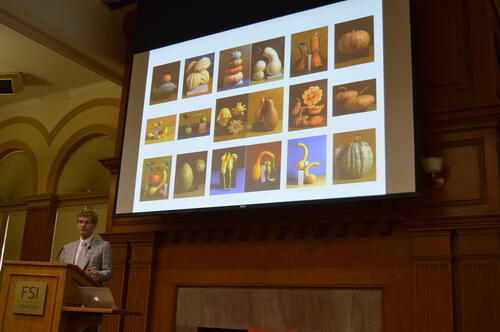
“The United States amassed a much more diverse array of seeds and crops as a result,” said Fowler. One program introduced 600 new apple varieties, 700 new types of pears, and 353 new varieties of mangoes to American farmers.
But the United States did not simply collect new crops. It also invested in research to develop new varieties, including through plant breeding.
Genetic erosion
Research into plant breeding quickly yielded many of the modern varieties of crops we grow today in the United States.
“With plant breeding came the rise of modern varieties that had useful traits like disease resistance,” said Fowler. A small handful of new varieties quickly gained popularity with American farmers, who now had a choice about whether or not to save seeds and grow many varieties of a crop at once. Most farmers chose not to, instead relying on the same few mainstream varieties their neighbors were growing.
This shift has led to what Fowler described as the “genetic erosion” of agriculture, a trend that can only be reversed by reviving the tradition of seed saving and plant breeding on a global scale.
Seed banks
“I have probably been to more seed banks than any other person,” said Fowler. Seeds from most crops can survive hundreds or even thousands of years in storage, but most storage facilities lack the physical security to provide lasting safe haven. Many seed banks are poorly built, too warm or humid for long-term storage, and vulnerable to natural disasters. Other facilities suffer damaged during civil wars and uprisings.
Even if banks are physically secure, said Fowler, most simply do not operate on a large enough scale to protect global crop diversity. “Most crops in the world have between one and 10 total seed samples in storage, and most have no plant breeders working on them at all,” said Fowler.
The doomsday vault
In 2005 Fowler was chosen to lead an international coalition to build the Svalbard Global Seed Vault. The Norwegian government owns the facility, and it is also managed by the Global Crop Diversity Trust and the Nordic Genetic Resource Center.
The vault is built into the side of a mountain in the far north of Norway, said Fowler, because the ideal temperature for storing seeds is minus 18 degrees Celsius.
Inside the frozen walls of the vault are shelves full of boxes holding duplicate seeds from smaller seed banks around the world. Foreign governments that contribute samples pay nothing for storage, and the seed packages are never opened by vault staff, said Fowler.
“The vault now houses seeds from over 864,000 varieties of plants,” said Fowler, adding that not a single sample has ever been lost.
 Seed storage boxes at the Svalbard Global Seed Vault.
The facility’s nickname, “the doomsday vault,” comes not only from its rugged physical location but from its capacity to withstand disasters – something its planners took great care to design. “We calculated how high the water would go if all ice in the world melted and we had the world’s largest ever tsunami,” said Fowler. “The vault is five stories above that.”
“Not a solution”
Fowler emphasized that no doomsday vault, no matter how secure its walls or how ample its seed collection, can solve the problem of crop genetic erosion. Building a vault “doesn’t mean that we as a society are getting serious about adapting agriculture to climate change,” Fowler said. Plant breeding and crop research programs focused on developing new climate-resilient varieties are just as crucial as saving seeds.
Although a few major staple crops like rice, wheat and corn are continually bred and improved in research labs around the world, most crops are largely ignored by researchers. For example, there are only six breeders of yams worldwide.
“Why conserve it if you’re not going to use it?” Fowler asked. “We are acting like crops are going to adapt by themselves, and we are assuming all but a handful of crops are unimportant.”
Quoting Charles Darwin, Fowler added that “it is not the strongest of the species that survives, nor the most intelligent, but the one most responsive to change.”
Full video and audio recordings of Dr. Fowler's May 6 lecture, and his interview with FSE director Roz Naylor, are available here.
Hero Image

All News button
1
Stanford’s Phillip Lipscy on China’s Asian Infrastructure Investment Bank
News Type
News
Date
Paragraphs
When China first proposed creating the Asian Infrastructure Investment Bank (AIIB) in 2013, it generated considerable anxiety in Washington and many other capitals. Many pundits and policymakers view the AIIB as a bid to undermine or replace the international architecture designed by the United States and its allies since the end of World War II. Although several U.S. allies, including Australia, Germany, and the United Kingdom, have declared their intention to join the AIIB, others, including Japan, have expressed ambivalence. For its part, the United States has made it clear that it will seek to influence the institution from the outside. But it would be a mistake to shun or undermine the AIIB. Rather, it should be welcomed. Both the United States and Japan have far more to gain by joining the AIIB and shaping its future than remaining on the sidelines.
The details remain vague, but the AIIB is meant to be a multilateral development institution that will focus on infrastructure needs in Asia. There is no question that this is a deserving cause. Asia’s large population, rapid growth, and integration with the global economy all generate demand for better infrastructure. A report by the Asian Development Bank (ADB) estimates the region needs about $750 billion annually in infrastructure-related financing. Citing historical underinvestment, McKinsey & Company, a global management consulting firm based in New York City, proclaims a “$1 trillion infrastructure opportunity” in Asia. [...]
This article was originally published on Foreign Affairs on May 7, 2015, and an excerpt has been reproduced here with permission. The full article may be viewed on the Foreign Affairs website.
Hero Image

All News button
1
Mao left China backward but, ironically, ready for reform
News Type
News
Date
Paragraphs
The damage that Mao Zedong wrought in China made it much easier for that country to move away from a Soviet-style economic model and toward a new market-oriented one, a Stanford scholar says.
In fact, China has been in full retreat for four decades from Mao's disastrous rule, according to a new book by Stanford sociology Professor Andrew Walder, a senior fellow at the Freeman Spogli Institute for International Studies and director emeritus of the Walter H. Shorenstein Asia Pacific Research Center.
"Mao ruined much of what he had built and created no viable alternative," he wrote. "At the time of his death, he left China backward and deeply divided."
Led by Mao, China's Communist Party seized power in 1949 after a long period of guerrilla insurgency followed by full-scale war. Mao launched a bloody Chinese revolution that resulted in the deaths of millions of Chinese over the next few decades.
In an interview, Walder said that Mao pushed campaign after campaign against the Chinese Communist party and bureaucracy after 1966 – "The bureaucracy was basically flat on its back at the time of his death."
By contrast, Walder noted, the Soviet bureaucracy was powerful and well-entrenched, and had enormous vested interests that thwarted genuine reforms.
"In post-Mao China, the economy was so backward and the bureaucratic interests so weak that market reform was bundled together with a program of national revival – restructuring the economy along market lines while rebuilding the party and bureaucracy," he said.
Therefore, the politics of reform were much easier for a Chinese leader like Deng Xiaoping than for a Soviet leader like Mikhail Gorbachev, who had to contend with an entrenched bureaucracy still proud of the fact that the USSR was (until the late 1980s) the second largest economy in the world and an undeniable superpower, according to Walder.
He noted that Mao's initiatives repeatedly led to unintended and unanticipated outcomes.
"What is so remarkable is that after 1956 this was a recurring pattern. His initiatives repeatedly ran into trouble, forcing him to backtrack and change direction constantly – although he always insisted that things had unfolded in ways that were according to his plans," Walder said.
Class struggle, imaginary enemies
Mao's China, he added, was defined by a harsh Communist Party rule and a socialist economy modeled after the Soviet Union. Mao himself intervened at almost every level, despite a large national bureaucracy that oversaw this authoritarian system.
"The doctrines and political organization that produced Mao's greatest achievements – victory in the civil war, the creation of China's first unified modern state, a historic transformation of urban and rural life – also generated his worst failures: the industrial depression and rural famine of the Great Leap Forward and the violent destruction and stagnation of the Cultural Revolution," Walder wrote.
He said that Mao misunderstood China's real problems in advocating a top-down "class struggle" against capitalism and imaginary enemies.
"At the time of his death (in 1976), he left China backward and deeply divided," Walder wrote.
The result was a gradual transition to the market-oriented system of today, he added. Almost immediately following Mao's death, his most fervent followers and supporters in the party were arrested and detained – all of which opened the door to reform and opportunity.
China has overcome widespread poverty to become the second largest economy in the world within the span of just a couple of decades. Still, according to Walder, China's rulers seek to cling to a sanitized version of Mao as a way to buttress their legitimacy.
"The damage of his misrule, and the incompetence on his part that it reflects, are not part of the official story anymore, and certainly this is not what is taught to school children or in party manuals in the present day," he said.
World War II and Stalinism
On two other key issues, Walder said his book challenges the conventional wisdom about China and Mao.
First, he says that Mao's forces did very little of the fighting against the Japanese in WWII.
Walder said that the victory of the Chinese Communist Party in 1949 over the Chinese nationalist forces has usually been traced to the strategy of guerrilla warfare in rural regions championed early on by Mao.
"But that was simply a strategy of survival during the Japanese invasion – and Mao's forces did very little of the fighting against the Japanese, in stark contrast to the popular myth of rural resistance." (Only 10 percent of China's military casualties were Red Army, he said.)
What Mao's Chinese Communist Party (CCP) excelled at was mass mobilization for all-out warfare during the Chinese civil war of 1945-49, Walder said.
"And this – pushing your organization and the population for all-out mobilization for war – is the real source of the CCP's success over the Chinese nationalists. This was more like the Soviet Union's war against German armies during World War II than a 'people's war' led by a party that was close to the rural people and built support by catering to their needs," he said.
Second, Walder describes Mao's thinking as frozen in Stalinist doctrine, despite the conventional view of him as an original thinker.
"In fact, Mao's core ideas were absorbed from late-1930s Soviet pamphlets put out under Stalin, and his thinking was very much frozen in that earlier era," Walder said. "The core idea that he absorbed from these pamphlets in creating 'Mao Thought' was that socialism had to be built in an all-out mobilization, like warfare, by extracting huge sacrifices from the population."
The most pernicious idea that Mao absorbed from these old Soviet pamphlets, Walder said, was that class struggle actually intensifies after the means of production are put under public ownership and former exploiting classes are liquidated.
"The sad corollary to this idea is that the Great Leader is the fount of correct ideas, and those who doubt or oppose him represent class enemies who actually oppose socialism," said Walder.
Based on this logic, Walder pointed out, the class struggle had to be waged against "incorrect ideas" as judged by the Great Leader.
"Mao's personality cult was an imitation of Stalin's own," he said.
And so, the Chinese leader held on to old Stalinist ideas long after they were rejected by the Soviet Union as crude distortions of Marxism.
"Mao was actually insisting on keeping to the old and tattered Stalinist playbook," Walder said.
Clifton Parker is a writer for the Stanford News Service.
Hero Image

All News button
1


