International Development

FSI researchers consider international development from a variety of angles. They analyze ideas such as how public action and good governance are cornerstones of economic prosperity in Mexico and how investments in high school education will improve China’s economy.

They are looking at novel technological interventions to improve rural livelihoods, like the development implications of solar power-generated crop growing in Northern Benin.

FSI academics also assess which political processes yield better access to public services, particularly in developing countries. With a focus on health care, researchers have studied the political incentives to embrace UNICEF’s child survival efforts and how a well-run anti-alcohol policy in Russia affected mortality rates.

FSI’s work on international development also includes training the next generation of leaders through pre- and post-doctoral fellowships as well as the Draper Hills Summer Fellows Program.

News Type
News
Date
Paragraphs

Bad weather in sub-Saharan Africa increases the spread of HIV, according to a study published in the June 2015 issue of the Economic Journal, co-authored by Stanford professor and FSE fellow Marshall Burke.

When the rains fail, farmers in rural areas often see their incomes fall dramatically and will try to make up for it however they can, including through sex work. Analysing data on more than 200,000 individuals across 19 African countries, the research team finds that by changing sexual behaviour, a year of very low rainfall can increase local infection rates by more than 10%.

The results have important policy implications for fighting the spread of the epidemic, as co-author Erick Gong of Middlebury College notes:

‘Existing approaches to stopping the spread of HIV – such as promoting condom use and the use of anti-retrovirals – remain critically important. But our results suggest that other policy approaches could be very useful too – in particular, approaches that provide safety nets to rural households when the weather turns bad.’

Policies and investments seemingly unrelated to HIV – such as the promotion of rural insurance or household savings schemes, or the development of drought-tolerant crops – might have surprising benefits in slowing the HIV epidemic. Co-author Kelly Jones of the International Food Policy Research Institute says:

‘The HIV/AIDS epidemic remains one of the world’s greatest health challenges, with over a million new infections per year in Africa alone. Our results expand the menu of options for addressing the epidemic, and highlight some surprising options that are not at the forefront of people’s minds.’

The research sheds valuable light on why HIV continues to spread in Africa. Previous studies have documented in limited settings that poor women often alter their sexual behaviour in response to an income shortfall. But until now, there has been little evidence that this response is big enough to affect the trajectory of the HIV epidemic.

To fill this gap, the researchers combined data on the HIV status of thousands of people across sub-Saharan Africa with data on the recent rainfall history in each individual’s location.

Because years of low rainfall can lead to much lower incomes in these locations, particularly in rural areas where people depend more heavily on agriculture for their livelihoods, variation in rainfall provides a way to study how changes in local economic conditions affect infection rates. Co-author Marshall Burke comments:

‘We were surprised by how strong the relationship is between recent rainfall fluctuations and local infection rates. As expected, the relationship is much stronger in rural areas, and particularly for women who report working in agriculture. These are the people who really suffer when the rains fail, and who are forced to turn to more desperate measures to make ends meet.’

Notes for editors: ‘Income Shocks and HIV in Africa’ by Marshall Burke, Erick Gong and Kelly Jones is published in the June 2015 issue of the Economic Journal.

Marshall Burke is an assistant professor of Earth System Science at Stanford University. Erick Gong is an assistant professor of economics at Middlebury College. Kelly Jones is a research fellow at the International Food Policy Research Institute (IFPRI).

For further information: contact Marshall Burke on +1-650-736-8571 (email: mburke@stanford.edu); Erick Gong on +1-802-443-5553 (email: egong@middlebury.edu); Kelly Jones on +1-202-862-4641 (email: k.jones@cgiar.org); or Romesh Vaitilingam on +44-7768-661095 (email: romesh@vaitilingam.com; Twitter: @econromesh).

Hero Image
75148497 50e081cd5b b Jon Rawlinson/flickr
All News button
1
Authors
Christian E. Ollano
News Type
News
Date
Paragraphs

The Center on Democracy, Development, and the Rule of Law proudly congratulates its graduating class of honors students for their outstanding original research conducted under the CDDRL Interdisciplinary Undergraduate Honors Program. Among those graduating includes Garima Sharma who was awarded the Firestone Medal for her thesis entitled "Factors Shaping Mothers' Aspirations for their Daughters in India: A Case Study of Forbesganj, Bihar." Sharma's project used both quantitative and qualitative methods to explore cultural, social and economic factors that shape female expectations in one of the poorest parts of India.

The Firestone Medal for Excellence in Undergraduate Research recognizes Stanford's top ten percent of honors theses in social science, science and engineering among the graduating senior class.

Initially struck by the high rates of early marriage upon her visit to northern India, Sharma conducted field interviews and surveys last summer, finding that exposure to educated and employed female role models produced an increase in mothers’ aspirations for their daughters.


cara and garima Cara Reichard (left) and Garima Sharma (right) both received awards under CDDRL for their outstanding theses projects.
"I think the most memorable experience in my research process was when I was interviewing the mothers in Forbesganj," said Sharma. "It was interesting to see that mothers coming from the same communities were saying very different things about their aspirations for their children." 


Sharma's research was conducted under the advisement of Associate Professor of Education and CDDRL Affiliated Faculty Member Christine Min Wotipka. In addition to the Firestone Award, Sharma received the 2015 Michelle Zimbalist Rosaldo Prize in the Social Sciences under the Program in Feminist, Gender, and Sexuality Studies.

Among other award winners, CDDRL honors student Cara Reichard received the CDDRL Best Thesis Award for her honors thesis "The Logic of International Courts: An Exploration of the East African Court of Justice," which analyzed the impact and legitimacy of rulings under the East African Court of Justice. Stefan Norgaard received a Firestone Medal under the Urban Studies program for his thesis entitled "Rainbow Junction: South Africa’s Born Free Generation and the Future of Democracy," which assessed democratic consolidation in South Africa via hyper-local civic interactions among the country's active youth.


"The CDDRL honors program has allowed us to write theses around issues that really matter," said Norgaard. "What sets the program apart is that it pushes us to pursue projects aimed at changing things and making an active contribution to scholarship around the world."


Norgaard, Sharma and Reichard are part of a cohort of ten graduating CDDRL honors students who have spent the past year working in consultation with CDDRL affiliated faculty members and attending honors research workshops to develop their theses projects. Many traveled abroad to collect data, conduct interviews, and spend time in the country they were researching. Collectively, their topics documented some of the most pressing issues impacting democracy today in South Africa, India, North Korea, Swaziland, Cuba and Uganda, among others.


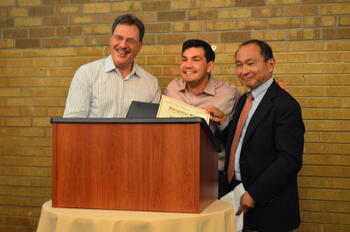
dsc 0247 Stefan Norgaard with CDDRL Director Larry Diamond (left) and FSI Olivier Nomellini Senior Fellow Francis Fukuyama (right).
"This year's CDDRL honors class produced an extraordinary range of thesis topics, from deliberative democracy in California to the role of courts in East Africa," said FSI Olivier Nomellini Senior Fellow Francis Fukuyama, advisor to the CDDRL Interdisciplinary Undergraduate Honors Program. "The class was particularly diverse in terms of majors, with students coming from human biology and statistics as well as economics and political science; their work benefited greatly from the exposure they received to a range of disciplinary approaches. Most of all they learned from each other."


In the upcoming 2015-2016 academic year, the program will bring in the new leadership of CDDRL Deputy Director Stephen Stedman who will advise a cohort of 15 honors students, one of the program's largest and most diverse classes to date.  

The CDDRL Interdisciplinary Undergraduate Honors Program trains students from any academic department at Stanford to prepare them to write a policy-relevant research thesis with global impact on a subject touching on democracy, development, and the rule of law. Honors students participate in research methods workshops; attend honors college in Washington, D.C.; connect to the CDDRL research community; and write their thesis in close consultation with a faculty advisor to graduate with a certificate of honors in democracy, development, and the rule of law.

A list of the 2015 graduating class of CDDRL honors students, their theses advisors, and a link to their theses can be found below:


NameMajorThesis
Monica DeyHuman Biology
Selamile DlaminiManagement Science & Engineering
Max JohnsonInternational Relations
Hamin KimHuman Biology

NGOs and Effective Aid Delivery in the Democratic People's Republic of Korea (Thesis not available for public.)

Advisor: Gary Schoolnik

Stefan NorgaardPublic Policy
Cara ReichardPolitical Science
Ashley SemanskeeHuman Biology

Community Engagement and Accountability in US Urban Public School Districts (Thesis not available.)

Advisor: Martin Carnoy and Susanna Loeb

Garima Sharma

Economics

Factors Shaping Mothers’ Aspirations for their Daughters in India: A Case Study of Forbesganj, Bihar 

Advisor: Christine Min Wotipka

Thuy TranEconomics
Shawn TutejaMathematics


Hero Image
cddrl2015honors
The graduating class of 2014-2015 CDDRL senior honors students take a group photo with CDDRL Director Larry Diamond and FSI Oliver Nomellini Senior Fellow and CDDRL Honors Program Advisor Francis Fukuyama. From left to right: Didi Kuo (CDDRL honors program teaching assistant); Stefan Norgaard; Monica Dey; Hamin Kim; Garima Sharma; Larry Diamond; Ashley Semanskee; Selamile Dlamini; Max Johnson; Cara Reichard; Thuy Tran; Shawn Tuteja; and Francis Fukuyama.
Lauren Weitzman
All News button
1
Paragraphs

This paper reexamines Japanese policy choices during its banking crisis in the 1990s and draws some lessons relevant for the United States and Europe in the aftermath of the global financial crisis of 2007–09. The paper focuses on two aspects of postcrisis economic policy of Japan: the delay in bank recapitalization and the lack of structural reforms. These two policy shortcomings retarded Japan’s recovery from the crisis and were responsible for its stagnant postcrisis growth. The paper also suggests some political economy factors that contributed to the Japanese policies. In France, Italy, and Spain bank recapitalization has been delayed and the structural reforms have been slow. Without drastic changes, they are likely to follow Japan’s path to long economic stagnation. The situation in Germany looks somewhat better mainly because the structural reform was undertaken before the crisis. Although the recovery has been slow in the United States as well, the problems are at least different from those faced by Japan then and many European countries now.

All Publications button
1
Publication Type
Journal Articles
Publication Date
Journal Publisher
IMF Economic Review
Authors
Takeo Hoshi
News Type
News
Date
Paragraphs

Stanford University’s Walter H. Shorenstein Asia-Pacific Research Center (APARC) is launching a U.S.-Asia Security Initiative spearheaded by a former top American diplomat to deepen dialogue on contemporary Asia-Pacific security issues and to further bridge American and Asian academics, government officials and industry leaders.

A new and uncertain multipolar system is emerging in Asia. The United States is and will remain a global power, but it is evident the post-Cold War international order is increasingly under strain. There is a pressing need for research about how developments in the Asia-Pacific region impact U.S. interests, and what the optimal strategies are to respond. Led by Karl Eikenberry, who served as U.S. ambassador to Afghanistan from 2009 to 2011, the initiative will look beyond simplistic notions of nations engaging harmoniously or competing against each other and explore a range of policy options.

Combining expertise from across Stanford University, the initiative will gather faculty and researchers from the Freeman Spogli Institute for International Studies (FSI), and take place under the auspices of Shorenstein APARC, a center focused on interdisciplinary research on contemporary issues of international cooperation, governance and security in the Asia-Pacific region.

Eikenberry, an Oksenberg-Rohlen Distinguished Fellow at Shorenstein APARC, retired from the U.S. Army as a lieutenant general after 35 years of service before taking the role as ambassador. At Stanford, he has returned to an early and longstanding interest in Asia, contributing to an urgent discussion about how the United States should respond regionally and globally to an increasingly strong China. The initiative is founded on the premise that there is a role for an institution that not only fosters groundbreaking research, but also serves to convene academic and governmental expertise from across the Asia-Pacific region in a dialogue aiming to inform policy and strategy.

“As China rises and Japan seeks a greater defense role in Asia, a number of questions are raised over the United States’ role in the region. This creates a great impetus for stakeholders to gather and develop an understanding of today’s perplexing security issues,” Eikenberry said.

“It’s an honor to lead this Stanford initiative and make possible opportunities for students, scholars, peers and leaders across the world.”

Before arriving at Stanford, Eikenberry’s Asia-related postings included assistant army, and later, defense attaché at the U.S. Embassy Beijing, operational assignments in the Republic of Korea and Hawaii, Director for Strategic Plans and Policy at U.S. Pacific Command, Senior Country Director for China at the Office of the Secretary of Defense, and two senior command tours in Afghanistan. He is a graduate of the U.S. Military Academy, holds master’s degrees from Harvard University and Stanford University, and has an advanced degree in Chinese history from Nanjing University.

The three-year initiative will build synergies with existing activities at Stanford, drawing scholars, government officials and industry leaders to engage at conferences and public seminars on important U.S.-Asia security themes. Understanding that inquiry is enlivened through interdisciplinary dialogue, participants will share best practices across multiple fields including diplomacy, military strategy and environmental risk.

“I can’t think of a better person to drive this initiative – Karl has a profound understanding of the economic, diplomatic and military complexities in the region. I have every confidence that it will develop into a robust, established project under his leadership,” said Gi-Wook Shin, director of Shorenstein APARC.

Launching July 1, 2015, the initiative aims to bolster local, national and global networks through several foundational components, including a core working group of experts from Stanford and peer institutions to provide new perspectives on U.S. policies in Asia; educational opportunities for Stanford students; and public programs that will bring intellectual and strategic leaders to Stanford to enrich the conversation on Asia-Pacific security.

The initiative seeks to operate as a focal point for academic scholarship on the west coast of the United States and offer practical steps that stakeholders can take to strengthen the security architecture and U.S. alliance commitments in the region. Outcomes from the initiative’s activities will include publications and policy reports, many of which will be offered open access online.

“As the Asia-Pacific region continues to rise, we see new threats but also greater opportunity to work together,” said Michael McFaul, director of FSI. “Stanford and FSI excel in offering practical solutions to policy challenges and can play a role in identifying strategies aimed at maintaining peace and stability in the region.”


Initiative inquires: Charlotte Lee, Shorenstein APARC, cplee@stanford.edu, (650) 725-6445

Media inquires: Lisa Griswold, Communications and Outreach Coordinator, Shorenstein APARC, lisagris@stanford.edu, (650) 736-0656

Hero Image
usnavy flickr uspacificfleet
In Sasebo, Japan, members from the maritime forces of India, Japan and the United States observe a trilateral naval field exercise in July 2014.
Flickr/U.S. Pacific Fleet
All News button
1
Subscribe to International Development