Security

FSI scholars produce research aimed at creating a safer world and examing the consequences of security policies on institutions and society. They look at longstanding issues including nuclear nonproliferation and the conflicts between countries like North and South Korea. But their research also examines new and emerging areas that transcend traditional borders – the drug war in Mexico and expanding terrorism networks. FSI researchers look at the changing methods of warfare with a focus on biosecurity and nuclear risk. They tackle cybersecurity with an eye toward privacy concerns and explore the implications of new actors like hackers.

Along with the changing face of conflict, terrorism and crime, FSI researchers study food security. They tackle the global problems of hunger, poverty and environmental degradation by generating knowledge and policy-relevant solutions. 

0
janani_2_-_janani_mohan.jpg

Janani Mohan has an extensive background in nuclear, human rights, defense, and science policy, with experiences across the U.S. federal government and think tanks. Currently, Janani is a Ford Dorsey Fellow at Stanford University's Masters in International Policy Program, and was also awarded the McCaw Fellow for exchange study at the Diplomatic Academy in Vienna, Austria. While at Stanford, Janani has researched Russia-Pakistan nuclear energy cooperation and transitional justice in Southeast Asia. Prior to to Stanford, she has worked and interned with seven federal government agencies, served as a think-tank representative to the United Nations in Austria, co-founded a cybersecurity startup, and graduated Summa Cum Laude from UC Berkeley in Political Science. Janani also co-founded Dweebs Global, an international COVID-response nonprofit which works in over 35 countries around the world to provide free career and mental health resources. For fun, she loves travelling, taking photos, and playing with the world's cutest dog, Rishi.

Master's in International Policy Class of 2022
0
headshot_fsi_-_arden_anne_farr.jpg

Arden graduated with bachelor’s degrees in economics and international affairs from the University of Georgia. She researched nonproliferation issues at KAIST and the James Martin Center for Nonproliferation Studies and developed WMD terrorism policy through the U.S. government. She also tracked propaganda and disinformation campaigns for two years through AFRICOM and the U.S. Department of State. In addition to her involvement with NGOs focused on human rights issues in the East Asian and Pacific Region, Arden received a U.S. Department of State Certificate of Appreciation for exemplary service regarding the promotion of human rights in North Korea and Southeast Asia. At Stanford, Arden intends to develop skills relevant to a career focused on disarmament, arms control, and mass atrocity prevention. During her free time, Arden enjoys running, listening to political podcasts, cooking experimentally, and traveling.

Master's in International Policy Class of 2023
0
bentley_-_headshot_-_francesca_elisabeth_bentley.jpg

Francesca Bentley was born and raised in Illinois and spent her later years living in several areas of the North and Southeast. She recently graduated from Spelman College, where she attained a B.A. in Political Science with a minor in Psychology. During her undergraduate matriculation, Francesca worked as a Peer Recitation Facilitator for the Department of African Diaspora Studies and served as Spelman College’s Pulitzer Center Campus Consortium Reporting Fellow for 2020. While working for the Pulitzer Center, Francesca published a piece on African refugees’ and asylum seekers’ perspectives on American racism.

Additionally, Francesca studied abroad twice while at Spelman, once in Barcelona, Spain and once in Cape Town, South Africa - where she worked as a paralegal. In the summer of 2020, Francesca assisted U.C. San Diego’s Center for Peace and Security Studies team in gathering information on foreign countries’ nuclear platforms. For much of this year, Francesca worked as a research assistant with an MIT professor to create datasets detailing companies’ stances and reactions to racial and social justice issues that will eventually be made public to consumers. Francesca is exploring her interest in coercive diplomacy through the MIP's International Security specialization, in hopes of using her knowledge acquired through the MIP program to become a Foreign Service Officer in order to generate greater stability in African states and strengthen the U.S.’ relations with said communities.

Master's in International Policy Class of 2023
Authors
Noa Ronkin
News Type
News
Date
Paragraphs

The Walter H. Shorenstein Asia-Pacific Research Center (APARC), Stanford University’s hub for interdisciplinary research, education, and engagement on contemporary Asia, invites nominations for the 2022 Shorenstein Journalism Award. The award recognizes outstanding journalists who have spent their careers helping audiences worldwide understand the complexities of the Asia-Pacific region. The 2022 award will honor a recipient whose work has primarily appeared in American news media. APARC invites 2022 award nomination submissions from news editors, publishers, scholars, journalism associations, and entities focused on researching and interpreting the Asia-Pacific region.  Submissions are due by Tuesday, February 15, 2022.

Sponsored by APARC, the award carries a cash prize of US $10,000. It alternates between recipients whose work has primarily appeared in Asian news media and those whose work has primarily appeared in American news media. The 2022 award will recognize a recipient from the latter category. For the purpose of the award, the Asia-Pacific region is defined broadly to include Northeast, Southeast, South, and Central Asia and Australasia. Both individual journalists with a considerable body of work and journalism organizations are eligible for the award. Nominees’ work may be in traditional forms of print or broadcast journalism and/or in new forms of multimedia journalism. The Award Selection Committee, whose members are experts in journalism and Asia research and policy, presides over the judging of nominees and is responsible for the selection of honorees.

An annual tradition since 2002, the award honors the legacy of APARC benefactor, Mr. Walter H. Shorenstein, and his twin passions for promoting excellence in journalism and understanding of Asia. Over the course of its history, the award has recognized world-class journalists who push the boundaries of coverage of the Asia-Pacific region and help advance mutual understanding between audiences in the United States and their Asian counterparts. Recent honorees include Burmese journalist and human rights defender Swe Win; former Wall Street Journal investigative reporter Tom Wright; the internationally esteemed champion of press freedom Maria Ressa, CEO and executive editor of the Philippine news platform Rappler and winner of the 2021 Nobel Peace Prize; former Washington Post Beijing and Tokyo bureau chief Anna Fifield; and Editor of the Wire Siddharth Varadarajan.

Award nominations are accepted electronically through Tuesday, February 15, 2022, at 11:59 PM PST. For information about the nomination procedures and to submit a nomination please visit the award nomination entry page. The Center will announce the winner by April 2022 and present the award at a public ceremony at Stanford in the autumn quarter of 2022.

Please direct all inquiries to aparc-communications@stanford.edu.

Read More

Autumn scene on the Stanford campus with a call to apply for APARC's 2022-23 fellowships for Asia schoalrs
News

APARC Announces 2022-23 Fellowships for Asia Specialists

The Center offers fellowships for postdoctoral scholars specializing in contemporary Asia, Japan, and Asia health policy and for experts on Southeast Asia.
APARC Announces 2022-23 Fellowships for Asia Specialists
North Korea Conundrum Book cover
News

How to Solve the North Korean Conundrum: The Role of Human Rights in Policy Toward the DPRK

APARC's new edited volume, 'The North Korean Conundrum,' shines a spotlight on the North Korean human rights crisis and its connection to nuclear security. In the book launch discussion, contributors to the volume explain why improving human rights in the country ought to play an integral part of any comprehensive U.S. engagement strategy with the DPRK.
How to Solve the North Korean Conundrum: The Role of Human Rights in Policy Toward the DPRK
Hero Image
Stanford arch and text calling for nominations for APARC's 2022 Shorenstein Journalism Award.
All News button
1
Subtitle

Sponsored by Stanford University’s Shorenstein Asia-Pacific Research Center, the annual award recognizes outstanding journalists and journalism organizations for excellence in coverage of the Asia-Pacific region. News editors, publishers, scholars, and organizations focused on Asia research and analysis are invited to submit nominations for the 2022 award through February 15.

All Publications button
1
Publication Type
Journal Articles
Publication Date
Subtitle
Is it possible to reduce crime without exacerbating adversarial relationships between police and citizens? Community policing is a celebrated reform with that aim, which is now adopted on six continents. However, the evidence base is limited, studying reform components in isolation in a limited set of countries, and remaining largely silent on citizen-police trust. We designed six field experiments with Global South police agencies to study locally designed models of community policing using coordinated measures of crime and the attitudes and behaviors of citizens and police. In a preregistered meta-analysis, we found that these interventions led to mixed implementation, largely failed to improve citizen-police relations, and did not reduce crime. Societies may need to implement structural changes first for incremental police reforms such as community policing to succeed.
Journal Publisher
Science
Authors
Number
Issue 6571
-

Image
Sandra González-Bailón seminar flyer

Join us  Tuesday, December 7th from 12 PM - 1 PM PST for “Media Choices, Niche Behavior, and Biases in Online Information” featuring Sandra González-Bailón, Associate Professor at the Annenberg School for Communication at University of Pennsylvania. This seminar series is organized by the Cyber Policy Center’s Program on Democracy and the Internet and the William and Flora Hewlett Foundation’s Cyber Initiative.  

The quality of our democracies relies on the quality of the information that citizens consume but we still know very little about how citizens engage with the news “in the wild”. In this talk, I will discuss two papers that examine that question in different settings. The first paper analyzes the media choices of a representative panel of the U.S. population (N ~ 55,000) as they consume TV, web, and YouTube content over a period of 44 months. Less than 10% of the panelists (N ~ 5,300) view and browse news on the three platforms. This small group of news hyper-consumers is formed predominantly by older male users with higher education. We find no evidence of substitution effects in the time these users spend consuming news on each of the three platforms, but consuming news across the media landscape is a choice that only a small and unrepresentative slice of the population makes. These results help us characterize the digital equivalent of the ‘opinion leaders’ first proposed to understand the effects of mass media. The hyper-consumers we identify in our analyses create the elite of opinion leaders that have a disproportionate influence in how news content is selected, circulated, and (ultimately) algorithmically amplified. That this small group is far from representing the population at large is one of the ways in which online information may perpetuate important biases in the salience of some topics over others. The second paper analyzes news sharing in social media during one of the largest protest mobilizations in U.S. history to examine ideological asymmetries in the posting of news content. We extract the list of URLs shared during the mobilization period and we characterize those web sites in terms of their audience reach and the ideological composition of that audience. We also analyze the reliability of the sites in terms of the credibility and transparency of the information they publish. We show that there is no evidence of unreliable sources having any prominent visibility during the protest period, but we do identify asymmetries in the ideological slant of the sources shared, with a clear bias towards right-leaning domains. Our results suggest that online networks are contested spaces where the activism of progressive movements coexists with the narratives of mainstream media, which gain visibility under the same stream of information but whose reporting is not necessarily aligned with the activists’ goals.

About the speaker:

Sandra González-Bailón is an Associate Professor at the Annenberg School for Communication, and affiliated faculty at the Warren Center for Network and Data Sciences. Her research lies at the intersection of network science, computational tools, and political communication. She is the author of Decoding the Social World (MIT Press, 2017) and co-editor of The Oxford Handbook of Networked Communication (OUP, 2020). More information on her research can be found at https://sandragonzalezbailon.net/
 
Her articles have appeared in journals like PNAS, Nature, Science, Political Communication, The Journal of Communication, and Social Networks, among others. She is the author of the book Decoding the Social World (MIT Press, 2017) and co-editor of The Oxford Handbook of Networked Communication (OUP, 2020). She serves as Associate Editor for the journals Social Networks, EPJ Data Science, and The International Journal of Press/Politics, and she is a member of the Board of Reviewing Editors for Science. She leads the research group DiMeNet (/daɪmnet/) — acronym for Digital Media, Networks, and Political Communication.


Seminars
-

Image
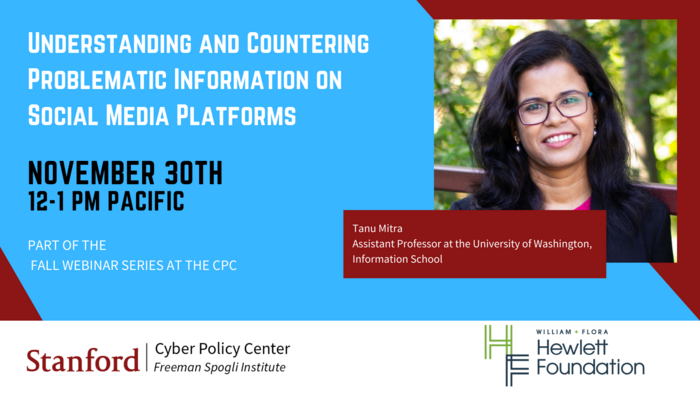
tanu mitra event understanding and countering problematic information on social media platforms

Join us Tuesday, November 30th from 12 PM - 1 PM PT for Understanding and Countering Problematic Information on Social Media Platforms featuring Tanu Mitra, Assistant Professor at University of Washington’s Information School. This seminar series is organized by the Cyber Policy Center’s Program on Democracy and the Internet and the William and Flora Hewlett Foundation’s Cyber Initiative. 

Online social media platforms have brought numerous positive changes, including access to vast amounts of news and information. Yet, those very opportunities have created new challenges—our information ecosystem is now rife with problematic content, ranging from misinformation, conspiracy theories, to hateful and incendiary propaganda. As a social computing researcher, Dr. Mitra’s work introduces computational methods and systems to understand and design defenses against such problematic online content. In this talk, she will focus on two aspects of problematic online information: 1) conspiracy theories and 2) extremist propaganda.

First, leveraging data spanning millions of conspiratorial posts on Reddit, 4chan, and 8chan, Dr. Mitra will present scalable methods to unravel who participates in online conspiratorial discussions, what causes users to join conspiratorial communities and then potentially abandon them. Second, she will dive into a special type of problematic content: extremist hate groups. Merging theories from social movement research with big data analyses, Dr. Mitra will discuss the ecosystem of extremists’ communication and the roles played by them. Finally, she will close by previewing important new opportunities to address some of these problems, including conducting social audits to defend against algorithmically generated misinformation and designing socio-technical interventions to promote meaningful credibility assessment of information.


About the speaker:

Image
Tanu Mitra
Tanu Mitra is an Assistant Professor at the University of Washington, Information School, where she leads the Social Computing research group. She and her students study and build large-scale social computing systems to understand and counter problematic information online. Her research spans auditing online systems for misinformation and conspiratorial content, understanding digital misinformation, unraveling narratives of online extremism and hate, and building technology to foster critical thinking online. Her work employs a range of interdisciplinary methods from the fields of human computer interaction, data mining, machine learning, and natural language processing. Dr. Mitra’s work has been supported by grants from the NSF, DoD, Google, Social Science One, and other Foundations. Her research has been recognized through multiple awards and honors, including an NSF-CRII, an early career ONR-YIP, Adamic-Glance Distinguished Young Researcher award and Virginia Tech College of Engineering Outstanding New Assistant Professor award, along with several best paper honorable mention awards. Dr. Mitra received her PhD in Computer Science from Georgia Tech’s School of Interactive Computing and her Masters in Computer Science from Texas A&M University

0
morlino_headshot_-_madeleine_morlino.jpg

Maddy Morlino is pursuing a Master’s in International Policy at Stanford University, specializing in international security, immigration, and human rights. At Stanford, she is a Hoover Veteran Fellowship Program research assistant focusing on trafficking in person prevention and response training for the Department of Defense. She is also a research assistant for Lieutenant General H.R. McMaster, co-chair of her program’s Racial Equality, Diversity, and Inclusion Task Force, co-vice president for social impact at DreamxAmerica, and a Knight-Hennessy scholar. Maddy obtained her B.S. in political science with a minor in philosophy from the U.S. Air Force Academy in 2020. Outside of the classroom, she enjoys running, watching movie trailers, scrapbooking, and traveling. Maddy will serve as a U.S. Air Force intelligence officer after graduation.

Master's in International Policy Class of 2022
0
chaeri.jpg

Chaeri Park is pursuing a Master's degree in International Policy at Stanford, with a concentration in Cyber Policy and Security. She comes to Stanford after working as a foreign service officer for seven years in the Ministry of Foreign Affairs of the Republic of Korea. She was involved in diverse areas of global cooperation from public diplomacy to economic affairs, where she focused on the Northeast Asian region. Chaeri was also posted to the Korean Embassy in Tokyo as a Second Secretary, and spent two years in Japan.

  At Stanford, Chaeri is expanding her area of interest to cybersecurity, propaganda, and emerging technologies. She successfully completed her position as a Student Fellow with the Japanese Diaspora project at the Hoover Institute and a summer internship with the Asia Society Policy Institute (APSI) in Washington D.C., where she worked on projects related to developments of Ethical Artificial Intelligence(AI) and privacy laws in Southeast Asia.   Chaeri graduated from Korea University in 2013 with a Bachelor's degree in Economics and Business Administration. Outside of class, she enjoys playing violin and golfing with her friends.
Master's in International Policy Class of 2022
-

*For fall quarter 2021, CISAC will be hosting hybrid events. Many events will offer limited-capacity in-person attendance for Stanford faculty, staff, fellows, visiting scholars, and students in accordance with Stanford’s health and safety guidelines, and be open to the public online via Zoom. All CISAC events are scheduled using the Pacific Time Zone.


REGISTRATION


Seminar Recording

About the Event: The Afghan government’s collapse in August demonstrated that two decades of donor-driven state-building efforts failed to build a foundation for a stable, democratic, and prosperous Afghanistan. Why did the United States and its allies fail, and what should donors learn for similar state-building efforts in the future, both large and small?

Spanning the U.S. government’s problematic strategies, inappropriate timelines, and poor understanding of the Afghan context, lessons learned reports by the Special Inspector General for Afghanistan Reconstruction (SIGAR) have warned for years that the Afghan government was exceptionally fragile and that many of the gains alleged by the U.S. officials were hollow and unsustainable. This CISAC seminar will detail how and why the U.S. government should reform its own institutions to more effectively stabilize conflict-affected environments around the world. 

Download SIGAR’s 20th anniversary report, What We Need to Learn (2021)

Download SIGAR’s report, Stabilization: Lessons from the U.S. Experience in Afghanistan (2018)


About the Speaker: David H. Young is a supervisory research analyst at the Special Inspector General for Afghanistan Reconstruction and a conflict and governance advisor with experience in six conflict/post-conflict environments: Afghanistan, the Sahel, Israel/Palestine, the Balkans, the Caucasus, and Northern Ireland. At SIGAR, he was the lead author of three comprehensive lessons learned reports: 1) A study of U.S. efforts to stabilize contested Afghan communities, 2) A review of U.S. efforts to build credible and transparent Afghan electoral institutions, and 3) the agency’s 20th anniversary report, What We Need to Learn. He was a civilian advisor to ISAF in Nuristan and Laghman provinces during the Afghanistan surge and subsequently served as a governance advisor to the World Bank, the U.S. Institute of Peace, and Afghanistan's Independent Directorate of Local Governance. His writing and commentary has appeared in the New York Times, the Atlantic, the Christian Science Monitor, Foreign Policy, and the Daily Beast, among others.

Virtual Only. This event will not be held in person.

David Young Special Inspector General for Afghanistan Reconstruction
Seminars
Subscribe to Security