International Relations

FSI researchers strive to understand how countries relate to one another, and what policies are needed to achieve global stability and prosperity. International relations experts focus on the challenging U.S.-Russian relationship, the alliance between the U.S. and Japan and the limitations of America’s counterinsurgency strategy in Afghanistan.

Foreign aid is also examined by scholars trying to understand whether money earmarked for health improvements reaches those who need it most. And FSI’s Walter H. Shorenstein Asia-Pacific Research Center has published on the need for strong South Korean leadership in dealing with its northern neighbor.

FSI researchers also look at the citizens who drive international relations, studying the effects of migration and how borders shape people’s lives. Meanwhile FSI students are very much involved in this area, working with the United Nations in Ethiopia to rethink refugee communities.

Trade is also a key component of international relations, with FSI approaching the topic from a slew of angles and states. The economy of trade is rife for study, with an APARC event on the implications of more open trade policies in Japan, and FSI researchers making sense of who would benefit from a free trade zone between the European Union and the United States.

-

This is a virtual event. Please click here to register and generate a link to the talk. 
The link will be unique to you; please save it and do not share with others.


This event is co-sponsored by the Center on Democracy, Development, and the Rule of Law.

How does autocratic lobbying affect political outcomes and media coverage in democracies? This talk focuses on a dataset drawn from the public records of the US Foreign Agents Registration Act. It includes over 10,000 lobbying activities undertaken by the Chinese government between 2005 and 2019. The evidence suggests that Chinese government lobbying makes legislators at least twice as likely to sponsor legislation that is favorable to Chinese interests. Moreover, US media outlets that participated in Chinese-government sponsored trips subsequently covered China as less threatening. Coverage pivoted away from US-China military rivalry and the CCP’s persecution of religious minorities and toward US-China economic cooperation. These results suggest that autocratic lobbying poses an important challenge to democratic integrity.


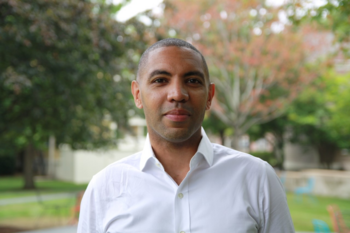
Portrait of Erin Baggott CarterErin Baggott Carter is an Assistant Professor at the Department of Political Science and International Relations at the University of Southern California. There, she is also a Co-PI at the Lab on Non-Democratic Politics. She received a Ph.D. in Government from Harvard University, is currently a visiting scholar at the Stanford Center on Democracy, Development and the Rule of Law, and was previously a Fellow at the Stanford Center for International Security and Cooperation.

Dr. Carter's research focuses on Chinese politics and propaganda. She recently completed a book on autocratic propaganda based on an original dataset of eight million articles in Arabic, Chinese, English, French, Russian, and Spanish drawn from state-run newspapers in nearly 70 countries. She is currently working on a book on how domestic politics influence US-China relations. Her other work has appeared or is forthcoming in the British Journal of Political ScienceJournal of Conflict Resolution, and International Interactions. Her work has been featured by the New York Times, the Brookings Institution, and the Washington Post Monkeycage Blog.


Image
American and Chinese flags
This event is part of the 2021 Winter/Spring Colloquia series, Biden’s America, Xi’s China: What’s Now & What’s Next?, sponsored by APARC's China Program.


Via Zoom Webinar. Register at: https://bit.ly/3beG7Qz

Erin Baggott Carter Assistant Professor, Department of Political Science and International Relations, University of Southern California; Visiting Scholar, Center on Democracy, Development and the Rule of Law, Stanford University
Seminars
Authors
Oriana Skylar Mastro
News Type
Commentary
Date
Paragraphs

This article by Oriana Skylar Mastro was originally published by the Lowy Institute.

Chinese exercises in the South China Sea last month, and the strong US response, show these disputed waters will not soon be calm. While the focus has largely been on military maneuvers, competition in legal positions has also been heating up. Last year, both the United States and Australia risked China’s wrath by officially stating that China’s claims in the South China Sea are unlawful. Other claimants were pleased by this change of policy, but none voiced it prominently.

The issue, however, is not that China flagrantly violates international law – it is that it does so while simultaneously creating a veneer of legal legitimacy for its position.

The conventional wisdom is that China claims sovereignty over “virtually all South China Sea islands and their adjacent waters.” Its claims are “sweeping” and more expansive than those of any other rival claimant. In 2009, Dai Bingguo, then a top Chinese official, first referred to the South China Sea as a “core interest”, a term often used for Taiwan, Xinjiang, and Tibet. While China has not been specific about the extent of its claims, it uses a “nine-dash line” which “swoops down past Vietnam and the Philippines, and towards Indonesia, encompassing virtually all of the South China Sea”, to delineate its claims.

[Subscribe to APARC's newsletters to stay current on our scholars' research.]

On the surface, it appears that Chinese leaders are relying on a historical argument to buttress their claims – China traces its interaction with the South China Sea back to the Western Han Dynasty. Thus, Beijing’s narrative about its claims begins as early as the 2nd century BCE, when Chinese people sailed in the South China Sea and discovered some of the region’s land features.

Scholars have meticulously cataloged the dubious nature of this history. And besides, the UN Convention for the Law of the Sea (UNCLOS) does not grant signatories the right make claims based on historical legacy, and the concept of “historic claims” lacks a clear basis in international law.

But this is not actually how China lays claim to 90% of the South China Sea. China’s abuse and misapplication of international law is a bit more complex. There are four levels that build on one another.

First, China claims it has the same rights as archipelagic states, those countries mainly made up of islands. One of the benefits of archipelagic status is that the waters between islands are considered internal waters, like rivers inside a country. Other countries have no right to transit these waters without permission. This archipelagic status is conferred through the UN, and only 22 nations claim it.

Spoiler alert: China is not one of them.

China is undeniably a continental country, but nevertheless, it drew straight baselines around the Paracel Islands and claimed the waters between the islands to be internal waters. Beijing has not done this explicitly for the Spratly islands area, but its reaction to the activities of other countries suggests that is its interpretation. My discussions with Chinese strategists reveal that China will likely explicitly draw baselines to claim internal waters between the Spratly Islands once it has the military capabilities in place to enforce it. (This is not an easy task, as the Spratlys’ sea zone is 12 times that of the Paracels, covering 160,000 to 180,000 square kilometers of water.)

While international law may support the position of the US and Australia on legal behavior within the EEZs, countries need to work harder to solidify this norm more broadly.
Oriana Skylar Mastro
FSI Center Fellow

China then claims a 12 nautical mile (nm) territorial sea from the Paracel baseline, not from the individual islands, and in the Spratlys from many features that under international law are not awarded this right, such as artificial islands. Moreover, China’s interpretation of the territorial sea is that the state has the exclusive right to make, apply and execute its own laws in that space without foreign interference. But according to UNCLOS, all ships, civilian or military, enjoy the right of innocent passage through other states’ territorial seas. Moreover, the contiguous zone is considered part of international waters, and states do not have the right to limit navigation or exercise any control for security purposes.

Lastly, China claims 200 nm from the end of the territorial sea as its exclusive economic zone (EEZ), where it claims to have the right to regulate military activity. The US insists that freedom of navigation of military vessels is a universally established and accepted practice enshrined in international law – in other words, states do not have the right to limit navigation or exercise any control for security purposes in EEZs. Australia shares this view, but not all countries accept this interpretation. Argentina, Brazil, India, Indonesia, Iran, Malaysia, the Maldives, Oman, and Vietnam agree with China that warships have no automatic right of innocent passage in their territorial seas. Twenty other developing countries (including Brazil, India, Malaysia, and Vietnam) insist that military activities such as close-in surveillance and reconnaissance by a country in another country’s EEZ infringe on coastal states’ security interests and therefore are not protected under freedom of navigation.

In other words, while international law may support the position of the US and Australia on legal behavior within the EEZs, countries need to work harder to solidify this norm more broadly.

Through these three positions alone on internal waters, territorial seas and EEZs, China lays claim to approximately 80% of the South China Sea. Then China uses the nine-dash line to cover the remaining territory and provide redundancy by claiming “historic waters” – i.e., that China has historically controlled this maritime environment – again, a view that has no basis in international law.

Image
Table comparing the practices of China in the South China Sea verus the norms of international laws

The US has taken steps to challenge the false legal basis of China’s claims. This is the main purpose behind freedom-of-navigation operations, or FONOPS – to demonstrate through action that the US does not accept China’s position that areas are not international waters but internal or territorial waters. In other instances, the US is signaling that it does not accept an area to be in China’s EEZ, although China would not have the right to regulate military activity there anyway.

But undermining China’s false legal claims will take more than military operations and harsh statements. In 2016, the Hague Tribunal ruled that China’s claims of historic rights in the South China Sea lacked legal foundation, China’s actions in the region infringed on the rights of the Philippines, and features in the Spratlys are not entitled to EEZs or territorial zones. Yet Washington’s ongoing refusal itself to ratify UNCLOS undermines the general effectiveness of pushing back against Beijing with legal tools of statecraft. Additionally, Washington squandered an opportunity to support the Philippines in enforcing the international legal tribunal’s 2016 ruling in its favor, further reducing the attractiveness for other claimants to challenge Beijing on legal grounds.

The US should not make the same mistake twice. It should support other claimants that may want to pursue legal action against China (Vietnam is currently considering this course of action). Then, when the tribunal rules once more against China, the US should lead the charge to enforce the ruling.

China is using all the tools of statecraft at its disposal to gain control over this vital strategic waterway. The US and its allies should do the same.

Read More

Photograph of Xi Jinping and Vladmir Putin walking in front of two lines of armed Chinese soldiers
News

Military Competition with China: Harder to Win Than During the Cold War?

On February 10th, the APARC China Program hosted Professor Oriana Mastro to discuss military relations between the US and China, and why deterrence might be even more difficult than during the Cold War.
Military Competition with China: Harder to Win Than During the Cold War?
A warship sailing in the South China Sea and a photo of three soldiers standing guard in front of a Chinese traditional building
News

China’s South China Sea Strategy Prioritizes Deterrence Against the US, Says Stanford Expert

Analysis by FSI Center Fellow Oriana Skylar Mastro reveals that the Chinese military has taken a more active role in China’s South China Sea strategy, but not necessarily a more aggressive one.
China’s South China Sea Strategy Prioritizes Deterrence Against the US, Says Stanford Expert
Battleships patrolling in the open ocean.
Commentary

Beijing’s Line on the South China Sea: “Nothing to See Here”

China’s official denials of growing military capability in the region look a lot like gaslighting.
Beijing’s Line on the South China Sea: “Nothing to See Here”
Hero Image
Aircraft assigned to the Theodore Roosevelt Carrier Strike Group fly over the South China Sea
Aircraft assigned to the Theodore Roosevelt Carrier Strike Group fly over the South China Sea.
U.S. Indo-Pacific Command, Flickr
All News button
1
Subtitle

Beijing’s misapplication of international law in the disputed waters is more complex than it seems on the surface.

Authors
News Type
Blogs
Date
Paragraphs

Grandparents have an endearing position of high stature in Mexican culture. Grandchildren have countless stories about the cariño (endearment) they receive from Abuelito (Grandpa) and Abuelita (Grandma). My immigrant grandparents sacrificed a lot when they migrated to the United States. Their courageous journeys and perseverance to attain the American dream left an invaluable mark on me. My abuelito’s journey to the United States initially on the Bracero Program led me to conduct research on the program. The Bracero Program was a binational labor agreement between the United States and Mexico that was in effect from 1942 to 1964. It was established due to the labor shortage brought about by World War II. Thousands of Mexican men were recruited and joined the program to work primarily in agriculture in states like California.

It was my abuelito’s cariño, work ethic, and courage as an immigrant that I have never forgotten. My abuelito worked in the highlands of Jalisco, Mexico, where his skilled farm labor contributed to making the highlands of Jalisco productive for the cultivation of agave. Thousands of the region’s men—including my abuelito—joined the Bracero Program and left Mexico for the United States. Once in the United States, they worked in the agricultural industry and transformed it into the multibillion-dollar business that it is today.

In my research, I have had the chance to interview members of the family of Rafael Silva, who was also a bracero from Jalisco. One of his grandsons, Isa Silva, will be entering Stanford next fall as a recruit for the Stanford Men’s Basketball team. I recently had the chance to talk with Isa and reflect upon the legacy of his abuelito and mine. The work that they performed was brutal, often working with the short-handled hoe for long periods. Reflecting on his abuelito’s contribution to making the Salinas Valley into the “Salad Bowl of the World,” Isa noted, “My grandparents’ immigrant journey and hard work means everything to me. It’s one thing that motivates me and inspires me. I respect the generations before me and am forever grateful for their sacrifices. Because of my grandparents and parents, I work hard in the classroom and it has taught me to give back.”

After the Bracero Program formally ended in 1964, agricultural executives sponsored thousands of braceros like Rafael Silva to stay in California. Not only had the braceros’ lives been transformed from rural poverty in Mexico to making working-class earnings, but their hard work would also eventually transform the lives of their children and grandchildren like Isa. Considered the “Ellis Island” for many Mexican immigrants, the U.S.–Mexico border became an important migration corridor for thousands wanting to find work in the agricultural fields in places like the Salinas Valley. For many young braceros, their earnings provided them with the hope of one day marrying and starting a family. For Rafael Silva, that hope became a reality when he married Eva Silva Ruelas and they settled near the U.S.–Mexico border in San Luis, Sonora, Mexico. While Rafael worked in the agricultural fields in Arizona, Eva and her young children resided in San Luis. Eventually they were able to move together to the Salinas Valley where Rafael continued working in the agricultural fields and Eva worked at the Matsui Nursery, a company founded by Andy Matsui, an immigrant from Japan.

My research has uncovered numerous stories of braceros like Rafael Silva overcoming poverty. Among children and grandchildren of braceros are professors at U.C. Berkeley and Stanford, members of the U.S. Congress and California legislature, as well as successful entrepreneurs, attorneys, educators, physicians, and a former NASA astronaut. Despite these successes, braceros themselves have received little recognition. With this in mind, I decided to organize an event with SPICE to honor braceros, with hopes that it would also make an indelible impression on a Mexican American generation whose bracero fathers or grandfathers had made major contributions to the U.S. economy. They, too, were part of America’s “Greatest Generation.”

Image
photo of braceros in Stanford sweatshirts


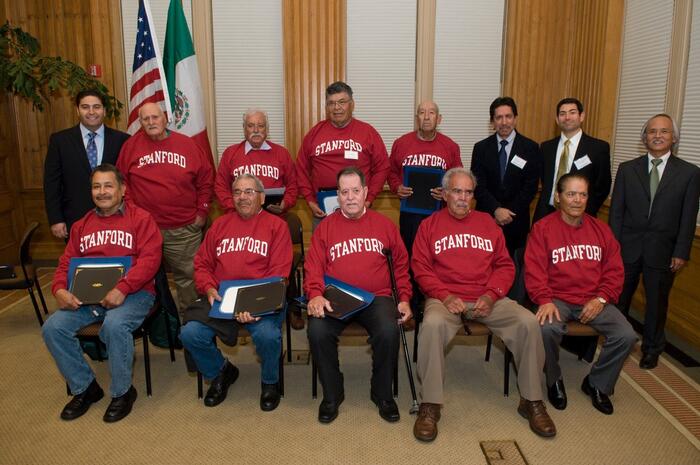
On February 26, 2014, ten former braceros and their families were invited to an event at Encina Hall at Stanford. The invitees included Rafael Silva and Eva Silva Ruelas. Former FSI Director Mariano Florentino Cuellar, who is currently a California Supreme Court Justice, spoke along with Stanford Biology Professor Rodolfo Dirzo and me. SPICE Director Gary Mukai moderated the event and spoke about his youth as a farm laborer working with braceros. The evening was historic in that it was one of only a few times that former agricultural workers were recognized at a university. In the photo, I am standing next to my abuelito, José Guadalupe Rodriguez Fonseca, top left. Isa’s abuelito, Rafael Silva, is in the front center.

Image
extended Silva family


What else stood out that evening was the Silva grandchildren’s palpable love for their grandparents. One photo of the evening captures the Silva family legacy. Rafael (wearing a Stanford sweatshirt) and Eva Silva are in the middle with six of their children and numerous grandchildren surrounding them. Isa is standing in front of his grandfather. Three of their grandchildren are currently attending Stanford, with Isa soon to become the fourth. Reminiscing about the event, Isa noted, “I was a ten-year-old boy. It was cool to see the whole family get together and be there. We were there to support my abuelito and recognize all his hard work. It was great to see him honored for what he did so long ago. As we grow older, we appreciate him more and more.” Isa knows that his abuelito and abuelita’s journey is what transformed the Silva family and made his own American dream possible. Reflecting that pride in his family’s story, Isa closed our conversation by saying, “On and off the court, I will always represent being Mexican American.”

Read More

Hero Image
Isa Silva and his family
Isa Silva and his family; photo courtesy Karen Hickey/Stanford Athletics
All News button
1
Subtitle

Isa Silva, grandson of a bracero from Jalisco, will enter Stanford next fall as a recruit for the Stanford Men’s Basketball team.

News Type
News
Date
Paragraphs

The 2020 US election occurred in the middle of a once-in-a-century pandemic, yet the voter turnout was the highest in 120 years.  After all the mail-in ballots were counted, former Vice President Joseph Biden was declared the winner of the popular vote and the Electoral College vote by a wide margin.  Yet, Donald Trump refused to concede defeat for two months after the results became clear and mounted a series of court challenges to fight the results, including taking his baseless claims of fraud to the Supreme Court.  Even more unprecedented, mobs of Trump supporters assaulted the Capitol building on Jan. 6, forcing an evacuation of both the House of Representatives and the Senate.  In the aftermath of that insurrection in Washington, the US House of Representatives voted to impeach Trump for his role in inciting the insurrection and not stopping the mob action, making him the first president in US history to be impeached twice.  To help understand this historic US election and its aftermath, SCPKU on Jan. 13, 2021 convened a distinguished roundtable titled “The 2020 U.S. Election: Stress Test for American Democracy.”

The Stanford participants were Professors David Brady and Bruce Cain; Professors Pan Wei and Wang Yong joined from Peking University.  Professors Jean Oi from Stanford and Wang Dong from PKU moderated.  The event was part of an ongoing collaboration between SCPKU and Peking University.

Professor Brady analyzed the election results at the presidential level and down-ballot.  Using survey data, he highlighted the extreme divisions within the electorate.  However, the results of the election as a whole show that it was a referendum on Trump at the top of the ticket, where he failed, but down-ballot the Republicans made gains, especially in the House.  The crucial issue that drove the loss for Trump was his handling of the coronavirus pandemic.  That cost former President Trump five battleground states and the election.  Prof. Brady cautioned that the progressives and the Democratic Party would be wrong if they thought the election outcome signaled a huge surge to the left.

Professor Bruce Cain analyzed the aftermath of the election, including the decision to impeach Trump, which had happened only on the morning of our program, asking why the Democrats had chosen that route and where the Democratic and Republican parties are headed after the election.  The impact of seeing the far-right extremists breach the Capitol cannot be overstated.  Regardless of whether one calls it a coup, a riot, or an insurrection, it was traumatic for members of Congress.  This trauma made it unacceptable to do nothing, even if some Republicans were willing to go down that route.  There had to be accountability.  Impeachment was the better choice to ensure that nothing like this would ever happen again.  As for where the parties might be headed, Prof. Cain thinks we are likely to see consensus regarding the need to fix some of the problems in the electoral system and the way it is administered.  He questioned how much foreign policy would figure into the agenda of the Biden administration in the first year.  He stated that the progressives are going to force the Democratic Party into something a little bit closer to what Trump was trying to do in terms of paying attention to the implications of economic policy.  Prof. Cain further offered that there will probably be more of a renewal than was seen under the Trump administration towards human rights.

Professor Pan Wei offered his observation that three big changes are dividing Americans and undermining the basis of the American democracy.  The first is a widespread anti-intellectualism; the social respect for scientific knowledge is degrading among the ordinary people.  The second change is the rapid growth of individualism, which he sees manifest in the strong and healthy not wanting to wear a mask to protect the health of the old.  The third change Prof. Pan noted was the manipulation of the new capital of social media, where groups strengthen their political identities.  He blamed government for not regulating media platforms, allowing companies to ban individuals, including the president.  He reasoned that the cause for the three major changes is a new digital technology, which is bringing the US deep into the age of tertiary industry.  The US leads in the decentralization of digital technology, where individuals are creating innovative ideas that create rich overnight.  Prof. Pan worries about the increasing competition and inequality that will come from such developments, especially surrounding the ability to attend elite universities.  He concluded that it is America against America.  This contradictory combination of the three changes has brought about the current social and political results in the US.  He stated that President Trump catered to the anti-intellectualism, which led to the mishandling of COVID-19.  Were it not for that, Prof. Pan thinks Trump would have been reelected.

Professor Wang Yong argued that we need to go beyond President Trump to explore the reasons for the problems in the US democracy.  He focused on the effects of economic globalization and argued that the US, as its biggest beneficiary, has seen a widening wealth gap and more inequality.  In addition, he remarked that the US has overreached in international relations and expended too many resources intervening in other countries, fighting two wars in the Middle East and Afghanistan.  The consequences have manifested in the handling of COVID and the outcome of the election.  COVID changed the way people vote, which made the election more chaotic.  He submitted that the US political system had failed the stress test, and that perhaps it was a good time for people in the United States to talk about the reform of the 100-year-old tradition that is its political system.  American political division is seen by many as the world’s biggest challenge in 2021.  Prof. Wang concluded with questions and hope that the Biden administration will lead to a positive impact on US China relations.

Following the presentations, the participants engaged in a lively discussion and Q&A on a number of different topics.  One clear conclusion was that the Stanford participants all agreed that the US did pass the stress test, even if it was difficult, and that possibly the US may be stronger for it.  

SCPKU will continue to host similar programs in the coming months and deepen the understanding between the US and China.

Hero Image
THE 2020 US ELECTION: STRESS TEST FOR AMERICAN DEMOCRACY
All News button
1
Authors
Callista Wells
News Type
News
Date
Paragraphs

On February 10, 2021, the China Program at Shorenstein APARC hosted Professor Oriana Skylar Mastro, Center Fellow at the Freeman Spogli Institute for International Studies​ for the virtual program "Military Competition with China: Harder to Win Than During the Cold War?" Professor Jean Oi, William Haas Professor of Chinese Politics and director of the APARC China Program, moderated the event.

As US-China competition intensifies, experts debate the degree to which the current strategic environment resembles that of the Cold War. Those that argue against the analogy often highlight how China is deeply integrated into the US-led world order. They also point out that, while tense, US-China relations have not turned overtly adversarial. But there is another, less optimistic reason the comparison is unhelpful: deterring and defeating Chinese aggression is harder now than it was against the Soviet Union. In her talk, Dr. Mastro analyzed how technology, geography, relative resources and the alliance system complicate U.S. efforts to enhance the credibility of its deterrence posture and, in a crisis, form any sort of coalition. Mastro and Oi's thought-provoking discussion ranged from the topic of why even US allies are hesitant to take a strong stance against China to whether or not Taiwan could be a catalyst for military conflict. Watch now: 

Read More

Min Ye speaking
News

Domestic or International? The Belt and Road Initiative Is More Internally Focused Than We Think, Says Expert Min Ye

Domestic or International? The Belt and Road Initiative Is More Internally Focused Than We Think, Says Expert Min Ye
Banner of Hau L. Lee
News

The Pandemic, U.S.-China Tensions and Redesigning the Global Supply Chain

The Pandemic, U.S.-China Tensions and Redesigning the Global Supply Chain
Hero Image
Photograph of Xi Jinping and Vladmir Putin walking in front of two lines of armed Chinese soldiers Getty Images
All News button
1
Subtitle

On February 10th, the APARC China Program hosted Professor Oriana Mastro to discuss military relations between the US and China, and why deterrence might be even more difficult than during the Cold War.

Authors
Arzan Tarapore
News Type
Commentary
Date
Paragraphs

This piece was originally published by the Lowy Institute's The Interpreter

To break the border stand-off between India and China in the Himalayas, some Indian analysts have advocated going on the offensive against China in the Indian Ocean. But that would be vague, illogical and imprudent, with little chance of success and significant risk of blowback. Instead, India and its partners should prioritize a more effective denial strategy in the Indian Ocean, to deter and counter any potential future coercion there.

Strategies of denial seek to reinforce defensive bulwarks so that potential aggressors are dissuaded from launching an attack – or, failing that, thwarted from succeeding. They are generally considered more effective and reliable than strategies of punishment, which rely instead on the threat of retaliation after the aggressor launches its attack. Punishment was the cornerstone of nuclear deterrence during the Cold War and since, but that strategy is considerably less reliable in the conventional and sub-conventional conflicts which India now faces.

[Subscribe to APARC's newsletters to get the latest commentary and analysis by our scholars.]

The False Promise of Punishment

Since May 2020, Indian and Chinese troops have been locked in a tense – and, at timesviolent – stand-off in the Himalayas, after Chinese incursions into the Indian-controlled territory of Ladakh. This scenario looks likely to last for months, if not years, to come. Some Indian analyses have called for bold action hundreds of kilometers away, in the Indian Ocean. They argue that horizontal escalation would broaden the Himalayas confrontation to an arena where India enjoys clear strategic advantages, allowing it to counter Chinese coercion more effectively.

The idea of taking the fight to the oceans has superficial appeal. India sits astride some of the world’s most vital sea lines of communication in the northern Indian Ocean – on which China, like all of East Asia, depends critically for trade and energy flows. India’s Navy dominates the Indian Ocean and could, the argument goes, apply excruciating pressure on the Chinese economy. This leverage could be applied in times of crisis, such as the ongoing border stand-off, or even in peacetime as a deterrent against Chinese coercion. Surely this would be less bloody than a war between the two largest armies in the world.

Rather than using its advantages to start a war it would lose, a denial strategy would be mindful of India’s limitations and focus on erecting political and military obstacles to Chinese coercion in the region.
Arzan Tarapore

But the concept is unclear. It is often framed as a vague statement of Indian power, without elucidating exactly how force should be used. Should India impose a blockade of all oil tankers bound for East Asia? Board and inspect some Chinese trading vessels? Intimidate a Chinese survey ship in the Bay of Bengal, or sink a Chinese navy ship conducting anti-piracy patrols? Some of these moves would be seen as acts of war – and most would be dramatically escalatory, especially for an Indian government that has been at pains to downplay the current crisis.

More fundamentally, such moves would have no “theory of success”. How would such pressure create the desired political effect in countering Chinese coercion? A blockade would be tantamount to an act of war – but a painfully slow war that would likely require months of stringent application and be unlikely to decisively strangle the Chinese economy. Short of a long blockade, in any realistic contingency, incremental Indian pressure in the Indian Ocean is unlikely to compel a Chinese regime that has staked its legitimacy on national rejuvenation and regional hegemony.

On the other hand, history suggests that even minor Indian naval offensives against China would invite an escalating retaliation. China would not only unleash its rapidly expanding surface and sub-surface fleet against India’s navy, but it could also impose pain elsewhere. China’s options against the Indian homeland – from long-range missile strikes to cyberattacks to more land grabs on the border – would be militarily feasible and politically devastating to New Delhi. Going on the offensive in the Indian Ocean, therefore, is likely to backfire, probably very badly.

Building “Strategic Leverage” in the Indian Ocean

While the Indian Ocean may not offer a magic bullet to resolve the border crisis, it is intrinsically important for India-China competition. China’s military expansion into the Indian Ocean poses multiple risks for India and its partners such as Australia and the United States. These like-minded partners should build their strategic leverage – political relationships and military capability – to manage these risks.

India enjoys unique advantages in the Indian Ocean, due to its geography and informal networks across the region. But rather than using its advantages to start a war it would lose, a denial strategy would be mindful of India’s limitations and focus on erecting political and military obstacles to Chinese coercion in the region.

India could focus on more actively binding itself to smaller regional states – as it already does by sharing maritime domain awareness and space-based surveillance data. Building strategic interdependence would cultivate smaller states’ desire for continued cooperation with India, and institutional resistance to Chinese attempts to coerce or bribe their political leadership.

India could also enhance its sea denial capabilities. Improving its anti-submarine warfare capabilities and expanding its stock of long-range precision missiles, for example, would help to deter the prospect of Chinese direct military intervention. This could be done at a fraction of the cost of building a small number of large capital ships. The Indian Navy is doctrinally committed to pursuing sea control, which like-minded partners such as Australia should welcome. But rapidly expanding its capabilities for sea denial would serve as a stopgap and hedge against China’s ballooning naval power, which will soon be able to contest India’s dominance in the ocean.

A denial strategy in the Indian Ocean will not resolve the current border crisis in Ladakh. But it would offer a realistic roadmap for building political influence and military power in the region. It would provide the strategic leverage necessary to deter or counter future acts of coercion in the Indian Ocean.

Read More

U.S. Navy and Indian Navy ships steam in formation in the Indian Ocean.
News

How to Mitigate the Risks of Chinese Military Expansion in the Indian Ocean Region

China’s expanding military capacity in the Indian Ocean region poses risks for the United States and its partners, writes South Asia Research Scholar Arzan Tarapore in 'The Washington Quarterly,' offering a framework by which the Quad and others can build strategic leverage to curtail China’s capacity to coerce small states or posture for war.
How to Mitigate the Risks of Chinese Military Expansion in the Indian Ocean Region
National Guard at the US Capitol
Commentary

The Soft War That America Is Losing

The US depends far more on its soft power than authoritarian China does. Once it is lost, it is hard to get back.
The Soft War That America Is Losing
Protesters in Myanmar stand on a picture of General Min Aung Hlaing
Commentary

Democracy Challenged: Donald Trump, Min Aung Hlaing, and Indonesia

Southeast Asia Program Director Donald K. Emmerson compares responses across Southeast Asia to the February coup in Myanmar and reflects on the parallels and differences between the state of democracy there and in the United States.
Democracy Challenged: Donald Trump, Min Aung Hlaing, and Indonesia
Hero Image
Two destroyer navy ships sail alongside each other
The Indian Navy destroyer INS Kolkata alongside guided-missile destroyer USS Street during Exercise Malabar, November 2020.
US Pacific Fleet/ Flickr
All News button
1
Subtitle

The stand-off with China in the Himalayas has raised a broader debate about India’s strategic outlook.

-

REGISTER HERE


The United States has historically played an important role in promoting democracy to countries across the globe. But is the role of the U.S. as a leading advocate for democracy now diminished following the recent U.S. election and mob attack on the U.S. Capitol? 

The panel for this event will feature democracy activists from around the world, all of whom are graduates of the Draper Hills Program at the Center for Democracy, Development and the Rule of Law (CDDRL). In a discussion moderated by Professor Francis Fukuyama, they will offer their perspectives on the need for democracy promotion in their home countries at the current moment, particularly what role the new Biden administration could constructively play. Professor Michael McFaul’s recent series of articles [https://www.americanpurpose.com/articles/sell-it-again-uncle-sam/] in American Purpose, an online magazine recently launched by Professor Fukuyama, about the need for democracy promotion, will be the starting point for the discussion. Professor McFaul will offer introductory remarks.

PANELISTS:


Image
Moussa Kondo
Kondo Moussa, Class of 2018, Mali - Director Accountability Lab Mali . Kondo founded and runs the Mali chapter of the Accountability Lab, a U.S.-based nonprofit that promotes public accountability in six African and Asian countries. Rather than condemning corrupt leaders, it works to boost the influence of their honest counterparts, running grassroots “Integrity Idol” campaigns to celebrate their good work. Communities nominate local civil servants, and the Lab then profiles the top five on TV. The movement reaches a broader audience, as viewers across the country vote for their favorite candidates. It also runs in-country incubators to train and mentor “accountrapreneurs” who launch their own accountability projects. Kondo, a journalist, started Mali’s Lab after spending six months embedded with Liberia’s team during his 2015 Mandela Washington Fellowship. While Accountability Lab is not new, Kondo has successfully adapted it to a new and challenging context.


Image
Sahili Chopra
Shaili Chopra, Class of 2019, India - An Indian journalist turned entrepreneur whose work is focused on championing real women and their stories across India. Chopra is the founder of SheThePeople.TV, which is India's only women's channel. SheThePeople.TV is a form of digital democracy where women get to choose, speak up, and set the agenda. Chopra uses the internet to spotlight issues of women's rights, their role in a democracy, and empower them in a digitally connected world. Chopra is the recipient of India's highest honor in journalism and counted among the top 50 most influential women in media in India and is a Vital Voices fellow. She holds a BA in Economics from Delhi University and a Masters diploma in Journalism from the Asian College of Journalism in Chennai.  


Image
Mohamad Najem

Mohamad Najem, Class of 2019, Lebanon - Mohamad is the executive director of the Beirut–based digital rights organization Social Media Exchange (SMEX), the Middle East and North Africa’s leading digital rights research and policy advocacy organization. His work includes local and regional advocacy campaigns, research on privacy, data protection, and freedom of expression. Najem organized “Bread & Net”, the first unconference in the Middle East and North Africa region that tackled topics related to technology and human rights. Najem’s career began in the humanitarian aid arena. Najem was a 2014 New America Foundation Fellow and an alumnus of the Arts, Sciences, and Technology University in Lebanon where he completed his Masters in Business Administration. 


Anna Dobrovolskaya

Anna Dobrovolskaya Class of 2019, Russia – is a human rights activist based in Moscow, serving as the executive director of the Memorial Human Rights Center (MHRC). The Center is the biggest Russian human rights NGO, working to provide legal aid and consultation for refugees and asylum seekers, monitoring human rights violations in post-conflict zones and advocating for a human-rights based approach in fighting terrorism; as well as raising awareness about politically-motivated repression in Russia and maintains its own list of political prisoners. Dobrovolskaya’s areas of expertise include human rights education and awareness-raising activities and programs for young people and activists since 2008. She is a member of the Council of Europe pool of trainers. Her work currently lies in NGO management and providing consultancy to various human rights groups and initiatives. Anna was the author of the first Russian play about the life of human rights defenders, which is being performed in Teatr.doc since 2017.


This event is co-sponsored by the Freeman Spogli Institute for International Studies and the Center for Democracy, Development and the Rule of Law.

-

* Please note all CISAC events are scheduled using the Pacific Time Zone.


Seminar Recording: https://youtu.be/aK8_FjQtlKc


About the Event: The US administration has pivoted 180°. So, what does that mean for Europe?

The last four years have shaped the way European media relate to world powers, security and Europe’s increasing push for sovereignty and strategic autonomy. We will discuss European and national media in Europe, as well as how media differ in Western and Eastern Europe. We will also look at how the narrative will change now that the US is once again striving for global leadership and transatlantic cooperation.

A key issue is how US-based media coverage is influencing the narrative. Increasing media output from Washington about the rest of the world is also shaping the narrative. Big Tech and digital media investments are pushing into national markets and will shape the way that news is made and consumed. Finally, we will dive into the role that media will play in rebalancing the power players in international security, and most importantly, fostering cooperation.


About the Speaker: Shéhérazade Semsar-de Boisséson is CEO of POLITICO in Europe, a joint venture between POLITICO and Axel Springer.

Shéhérazade was previously owner and publisher of European Voice, the leading media in Brussels covering EU policy, which she acquired from the Economist Group in 2013. In December 2014, POLITICO and Axel Springer jointly acquired European Voice and Paris-based Development Institute International (Dii), France’s leading event promoter in the public affairs space, a business Shéhérazade co-founded in 1993.

A native of Tehran, Iran and a French national, Shéhérazade graduated from the School of Foreign Service, Georgetown University in 1990 with a B.A. and a M.S. in International Finance.

Shéhérazade served as a member of the Board of Directors of Georgetown University, Washington D.C. from 2013 to 2019. She is currently serving on the Advisory Board of Georgetown’s School of Foreign Service and on the Board of Directors of the French-American Foundation.

From 2008 to 2010, Shéhérazade served on the Board of Directors of Femmes Forums, a leading women’s club in Paris, France. She represents DII at the French think tank: Institut Montaigne.

Shéhérazade lives in Brussels with her husband Laurent de Boisséson and their three children: Inès, Louise and Cyrus.

Virtual Seminar

Sheherazade Semsar-de Boisséson CEO POLITICO Europe
Seminars
-

* Please note all CISAC events are scheduled using the Pacific Time Zone.


Attend Webinar: https://stanford.zoom.us/j/93236889762?pwd=eVFtbVJDME95MU9wNU1scFNWTDUxdz09


About the Event: Synthetic Biology (SB) is one of the most promising fields of research for the 21st century. SB offers powerful new ways to improve human health, build the global economy, manufacture sustainable materials, and address climate change. However, current access to SBenabled breakthroughs is unequal, largely due to bottlenecks in infrastructure and education. Here, I describe our efforts to re-think the way we engineer biology using cell-free systems to address these bottlenecks. We show how the ability to readily store, distribute, and activate low-cost, freeze-dried cell-free systems by simply adding water has opened new opportunities for on-demand biomanufacturing of vaccines for global health, point-of-care diagnostics for environmental safety, and education for SB literacy and citizenship. By integrating cell-free systems with AI, we also show the ability to accelerate the production of carbon-negative platform chemicals. Looking forward, advances in engineering tools and new knowledge underpinning the fundamental science of living matter will ensure that SB helps solve humanity’s most pressing challenges.


About the Speaker: Michael Jewett is the Charles Deering McCormick Professor of Teaching Excellence, the Walter P. Murphy Professor of Chemical and Biological Engineering, and Director of the Center for Synthetic Biology at Northwestern University. Dr. Jewett received his PhD in 2005 at Stanford University, completed postdoctoral studies at the Center for Microbial Biotechnology in Denmark and the Harvard Medical School, and was a guest professor at the Swiss Federal Institute of Technology (ETH Zurich). He is the recipient of the NIH Pathway to Independence Award, David and Lucile Packard Fellowship in Science and Engineering, Camille-Dreyfus Teacher-Scholar Award, and a Finalist for the Blavatnik National Awards for Young Scientists, among others. He is the co-founder of SwiftScale Biologics, Stemloop, Inc., Pearl Bio, Induro Therapeutics, and Design Pharmaceuticals. Jewett is a Fellow of AIMBE, AAAS, and NAI.


For more information please contact Drew Endy (endy@stanford.edu) or Paul McIntyre (pcm1@slac.stanford.edu).

Virtual Seminar

Michael Jewett Professor Northwestern University
Seminars
Authors
Callista Wells
News Type
News
Date
Paragraphs

On January 27, 2021, the China Program at Shorenstein APARC hosted Professor Hau L. Lee, The Thoma Professor of Operations, Information & Technology at the Stanford Graduate School of Business for the virtual program “The Pandemic, U.S-China Tensions and Redesigning the Global Supply Chain.” Professor Jean Oi, William Haas Professor of Chinese Politics and director of the APARC China Program, moderated the event.

Professor Lee focused on an important question that has only become more pressing due to the COVID-19 pandemic: How, if at all, should businesses redesign their supply chains? Since the beginning of the pandemic, explains Lee, there has been an increase in calls for “redundancy” in supply chains in order to protect them from the problems they faced early in the pandemic, when China was first hit by shut downs and slowed productivity. Advice has been varied, ranging from the “China Plus One” strategy in which businesses simply add a secondary production location, to completely domesticating supply chains.

Lee warns, however, of the perils of overreaction. There are numerous risks that come along with a fully domestic supply chain, not least the danger of “having all of your eggs in one basket.” Instead, says Lee, businesses should move cautiously and, instead of fully divesting from China, should use the country intelligently. 

Professor Lee’s “In and Out Design” encourages businesses to work from the inside out, securing and strengthening their supply chains by starting at home. Companies must first build “internal supply chain excellence,” after which they can move on to making sure their strategic partners are equally strong and can work to their advantage. Eventually, companies can move on to strengthening the extended value chain and, ultimately, their entire ecosystem. Using strategies like dual response, leveraging “lubricants,” and bolstering capacity-building capabilities, businesses can create a more stable future. 

The session concluded with a fruitful Q&A between Professor Lee and the audience, moderated by Professor Oi.

A video recording of this program is available upon request. Please contact Callista Wells, China Program Coordinator at cvwells@stanford.edu with any inquiries.

Read More

Min Ye speaking
News

Domestic or International? The Belt and Road Initiative Is More Internally Focused Than We Think, Says Expert Min Ye

Domestic or International? The Belt and Road Initiative Is More Internally Focused Than We Think, Says Expert Min Ye
Photograph of the UN building in Geneva, Switzerland
News

Rebuilding International Institutions Will be Tough but Necessary, Say Stanford Experts Thomas Fingar and Stephen Stedman

Fingar and Stedman spoke as part of the APARC program “Rebuilding International Institutions,” which examined the future of international institutions such as the United Nations (UN), World Trade Organization (WTO), and World Health Organization (WHO) in our evolving global political landscape.
Rebuilding International Institutions Will be Tough but Necessary, Say Stanford Experts Thomas Fingar and Stephen Stedman
Hero Image
Banner of Hau L. Lee
All News button
1
Subscribe to International Relations