International Relations

FSI researchers strive to understand how countries relate to one another, and what policies are needed to achieve global stability and prosperity. International relations experts focus on the challenging U.S.-Russian relationship, the alliance between the U.S. and Japan and the limitations of America’s counterinsurgency strategy in Afghanistan.

Foreign aid is also examined by scholars trying to understand whether money earmarked for health improvements reaches those who need it most. And FSI’s Walter H. Shorenstein Asia-Pacific Research Center has published on the need for strong South Korean leadership in dealing with its northern neighbor.

FSI researchers also look at the citizens who drive international relations, studying the effects of migration and how borders shape people’s lives. Meanwhile FSI students are very much involved in this area, working with the United Nations in Ethiopia to rethink refugee communities.

Trade is also a key component of international relations, with FSI approaching the topic from a slew of angles and states. The economy of trade is rife for study, with an APARC event on the implications of more open trade policies in Japan, and FSI researchers making sense of who would benefit from a free trade zone between the European Union and the United States.

Authors
Callista Wells
News Type
News
Date
Paragraphs

The China Program at Shorenstein APARC had the privilege of hosting Jude Blanchette, the Freeman Chair in China Studies at the Center for Strategic and International Studies (CSIS). The program, entitled "What’s ‘Communist’ about the Communist Party of China?," explored the goals and ideology of the Chinese Communist Party (CCP), as well as what they might mean for the future of China in the global community. Professor Jean Oi, William Haas Professor of Chinese Politics and director of the APARC China Program, moderated the event.

After the death of Mao Zedong in 1976, the goals of the CCP became less clear. As the country began to adopt market reforms in the 1980s and 1990s, CCP theorists were forced into contortions providing ideological justifications for policies that appeared overtly capitalist. Deng Xiaoping’s concept of “Socialism with Chinese characteristics” came to be seen as a theoretical fig leaf rather than a description of an egalitarian economic system, and by the 2000s, a consensus emerged that the CCP had completely abandoned any pretense of pursuing the Marxist vision it purported to hold. With the rise of Xi Jinping, however, the Party talks with renewed vigor about Marxism-Leninism and the goal of achieving actual, existing socialism. Has the CCP re-discovered communism?  In his talk, Blanchette discussed the abandoned and existing legacies of Mao Zedong, Marxism-Leninism, and the CCP’s vision of socialism. Watch now: 

Read More

Min Ye speaking
News

Domestic or International? The Belt and Road Initiative Is More Internally Focused Than We Think, Says Expert Min Ye

Domestic or International? The Belt and Road Initiative Is More Internally Focused Than We Think, Says Expert Min Ye
Banner of Hau L. Lee
News

The Pandemic, U.S.-China Tensions and Redesigning the Global Supply Chain

The Pandemic, U.S.-China Tensions and Redesigning the Global Supply Chain
American and Chinese flags
News

U.S.-China Relations in the Biden Era

Dr. Thomas Wright examines the recent history of US-China relations and what that might mean for the new administration.
U.S.-China Relations in the Biden Era
Hero Image
National Emblem of the People's Republic of China on the Great Hall of the People
All News button
1
Subtitle

Is the Chinese Communist Party really communist at all? Expert Jude Blanchette, Freeman Chair in China Studies at the Center for Strategic and International Studies, weighs in.

-

* Please note all CISAC events are scheduled using the Pacific Time Zone.


Seminar Recording:  https://youtu.be/-hERfg-DCYw


About the Event: 

This presentation explores two topics at the nexus of technology and international security: interstate influence operations and technological revolutions.

After Russian interference in the 2016 U.S. election, influence operations have become a central focus among American policymakers, foreign policy pundits, and publics alike. Yet, Goldstein argues that they remain under-explored and under-theorized in international security studies, with disagreement over how to define the phenomenon implicit in the existing literature. Goldstein will introduce a conceptual framework for foreign influence operations and argue that security studies scholars should pay greater attention to the subject for two reasons. First, they are policy-relevant and likely to remain so; they are cost effective, propagandists are prone to inflate their impact, and they are difficult to deter. Second, studying influence operations can contribute to the academic discipline of security studies by helping to expand restrictive notions of state power and challenge dominant models of foreign policy decision-making.

How do emerging technologies affect the rise and fall of great powers? Scholars have long observed that rounds of technological revolution disrupt the economic balance of power, bringing about a power transition in the international system. However, there has been limited investigation of how this process occurs. The standard explanation emphasizes a country’s ability to dominate innovation in leading sectors, seizing monopoly profits in new, fast-growing industries centered around major technological breakthroughs. Investigating historical cases of industrial revolutions followed by economic power transitions, Ding will present an alternative mechanism based on the diffusion of general-purpose technologies. The findings have direct implications for how recent breakthroughs in artificial intelligence could affect the U.S.-China power balance.


About the Speakers: 

Jeffrey Ding is a Ph.D. candidate in the Department of Politics and International Relations at the University of Oxford. Jeffrey’s current research is centered on how technological change affects the rise and fall of great powers. Through investigating historical cases of industrial revolutions, Jeffrey traces causal mechanisms that connect significant technical breakthroughs and economic power transitions — with an eye toward the implications of advances in AI for a possible U.S.-China power transition. Jeffrey’s previous research covered related topics, including China's development of AI, identifying strategic goods and technologies, and technical standards as a vehicle of AI governance.


Josh A. Goldstein is a PhD Candidate and Clarendon Scholar in the Department of Politics and International Relations at the University of Oxford. For the 2020-2021 year, he is a pre-doctoral fellow with the Stanford Internet Observatory and part of the inaugural class of non-resident Hans J. Morgenthau Fellows at the Notre Dame International Security Center. Josh’s 3-paper doctoral dissertation takes a multi-method approach to studying the challenges that democracies face from influence operations. His broader research interests lie in international security, political psychology, and foreign policy-decision making.


Virtual Seminar

0
Postdoctoral Fellow, Stanford Internet Observatory (2021-2022)
Predoctoral Fellow, Stanford Internet Observatory (2020-2021)
Josh-Goldstein.jpeg

Josh A. Goldstein is a past postdoctoral scholar at the Stanford Internet Observatory. He received his PhD in International Relations from the University of Oxford, where he studied as a Clarendon Scholar. At the Stanford Internet Observatory, Dr. Goldstein investigated covert influence operations on social media platforms, studied the effects of foreign interference on democratic societies, and explored how emerging technologies will impact the future of propaganda campaigns. He has given briefings to the Department of Defense, the State Department, and senior technology journalists based on this work, and published in outlets including Brookings, Lawfare, and Foreign Policy.

Prior to joining SIO, Dr. Goldstein received an MPhil in International Relations at Oxford with distinction and a BA in Government from Harvard College, summa cum laude. He also assisted with research and writing related to international security at the Belfer Center, Brookings Institution, House Foreign Affairs Committee, and Department of Defense.

0
ding.png

Jeff is an Assistant Professor of Political Science at George Washington University. Previously, he was a postdoctoral fellow at Stanford's Center for International Security and Cooperation, sponsored by Stanford's Institute for Human-Centered Artificial Intelligence. His research agenda centers on technological change and international politics. His book project investigates how past technological revolutions influenced the rise and fall of great powers, with implications for U.S.-China competition in emerging technologies like AI. Other research papers tackle how states should identify strategic technologies, assessments of national scientific and technological capabilities, and interstate cooperation on nuclear safety and security technologies. Jeff's work has been published in Foreign Affairs, Security Studies, The Washington Post, and other outlets. Jeff received his PhD in 2021 from the University of Oxford, where he studied as a Rhodes Scholar. He has also worked as a researcher for Georgetown's Center for Security and Emerging Technology and the Centre for the Governance of AI at the University of Oxford.

Affilate
Seminars
Authors
Callista Wells
News Type
News
Date
Paragraphs

On February 24, 2021, the China Program at Shorenstein APARC hosted Dr. Thomas Wright, director of the Center on the United States and Europe and a senior fellow in the Project on International Order and Strategy at the Brookings Institution. Professor Jean Oi, William Haas Professor of Chinese Politics and director of the APARC China Program, moderated the event.

The program, entitled "U.S.-China Relations in the Biden Era," explored the future of US-China relations based on experience from past administrations. Under former President Trump, U.S. relations with China evolved into outright rivalry. In his talk, Dr. Wright discussed whether this rivalry will continue and evolve during a Biden administration by analyzing the roots of strategic competition between the two countries and various strands of thinking within the Biden team. According to Wright, the most likely outcome is that the competition between the two countries will evolve into a clash of governance systems and the emergence of two interdependent blocs where ideological differences become a significant driver of geopolitics. Cooperation is possible but it will be significantly shaped by conditions of rivalry. Watch now:

Read More

Min Ye speaking
News

Domestic or International? The Belt and Road Initiative Is More Internally Focused Than We Think, Says Expert Min Ye

Domestic or International? The Belt and Road Initiative Is More Internally Focused Than We Think, Says Expert Min Ye
Banner of Hau L. Lee
News

The Pandemic, U.S.-China Tensions and Redesigning the Global Supply Chain

The Pandemic, U.S.-China Tensions and Redesigning the Global Supply Chain
Photograph of Xi Jinping and Vladmir Putin walking in front of two lines of armed Chinese soldiers
News

Military Competition with China: Harder to Win Than During the Cold War?

On February 10th, the APARC China Program hosted Professor Oriana Mastro to discuss military relations between the US and China, and why deterrence might be even more difficult than during the Cold War.
Military Competition with China: Harder to Win Than During the Cold War?
Hero Image
American and Chinese flags
All News button
1
Subtitle

Dr. Thomas Wright examines the recent history of US-China relations and what that might mean for the new administration.

-

This is a virtual event. Please click here to register and generate a link to the talk. 
The link will be unique to you; please save it and do not share with others.

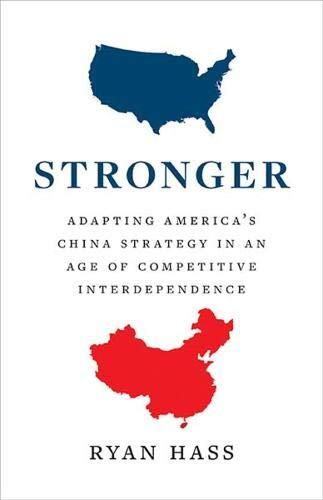
How can the U.S. best manage its relationship with China? The country is at once a major and increasingly hostile competitor to the U.S., a formidable challenger to U.S.’ regional and global leadership, and an important partner on a range of transnational challenges. Will it be possible for both sides to coexist amidst intensifying competition? How great is the risk of US-China conflict, including over Taiwan? Ryan Hass, author of Stronger: Adapting America’s China Strategy in an Age of Competitive Interdependence, will address these questions and more in opening comments before engaging in an open Q&A on the future of the world’s most consequential bilateral relationship.


Image
Portrait of Ryan Hass
Ryan Hass is a senior fellow and the Michael H. Armacost Chair in the Foreign Policy program at Brookings, where he holds a joint appointment to the John L. Thornton China Center and the Center for East Asia Policy Studies. He is also the Interim Chen-Fu and Cecilia Yen Koo Chair in Taiwan Studies. Hass focuses his research and analysis on enhancing policy development on the pressing political, economic, and security challenges facing the United States in East Asia. He is the author of Stronger: Adapting America’s China Strategy in an Age of Competitive Interdependence, published by Yale University Press.

Image
"Stronger" Book Cover
From 2013 to 2017, Hass served as the director for China, Taiwan and Mongolia at the National Security Council (NSC) staff. In that role, he advised President Obama and senior White House officials on all aspects of U.S. policy toward China, Taiwan, and Mongolia, and coordinated the implementation of U.S. policy toward this region among U.S. government departments and agencies. He joined President Obama’s state visit delegations in Beijing and Washington respectively in 2014 and 2015, and the president’s delegation to Hangzhou, China, for the G-20 in 2016, and to Lima, Peru, for the Asia-Pacific Economic Cooperation (APEC) Leaders Meetings in 2016. Prior to joining NSC, Hass served as a Foreign Service Officer in U.S. Embassy Beijing, where he earned the State Department Director General’s award for impact and originality in reporting. Hass also served in Embassy Seoul and Embassy Ulaanbaatar, and domestically in the State Department Offices of Taiwan Coordination and Korean Affairs. 


Image
American and Chinese flags
This event is part of the 2021 Winter/Spring Colloquia series, Biden’s America, Xi’s China: What’s Now & What’s Next?, sponsored by APARC's China Program.


Via Zoom Webinar. Register at: https://bit.ly/3c3v10W

Ryan Hass Senior Fellow, Michael H. Armacost Chair in Foreign Policy Studies, Brookings Institution
Seminars
Authors
Austin Cooper
News Type
News
Date
Paragraphs

In January, the French historian Benjamin Stora filed a report commissioned by the French President Emmanuel Macron aimed at “reconciliation of memories between France and Algeria,” which France ruled as the jewel of its colonial empire for more than 130 years.

Read the rest at Bulletin of the Atomic Scientists

Hero Image
Director of nuclear experiment center, General Jean Thiry, pressing a button to trigger the explosion of the third French atomic bomb at the Reggane test site in the Algerian Sahara, December 27, 1960
AFP/Getty Images
All News button
1
Subtitle

French President Emmanuel Macron commissioned a report aimed at “reconciliation of memories between France and Algeria,” which France ruled as the jewel of its colonial empire for more than 130 years. The Stora Report addressed several scars from the Algerian War for Independence and still comes up short of a clear path toward nuclear reconciliation.

Authors
News Type
News
Date
Paragraphs

The Doomsday Clock is a metaphor. It moves closer to midnight depending on how close we are to human-made global catastrophe through climate change, nuclear weapons, and pandemics fueled by misinformation and failed leadership. Y’know, the typical folly of humankind. Find out what time it is from Sharon Squassoni and Herb Lin, two members of the Bulletin of Atomic Scientists. READ MORE


Hero Image
Bomb exploding NATIONAL NUCLEAR SECURITY ADMINISTRATION / NEVADA SITE OFFICE / WIKIPEDIA
All News button
1
Subtitle

The Doomsday Clock is a metaphor. It moves closer to midnight depending on how close we are to human-made global catastrophe through climate change, nuclear weapons, and pandemics fueled by misinformation and failed leadership. Y’know, the typical folly of humankind. Find out what time it is from two members of the Bulletin of Atomic Scientists.

-

About the Event:  Decentralization and community-driven development programs have become increasingly common policies to attempt to improve the distribution of public goods across low- and middle-income countries. We study a series of reforms in the city of Delhi that decentralized the administration of discretionary school-level budgets to elected bodies of parents. We find that parents have preferences for representatives that are substantially more educated than them and discriminate against Muslims. Parents act on these preferences when given the opportunity to elect SMC members. They elect parents that are wealthier and more educated and are also of higher status. The paper provides empirical evidence to the question of under what conditions decentralization leads to elite capture. When bureaucrats have a stronger say in the selection of representatives, budgets are captured to reflect the preferences of state representatives, rather than constituents.


Image
Emmerich Davies
About the Speaker:  Emmerich Davies is an Assistant Professor of Education at the Harvard Graduate School of Education, a Faculty Associate at the Weatherhead Center for International Affairs and Center for International Development, and a co-convener of the Brown-Harvard-M.I.T. Joint Seminar on South Asian Politics. He studies the political economy of education with a regional focus on South Asia. His work has been published in Comparative Political Studies and Governance. He received his Ph.D. and M.A. in political science from the University of Pennsylvania, and his B.A. in political science and economics from Stanford University.

Online, via Zoom:  REGISTER

Emmerich Davies Assistant Professor of Education at the Harvard Graduate School of Education
Seminars
-

* Please note all CISAC events are scheduled using the Pacific Time Zone.


Seminar Recording:  https://youtu.be/Mwjn39S48rE


About the Event: NATO Secretary General Stoltenberg will speak about how the transatlantic alliance is adapting to change in this turbulent period.  President Biden has clearly signaled that he is resolved to reach out to the NATO allies, working to repair the trans-Atlantic bond. To strengthen the bond between America and Europe and prepare the alliance for the future, the Secretary General has launched the NATO 2030 initiative.  This includes proposals on how NATO can better harness technology and innovation, tackle the security implications of climate change, and help make our societies more resilient. While NATO must continue to deter and defend against Russia, it is also keeping channels open to Moscow. The rise of China presents both challenges and opportunities that NATO has started to address. And missions in Afghanistan and Iraq are on the cusp of change, with decisions underway about what role NATO will play in the future. All in all, an exciting time to hear from NATO’s Secretary General.

This event is co-sponsored with The Europe Center.


About the Speaker: 

Jens Stoltenberg became NATO Secretary General in October 2014, following a distinguished international and domestic career. As a former Prime Minister of Norway and UN Special Envoy, Mr. Stoltenberg has been a strong supporter of greater global and transatlantic cooperation. Mr. Stoltenberg’s mandate as NATO Secretary General has been extended until the end of September 2022.

Under Mr. Stoltenberg’s leadership, NATO has responded to a more challenging security environment by implementing the biggest reinforcement of its collective defence since the Cold War, increasing the readiness of its forces and deploying combat troops in the eastern part of the Alliance. He believes in credible deterrence and defence while maintaining dialogue with Russia. He has also advocated for increased defence spending and better burden sharing within the Alliance, and a greater focus on innovation. NATO has also stepped up its efforts in the fight against terrorism. He strongly supports a partnership approach, with cooperation between NATO and the European Union reaching unprecedented levels.

Before coming to NATO, he was the UN Special Envoy on Climate Change from 2013 to 2014. He has also chaired UN High-level Panels on climate financing and the coherence between development, humanitarian assistance and environmental policies.

As Prime Minister of Norway, Mr. Stoltenberg increased the defence spending and transformed the Norwegian armed forces with new high-end capabilities and investments. He also signed an agreement with Russia on establishing maritime borders in the Barents and Polar Sea, ending a 30-years dispute.

Mr. Stoltenberg was also Prime Minister during the deadly terrorist attacks, which killed 77 people in Oslo and Utøya on 22 July 2011, urging in response, “more democracy, more openness, and more humanity, but never naïvete”.

Mr Stoltenberg holds a postgraduate degree in Economics from the University of Oslo. After graduating in 1987, he held a research post at the National Statistical Institute of Norway, before embarking on a career in Norwegian politics.

  • 2005-2013: Prime Minister of Norway
  • 2002-2014: Leader of the Norwegian Labor Party
  • 2000-2001: Prime Minister of Norway
  • 1996-1997: Minister of Finance
  • 1993-1996: Minister of Industry and Energy
  • 1991-2014: Member of Parliament
  • 1990-1991: State Secretary at the Ministry of the Environment
  • 1985-1989: Leader of the Norwegian Labour Youth

Jens Stoltenberg was born in Oslo on 16 March 1959. He is married to Ingrid Schulerud. They have two grown-up children.

Virtual Seminar

Jens Stoltenberg Secretary General NATO
Seminars
Authors
Oriana Skylar Mastro
News Type
Commentary
Date
Paragraphs

This article by Oriana Skylar Mastro was originally published in The Interpreter, a publication by the Lowy Institute.

When China began three days of military exercises in the South China Sea’s Gulf of Tonkin back in January, some observers speculated that Beijing was testing the new Biden administration. Harsh words from Beijing accompanied the exercises, with China’s foreign ministry spokesperson Wang Wenbin declaring the drills were “necessary measures to resolutely safeguard national sovereignty and security”.

Even against this backdrop, China’s official position is that it remains committed to a peaceful resolution of the South China Sea issue. And the rhetoric China employs at different times does make for a fascinating contrast. For example, China’s Foreign Ministry asserted in July 2020 that “China is not seeking to become a maritime empire” and that it “treats its neighboring nations on an equal basis and exercises the greatest restraint.”

[Subscribe to our newsletters to get the latest from our researchers.]

How then should we make sense of the mixed messages coming from Beijing? Most China experts find discourse to be informative – if not about China’s intentions, then at least about its aspirations. But which statements are indicative of China’s true position?

I argued recently in research for the Wilson Center that scholars need to evaluate the content and specificity of Chinese national discourse in addition to the position of the author or speaker involved. To that end, I analyzed all public speeches made by members of the Politburo of the Chinese Communist Party from 2013 to 2018. Xi Jinping led both of the Politburos I studied, and each had 25 members. Since some members served in both, this yields speeches by 39 unique individuals.

The speeches related to the South China Sea could be separated into those that mentioned cooperative themes and those with competitive themes. Cooperative themes have two subcategories, cooperation, and political solutions. Competitive themes have five subcategories: sovereignty, military, freedom, tension, and non-regional countries/the United States.

In what might appear good news for regional stability, China’s leaders used more cooperative discourse in public statements about the South China Sea than competitive themes. This might be taken to indicate a willingness to compromise with other claimants – a feature that is especially evident during the first year of each new Party Congress, namely 2013 and 2018.

However, one of the tenets of deriving intentions from discourse is that not all leadership statements are created equal. We need to consider personal power, accountability, and reputation for honesty. This means that statements by Xi, who is described as having “more power and more personal authority than any post-Mao leader”, take precedent.

Ambiguity suggests the leadership wants to have maximum flexibility and avoid being boxed in by its aggressive rhetoric.
Oriana Skylar Mastro
FSI Center Fellow

So here is the bad news. My analysis showed that Xi’s statements accounted for 42.7% of the competitive themes mentioned, even though he is only one of 39 leaders during this period.

There are additional reasons to discount Xi’s cooperative statements: his reputation for dishonesty.

In September 2015, Xi made a public statement at the White House promising not to “militarise” the artificial islands China had been building in the South China Sea. Xi stated that “relevant construction activities that China is undertaking … do not target or impact any country, and China does not intend to pursue militarisation”. While the language at the time was deemed “new”, the pledge remained unclear. Then and subsequently, Xi did not promise to freeze dredging, island-building or activities in the region, nor did he offer any clarity about what “militarisation” meant. In May 2019, then–Chairman of the Joint Chiefs of Staff General Joseph Dunford said that China had “clearly … walked away from that commitment” given the “10,000-foot runways, ammunition storage facilities, routine deployment of missile defence capabilities, aviation capabilities and so forth” on the islands. My analysis in a previous Interpreter article shows that China has indeed militarised these islands to establish control over the islands and the surrounding waters.

Interestingly, China’s foreign ministry also makes more competitive statements than cooperative statements, contrary to what might be the expectation that professional diplomats would lean towards negotiations and reassurance. If soothing language was supposed to mask China’s intentions, ministry statements would be the most likely source. But instead, China seems to prioritise articulating its position on sovereignty and issuing threats to those who violate it over reassurance.

None of this means China will use force in the South China Sea. Xi’s statements calling for a tough stance to protect China’s perceived sovereignty in the South China sea lack specificity – there are no allusions to a timeline or preferred methods. Such ambiguity suggests the leadership wants to have maximum flexibility and avoid being boxed in by its aggressive rhetoric, even if it is popular with the Chinese public. And the Chinese leadership undoubtedly prefers to use diplomatic, legal and economic tools to establish sovereignty over these waters.

But my analysis suggests that China will be unlikely to make the compromises necessary on its expansive territorial claims in these waters to facilitate a viable diplomatic resolution. Instead, China’s leaders hope that political, economic and military power will convince other countries to accommodate China’s position without a fight. And if the other claimants concede to Beijing, it will be harder for the United States or Australia to push back on China’s position.

Read More

Oriana Skylar Mastro testifies to the U.S.-China Economic and Security Review Commission on Taiwan deterrence.
News

Oriana Skylar Mastro Testifies on Deterring PRC Aggression Toward Taiwan to Congressional Review Commission

China may now be able to prevail in cross-strait contingencies even if the United States intervenes in Taiwan’s defense, Chinese security expert Oriana Skylar Mastro tells the U.S.-China Economic and Security Review Commission. Changes must be made to U.S. military capabilities, not U.S. policy, she argues.
Oriana Skylar Mastro Testifies on Deterring PRC Aggression Toward Taiwan to Congressional Review Commission
Aircraft assigned to the Theodore Roosevelt Carrier Strike Group fly over the South China Sea
Commentary

How China is Bending the Rules in the South China Sea

Beijing’s misapplication of international law in the disputed waters is more complex than it seems on the surface.
How China is Bending the Rules in the South China Sea
Photograph of Xi Jinping and Vladmir Putin walking in front of two lines of armed Chinese soldiers
News

Military Competition with China: Harder to Win Than During the Cold War?

On February 10th, the APARC China Program hosted Professor Oriana Mastro to discuss military relations between the US and China, and why deterrence might be even more difficult than during the Cold War.
Military Competition with China: Harder to Win Than During the Cold War?
Hero Image
A naval ship in the South China Sea in the background fo two officers.
China’s leaders are using cooperative discourse in public statements about the South China Sea than competitive themes, but signalling more competitive actions.
Getty Images
All News button
1
Subtitle

The rhetoric weaves between cooperative and competitive, leaving the question of what – and who – to believe.

Authors
News Type
News
Date
Paragraphs

There are strong indications that the Biden administration intends to continue strengthening U.S.-Taiwan ties. The Biden team invited Taiwan's representative Bi-khim Hsiao to the presidential inauguration, supporters of Taiwan now hold senior roles in the administration, and officials have pledged "rock-solid" U.S. commitment to Taiwan, warning that PRC military pressure against Taiwan threatens regional peace and stability. But Cross-strait deterrence is arguably weaker today than at any point since the Korean War, according to Chinese military and security expert Oriana Skylar Mastro, FSI Center Fellow at APARC.

On February 18, 2021, Mastro testified to the U.S.-China Economic and Security Review Commission at a hearing on Deterring PRC Aggression Toward Taiwan. Her testimony on the political and strategic dynamics underpinning deterrence across the Taiwan Strait is available to watch below.

[Subscribe to APARC's newsletters for the latest analysis from our experts.]

Beijing has turned to increasingly hostile and combative rhetoric and actions since the democratic election of Taiwan’s president, Tsai Ing-wen. PLA air and water operations around Taiwan, particularly in the Taiwan Strait, have increased significantly in the past year, and concern is growing that the Chinese Communist Party is imminently planning to use force to compel Taiwan to accept unification with mainland China.

Drawing on her expertise in both policy and military security, Mastro explains why deterrence in Taiwan must be based on military capabilities rather than signaling through policy.

Catalysts to Conflict

Foremost, Mastro argues that the basic circumstances of aggression towards Taiwan have changed. In years past, it was accepted that China would launch military operations against Taiwan in response to actions or policy positions taken there or in the United States. However, Mastro believes that China is now primed to force a campaign of reunification regardless of either Taiwan’s or the U.S.’s policies moving forward.

By Mastro’s assessment, China is now in a position where it could prevail in cross-strait military contingencies even if the U.S. intervenes in Taiwan’s defense. The reform overhaul and modernization of China’s military have vastly improved the quality it equipment and confidence in its capability. China now possesses offensive weaponry, including ballistic and cruise missiles, which if deployed, could destroy U.S. bases in the Western Pacific. Sophisticated cyber attacks on domestic infrastructure both in Taiwan and the United States are also a credible threat and viable form of retaliation.

As long as President Xi is confident that the PLA can successfully back a forced unification in Taiwan, Mastro argues that action of some kind against Taiwan is not a matter of if, but of when, and what severity.

Types of Escalation

Failure to reunify Taiwan is too high a political and military cost for the PRC to risk, but there is also growing agitation amongst the mainland Chinese population for a resolution on the half-baked status of the island and its governance. Mastro believes that this pressure will ensure that action will be taken on Taiwan in the next 3 to 5 years.

Since Taiwan cannot withstand a sustained, active assault from China on its own, the deciding factor in when and how China moves against Taiwan is largely dependent on the signals the U.S. sends. And since China is increasingly confident in its own military, the signals the U.S. sends must likewise be ground in military capability, not policy, says Mastro.  

As long as the U.S. does not make significant changes to improve its force posture in the region, China can afford to wait. Until Beijing is ready to take Taiwan by force, its leadership will carefully calibrate responses to U.S. or Taiwan actions so as not to escalate to war.
Oriana Skylar Mastro
FSI Center Fellow

If China believes there will be little or no intervention or support from the U.S., it is likely to follow a graduated plan of attack, using economic blockages and targeted military action to bring about capitulation. If, however, it appears the U.S. will intervene, China is much more likely to move quickly and escalate violence and force rapidly to maximize damage before a full U.S. defense response can be coordinated.

Policy Recommendations

To effectively counter China on Taiwan, Mastro recommends crafting policy that creates doubt over China’s ability to successfully absorb Taiwan through military means. To do this, the United States needs to focus forces and develop operational plans that credibly off-set China’s goals while not triggering a panicked response from Beijing that could escalate into rapid conflict.

Mastro also urges the allocation of more resources toward intelligence, surveillance, and reconnaissance (ISR), base development, and firepower in the Asia-Pacific region. Investing in these signals U.S. commitment to determent and the capacity to follow through if need be.

Finally, Mastro urges additional research into U.S. war termination behavior. Any involvement in Taiwan must be as limited and without the possibility for escalating levels of violence and long term unsustainable, unwinnable commitments. In preparing to potentially fight a war, she reminds policymakers that they need to know how to end one as well.

A recording of the full hearing is available courtesy of the U.S.-China Economic and Security Review Commission.

Read More

Aircraft assigned to the Theodore Roosevelt Carrier Strike Group fly over the South China Sea
Commentary

How China is Bending the Rules in the South China Sea

Beijing’s misapplication of international law in the disputed waters is more complex than it seems on the surface.
How China is Bending the Rules in the South China Sea
A warship sailing in the South China Sea and a photo of three soldiers standing guard in front of a Chinese traditional building
News

China’s South China Sea Strategy Prioritizes Deterrence Against the US, Says Stanford Expert

Analysis by FSI Center Fellow Oriana Skylar Mastro reveals that the Chinese military has taken a more active role in China’s South China Sea strategy, but not necessarily a more aggressive one.
China’s South China Sea Strategy Prioritizes Deterrence Against the US, Says Stanford Expert
Karen Eggleston speaking to an online panel.
News

Karen Eggleston Testifies on China’s Healthcare System to Congressional Review Commission

Asia health policy expert Karen Eggleston provides testimony for a U.S.-China Economic and Security Review Commission hearing on China's domestic healthcare infrastructure and the use of technology in its healthcare system amid COVID-19.
Karen Eggleston Testifies on China’s Healthcare System to Congressional Review Commission
Hero Image
Oriana Skylar Mastro testifies to the U.S.-China Economic and Security Review Commission on Taiwan deterrence.
All News button
1
Subtitle

China may now be able to prevail in cross-strait contingencies even if the United States intervenes in Taiwan’s defense, Chinese security expert Oriana Skylar Mastro tells the U.S.-China Economic and Security Review Commission. Changes must be made to U.S. military capabilities, not U.S. policy, she argues.

Subscribe to International Relations