Authors
Nensi Hayotsyan
News Type
News
Date
Paragraphs

In a CDDRL research seminar held on November 20, 2025, Gerhard Casper Postdoctoral Fellow Ana Paula Pellegrino presented her research on the emergence of police-led armed illicit groups (PLAIGs) in Brazil. Pellegrino defines them as illicit organizations with coercive capacity led by active-duty police officers. Her seminar explored what makes these groups distinctive, why they form, and the conditions that allow them to take shape.

As discussed by Pellegrino, unlike ordinary corruption, informal protection rackets, or gangs that employ off-duty police as security, PLAIGs are fully organized and independently governed armed groups that operate illicitly, possess their own coercive capacity, and are led by active-duty police officers who remain part of the state. Because of this unique position inside the public safety apparatus, these groups can draw on the authority and resources of the state, becoming spoilers of efforts to monopolize violence.

To better understand how these groups arise, Pellegrino examines both the motivations behind their formation and the conditions that enable them. She argues that officers create these groups primarily as a rent-extraction strategy when they perceive the costs of policing to be rising, typically in response to a growing armed threat. As violence escalates, both politicians and the police feel pressure: politicians face public demands for safety, while officers face greater personal danger on the ground. This imbalance produces frustration within the police ranks and motivates some officers to exploit their coercive capacity for profit. 

However, motivation alone is not enough, as the opportunity to form PLAIGs depends on two enabling conditions. First, police must have greater coercive capacity than the threat they face, allowing them to compete with or expel armed groups. Second, they must have sufficient discretion to use their capacity outside of official duties. Pellegrino emphasizes that this autonomy is shaped by the degree of political control over police. When oversight is strong, officers cannot use state resources to build private organizations. When oversight is weak, however, officers have both the means and the opportunity to organize. Pellegrino refers to this dynamic as the Warrior’s Paradox: the increased investment in police capacity meant to combat disorder also creates the conditions for police to generate disorder themselves.

To test her argument, Pellegrino draws on extensive process tracing and three years of fieldwork in Rio de Janeiro and São Paulo. Despite similar histories of police violence, only Rio developed PLAIGs. Pellegrino shows that Rio consistently expanded police coercive power while failing to impose meaningful oversight, creating the conditions for PLAIGs to flourish after the rise of the Red Command and the Third Command of the Capital, prison gangs turned drug trade organizations. São Paulo, by contrast, implemented institutional reforms in the 1990s and early 2000s that tightened accountability, standardized use-of-force rules, and constrained police discretion, even after the rise of the First Command of the Capital, an equally powerful drug trade organization. As a result, officers in São Paulo lacked the autonomy and impunity necessary to form armed organizations.

Pellegrino closed by emphasizing that PLAIGs emerge not from state weakness but from well-equipped police forces operating with insufficient oversight, enabling officers to convert state authority into private coercive power. This, she claims, illustrates how police can become actors who undermine, rather than protect, the state’s monopoly of violence.

Read More

Hanna Folsz presented her research in a CDDRL seminar on November 13, 2025.
News

Economic Retaliation and the Decline of Opposition Quality

CDDRL Pre-doctoral Fellow Hanna Folsz presented her research, which builds on her focus on authoritarianism and democratic backsliding.
Economic Retaliation and the Decline of Opposition Quality
Killian Clarke
News

The Fragility of Democratic Revolutions: Why Counterrevolutions Emerge and Succeed

Georgetown political scientist Killian Clarke argues that unarmed, democratic revolutions are uniquely vulnerable to reversal, not because they lack legitimacy or popular support, but because of the kinds of power resources they rely on and later abandon.
The Fragility of Democratic Revolutions: Why Counterrevolutions Emerge and Succeed
Oren Samet presented his research in a CDDRL seminar on October 30, 2025.
News

Challenging Autocrats Abroad: Opposition Parties on the International Stage

In a CDDRL research seminar, Einstein-Moos Postdoctoral Fellow Oren Samet explored the benefits, costs, and global reach of opposition diplomacy.
Challenging Autocrats Abroad: Opposition Parties on the International Stage
Hero Image
Anna Paula Pellegrino presented her research in a CDDRL seminar on November 20, 2025.
Nora Sulots
All News button
1
Subtitle

Gerhard Casper Postdoctoral Fellow Ana Paula Pellegrino presented her research on police-led armed illicit groups in Brazil, exploring what distinguishes them and the conditions that enable their formation.
Date Label
Authors
News Type
News
Date
Paragraphs

Motivation and Summary


Modern states depend upon bureaucracies effectively delivering services and enforcing regulations, from public health to environmental protection and postal services. When bureaucracies are plagued by inefficiency and incapacity and are unable to “deliver the goods,” elected representatives suffer. This can open the door for citizens to throw their support behind authoritarian leaders who promise to deliver more effectively.

A central question of bureaucratic design concerns the degree of autonomy that ‘principals’ — political actors like legislators — should delegate to bureaucratic ‘agents.’ Calibrating autonomy is crucial because principals cannot perfectly monitor or control agents, whose preferences often diverge from their own. On the one hand, highly autonomous bureaucrats may become unaccountable to their principals. Think of national security agencies that create secretive dissident watchlists or even authorize assassinations. On the other hand, bureaucracies with little autonomy will find their decision-making hamstrung by “red tape.” If public health agencies required extensive legislative approval for every aspect of vaccine delivery, infection rates would skyrocket. How, then, can bureaucracies be designed to achieve their goals, creatively respond to new problems, and minimize corruption, all while being perceived as legitimate?

In “Calibrating autonomy,” Katherine Bersch and Francis Fukuyama disaggregate the concept of autonomy into two facets (independence and discretion), present hypotheses concerning how each facet relates to capacity and quality, and then test these hypotheses, primarily using survey data from Brazilian bureaucrats. Their findings caution against overly blunt efforts to calibrate autonomy across multiple bureaucracies, suggesting instead that policymakers should understand a given agency’s capacity to perform.

Argument and Hypotheses


The article builds on earlier research by co-author Francis Fukuyama, who in 2013 hypothesized a key moderating role for bureaucratic capacity in the relationship between autonomy and quality. Briefly, low-capacity agencies — lacking expertise and resources — will likely struggle to utilize their autonomy and deliver, whereas high-capacity bureaucracies will deliver effectively for opposite reasons. However, autonomy is itself a complex concept that ought to be disentangled before one can begin to spell out how it is linked to delivery.

Independence, the first “face” of autonomy, concerns the degree to which bureaucrats are constrained by actors who are close to politics, such as elected leaders or politically-appointed agency heads. More independent bureaucrats might allocate waste management contracts on the basis of cost-effectiveness or service quality records. Less independent bureaucrats might allocate according to the whims of politicians who wish to reward their allies. The degree of independence is oftentimes a function of the number and extent of political appointees in a given agency. 

The second face of autonomy is discretion, or rather, the extent to which agencies are constrained by laws, rules, or protocols. Waste management agencies with limited discretion may struggle to respond to sporadic garbage pile-ups, whereas those with high discretion may set unpredictable collection schedules. 

These two faces of autonomy lead to different expectations about how they are connected to quality. The authors hypothesize that independence and quality stand in a linear and positive relationship: agencies that are more unconstrained by political actors will deliver more effectively. By contrast, discretion and quality stand in a non-linear or “Goldilocks” relationship: too few and too many constraining rules will reduce quality. Following Fukuyama’s earlier research, capacity moderates these relationships; for example, less independence in specifically low-capacity agencies may strengthen quality, perhaps in cases where legislative actors are able to appoint highly qualified experts.

Methods and Findings


The authors select Brazil as their case, in part because it exhibits considerable internal variation in bureaucratic quality: some agencies are professional while others are incompetent. By focusing on one country, they avoid comparing fundamentally different national bureaucratic contexts. Further, selecting Brazil — with both strong and weak bureaucracies — reduces ‘selection biases,’ i.e., mistaking characteristics of only high- or low-quality agencies as causes of overall performance. From a global standpoint, Brazilian bureaucracies are solidly middle-ranged, neither outstanding nor abysmal. 

The main empirical part of the paper involves a 2018 survey of over 3200 Brazilian federal bureaucrats. About 60% of the respondents are political appointees and 40% are civil servants, which enables looking at bureaucrats who stand in different relationships to political actors. The authors exclude military personnel, teachers, nurses, and local police officers.

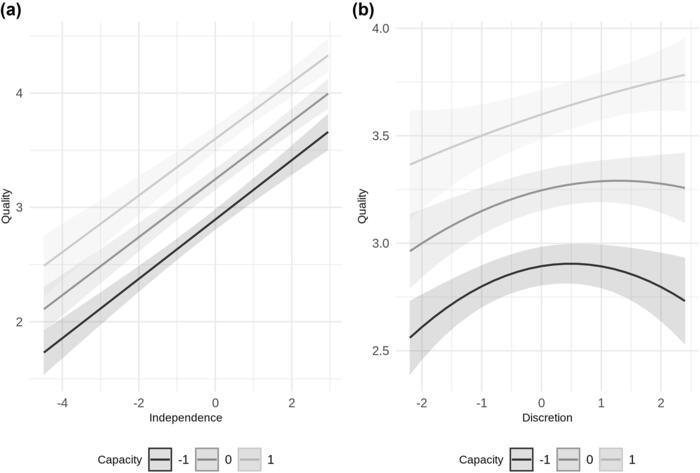
As hypothesized, respondents’ perceptions of agency independence increase their perceptions of quality in a linear way. This finding likely reflects Brazil’s coalitional style of government: politicians benefit electorally from strong government performance; without bureaucratic independence, political pressure and influence from the many coalition partners would likely hinder bureaucrats and weaken performance. Meanwhile, perceptions of discretion align with the authors’ non-linear expectations.


Image
Figure 3: (a) Impact of independence on quality at varying levels of capacity. (b) Impact of discretion on quality at varying levels of capacity.


Figure 3: (a) Impact of independence on quality at varying levels of capacity. (b) Impact of discretion on quality at varying levels of capacity.


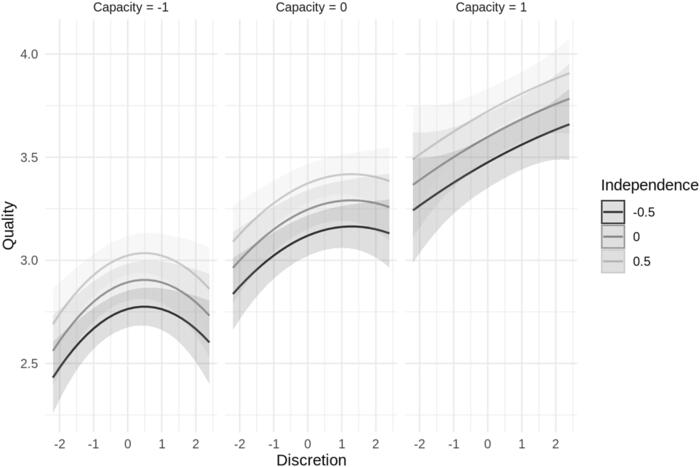
These findings are mediated by capacity, which the authors measure in terms of resources, career length, salaries, and the proportion of agents in core or expert careers. The findings hold even when controlling for political factors like party membership or appointment type (political vs. civil servant), individual characteristics such as gender or years of service, and agency differences, including budget or size. These controls are based on administrative data from over 326,000 bureaucrats across Brazil’s 95 most important federal agencies.


Image
FIgure 4: Quality at varying levels of capacity.


Figure 4: Quality at varying levels of capacity.


Contributions and Implications

“Calibrating autonomy” makes important conceptual and empirical contributions to our understanding of bureaucratic performance. By disaggregating the concept of autonomy into independence and discretion, it helps make sense of seemingly contradictory empirical findings, namely that both minimally and highly autonomous bureaucracies perform well. And by evaluating their hypotheses about the two faces of autonomy using Brazilian data, the authors guard against selection biases or problems from comparing countries with quite different bureaucratic landscapes.

The paper serves as a caution against overly simplistic or blunt “solutions” to poor bureaucratic performance. Merely limiting discretion or increasing legislative oversight can make matters worse if the relevant bureaucratic culture is not properly understood, especially when it comes to capacity.

*Research-in-Brief prepared by Adam Fefer.

Hero Image
National Congress of Brazil (Congresso Nacional) in Brasília
National Congress of Brazil (Congresso Nacional).
Gabriel Tiveron
All News button
1
Subtitle

CDDRL Research-in-Brief [4-minute read]

Date Label
Paragraphs

In 2016, a team of three researchers based at Stanford University — Beatriz Magaloni, Vanessa Melo, and Gustavo Robles — conducted a groundbreaking experiment in Rocinha, Rio de Janeiro’s largest favela (informal settlement), to test whether body-worn cameras (BWC) could reduce police violence and improve community relations.

The findings reveal that body cameras hold great promise, but they also come with serious challenges.  Before the experiment started, one police unit commander ominously told the researchers: “If you give body cameras to my officers, this will stop them from doing their job.”

All Publications button
1
Publication Type
Policy Briefs
Publication Date
Subtitle

Research brief on "Warriors and Vigilantes as Police Officers: Evidence from a Field Experiment with Body Cameras in Rio de Janeiro," by Beatriz Magaloni, Vanessa Melo, and Gustavo Robles (Cambridge Journal of Evidence-Based Policing, Volume 7, article number 2, (2023)).

Journal Publisher
Scientia
Authors
Authors
News Type
News
Date
Paragraphs

Motivation


Retaliation (or the threat thereof) is a central component of human behavior. It plays a key role in sustaining cooperation — such as in international organizations or free trade agreements — because those known to retaliate come to acquire a reputation of being hard to exploit. But how does the use and function of retaliation vary across cultures, and how does it interact with formal forms of punishment?

In “Cross-cultural differences in retaliation: Evidence from the soccer field,” Alain Schläpfer tackles these questions using data on retaliation from association football. Retaliation is simply defined in terms of fouling: player B retaliates against player A if and only if, after A fouls B, B then fouls A. Among other findings, Schläpfer shows that players from cultures emphasizing revenge are more likely to retaliate on the football field. This form of ‘informal punishment’ by players also interacts with ‘formal punishment’ by referees: retaliation by B is less likely when A is sanctioned with a yellow card. Schläpfer’s paper increases our knowledge of the causes and consequences of retaliation, while showing how informal cultural norms interact with the formal rules of football.  

Data


Schläpfer creates a data set of fouls committed over three football seasons (2016-2019) in nine of the world’s top professional men’s leagues. This includes the European leagues of Premier League (England), Serie A (Italy), Bundesliga (Germany), LaLiga (Spain), and Ligue 1 (France), as well as Série A (Brazil), Liga Profesional (Argentina), Liga MX (Mexico), and Major League Soccer (United States). The dataset comprises 9,531 games, 230,113 fouls committed by 10,928 unique perpetrators from 139 countries against 11,115 unique victims from 137 countries.

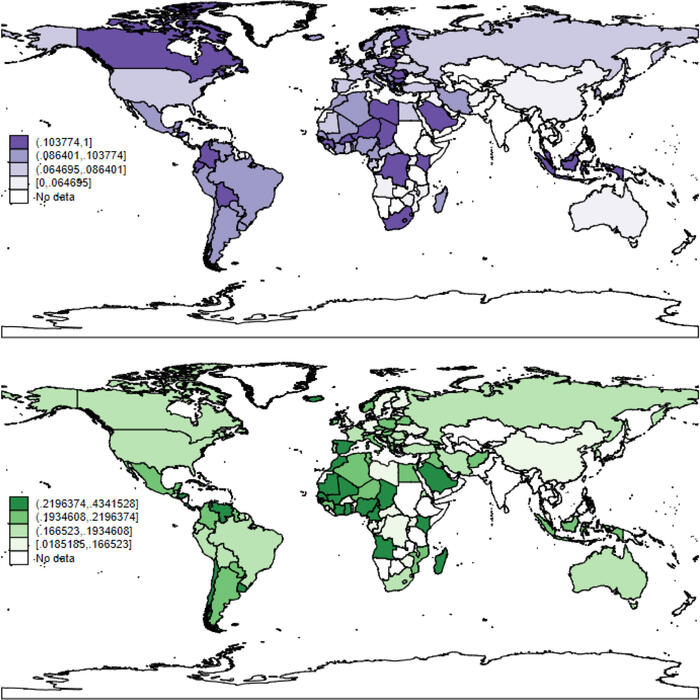
Because Schläpfer hypothesizes that being from more revenge-centric cultures explains on-field retaliation, the key independent variable is measured using a dataset from Stelios Michalopoulos and Melanie Meng Xue that identifies revenge motifs in a culture’s folklore. Examples of this include supernatural forces avenging human murders or animals avenging the death of their friends by humans. Schläpfer uses a host of other independent variables, such as country-level survey data about the desire to punish — as opposed to rehabilitate — criminals, which is also theoretically linked to revenge. As stated above, retaliation is measured in terms of fouls committed. Schläpfer shows that there is substantial variation in retaliation rates among players from different countries, from Gabon (8%) to Iceland (31%). Can the folklore in the country of origin explain the behavior of players on the field?


Image
Fig. 1. The share of fouls retaliated in soccer games (top) and the prevalence of revenge motifs in folklore (bottom). Both variables tend to have higher values for players and folklore from the Middle East, Central Africa, Eastern Europe, and parts of South America.


Fig. 1. The share of fouls retaliated in soccer games (top) and the prevalence of revenge motifs in folklore (bottom). Both variables tend to have higher values for players and folklore from the Middle East, Central Africa, Eastern Europe, and parts of South America.


Findings


Retaliation:

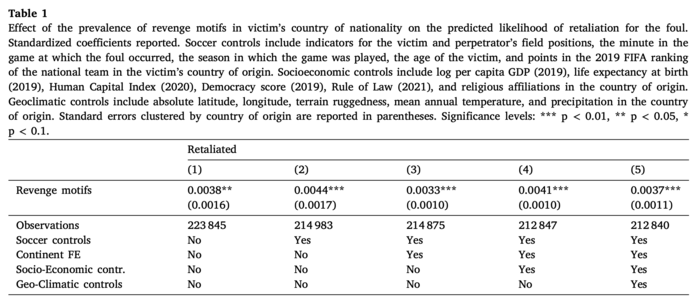
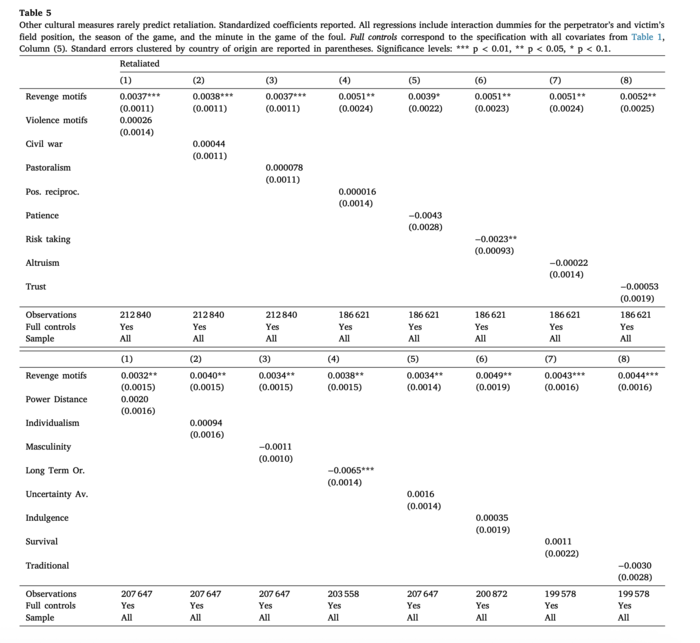
Schläpfer finds evidence that players from cultures that value revenge are indeed more likely to retaliate for fouls. However, they are not more likely to commit fouls overall, cautioning us against conflating the concepts of retaliation and violence. Indeed, Schläpfer demonstrates that motifs of violence in a culture's folklore do not predict retaliation. Players are also found to be more retaliatory early on in a game, which is consistent with its use as a signal or aspect of one’s reputation. In other words, retaliation serves to deter future fouls. Victims of fouls also retaliate quickly. Indeed, retaliation rates are stable or slightly increasing during the first 30 minutes of a game, but then fall consistently thereafter.


Image
Table 1. Effect of the prevalence of revenge motifs in victim’s country of nationality on the predicted likelihood of retaliation for the foul.


Evidence is also provided to show that retaliation deters future transgressions: perpetrators are less likely to foul again if victims retaliate for the initial foul. However, this deterrence finding is only observed when the perpetrator is from a revenge culture. In other words, for retaliation to support cooperation (the absence of fouls), players must share a similar cultural background.

Schläpfer’s findings hold even when soccer-related or socioeconomic factors are taken into account. Further, the paper considers, but finds little support for, alternative explanations of why retaliation varies. These include that some teams encourage players to retaliate more or employ more players from revenge cultures. Further, retaliation does not appear to be driven by emotions; otherwise, it would be less likely to occur after halftime when players have had a chance to cool down, but this is not the case.


Image
Table 5. Other cultural measures rarely predict retaliation. Standardized coefficients reported.


Informal and Formal Sanctioning:

Finally, Schläpfer analyzes the interaction between player retaliation and refereeing. Most importantly, retaliation is significantly less likely if a foul is sanctioned with a yellow card. This illustrates the theoretical principle of formal punishment “crowding out” informal punishment, such as religious excommunication, which carries greater weight than social shunning or police fines compared to peer pressure. Both retaliation and referee sanctioning are shown to reduce the frequency of repeated offenses by perpetrators, especially among players from revenge cultures. However, Schläpfer finds that formal sanctioning is roughly three times more effective than retaliation. This suggests that football referees are doing a better job managing conflict between players than players themselves. 

Schläpfer concludes by mentioning a few of the paper’s limitations. First of all, retaliation is measured only by what referees sanction. However, referees may miss crucial incidents for which retaliation is a response, such as Zinedine Zidane’s 2006 World Cup headbutt after a verbal insult (that was not sanctioned). This is important because individuals from revenge cultures are likely to be particularly offended by verbal insults. Second, the paper does not capture retaliation that occurs across games played by the same teams over time, particularly when rivalries and hostilities have intensified. Similarly, it does not account for preemptive retaliation that does not follow a foul. Ultimately, Schläpfer deepens our understanding of retaliation in a domain where many would expect it not to operate or to do so with minimal significance. The article impressively marshals large-scale data from both sports and cultural history to clarify the causes and consequences of retaliation.

*Research-in-Brief prepared by Adam Fefer.

Hero Image
A person in a red and blue football uniform on a field Jona Møller via Unsplash
All News button
1
Subtitle

CDDRL Research-in-Brief [4-minute read]

Date Label
Authors
News Type
News
Date
Paragraphs

Motivation & Contribution


Over the past 10-15 years, both longstanding and relatively new democracies have suffered from backsliding and erosion, including India, the United States, Brazil, Turkey, and many others. Many social scientists have explained this wave of backsliding in terms of either (a) elected autocrats who undermine democracy from within or (b) declining popular support for democrats who have failed to deliver economic growth and prosperity. However, recent scholarship by Thomas Carothers and Brendan Hartnett has questioned the wisdom of the latter. For example, India enjoyed strong economic growth prior to its backsliding under Narendra Modi.

In “Delivering for Democracy,” Francis Fukuyama, Chris Dann, and Beatriz Magaloni set out to more systematically evaluate the evidence connecting popular support for democracy with delivery, examining both backsliding and non-backsliding countries. After finding preliminary evidence for the democracy-delivery relationship, they offer an explanation of why delivery is simultaneously so important and so elusive under democratic governance.

Evidence


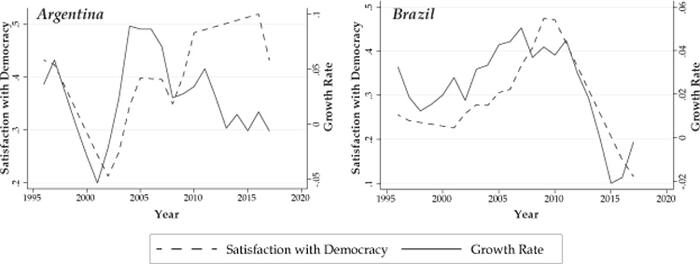
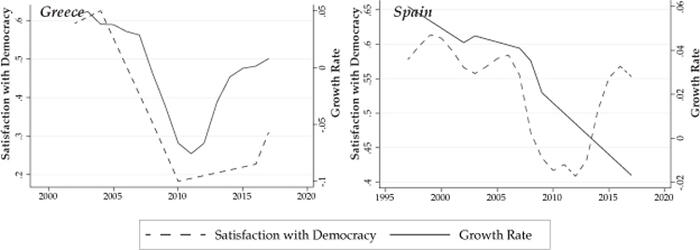
Using ten data sources covering 650,000 people in both old and new democracies, the authors find a strong, positive correlation between satisfaction with democracy and economic performance. This relationship holds not only for many countries at one point in time but for pairs of countries over time. In two developing democracies — Argentina and Brazil — as well as in two developed democracies — Greece and Spain — satisfaction and delivery have been closely connected since 2005, plummeting during economic crises and rising during periods of prosperity. These patterns call for an explanation for why voters care so much about delivery, such that they may be willing to sacrifice their democratic freedoms for it.


Image
Graphs showing satisfaction with democracy and growth rate in Argentina and Brazil


Image
Graphs showing satisfaction with democracy and growth rate in Greece and Spain


The Argument


Delivery is Important

The authors begin from the axiom that stable political life depends upon citizens perceiving their governments as legitimate. Legitimacy can be thought of in terms of both performance — the effective delivery of goods and services — and procedure, which encompasses policies that reflect the democratic will of the people. As the examples of China, Turkey, Saudi Arabia, and Singapore show, however, plenty of autocracies and backsliding democracies have not only delivered, but have also arguably outperformed their democratic peers. From China’s Belt and Road Initiative to Turkey’s Yavuz Sultan Selim Bridge, authoritarian leaders and ruling parties have achieved remarkable performance legitimacy. 

Although autocracies, by definition, cannot be procedurally legitimate, this may carry little weight for democratic citizens who experience prolonged unemployment or must deal with dilapidated infrastructure. Indeed, public engagement through procedural channels — such as voting or jury service — has steadily declined across the democratic world. Democratic voters are increasingly willing to support outsider candidates who build new infrastructure or promise to fight crime, but who nonetheless restrict their political freedoms. Many citizens of El Salvador — which now claims the world’s highest incarceration rate — continue to view Nayib Bukele’s administration as the surest way of delivering security, despite a years-long state of emergency that has seriously eroded democratic freedoms. 

Meanwhile, established democracies built much of their infrastructure decades ago, so investments primarily maintain these systems, rather than showcasing new projects that can garner public support. In some cases, democracies have struggled to even maintain their existing infrastructure, perhaps best exemplified by the collapse of Baltimore’s Francis Scott Key Bridge. All of this creates the conditions for voters to support far-right, anti-democratic parties, which often blame immigrants for economic problems and propose illiberal solutions.

Yet Democratic Delivery is Difficult

Elected democrats seeking to deliver may find themselves hamstrung in ways that autocrats are not. For one, democratic institutions are composed of ‘veto players’ who can stymie the introduction of badly needed policies: national and subnational governments, multiple legislative chambers, judges who review and overturn executive action, and so on. At the same time, democrats must worry about election cycles and term limits, decreasing their incentives to deliver for the long term when later politicians may take credit. Meanwhile, legal and regulatory systems, such as those intended to protect the environment, may prevent the building of critical infrastructure. Property rights prevent the forcible displacement of communities for development, while civil liberties prevent the repression of those who refuse to be displaced. Rules meant to prevent regulatory capture often become arenas where powerful interest groups block and delay government action. 

Independent news media present another potential impediment to delivery, as criticism from journalists can make incumbents wary of undertaking new projects. In addition, media bias can convince voters to remove politicians who do, in fact, deliver. By contrast, autocrats who censor media and arrest journalists can focus on delivery alone, even while their development schemes often rest on corrupt and nepotistic practices. Popular discontent with democratic government ultimately creates a damaging feedback loop: voters are unwilling to fund government projects, in turn leading government to function worse, generating further discontent.


Autocrats have figured out ways to deliver the goods and services their citizens want, but this does not make autocracy a just political system.


Prospects


Autocrats have figured out ways to deliver the goods and services their citizens want, but this does not make autocracy a just political system. By the same token, democracies may struggle to deliver, but their procedural legitimacy — especially voters’ ability to hold representatives to account — entails a powerful means of generating fair and inclusive delivery. As such, the authors call on democracies to examine their past and that of their peer countries — both developed and developing — for inspiration. For example, the U.S. New Deal was exemplary in building ambitious and popular infrastructure, as well as providing broad social and economic protections. (Of course, most of these projects would be hamstrung by modern-day regulatory frameworks.)

Meanwhile, Australia’s citizens have both benefited from a recent infrastructure boom and have demonstrated strong support for democracy. Finally, many Latin American countries have implemented popular and effective programs like conditional cash transfers. For the authors, addressing the issues most pressing to voters — such as job creation, which is especially salient to young people, who are most dissatisfied with democracy — will require democratic governments to strike the right balance between democracy and delivery.

*Research-in-Brief prepared by Adam Fefer.

Hero Image
Group of people protesting in Ibadan, Nigeria, holding a sign reading "#EndSARS #EndBadGov"
Group of people protesting in Ibadan, Nigeria.
Oladipo Adejumo via Unsplash
All News button
0
Subtitle

CDDRL Research-in-Brief [4-minute read]

Date Label
0
CDDRL Honors Student, 2025-26
lila_bacheller.jpg

Major: International Relations
Hometown: Sioux Falls, South Dakota
Thesis Advisors: Harold Trinkunas and Stephen Stedman

Tentative Thesis Title: Civil-Military Relations and Democratic Consolidation in Brazil: Examining Civilian Control Over the Armed Forces Since 1985

Future aspirations post-Stanford: After Stanford, my long-term goal is to work in national security. While I see multiple paths in this field, I am currently interested in attending law school and exploring opportunities in the federal government and industry.

A fun fact about yourself: When I say "bag," everyone immediately knows I'm from the Midwest.

Date Label

Encina Hall, E109
616 Jane Stanford Way
Stanford, CA 94305-6055

0
Gerhard Casper Postdoctoral Fellow, 2025-26
xt4c0697.jpg

Ana Paula Pellegrino is the Gerhard Casper Fellow in Rule of Law at the Center on Democracy, Development and the Rule of Law (CDDRL) and a JSD Candidate at Stanford Law School. Pellegrino is an empirical political scientist using experimental, observational, and qualitative data to study questions of criminal and political violence, with a particular interest in Latin America. Her research agenda includes projects on state and non-state armed actors, including police and criminal groups, and how they form and engage with each other. Other projects explore public attitudes towards violence and war, as well as the micro-dynamics of violence and war outcomes.

Pellegrino's work has been supported by Georgetown University, Fundação Estudar’s Leaders program, and the Harry Frank Guggenheim Foundation’s Emerging Scholars program. She holds a Ph.D. in Government from Georgetown University and a BA and MA in International Relations from the Pontifical Catholic University of Rio de Janeiro. She is an incoming Assistant Professor at the School of Government at the Pontifical Catholic University of Chile, in Santiago, where she will begin in July 2026.

Date Label
Authors
News Type
News
Date
Paragraphs

After almost two years of hard work and study, the 2025 cohort of the Ford Dorsey Master's in International Policy program (MIP) is preparing for the final stretch of their learning journey at the Freeman Spogli Institute for International Studies (FSI). 

Each year, second-year MIP students participate in the Policy Change Studio, which takes their learning out of the realm of theory and into hands-on, on-the-ground application. Recognizing that the world outside the classroom is much more complex, bureaucratic, and constrained than textbook case studies, the Studio is a two-quarter course designed to provide students with direct experience researching, developing, and implementing policy goals.   

Our students are setting out for Belgium, Mongolia, Ghana, Australia, and India to work directly with research groups, NGOs, and policy institutions on pressing challenges affecting local communities and global alliances alike. Keep reading to learn more about each project.


Securing Trust: A Framework for Effective Cyber Threat Information Sharing in NATO

Over the past few months, through problem identification and early solutions development, our research has identified three key challenges in NATO’s cyber threat information sharing landscape. First, despite the presence of existing protocols such as NCIRC and MISP, significant communication
[Left to right]: Emerson Johnston, Tiffany Saade, Chan Leem
Emerson Johnston, Tiffany Saade, Chan Leem, Markos Magana (not pictured)

gaps persist between stakeholders. This is exacerbated by the lack of clear, standardized specifications from NATO, leading to inconsistent implementation and operational friction. Second, at its core, this is an intelligence-sharing challenge: member states operate under different national frameworks, threat perceptions, and priorities, which influence what information they are willing (or unwilling) to share. Third, the fragmentation of sharing systems is not merely a technical hurdle but often a deliberate choice made for operational and security reasons, reflecting concerns over sovereignty, data protection, and strategic advantage.

While technological advancements can enhance interoperability, they alone will not drive adoption. Our research highlights that the underlying issue is one of trust and incentives—NATO must establish mechanisms that encourage collaboration beyond just technological solutions. Without a strong foundation of mutual trust, transparency, and shared benefits, even the most advanced systems will face resistance. Creating sustainable incentives for participation—whether through policy alignment, risk reduction assurances, or value-added intelligence sharing—will be essential in fostering a more effective and unified cyber defense posture within NATO.


Cultivating Community-Led Policies: GerHub and Mongolia’s Billion Trees Initiative

Our team is collaborating with GerHub in Mongolia to establish an influential policy think tank aimed at fostering community-informed and data-driven policymaking. Leveraging GerHub’s unique and extensive connections within the ger communities of Mongolia, we aim to empower policies that authentically reflect local needs and insights.
[Left to right]: Julia Ilhardt, Serena Rivera-Korver, Johanna von der Leyen, and Michael Alisky
Julia Ilhardt, Serena Rivera-Korver, Johanna von der Leyen, and Michael Alisky

A key component of our project involves conducting in-depth research and stakeholder interviews focused on Mongolia's "Billion Trees Initiative," where we will be seeking actionable insights to scale up the initiative effectively and sustainably.


Countering Coordinated Political Disinformation Campaigns in Ghana

Our team is working with the Africa Center for Strategic Studies to examine disinformation issues in Ghana. We are focusing on how coordinated influence operations are being used to create and spread political disinformation. We aim to understand how PR companies and
[Left to right]: Euysun Hwang, Sakeena Razick, Leticia Lie, and Julie Tamura
Euysun Hwang, Sakeena Razick, Leticia Lie, Julie Tamura, and Anjali Kumar (not pictured)

influencers work with politicians to coordinate these influence operations and shape public opinion. Our policy recommendations will address how governments and civil societies can work together to tackle this issue.


The recent ratification of the Technology Safeguard Agreement (TSA) by the United States and Australia lays the foundation for smoother exchange of commercial space technologies and permits U.S. commercial space launch companies to conduct reentry in Australia. With the sponsorship of the
[Left to right]: Samara Nassor, Gustavs Zilgalvis, and Helen Phillips
Samara Nassor, Gustavs Zilgalvis, Helen Phillips, and Joe Wishart (not pictured)

Australian Space Agency and U.S. Defense Innovation Unit, the goal of this project is to leverage Australia's strategic geographic position and investment in reentry infrastructure to mitigate the hurdles that U.S. commercial startups experience accessing military ranges for reentry. Our project aims to create a robust foundation for the development of orbital return capabilities in Australia, fostering greater commercial and national security collaboration between the U.S. and Australia.


Overcoming Computational Resource Gaps for Open Source AI in India

Our team is working with Digital Futures Lab (DFL), a non-profit research network in India that examines the intersection of technology and society in the Global South. Our project focuses on identifying the key components of open source AI in India and how limited access
[Left to right]: Sandeep Abraham, Sabina Nong, Kevin Klyman, and Emily Capstick
Sandeep Abraham, Sabina Nong, Kevin Klyman, and Emily Capstick

to computational resources acts as a barrier to adoption. India has a thriving tech sector, and openly available AI models have the potential to democratize access to this trailblazing technology. At the same time, AI is expensive to build and deploy, and access to the specialized computational resources needed to do so is limited even for top Indian companies. Our team aims to develop solutions in partnership with Digital Futures Lab that can help bolster the AI ecosystem across India.


Combating Human Trafficking in the Informal Mining Industry in Ghana

Our team is working with the Ghana Center for Democratic Development to identify ways to disrupt human trafficking into forced labor in Ghana’s informal mining sector. So far, our research and conversations with stakeholders has highlighted the complex systems — ranging from poverty to illicit networks —
[Left to right]: Alex Bue, Rachel Desch, and Marco Baeza
Alex Bue, Rachel Desch, Marco Baeza, and Hye Jin Kim (not pictured)

that contribute to this issue. During our fieldwork, we will explore community- and government-driven programs aimed at preventing and combating trafficking. Our final report will analyze existing policies, pinpoint gaps, and propose community-led interventions to address them.


The Ford Dorsey Master's in International Policy

Want to learn more? MIP holds admission events throughout the year, including graduate fairs and webinars, where you can meet our staff and ask questions about the program.

Read More

The Class of 2026 of the Ford Dorsey Master's in International Policy on the steps of Encina Hall at Stanford University.
News

Meet the Ford Dorsey Master's in International Policy Class of 2026

Hailing from every corner of the globe, the new class of the Ford Dorsey Master's in International Policy is ready to make an impact on nuclear policy, digital trust and safety, rural investment, and more.
Meet the Ford Dorsey Master's in International Policy Class of 2026
A close-up/macro photograph of Middle East from a desktop globe.
News

New Continuing Studies Course with CDDRL Scholars on Geopolitics in the 21st-Century Middle East

Open for enrollment now through Stanford Continuing Studies, "Geopolitics in the 21st-Century Middle East: Insights from Stanford Scholars and Other Experts" will run online for ten weeks on Wednesdays, from April 2 through June 4.
New Continuing Studies Course with CDDRL Scholars on Geopolitics in the 21st-Century Middle East
a group photo taken at a table with four people sitting down.
Blogs

SPICE Provides Excellent Learning Opportunities for Japanese University Students

SPICE/Stanford collaborates with the Graduate School of Education at the University of Tokyo.
SPICE Provides Excellent Learning Opportunities for Japanese University Students
Hero Image
A collage of six student groups from the 2025 Policy Change Studio at the Ford Dorsey Master's in International Policy at the Freeman Spogli Institute for International Studies.
All News button
1
Subtitle

Students in the Ford Dorsey Master's in International Policy program are practicing their policymaking skills through projects on cybersecurity within NATO, countering political disinformation in Ghana, commercial space technology in Australia, and more.

Date Label
Paragraphs

The interactions between bureaucratic agencies and political actors shape governance outcomes, yet scholars disagree about how bureaucratic autonomy relates to government quality. Some claim that enhancing autonomy improves quality, whereas others maintain the opposite. An influential article by Fukuyama (2013) in Governance suggests a curvilinear relationship, moderated by capacity. This article evaluates the theory empirically, focusing on within-country variation and two dimensions of autonomy: independence and discretion. Drawing on an original survey of over 3200 public sector workers in Brazil and administrative data on 325,000 public servants, we find evidence suggesting that the relationship between perceived autonomy and quality depends on the type of perceived autonomy and level of capacity. Public servants' perceptions of independence from political actors are associated with increased perceptions about governance quality in a linear fashion. For perceived discretion, we find initial evidence of a Goldilocks relationship: too little reduces perceptions of government quality but so does too much, especially in low-capacity areas. Our findings offer initial evidence that may qualify claims that limiting bureaucratic discretion while increasing political oversight improves governance; instead, context may be crucial.

All Publications button
1
Publication Type
Journal Articles
Publication Date
Journal Publisher
Governance
Authors
Francis Fukuyama
Number
Issue 1, January 2025, e12865
Authors
News Type
Blogs
Date
Paragraphs

For many, spring break is synonymous with time away on laid back beaches. But for the hardworking students in the Ford Dorsey Master's in International Policy Class of 2024, the break from their normal classes was the perfect opportunity to meet with partners all over the world and conduct field research for their capstone projects.

Each year, second year master's students participate in a two quarter course called the Policy Change Studio. Built on the idea that hands-on experience navigating the realities of bureaucracy, resource constraints, and politics is just as important for students as book learning and theory, this capstone course pairs groups of students with governments, NGOs, and research institutes around the world to practice crafting policy solutions that help local communities.

From agricultural policy in Mongolia to public transportation in Ghana, cyber resilience in Taiwan and AI governance in Brazil, keep reading to see how our students have been making an impact!


Brazil

Poramin Insom, Justin Yates, Thay Graciano, and Rosie Lebel traveled to Rio de Janeiro to work with the Institute for Technology and Society to investigate ways to design a governance strategy for digital and AI tools in public defenders' offices.

Artificial Intelligence promises to transform Public Defenders in Brazil, as seen throughout our fieldwork trip in Rio de Janeiro. Our team spent the week discussing the integration of AI in legal practices with defenders from 13 states and experts from Instituto de Tecnologia e Sociedade (ITS Rio) and COPPE / UFRJ. We focused on developing AI tools tailored to reduce administrative burdens, enabling defenders to concentrate on advocacy. With nearly 80% of Brazilians entitled to free legal aid, AI can automate routine tasks like document categorization and grammatical corrections.

Significant challenges relate to privacy and potential biases in algorithms, underscoring the need for collaborative governance to ethically implement these solutions. Thus, a unified technological strategy is crucial. We hope that through our work, we can create a collaborative governance framework that will facilitate the development of digital and AI tools, ultimately helping citizens at large. We appreciated the opportunity to learn from incredibly dedicated professionals who are excited to find new ways to jointly develop tools.


China-Taiwan

Sara Shah, Elliot Stewart, Nickson Quak, and Gaute Friis traveled to Taiwan to gain a firsthand perspective on China’s foreign information manipulation and influence (FIMI), with a specific focus on the role that commercial firms are playing in supporting these campaigns.

We met with government agencies, legislators, military and national security officials, private sector actors, and civil society figures within Taiwan's vibrant ecosystem for countering Foreign Information Manipulation and Interference (FIMI). On the ground, the team found that China’s FIMI operations are evolving and increasingly subtle and complex. As generative AI empowers malign actors, our team assessed that the battle against sophisticated, state-sponsored influence campaigns requires a more integrated and strategic approach that spans legal, technological, and societal responses.


Ghana

Skylar Coleman and Maya Rosales traveled to Accra and Cape Coast in Ghana while Rosie Ith traveled to Washington DC and Toronto to better understand the transit ecosystem in Ghana and the financial and governing barriers to executing accessible and reliable transportation.

During their time in Ghana, Skylar and Maya met with various stakeholders in the Ghanaian transportation field, including government agencies, ride-share apps, freight businesses, academics, and paratransit operators. Presently, paratransit operators, known locally as "tro tros," dominate the public transportation space and with a variety of meetings with their union officials and drivers in terminals around Accra they were able to learn about the nature of the tro tro business and their relationships — and lack thereof — with the government.

In D.C., Rosie met with development organizations and transport officials and attended the World Bank’s Transforming Transportation Conference and their paratransit and finance roundtable. Collectively, they learned about the issues facing the transport industry primarily related to problems surrounding bankability, infrastructure and vehicle financing, and lack of government collaboration with stakeholders. Insights from the trip spurred their team away from conventional physical interventions and toward solutions that will bridge stakeholder gaps and improve transport governance and policy implementation.


Mongolia

Ashwini Thakare, Kelsey Freeman, Olivia Hampsher-Monk, and Sarah Brakebill-Hacke traveled to Mongolia and Washington D.C. to better understand grassland degradation, the role that livestock overgrazing plays in exacerbating the problem, and what is currently being done to address it.

Our team had the opportunity to go to Mongolia and Washington DC where we conducted over twenty structured interviews with a variety of stakeholders. We spoke with people including local and central government officials, officials of international organizations, representatives from mining and cashmere industries, community organizations, academic researchers, herder households, NGOs and Mongolian politicians. Though we knew the practice of nomadic herding is core to Mongolia’s national identity, we didn’t fully realize just how integrated this practice, and the problem of grassland degradation, are in the economy, society and politics of Mongolia.

In the run-up to Mongolia’s election in June, this issue was especially top of mind to those we interviewed. Everyone we spoke with had some form of direct connection with herding, mostly through their own families. Our interviews, as well as being in Ulaanbaatar and the surrounding provinces, helped us to deepen our understanding of the context in which possible interventions operate. Most especially we observed all the extensive work that is being done to tackle grassland degradation and that institutionalizing and supporting these existing approaches could help tackle this issue.


New Zealand

Andrea Purwandaya, Raul Ruiz, and Sebastian Ogando traveled to Auckland and Wellington in New Zealand to support Netsafe’s efforts in combating online harms among 18- to 30-year-olds of Chinese descent. This partnership aims to enhance online safety messages to build safer online environments for everyone.

While on the ground, our team met with members from Chinese student organizations and professional associations to gather primary evidence on the online harms they face. We also met with Tom Udall, the U.S. Ambassador to New Zealand, his team, and university faculty to brainstorm solutions to tackle this problem. We learned about the prevalent use of “super-apps” beyond WeChat in crowdsourcing solutions and support, and were able to better grasp the complexities of the relationships between public safety organizations and the focus demographic. In retrospect, it was insightful to hear from actors across the public, private, and civic sectors about the prevalence of online harms and how invested major stakeholders are in finding common solutions through a joint, holistic approach.


Sierra Leone

Felipe Galvis-Delgado, Ibilola Owoyele, Javier Cantu, and Pamella Ahairwe traveled to Freetown, Sierra Leone to analyze headwinds affecting the country's solar mini grid industry as well as potential avenues to bolster the industry's current business models.

Our team met with private sector mini grid developers, government officials from the public utilities commission and energy ministry, and rural communities benefiting from mini grid electrification. While we saw first-hand the significant impact that solar mini grids can have on communities living in energy poverty, we also developed a deeper understanding of the macroeconomic, market, and policy conditions preventing the industry from reaching its full potential of providing energy access to millions of Sierra Leoneans. Moving forward, we will explore innovative climate finance solutions and leverage our policy experience to develop feasible recommendations specific to the local environment.


Taiwan

Dwight Knightly, Hamzah Daud, Francesca Verville, and Tabatha Anderson traveled to Taipei, Keelung, and Hsinchu, Taiwan to explore the island democracy’s current posture and future preparedness regarding the security of its critical communications infrastructure—with a special focus on its undersea fiber-optic cables.

During our travels around Taiwan and our many meetings, we were surprised with the lack of consensus among local decision-makers regarding which potential solution pathways were likely to yield the most timely and effective results. These discrepancies often reflected the presence of information asymmetries and divergent institutional interests across stakeholders—both of which run counter to Taiwan’s most urgent strategic priorities. Revising existing bureaucratic authorities and facilitating the spread of technical expertise would enable—and enrich—investment in future resilience.

While we anticipated that structural inefficiencies would impede change to some degree, our onsite interviews gave us a clearer picture of where policy interventions will likely have the most positive effect for Taiwan's defense. With the insights from our fieldwork, we intend to spend the remainder of the quarter exploring new leads, delving into theory of change, and designing a set of meaningful policy recommendations.


The Ford Dorsey Master's in International Policy

Want to learn more? MIP holds admission events throughout the year, including graduate fairs and webinars, where you can meet our staff and ask questions about the program.

Read More

The Ford Dorsey Master's in International Policy Class of 2024 at the Freeman Spogli Institute for International Studies.
Blogs

Meet the Ford Dorsey Master's in International Policy Class of 2024

The 2024 class of the Ford Dorsey Master’s in International Policy has arrived at Stanford eager to learn from our scholars and tackle policy challenges ranging from food security to cryptocurrency privacy.
Meet the Ford Dorsey Master's in International Policy Class of 2024
A photo collage of the 2023 cohort of the Ford Dorsey Master's in International Policy on their Policy Change Studio internships.
Blogs

Master's Students Tackle Policy Projects Around the Globe

From Egypt to England, the Maldives to Switzerland, Vietnam, Ghana, Kenya, and Fiji, the 2023 cohort of the Ford Dorsey Master's in International Policy has criss-crossed the world practicing their policymaking skills.
Master's Students Tackle Policy Projects Around the Globe
Hero Image
A seven picture collage of travel photos taken by the Ford Dorsey Master's in International Policy Class of 2024 during their spring internships through the Policy Change Studio.
Students from the Class of 2024 of the Ford Dorsey Master's in International Policy traveled the globe over their spring break to meet with partners of the Policy Change Studio and research their projects in the field.
Ford Dorsey Master's in International Policy
All News button
1
Subtitle

Each spring, second year students in the Ford Dorsey Master's in International Policy spread out across the globe to work on projects affecting communities from Sierra Leone to Mongolia, New Zealand, and beyond.

Date Label
Subscribe to Brazil