News Type
News
Date
Paragraphs

In an exciting development, the Industry-Wide Deliberative Forum convened by Stanford University’s Deliberative Democracy Lab is announcing the addition of two new companies — DoorDash and Microsoft — joining the group of technology companies Cohere, Meta, Oracle, and PayPal, advised by the Collective Intelligence Project in a collaborative effort to engage the public in shaping the future of AI agents. 

There is a gap between the development of technology, particularly AI, and the public's understanding of these advancements. This Forum is answering the question: what if the public could be more than just passive users of these technologies, but instead take an active role in shaping their progress? This growing group of technology companies is excited to engage in a collaborative approach to consulting the public on these complex issues. 

The inclusion of DoorDash and Microsoft speaks to the importance of this Forum and of engaging the public on the future of AI agents. "We believe the future of AI agents must be shaped thoughtfully, with meaningful public input. This forum provides an important platform to elevate diverse voices and guide the responsible development of AI that all businesses can benefit from,” said Chris Roberts, Director of Community Policy and Safety, at DoorDash. 

“We’re proud to support and participate in this effort.”

The Industry-Wide Deliberative Forum is set to take place in Fall 2025 and will be conducted on the AI-assisted Stanford Online Deliberation Platform. This Forum is rooted in deliberation, which involves bringing together representative samples of the public, presenting them with options and their associated tradeoffs, and encouraging them to reflect on both this education and their personal experiences. Research has shown that deliberative methods yield more thoughtful feedback for decision-makers, as individuals must consider the complexities of the issues at hand, rather than simply top-of-mind reactions.

“Microsoft is excited to join this cross-industry collaborative effort to better understand public perspectives on how to build the next generation of trustworthy AI systems,” Amanda Craig, Senior Director of Public Policy, Office of Responsible AI, Microsoft. 

The collaboration encourages thoughtful feedback rather than reactive opinions, ensuring that the public’s perspective is both informed and actionable. “Welcoming DoorDash and Microsoft to our collaborative table is an excellent opportunity to broaden the impact of our work,” said James Fishkin, Director of Stanford’s Deliberative Democracy Lab. “This expansion embodies a shared commitment to collectively shaping our future with AI through public consultations that are both representative and thoughtful.”

Media Contact: Alice Siu, Stanford Deliberative Democracy Lab

Read More

Agentic AI Workflow Automation, Artificial intelligence AI driven decision-making concept illustration blue background
News

Deliberative Democracy and the Ethical Challenges of Generative AI

CDDRL Research-in-Brief [4-minute read]
Deliberative Democracy and the Ethical Challenges of Generative AI
America in One Room: Pennsylvania
News

Pennsylvania Voters Bridge Deep Political Divides, Reduce Polarization in Groundbreaking Deliberative Polling® Event

America in One Room: Pennsylvania brings together a representative sample of registered Pennsylvania voters for a statewide Deliberative Poll in this crucial swing state, revealing surprising common ground and public opinion shifts on issues from immigration to healthcare to democratic reform.
Pennsylvania Voters Bridge Deep Political Divides, Reduce Polarization in Groundbreaking Deliberative Polling® Event
Futuristic 3D Render
News

Industry-Wide Deliberative Forum Invites Public to Weigh In on the Future of AI Agents

There is a significant gap between what technology, especially AI technology, is being developed and the public's understanding of such technologies. We must ask: what if the public were not just passive recipients of these technologies, but active participants in guiding their evolution?
Industry-Wide Deliberative Forum Invites Public to Weigh In on the Future of AI Agents
Hero Image
Close-up of a computer chip labeled ‘AI Artificial Intelligence,’ embedded in a circuit board with gold connectors and electronic components.
BoliviaInteligente via Unsplash
All News button
1
Subtitle

The inclusion of these companies in the Industry-Wide Deliberative Forum, convened by Stanford University’s Deliberative Democracy Lab, speaks to its importance and the need to engage the public on the future of AI agents.

Date Label
Authors
Heather Rahimi
News Type
News
Date
Paragraphs

Imagine one test deciding your future. For millions of students in China every year, that test is the gaokao—the national university entrance exam and one of the most competitive educational systems in the world. Published by Harvard University Press in Fall 2025, The Highest Exam: How the Gaokao Shapes China, takes readers inside this high-stakes exam and uncovers how it has shaped families, careers, and even the nation itself.

Written by leading scholars Ruixue Jia and Hongbin Li, with writer and researcher Claire Cousineau, the book combines rigorous research with compelling personal narratives to reveal how the gaokao has become much more than a test: it is a tool to shape China’s society and economy.

The gaokao has long been considered one of the world’s most consequential educational exams. Each year, tens of millions of students sit for this high-stakes test that determines access to universities, career opportunities, and pathways of social mobility. The Highest Exam traces the gaokao’s historical origins and evolution, showing how it became deeply intertwined with China’s governance, social strata, and economy. 

Through empirical analysis and personal narrative, the book illustrates how the exam system reflects broader themes in Chinese society: the pursuit of meritocracy, the tension between equality and advantage, and the state’s reliance on education to reinforce legitimacy. The authors aptly identify China’s education system as a centralized hierarchical tournament, returning to this framework in each section of the book: family, state, and society. 

The Highest Exam also brings a comparative lens, contrasting China’s exam-driven system with education practices in the United States and beyond. It raises urgent questions about fairness, access, and the role of education in shaping societies—questions that resonate far beyond China’s borders.

Engaging and deeply researched, The Highest Exam is essential reading for anyone interested in education, global society, or the forces shaping the next generation.


About the Authors
 

Ruixue Jia is Professor of Economics at the School of Global Policy and Strategy, University of California, San Diego.

Hongbin Li is Co-director of Stanford Center on China's Economy and Institutions, and a Senior Fellow of Stanford Institute for Economic Policy Research (SIEPR) and the Freeman Spogli Institute for International Studies (FSI) at Stanford University.

Claire Cousineau is a writer and former researcher at the Stanford Center on China’s Economy and Institutions, she is currently pursuing her MBA at Duke University.


Availability


The Highest Exam: How the Gaokao Shapes China is available now for purchase from Amazon and elsewhere.  


Upcoming Book Event


Join us on Tuesday, October 21 at 4 PM (Pacific) for a fireside chat with co-authors Ruixue Jia and Hongbin Li. The fireside chat will be held in-person in the Bechtel Conference Center and livestreamed for virtual attendees. Learn More & Register


Read More

A girl in China sits at a classroom desk taking a test.
News

Hongbin Li Contributes to the WSJ and Previews New Book "The Highest Exam"

Co-authors Hongbin Li and Ruixue Jia write for the WSJ, "The Test That Rules Chinese Society: The gaokao is China’s college entrance exam, but it shapes the country and its people far beyond the classroom."
Hongbin Li Contributes to the WSJ and Previews New Book "The Highest Exam"
Book cover: Institutional Genes: Origins of China's Institutions and Totalitarianism by Chenggang Xu
News

New Book by Chenggang Xu Unpacks the Deep Roots of China’s Totalitarian Regime

SCCEI Senior Research Scholar Chenggang Xu’s latest book, "Institutional Genes: Origins of China's Institutions and Totalitarianism", explores the origins and evolution of China's institutions and communist totalitarianism.
New Book by Chenggang Xu Unpacks the Deep Roots of China’s Totalitarian Regime
Scott Rozelle, Xiaonian Xu, Loren Brandt, and Mary Lovely converse as the panelists during a SCCEI event.
News

SCCEI Event Explores China’s Industrial Policy and Global Competition

During this SCCEI event, expert panelists Xiaonian Xu, Loren Brandt, and Mary Lovely shared insights on the historical context, current trends, and future implications of China’s economic strategy and its impact on global trade.
SCCEI Event Explores China’s Industrial Policy and Global Competition
All News button
1
Subtitle

"The Highest Exam: How the Gaokao Shapes China", written by Ruixue Jia, Hongbin Li, and Claire Cousineau, combines rigorous research with compelling personal narratives to reveal how the gaokao has become much more than a test: it is a tool to shape China’s society and economy.

Date Label
Authors
Noa Ronkin
News Type
News
Date
Paragraphs

As the U.S.-China competition unfolds in areas ranging from trade to technology to the military, the rival-making discourse surrounding this great power competition was the focus of the conference Beyond a New Cold War, organized and hosted by the Stanford Next Asia Policy Lab (SNAPL).

Held on August 14, 2025, the event showcased SNAPL research illuminating how U.S. political leaders and the media shape narratives concerning China and how citizens in young democracies perceive these narratives. Serving as discussants were experts from Columbia University, the University of California, Berkeley, the Hoover Institution (represented by a former National Security Affairs Fellow), and the U.S. Congressional-Executive Commission on China.

The studies presented and discussed at the conference are part of SNAPL’s U.S.-Asia Relations research track, one of four research streams the lab pursues. Housed at the Shorenstein Asia-Pacific Research Center (APARC) and founded by sociologist Gi-Wook Shin, the lab aims to generate evidence-based policy recommendations and promote transnational collaboration with academic and policy institutions to advance the future prosperity of Asia and U.S.-Asia relations.

“This conference provided an excellent opportunity to engage the policy community with our research findings,” says Shin, the William J. Perry Professor of Contemporary Korea, a senior fellow at the Freeman Spogli Institute for International Studies (FSI), and the director of APARC and the Korea Program. “The lab will continue to foster ongoing dialogue between academic and policy circles.” 

The conference builds on previous SNAPL forums and meetings with policy and academic communities in Washington, D.C., held in September 2024. These policy engagement activities are made possible thanks to a grant from FSI. 


Sign up for APARC newsletters to receive our experts' updates >


Xinru Ma presenting from a lectern, poninting to a screen behind her.
Xinru Ma

Dynamics of American Elite Discourse on China


At the first conference panel, Research Fellow Xinru Ma shared a study that unravels who leads elite discourse on U.S.-China relations – whether Congress, the White House, or the media. While prior research suggests that each of these actors could have distinct agenda-setting capacities, their relative influence and its directionality in foreign policy discourse remain empirically underexamined.

The study addresses this question by investigating China-focused discourse and framing by the U.S. legislative and executive branches as well as the media. Using computational and causal inference methods, the study analyzes social media data from the legislative and executive branches alongside major U.S. media outlets across two periods: the 116th Congress (January 3, 2019 – January 3, 2021) and the 118th Congress (January 3, 2023 – January 3, 2025).

The analysis reveals that, both in terms of issue attention and framing, the media tends to follow the lead of Congress and the President. The findings also indicate that Republican lawmakers exert greater influence on setting the China agenda in the media. In contrast, Democratic lawmakers are stronger predictors of how the media frames the issues at stake. Moreover, the findings suggest that presidential influence on China discourse weakened sharply in the 118th Congress, and that there is an overall shift toward party-driven, rather than institutionally mediated, communication among elites. 


Policy Implications
 

  • Media Weakness: The reliance of media outlets on partisan cues from political elites on foreign policy issues increases the risk of incomplete or skewed public understanding of China and U.S.-China relations. The risk is especially disconcerting as U.S. reporters face limited access to China.
  • Partisan Echo Chambers: Communication flows primarily within partisan networks rather than across institutions, with the separation of powers becoming less effective as a system of checks and balances. The splintering of political discourse into parallel echo chambers risks eroding opportunities for cross-party dialogue and democratic deliberation on complex foreign policy issues.
  • Fragmented Messaging: Divergent partisan messaging on China signals inconsistency to both domestic and international audiences who might draw contradictory conclusions about U.S. intentions. This dynamic gives rise to strategic miscalculations abroad and a fragmented public understanding of China policy at home.
  • Declining  Institutional Voices: The decline of institutional power over shaping U.S. discourse on China has created a growing vulnerability. As individual political figures gain sway, personalized narratives often prioritize short-term visibility over a coherent, long-term strategy.
Gidong Kim delivers a presentation in a conference room.
Gidong Kim

Democracy vs. Autocracy: A View from Young Democracies


Despite their deep divisions on most issues, there is one topic Republicans and Democrats converge on: China. Both parties increasingly frame the intensifying U.S.-China tensions as a strategic competition between democracy and autocracy. But is the value diplomacy this approach begets effective in promoting liberal values in young democracies?

At the second conference panel, Visiting Scholar Gidong Kim presented a study that addresses this question. “This study challenges the effectiveness of the value-laden U.S. diplomacy in young democracies and presents a more nuanced explanation of democracy's role in forming public opinion on foreign policy,” says Kim, formerly a postdoctoral fellow with SNAPL and currently an assistant professor of political science at Hankuk University of Foreign Studies (HUFS).

The study hypothesizes that in young democracies, where democratic histories are relatively short and legacies of authoritarian rule endure, citizens tend to understand democracy in terms of electoral institutions rather than liberal values. Similarly, in the context of the U.S.-China competition, citizens in these countries tend to perceive China’s threats to electoral institutions more seriously than its threats to liberal values.

To test this proposition, the study uses a country-level, cross-national analysis and an original survey experiment in South Korea. The findings support the hypothesis.

Policy Implications
 

  • Context Matters: U.S. policymakers must acknowledge the limits of value-driven diplomacy. Washington should diversify its foreign policy toolkit and adapt it to regional contexts: in Western Europe, liberal values rhetoric can reinforce alliances, but in young democracies, the design and strength of electoral institutions carry greater weight.
  • A Crisis of Credibility: For China, there is an equally clear lesson about the need to rethink its approach to diplomacy. Without addressing suspicions of election interference in democratic countries, Beijing will struggle to gain traction with the publics in young Asian democracies and dissipate anti-China sentiments in those countries, even if it increases its soft power through liberalization policies.


SNAPL’s studies presented at the conference underscore the crucial role that narratives and public perceptions play in international relations. They suggest that great power competition is not just about power. Rather, it is also about persuasion, which, in turn, depends on how different audiences — at home and abroad — perceive the story.

Read More

Gi-Wook Shin seated in his office, speaking to the camera during an interview.
News

Sociologist Gi-Wook Shin Illuminates How Strategic Human Resource Development Helped Build Asia-Pacific Economic Giants

In his new book, The Four Talent Giants, Shin offers a new framework for understanding the rise of economic powerhouses by examining the distinct human capital development strategies used by Japan, Australia, China, and India.
Sociologist Gi-Wook Shin Illuminates How Strategic Human Resource Development Helped Build Asia-Pacific Economic Giants
Collage of headshots of Stanford students
News

Stanford Next Asia Policy Lab Research Assistants Admitted to Top Doctoral Programs

A Stanford student and four recent alumni who served as research assistants at the Stanford Next Asia Policy Lab will begin doctoral studies at top institutions in fall 2025. At the lab, which is committed to rigorous, policy-relevant research and student mentorship, they gained hands-on experience and honed skills valuable for the next stage of their academic journeys.
Stanford Next Asia Policy Lab Research Assistants Admitted to Top Doctoral Programs
Korean activists released from prison on August 16, 1945.
Commentary

Can the United States and Asia Commemorate the End of the Pacific War Together?

Within Asia, World War II memories and commemorations are not only different from those in the United States but also divided and contested, still shaping and affected by politics and nationalism. Only when U.S. and Asian leaders come together to mark the end of the Asia-Pacific war can they present a credible, collective vision for the peace and prosperity of this important region.
Can the United States and Asia Commemorate the End of the Pacific War Together?
Hero Image
Stanford Next Asia Policy Lab team members and invited discussants during a roundtable discussion in a conference room.
Stanford Next Asia Policy Lab members and invited discussants at the conference "Beyond a New Cold War: Political Messaging and Public Perceptions on China" – August 14, 2025.
All News button
1
Subtitle

At a recent conference, lab members presented data-driven, policy-relevant insights into rival-making in U.S.-China relations.

Date Label
Paragraphs
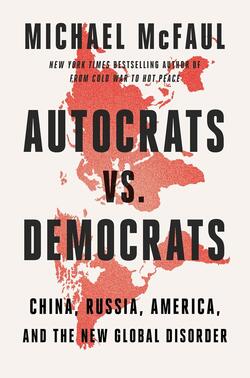
Cover of Autocrats vs Democrats Book

Amid the constant party divisions in Washington, DC, one issue generates stunning consensus—China—with Republicans and Democrats alike battling over which party can take the most hawkish stance toward the ascendant superpower. Indeed, far from trying to avoid a new Cold War with China, many have embraced it, finding comfort in the familiar construct, almost willing it into existence. And yet, even as politicians and intellectuals race to embrace this Cold War 2.0, many of the perils we face today are distinctly different from those of the Cold War with the Soviets. The alliance between the autocracies of China and Russia, the nature of the ideological struggle, China’s economic might, the rise of the far right in the United States and in Europe, and the growing isolationism and polarization in American society—taken together these represent new challenges for the democratic world. Some elements of the Cold War have reappeared today, but many features of the current great power competition have no analogy from the past century.

For decades Michael McFaul, former ambassador to Russia and international affairs analyst for NBC News, has been one of the preeminent thinkers about American foreign policy. Now, in this provocative work, he challenges the encroaching orthodoxy on Russia and China, arguing persuasively that the way forward is not to force our current conflict into a decades-old paradigm but to learn from our Cold War past so that democracy can again emerge victorious. Examining America’s layered, modern history with both Russia and China, he demonstrates that, instead of simplistically framing our competition with China and Russia as a second Cold War, we must understand the unique military, economic, and ideological challenges that come from China and Russia today, and the develop innovative policies that follow from that analysis, not just a return to the Cold War playbook.

At once a clarion call for American foreign policy and a forceful rebuttal of the creeping Washington consensus around China, Autocrats vs. Democrats demonstrates that the key to prevailing in this new era isn’t simply defeating our enemies through might, but using their oppressive regimes against them—to remind the world of the power and potential that our democratic freedoms make possible. 

Michael McFaul headshot

Professor Michael McFaul

FSI Director
"Autocrats vs. Democrats: China, Russia, America, and the New Global" is available starting October 28, 2025.
ORDER NOW
All Publications button
1
Publication Type
Books
Publication Date
Subtitle

From FSI Director, New York Times bestselling author, and former ambassador to Russia Michael McFaul comes a clear-eyed look at how the rise of autocratic China and Russia are compelling some to think that we have entered a new Cold War—and why we must reject that thinking in order to prevail. 

Authors
Michael A. McFaul
Book Publisher
Mariner Books
Authors
Melissa Morgan
News Type
Commentary
Date
Paragraphs

On August 15, President Donald Trump welcomed Vladimir Putin to the Joint Base Elmendorf-Richardson in Anchorage, Alaska. It was the first time since their sideline meeting in 2019 at the G20 meeting in Osaka, Japan that the two leaders have met, and the first time Putin has traveled to the United States since the United Nations General Assembly in New York in 2015.

While President Volodymyr Zelenskyy of Ukraine met with President Trump in Washington, DC the following  week, some observers have expressed trepidation over the prospect of a deal being made between Russia and the United States without the input of Ukraine.

Writing for Brookings ahead of the summit, Steven Pifer, an affiliate at the Center for International Security and Cooperation and The Europe Center, and a former U.S. Ambassador to Ukraine warned:

“Putin will seek to trap Trump into endorsing a position that incorporates the major elements of long-standing Russian demands. If Trump agrees, he will suffer unflattering comparisons to Neville Chamberlain, who agreed to surrender a large part of Czechoslovakia to Nazi Germany in 1938. While the Czechoslovakian government concluded it had no choice and accepted the territorial loss, the Ukrainians will say no. They will not embrace their own capitulation.”

So how did the meeting in Anchorage actually play out?

In commentary on social media, FSI Director and former U.S. Ambassador to Russia Michael McFaul summarized the talks in the context of the Yalta Conference, an agreement between the United States, the United Kingdom, and the Soviet Union made in the waning months of WWII that quickly fell apart when Joseph Stalin broke promises made to Western leaders to maintain and support democratic elections in Eastern Europe.

Speaking on NPR’s Morning Edition, McFaul elaborated on his concerns: 

“What I think the worst outcome would be is if President Trump starts negotiating on behalf of the Ukrainians without the Ukrainians in the room. Trump needs something tangible, and I hope that doesn't make him too anxious to start negotiating on behalf of the Ukrainians because that would be a disaster. If he jams President Zelenskyy with something he can't accept, that would be the worst of all outcomes.”

Pifer echoed his relief about the lack of discussion over particulars about Ukraine between the two leaders, but also pointed out that the broadest goal of the meeting also hadn’t been met.

“The good news is, President Trump didn’t give away the store. I was concerned he might get into bargaining on details about Ukraine without the Ukrainians there, which would be to their detriment. But it seems Mr. Trump failed in his stated goal to achieve a ceasefire between Russia and Ukraine,” said Pifer. 

But even without a concrete policy outcome, Pifer says the Alaska meeting was an optical victory for Russia: 

“The significance for Vladimir Putin is that the meeting happened in the first place. Since Russia launched its invasion of Ukraine back in 2022, there’s been a boycott by Western leaders of any kind of face-to-face meeting with Putin. And by hosting him in Alaska, Trump broke that boycott. That is being played up in Moscow as a huge victory that Putin has been legitimized again.”

On Monday, August 18, President Zelenskyy and a cadre of other European leaders met with President Trump at the White House to discuss the Friday meeting and reinforce Europe’s positions and redlines against capitulation to Russian demands.

In analysis for Foreign Policy, Pifer outlined the stakes of this follow-up meeting for the European delegation:

“Zelenskyy and his European colleagues face a tricky challenge. They have to diplomatically offer suggestions to walk Trump back from a position that he does not appear to understand would be bad for Ukraine, bad for Europe, and bad for American interests. And they have to do so without setting off an explosion that could disrupt U.S.-Ukrainian and U.S.-European relations.”

McFaul is also cautious about the tone and tack of the discussions moving forward:

“I think it’s a good thing [the Europeans and Trump] are talking about security guarantees,“ he told Alex Witt on MSNBC. “But the devil is in the details. We keep hearing something about ‘NATO-like security guarantees.’ Why not just NATO security guarantees?"

The argument for building a lasting ceasefire in Ukraine based on NATO membership is a proposal McFaul has long supported.

“This notion that these guarantees are going to be something like NATO but less than NATO . . . if I were the Ukrainians, that would make me nervous. They had guarantees like that in 1994 called the Budapest Memorandum, and it meant nothing. It didn’t stop Putin from invading in 2014, and it didn’t stop him from launching a full-scale war in 2022,” McFaul reminded viewers.

“To me,” he argues, “it has to be NATO, not NATO-lite. The only way to do real, credible security guarantees for Ukraine is membership in NATO.”

In assessing the White House meeting with President Zelenskyy and European leadership, Rose Gottemoeller, the William J. Perry lecturer at CISAC and former deputy secretary of NATO, is cautiously optimistic. 

“This was a major step along the road, and it was vital that the Europeans were there as well as Ukraine,” she told the CBC.

A seasoned negotiator with direct experience working on high-level diplomacy with Russia, Gottemoeller is no stranger to the long process of dealmaking with the Kremlin.

“There are many steps to get through. We are not there yet. As much as Trump would like to walk out of the Oval Office and say, ‘We got the deal done,’ I think there will be many more hoops to jump through before that is possible.”


Additional insights from our scholars on the Trump-Putin summit and White House meeting with Zelenskyy and other European leaders can be found at the following links:

Russia, Ukraine, and Trump on Katie Couric
Trump Meets with Putin: Experts React in the Bulletin of the Atomic Scientists
There Are No Participation Trophies in High-Stakes Diplomacy on Substack


Stay Connected

Subscribe for email updates to stay up-to-date on commentary and analysis from FSI scholars.

Read More

2025 Strengthening Ukrainian Democracy and Development fellows
News

Ukrainian Leaders Advance Postwar Recovery Through Stanford Fellowship

Meet the four fellows participating in CDDRL’s Strengthening Democracy and Development Program and learn how they are forging solutions to help Ukraine rise stronger from the challenges of war.
Ukrainian Leaders Advance Postwar Recovery Through Stanford Fellowship
The Russian and American flags flying side by side
Commentary

Displaying Weakness to the Kremlin

For a U.S. administration claiming that it wants to restore American power in order, among other things, to negotiate from a position of strength, the past week has not advanced the cause.
Displaying Weakness to the Kremlin
James Goldgeier on the World Class podcast
Commentary

The Future of U.S.-Europe Security Partnerships

On the World Class podcast, James Goldgeier and Michael McFaul discuss how relations are evolving between the United States and Europe, and what that means for the future of Ukraine, defense strategy in Europe, and global security interests.
The Future of U.S.-Europe Security Partnerships
Hero Image
Vladimir Putin and Donald Trump in conversation on the tarmac of the Joint Base Elmendorf-Richardson on August 15, 2025 in Anchorage, Alaska.
Photo Credit: Getty Images
All News button
1
Subtitle

FSI scholars Michael McFaul, Steven Pifer, and Rose Gottemoeller analyze the Alaska meeting between Donald Trump and Vladimir Putin and its implications for Ukraine’s security and sovereignty.

Image
Vladimir Putin and Donald Trump in conversation on the tarmac of the Joint Base Elmendorf-Richardson on August 15, 2025 in Anchorage, Alaska.
Photo credit Photo Credit: Getty Images
Title
After the Trump-Putin Summit, Is Ending the Ukraine-Russia War Any Closer?
Aria Label
Read More After the Trump-Putin Summit, Is Ending the Ukraine-Russia War Any Closer?
Date Label
Display Hero Image Wide (1320px)
No
Paragraphs
Image
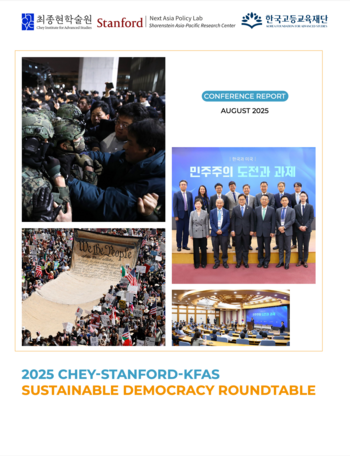
Report cover showing democracy demonstrations in South Korea

In partnership with the the Chey Institute and the Korea Foundation for Advanced Studies (KFAS), the Shorenstein Asia-Pacific Research Center (APARC) and the Stanford Next Asia Policy Lab (SNAPL) at Stanford University presented the third installment of the “Sustainable Democracy Roundtable” series in Seoul, South Korea, where experts diagnosed the current state of democracy, its threats, and possible prescriptions for democratic prosperity. The goal of the roundtable is to create a necessary platform and opportunity for scholars of various disciplines and ranks to identify core issues and propose unique solutions to globally pertinent policy issues. This year's roundtable went a step further by holding its public sessions at the National Assembly, where legislators joined scholars and civic leaders in the search for solutions to the democratic crisis.

The roundtable series is part of SNAPL's Democratic Crisis and Reform research track.

The roundtable was made possible thanks to the generous support and partnership with the Chey Institute and the  Korea Foundation for Advanced Studies (KFAS).

This report summarizes the discussions held at the roundtable using a modified version of the Chatham House Rule, only identifying speakers by their country of origin.


All Publications button
1
Publication Type
Reports
Publication Date
Authors
Authors
News Type
Blogs
Date
Paragraphs

I have always wished to learn more about Korea. Since I am only half Korean, my grandparents’ stories of Seoul made up the extent of my knowledge for much of my childhood. As I grew up and began to slot together my identity in a patchwork of personality and truths, my Korean identity simply did not fit. I could barely stomach the spice of bibimmyeon, my mother’s favorite Korean noodle dish. Wearing hanboks, the traditional Korean dress, never gave me the elegance my cousins seemed to embody. Speaking Korean didn’t come to me as easily as it did for my sister. What I did have were my grandparents’ firsthand stories, with rich history peeking through childhood anecdotes and accounts of war. Korean history always felt quite accessible to me, even if it didn’t make me feel Korean enough.

Accordingly, getting to participate in the Sejong Korea Scholars Program was a dream come true for me. I sensed that it would be a unique and incredible opportunity, and that perception was immediately confirmed by the first introductory meeting on Zoom. If anything, the online format made the focus of the program even clearer, and each virtual classroom felt just as grounded as any in-person class I’ve experienced.

It was especially exciting to be surrounded by 18 other like-minded and talented peers. We were all in pursuit of the same learning, the same deep dive into Korean history—and many were in the program for reasons similar to mine. There was a deep affinity for culture in the group, and not just for Korean culture. With so many Korean Americans in the group, it was fun to post or comment about our connections to Korea, and just as exciting to learn about Korean Americans from esteemed Professor Kyeyoung Park, who graciously answered all of our questions. I also must commend the students who weren’t Korean and simply were excited about Korean history; their passion was always quite inspiring.

I will forever remember this program as a place where my writing became true to myself, and went beyond what I ever could have imagined.

Above all, what made SKSP so special was the historiography, which had long been a personal area of interest. Dr. HyoJung Jang, our extraordinary instructor, curated a diverse assortment of sources each week, ranging from U.S. government documents to articles to contemporary qualitative experiments. In between each virtual classroom, I pored over several sources, and reflected on the way they interacted with each other. As I worked on our biweekly writing assignment, I found myself making multiple connections for each source and forming my own mini arguments in the paragraphs. By the time we got to each lecture, I had stewed on my ideas long enough to get quite excited about the questions I wanted to ask.

Each lecturer gave a spectacular presentation and was quite generous with their time. In particular, I’ll highlight Professor Gi-Wook Shin and Professor Nancy Abelmann, who taught us about different facets of contemporary Korean society: nationalism and the education system, respectively. Their talks were grounded in Korean norms of filial piety, respect, and also patriarchal systems, a topic I intended to write my paper about.

At the time, however, my paper topic was, quite frankly, a mess. I knew I wanted to involve pop culture somehow into my discussion of ingrained misogyny in Korean society, but had written some incredibly vague topic proposal about sexist dating norms present in music and TV shows. Luckily, Dr. Jang gave some much-needed feedback about the large scope of my proposal. In the process of reading through academic papers around sexism, I came across digital feminist movements, and decided that the accessibility and weaponization of the internet was going to be my new focus. Of all the incredible experiences in the program, I think I’ll always remember writing my paper, how Dr. Jang was an especially important personal mentor, and the overwhelming feeling (as I was writing) that I was connected to my culture, somehow.

When I think back to the way I worried over my lack of a connection to Korea at the beginning of the year, I find my concerns a bit silly now. I now know that I have always been connected to my heritage through my history. Even if that didn’t feel like it was enough before, my scholarship and pursuit of Korean history through SKSP have now proven that to me. I will forever remember this program as a place where my writing became true to myself, and went beyond what I ever could have imagined. To all interested students, I urge you to apply without inhibition. You will surely find something you didn’t know you needed—whether it’s a reassurance about your culture, a reignited passion, or simply growth—in the Sejong Korea Scholars Program. 

SKSP is one of several online courses offered by SPICE.

To stay updated on SPICE news, join our email list and follow us on Facebook, X, and Instagram.

Read More

a student standing on campus
Blogs

Roots to Flowers: A Reflection on the Sejong Korea Scholars Program

The following reflection is a guest post written by Jason Shim, alumnus of the Sejong Scholars Program, which is currently accepting student applications until November 1, 2024.
Roots to Flowers: A Reflection on the Sejong Korea Scholars Program
Hero Image
person standing in the street at night
All News button
1
Subtitle

The following reflection is a guest post written by Eloisa Lin, an alumna of the Sejong Scholars Program.

Date Label
1
Visiting Scholar at APARC, Japan Program Fellow, 2025-2026
kemy_monahan.jpg

Katherine (Kemy) joined the Walter H. Shorenstein Asia-Pacific Research Center (APARC) as a visiting scholar, Japan Program Fellow, from September 2025 to March 2026. Ms. Monahan has completed 16 assignments on four continents in her 30 years as a Foreign Service Officer with the U.S. Department of State.  She recently returned from Tokyo, where she was Deputy Chief of Mission at the U.S. Embassy in Japan, following roles as Charge d’affaires for Papua New Guinea, Solomon Islands, and Vanuatu, and Deputy Chief of Mission to New Zealand, Samoa, Cook Islands, and Niue.  She was Director for East Asia at the National Security Council from 2022 to 2023.  Previously, she worked for the U.S. Department of Treasury in Tokyo, as Economic, Trade and Labor Counselor in Mexico City, Privatization lead in Warsaw after the fall of the Berlin Wall, Advisor to the World Bank, and Deputy Executive Director of the Secretary of State’s Global Health Initiative, among other roles.  As lead of UNICEF’s International Financial Institutions office, Ms. Monahan negotiated over $1 billion in funding for children. A member of the Bar in California and DC, Ms. Monahan began as an attorney in Los Angeles. 

Date Label
Authors
Gary Mukai
News Type
Blogs
Date
Paragraphs

The fifth year of the Stanford/SPICE East Asia Seminars for Teachers in Hawaiʻi (“Stanford SEAS Hawai‘i”) was launched in April 2025 and included four online seminars that featured Stanford-affiliated scholars—Professor Ethan Segal, Professor Andrew Walder, PhD candidate Zoë Gioja, and Ambassador Scot Marciel—and culminated in a three-day in-person summer institute that took place from July 12 to 14, 2025 at the Hawai‘i Imin International Conference Center at Jefferson Hall, East-West Center. This year’s cohort included 19 public and private high school teachers—Stanford/Freeman SEAS Hawai‘i Fellows—from across Hawai‘i. Below are the names of the 2025 Stanford/Freeman SEAS Hawai‘i Fellows, their schools, and the islands where their schools are located:

Adrienne PuluMaui High SchoolMaui
Amelia ThorneKonawaena High SchoolHawai‘i
Angelica GrimbleKailua High SchoolO‘ahu
Annie PaopaoKahuku High and Intermediate SchoolO‘ahu
Aura-Rae Pohai WongCentral District Office @ ‘Aiea ElementaryO‘ahu
Casey HultenKea‘au High SchoolHawai‘i
Eric AsuncionMaui High SchoolMaui
Jaylin Petersen‘Aiea High SchoolO‘ahu
Jonathan LoomisMcKinley High SchoolO‘ahu
Kristen HairstonLeilehua High SchoolO‘ahu
Lono BaldadoHilo High SchoolHawai‘i
Lyn Nicole Chua‘Aiea High SchoolO‘ahu
Mahina GooPearl City High SchoolO‘ahu
Micah Kawaguchi-AiletcherLahainaluna High SchoolMaui
Michelle Levine AquinoFarrington High SchoolO‘ahu
Misael BernardHawaiian Mission AcademyO‘ahu
Rhealiza Pira-MikiKonawaena High SchoolHawai‘i
Rukhsanna GuidrozSeabury HallMaui
Tammy JohnsonCalvary Chapel Christian SchoolO‘ahu

Stanford SEAS Hawai‘i Manager Rylan Sekiguchi invited scholars from Hawai‘i as well as curriculum writers and facilitators of teacher professional development to offer presentations over the course of the institute. They are listed below as well as the titles of their presentations. The presentation topics were selected to support Hawai‘i State Department of Education standards such as “U.S. History and Government Theme 1 (Immigration and Migration, 1880–1930), Anchor Standard 16 (Global Interconnections and Changing Spatial Patterns): Cause and Effects of Migration.”

  • Shana Brown, Associate Professor, University of Hawai‘i at Mānoa, “U.S.–China Relations: Problems and Potential”
  • Douglas D. L. Chong, President of the Hawaii Chinese History Center, “The Chinese Diaspora in Hawai‘i”
  • Jonas Edman, Instructional Designer, SPICE, “SPICE Curricula on Chinese American History”
  • Naomi Funahashi, Manager, Reischauer Scholars Program and Teacher Professional Development, SPICE, “Teaching Contemporary Korea with SPICE”
  • Merle Grybowski, Director of Teacher Training, Pacific and Asian Affairs Council, “East-West Center Walkabout”
  • Patricia Halagao, Professor, University of Hawai‘i at Mānoa, “Teaching Filipino Identity, History, and Resistance”
  • Ken K. Ito, Professor Emeritus, University of Hawai‘i at Mānoa, “Nakashima Naoto’s ‘Waiawa Station’ (1934) as Diasporic Fiction”
  • C. Harrison Kim, Associate Professor, University of Hawai‘i at Mānoa, “Korea in the 20th Century: Colonialism, North/South Division, Futures”
  • Jonathan Okamura, Professor Emeritus, University of Hawai‘i at Mānoa, “East Asians and Southeast Asians in Unequal Hawai‘i”
  • Rylan Sekiguchi, Manager of Curriculum and Instructional Design, SPICE, “Divided Memories: Comparing History Textbooks”
     
Image
a person speaking at the podium


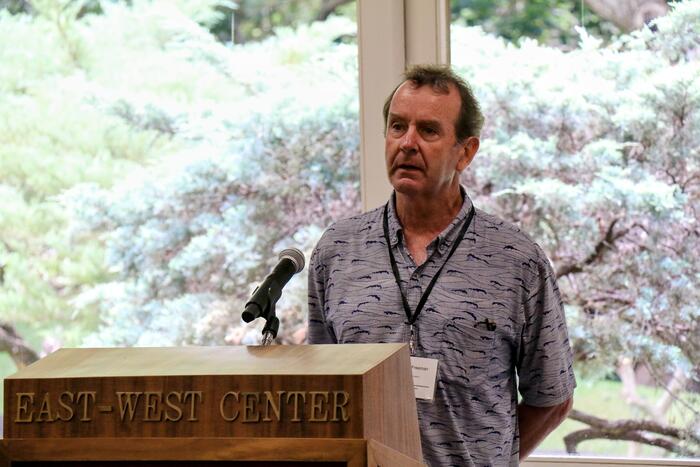
Stanford SEAS Hawai‘i is made possible by a generous grant from the Freeman Foundation. President Graeme Freeman (photo above) spoke during the summer institute about the Freeman Foundation’s mission of helping to enhance the teaching of East Asia through programs such as the National Consortium for Teaching about Asia and Stanford SEAS Hawaiʻi and expressed his gratitude to the Stanford/Freeman SEAS Hawai‘i Fellows for the tremendous impact their learning has on their students. Graeme was joined by Vice President Shereen Goto, Executive Assistant Sandra Lee, and Foundation Assistant Kellie Matsudaira of the Freeman Foundation. Additional support for the summer institute was kindly provided by Stanford Global Studies and the Stanford Center for East Asian Studies through the U.S. Department of Education National Resource Center funding under the auspices of Title VI, Section 602(a) of the Higher Education Act of 1965.

As I observed the lectures, curriculum demonstrations, and listened to the Stanford/Freeman SEAS Hawai‘i Fellows’ comments, questions, and resource sharing, I reflected on ways that SPICE has continued to serve as a bridge between Stanford University scholars and teachers in Hawai‘i since 1988 when SPICE founding director Dr. David Grossman established the Consortium for Teaching Asia and the Pacific in the Schools (CTAPS) at the East-West Center. During the institute, I shared thoughts on three Stanford scholars. Stanford scholar Lee Shulman is someone whom I mentioned to teachers at the second CTAPS summer institute that was held in 1989. Shulman is known for developing the concept of pedagogical content knowledge or PCK, which emphasizes that teachers need not only subject matter expertise but also pedagogical content knowledge. While listening to the Stanford/Freeman SEAS Hawai‘i Fellows, their unique blend of subject matter knowledge and pedagogical content knowledge really shined. Second, during the institute, I could really feel the fellows’ embrace of the diversity of their students, the people in Hawai‘i, and beyond. I spoke about Stanford psychologist Jamil Zaki, who has noted that empathy is an umbrella term that captures at least three ways that we connect with one another’s emotions. One is emotional empathy, which is vicariously sharing somebody else’s feelings. Cognitive empathy is one’s attempt to understand what someone else is feeling and why. And empathic concern or compassion is one’s motivation to improve others’ well-being. Third, Stephen Murphy-Shigematsu is a psychologist formerly with the University of Tokyo who now teaches at Stanford. His scholarship on heartfulness—elucidated in his book, From Mindfulness to Heartfulness: Transforming Self and Society with Compassion—notes that heartfulness is a way of living with mindfulness, compassion, and responsibility that enhances well-being and transformation. Sekiguchi noted that he certainly felt this heartfulness while interacting with the Stanford/Freeman SEAS Hawai‘i Fellows since April of this year.

In the month following the institute’s conclusion, each Stanford/Freeman SEAS Hawai‘i Fellow will create an original lesson plan that incorporates content that was introduced during Stanford SEAS Hawaiʻi. Sekiguchi awaits in anticipation of seeing how content from the seminar will reach hundreds of secondary school students throughout Hawai‘i.

Sekiguchi and Sabrina Ishimatsu, SPICE Event Coordinator, who organized the institute, and I are grateful to the East-West Center for allowing SPICE to host the Stanford SEAS Hawai‘i summer institute at its beautiful venue.

Most importantly, everyone at SPICE is immensely grateful to President Graeme Freeman, Vice President Shereen Goto, and the Freeman Foundation for its generosity in making Stanford SEAS Hawai‘i possible and providing us the opportunity to engage Stanford/Freeman SEAS Hawai‘i Fellows with scholars from Stanford University, the University of Hawai‘i at Mānoa, and beyond.

To stay informed of SPICE news, join our email list and follow us on Facebook, X, and Instagram.

Read More

Stanford Professor Kären Wigen gives a virtual seminar for Stanford SEAS Hawaii
News

Teachers in Hawaii Connect with Stanford Scholars

Twenty-four high school educators comprise the inaugural cohort of Stanford/Freeman SEAS Hawaii Fellows.
Teachers in Hawaii Connect with Stanford Scholars
Hero Image
group of people standing outside
Stanford/Freeman SEAS Hawai‘i Fellows at the East-West Center | Photo Credit: Sheldon Tamon
All News button
1
Subtitle

The Stanford/Freeman SEAS Hawai‘i Fellows gathered at the East-West Center, from July 12 to 14, 2025.

Date Label
0
CDDRL Honors Student, 2025-26
img_1259_3_-_emma_wang.jpg

Major: Political Science
Hometown: Naperville, Illinois
Thesis Advisor: Jonathan Rodden

Tentative Thesis Title: Broadband for All: Historical Lessons and International Models for U.S. Internet Policy

Future aspirations post-Stanford: After completing my master's in computer science, I hope to go to law school and work in technology law.

A fun fact about yourself: I started lion dancing when I came to college!

Date Label
Subscribe to United States