-
Session 6: Japan’s Official Development Assistance — Reexaminations of Major Issues in Modern Japanese Politics and Diplomacy Seminar Series

This lecture is the final installment in the Japan Program's spring 2025 seminar series, Reexaminations of Major Issues in Modern Japanese Politics and Diplomacy.

Session 6: Japan's Official Development Assistance

Japan began its Official Development Assistance in 1954, only 9 years after its defeat, and became No. 1 donor in the 1990s. The amount of ODA began to decline in 1997, reaching half of its peak, and Japan is now No. 3 in the world. However, Japan developed various unique approaches in its ODA. Now, as the US withdraws from ODA and the conflict between advanced and developing countries becomes tense, Japan’s ODA may provide unique approaches to developing countries.

Join us for our 2025 spring quarter seminar series featuring Shorenstein APARC Visiting Scholar and Japan Program Fellow Dr. Shinichi Kitaoka, Emeritus professor at the University of Tokyo and a distinguished scholar in modern Japanese politics, as he presents new interpretations of six major issues in modern Japanese politics based on recent studies in Japan and his own experience as the Ambassador to the United Nations and the President of Japan International Cooperation Agency.

This seminar series re-examines several important and well-known issues in modern Japanese politics and diplomacy from the late 19th century to the 21st century based on the lecturer’s recent research and experience within the government. Topics include Meiji Restoration as a democratic revolution; the resilience of Taisho Democracy; the military as a bureaucracy; surrender and the American occupation; the Yoshida Doctrine and the regime of 1955; the development of ODA policy; and the recent development of security policy in the 21st century.

Catered dinner will be served at seminar sessions.

Speaker:

Headshot photo of Shinichi Kitaoka

Shinichi Kitaoka is the former President of the Japan International Cooperation Agency (JICA: 2015-2022) and Emeritus Professor, University of Tokyo. Previous posts include President of the International University of Japan (2012-2015), professor at University of Tokyo (1997-2012), Professor of National Graduate Institute for Policy Studies (GRIPS) (2012-), Professor of Graduate Schools for Law and Politics, the University of Tokyo (1997-2004, 2006-2012), Ambassador Extraordinary and Plenipotentiary, Deputy Permanent Representative of Japan to the United Nations (2004-2006), and Professor of College of Law and Politics, Rikkyo University (1985-1997).

Dr. Kitaoka’s specialty is modern Japanese politics and diplomacy. He obtained his BA (1971) and PhD (1976) from the University of Tokyo. He is also Emeritus Professor at Rikkyo University. He received many awards including the Medal with Purple Ribbon for his academic achievements in 2011.

Okimoto Conference Room
Encina Hall, Third Floor,
616 Jane Stanford Way, Stanford, CA 94305

1
Visiting Scholar, Japan Program Fellow, 2025
kitaoka_photo.jpg Ph.D.

Professor Shinichi Kitaoka joined the Walter H. Shorenstein Asia-Pacific Research Center (APARC) as Visiting Scholar, Japan Program Fellow for the spring quarter of 2025. He serves as Special Advisor to the President (former President) of the Japan International Cooperation Agency (JICA), as well as Emeritus Professor of the University of Tokyo and Rikkyo University. Previously, he was President of JICA. Dr. Kitaoka’s career also includes President of the International University of Japan (2012-2015), Professor of National Graduate Institute for Policy Studies (GRIPS) (2012-), Professor of Graduate Schools for Law and Politics, the University of Tokyo (1997-2004, 2006-2012), Ambassador Extraordinary and Plenipotentiary, Deputy Permanent Representative of Japan to the United Nations (2004-2006), and Professor of College of Law and Politics, Rikkyo University (1985-1997).

Dr. Kitaoka’s specialty is modern Japanese politics and diplomacy. He obtained his B.A. (1971) and his Ph.D. (1976) both from the University of Tokyo.

Date Label
Shinichi Kitaoka, Visiting Scholar at APARC and Japan Program Fellow, 2025
Date Label
-

This lecture is the fourth installment in the Japan Program's spring 2025 seminar series, Reexaminations of Major Issues in Modern Japanese Politics and Diplomacy.

Session 4: The Regime of 1955


In 1955, the Liberal Democratic Party and the Japan Socialist Party were formed. While the former led Japan for 38 years, the latter remained out of power. The reasons for this rivalry and the consequences of this system will be discussed.

Join us for our 2025 spring quarter seminar series featuring Shorenstein APARC Visiting Scholar and Japan Program Fellow Dr. Shinichi Kitaoka, Emeritus professor at the University of Tokyo and a distinguished scholar in modern Japanese politics, as he presents new interpretations of six major issues in modern Japanese politics based on recent studies in Japan and his own experience as the Ambassador to the United Nations and the President of Japan International Cooperation Agency.

This seminar series re-examines several important and well-known issues in modern Japanese politics and diplomacy from the late 19th century to the 21st century based on the lecturer’s recent research and experience within the government. Topics include Meiji Restoration as a democratic revolution; the resilience of Taisho Democracy; the military as a bureaucracy; surrender and the American occupation; the Yoshida Doctrine and the regime of 1955; the development of ODA policy; and the recent development of security policy in the 21st century.

Catered dinner will be served at seminar sessions.

Speaker:

 
Headshot photo of Shinichi Kitaoka

Shinichi Kitaoka is the former President of the Japan International Cooperation Agency (JICA: 2015-2022) and Emeritus Professor, University of Tokyo. Previous posts include President of the International University of Japan (2012-2015), professor at University of Tokyo (1997-2012), Professor of National Graduate Institute for Policy Studies (GRIPS) (2012-), Professor of Graduate Schools for Law and Politics, the University of Tokyo (1997-2004, 2006-2012), Ambassador Extraordinary and Plenipotentiary, Deputy Permanent Representative of Japan to the United Nations (2004-2006), and Professor of College of Law and Politics, Rikkyo University (1985-1997).

Dr. Kitaoka’s specialty is modern Japanese politics and diplomacy. He obtained his BA (1971) and PhD (1976) from the University of Tokyo. He is also Emeritus Professor at Rikkyo University. He received many awards including the Medal with Purple Ribbon for his academic achievements in 2011.

Philippines Conference Room
Encina Hall, Third Floor, Central, C330
616 Jane Stanford Way, Stanford, CA 94305

1
Visiting Scholar, Japan Program Fellow, 2025
kitaoka_photo.jpg Ph.D.

Professor Shinichi Kitaoka joined the Walter H. Shorenstein Asia-Pacific Research Center (APARC) as Visiting Scholar, Japan Program Fellow for the spring quarter of 2025. He serves as Special Advisor to the President (former President) of the Japan International Cooperation Agency (JICA), as well as Emeritus Professor of the University of Tokyo and Rikkyo University. Previously, he was President of JICA. Dr. Kitaoka’s career also includes President of the International University of Japan (2012-2015), Professor of National Graduate Institute for Policy Studies (GRIPS) (2012-), Professor of Graduate Schools for Law and Politics, the University of Tokyo (1997-2004, 2006-2012), Ambassador Extraordinary and Plenipotentiary, Deputy Permanent Representative of Japan to the United Nations (2004-2006), and Professor of College of Law and Politics, Rikkyo University (1985-1997).

Dr. Kitaoka’s specialty is modern Japanese politics and diplomacy. He obtained his B.A. (1971) and his Ph.D. (1976) both from the University of Tokyo.

Date Label
Shinichi Kitaoka, Visiting Scholar at APARC and Japan Program Fellow, 2025
Date Label
-
Flyer for session 3 in the series "Reexaminations of Major Issues in Modern Japanese Politics and Diplomacy" with a headshot of speaker Shinich Kitaoka

This lecture is the first installment in the Japan Program's spring 2025 seminar series, Reexaminations of Major Issues in Modern Japanese Politics and Diplomacy.

Session 3: Surrender and Occupation

What was the purpose of the United States? What did unconditional surrender mean? Why were the atomic bombs dropped? How was the constitution written and the Tokyo International Tribunal conducted? The legacies of occupation will also be discussed.


Join us for our Spring Quarter Seminar Series featuring Shorenstein APARC Visiting Scholar and Japan Program Fellow Dr. Shinichi Kitaoka, Emeritus professor at the University of Tokyo and a distinguished scholar in modern Japanese politics, presents his new interpretations of six major issues in modern Japanese politics based on recent studies in Japan and his own experience as the Ambassador to the United Nations and the President of Japan International Cooperation Agency.

This seminar series re-examines several important and well-known issues in modern Japanese politics and diplomacy from the late 19th century to the 21st century based upon the lecturer’s recent research and experience within the government. Major topics are, Meiji Restoration as a democratic revolution, resilience of Taisho Democracy, Military as a bureaucracy, Surrender and the American Occupation, Yoshida Doctrine and the Regime of 1955, Development of ODA policy, and recent development of Security Policy in the 21st Century.

Catered dinner will be served at seminar sessions.


Speaker:

Headshot photo of Shinichi Kitaoka

Shinichi Kitaoka is the former President of the Japan International Cooperation Agency (JICA: 2015-2022) and Emeritus Professor, University of Tokyo. Previous posts include President of the International University of Japan (2012-2015), professor at University of Tokyo (1997-2012), Professor of National Graduate Institute for Policy Studies (GRIPS) (2012-), Professor of Graduate Schools for Law and Politics, the University of Tokyo (1997-2004, 2006-2012), Ambassador Extraordinary and Plenipotentiary, Deputy Permanent Representative of Japan to the United Nations (2004-2006), and Professor of College of Law and Politics, Rikkyo University (1985-1997).

Dr. Kitaoka’s specialty is modern Japanese politics and diplomacy. He obtained his B.A. (1971) and his Ph.D. (1976) both from the University of Tokyo. He is Emeritus Professor of the University of Tokyo and Rikkyo University. He received many awards including the Medal with Purple Ribbon for his academic achievements in 2011.

Philippines Conference Room
Encina Hall, Third Floor, Central, C330
616 Jane Stanford Way, Stanford, CA 94305

1
Visiting Scholar, Japan Program Fellow, 2025
kitaoka_photo.jpg Ph.D.

Professor Shinichi Kitaoka joined the Walter H. Shorenstein Asia-Pacific Research Center (APARC) as Visiting Scholar, Japan Program Fellow for the spring quarter of 2025. He serves as Special Advisor to the President (former President) of the Japan International Cooperation Agency (JICA), as well as Emeritus Professor of the University of Tokyo and Rikkyo University. Previously, he was President of JICA. Dr. Kitaoka’s career also includes President of the International University of Japan (2012-2015), Professor of National Graduate Institute for Policy Studies (GRIPS) (2012-), Professor of Graduate Schools for Law and Politics, the University of Tokyo (1997-2004, 2006-2012), Ambassador Extraordinary and Plenipotentiary, Deputy Permanent Representative of Japan to the United Nations (2004-2006), and Professor of College of Law and Politics, Rikkyo University (1985-1997).

Dr. Kitaoka’s specialty is modern Japanese politics and diplomacy. He obtained his B.A. (1971) and his Ph.D. (1976) both from the University of Tokyo.

Date Label
Shinichi Kitaoka, Visiting Scholar at APARC and Japan Program Fellow, 2025
Date Label
Authors
News Type
Blogs
Date
Paragraphs

The following is a guest article written by Shotaro Yoshida, who traveled to the San Francisco Bay Area with other graduate students from the University of Tokyo—under the leadership of Professor Hideto Fukudome—in January 2025. Shotaro is also a Project Assistant Professor at the University of Yamanashi. SPICE/Stanford collaborates closely with the Graduate School of Education at the University of Tokyo and met with the students during their visit to the Bay Area.

In 2024, the number of foreign residents in Japan increased by approximately 5 percent from the previous year, reaching about 3.6 million and constituting roughly 3 percent of the total population. As diversity grows, university education is placing greater emphasis on diversity initiatives. However, discussions in Japan are also being influenced by increasing headwinds against diversity promotion due to the 2025 change in government.

Despite demographic changes, Japan persists in the myth of “ethnic homogeneity” and the “absence of racial discrimination.” Although discrimination against Koreans, Ainu, and Okinawans in Japan has been recognized as racial discrimination, and a comprehensive anti-discrimination law has been recommended, this reality is often ignored. This may reflect historical amnesia and a tendency to perceive diversity as “foreign values.”

The U.S. experiences of Chinese immigrant exclusion (1882) and Japanese American internment during World War II, as discussed in this SPICE-supported program, provide valuable perspective for reflecting on Japan’s own history. This highlights that Japan has its own history of similar discrimination and exclusion.

The discriminatory structures formed during Japan’s modernization since the Meiji period developed a unique concept of “ethnicity” to counter Western classifications of Japanese as the “yellow race.” This concept functioned to differentiate Japanese from Chinese people.

Image
chinatown in San Francisco


Since Yokohama’s sea port opened in 1859, Chinese immigrants were important trade intermediaries, and bridged the West and Japan. By 1899, however, Japan created systems to clearly separate “inside” from “outside” through immigration and nationality controls, with discriminatory rules targeting Chinese laborers. This blood-based system became the model for Japan’s current foreign resident management. Photo above of Chinatown, Yokohama, courtesy Shotaro Yoshida.

During the Great Kanto Earthquake of 1923, not only Koreans but also many Chinese residents were killed. During World War II in 1944, approximately 40,000 Chinese were forcibly transported to harsh labor environments including mines and ports in Japan. At the Port of Tokyo alone, about 29 percent of these transported Chinese died within a short period. During the same period, civilian internment of “enemy nationals” also occurred. These historical facts have long been overlooked in Japanese society and inadequately addressed in history education.

Image
people standing in front of a sign at Angel Island


In the San Francisco Bay Area, the history of Angel Island Immigration Station and Japanese American internment is preserved in museums, with educational programs communicating these experiences to future generations. For instance, SPICE Instructor Jonas Edman delivered lectures on Chinese exclusion at Angel Island, while SPICE Director Dr. Gary Mukai, who has developed educational materials on Japanese American internment, guided us through his hometown San Jose’s Japantown, and we also had a tour of the Japanese American Museum of San Jose. This appears to serve as a foundation for contemporary diversity discussions, in stark contrast to Japan, which has few facilities or educational initiatives documenting histories of discrimination and exclusion against Chinese immigrants and others. Photo above of graduate students from the University of Tokyo, courtesy Shotaro Yoshida.

The prerequisite for meaningful diversity discussions in Japan is confronting its history of discrimination and exclusion. Engaging with the diversity that already exists in Japan and these historical facts through college education is both an exercise of academic freedom and our responsibility.

To stay informed of SPICE news, join our email list and follow us on FacebookX, and Instagram.

Read More

a group photo taken at a table with four people sitting down.
Blogs

SPICE Provides Excellent Learning Opportunities for Japanese University Students

SPICE/Stanford collaborates with the Graduate School of Education at the University of Tokyo.
SPICE Provides Excellent Learning Opportunities for Japanese University Students
gate to University of Tokyo
Blogs

A Gateway to Collaboration: SPICE/Stanford and CASEER/University of Tokyo

The SPICE/Stanford–CASEER/UTokyo Lecture Series provides a platform to share current educational research and practice.
A Gateway to Collaboration: SPICE/Stanford and CASEER/University of Tokyo
Hero Image
A man on a boat; island in the background
Shotaro Yoshida on a ferry to Angel Island
Photo Courtesy: Shotaro Yoshida
All News button
1
Subtitle

Shotaro Yoshida, a PhD student in the Graduate School of Education at the University of Tokyo, shares his thoughts following a study tour to the San Francisco Bay Area led by Professor Hideto Fukudome.

Date Label
-
Digital flyer for Shorenstein APARC Japan Program April 15, 2025 event: Recalibrating U.S.-Japan Collaboration in a Time of Tumult


As the United States redefines its role in the world, its closest ally, Japan, gains new prominence while facing new pressures, new challenges, and new opportunities. This symposium features leading experts on issues that concern the American, Japanese, and global public in this turbulent time. They will explore the evolving U.S.-Japan ties from various angles and engage in a wide-ranging conversation spanning the liberal international order, global trade, DEI, civil society — and baseball.

Free lunch and refreshments will be provided on a first-come, first-served basis

This symposium is co-sponsored by the Shorenstein Asia-Pacific Research Center Japan Program and the United States-Japan Foundation
 

Agenda


Session 1 – Global Democracy, Foreign Aid, and Regional Security: As the U.S. Pulls Back, Will Tokyo Step Up?

12:00 PM - 1:30 PM


Larry Diamond, Mosbacher Senior Fellow of Global Democracy at the Freeman Spogli Institute for International Studies

Shinichi Kitaoka, former Japanese Ambassador to the United Nations, former former President of the Japan International Cooperation Agency (JICA

Kiyoteru Tsutsui, Director, Japan Program at Shorenstein APARC; Stanford Professor of Sociology


Session 2 – How Tariffs and Trade Wars are Reshaping the Indo-Pacific

1:45 PM - 2:30 PM


Wendy Cutler, Vice President at the Asia Society Policy Institute (ASPI), former Acting Deputy United States Trade Representative

Peter Wonacott, Managing Editor, Stanford Doerr School of Sustainability; former Wall Street Journal Deputy Washington Bureau Chief


Session 3 — The Future of DEI, ESG, SDGs: Will Japan Follow the U.S. or Stay the Course?

2:30 PM - 3:15 PM


Keiko Tashiro, Deputy President, Head of Sustainability, Daiwa Securities Group Inc.

Gayle Peterson, Associate Fellow, Saïd School of Business, University of Oxford

Patricia Bromley, Co-Director, Stanford Center on Philanthropy and Civil Society


Session 4 — Redefining the Relationship Through Civil Society: Burden Sharing, Knowledge Sharing, Picking up the Slack

3:30 PM - 4:15 PM


Mike Berkowitz, Executive Director, Democracy Funders Network

Laura Deal Lacey, Executive Vice President, International Milken Institute

Jacob M. Schlesinger, President & CEO, United States-Japan Foundation


Session 5 — Diamond Diplomacy Redux: Baseball as a Bilateral Bridge

4:15 PM - 5:00 PM


Stan Kasten, President & CEO, Los Angeles Dodgers

Yuriko Gamo Romer, Director/Producer, Diamond Diplomacy documentary


Speakers


Larry Diamond

Larry Diamond is a senior fellow at the Hoover Institution and the Mosbacher Senior Fellow in Global Democracy at Stanford's Freeman Spogli Institute for International Studies (FSI). He chairs the Hoover Institution Project on Taiwan in the Indo-Pacific Region. He is the founding co-editor of the Journal of Democracy and serves as a senior consultant at the International Forum for Democratic Studies of the National Endowment for Democracy. His research focuses on democratic trends and conditions around the world and on policies and reforms to defend and advance democracy. During 2002–03, he served as a consultant to the US Agency for International Development (USAID) and was a contributing author of its report Foreign Aid in the National Interest.

Headshot photo of Shinichi Kitaoka

Shinichi Kitaoka is a Shorenstein APARC visiting scholar and Japan Program fellow. He was president of the Japan International Cooperation Agency (JICA: 2015-2022) and is an emeritus professor at the University of Tokyo. Previous posts include president of the International University of Japan (2012-2015), professor at University of Tokyo (1997-2012), professor of the National Graduate Institute for Policy Studies (GRIPS) (2012-), professor of Graduate Schools for Law and Politics, the University of Tokyo (1997-2004, 2006-2012), ambassador extraordinary and plenipotentiary, deputy permanent representative of Japan to the United Nations (2004-2006), and professor of the College of Law and Politics, Rikkyo University (1985-1997). His specialty is modern Japanese politics and diplomacy. He is a former member of the Board of Trustees of the United States-Japan Foundation.

Square portrait photo of Kiyoteru Tsutsui

Kiyoteru Tsutsui is the Henri H. and Tomoye Takahashi Professor and Senior Fellow in Japanese Studies at Shorenstein APARC, the director of the Japan Program, and deputy director at APARC, a senior fellow of the Freeman Spogli Institute for International Studies, and Professor of Sociology, all at Stanford University. His research interests lie in political/comparative sociology, social movements, globalization, human rights, and Japanese society. His current projects include studies of populism and the future of democracy, global expansion of corporate social responsibility and its impact on corporate behavior, Japan’s public diplomacy, and perceptions of Japan in the world. He is a fellow in the United States-Japan Foundation's U.S.-Japan Leadership Program network.

Wendy Cutler, VP of Asia Society

Wendy Cutler is vice president at the Asia Society Policy Institute (ASPI) and the managing director of the Washington, D.C. office. She focuses on leading initiatives that address challenges related to trade, investment, and innovation, as well as women’s empowerment in Asia. She joined ASPI after nearly three decades as a diplomat and negotiator in the Office of the U.S. Trade Representative (USTR), where she also served as acting deputy U.S. trade representative. During her USTR career, she worked on a range of bilateral, regional, and multilateral trade negotiations and initiatives, including the U.S.-Korea Free Trade Agreement, the Trans-Pacific Partnership, U.S.-China negotiations, and the WTO Financial Services negotiations. She is a member of the Board of Trustees of the United States-Japan Foundation.

headshot photo of Peter wonacott

Peter Wonacotis managing editor of a new global-facing sustainability publication being developed at the Stanford Doerr School of Sustainability. He previously worked for nearly three decades at The Wall Street Journal, where he was a correspondent in China, a senior correspondent in South Asia, chief of the Africa bureau, chief of the Middle East and North Africa bureau, and deputy chief of Washington coverage. He spent a year at the Johns Hopkins University-/Nanjing University Center for U.S.-China Studies, and is fluent in Mandarin.

headshot photo of Keiko Tashiro

Keiko Tashiro is a Member of the Board, Deputy President at Daiwa Securities Group, a position she has held since 2019. She currently serves as the Head of Asset Management, Sustainability and Financial Education. She has held various positions at Daiwa, including overseas assignments in Singapore, London, and New York. Outside of the firm, she serves as Vice Chairman at the Japan Association of Corporate Executive, a Trustee of the International Financial Reporting Standards (IFRS) foundation and Vice Chair of the Daiwa Anglo-Japanese Foundation. She is also a member of the Board of Trustees of the United States-Japan Foundation.

headshot photo of Gayle Peterson

Gayle Peterson is associate fellow at Saïd Business School, University of Oxford and senior managing director of pfc social impact advisors. She directs Oxford's Impact Investing Programme and the Social Finance Programme. She has two decades of experience as a strategist, philanthropist, and advisor to social investors worldwide and has managed and assessed more than $15 billion in philanthropic and social investments to alleviate poverty, mitigate climate change, promote gender and financial inclusion, and build the capacity of new leaders in the field of social finance. She is currently leading a global case and film series, Ten Years in the Making: Japan’s Impact Economy, examining the role of philanthropy, public, and private sectors in addressing Japan’s most complex socio-economic challenges.  

bromley patricia gse

Patricia Bromley is associate professor in the Graduate School of Education, the Doerr School of Sustainability, and (by courtesy) Sociology at Stanford University. She also directs the Scandinavian Consortium for Organizational Research (SCANCOR) and is co-director of the Center on Philanthropy and Civil Society (PACS). She teaches courses related to sustainable development, nonprofit organizations, and global education policy. Her research examines the expansive societal effects of the rise and globalization of a liberal world culture as well as contemporary challenges to that order, such as growing restrictions on civil society organizations. Much of her current work takes place in the Global Civil Society and Sustainable Development Lab in PACS. Current research includes multiple projects related to sustainable development, education, organizations, and civil society.

Headshot photo of Mike Berkowitz

Mike Berkowitz is co-founder & principal at Third Plateau, where he leads the firm’s Democracy practice and works across its Philanthropic Management and Jewish Community Impact portfolios. He serves as executive director of the Democracy Funders Network, a cross-ideological learning and action community for donors concerned about the health of American democracy. He is also co-founder of Patriots & Pragmatists, a network and convening space through which civic leaders and influencers debate, envision, and realize a brighter future for American democracy. He is a senior advisor to the Pritzker Innovation Fund, which supports the development and advancement of paradigm-shifting ideas to address the world’s most wicked problems, with a primary focus on climate and energy and on U.S. democracy. 

Headshot photo of Laura Deal Lacey

Laura Deal Lacey is the Executive Vice President of International at the Milken Institute. 

As the first employee of the Milken Institute in Asia, Deal Lacey was instrumental in establishing its center, programs, and activities in the Asia Pacific region. Over time, her responsibilities expanded to strategically grow the Institute’s presence across Europe, the Middle East, Latin America, and Africa.

Before joining the Institute, Deal Lacey served as the Executive Director of the American Chamber of Commerce in Singapore, where she represented the interests of U.S. companies, working to advance policy and business issues facing American businesses in Southeast Asia.

She serves on the board of FWD Insurance (Group) and is a member of the advisory board for The Sim Kee Boon Institute for Financial Economics at Singapore Management University.

Deal Lacey holds a Bachelor of Science from Arizona State University, a Master of Science from Columbia University, and an International Directors Certificate in Corporate Governance from INSEAD in France.

Headshot photo of Jacob M. Schlesinger

Jacob M. Schlesinger is president and CEO of the United States-Japan Foundation, an organization that gives grants and runs a fellowship program dedicated to bolstering relations between the two countries. Schlesinger previously worked at The Wall Street Journal for more than 30 years as a reporter and editor in Washington, D.C., Tokyo, and Detroit. He was a fellow at Stanford’s Asia-Pacific Research Center from 1994-1996 and returned to Stanford in 2021 as a fellow at the Distinguished Careers Institute, where he studied the threats and challenges to democracy, in the U.S. and around the world.  

Headshot photo of Stan Kasten

Stan Kasten is president & CEO of the Los Angeles Dodgers baseball team, a position he has held since 2012. He has been a member of numerous ownership committees in Major League Baseball, the National Basketball Association, and the National Hockey League, and is a former trustee of the Naismith Basketball Hall of Fame. In 1999, he became the first person to hold the title of president of three different teams in three different major sports simultaneously, doing so with MLB’s Atlanta Braves, the NBA’s Atlanta Hawks, and the NHL’s Atlanta Thrashers. He currently serves on the Advisory Board of the Professional Women’s Hockey League, founded in 2023. He is a member of the Board of Trustees of the United States-Japan Foundation.

Headshot photo of Yuriko Gamo Romer

Yuriko Gamo Romer is an award-winning documentary filmmaker. Her documentary, Diamond Diplomacy (funded in part by the U.S. Japan Foundation) is about U.S.-Japan relations through a shared love of baseball. Romer’s previous films include Baseball Behind Barbed Wire, about the WWII Japanese American incarceration and Mrs. Judo about Keiko Fukuda (1913-2013) the first woman to attain the tenth-degree black belt in judo (nationally on PBS, 20+ film festivals internationally and the Grand Jury Award for Best Documentary, 2013 International Festival of Sport Films Moscow.  Her thesis Occidental Encounters won the Student Academy Award (Gold Medal), and Heartland Film Festival’s Jimmy Stewart Memorial Crystal Heart Award. MA documentary filmmaking, Stanford University. (Teaching fellowship, National Academy of Television Arts and Sciences Scholar)

Frances C. Arrillaga Alumni Center
Fisher Conference Center
326 Galvez Street
Stanford, CA 94305

Date Label
Authors
News Type
News
Date
Paragraphs

The Neukom Center for the Rule of Law at Stanford Law School recently hosted two academic events as part of a larger academic discussion program examining the constitutional and legal implications of President Donald Trump’s executive orders and other administrative changes. As part of this ongoing series on the new administration’s policy measures, these two events brought together leading scholars to review the evolving legal landscape and assess the challenges posed to the rule of law. Both discussions were moderated by Diego Zambrano, Faculty Director of the Neukom Center and Professor of Law, and were attended by members of the Stanford community.

Read more.

Hero Image
Panel hosted by the Neukom Center for the Rule of Law
All News button
1
Subtitle

Two events moderated by Professor Diego Zambrano brought together leading scholars to review the evolving legal landscape and assess the challenges posed to the rule of law.

Date Label
-
Flyer for the seminar "Meiji Restoration," part of a series reexaminning issues in modern Japanese politics and diplomacy, with a portrait of speaker Shinichi Kitaoka


This lecture is the first installment in the Japan Program's spring 2025 seminar series, Reexaminations of Major Issues in Modern Japanese Politics and Diplomacy.

Session 1: Meiji Restoration 


Meiji Restoration, or revolution, was not only the establishment of a centralized government but also a democratic revolution in terms of Japanese people's wider participation across classes and regions.

Join us for our 2025 spring quarter seminar series featuring Shorenstein APARC Visiting Scholar and Japan Program Fellow Dr. Shinichi Kitaoka, Emeritus professor at the University of Tokyo and a distinguished scholar in modern Japanese politics, as he presents new interpretations of six major issues in modern Japanese politics based on recent studies in Japan and his own experience as the Ambassador to the United Nations and the President of Japan International Cooperation Agency.

This seminar series re-examines several important and well-known issues in modern Japanese politics and diplomacy from the late 19th century to the 21st century based on the lecturer’s recent research and experience within the government. Topics include Meiji Restoration as a democratic revolution; the resilience of Taisho Democracy; the military as a bureaucracy; surrender and the American occupation; the Yoshida Doctrine and the regime of 1955; the development of ODA policy; and the recent development of security policy in the 21st century.

Catered dinner will be served at seminar sessions.

Speaker:

Headshot photo of Shinichi Kitaoka

Shinichi Kitaoka is the former President of the Japan International Cooperation Agency (JICA: 2015-2022) and Emeritus Professor, University of Tokyo. Previous posts include President of the International University of Japan (2012-2015), professor at University of Tokyo (1997-2012), Professor of National Graduate Institute for Policy Studies (GRIPS) (2012-), Professor of Graduate Schools for Law and Politics, the University of Tokyo (1997-2004, 2006-2012), Ambassador Extraordinary and Plenipotentiary, Deputy Permanent Representative of Japan to the United Nations (2004-2006), and Professor of College of Law and Politics, Rikkyo University (1985-1997).

Dr. Kitaoka’s specialty is modern Japanese politics and diplomacy. He obtained his BA (1971) and PhD (1976) from the University of Tokyo. He is also Emeritus Professor at Rikkyo University. He received many awards including the Medal with Purple Ribbon for his academic achievements in 2011.

1
Visiting Scholar, Japan Program Fellow, 2025
kitaoka_photo.jpg Ph.D.

Professor Shinichi Kitaoka joined the Walter H. Shorenstein Asia-Pacific Research Center (APARC) as Visiting Scholar, Japan Program Fellow for the spring quarter of 2025. He serves as Special Advisor to the President (former President) of the Japan International Cooperation Agency (JICA), as well as Emeritus Professor of the University of Tokyo and Rikkyo University. Previously, he was President of JICA. Dr. Kitaoka’s career also includes President of the International University of Japan (2012-2015), Professor of National Graduate Institute for Policy Studies (GRIPS) (2012-), Professor of Graduate Schools for Law and Politics, the University of Tokyo (1997-2004, 2006-2012), Ambassador Extraordinary and Plenipotentiary, Deputy Permanent Representative of Japan to the United Nations (2004-2006), and Professor of College of Law and Politics, Rikkyo University (1985-1997).

Dr. Kitaoka’s specialty is modern Japanese politics and diplomacy. He obtained his B.A. (1971) and his Ph.D. (1976) both from the University of Tokyo.

Date Label
Shinichi Kitaoka, Visiting Scholar at APARC and Japan Program Fellow, 2025
Date Label
Authors
Gary Mukai
News Type
Blogs
Date
Paragraphs

SPICE has the honor of working closely with the Yanai Tadashi Foundation. The Yanai Tadashi Foundation’s mission is twofold. The first focuses on leader development by developing “leaders who can solve issues from a global perspective and drive the growth of Japan and the world.” The Foundation works towards this goal through its International Scholarship Program and the Ryugaku Fellowship, a study abroad support program. The recipients of the International Scholarship Program have the honor of carrying the title of Yanai Scholar. Since 2015, the Yanai Tadashi Foundation has funded very generous scholarships to Japanese students who enter top colleges and universities in the United States and the United Kingdom.

The second mission focuses on the promotion of mutual understanding. The Foundation “strives to create a society where people with diverse backgrounds develop mutual understanding and live in harmony.” The Foundation works towards this goal through Stanford e-Japan, a distance-learning course administered through SPICE with generous support from the Yanai Tadashi Foundation. First offered in Spring 2015, Stanford e-Japan enrolls exceptional high school students in Japan to engage in an intensive study of U.S. society and culture and U.S.–Japan relations. The Spring 2025 course marks the tenth year of Stanford e-Japan. The instructors of Stanford e-Japan are Waka Takahashi Brown, Manager and spring session instructor, and Meiko Kotani, fall session instructor. One of the goals of the course is to encourage Japanese students to consider applying to colleges and universities in the United States. Though many Japanese students have considered doing so, one major concern has been the cost.

Image
Three people standing in front of a world map


Meiko Kotani and I recently met four freshman Yanai Scholars at Stanford, and they offered to share their experiences at Stanford—as well as their gratitude to Mr. Tadashi Yanai and the Yanai Tadashi Foundation—in this article. Photo above: Gary Mukai, Mr. Tadashi Yanai, and Waka Takahashi Brown, courtesy the Yanai Tadashi Foundation.

Koichi Kimoto

I am a first-year student planning to study Aerospace Engineering/Electrical Engineering. As a Yanai Tadashi Foundation Scholar at Stanford, I feel very honored and grateful to be able to attend a university abundant of opportunities in terms of activities and network at virtually no cost. I know for a fact that my family would not have been able to support my college education costs in a university in the United States (especially a private school), so being a recipient of the Yanai Tadashi Foundation scholarship was the enabling part in realizing my goals of studying Aerospace Engineering at a school in the United States, where the field is most predominant.

Receiving the scholarship acceptance before college admissions was also a huge benefit both psychologically and admissions-wise, since it alleviated my worries about financial burden and kept me solely focused on just getting into a university. Moreover, not only does the YTF scholarship help me attend Stanford right now, but being a part of such a wonderful community of such diverse, talented people has made me a part of an amazing network full of potential collaborators in various fields ranging from engineering, computer science, and music, and I have accomplished so much with my fellow Yanai Scholars, and I hope to keep and learning and growing through this opportunity of a lifetime.

Chisa Ogaki

I am beyond grateful and honored to be able to study at Stanford as a Yanai Tadashi Foundation Scholar. Thanks to Mr. Yanai and the Foundation, I am able to immerse myself fully in my college experience and pursue a degree in Mechanical Engineering without any financial burden on my family. Beyond the generous financial support, what truly differentiates the Yanai Tadashi Foundation from other scholarship foundations in Japan is the community. It has been invigorating to connect with and learn from fellow Yanai Scholars who are all incredibly skilled in their respective fields. Our alumni are always willing to offer mentorship and many of us stay connected well after graduating college.

The Foundation also actively helps us build this sense of community by hosting annual retreats and events that bring us scholars together. One of the highlights of my Stanford experience so far is the weekly dinner I have with three other first-year Yanai Scholars at Stanford. After a long and eventful week, it is always refreshing to come together on the weekend to recap and share stories. Listening to each of their experiences refuels my motivation to work harder in the following week. The connections I have made with fellow Yanai Scholars have enriched my college experience and will continue to inspire me to make the most of my education at Stanford.

Issa Sadamoto

I am a freshman studying Computer Science, with an interest in other fields such as Classics, History, and International Relations. Being able to attend Stanford through the financial assistance granted by the Yanai Tadashi Foundation, I am most grateful for the chance to attend a university that allows me to explore my breadth of interest to the fullest extent, not constrained by a narrow four-year structure. Taking classes and being able to enjoy undergraduate life having the privilege not to worry about my financial situation, the Yanai Tadashi Foundation and Stanford enable me to dive into my interests and find my future passions.

The Foundation’s support extends beyond mere financial assistance. The community it has formed has helped to push and motivate me. The environment of highly motivated peers within the community motivates me daily to excel academically and engage meaningfully with campus opportunities. The diverse perspectives I have encountered have challenged my preconceptions and enriched my worldview in ways I never anticipated. Each conversation with fellow scholars introduces new ideas that complement my technical studies with humanistic insights. This integration of knowledge domains is precisely what I hoped to achieve in my education. I hope to keep leveraging this amazing chance to further grow and develop my interests, and to keep learning from the wonderful environment offered by Stanford!

Shodai Tanaka

Firstly, I love the violin. My dream was to study the physics of musical instruments at Stanford. The dream has come true with the support of the Yanai Tadashi Foundation scholarship and the great community of Yanai Scholars. Since coming here, I have been recognizing the history of the Japanese people anew, including the history of myself. As an international student who has spent almost the entirety of my life inside Hokkaido, Japan, it is not an easy workload to study abroad and be exposed to a different culture. However, in Stanford’s environment, with freedom and therefore requiring agency, I am gaining diverse thinking perspectives from intriguing teachers and friends.

Also, as an enthusiastic violin player, I am joining the ensemble group playing early-period music. It is interesting to perform and talk about music with fascinating people at Stanford who are scientists and musicians. I have been immersed in the interdisciplinary culture at Stanford, which transcends fields from biology to visual arts, from music to computer science, physics, and even politics. I have an urge to further my interdisciplinary exploration with “Wakuwaku” (わくわく).


Image
a person standing in front of bookshelves

During a recent meeting at the Yanai Tadashi Foundation in Tokyo, I had the pleasure of meeting with Chikano Shiroma, SPICE’s former main liaison at the Yanai Tadashi Foundation; photo to the left courtesy the Yanai Tadashi Foundation. She has met with many Yanai Scholars at Stanford and other colleges and universities. Waka Takahashi Brown, Meiko Kotani, and I would like to express our heartfelt gratitude to her for her unwavering support of Stanford e-Japan and the chance to work with Yanai Scholars, several of whom are alumni of Stanford e-Japan. Two of Chikano Shiroma’s colleagues—Kano Sasaki, Masami Ueda—kindly joined the meeting as well, and we are looking forward to working closely with them as well as Ayako Tamura and Takatoshi Tanaka this year. 

To stay informed of SPICE news, join our email list and follow us on FacebookX, and Instagram.

Read More

Japanese scholar and Ambassador Armacost chatting in a conference room
News

Four Stanford e-Japan Alumni Awarded Yanai Tadashi Foundation Scholarships

In 2015, SPICE launched the inaugural online course, Stanford e-Japan, for high school students in Japan.
Four Stanford e-Japan Alumni Awarded Yanai Tadashi Foundation Scholarships
Students holding plaques standing on staircase on Stanford campus.
Blogs

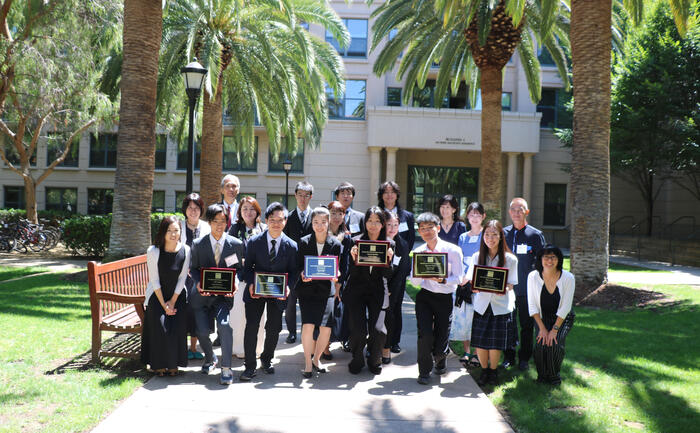
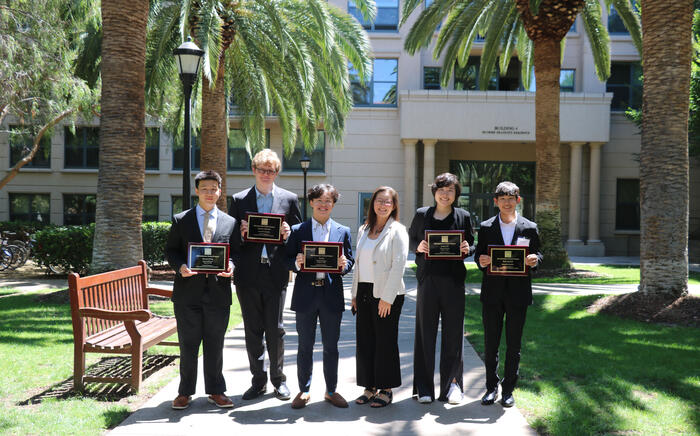
Highest Performing Students of Stanford e-Japan and the Reischauer Scholars Program Are Recognized at Stanford University

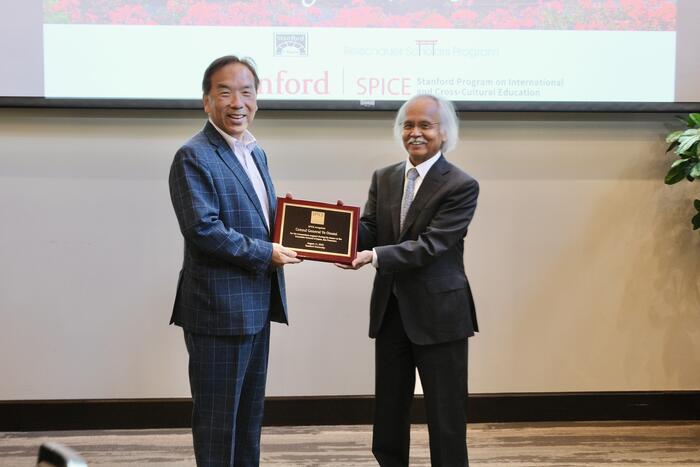
The Honorable Yo Osumi, Consul General of Japan in San Francisco, makes opening comments.
Highest Performing Students of Stanford e-Japan and the Reischauer Scholars Program Are Recognized at Stanford University
collage of Japanese students
News

Empowering the Next Generation of Japanese Leaders

Yanai Scholars, Stanford e-Japan alumni, and EducationUSA representatives highlight a special session for the Spring 2022 Stanford e-Japan students.
Empowering the Next Generation of Japanese Leaders
Hero Image
people sitting around a table
Left to right: Koichi Kimoto, Meiko Kotani, Shodai Tanaka, Issa Sadamoto, Gary Mukai, Chisa Ogaki
Photo Courtesy: Koichi Kimoto
All News button
1
Subtitle

Four Stanford freshmen Yanai Scholars reflect on their experiences.

Date Label
Authors
News Type
Commentary
Date
Paragraphs

People are fed up with political parties, and that's a big problem for democracy, says political scientist Didi Kuo. She joins host Michael McFaul on the World Class podcast to discuss why we need well-functioning parties, how we got the party system we have today, and what can be done to course correct and build better parties for the future.

Watch the video version of their conversation above, or listen to the audio below, on Apple Podcasts, Spotify, and other major podcast platforms. A full transcript of the episode is also available.

Kuo's latest book is The Great Retreat: How Political Parties Should Behave and Why They Don't, published by Oxford University Press.

TRANSCRIPT:


McFaul: You're listening to World Class from the Freeman Spogli Institute for International Studies at Stanford University. I'm your host, Michael McFaul, the Director of FSI. Today, I'm talking with Didi Kuo, a Center Fellow here at th Center on Democracy, Development and Rule of Law. 

She's an expert on comparative politics, democratization, political reform, and she's the new author of this fantastic book called The Great Retreat, How Political Parties Should Behave and Why They Don't.  You should all buy it now. 

Didi, thanks for coming on to World Class with us.

Kuo: Thank you Mike

McFaul: What's the origin story here? Why did you decide to write this book?

Kuo: It's interesting that we're both here at CDDRL because this is very much a product of our intellectual programming. So when I first got to Stanford ten years ago, we started a program on American democracy in comparative perspective.

We at CDDRL have primarily been concerned with how to build strong democracies in places where democracy is emerging and how to have that partner with effective development.

And we started this program on U.S. democracy because we noticed there were these new challenges in the U.S.. I mean, they have historical roots, of course. But we wanted to look abroad and see, are these challenges just in the United States or are they in a lot of other places? And also, what kind of lessons can we draw from them?

And as a result, I got a lot of cool opportunities with the reform community around the United States. And one thing that really struck me is there's deep and widespread anti-party sentiment among a lot of people who care deeply about American democracy. And as a political scientist and a comparativist in particular, it runs counter to everything we know about the relationship of parties and democracy. And really the long-running empirical finding, in anyone who studies democratic consolidation and stability, is that you need strong and robust parties in order to ensure good democratic outcomes.

So, this book was born of a sort of understanding of this big disconnect. We have a public that increasingly dislikes and distrust parties. We also have a lot of historical evidence that we need strong parties to get better democratic outcomes. And in particular, to mediate this relationship of democracy and capitalism that has long been considered stable, but has been fraught, especially at the start in the 19th century.

This book is to try to help us understand what parties historically have been good for, why it is that they're weak today, and why we should think in a kind of pro-party or a party-building framework when we also think about democratic renewal.

McFaul: Well, that's a great segue. Those are three great questions. You just asked three big ‘why’ questions. Let's talk about them in detail.

So, why parties in the first place, right? It's not intuitive, I think, to a lot of people that parties are necessary for democracy. Tell us that story.

And then the next ‘why’ question is, why are they in retreat?

Kuo: There's a long history. We could go all the way back to the beginning of modern democracy when democracy was very limited, right?

So you had these little proto democracies, including the United States, that had legislatures but were not popularly elected in many cases and suffrage was not universal. And in those places you had what Duverger referred to as kind of elite cadre parties. So loose factions in the legislature.

McFaul: Talk about who Duverger is. That just rolls off of your lips, but not necessarily everybody else's.

Kuo: He's a French political scientist who did very early studies of political parties and he's someone who's most well known for an adage that if you have single member districts and first-past-the-post elections, you're likely to get two political parties. And if you have proportional representation, you get multiple parties.

When he was sort of thinking of the history of parties, he noted that they were initially just these elite factions in the legislature. But as democracy expanded and suffrage itself was extended to people who didn't have to own property to vote, there was this kind of dilemma: How do you actually mobilize people into a democratic system and how do you make it actually representative?

And the answer was party organizations.

So parties had to build local chapters. A lot of campaigning and electioneering was very labor intensive. So you had to deploy election agents and volunteers to go literally register people to vote. Parties purveyed the initial journalism, literature, party pamphlets. And elections themselves were often big spectacles. There were public rallies, people voted viva voce, by voice, before the secret ballot. So parties distributed ballots once we got to that era of voting. So a lot of the actual coordination of democratic elections was through parties.

But at the same time, parties performed this linkage function of trying to understand—what are the segments in society? How can we create distinct parties around them that will represent specific constituencies and segments?

And so we have this famous idea from political science that political parties freeze the divisions in society in various ways.

That's kind of a static conception of the party, but over time parties, of course, adapt to the modern era. Once we have full suffrage, for example, parties already have an infrastructure that allows them to integrate new voters. And as we move into the post-war era, in the 19th century, there was a lot of skepticism about whether or not you can have market capitalism and democracy. People like Karl Marx said that these institutions are just going to get captured, right?

McFaul: Right. Right.

Kuo: The post-war consensus about democratic capitalism was because political parties could serve a function of mobilizing interests distinct to capital. You got labor parties and social democratic parties that had strong ties to trade unions. You had the mainstream parties of the center-left and the center-right that alternated in power, competed in fairly predictable ways along a set of economic interests and issues, and developed policy programs that hewed to their different kind of ideological conceptions of the relationship of states and markets.

That's a long way of answering the question of why we have parties. They serve an electoral function and they also serve a representative intermediary linkage function.

Now the retreat. The retreat is after the 1970s, which is an era that, you know . . .

McFaul: It was way back then! Oh! Not just in the last four or five years. That's interesting. Go ahead. I didn't mean to interrupt. Go ahead.

Kuo: No, it's okay! So you get a bunch of different things happening beginning in the 70s, but really accelerating in the 90s.

First, parties adapt to changing communications technology. They become more professionalized and more nationalized. So you start to see an atrophying of local party organizations arise in the use of, first it was direct mail and then of course, if we accelerate way into the nineties, it starts to be a little bit digital. And now, television advertising, et cetera, allows parties to reach voters directly.

So they rely more on professional polling strategists, consultants, to do a lot of the campaign messaging that used to be done in-house or even through a more bottom-up process. And those have had the effects of potentially eroding the intermediary and linkage function of parties, despite the fact that parties continue to be very good at winning elections.

The book focuses at length, I would say, on the 90s, the end of the Cold War, when there's a real consensus about market and political liberalization around the world. And the way that that takes root in Western democracies is through cross-partisan agreement that economic growth should be the foremost goal of government, and that the way to achieve growth is through policies we would associate with neoliberal orthodoxy.

So, deregulation, free trade, globalization, cutting corporate taxes. And that basically creates a consensus in favor of a pro-market, anti-state relationship of democratic capitalism.

McFaul: Just so I'm clear, that happened in both Europe and the United States? Left parties both moved that way, right? I know the American story pretty well. That's like Bill Clinton and the Democratic Leadership Council and the Third Way. It was not just in our countries, it was in Europe as well?

Kuo: Right! And there's a really interesting history of Bill Clinton, Tony Blair, Gerhard Schröder, new leaders who led these insurgent factions within parties of the left to say we have an electability crisis. In order to become a majority party once again, we're going to need to adopt some of the policies of the right and we can do it with social democratic characteristics. We can still care about alleviating poverty through market means. We don't have to rely on the state.

And so you have people like Bill Clinton saying the era of big government is over. But you also have Western European leaders within the social democratic parties getting together at different Third Way conferences and conventions talking about a new era of global social democracy.

And in Europe, the way that that really took hold was the project of the European Union, which provides a really interesting comparison to the United States because once the EU is up and running as a common currency union and it is responsible for a lot of macroeconomic policy, and the free movement of goods, people, and capital across borders, it constrains what national governments can offer. And political parties across Europe, especially of the left, become more constrained in the kinds of economic policies that they adopt in elections. And that kind of convergence of parties nationally provides ample opportunity for extremist parties to fill that void in representation.

It is not dissimilar from what happened in Latin America after structural adjustment policies implemented and mandated by the West take hold in the 80s and 90s, where you have parties along the political spectrum of the left and the right implementing very similar austerity policies, scaling back the scope of their bureaucracies, and in doing, also muddled party distinctions in a way that created more voter antipathy and distrust and ultimately paved the way for more extremist leaders there as well.

McFaul: So, to fast-forward, let's do America and if we have time, we'll come back to Europe . . . tell us a little more about the more recent, and let's focus on Trump first, right?

So Trump seems to be a highly disruptive person within the Republican Party, both in terms of his worldviews and his ideas, but also in terms of his methods, right? Tell us how Trump took over the Republican Party.

Kuo: So there are two things I would point to here.

One is that some of the trends that we've already talked about, including professionalization and nationalization have been true everywhere, right? You need less of a party infrastructure these days. It's something that Allen Hicken and Rachel Riedl have called party deinstitutionalization around the world. Nowadays, a lot of leaders can just use social media to connect directly to audiences.

McFaul: Right. As Trump most certainly did, right? I mean, the first time he ran, he just went, he was on Twitter. He didn't have to go through the party and he didn't have to go on TV.

Kuo: Well, he was already a celebrity.

McFaul: He was already a celebrity, right.

Kuo: As a result, you can obviate a party infrastructure entirely as a candidate. And that's led to trends of personalization. And there's a great new book about how we're entering an era of personalistic parties where they still compete in democratic elections, but they are vulnerable to takeover by specific individuals.

Of course, the way that parties succeed in supporting democracy is when they can transcend the needs of any one individual, right? And they become these brands that last over time and people need to kind of put aside their self-interest to work in the interest of a party. It has a disciplining effect.

Under a personalistic party, of course, there is no such thing and it starts to resemble more of the worlds that you're familiar with: one in which loyalty to an individual is paramount and institutions are only important in so far as they serve the desires of that individual.

I was just reading this morning—and I know we're going a little wide—that Republican members of Congress are now asking for specific exceptions to the DOGE cuts. Which is, of course, what happens in a patrimonial regime and in an era, that I've written about, when patronage and clientelism were far more pervasive than they are today. So building a clean state takes a very long time. Dismantling it can be very fast.

So, on the one hand, there are some trends in political parties and the way they organize that make it more likely that an individual can come to power very quickly. But on the other hand, the other trend that I think is global rather than—or at least in the West—is that of far right extremism.

You and I have written about global populism years ago and we now see through any number of different kinds of overlapping reasons, but one of them is that people are upset at, sort of, this bargain of democratic capitalism, right? It hasn't worked for a lot of people, especially the workers who are left behind by the promise of globalization.

And if we think of the 21st century, the global financial crisis didn't translate into some kind of change in the political alignment or the left and the right, at least that change hasn't been fast by any means. And after the COVID pandemic, that's kind of a juncture of even more distrust. It accelerated that. As a result, you have a lot more general grievance, discontent in the electorate that, again, is ripe for extremist messaging. People don't feel loyal to democratic institutions or processes.

Now, it's not a given that just because there's a combination of democratic and economic unrest that you're necessarily going to get strongman leaders, but it certainly makes it more likely. It can facilitate that kind of politics.

Those are both what I see as long running factors that produced President Trump.

And then I'll just point to a very quick thing is that in the book, I spent some time in the conclusion arguing that when there's a imbalance between who democracy serves—you know, say we go in a much more sort of pro-market private sector direction—it makes it much harder for the government to articulate its raison d'être and the way that the government has effectively protected people or implemented programs that people care about.

These anti-state attitudes have been building in the United States for a really long time and that has made it more likely that people think the private sector should solve problems and it has also has really accelerated the thing that none of us really foresaw which is things like the private sector now, Elon Musk, being asked to make decisions about how the federal government should operate.

For the world's richest man, who's not democratically elected, to take a chainsaw to government and to seemingly do it without being held to account, because the litigation process is going to be slow and is likely to have differential outcomes depending on which circuit court you go to, that is an outcome that I didn't really anticipate: that we would literally just give capitalists the keys to the kingdom.

McFaul: Well, you and me both. I mean, just one more question on that and then let's talk about some solutions or party systems that work.

So this paradox in the United States: I'll just make it personal, but it's an anecdote about a bigger story that's in your book.

I grew up in a working-class Catholic family in Montana. Both my parents were members of unions. And my grandfather was a union leader in Wisconsin at a factory, right?

They voted for decades for Democrats, no question about it. There was never any debate. It was just, “we’re part of the Democratic Party.” And now, seeing the data from the last several election cycles, you have this flip where people that self-identify as working class or less well-off in terms of income, vote for, as you say, a billionaire who's a president who's got as his lieutenant or co-president the richest man in the world. That's such a paradox to me. How did that happen?

Kuo: This his realignment of around class and education has been somewhat long in the running, I suppose.

Since the 90s, people have noted that there's new middle-class coalitions that support, for example, the DLC and the project of the Third Way. Whereas the Republican Party, which used to be very reliably the party of capital, has very recently been breaking its long-standing alliance with business.

When Kevin McCarthy was speaker, he argued that corporations are becoming “too woke.” That chambers of commerce are not reliably Republican enough. And we've started to see these tensions, within and among capitalists themselves, they say we need to move towards stakeholder capitalism rather than shareholder capitalism and embrace environmental, social, and governance goals and implement DEI projects.

All of that has been under attack by certain Republican leaders and Republican governors like Greg Abbott and Ron DeSantis. And today, I think we have a very uneasy relationship between capitol and the Republican Party. We've seen a lot of owners of corporations capitulate very quickly to Trump. But again, I don't think that this is like a long-term winning strategy.

But the realignment is also around education. So part of it is that there's not really a reliable party of the working class. And the left is in crisis across the advanced democracies. The social democrats have had very bad electoral showings. In Germany, the worst post-war electoral showing ever was a few weeks ago.

And when that happens, the parties of the left now are more likely to represent people who are better educated. So professionals with higher levels of education, more reliably vote for parties of the left.  Whereas the working class is either up for grabs or increasingly is targeted by parties of the right, not necessarily through economic appeals, but instead through kind of grievance and nationalism, xenophobia, those kinds of cultural issues.

There are some scholars who have been able to empirically document that contestation over economic policy has either declined or stayed the same over the past 30 or 40 years, while there's been an uptick in contestation over cultural issues or ones that are person-based, that are less divisible, that there's less issues, areas for compromise. And that's how you're simultaneously able to see polarization between parties, even though there's also kind of an underlying—or was for a while, at least—economic consensus.

Which is all just to say that the issue of “who do the working class vote for?” is increasingly unsettled.  And both parties claim to represent the working class, although they do so in very different ways.

McFaul: Two last questions. I know we're running out of time. First, what's a good example of a well-functioning party system in the world?

Kuo: A party system that functions well is one that kind of preserves democracy and party competition.

And there are many places in Western Europe, where we still see similar trends of  less rates of party membership. People are less likely to want to join parties. They may switch their votes more, but those parties are still able to preserve democratic procedures and fairness.

I would point to places where parties have actually succeeded in blocking anti-democratic candidates.

In France, there have been multiple times that Marine Le Pen's National Rally made it to the final round of the French presidential election and the parties worked together to stop that. And that was also true when it looked as if that party, the National Rally, was going to make inroads in French legislative elections. All parties worked together to preclude that from happening by sort of bargaining over where they would run candidates.

You know that Poland's Law And Justice party finally suffered electoral defeat and was precluded from a majority by, again, a lot of civil society actors coming together with political parties across the spectrum to block PiS. 

And in Brazil and South Korea, leaders who have overreached have been held to account. 

That's less about parties in general and more about parties in moments of democratic crisis when there's a real possibility of an anti-democratic leader being elected. But I think that in the United States, we now face this question that is prior to building strong parties, we need to establish pro-democracy coalitions across people who disagree, you know, whose issues are not the same, who care about different things. But you have people in the center-right, who now don't have a party. You have people across the political spectrum who should care more about principles and American values than they do about whether or not they should continue to capitulate to this administration in this moment.

McFaul: Right. Well, you may have just answered my last question, but if you were going to write a decade from now, a new book called The Great Renewal, How Political Parties Should Behave and Why They Do, what would have to change in that decade for you to be able to write that book?

Kuo: There's one theory of democratic transition called “pacting” about when, you know, elites come together and create just an agreement that they're going to put down their arms and agree on these rules of the game. 

The most basic thing that needs to happen is a recommitment to American values and holding people accountable who have violated those values. And I would say those values have to do with accountability, rule of law.

But that's a conversation for another time  But the first thing would be to get the democratic house in order to allow fair play and reestablishing the rules of the game.

The other things that I would really like to see are for parties to reestablish themselves as linkage organizations. And you could do this in any number of ways. One is that parties have been delegating a lot of the work of elections to outside groups. So get out the vote efforts, messaging, issue areas. They can bring that back in-house.

And Giovanni Sartori, a political scientist, once described parties as a transmission belt between society and leaders. If they want to do that again, they will need to bring all of that knowledge and work back within the parties and allow for a bottom-up process of listening to what it is people on the ground want. I don't want to just say voters, because they are more than that. Citizens, people who are living in this country and making their living here and trying to make it a better place also need some way of having their voices heard within the party and for parties to serve that sort of deliberative, factional, mediating function again.

I'd also like to see changes to campaign finance where we learn from most other democracies that have reigned in how private money can affect elections. We have really a diffuse campaign finance system now where many—especially billionaires—can influence politics or at least get their preferred outcome by acting through any number of channels outside the party. But given the current Supreme Court interpretation of speech and equating it to money, it's unlikely that we'll see that anytime soon, but I think it would be good for our political system.

And finally, I would like people who have an issue they care about, or who think the parties are failing, to work within parties rather than outside of them. You can build power outside of a party, but eventually you will need to work within the channels of party organizations to accomplish long-lasting change.

And I think that if people could sort of imagine a world in which they are partisans, but not in a fake way or a way that's highly attenuated from everyday action, but partisans who realize that compromise is part of this, and negotiation, and doing the hard work of everyday politics, seeing that as a goal rather than an enemy, I think would be very helpful.

McFaul: Well those are all very practical things to think about and for people to do.

So Didi, congratulations! Thanks for being on World Class.

The book is called The Great Retreat, How Political Parties Should Behave and Why They Don't.

Please buy this book. If you don't buy books like this, they won't get written in the future. And we need this kind of research for the health of our democracy. This book is not just about parties; it's really about the future of democracy here in the United States and Europe.

So congratulations, Didi! Great to have you on World Class.

Kuo: Thanks Mike, thanks everyone for listening.

McFaul: You've been listening to World Class from the Freeman Spogli Institute for International Studies at Stanford University. If you like what you're hearing, please leave us a review and be sure to subscribe on Apple, Spotify, or wherever you get your podcasts to stay up to date on what's happening in the world and why.

Read More

Meet Our Researchers: Dr. Didi Kuo
Q&As

Meet Our Researchers: Dr. Didi Kuo

Examining democratization, political reform, and the role of political parties with FSI Center Fellow Dr. Didi Kuo.
Meet Our Researchers: Dr. Didi Kuo
Steven Pifer on World Class podcast
Commentary

Assessing Europe's Security After Three Years of War in Ukraine

Steven Pifer joins Michael McFaul on World Class to discuss how America's relationship with Ukraine and Europe is shifting, and what that means for the future of international security.
Assessing Europe's Security After Three Years of War in Ukraine
Didi Kuo
News

In her new book, Didi Kuo argues political parties no longer exist to represent their constituents

Kuo, a fellow at the Freeman Spogli Institute for International Studies, says this evolution lays the groundwork for serious imbalances in who democracy serves.
In her new book, Didi Kuo argues political parties no longer exist to represent their constituents
All News button
1
Subtitle

Didi Kuo joins Michael McFaul on the World Class podcast to explain why political parties are an essential part of a democracy, and how they can be reshaped to better serve the people they represent.

Date Label
Authors
Soraya Johnson
News Type
Q&As
Date
Paragraphs

The "Meet Our Researchers" series showcases the incredible scholars at Stanford’s Center on Democracy, Development and the Rule of Law (CDDRL). Through engaging interviews conducted by our undergraduate research assistants, we explore the journeys, passions, and insights of CDDRL’s faculty and researchers.

Michael Bennon is a Research Scholar and program manager of CDDRL’s Global Infrastructure Policy Research Initiative. Having served as a Captain in the US Army and US Army Corps of Engineers, he now teaches Global Project Finance at Stanford University. His research focuses on infrastructure development, specifically on the importance of restructuring incentives, public-private partnerships, legal regulation, and the shifting landscape of foreign investment in infrastructure.

What inspired you to pursue research in your current field, and how did your journey lead you to CDDRL?


I used to work for the federal government as an engineer. We were constantly running into hurdles, unnecessary red tape, and misaligned incentives — I felt there had to be a better way to do infrastructure development. So, I went to graduate school at Stanford, studying under Dr. Raymond Levitt, who focused on the cross-disciplinary intersection of engineering, international relations, finance, and law. We worked to address gaps in the research world regarding infrastructure development from a project finance perspective.

After graduate school, I continued working with Dr. Levitt and began teaching about the financing of large infrastructure projects. I began collaborating with CDDRL when researching China’s Belt and Road Initiative (BRI) and international infrastructure development more broadly. The throughline of my journey, from focusing on engineering to organization management to law, has been to follow the biggest challenges in infrastructure.

How do you visualize the creation of more effective incentive structures to motivate private companies to further global development? How can the public-private partnership work more effectively?


There's a myriad of flaws in the infrastructure development sector with incentives. The basic disconnect is that in a democracy, elected officials rely on bureaucracy and various agencies to develop complex infrastructure projects, which can lead to a convoluted system. When a government infrastructure project goes over budget, the many groups involved often don’t bear the costs — taxpayers do.

However, effective public-private partnerships can help solve these broken incentives. For example, if a project is structured so that the companies building the infrastructure are also responsible for maintaining it, then they are incentivized to create projects that last.

Internationally, in the old pre-BRI paradigm of development, there were two ways for a developing country to fund its infrastructure: either by borrowing money or financing projects through foreign direct investment. For the latter, there’s a form of private-public partnership, as international investors invest directly into the project instead of through the government.


Effective public-private partnerships can help solve broken incentives. For example, if a project is structured so that the companies building the infrastructure are also responsible for maintaining it, then they are incentivized to create projects that last.
Michael Bennon


How has infrastructure development been used to gain influence in diplomacy? How has our understanding of that tool changed since BRI, and how successful has it been for China?


Infrastructure development has always been a problematic tool for amassing geopolitical influence; it builds friendships when loans are going out, then creates enemies once they’re issued. A recent example is the 1997 Asian financial crisis when Western countries had invested in power plants throughout the continent, only for many countries to default and expropriate. This has happened repeatedly throughout history.

While China’s done quite well at protecting its economic interests in infrastructure projects, it's a mixed bag due to the prevalence of moral hazard, public backlash, and the tarnishing of diplomatic ties. With the state being so heavily involved in BRI, China intervenes when countries want to default or expropriate, protecting its interests and those of state-owned enterprises effectively. However, this can lead to a moral hazard problem because these enterprises feel too protected by China and act without the appropriate caution while building risky projects.

Today, many countries that have received BRI lending have serious relational problems with China, if not at the government level, then among the public. People tend to push back and feel taken advantage of when a foreign country comes in and builds projects, especially with rumor mills churning out narratives about China’s 'debt-trap diplomacy.' These diplomatic challenges were true long before the BRI and persist today.

Why do countries, through BRI or other means, decide to take on infrastructure projects they obviously can’t afford?


Countries often don’t behave rationally — politics, corrupt officials, and conflicting interests all affect policymaking. Also, everyone builds infrastructure projects that may bankrupt them, partly due to an ingrained optimism bias in the infrastructure sector.

We’re in the worst developing country debt crisis in modern history, and countries are having a difficult time navigating a changing infrastructure lending landscape. China is now the largest bilateral lender, and its absence from international organizations like the Paris Club prevents the unified action needed to allow countries to emerge from debt crises. Even the International Monetary Fund (IMF) is struggling to help them, as it is cautious about issuing aid to countries with murky BRI loans to pay back.

Funding for infrastructure development can be used as an incentive for democratization through conditionality on loans. However, many countries are turning away from traditional Western lending institutions in favor of alternative lenders with fewer conditions. How can we balance the importance of conditionality and incentivizing democratization while preventing the decreased reliance on Western institutions?

Conditionality can be positive in promoting democratization, but there have to be limits to it, especially because it becomes less effective when alternative lenders like China exist. Conditionality began as limited to policies that promote democratization, development, and liberalization but has metastasized to the point where lenders are pushing a wide range of policies on borrower countries. Many of these conditions, such as environmental or social protections, are good policies but can be viewed as a manifestation of Western imperialism within these countries. These programs also become futile when countries become simply incentivized to seek Chinese loans instead, which have virtually no conditionality.

Is the turn away from Western lending institutions an inevitable shift, or can policy changes encourage its prodominance again, if that’s something that we want?


Western institutions are better for infrastructure development, as organizations like the World Bank are the best at protecting human rights and preventing environmental disasters. There are also strategic and security reasons for promoting Western institutions — for example, we don’t want Chinese technology companies building telecommunications grids in other countries.

The bigger question is, what would a return to a Western-dominated model of investment look like? Pre-BRI, there was an open, liberal system of direct investment from private companies. BRI represented a pivot to more state-driven investment. Should the US shift to a similar model, or return to private direct investment fueling infrastructure development? The Biden administration’s alternative to BRI for state-driven investment was the Partnership for Global Infrastructure and Investment (PGII). Despite mutual investment in telecommunications and renewable energy, PGII focuses on developing very different sectors than BRI, building social impact projects like healthcare infrastructure.

What is the most exciting or impactful finding from your research, and why do you think it matters for democracy, development, or the rule of law?


I’m focusing on how liberal democracies can get building again, so I researched flaws in domestic infrastructure projects within the US. It revealed how the judicial system was an engine fueling how infrastructure projects are conducted; I realized the extent to which permitting regulation and environmental litigation had been driving my own incentives when I was a bureaucrat. Decisions are often made in response to case law and to ‘litigation-proof’ projects, which can incentivize inefficient and expensive project management. I believe democracies are perfectly capable of building infrastructure projects well, but problems in current building initiatives, from the California High-Speed Rail to our housing crisis, are rooted in the outsized effects of the threat of lawsuits.


I believe democracies are perfectly capable of building infrastructure projects well, but problems in current building initiatives, from the California High-Speed Rail to our housing crisis, are rooted in the outsized effects of the threat of lawsuits.
Michael Bennon


How do you see your research influencing policy or contributing to real-world change?


I do research on practical public-private partnership policy in the United States, working with the Build America Center and the Department of Transportation to directly supply the government with research when needed.

There are policy changes that must occur to promote effective infrastructure development. The US will have to reform institutions that predated BRI to adapt to today’s post-BRI world. The three key institutions are the World Bank, the IMF, and the World Trade Organization (WTO). I hope that my ideas can influence their restructuring. For domestic development, I’m continuing my work with the Build America Center on how governments can more efficiently procure infrastructure projects and help public officials adopt best practices.

Lastly, what book would you recommend for students interested in a research career in your field?


The first book, which is extraordinarily boring but crucial to infrastructure development, is The Strategic Management of Large Engineering Projects: Shaping Institutions, Risks, and Governance. Written by Miller, Lessard, Michaud, and Floricel, it includes the perspectives of MIT engineers on infrastructure project case studies to understand why so many have failed. For some great history, the economist Raymond Vernon’s book Sovereignty at Bay develops the idea that relationships sour over international investment and that it’s not an effective diplomatic tool.

Read More

Launching viaduct bridge in progress for Pune metro rail project in Pune city, Maharashtra, India.
News

CDDRL’s Leadership Academy for Development Announces New Public-Private Partnerships Program with the International Finance Corporation

The Center on Democracy, Development and the Rule of Law’s (CDDRL) Leadership Academy for Development (LAD) is embarking on a new partnership with the International Finance Corporation to educate senior leaders on infrastructure policy, governance, and public-private partnerships.
CDDRL’s Leadership Academy for Development Announces New Public-Private Partnerships Program with the International Finance Corporation
Construction on a building in Sri Lanka
Q&As

Stanford Researchers Explore the Challenges Created By and Reforms Needed to Improve China’s Belt and Road Initiative

Francis Fukuyama and Michael Bennon share their insights on the potential implications of the Belt and Road Initiative (BRI) on global development finance, as well as suggestions for reforms that could bolster international stakeholders’ ability to manage any potential debt crises arising from BRI projects.
Stanford Researchers Explore the Challenges Created By and Reforms Needed to Improve China’s Belt and Road Initiative
Hero Image
Meet Our Researchers: Michael Bennon
All News button
1
Subtitle

Investigating how infrastructure project financing has changed amidst global geopolitical competition and how democracies can more effectively build in the future with CDDRL research scholar Michael Bennon.

Date Label
Subscribe to United States