


Democracy World with Francis Fukuyama
News Type
Commentary
Date
Paragraphs
"I don't think anyone, including many in the media themselves, would say that they are somehow completely political neutral, but a much deeper assertion was made where even factual statements and fact-checking done by organizations like the New York Times or CNN were called into question, and they were called into question by people purporting to put forward facts that really had no actual empirical basis other than the fact that someone had said it on the Internet," says CDDRL Mosbacher Director Francis Fukuyama.
Hero Image

All News button
1
Competing Narratives on Syria amid International Escalation
-
ABSTRACT
By now, those following the news on Syria have been saturated with analysis, data, information, and misinformation on developments there since 2011. Yet we observe an increasing gravitation to mutually exclusive narratives that adorn websites and publications on the situation in Syria: (a) the narrative of pure and consistent revolution versus that of (b) external conspiracy/designs on Syria. Both narratives carry grains of truth, but are encumbered by maximalist claims and fundamental blindspots that forfeit various potentials for enduring cease-fires and/or transitions, let alone mutual understanding. This talk will address these competing narratives in the context of international escalation marked by increasing US-Russian tension and continued multi-layered conflicts on the battlefield. It closes with addressing a framework for understanding and gauging potential prospects despite conflicting declarations by all parties involved.
SPEAKER BIO
Image
*This event is supported by the Stanford Initiative for Religious and Ethnic Understanding and Coexistence
Reuben Hills Conference Room
2nd Floor East Wing E207
Encina Hall
616 Serra Street
Stanford, California 94305
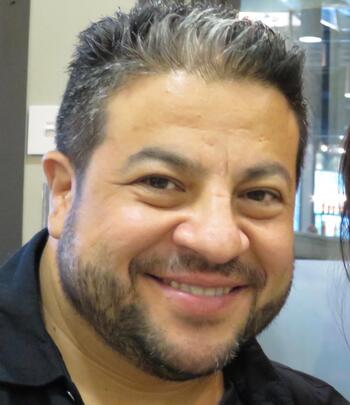
Bassam Haddad
Associate Professor
George Mason University
Seminars
Bassem Youssef Joins ARD as a Visiting Scholar
News Type
News
Date
Paragraphs
The Program on Arab Reform and Democracy (ARD) at Stanford’s Center on Democracy, Development, and the Rule of Law (CDDRL) is pleased to welcome international media figure and Egyptian political satirist Bassem Youssef as a visiting scholar during the Fall of 2016. Dubbed the Jon Stewart of the Arab World, Youssef was the host of the popular TV political satire show Al-Bernameg, which was the first of its kind in the Middle East region. Al-Bernameg was the most watched show in the history of Egyptian TV with an average of 40 million viewers every week. Due to its sharp criticism of Egyptian leaders, Al-Bernameg faced political pressure from successive governments until it was finally taken off the air in the summer of 2014. Recently, Youssef launched “The Democracy Handbook,” a Fusion TV digital series that satirizes American politics through a Middle Eastern perspective. Named one of TIME’s “100 most influential people in the world” in 2013, Youssef served as a resident fellow at the Institute of Politics at Harvard University’s Kennedy School of Government in 2015.
Youssef’s fellowship is supported by a generous grant from the Carnegie Corporation, and by the Stanford Arts Office of the Associate Dean. In the following interview Youssef discusses his current projects and their relevance to the Stanford community.
[[{"fid":"224139","view_mode":"crop_870xauto","fields":{"format":"crop_870xauto","field_file_image_description[und][0][value]":"Bassem Youssef at CDDRL","field_file_image_alt_text[und][0][value]":"","field_file_image_title_text[und][0][value]":"","field_credit[und][0][value]":"Djurdja Jovanovic Padejski ","field_caption[und][0][value]":"Bassem Youssef speaking with members of the CDDRL community at Stanford University, September 29, 2016","field_related_image_aspect[und][0][value]":"","thumbnails":"crop_870xauto"},"type":"media","attributes":{"width":"870","class":"media-element file-crop-870xauto"}}]]
Bassem Youssef in conversation with ARD Associate-Director Hesham Sallam and CDDRL Visiting Scholar Alexandra Pichler Fong at the CDDRL fall 2016 reception, September 29, 2016 (Photo credit: Djurdja Jovanovic Padejski)
What are your research goals and priorities at CDDRL, Stanford?
I am not a stranger to CDDRL. About a year ago I spoke at the Center in conversation with Professor Larry Diamond in what might have been one of the best interviews I had on a college campus in the United States. During my visit, I was very impressed with CDDRL’s efforts to try to make sense of all what is happening in the Middle East and to nuance American perspectives on the situation the region. I was elated when I was informed that there was a chance for me to join forces with this prestigious center.
Through my fellowship at CDDRL, I would like to bring a different voice to the discussion over what is happening in the Middle East and the Muslim World, and how narratives in the United States can affect the realities in the region. Beyond my own research on satire and social change, my priority is to connect with the student community at Stanford and encourage them to find their own voices and their own opinions about that part of the world. I believe that satire can be a great tool to understand and even change how people view the world around them. As much I have a lot to share with students, I am sure I will have a great deal to learn from them too, and from the Stanford community more generally. I had the privilege to meet with some of the smartest young people here and I look forward to benefit from this intellectually promising experience.
How are the ongoing political developments in the United States informing your current projects?
After I moved to the United States, I started to follow the American elections very closely. With the rise of a populist Right not just in the States but also in Europe, I could see many similarities of how masses are being controlled through hate, xenophobia, and fear. These have been key elements in the narratives used by many Middle Eastern regimes for decades. As people were horrified with the likes of Donald Trump, Ted Cruz and Ben Carson, this came to me as a reminder that no nation, no matter how strong or advanced, is free of such forms of public manipulation and fear-mongering. This was a great starting point for me here in the States. I discovered many similarities that I can comment on and use to show people that we are not that different from each other and that intolerance and bigotry have no single home or language. I was fortunate to relay that message in my new show in America "Democracy Handbook" and also in my coverage of the National Conventions of the Republican and Democratic Parties.
What is your assessment of the prospects for meaningful political change at the current moment in Egypt?
The current realities in Egypt and the Middle East are a product of decades of authoritarian rule. What happened in the Arab Spring interrupted the rule of particular autocrats, but did not succeed in delivering the type of lasting social change we all had hoped for. The biggest obstacle to meaningful social change in Egypt remains the massive webs of special interests that have ruled the country for the last 60 years and shaped its political and social hierarchies. It was naive of us to think that 18 days of protests could make profound changes to the system. You can get rid of the autocrat at the helm, but the system can still endure, as evidenced by the current realities. Any changes will be worthless in the absence of complete transparency and accountability of the ruling class that controls the country’s economy, governance, and legislation.
Hero Image

All News button
1
Taiwan's Democracy Challenged: The Chen Shui-bian Years
-
Image

This discussion will be based on the authors' recently published book, Taiwan's Democracy Challenged: The Chen Shui-bian Years, Lynne Rienner Publishing (2016).
Abstract
At the end of Chen Shui-bian’s two terms as the president of Taiwan, his tenure was widely viewed as a disappointment, if not an outright failure. Today, the Chen years (2000-2008) are remembered mostly for relentless partisan fighting over cross-Strait relations and national identity questions, prolonged political gridlock, and damaging corruption scandals—as an era that challenged, rather than helped consolidate, Taiwan’s young democracy and squandered most of the promise with which it began.
Yet as Taiwan’s Democracy Challenged: The Chen Shui-bian Years documents, this conventional narrative obscures a more complex and more positive story. The chapters here cover the diverse array of ways in which democratic practices were deepened during this period, including the depoliticization of the military and intelligence forces, the ascendance of an independent and professional judicial system, a strengthened commitment to constitutionalism and respect for the rule of law, and the creation of greater space for civil society representatives in the policy-making process. Even the conventional wisdom about unprecedented political polarization during this era is misleading: while elite politics became more divided and acrimonious, mass public opinion on cross-Strait relations and national identity was actually converging.
Not all developments were so positive: strong partisans on both sides of the political divide remained only weakly committed to democratic principles, the reporting of news organizations became more sensationalist and partisan, and the Taiwanese state’s exceptional autonomy from sectoral interests and vaunted capacity for long-term planning deteriorated. But on the whole, the authors argue, these years were not squandered. By the end of the Chen Shui-bian era, Taiwan’s democracy was firmly consolidated.
This event is sponsored by the Taiwan Democracy Project in the Center on Democracy, Development, and the Rule of Law. It is free and open to the public, and lunch will be served. Please RSVP by October 31.
Taiwan's Democracy Challenged presentation slides
Download pdf
CISAC Central Conference Room, Encina Hall 2nd Floor
Larry Diamond
CDDRL
Stanford University
Encina Hall, C147
616 Jane Stanford Way
Stanford, CA 94305-6055
0
ldiamond@stanford.edu
Mosbacher Senior Fellow in Global Democracy at the Freeman Spogli Institute for International Studies
William L. Clayton Senior Fellow at the Hoover Institution
Professor, by courtesy, of Political Science and Sociology
Larry Diamond is the William L. Clayton Senior Fellow at the Hoover Institution, the Mosbacher Senior Fellow in Global Democracy at the Freeman Spogli Institute for International Studies (FSI), and a Bass University Fellow in Undergraduate Education at Stanford University. He is also professor by courtesy of Political Science and Sociology at Stanford, where he lectures and teaches courses on democracy (including an online course on EdX). At the Hoover Institution, he co-leads the Project on Taiwan in the Indo-Pacific Region and participates in the Project on the U.S., China, and the World. At FSI, he is among the core faculty of the Center on Democracy, Development and the Rule of Law, which he directed for six and a half years. He leads FSI’s Israel Studies Program and is a member of the Program on Arab Reform and Development. He also co-leads the Global Digital Policy Incubator, based at FSI’s Cyber Policy Center. He served for 32 years as founding co-editor of the Journal of Democracy.
Diamond’s research focuses on global trends affecting freedom and democracy and on U.S. and international policies to defend and advance democracy. His book, Ill Winds: Saving Democracy from Russian Rage, Chinese Ambition, and American Complacency, analyzes the challenges confronting liberal democracy in the United States and around the world at this potential “hinge in history,” and offers an agenda for strengthening and defending democracy at home and abroad. A paperback edition with a new preface was released by Penguin in April 2020. His other books include: In Search of Democracy (2016), The Spirit of Democracy (2008), Developing Democracy: Toward Consolidation (1999), Promoting Democracy in the 1990s (1995), and Class, Ethnicity, and Democracy in Nigeria (1989). He has edited or coedited more than fifty books, including China’s Influence and American Interests (2019, with Orville Schell), Silicon Triangle: The United States, China, Taiwan the Global Semiconductor Security (2023, with James O. Ellis Jr. and Orville Schell), and The Troubling State of India’s Democracy (2024, with Sumit Ganguly and Dinsha Mistree).
During 2002–03, Diamond served as a consultant to the US Agency for International Development (USAID) and was a contributing author of its report, Foreign Aid in the National Interest. He has advised and lectured to universities and think tanks around the world, and to the World Bank, the United Nations, the State Department, and other organizations dealing with governance and development. During the first three months of 2004, Diamond served as a senior adviser on governance to the Coalition Provisional Authority in Baghdad. His 2005 book, Squandered Victory: The American Occupation and the Bungled Effort to Bring Democracy to Iraq, was one of the first books to critically analyze America's postwar engagement in Iraq.
Among Diamond’s other edited books are Democracy in Decline?; Democratization and Authoritarianism in the Arab World; Will China Democratize?; and Liberation Technology: Social Media and the Struggle for Democracy, all edited with Marc F. Plattner; and Politics and Culture in Contemporary Iran, with Abbas Milani. With Juan J. Linz and Seymour Martin Lipset, he edited the series, Democracy in Developing Countries, which helped to shape a new generation of comparative study of democratic development.
Download full-resolution headshot; photo credit: Rod Searcey.
Former Director of the Center on Democracy, Development and the Rule of Law
Faculty Chair, Jan Koum Israel Studies Program
Hide publication sections
Off
Seminars
A way to bridge aging societies in Japan and South Korea
News Type
Commentary
Date
Paragraphs
Japan and South Korea face serious demographic crises. Japan has the oldest population in the world and South Korea is one of the most rapidly aging. Together they top the list in terms of proportion of elderly by 2050, with 40.1% and 35.9% respectively being 65 and over, according to a U.S. Census Bureau forecast. Both nations are seeing shrinking working-age populations, with their birthrates among the lowest in the world. This puts them at great risk as they struggle to find new engines of economic growth.
Some experts argue that Japan and South Korea should encourage immigration. The former head of Tokyo's Immigration Bureau, Hidenori Sakanaka, said that "we need an immigration revolution to bring in 10 million people in the next 50 years, otherwise the Japanese economy will collapse." Jongryn Mo, a professor at Yonsei University in Seoul has written a book, "Strong Immigration Nation," urging a similar policy for South Korea.
Is migration the answer?
Japan and South Korea are already supplementing their shrinking workforce with foreign labor, mostly unskilled migrant workers from China and Southeast Asia doing jobs that locals shun.
But it is time to attract more skilled workers. In Japan, only 18.4% of foreign workers were technicians or professionals in 2015, while the figure in Korea is just 7.8% this year. Skilled foreign workers can fill many jobs from staffing hospitals to working as technicians in middle-tier companies and software engineers in large ones.
The challenge, however, is that both countries remain exclusionary, closed societies despite a substantial rise in the numbers of foreigners. Politicians fear losing votes from workers worried about foreigners taking their jobs.
According to a recent report by the French business school INSEAD, Japan and South Korea are ranked 53rd and 61st, respectively in their level of tolerance for immigrants. Most foreign skilled workers have little intention to settle down in Japan or South Korea on a permanent basis, although unskilled ones might be more willing to stay.
Maria, a Guatemalan professional, decided to leave South Korea after working for six years in the overseas marketing department of a large Korean corporation. "Some Koreans complain that foreigners leave after a few years, but we leave because we're never included in the first place. Korean companies pay a lot to bring foreigners here. And then they don't even ask these people about their opinion."
Srey, a Cambodian student studying in Japan, said, "The Japanese are very helpful and very friendly, but at the same time they look at me as a 'gaijin' no matter how good I am at Japanese or able to speak to them. I am not planning to work in Japan."
Bridging strategy
South Korea and Japan need to find a more creative strategy in utilizing foreign talent. In particular, they should pay close attention to their transnational networks rather than pushing for permanent migration. Not only should both countries focus on the knowledge and skills of foreign labor talent, but also the social networks they can possess.
This calls for a particular type of social capital: transnational bridging. A person who has social ties in more than one place can serve as a bridge between those different places. Such bridging can be performed within a city or a country or across borders, but the latter is becoming more important with globalization. By bridging distant networks, people can connect disparate cultures, build trust and facilitate cross-national cooperation that are essential in business transactions. Many Indian and Chinese entrepreneurs and engineers working in Silicon Valley are active in transnational bridging with their home country.
Transnational bridging can be a good new strategy for South Korea and Japan in attracting foreign skilled labor since they can offer valuable experiences and networks as advanced economies, if not permanent places to live. They can help foreign talent to build social ties while studying and working and encourage them to serve as a bridge between South Korea and Japan and their next destination once they leave in what could be called "brain linkage."
They can still contribute to South Korea or Japan even after they depart. Maria said she was willing to do business involving both South Korea and her home country. Srey is also eager to do business with Japan after graduating, even though he will not work in the country.
South Korea and Japan should adopt a policy of "Study-Work-Bridge" rather than the "Study-Work-Migration" pathway commonly encouraged by settler societies. This new policy framework would establish programs providing systematic networking opportunities for skilled foreigners while in Japan or South Korea. It would upgrade the quality of campus life for foreign students and work environments for foreign professionals so they leave with positive experiences.
Most importantly, it would provide institutional support to help maintain transnational networks between foreigners and South Koreans and Japanese.
In Japan, a Study-Work framework has already begun to take shape. Among foreign students seeking employment in Japan in 2013, approximately 24% found jobs. According to the country's ministry of justice, 10,696 of 11,698 foreign students are successful in applying for a change of visa status after graduating from college. This is very encouraging. Still, foreign students feel that Japanese companies are reluctant to embrace their full potential and largely expect them to assimilate, often leading them to stay in Japan only for a short time.
In South Korea, with a shorter history of foreign student intake, a Study-Work framework has yet to emerge. While 64.3% of South Korean companies say they need and want to hire foreign students, only a very small portion of foreign students work in South Korean companies after graduation, perhaps as low as 1%. South Korea's immigration laws for foreign students have eased slightly in recent years, but there is an urgent need to develop solid, institutionalized support for responding to the substantial demand by foreign students who wish to find employment after their studies.
Challenges ahead
Both countries are moving in the right direction, but until they are ready to embrace a more comprehensive migration policy down the road, they should develop the "bridging" component of a Study-Work-Bridge framework as an interim strategy. That means considering how foreign skilled labor can contribute to their economies even if they stay only temporarily.
This non-migration-bridging concept can be also appealing to foreign workers who like to move on after gaining valuable experiences and networks. By activating the social networks they have left behind, foreigners can later become powerful "transnational bridges." With economic globalization, such linkages will be all the more important.
Research shows that science and engineering majors may have more to contribute as human capital, but business and social science majors are more inclined to play a bridging role. Universities and corporations should establish diversity offices, as seen in the U.S. and elsewhere, to promote a culture of tolerance and non-discrimination.
The challenges associated with aging, depopulation and a shrinking workforce are expected to intensify in the coming years. Yet foreign talent is readily at hand for both countries. They need to look no further than the skilled foreigners who already have connections with South Korea or Japan either through schooling or employment and to continue to cultivate such connections through a Study-Work-Bridge approach.
Gi-Wook Shin is director of the Walter H. Shorenstein Asia-Pacific Research Center at Stanford University and co-author of Global Talent: Skilled Labor as Social Capital in Korea. Rennie J. Moon is an associate professor at the Underwood International College at Yonsei University in Seoul.
This article was originally carried by Nikkei Asian Review on Aug. 31 and reposted with permission.
Hero Image

All News button
1
South Korea's asymmetric alliance with the United States
News Type
Commentary
Date
Paragraphs
Alliances serve an important purpose in international relations, but the attention given by each country to each other is rarely equal. This kind of asymmetry is apparent in the U.S.-South Korea alliance; however, South Korea as the weaker ally can work to garner greater attention from the United States by leveraging the news media, according to Stanford professor Gi-Wook Shin and Yonsei University professor Rennie Moon.
Their co-authored editorial can be viewed on the AIIA blog. More on the subject can be found in an extended journal article by Shin, Moon and Hilary Izatt in the Australian Journal of International Affairs, and the Stanford University Press book One Alliance, Two Lenses: U.S.-Korea Relations in a New Era.
Hero Image

All News button
1


At Stanford, Fu Ying discusses prospect of building US-China consensus
News Type
News
Date
Paragraphs
China and the United States have lately been characterized as geostrategic rivals and on a path toward inevitable conflict. But, according to Fu Ying, chairperson of China’s Foreign Affairs Committee of the National People’s Congress and former ambassador to the Philippines, Australia and the United Kingdom, this picture is incomplete and misrepresents a reality that is much more nuanced.
Fu discussed the current state of U.S.-China relations in a keynote speech at Stanford on Tuesday. Speaking to a full house in Encina Hall, she described different perspectives and shared challenges of China and the United States, and urged a new consensus between the world’s two largest economies.
“In the past thirty years, we’ve had friendly moments, but we were never very close. We had problems, but the relationship was strong enough to avoid derailing.
“Now we are at a higher level. If we work together now, we are capable of making big differences in the world. But if we fight, we will bring disasters – not only to the two countries, but to the world,” Fu said.
Fu’s visit was co-hosted by the China Program at the Shorenstein Asia-Pacific Research Center and the Center on Democracy, Development, and the Rule of Law, two centers in the Freeman Spogli Institute (FSI). Following her remarks, Thomas Fingar, a Shorenstein APARC Distinguished Fellow and former chairman of the National Intelligence Council, offered comments and took questions from the audience.
Fu opened her speech by saying she welcomed alternative views and “a debate.”
Misunderstandings, she said, afflict the U.S.-China relationship. Confusion shared between the two countries can largely be attributed to a “perception gap,” which, she said, is aggrandized through media reporting.
Concern on the American side over China, she said, is tied to its own doubts over its “constructive engagement” strategy. An approach held during the past eight U.S. administrations, the strategy was based on an assumption that supporting market-based reforms in China would lead to political change, she said. However, this has not occurred, and some in the U.S. are now urging the construction of another “grand strategy.”
The United States, she said, also has “rising anxiety about what kind of a global role China is going to play,” and about the future direction of the Chinese economy after its growth slid to hover around seven percent in the last two years compared to its once double digit growth in the past decade.
China interprets the United States’ apprehension as misguided, Fu said. “We see it as a reflection of the United States’ fear of losing its own primary position in the world.”
On the other hand, China, she said, is “relatively more positive” about its overall engagement with the United States. The purpose of Chinese foreign policy, Fu said, is to improve the international environment and to raise the standard of living of its people without exporting its values or seeking world power. “We believe China has achieved this purpose,” she added.
The United States and others must also remember that the past can loom large in the minds of the Chinese people, Fu said.
In attempting to understand China, “one should not lose sight of the historical dimension,” she said. China at various times in the nineteenth to early twentieth century was under occupation by foreign powers, she said, and this is a reason why sovereignty is a closely held value in the Chinese ethos.
The overall “perception gap” between China and the United States has moved from misunderstanding to fear, and that, she said, is causing negative spillover effects for both countries.
Two manifestations of this fear, she cited, are the United States’ “reluctance to acknowledge China’s efforts to help improve the existing order,” such as the development of the Asian Infrastructure Investment Bank and ‘One Belt, One Road’ initiative, and the U.S.’ “growing interference” in South China Sea issues.
“Will it lead to a reckless urge to ‘throw down the gauntlet’?” Fu asked.
She acknowledged that collision is a concern. China is focused on addressing its challenges with the United States, including avoiding potential incidents and finding ways “to adapt to and participate in adjustment in international order,” Fu said.
Yet, she cautioned that the two countries be realistic in their aims and know that China is not seeking to emulate the United States. China and the United States, unlike Japan and South Korea, do not have a formal strategic or security alliance, and they need not have one, Fu said.
“China is not an ally, and it should not be an enemy either,” she said.
“Can we accept and respect each other, and build new consensus?” she asked. She then stated, “I want to end my speech with a question mark as a salute to Stanford University which is renowned for its capability of addressing difficult questions.”
Fingar gave a brief response to Fu’s address.
Calling it largely “fictional,” he challenged the notion that there is high “American anxiety” about China. Instead, he noted, “Americans do not think very much about China,” as reflected in the multitude of polls taken recently during the primary campaigns. Thus, “there isn’t a lot of public drive to do things differently with China.”
Among U.S. academics, however, there is “puzzlement,” Fingar suggested. Puzzlement, he explained, borne less from any kind of loss of confidence in U.S. policy of constructive engagement but rather from China’s seeming departure from a trajectory that it had set for itself over the last 40 years. At the moment China’s reforms appear “bogged down;" its leaders, slow to take the critical steps necessary for economic growth; and its engagement with the outside world, increasingly unpredictable. “The puzzlement about China,” therefore, and “concern about policy has at least as much to do with concern that China may be stumbling as it does about a rising China,” he added. Debunking the zero-sum notion of international relations, Fingar emphasized instead that the United States has “done very well as a nation” in part because of its active engagement with and because of China’s success. “We welcome the rise of China, the rise of others,” he stated.
Fingar concluded with his opinion that the debacle in the South China Sea does not pose a serious threat to the relationship. Instead, “the world needs more examples of joint U.S.-Chinese cooperation and leadership” as was the case with recent breakthroughs in climate change between the United States and China. Otherwise, he added, other countries will not commit their resources for fear of a veto or objection from either the United States or China.
Later that day, Fu met with faculty members of FSI and Hoover.
Related links:
Hero Image

All News button
1
Shorenstein APARC scholars discuss President Obama's visit to Hiroshima
News Type
Commentary
Date
Paragraphs
In the wake of this month’s G7 Summit in Japan, U.S. President Barack Obama has an opportunity to make a presidential visit to Hiroshima. Such a visit would reinforce his vision of a nuclear-free world and solidify an important legacy of his foreign policy, Shorenstein APARC Director Gi-Wook Shin and Associate Director for Research Daniel Sneider write in an editorial for The Diplomat. The co-authors argue that the visit be framed in a way that would contribute to historical reconciliation in Northeast Asia and not undermine progress made between Japan and South Korea.
Sneider wrote in an earlier Toyo Keizei editorial that while the White House has not yet announced a decision, the momentum for such a visit exists. And while issues of divided historical memory cannot be ignored, the occasion would not include an apology. The editorial can be viewed online in English and Japanese.
Sneider also contributed to Public Radio International's podcast series "Whose Century Is It?" and two articles on the Huffington Post Japan website. The first article, written in Japanese, examines how the history of atomic bombings are taught in the United States, and the second article, written in English, explores the question of acceptability of President Obama's visit to Hiroshima by the Japanese people.
During the visit, Obama delivered a speech that outlined the threat of nuclear weapons and the need for a world free from them. Writing for Nippon.com, Sneider said the speech and overall visit was well-received by many, but also had its critics. "The best judgment of the impact of Obama's Hiroshima visit may be what follows in Northeast Asia, where the task of postwar reconciliation remains unfinished," he wrote. The editorial can be viewed online in English and Japanese.
Shin and Sneider lead a decade-long research project that examines historical reconciliation in Asia, and are co-authors of the forthcoming book, Divergent Memories, about elite opinion and wartime memory in Asia.
Hero Image

All News button
1