How Cities Are Rewriting Global Climate Governance
Growing up on a Philippine military base, Gaea Morales’ interest in global politics is rooted in questions of what drives successful local peacebuilding and security. Spending summers between Manila and Davao in her youth, she was first exposed to the ways socioeconomic insecurity, especially as a result of disaster-driven resource scarcity, can foment conflict and institutional distrust. At the same time, her exposure to community-led disaster relief efforts highlighted the importance of building rapport and community engagement in effective public service delivery.
When she first came to the U.S. to pursue a degree in diplomacy, she had hoped to develop expertise in environmental governance and join the foreign service to advance climate security and cooperation. Amid growing state-led backlash against global environmental institutions, however, she started to question the linkages between international and domestic politics and the limits of a state-centric international order in responding to transboundary threats. Inspired by mentors across academia and the public sector working to sustain international commitments at the most local level, she pursued a doctorate anchored on the question of how cities translate global norms within local institutions, especially in climate-vulnerable contexts like her home region of Southeast Asia.
As APARC’s 2025-26 Shorenstein Postdoctoral Fellow on Contemporary Asia, Gaea spent the last academic year developing her dissertation into a book project that illuminates the factors that incentivize and enable local governments to participate in global governance, and more specifically, to implement climate action initiatives even in the absence of central government support. Looking ahead, she is working to dedicate her career to blurring the lines between traditional conceptions of global and local politics while bridging research and policy in the realm of climate resilience and sustainable development.
We spoke with Gaea about her work and fellowship experience at APARC. This interview has been edited lightly for clarity.
Get APARC fellowship announcements and scholars' insights delivered to your inbox >
Could you describe your research briefly?
Broadly, my research centers on the question of what happens between negotiating international agreements and the local delivery of services, or between “thinking globally” and “acting locally.” The climate crisis challenges the status quo of global governance practices: while most of our approaches focus on national mitigation and adaptation commitments, the burdens of the crisis are unevenly distributed across and within countries. I join a growing community of scholars and practitioners who are responding to this empirical reality by studying local and regional governments as global actors in their own right. More narrowly, my book project investigates why and how some of the world’s most climate-vulnerable cities innovate in response to climate challenges, while also operating within their respective sociolegal and financial responsibilities and constraints.
My other projects also lie at the intersection of global and local environmental governance, including studying cross-sectoral local (i.e., public-academic) partnerships in sustainable policy development, local policy implications of the institutionalization of environmental rights in international law and courts, rural-urban inequalities in foreign disaster aid distribution, and the local adoption of anticipatory action frameworks.
What sparked your passion for your academic topic?
My passion for environmental issues is deeply rooted in my own experiences and those of my community. Born and raised in the Philippines, I witnessed firsthand how extreme weather and natural disasters can not only drive conflict, but also shape the way people live their everyday lives: from anticipating school and work suspensions during the monsoon season, price hikes on produce due to droughts, and even nationwide donation drives and fundraisers. Media narratives often highlight Filipino “resilience” amid calamity. Yet such discourse raises questions about who bears responsibility for disaster response and prevention when failing public infrastructure exacerbates climate risks and disproportionately burdens some communities over others.
Early in my academic journey as a student of international relations, I was inspired by the potential of landmark negotiations, such as the Sustainable Development Goals (2015) and the Paris Agreement (2016), to develop environmental standards by which to hold our political leaders accountable. But, ultimately, I was inspired by my mentors in both the academic and policy worlds, from Manila to Los Angeles, who have instilled in me the belief that all global politics is local and that civic engagement with and especially across local governments can catalyze policy, progressive action, and innovation from the bottom up.
What message do you hope people will take from your research?
A key message of my research is that, although national governments commit to international agreements, local context and local champions determine which projects get implemented and how. The knowledge, capacity, and political will of local leaders are shaped not just by central government mandates or their supporters, but also by a desire to build a reputation within a network of cities, international organizations, and other global actors. As cities across the globe face increasingly similar climate challenges, they can exchange lessons learned and use their credibility to access technical and financial support to then act on these lessons.
On that note, I also want to shed light on the complexity of climate and environmental governance and make a case for stronger multi-level governance standards that integrate international, national, and local perspectives right from the negotiating and planning phases through project implementation.
You conducted field research in three major Southeast Asian capitals: Bangkok, Jakarta, and Metro Manila. What similarities and differences did you find across these cities’ responses to climate vulnerabilities and in their climate politics?
Although Jakarta, Metro Manila, and Bangkok possess unique characteristics and, by extension, have varying environmental priorities, they share many of the same challenges one would expect of rapidly urbanizing coastal capitals in an era of climate change. Governments across all cities had climate change, disaster response and recovery, and/or environmental issues more broadly as a priority issue area. For example, it was unsurprising to learn that Jakarta – the world’s fastest-sinking megacity – was focused on innovating flood management, including digital flood-monitoring systems and mangrove restoration along the northern coast of the capital.
Given the twin challenges of pollution and mobility in the Philippines’ capital region, cities in Metro Manila, such as Quezon City, have focused on developing local infrastructure for air-quality monitoring and electrification of public transit.
Finally, Bangkok is also facing the threats of extreme heat and subsidence, and it is investing heavily in tree-planting initiatives and the accessibility of parks and green spaces for stormwater retention and cooling.
All local governments, to varying degrees, cited limited resources to develop the plans and projects that central governments required to meet their respective country’s international commitments. To meet this governance gap, all cities actively incorporated lessons learned either directly from other cities through bilateral or multilateral forums or directly through partnerships with city network organizations and development agencies that provided both technical and financial support.
How has the postdoctoral fellowship at APARC supported your research and your experience at Stanford?
My time at APARC was incredibly enriching, thanks in large part to its remarkable diversity spanning nationalities, professional backgrounds, areas of expertise, and epistemological approaches. I’m humbled to have been a part of this interdisciplinary and supportive community. As an early-career researcher, I’m especially grateful to have had the chance to engage with leading scholars whose legacies continue to shape (Southeast) Asian studies.
Finally, I’m grateful for having the opportunity to participate in APARC’s annual Trans-Pacific Sustainability Dialogue (TPSD), held in Manila in November 2025. This event allowed me to share my research findings with local stakeholders (several of whom I first met while conducting fieldwork as a graduate student) and learn directly from policy experts and scholars with overlapping questions and interests.
What future research areas are you exploring? And what’s on the horizon for you professionally?
There is still so much ground to cover related to global environmental governance, and I’m excited to keep pursuing this topic in both my research and pedagogy. I’ll continue work on my book project as well as ongoing work on urban-rural inequalities in climate resilience, environmental rights, and anticipatory action initiatives in the Philippines, and I look forward to teaching courses on global environmental politics. I’m also eager to explore future projects on the global ecosystem of climate financing mechanisms, including the evolution of the fund for responding to loss and damage (FRLD), the intersection of corruption and climate risks, and ways to mitigate climate-driven internal displacement through a gender equity lens.
This coming Fall 2026, I will be starting as the Helen Houlahan Rigali Assistant Professor of Political Science at Loyola University Chicago. It’s a privilege to be able to continue my research (at another global city, no less) and join such a vibrant community of scholars at Loyola.
What advice would you give to prospective APARC postdoctoral scholars?
One of the most influential pieces of advice I’ve received, especially while I was on the academic job market, is: Don’t reject yourself for an opportunity. Believe and bet on yourself. I’m so incredibly grateful for my time at Stanford, and I wouldn’t have had this opportunity (and many others leading up to it) if I had let self-doubt keep me from applying in the first place. If you believe in yourself and the value of your contributions, your work will speak for itself.
And once you’re here, don’t forget to explore within and beyond Encina Hall whenever you get the chance. Stanford – and the broader Bay Area - has so much to offer, from seminars showcasing cutting-edge research in progress, hands-on pedagogical and data science training workshops, to global forums addressing a wide range of contemporary issues.
Read More


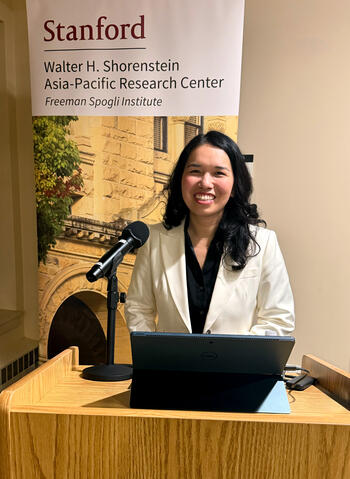
Political scientist Gaea Morales, APARC’s 2025-26 Shorenstein postdoctoral fellow on contemporary Asia, studies questions at the nexus of global policy and local action and how Southeast Asian megacities build climate resilience by drawing on local knowledge and global networks to drive change from the ground up, even in the absence of central government support.