
Sustainable development
Authors
Callista Wells
News Type
News
Date
Paragraphs

The Stanford Center at Peking University (SCPKU), the Center on Democracy, Development and the Rule of Law (CDDRL), and the APARC China Program jointly hosted a workshop on China’s Belt and Road Initiative (BRI) in early March. The workshop, held on March 2 and 3, welcomed researchers from around the world with expertise in the Initiative. Unfortunately, because of the rapidly developing health emergency related to the coronavirus, participants from not only China, but also Japan, were prevented from attending. As described by Professor Jean Oi, founding director of SCPKU and the China Program, and Professor Francis Fukuyama, director of CDDRL and the Ford Dorsey Master's in International Policy, who co-chaired the workshop, the meeting aimed to provide a global perspective on the BRI, consolidate knowledge on this opaque topic, and determine the best method and resources for future research.  

The workshop began with presentations from several of the invited guests. Dr. Atif Ansar from the University of Oxford’s Saïd Business School kicked off the first day by describing not only the tremendous opportunity that the BRI presents to developing economies, but also the serious pitfalls that often accompany colossal infrastructure projects. Pointing out the poor returns on investment of mega infrastructure projects, Ansar examined the frequest cost and schedule overruns, random disasters, and environmental degradation that outweigh the minimal benefits that they generally yield. China’s own track record from domestic infrastructure projects does little to mitigate fear of these risks, Ansar claimed. In response, he urged professional management of BRI investments, institutional reforms, and intensified deployment of technology in BRI projects. Dr. Ansar was followed by Dr. Xue Gong of the S. Rajaratnam School of International Studies, Nanyang Technological University, Singapore. Dr. Gong’s analysis centered on the extent to which China’s geopolitical motivations influenced its outward foreign direct investments (OFDI). Although her research was still in the early stages, her empirical analysis of China’s OFDI inflows into fifty BRI recipient countries from 2007-2018 nevertheless revealed that geopolitical factors often outweigh economic factors when it comes to China’s OFDI destinations.
Image
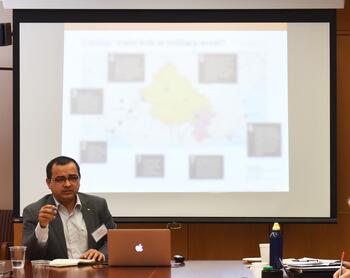
Amit Bhandari of Gateway House: Indian Council on Global Relations presents his research at the Belt and Road Workshop.
Participants then heard presentations from Amit Bhandari of Gateway House: Indian Council on Global Relations and Professor Cheng-Chwee Kuik of the National University of Malaysia. Mr. Bhandari’s talk focused on Chinese investments in India’s six neighboring countries, which tend to center more on energy rather than connectivity projects. He first found that the investments are generally not economical for the host countries because they come with high costs and high interest rates. Secondly, he argued that these projects often lacked a clear economic rationale, appearing instead to embed a geopolitical logic not always friendly to India. Professor Kuik, by contrast, provided a counterexample in his analysis of BRI projects in Southeast Asia. He described how, in Southeast Asia, host countries’ reception of the BRI has varied substantially; and how various stakeholders, including states, sub-states and other entities, have used their leverage to shape outcomes more or less favorable to themselves. Kuik’s analysis injected complexity into the often black-and-white characterizations of the BRI. He highlighted the multidimensional dynamics that play out among local and state-level players in pursuit of their goals, and in the process of BRI implementation.

Professor Curtis J. Milhaupt and Scholar-in-Residence Jeffrey Ball, both at Stanford Law School, followed with individual presentations on the role of State-Owned Enterprises (SOEs) in the BRI and the emissions impact of the BRI on climate change, respectively. Professor Milhaupt  characterized Chinese SOEs as both geopolitical and commercial actors, simultaneously charged with implementing Party policies and attaining corporate profits. Chinese SOEs are major undertakers of significant overseas BRI projects, acting not only as builders but also as investors, partners, and operators. This situation, Milhaupt asserted, carries significant risks for SOEs because these megaprojects often provide dismal returns, have high default rates, and can trigger political backlash in their localities. Milhaupt highlighted the importance of gathering firm-level data on businesses actually engaged in BRI projects to better infer geostrategic, financial, or other motivations. Jeffrey Ball turned the discussion to carbon emissions from BRI projects and presented preliminary findings from his four-country case studies. He concluded that, on aggregate, the emissions impact of the BRI is still “more brown than green.” Twenty-eight percent of global carbon emissions may be accounted for by BRI projects, Ball asserted, underscoring the importance of the BRI to the future of global climate change.

The day concluded with presentations by  Michael Bennon, Managing Director at the Stanford Global Projects Center, and Professor David M. Lampton, Oksenberg-Rohlen Fellow at the Freeman Spogli Institute for International Studies. Bennon first presented findings from two empirical case studies of BRI projects and then went on to describe how the BRI is now practically the “only game in town” for infrastructure funding for developing countries. Lengthy environmental review processes at Western multilateral banks have turned the World Bank, for example, from a lending bank into a “knowledge bank,” he argued. He also highlighted that, in general, economic returns on BRI projects for China are very poor, even though recipient countries may accrue macroeconomic benefits from these projects. Finally, Professor Lampton turned the discussion back to Southeast Asia, where China is currently undertaking massive cross-border high-speed rail projects through eight ASEAN countries. He described how each host country had varying capacity to negotiate against its giant neighbor, and how the sequential implementation of these cross-border rail projects also had varying impacts on the negotiating positions of these host countries. BRI played out differently in each country, in other words, eliciting different reactions, push-backs and negotiated terms.

The second day of the workshop was dedicated to working toward a collaborative approach to future BRI research. The group discussed the key gaps in the existing research, including how to know what China’s true intentions are, how to measure those intentions, who the main players and their interests in both China and the host countries are, and even what the BRI is, exactly. Some cautioned that high-profile projects may not be representative of the whole. Participants brainstormed about existing and future sources of data, and stressed the importance of diversifying studies and seeking empirical evidence.

Hero Image
Participants in the Belt and Road Initiative Workshop at Stanford University, March 2-3, 2020.
All News button
1
-

Join us for a talk with agricultural and development economist Christopher B. Barrett, this quarter’s visiting scholar with the Center on Food Security and the Environment. Barrett is the Stephen B. and Janice G. Ashley Professor of Applied Economics and Management and an International Professor of Agriculture with Cornell’s Dyson School of Applied Economics and Management.

Professor Barrett will discuss food systems advances over the past 50 years that have promoted unprecedented reduction globally in poverty and hunger, averted considerable deforestation, and broadly improved lives, livelihoods and environments in much of the world. He’ll share perspectives on the reasons why, despite those advances, those systems increasingly fail large communities in environmental, health, and increasingly in economic terms and appear ill-suited to cope with inevitable further changes in climate, incomes, and population over the coming 50 years. Barrett will explore the new generation of innovations underway that must overcome a host of scientific and socioeconomic obstacles.
 
Also a Professor of Economics in the Department of Economics, Barrett is co-editor in chief of the journal Food Policy, is a faculty fellow with David R. Atkinson Center for a Sustainable Future and serves as the director of the Stimulating Agriculture and Rural Transformation (StART) Initiative housed at the Cornell International Institute for Food, Agriculture and Development.
 

Lectures
Authors
News Type
News
Date
Paragraphs

By monitoring crops through machine learning and satellite data, Stanford scientists have found farms that till the soil less can increase yields of corn and soybeans and improve the health of the soil – a win-win for meeting growing food needs worldwide.

Agriculture degrades over 24 million acres of fertile soil every year, raising concerns about meeting the rising global demand for food. But a simple farming practice born from the 1930’s Dust Bowl could provide a solution, according to new Stanford research. The study, published Dec. 6 in Environmental Research Letters, shows that Midwest farmers who reduced how much they overturned the soil – known as tilling – increased corn and soybean yields while also nurturing healthier soils and lowering production costs.

“Reduced tillage is a win-win for agriculture across the Corn Belt,” said study lead author Jillian Deines, a postdoctoral scholar at Stanford’s Center on Food Security and the Environment. “Worries that it can hurt crop yields have prevented some farmers from switching practices, but we found it typically leads to increased yields.”

The U.S. – the largest producer of corn and soybeans worldwide – grows a majority of these two crops in the Midwest. Farmers plucked about 367 million metric tons of corn and 108 million metric tons of soybeans from American soil this past growing season, providing key food, oil, feedstock, ethanol and export value.

Monitoring farming from space


Farmers generally till the soil prior to planting corn or soybeans – a practice known to control weeds, mix nutrients, break up compacted dirt and ultimately increase food production over the short term. However, over time this method degrades soil. A 2015 report from the Food and Agriculture Organization of the United Nations found that in the past 40 years the world has lost a third of food-producing land to diminished soil. The demise of once fertile land poses a serious challenge for food production, especially with mounting pressures on agriculture to feed a growing global population.

In contrast, reduced tillage – also known as conservation tillage – promotes healthier soil management, reduces erosion and runoff and improves water retention and drainage. It involves leaving the previous year’s crop residue (such as corn stalks) on the ground when planting the next crop, with little or no mechanical tillage. The practice is used globally on over 370 million acres, mostly in South America, Oceania and North America. However, many farmers fear the method could reduce yields and profits. Past studies of yield effects have been limited to local experiments, often at research stations, that don’t fully reflect production-scale practices.

The Stanford team turned to machine learning and satellite datasets to address this knowledge gap. First, they identified areas of reduced and conventional tilling from previously published data outlining annual U.S. practices for 2005 to 2016. Using satellite-based crop yield models – which take into account variables such as climate and crop life-cycles – they also reviewed corn and soybean yields during this time. To quantify the impact of reduced tillage on crop yields, the researchers trained a comput

(Image credit: Jillian Deines) Average impacts on corn yields from conservation tillage across the U.S. Corn Belt from 2008 to 2017. Red colors indicate increased yields under conservation tillage, blue colors indicate yield declines.
er model to compare changes in yields based on tillage practice. They also recorded elements such as soil type and weather to help determine which conditions had a larger influence on harvests.

Improved yields


The researchers calculated corn yields improved an average of 3.3 percent and soybeans by 0.74 percent across fields managed with long-term conservation tillage practices in the nine states sampled. Yields from the additional tonnage rank in the top 15 worldwide for both crops. For corn, this totals approximately 11 million additional metric tons matching the 2018 country output of South Africa, Indonesia, Russia or Nigeria. For soybeans, the added 800,000 metric tons ranks in between Indonesia and South Africa’s country totals.

Some areas experienced up to an 8.1 percent increase for corn and 5.8 percent for soybeans. In other fields, negative yields of 1.3 percent for corn and 4.7 for soybeans occurred. Water within the soil and seasonal temperatures were the most influential factors in yield differences, especially in drier, warmer regions. Wet conditions were also found favorable to crops except during the early season where water-logged soils benefit from conventional tillage that in turn dries and aerates.

“Figuring out when and where reduced tillage works best could help maximize the benefits of the technology and guide farmers into the future,” said study senior author David Lobell, a professor of Earth system science in the School of Earth, Energy & Environmental Sciences and the Gloria and Richard Kushel Director of the Center on Food Security and the Environment.

It takes time to see the benefits from reduced tillage, as it works best under continuous implementation. According to the researchers’ calculations, corn farmers won’t see the full benefits for the first 11 years, and soybeans take twice as long for full yields to materialize. However, the approach also results in lower costs due to reduced need for labor, fuel and farming equipment while also sustaining fertile lands for continuous food production. The study does show a small positive gain even during the first year of implementation, with higher gains accruing over time as soil health improves. According to a 2017 Agricultural Censuses report, farmers appear to be getting on board with the long-term investment and close to 35 percent of cropland in the U.S. is now managed with reduced tillage.

“One of the big challenges in agriculture is achieving the best crop yields today without comprising future production. This research demonstrates that reduced tillage can be a solution for long-term crop productivity,” Deines said.


To read all stories about Stanford science, subscribe to the biweekly Stanford Science Digest.

David Lobell is also the William Wrigley Senior Fellow at the Stanford Woods Institute for the Environment, a senior fellow at the Freeman Spogli Institute for International Studies and the Stanford Institute for Economic Policy and Research. Graduate student Sherrie Wang is also a co-author. Research was funded by NASA Harvest.

 
Hero Image
30141460015 bc55de5c03 o
According to new Stanford research, tilling soils less can increase corn and soybean crops across the Midwest Corn Belt.
Flickr/Steven Baird
All News button
1
-

Fighting to End Hunger at Home & Abroad:  Ambassador Ertharin Cousin shares her journey & lessons learned

A Conversation in Global Health with Ertharin Cousin

FSI Payne Distinguished Lecturer | Former Executive Director of the World Food Programme | TIME's 100 Most Influential People

RSVP for conversation & lunch: www.tinyurl.com/CIGHErtharinCousin (please arrive at 11:45 am for lunch)

Professor Ertharin Cousin has been fighting to end global hunger for decades. As executive director of the World Food Programme from 2012 until 2017, she led the world’s largest humanitarian organization with 14,000 staff serving 80 million vulnerable people across 75 countries. As the US ambassador to the UN Agencies for Food and Agriculture, she served as the US representative for all food, agriculture, and nutrition related issues.

Prior to her global work, Cousin lead the domestic fight to end hunger. As chief operating officer at America’s Second Harvest (now Feeding America), she oversaw operations for a confederation of 200 food banks across America that served more than 50,000,000 meals per year.

Stanford School of Medicine Senior Communications Strategist Paul Costello will interview Professor Cousin about her experiences, unique pathway, and the way forward for ending the global hunger crisis.

cid:image002.png@01D509A2.91178F90cid:image003.png@01D509A2.91178F90cid:image004.png@01D509A2.91178F90cid:image005.jpg@01D50A42.AF28BEA0

Li Ka Shing Room 320 

Seminars
Authors
News Type
News
Date
Paragraphs
Stanford’s Center for Ocean Solutions and Center on Food Security and the Environment, together with Springer-Nature, are hosting a workshop focused on building a research agenda that, for the first time, analyzes the role of oceans within the context of global food systems.
 
Massive changes in the global food sector over the next few decades – driven by climate change and other environmental stresses, growing population and income, advances in technology, and shifts in policies and trade patterns – will have profound implications for the oceans and vice versa. While there is a large community of researchers addressing challenges in food policy and agriculture and a similar community in oceans and fisheries, there is very little interaction between them. This workshop addresses a pressing need to foster more interaction among these communities, to build a research agenda that illuminates the many interconnections among food and the oceans, and to inform action to meet these challenges.
 
“Stanford is in a perfect position to take the lead in developing this new area of research and outreach, with its strong expertise in terrestrial food systems, global food security, and the oceans,” claims Roz Naylor, Professor of Earth System Science, founding Director of the Center on Food Security and the Environment, and co-organizer of the workshop.
 
This event brings together diverse leaders across academia, business, policy, and government. Together participants will analyze the role of the oceans within a global food systems context, highlighting issues related to food security, equity, poverty alleviation, marine ecosystems, and environmental change. The aim is to define and develop this emerging field, as researchers and stakeholders explore cutting edge ideas and identify emerging trends and challenges that can inform ongoing policy discussions.
 

“This is a unique opportunity to build a new and vibrant community, bringing together leading researchers in oceans, fisheries, food, and agriculture from around the world," explained COS co-director Jim Leape. "We're coming together to ask the key questions needed to identify emerging themes and solutions, in lockstep with those who will put these findings into practice," added COS co-director Fiorenza Micheli. "As the world's demand for food continues to grow, we will increasingly need to understand and act on the critical role of the oceans to meet these challenges."

Jim Leape is also the William and Eva Price Fellow at the Stanford Woods Institute for the Environment. Fiorenza Micheli is also the David and Lucile Packard Professor in Marine Sciences at Stanford's Hopkins Marine Station and senior fellow at the Woods Institute. Read more about the Stanford Center for Ocean Solutions.


Hero Image
dxo4m7xvaaevgpg jpg large
All News button
1
Authors
News Type
Blogs
Date
Paragraphs

Widespread cultivation of oil palm trees has been both an economic boon and an environmental disaster for tropical developing-world countries. New research points to a more sustainable path forward through engagement with small-scale producers.

Nearly ubiquitous in products ranging from cookies to cosmetics, palm oil represents a bedeviling double-edged sword. Widespread cultivation of oil palm trees has been both an economic boon and an environmental disaster for tropical developing-world countries, contributing to large-scale habitat loss, among other impacts. New Stanford-led research points the way to a middle ground of sustainable development through engagement with an often overlooked segment of the supply chain (read related overview and research brief).

"The oil palm sector is working to achieve zero-deforestation supply chains in response to consumer-driven and regulatory pressures, but they won’t be successful until we find effective ways to include small-scale producers in sustainability strategies,” said Elsa Ordway, lead author of a Jan. 10 Nature Communications paper that examines the role of proliferating informal oil palm mills in African deforestation. Ordway, a postdoctoral fellow at The Harvard University Center for the Environment, did the research while a graduate student in Stanford’s School of Earth, Energy & Environmental Sciences.

Image
33707742795 db455551f6 o

An oil palm plantation in Cameroon (Image credit: Elsa Ordway)

Using remote sensing tools, Ordway and her colleagues mapped deforestation due to oil palm expansion in Southwest Cameroon, a top producing region in Africa’s third largest palm oil producing country (read about related Stanford research). Contrary to a widely publicized narrative of deforestation driven by industrial-scale expansion, the researchers found most oil palm expansion and associated deforestation occurred outside large, company-owned concessions, and that expansion and forest clearing by small-scale, non-industrial producers was more likely near low-yielding informal mills, scattered throughout the region. This is strong evidence that oil palm production gains in Cameroon are coming from extensification instead of intensification.

Possible solutions for reversing the extensification trend include improving crop and processing yields by using more high-yielding seed types, replanting old plantations, and upgrading and mechanizing milling technologies, among other approaches. To prevent intensification efforts from inciting further deforestation, they will need to be accompanied by complementary natural resource policies that include sustainability incentives for smallholders.

In Indonesia, where a large percentage of the world’s oil palm-related forest clearing has occurred, a similar focus on independent, smallholder producers could yield major benefits for both poverty alleviation and environmental conservation, according to a Jan. 4 Ambio study led by Rosamond Naylor, the William Wrigley Professor in the School of Earth, Energy & Environmental Sciences and a senior fellow at the Stanford Woods Institute for the Environment and the Freeman Spogli Institute for International Studies(Naylor coauthored the Cameroon study led by Ordway).

Using field surveys and government data, Naylor and her colleagues analyzed the role of small producers in economic development and environmental damage through land clearing. Their research focused on how changes in legal instruments and government policies during the past two decades, including the abandonment of revenue-sharing agreements between district and central governments and conflicting land title authority among local, regional and central authorities, have fueled rapid oil palm growth and forest clearing in Indonesia.

They found that Indonesia’s shift toward decentralized governance since the end of the Suharto dictatorship in 1998 has simultaneously encouraged economic development through the expansion of smallholder oil palm producers (by far the fastest growing subsector of the industry since decentralization began), reduced rural poverty, and driven ecologically destructive practices such as oil palm encroachment into more than 80 percent of the country’s Tesso Nilo National Park.

 A worker in East Kalimantan, Indonesia, loads palm fruit for transport to a factory that will process it into palm oil (Image credit: Joann de Zegher) A worker in East Kalimantan, Indonesia, loads palm fruit for transport to a factory that will process it into palm oil (Image credit: Joann de Zegher)

 A worker in East Kalimantan, Indonesia, loads palm fruit for transport to a factory that will process it into palm oil (Image credit: Joann de Zegher)

Among other potential solutions, Naylor and her coauthors suggest Indonesia’s Village Law of 2014, which devolves authority over economic development to the local level, be re-drafted to enforce existing environmental laws explicitly. Widespread use of external facilitators could help local leaders design sustainable development strategies and allocate village funds more efficiently, according to the research. Also, economic incentives for sustainable development, such as an India program in which residents are paid to leave forests standing, could make a significant impact.

There is reason for hope in recent moves by Indonesia’s government, including support for initiatives that involve large oil palm companies working with smallholders to reduce fires and increase productivity; and the mapping of a national fire prevention plan that relies on financial incentives.

“In all of these efforts, smallholder producers operating within a decentralized form of governance provide both the greatest challenges and the largest opportunities for enhancing rural development while minimizing environmental degradation,” the researchers write.

Coauthors of “Decentralization and the environment: Assessing smallholder oil palm development in Indonesia” include Matthew Higgins, a research assistant at Stanford’s Center on Food Security and the Environment; Ryan Edwards of Dartmouth College, and Walter Falcon, the Helen C. Farnsworth Professor of International Agricultural Policy, Emeritus, at Stanford.

Coauthors of “Oil palm expansion at the expense of forests in Southwest Cameroon associated with proliferation of informal mills” include Raymond Nkongho, a former fellow at Stanford’s Center for Food Security and the Environment; and Eric Lambin, the George and Setsuko Ishiyama Provostial Professor in the School of Earth, Energy & Environmental Sciences and a senior fellow at the Stanford Woods Institute for the Environment.


Hero Image
33707742795 db455551f6 o
iStockphoto/slpu9945
All News button
1
0
picture-62-1384135037.jpg

R. Quentin Grafton, FASSA, is Professor of Economics, ANU Public Policy Fellow, Fellow of the Asia and the Pacific Policy Society and Director of the Centre for Water Economics, Environment and Policy (CWEEP) at the Crawford School of Public Policy at the Australian National University. In April 2010 he was appointed the Chairholder, the UNESCO Chair in Water Economics and Transboundary Water Governance and between August 2013 and July 2014 served as Executive Director at the Australian National Institute of Public Policy(ANIPP). He currently serves as the Director of the Food, Energy, Environment and Water Network.

Braun Hall, Stanford University, Stanford, CA 94305

0
gorelick_0.jpg

Professor Gorelick runs the Hydrogeology and Water Resources program and directs the interdisciplinary Global Freshwater Initiative. He is also a Senior Fellow at the Woods Institute for the Environment. Dr. Gorelick is a US National Academy of Engineering (NAE) member and received Fulbright and Guggenheim Fellowships for research on water and oil resources. He is a Fellow of the American Association for the Advancement of Science (AAAS), American Geophysical Union (AGU) and the Geological Society of America (GSA. Dr. Gorelick has produced over 140 journal papers and 3 books in the areas of water management in underdeveloped regions, hydrogeology, optimal remediation design, hydrogeophysics, ecohydrology, and global oil resources.


Y2E2 Bldg, 473 VIA ORTEGA
Dept. Center on Food Security - Room 349
Stanford, CA 94305


0
img_3988.jpg

Stefania joined FSE as a research data analyst in March 2018 where she works with David Lobell on designing, implementing, and applying new satellite-based monitoring techniques to study several aspects of food security. 

Her current focuses include estimates of crop yields, crop classification, and detection of management practices in Africa and India using a variety of satellite sensors including Landsat (NASA/USGS), Sentinel 1 and 2 (ESA), combined with crop modeling and machine learning techniques.

Research Data Analyst
Date Label
Subscribe to Sustainable development