
The Ban Ki-moon Foundation and Stanford’s Asia-Pacific Research Center Launch Trans-Pacific Sustainability Dialogue
The Walter H. Shorenstein Asia-Pacific Research Center (APARC) at Stanford University and the Ban Ki-moon Foundation For a Better Future announced today the launch of an annual Trans-Pacific Sustainability Dialogue in Asia to accelerate progress on achieving the United Nations-adopted 2030 Agenda for Sustainable Development. The joint project will spur new research and policy partnerships between experts from the United States and Asia to expedite the implementation of the Agenda’s underlying 17 Sustainable Development Goals (SDGs) by governments and non-state actors. The two-day inaugural Dialogue will be held in Seoul, Republic of Korea, on October 27 and 28, 2022, and will be free and open to the public.
The Dialogue’s co-organizers include the Natural Capital Project (NatCap) of Stanford University, the Ministry of Foreign Affairs of the Republic of Korea, Korea Environmental Industry and Technology Institute (KEITI), Korea Environment Corporation (K-eco), and Korea Water Resources Corporation (K-water).
The first day will take place at The Plaza Seoul and will be co-hosted by the Korea Environment Institute. It will include a series of public sessions headlined by Ban Ki-moon, the eighth secretary-general of the UN, who will join a lineup of world leaders including Kevin Rudd, former prime minister of Australia and chief executive officer and president of the Asia Society; Iván Duque, former president of the Republic of Colombia; and Gombojav Zandanshatar, chairman of the State Great Hural (Parliament) of Mongolia.
“This Dialogue is very timely and relevant as the climate crisis is deepening in the aftermath of the Russian invasion of Ukraine and the Sustainable Development Goals are becoming more difficult to achieve in the midst of the Coronavirus pandemic,” says Mr. Ban Ki-moon. “Asia-Pacific countries should be more aggressive in the fight against climate change and more audacious in the role they play toward achieving the SDGs,” he noted.
In this spirit, expert discussions on the second day will bring together social science researchers and scientists from across the Asia-Pacific region, alongside policymakers and practitioners, to share local and global nature-positive solutions and new pathways of meaningful SDG acceleration actions. Co-hosted by and held at Ewha Womans University, the panel discussions will explore the making of livable, sustainable cities, such as Busan Metropolitan City, and the threats to them by climate change, disasters, and human security issues. To achieve systems transformation and sustainable development, discussions will turn to the need to value and invest in nature.
“Climate and sustainability solutions span disciplines and sectors and require collaboration with partners worldwide,” says Gi-Wook Shin, the William J. Perry Professor of Contemporary Korea at Stanford and director of APARC. “The launch of the Stanford Doerr School of Sustainability marks an opportune moment to scale up SDGs implementation by leveraging knowledge and expertise from across Stanford and the Asia-Pacific and engaging the next generation of scholars and experts,” Shin adds. “We are honored to join in this effort with Mr. Ban and his team, with whom APARC has an established relationship.”
Highlighting the role of youth in achieving the SDGs, the Dialogue includes student panels that feature young leaders from Stanford University, Ewha Womans University, Osaka University, and De La Salle University, among other Asian universities. Students’ research, applied work, and entrepreneurial endeavors across the region showcase innovations and transformations in green financing and sustainable investments, gender mainstreaming and climate governance, development cooperation for sustainable governance, and scaling environmental solutions through a business and social justice lens.
The Seoul Trans-Pacific Sustainability Dialogue is the inaugural event in APARC and the Ban Ki-moon Foundation’s joint effort to stimulate ambitious action to deliver the 2030 Agenda and SDGs. The annual Dialogue may rotate among different host cities in Asia to address different themes selected from the SDGs framework spearheaded by Mr. Ban Ki-moon during his term as the UN Secretary-General.
Visit the event page to register to attend the Trans-Pacific Sustainability Dialogue in person in Seoul, as well as for the full program agenda and speaker list.
The event is also offered online via a live webcast: watch the live-streamed sessions on the event page or via the Ban Ki-moon Foundation’s YouTube channel.
About the Walter H. Shorenstein Asia-Pacific Research Center
The Walter H. Shorenstein Asia-Pacific Research Center (Shorenstein APARC) addresses critical issues affecting the countries of Asia, their regional and global affairs, and U.S.-Asia relations. As Stanford University’s hub for the interdisciplinary study of contemporary Asia, APARC produces policy-relevant research, provides education and training to students, scholars, and practitioners, and strengthens dialogue and cooperation between counterparts in the Asia-Pacific and the United States. Founded in 1983, APARC today is home to a scholar community of distinguished academics and practitioners in government, business, and civil society, who specialize in trends that cut across the entire Asia-Pacific region. For more, visit aparc.stanford.edu.
About the Ban Ki-moon Foundation For a Better Future
The Ban Ki-moon Foundation For a Better Future follows and further develops the achievement and philosophy of Ban Ki-moon, the 8th Secretary General of the United Nations through upholding the values of unification, communication and co-existence, and dedication. It promotes three pillars of the UN including peace and security, development, and human rights and contributes to making a better future devoid of conflict and deficiency. In particular, the Ban Ki-moon Foundation actively collaborates with the UN, international organizations, and stakeholders toward achieving the 2030 Sustainable Development Goals and realizing the 2050 carbon net-zero of all state parties of the Paris Climate Accord of 2015. For more, visit http://eng.bf4bf.or.kr/.
Media Contact
Journalists interested in covering the event should contact Shorenstein APARC’s Communications Manager, Michael Breger at mbreger@stanford.edu. For further information on the Trans-Pacific Sustainability Dialogue, please contact Cheryll Alipio, Shorenstein APARC’s Associate Director for Program and Policy at calipio@stanford.edu.

The Trans-Pacific Sustainability Dialogue convenes social science researchers and scientists from Stanford University and across the Asia-Pacific region, alongside student leaders, policymakers, and practitioners, to generate new research and policy partnerships to accelerate the implementation of the United Nations-adopted Sustainable Development Goals. The inaugural Dialogue will be held in Seoul, Republic of Korea, on October 27 and 28, 2022.





 Meeting E20 by 2030: additional sugarcane, water and land resources needed, and extra sugar produced. Meeting the 20% ethanol-to-gasoline blending rate by 2030 with ethanol produced from molasses would require additional water and land resources and produce extra sugar. In contrast, ethanol produced from sugarcane juice could meet the blending target without risking water and land resources and would reduce extra sugar. (Image credit: Lee et al. / Environmental Research Letters)
 Micronutrient content and calories of sugar and selected crops. Sugar provides empty calories with no nutritional value. (Image credit: Lee et al. / Environmental Research Letters)
 Irrigation water use by major crops or crop groups in Maharashtra from 1970–71 to 2010–11. In Maharashtra, irrigation water use by sugarcane has increased more rapidly than any other crop over time, and sugarcane has used the highest share of total irrigation water in all time periods. (Image credit: Lee et al. / Environmental Research Letters)
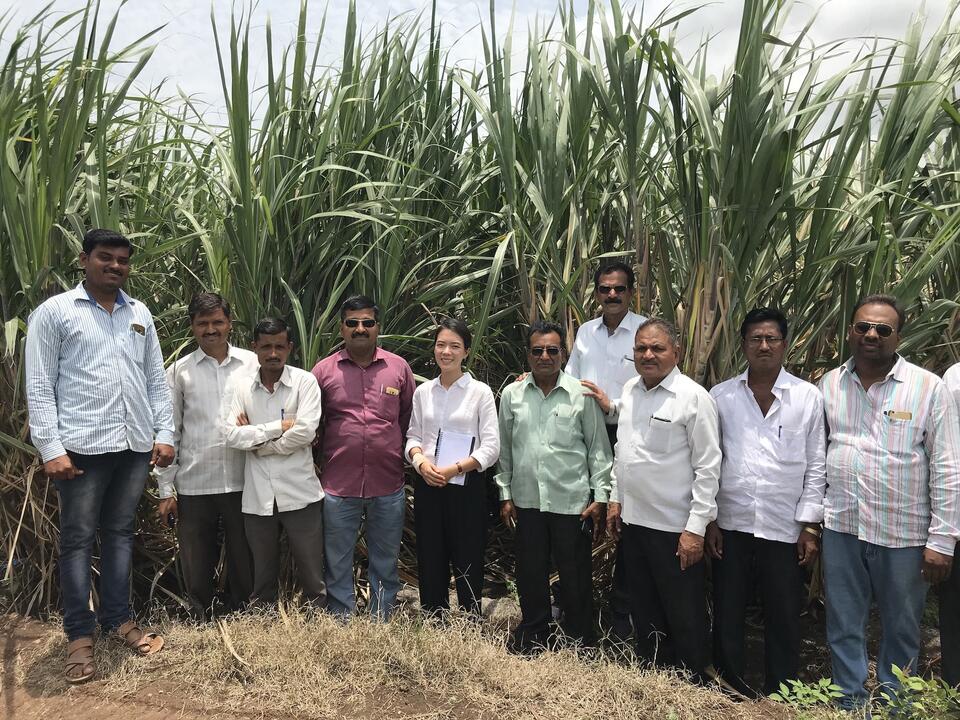 Lead study author Ju Young Lee, center, is pictured with local farmers and agricultural experts while visiting a sugarcane field in Maharashtra in western India in August 2018. (Image courtesy of Ju Young Lee)
