Mission Impossible? Socio-technical Integration of Nuclear Waste Geological Disposal Systems
Abstract: We present a new perspective on geological disposal systems for nuclear waste. Geological disposal systems encompass all the processes required for the permanent isolation of highly-radioactive materials from humans and the biosphere. Radioactive materials requiring geological disposal are created by commercial nuclear power plants, research reactors, and defense-related nuclear activities, such as spent nuclear fuel from commercial reactors and high-level waste from reprocessing to reclaim fissile material for weapons. We show that disposal systems are so complex that new methods of representation are required. Despite the common call for a systems approach, a broader perspective is needed to obtain an integrated view of disposal systems. We introduce a conceptual formalism of geological disposal systems based on a multi-scale integrated analysis approach. This ‘metabolic’ representation allows one to account for the technical complexity of disposal systems in relation to their broader societal context. Although the paper is conceptual, the integrated formalism can improve the understanding of the complexity of disposal systems and their policy requirements by connecting technical solutions with societal constraints. However, the paper also reveals the limits to efforts to integrate technical and social dimensions of geological disposal systems into a single formalism.
Nuclear waste costs Americans billions every year
Q&A with Rodney C. Ewing, co-director of the Center for International Security and Cooperation, a senior fellow at the Freeman Spogli Institute for International Studies and a Professor in the School of Earth, Energy and Environmental Sciences. Written with Nicole Feldman.
With the Trump-Kim Summit fresh in our minds, Americans are ready to confront nuclear challenges that have been on hold for decades. What many may not realize is that one of the biggest challenges is on the home front. Since the Manhattan Project officially began in 1942, the United States has faced ever-increasing stores of nuclear waste. In Part Three of our series on the consequences of nuclear war, expert Rodney C. Ewing tells us how the U.S.’s failure to implement a permanent solution for nuclear waste storage and disposal is costing Americans billions of dollars a year.
Where does our nuclear waste come from, and what is being done with it?
Broadly speaking, there are two types of nuclear waste.
The first is spent fuel from nuclear reactors used to generate electricity. Those reactors have left us with about 80,000 metric tonnes of used spent fuel, and we don’t have a way forward for the disposal of this waste. It’s stored at more than 75 sites in 35 states around the country, so many of us have some in our state, including California.
The second category is the waste generated by our nuclear weapons complex. That defense waste has accumulated since the earliest days of the Manhattan Project. The highly-radioactive waste from chemical processing is mainly stored in very large metal tanks. They are located at the Savannah River site in South Carolina, the Hanford site in Washington State, at Idaho National Laboratory in Idaho, and Nuclear Fuel Services site at West Valley in New York State.
I think it’s discouraging that we continue to release radioactivity to the environment because after more than 40 years we still have not developed a successful plan for going forward.
What’s wrong with what’s happening now?
This waste is problematic because the volume is large, many hundreds of thousands of cubic meters. The tanks in Hanford and Savannah River are way beyond their design lifetimes, so they’re corroding and some have leaked. The radioactive fluid is being released to the environment. The rates are not high, but I think it’s discouraging that we continue to release radioactivity to the environment because after more than 40 years of effort we still have not developed a successful plan for going forward.
The spent fuel from commercial power plants is much smaller, some 80,000 metric tonnes, but the total amount of radioactivity is roughly 20 to 30 times greater than defense waste. Today, it’s the spent fuel that demands the most attention as an immediate problem, particularly financially.
How much is nuclear waste costing American taxpayers?
The two categories of waste are separated in the budget. At the moment, the budget for the Department of Energy is about $30 billion. Of that budget, about $12 billion is for the nuclear weapons programs. That leaves us $18 billion to use for all things related to energy — nuclear power, fossil fuel, wind, and solar. About $6 billion, one third, is used to deal with the legacy high-level waste from the Manhattan Project. We as taxpayers pay $6 billion every year to address that problem, a huge cost that we will incur for many decades into the future. The projected total cost of clean-up after the Manhattan Project is well over $300 billion. That’s more than the original cost of the weapons programs and the actual total will be even higher. That’s just the defense waste.
What about the waste from nuclear energy? Is that clean-up cost also high?
In short, very. The Nuclear Waste Policy Act of 1982 created a tax on electricity generated by nuclear power plants. This tax would accumulate into the Nuclear Waste Fund for us to build a geologic repository — a mined facility deep within the earth — to safely dispose of the waste. What’s happened to that?
The fund has a balance of more than $40 billion. It’s controlled by Congress on an annual basis, and congressional budget rules make it very difficult to use those funds. It’s not a lockbox where the money goes and waits to be spent. Instead, it’s been applied against our national debt, so even though the fees have been collected, they haven’t been used for their intended purpose.
We pay about half-a-billion dollars a year to the utilities for their simply keeping the fuel because there’s no place for it to go.
The Department of Energy was to take ownership of this fuel on January 1, 1998, but they didn’t because there was no geologic repository. Now the utilities who have the fuel have to continue to deal with it onsite. They have sued the federal government for its failure to take ownership of the fuel, so now we pay about half-a-billion dollars a year to the utilities for their simply keeping the fuel because there’s no place for it to go. The projected cost of this penalty, let’s say, is something on the order of many tens of billions of dollars, depending on how long the spent fuel has to remain at the reactor sites. The cost of doing nothing over time will be equivalent to what we charge the rate payers, $40 billion over time. That doesn’t even include compensation to workers in defense facilities, soldiers exposed during atmospheric testing of nuclear weapons, and so on.
Clearly, the financial cost to taxpayers is high. What about the cost to the environment?
For the spent fuel, the volume — 80,000 metric tons — sounds like a lot, but compared to Gigatonnes of carbon emitted by burning fossil fuels, its volume is not so great. It’s well-contained, but there are some difficulties with how it’s stored. In some cases, the used fuel is kept in pools. Those pools have filled, and they weren’t meant for extended storage. We should be trying to get that fuel into what are called dry casks: obelisks concrete and metal.
Are there other challenges people may not be aware of?
What people don’t realize is that it is actually a serious technical challenge.
It’s very common for people to say there are no technical problems, that it’s just political. They say, “We know how to do it. It’s just a difficult public. Strict regulations. No one will let us solve this problem.”
I think what people don’t realize is that it is actually a serious technical challenge. The half-lives of some of these elements stretch into tens, if not hundreds of thousands of years. We’re asked to design solutions that will last as long as the risk. That’s not something we usually do. The technical and scientific challenge for nuclear waste is, whatever our solution, that we will never see whether we were correct or not. Designing a system where you don’t have feedback is very difficult.
What will happen if we don’t find a solution?
There will not be an immediate catastrophe; I don’t expect anything to explode. There will be environmental contamination, but the biggest problem is financial. We’re spending $6 billion a year trying to deal with the problem, and we’ll continue to spend $4.5 to $5 billion a year without solving the problem. That $5 billion could go to education or research. Imagine if instead of working on waste, we were working on solving our future energy needs.
What’s the best way for us to move forward?
At Stanford, over a two-year period we had a series of meetings to ask just this question: how does the U.S. break out of its gridlock situation and move ahead? We brought in international experts, members of the public, really quite an extraordinary effort, over 75 speakers in five meetings. We have a number of recommendations. We need a new, single purpose nuclear waste management organization. We need a new process for engaging not only the scientific and technical communities, but also the public. We need a new regulatory framework that recognizes the challenges of predicting repository performance over hundreds of thousands of years. Most importantly, we need to realize that dealing with nuclear waste is not only a technical issue, but also requires careful attention to social issues. It is very important to design an approach that engages local communities, states, and tribes. This report, Reset of U.S. Nuclear Waste Management Strategy and Policies, will be released this summer.
The Friendship of Sidney Drell and Andrei Sakharov
The following are remarks by Professor David Holloway at the Sid Drell Symposium on Fundamental Physics given at SLAC on 12 January 2018.
I want to thank the organizers for inviting me to speak at this conference. It’s a particular pleasure for me as a historian and political scientist to be a speaker at a symposium on Fundamental Physics. More seriously it is an honor for me to speak at a symposium in memory of Sid Drell, with whom I had the privilege to work for over thirty years. Sid agreed with Einstein that politics was much harder to study than physics. “The laws of physics stay the same,” he said. “The laws of politics change. And besides, you are supping with the Devil.”
Sakharov
My topic is Sid’s friendship with Andrei Sakharov, whom Sid greatly admired and more than once referred to as a saint. Sakharov was born in Moscow in 1921, five years before Sid. He died in 1989. I don’t want to go through Sakharov’s life, but I do want to mention a couple of things to provide context for Sid’s meetings with him and for their friendship. Sakharov’s mentor, Igor Tamm – a Nobel Prize-wining physicist – drew Sakharov into work on the design of thermonuclear weapons in 1948. From 1950 to 1968 Sakharov lived and worked in Arzamas-16 (now Sarov), the Soviet equivalent of Los Alamos. He played a key role in the development of Soviet thermonuclear weapons.
In 1968 Sakharov was removed from secret work after an essay he had written – Reflections on Progress, Peaceful Coexistence, and Intellectual Freedom – was published abroad. In the opening paragraph Sakharov states that his views were formed in the milieu of the scientific-technical intelligentsia, which was very worried about the future of humankind. Their concern, he continued, was all the stronger because what he called "the scientific method of directing politics, economics, art, education, and military affairs" had not yet become a reality. What did he mean by the "scientific method" in this context? His answer: "We consider 'scientific' that method which is based on a profound study of facts, theories, views, presupposing unprejudiced and open discussion, which is dispassionate in its conclusions." In other words, Sakharov wanted open discussion of important policy issues – something that did not happen in the Soviet Union.
In his essay Sakharov expressed ideas he had been coming to for some time, but the immediate stimulus to his writing the essay appears to have been that he was refused permission to publish an article about ABM systems. He (and other senior scientists at Arzamas-16) had come to the conclusion that “creating ABM defenses against massed attacks is not realistic, while for individual missiles it is difficult but possible.” Sakharov had written to Mikhail Suslov, an ideologically rigid Politburo member, whom he had met, expressing this view and asking for permission to publish an article on ABM systems. Suslov had denied him permission.
The publication of the essay abroad converted Sakharov from a scientist engaged in secret work into a world-famous figure. The essay sold 18 million copies in one year (it was printed in full in many newspapers).
I mention this episode and this essay to show that Sakharov, like Sid, was interested not only in physics but also profoundly interested in the application of science to policy, something that Sid had begun to do, starting in 1960 with Panofsky’s encouragement. It was the publication of the essay abroad that got Sakharov expelled from secret work. It is only then that he began to turn his attention to the defense of human rights in the Soviet Union, especially after 1970, when he met Elena Bonner, whom he married in 1972. In 1975 he was awarded the Nobel Peace Prize for his work for human rights. In his 1968 essay he had seen intellectual freedom as crucial for progress – how else could we deal with environmental degradation and the danger of thermonuclear war? In his Nobel lecture, Peace, Progress, and Human Rights, he named over one hundred of the political prisoners being held in the Soviet Union. He also made the general point that peace, progress, and human rights were indissolubly linked. For progress to be beneficial and peace secure, human rights (freedom of conscience, freedom of assembly, freedom of expression etc.) had to be protected. Thus the rights of the individual were intimately linked to our capacity to deal with global problems facing the human race.
Sid and Sakharov meet
In the early 1970s Sakharov was under intense pressure to curtail his activities, This came from the authorities and also from fellow members of the Academy of Sciences. That was the state of affairs in 1974 when he and Sid had their first meeting, which took place in Moscow, at a small conference on composite nucleon structure. Sid recalled “what I considered a great compliment to me, he apparently knew enough about me through whomever to sit down next to me at the meeting.” In his memoirs Sakharov writes of this meeting that Sid was a “young man,” “already a very well-known physicist.” They exchanged notes because Sakharov’s English was very poor and Sid’s Russian even worse. They could both get along a little bit in German. Sakharov then asked Sid about people in the West and invited Sid (and Viki Weisskopf) to dinner at his apartment on Chkalov Street (ulitsa Chkalova) where they met Elena Bonner and Bonner’s daughter Tanya Yankelevich, who was probably the person who made the conversation possible.
At that first meeting Sid and Sakharov formed a bond. They met again two years later at a High Energy International Meeting in Tbilisi. Sakharov and Bonner were both there. Sid spent a week with them, forming a close and warm rapport.
Sid maintained a steady correspondence with both Sakharov and Bonner. In the late 1970s much of this correspondence had to do with the repression of human rights in the Soviet Union and the persecution of physicists (and others). Sid was particularly helpful to Elena Bonner’s children in Boston, Efrem and Tanya Yankelevich. He also did what he could to keep Sakharov’s name – and his plight – in the news. He made sure Sakharov’s papers were published in the West; he helped to organize conferences on Sakharov, and to keep Sakharov’s name in the public mind. He was not alone in this – there was an organization called SOS (Sakharov, Orlov, and Shcharansky) founded at Berkeley – but he was one of a few, and he was persistent.
There is a touching letter from Sakharov to Sid in June 1981:
“Dear Sidney, I want to write to you this time not an ‘open’ but a most ordinary letter, to thank you from the bottom of my heart. Lusia [Elena Bonner] and I feel all the time that in that infinitely distant world to which our children have been mislaid and where they now live, there are some (very few) people who have not forgotten them or us, and you are one of them.” And then Sakharov writes, perhaps rather slyly in view of Sid’s liking for Madras jackets: “I sense that almost physically, seeing you in my mind’s eye in your check suit (although perhaps you now dress differently.)”
In 1978 Sid wrote N.N. Bogoliubov to explain that he would not take part in a Dubna-sponsored symposium on Elementary Particle Theory because of the way the physicist Yuri Orlov was being treated. Orlov had been condemned to seven years in the GULAG for documenting Soviet infringements of human rights, contrary to Soviet commitments in the Helsinki Final Act of 1975. Sid told Bogoliubov that he was very sorry to miss what would doubtless be a stimulating symposium and that he hoped the conditions would soon return for normal scientific collaboration.
The “Open Letter”
Sakharov was arrested in January 1980 and exiled to Gorkii for criticizing the Soviet intervention in Afghanistan. Gorkii was a closed city; foreigners could not travel there. Up to that point Sakharov had been able to use the prestige he had won by his role in nuclear weapons development to avoid arrest, though he had been under considerable social and political pressure from the authorities. In Gorkii he was cut off from Moscow, though Elena Bonner was able, at least initially, to travel back and forth from Gorkii to Moscow.
In 1982 Sid was invited by the Soviet government to visit Moscow to talk to high-level government and military officials about arms control. He made it a condition that he be allowed to see Bonner; and in fact he did so in a meeting arranged by the American Embassy. Sid gave her papers and copies of recent speeches he had made about arms control to take back to Gorkii.
Among those papers was a lecture Sid had given at Grace Cathedral and also recent Congressional testimony. Those statements prompted Sakharov to write one of his most important papers: “On the Danger of Thermonuclear War – an open letter to Dr. Sidney Drell,” which was published in the Summer 1983 issue of Foreign Affairs. The paper caused a great stir, because it intervened on a particular issue in an American debate about strategic weapons policy. Sakharov expressed qualified support for deployment by the US of the heavy MX ICBM.
Sid replied in a letter to Sakharov, pointing out the many areas of agreement between them that Sakharov had discussed in his letter: the dangers and the scale of disaster of nuclear war, which would be an act of suicide with no winners; the sole purpose of nuclear weapons being to deter nuclear aggression; the importance of parity in conventional arms in order not to feel driven to a nuclear “first use” policy; the grave dangers of escalation once the nuclear threshold was crossed; the overriding importance of arms negotiations and reductions; and the unlikelihood that a “star wars” ABM system would be practical.
Sid justified his opposition to the MX by noting that the silo-based system would be vulnerable to destruction in a Soviet first strike and therefore was essentially a first-strike weapon itself, because it would have to be used first if it were to be used at all.
In his memoirs Sakharov wrote: “I consider [Drell] a friend. For many years Drell was an advisor to the US government on questions of nuclear policy and disarmament. In a series of articles and presentations in recent years he has formulated his position on these questions. I fully share Drell’s basic principled positions, but I can’t completely agree with those assertions relating to recent actions, to assessments of the existing military and political situation, to the ways of attaining the goal of all reasonable people of eliminating the danger of nuclear war.” Then, in a note added in October 1983, he wrote that after reading Sid’s response he thought their differences were not so great after all.
After 1986
Through the years of Sakharov’s exile to Gorkii Sid kept up his activities on Sakharov’s behalf. In January 1986 he wrote an eloquent letter to Mikhail Gorbachev, who had become General Secretary in March the year before, urging him to allow Sakharov to return to Moscow from Gorkii. Gorbachev allowed Sakharov to come back to Moscow in December 1986. That Sid’s letter played a role in this decision seems unlikely, but the campaign for Sakharov in which Sid played such a large part surely was an important factor in Gorbachev’s decision, for it kept Sakharov in the public eye and meant that Gorbachev had to make a decision. Sid visited Moscow in the summer of 1987, seeing Sakharov for the first time in eleven years.
Sid made the comment that if you met Sakharov you would know he was an extraordinary person. Thanks to Sid, I had the opportunity to spend an evening with Sakharov in Moscow in June 1987, and my impression confirms Sid’s judgment. I talked to Sakharov about his role in the nuclear weapons program. I remember as I approached his front door thinking, “What am I doing here? This man has very important things to do in Russian public life. Why am I bothering him with my historical research?” Within a minute of his opening the door that feeling was gone. His personal charm made me feel totally at ease and he seemed very happy to talk about his life at Arzamas-16. Two impressions from that meeting: first, Sakharov did not speak quickly. If you asked a question, you could sense his mind turning like a searchlight and illuminating the issue you had brought up. Second, he had a clear, but detached, understanding of his own importance in Soviet history. I recalled at the time that one of the characteristics the Catholic Church looks for in a candidate for sainthood is the person’s awareness of their own holiness, but that awareness should be devoid of all arrogance. Humility does not mean denying one’s own gifts or role in life, but it does mean not taking the credit for oneself.
Drell, Sakharov, and Panofsky at Stanford,1989
In August 1989 Sakharov and Bonner visited Stanford. There was a physics meeting, I think, but what I remember is the talk Sakharov and Elena Bonner gave at CISAC, in Galvez House. 1989 was a tempestuous year in Soviet politics. Sakharov had been elected in March to the new Congress of People’s Deputies and at the first session of the Congress he had been the focal point of several tumultuous debates. He and Elena Bonner talked about that and discussed three broader issues: the constitutional issue; the question of nationalities; and the question of property. It was an extraordinary session. Four months later Sakharov died in his sleep in his apartment, a huge loss for the Soviet Union and the world.
Conclusion
The friendship between Sid and Sakharov was a genuine and close one, though they did not meet often. But they had maintained a correspondence during the difficult years between 1976 and 1987, and Sid had done whatever he could to help Sakharov and his family. The two men were in some ways alike. Physicists of course, and theoretical physicists. They had similar views on nuclear weapons. They were both greatly interested in the implications of new technologies.
The main similarity that strikes me, however, is their integrity. They both took their ethical responsibilities seriously. They thought about what was right, but once they decided what that was, they stuck with it, even if it looked like stubbornness to others. They had a commitment to do what they thought was right, and that was especially important when you engaged in policy or in politics – for then, in Sid’s words, you were “supping with the Devil.” The situations in which Sid and Sakharov found themselves were of course very different, but I think that integrity was there in both of them. Sid greatly admired Sakharov’s moral courage – he saw it as heroic, tantamount to sainthood. And my sense is that Sakharov recognized the same quality in Sid.
I want to end by reading from a poem by Boris Pasternak, which I think captures that quality. It was written in 1956 and addressed to himself. But it can be applied to physicists too. Sakharov organized his obituary of his mentor, Igor Tamm, around this poem. And I hope you will agree that the qualities Sakharov admired in Tamm are qualities we saw in Sid too. It is a short poem, and I will read only part of it, in my own (inadequate) translation.
It’s not becoming to be famous,
For that is not what lifts us up.
So do not build yourself an archive
Or pore over your manuscripts.
To be creative, give of yourself.
Don’t seek sensation, or success.
It’s shameful, when you don’t signify,
To be on everybody’s lips.
But live your life without imposture,
And live it so that, in the end,
You hear the summons of the future
And draw love in from far and wide.
…….
And never for a single moment
Renounce your true self, or pretend.
But be alive, alive and only
Alive and only, to the end.
Boris Pasternak 1956
Parallel power play: building nuclear cooperation in Argentina and Brazil
Abstract: In the fifty years following World War II, Argentina and Brazil constructed advanced nuclear energy programs that far outpaced those of other countries in Latin America. However, their more memorable and lasting contribution to nuclear energy history may well be diplomatic, rather than technical. Beginning in 1974 with an Argentine delegation’s tour of carefully selected Brazilian nuclear facilities, and vice versa, the two countries – under military rule and in a centuries-long competition for regional influence and dominance – began a rapprochement around nuclear energy as gradual as it was unlikely. A watershed presidential summit in 1980 pledged the neighbors to cooperation in specific areas of nuclear energy. It took until 1991, however, for a growing system of informal inspections to coalesce into the world’s only bilateral nuclear safeguards organization, known as ABACC. This talk will focus primarily on the contributions of the scientific and technical communities, and their close work with the two foreign ministries, within this delicate seventeen-year process.
Speaker bio: Chris Dunlap is a Nuclear Security Postdoctoral Fellow at CISAC. His research is funded by the MacArthur Foundation. His book project, developed from his dissertation, focuses on the fundamental role of nuclear energy technology and diplomacy in shaping modern Brazil and Argentina and their bilateral relationship. The paths taken to develop nuclear energy in the South American neighbor countries also illustrate the impact that these nations and their key actors, often left out of global energy history, made upon the physical, legal, and diplomatic structures of the Atomic Age. By 1995, both nations had ceased early-stage efforts toward a nuclear explosion, accepted full safeguards and international verification of all fuel cycle activities, and transformed the "imported magic" of nuclear technology into their own. How this happened, and why, is the history at the heart of the parallel power play that defined Brazil and Argentina's engagement with Atomic Age diplomacy and technology.
A new perspective on nuclear waste management: facing the technical and social challenges of a complex science-policy issue
Abstract: Continuing social concerns over nuclear energy technologies still limit the application of long-term solutions to nuclear waste management in most countries. These concerns result from a lack of public trust in the scientific basis used in the decision-making approach to waste disposal, particularly the siting of a geologic repository. Also, nuclear waste issues have become intertwined with the discussion of the future of nuclear energy. Moreover, setting aside the technical uncertainties about the long-term behavior of the waste materials under extended geologic disposal conditions, a scientific dilemma exists about how to deal with the preferences of future generations that will have to safely manage the waste. This stalemate situation has motivated an effort to frame the discussion from a different and interdisciplinary perspective.
An innovative approach to nuclear waste management called ENTRUST is proposed. The approach consists of an analytical framework for the holistic assessment of nuclear waste management strategies and policies where the primary focus is on building and maintaining public trust. Based on a careful use of quantitative information for technical issues, ENTRUST seeks to support a participative and deliberative analysis of the policy and narratives on strategies for nuclear waste management and disposal.
Speaker Bio: François Diaz-Maurin is a Nuclear Security Visiting Scholar at CISAC (2017-2019) and a European Commission’s Marie Sklodowska-Curie Fellow (2017-2020).
François’ research at CISAC deals with the issue of the long-term management of nuclear waste produced at commercial power plants in a context of uncertain transitions and persisting social concerns over nuclear energy technologies. His interdisciplinary research seeks to merge quantitative and qualitative methods for the holistic study of nuclear waste management systems and policies.
In this talk, François will be presenting the preliminary results of his 3-year research project entitled “Building Trust in Nuclear Waste Management through Participatory Quantitative Story Telling (ENTRUST)”. The project will contribute to CISAC’s “Reset of U.S. Nuclear Waste Management Policy” science-policy initiative.
François received both B.S. (2004, with distinction) and M.S. (2007, with distinction) degrees in civil engineering from the University of Rennes 1, France, and a Ph.D. degree in environmental science and technology (2013, summa cum laude) from the Universitat Autònoma de Barcelona, Spain. Before joining academia, François spent four years as an engineer in the design of nuclear energy technologies in Paris, France (2007-2008) and in Boston, MA (2009-2010) for AREVA Inc. North America and AREVA Federal Services LLC.
William J. Perry Conference Room
Encina Hall, 2nd floor
616 Serra Street
Stanford, CA 94305
Thorium reactors: silver bullet or proliferation hazard?
Abstract: Since their conception in the 1950s, thorium reactors have been promoted as a promising technology for nuclear energy generation, though they have not yet been successfully commercialized. Proponents of thorium reactors argue that they are safer, produce less waste, and are proliferation-resistant, compared with uranium-fueled light water reactors used around the world today. The central question guiding this research concerns the final claim. Is the thorium fuel cycle inherently more resistant to nuclear weapons proliferation than the traditional uranium fuel cycle?
Advocates argue that the thorium fuel cycle is less vulnerable to proliferation of nuclear weapons technology because little or no plutonium is produced. Additionally, fissile U-233 is claimed to be “self-protected” by U-232, which is produced with U-233 and decays through Tl-208, emitting highly energetic gamma radiation. But the amount of U-232 generated depends on reactor operation. Furthermore, the U-232 content can be further decreased by conducting chemical separations at the back-end of the fuel cycle.
This presentation will discuss the proliferation risks of the thorium fuel cycle. The potential for generating large stockpiles of isotopically pure U-233 by conducting protactinium separations at the back end of the fuel cycle is examined as a new proliferation pathway that current IAEA safeguards may not be prepared to address.
About the Speaker: Eva C. Uribe is a Stanton Nuclear Security Postdoctoral Fellow at CISAC for the 2016-2017 academic year. Her research involves identifying proliferation pathways in the thorium fuel cycle and assessing the potential impact and implications of U-233 stockpile generation on the international nonproliferation regime. Eva received a Ph.D. in Chemistry from the University of California, Berkeley in 2016. Her dissertation research focused on structural analysis of organically-modified porous silica surfaces for the extraction of uranium from aqueous solutions using nuclear magnetic resonance spectroscopy. In 2011 Eva received a B.S. from Yale University with a double major in Chemistry and Political Science. She served as a Next Generation Safeguards Initiative intern with the Nonproliferation Division at Los Alamos National Laboratory in 2008 and 2009.
Encina Hall, 2nd floor
SCPKU World Leaders Forum features Nobel laureate Steven Chu on climate change and clean energy
The Stanford Center at Peking University (SCPKU) held its second annual Lee Shau Kee World Leaders Forum at the center on Oct 13. This year’s conference, titled “Climate Change and Clean Energy,” was keynoted by Dr. Steven Chu, the William R. Kenan, Jr., Professor of Physics and Professor of Molecular and Cellular Physiology in the Medical School at Stanford University; the 12th U.S. Secretary of Energy; and co-recipient of the 1997 Nobel Prize in Physics for laser cooling and atom trapping. Two panel discussions with a diverse set of experts from academia, government, and industry were also part of the event.
After welcoming remarks by SCPKU Director Jean C. Oi and Xiamen University Dean of the School of Energy Research Ning Li, the conference kicked off with the first panel, “Paths to Clean Energy” which centered around two questions: Is renewable energy feasible and how does China move away from coal as a dominant energy source? The second panel, “Challenges and Opportunities to Clean Energy,” focused on barriers preventing China from being progressive on climate change. China’s National Energy Advisory Committee, British Petroleum-China, and the U.S. Commission on Natural Resources Protection were among the organizations represented by panelists.
[[{"fid":"224612","view_mode":"crop_870xauto","fields":{"format":"crop_870xauto","field_file_image_description[und][0][value]":"Panelists discuss climate change and clean energy at SCPKU's World Leaders Forum held October 13.","field_file_image_alt_text[und][0][value]":"","field_file_image_title_text[und][0][value]":"","field_credit[und][0][value]":"Stanford University","field_caption[und][0][value]":"Panelists discuss climate change and clean energy at SCPKU's World Leaders Forum held October 13.","field_related_image_aspect[und][0][value]":"","thumbnails":"crop_870xauto"},"type":"media","attributes":{"width":"870","style":"width: 600px;","class":"media-element file-crop-870xauto"}}]]
Panelists discuss climate change and clean energy at SCPKU's World Leaders Forum held October 13.
Courtesy of Stanford University
Steven Chu’s keynote wrapped up the forum, which touched on new data reflecting the risks of climate change and the need to continue progress on the development of clean energy. Regarding the pressing issue of pollution, he cited data from a British study inferring that the risk of contracting lung cancer is 29x higher in Beijing than other cities and highlighted Stanford’s research on nano-fiber filtration as a possible solution. Chu also spoke on the topic of energy storage and how the full cost of renewable energy needs to account for backup generation capacity, transmission and distribution systems, as well as the storage itself. Two things, he said, will likely play large roles in the future: high voltage lines (HVDC), and machine learning, which will be needed for largely autonomous management of the electrical grid. Nuclear energy will also be important to mitigate blackouts when transitioning to clean energy. In closing, Chu shared a poignant phrase from ancient Native Americans: “We do not inherit the land from our ancestors, we borrow it from our children.”
The purpose of the forum is to raise public understanding of the complex issues China and other countries face in the course of development. Funded by a generous gift from the Lee Shau Kee Foundation, the forum seeks to increase support for Asia-Pacific cooperation and turn ideas into action.
[[{"fid":"224609","view_mode":"crop_870xauto","fields":{"format":"crop_870xauto","field_file_image_description[und][0][value]":"Steven Chu poses with SCPKU World Leaders Forum attendees after delivering keynote.","field_file_image_alt_text[und][0][value]":"","field_file_image_title_text[und][0][value]":"","field_credit[und][0][value]":"Stanford University","field_caption[und][0][value]":"Steven Chu poses with SCPKU World Leaders Forum attendees after delivering keynote.","field_related_image_aspect[und][0][value]":"","thumbnails":"crop_870xauto"},"type":"media","attributes":{"width":"870","style":"width: 600px;","class":"media-element file-crop-870xauto"}}]]
Steven Chu poses with SCPKU World Leaders Forum attendees after delivering keynote.
Courtesy of Stanford University
[[{"fid":"224614","view_mode":"crop_870xauto","fields":{"format":"crop_870xauto","field_file_image_description[und][0][value]":"Reception following SCPKU's World Leaders Forum featuring the China National Symphony Orchestra Concert Quartet in the center's courtyard.","field_file_image_alt_text[und][0][value]":"","field_file_image_title_text[und][0][value]":"","field_credit[und][0][value]":"Stanford University","field_caption[und][0][value]":"Reception following SCPKU's World Leaders Forum featuring the China National Symphony Orchestra Concert Quartet in the center's courtyard.","field_related_image_aspect[und][0][value]":"","thumbnails":"crop_870xauto"},"type":"media","attributes":{"width":"870","style":"width: 600px;","class":"media-element file-crop-870xauto"}}]]
Reception following SCPKU's World Leaders Forum featuring the China National Symphony Orchestra Concert Quartet in
the center's courtyard.
Courtesy of Stanford University
Questions for the presidential candidates on nuclear terrorism, proliferation, weapons policy, and energy
Stanford expert Siegfried Hecker proposes a series of nuclear weapons and energy questions that journalists and citizens should consider asking the 2016 presidential candidates.
Where Should America Store its Nuclear Waste?
Plans to dispose of radioactive waste in a deep geologic repository have been stalled for the last five years, so the U.S. Department of Energy is now trying to develop a strategy for the siting of nuclear facilities, such as for interim storage and final geologic disposal.
Key to DOE’s strategy is “consent-based siting,” an approach which aims to minimize the political controversy from local communities and the state.
But how would such a process work in practice? And can the diverse range of stakeholders involved realistically be expected to reach a consensus on such a controversial issue?
Critical questions like these were the main focus of the third Reset of U.S. Nuclear Waste Management Strategy and Policy Series meeting held at Stanford last week.
Scientific experts, government officials and stakeholders at the state, tribal, national and international levels were all invited to discuss strategies to move forward a program that is now in stalemate as the growing inventories of spent nuclear fuel from commercial power plants and high-level defense waste continues to accumulate at sites across the country. Moving forward with the concept that communities and states have a say in the process requires considerable input from the concerned and affected parties, many of whom were represented at this meeting.
The Gordian Knot: Nuclear Waste Management in the United States
In 2008, the Department of Energy submitted a license application for a proposed repository at Yucca Mountain in Nevada. Politics, changes in legislation, lawsuits and ultimately a lack of public trust were among many reasons that plans for the Yucca Mountain repository were not realized. In the absence of a way forward, spent nuclear fuel from nuclear power reactors remains stranded at over 70 sites around the country.
And in another recent blow to America’s nuclear waste storage program, the government’s only deep geological repository for high-level transuranic nuclear (TRU) military waste stopped receiving waste two years ago. A release of radioactivity due to unanticipated chemical reactions in a drum of waste lead to the temporary closure of the Waste Isolation Pilot Plant (WIPP) in Carlsbad, New Mexico after 15 years of operation.
A Question of Consent
Last March, President Obama directed the DOE to start planning for the development of a defense-only repository for high-level nuclear waste. At the same time, the DOE announced that it would proceed in parallel to address storage and disposal of spent nuclear fuel from commercial nuclear power plants around the country.
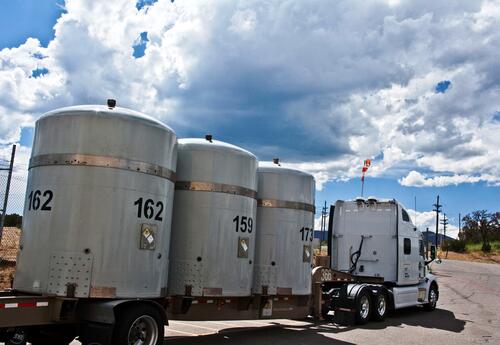
A shipment of transuranic waste from the defense industry heads for long-term storage at the Waste Isolation Pilot Plant in this photo from 2012.

Kotek served as staff director to the Blue Ribbon Commission on America’s Nuclear Future from 2010–2012, which recommended the consent-based strategy for locating nuclear waste facilities, such as a geologic repository. He acknowledged that previous top-down approaches haven’t worked and said the DOE is now seeking public input on how to design a consent-based siting approach by which communities are recognized as partners in the management and disposal of the waste.
“We aim to implement such a system incrementally, to ensure safe and secure operations, to build and maintain public trust and confidence, and to adapt our approach based on lessons learned,” Kotek said.
“As a first step, we will work collaboratively with the public, with interested communities, and with Congress to begin identifying potential partners in this effort.”
The Allocation of Power
States, tribes and local communities all want to have a major say over federal decisions concerning waste repositories, and they want the clear-cut ability to say “no” or “yes” to repositories or nuclear facilities in their jurisdiction.
John Heaton with the Carlsbad Department of Development in New Mexico said he believed the scientific work at Sandia National Laboratories was key to the community’s initial consent to build the Waste Isolation Pilot Plant (WIPP) in their region, and their willingness to reopen the plant in the near future.
“We already had independent monitoring in place at WIPP, and we are expecting to reopen by the end of the year with better safety measures,” said Heaton.
In contrast, for decades, the Shoshone Bannock Tribe in Idaho never made any agreements with the DOE on radioactive waste shipments traveling through their land. Instead, the DOE worked directly with the state, without dealing with the tribe.
“The state does not speak for the tribes, any more than we speak for the state,” said Talia Martin, DOE program director for the Shoshone Bannock Tribe.
“We’re waiting to hear how the DOE is going to interact with the tribes. Will it be a partnership or will they repeat the past where they negotiated with the state and not with us?”
In Nevada, the state consistently opposed the proposed geological repository at Yucca Mountain, but local communities were generally supportive. Nye County officials in Nevada are concerned that the consent-based siting effort by the DOE will only delay waste disposal progress. Nye County is committed to the resumption of Yucca Mountain licensing hearings.
“I believe an individual, well-informed on the ins and outs of waste repositories are generally of the opinion that Yucca Mountain would be the least expensive and fastest resolution to move the ultimate disposal of nuclear waste and high level defense waste,” said Cash Jaszczak, staff consultant for the Nye County Nuclear Waste Repository Project Office.
Finding a resolution for the different positions of state, tribal and local communities is at the heart of the design of a consent-based process.
An International Perspective
A panel of international speakers from Canada, Finland, France, Sweden and the United Kingdom shared the stories of their own national programs and their successes and failures.
Kathryn Shaver from Canada's Nuclear Waste Management Organization listens to a speaker during a steering committee meeting for the Reset of U.S. Nuclear Waste Management Strategy and Policy Series.
In Sweden, the industry producing the waste takes full responsibility for its disposal.
“I find it almost exotic that the utilities in the United States, the producers, can pay their way out of responsibility to the state,” said Saida Engstrom, vice president of SKB, the organization that manages Sweden’s nuclear waste.
“One has to find the incentives to have utilities committed to working towards a solution. I think if you produce waste, you should not be given a free pass.”
France and the U.K. are also pursuing public engagement as an integral part of the strategy for their national programs. But it hasn’t always been a smooth process. U.K. Head of Geologic Disposal Bruce Cairns described a consent-based process that failed in obtaining the consent of all involved parties, but he also described a new process that will give it another try.
Hope for a Solution
Rod Ewing, a senior fellow at Stanford’s Center for International Security and Cooperation, said that it is essential to have these extended discussions so that a new strategy has a greater chance of success.
“In another 30 years, the U.S. cannot afford to find itself in the same place that it is now,” said Ewing, who also serves as Frank Stanton professor in nuclear security at Stanford University.
Ewing said it was also important to include students in the conversation, so they understand that they will inherit the problem, and they are part of the future hope to find a safe, trustworthy, consent-based siting solution.
Stanford PhD candidate Katlyn Turner, who’s studying Geological and Environmental Sciences at Stanford, said the nuclear waste issue was just as critical as global warming.
“Regardless of how you feel about it, we have to deal with it,” said Katlyn Turner, a PhD student in Geological and Environmental Sciences at Stanford.
“My generation should frame it as this is waste that needs to be taken care of the same way we need to take care of C02, global warming, coal and other pollutants.”
The Steering Committee will use the input from this meeting, as well as its own extensive experience in waste management issues, to provide advice and recommendations on how the consent-based process might be applied to the U.S. program. It will also make recommendations on other issues such as the question of creating a new, independent waste management organization to oversee the consent-based process.
The Reset meeting was supported by the Precourt Institute for Energy and hosted by Stanford’s Center for International Security and Cooperation.
The next meeting of the Reset series will be In Washington, D.C. in May at George Washington University and will focus on the integration of the waste management system from the production of the waste to its final disposal in a geologic repository.