Abstract: The motivation to develop nuclear energy waned in the latter part of the twentieth century. Technologies such as very-high-temperature gas-cooled reactors and fast-neutron liquid-metal reactors had been pursued for the purpose of recycling used nuclear fuel from water-cooled reactors, or for the purpose of supplying high-temperature process heat to the chemical industry or for hydrogen production. While both worthwhile causes, one could argue that the important missing element of all of these advanced nuclear reactor technologies was a business case: how were nuclear power plants to be profitable? With the more widely recognized need for decarbonizing energy production, the new driver for developing nuclear energy became cost. Can nuclear power be economically competitive with natural gas and coal, in order to provide an economic driver for the displacement of fossil fuel? This became the new motivation for nuclear energy development in the twenty-first century, and over the last decade the unthinkable happened: a growing and striving ecosystem of nuclear energy start-up companies. Many of these start-up companies pursue the development of liquid-fuel molten salt reactors, fueled by thorium or uranium fuel. Other start-up companies develop solid-fuel reactors cooled by salt, or even fusion reactors cooled by salt. The common feature of nuclear reactors that utilize molten salt is the operation at high-temperature and atmospheric pressure. The high temperature leads to doubled power efficiencies, compared to conventional water-cooled reactors. The atmospheric pressure leads to a safety case that is arguably easier to demonstrate, and hence that would enable a faster commercialization time. On the other hand, there remain many technical risks and time-line uncertainties for the development of salt nuclear technologies. There remain also questions of policy, licensing, and compatibility with local industry and local culture, necessary elements for the global development of such nuclear reactors. This talk will explore some of the challenges faced by the global deployment of molten-salt and salt-cooled reactors, and some of the challenges faced by nuclear start-up companies in order to change the innovation cycle for nuclear energy technology from thirty years to a much shorter time frame.
Speaker's Biography:
Image
Raluca Scarlat is an assistant professor at UC Berkeley, in the Department of Nuclear Engineering. Raluca Scarlat’s research focuses on chemistry, electrochemistry and physical chemistry of high-temperature inorganic fluids and their application to energy systems. Her research includes safety analysis, licensing and design of nuclear reactors and engineering ethics, and she has extensive experience in design and safety analysis of fluoride-salt-cooled high-temperature reactors (FHRs) and Molten Salt Reactors (MSRs). Professor Scarlat has a Ph.D. in Nuclear Engineering from UC Berkeley, a certificate in Management of Technology from the Hass School of Business, and a B.S. in Chemical and Biomolecular Engineering from Cornell University. Scarlat has published articles in Electrochemical Society Journal, Journal of Fluorine Chemistry, Journal of Nuclear Materials, Nuclear Engineering and Design, Nuclear Instruments and Methods, Journal of Engineering for Gas Turbines and Power, Nuclear Technology, and Progress in Nuclear Energy.
North Korea currently has only one publicly known uranium mine—the Pyongsăn uranium mining and milling complex—that serves as a first step in the country’s pathway towards nuclear weapons.
Using a combination of multispectral imagery sourced from the European Space Agency’s Copernicus Sentinel-2 satellite and a review of geological analyses dating back to 1955, a new study from Stanford’s Center for International Security and Cooperation (CISAC) in Jane’s Intelligence Review by geological sciences postdoctoral fellow Sulgiye Park (PhD ’17) and CISAC honors student Federico Derby (BS ’19) looks for evidence of uranium mining in North Korea, going beyond what is currently available in open sources in order to estimate the uranium resources and their locations in North Korea.
The peer-reviewed CISAC study has identified around 18 additional sites in North Korea where the hyperspectral signatures and geological profile combine to suggest the possibility of uranium mining. Nevertheless, CISAC and Jane’s stress that the presence of these ‘hotspots’ does not imply the presence of an active uranium mine or related facility, but rather a site that warrants further analysis.
In this Q&A with Katy Gabel Chui, researchers Sulgiye Park and Federico Derby discuss their work on the project:
How did you land on this project? What made you think to look for more mining sites?
Sulgiye Park (SP) and Federico Derby (FD): Very little is known about the front-end of North Korea’s nuclear fuel cycle, particularly when it comes to the mining and milling processes of uranium production pathway. To date, assessments of this portion of North Korea’s nuclear fuel cycle have been mostly conducted through traditional (electro-optical) satellite imagery observations---the type of imagery that you can access through Google Earth, for instance.
We wanted to get a more complete grasp of North Korea's uranium mining and processing capacity by conducting a multi-disciplinary approach that combines both the visible signatures from multi-spectral satellite imagery and a geological dataset that contains information such as mineralogy and geochemistry. The two individual methods come together at the end to provide information that encapsulates the potential regions likely to host uranium deposits and mines.
What is multispectral imaging? How would it ordinarily be used, and how did you use it for this project?
SP and FD: Traditional electro-optical satellite imagery exploits only three portions of the electromagnetic spectrum; namely, the blue, green and red bands. In general, when using the term “multispectral” within the satellite imagery community, we are usually referring to a satellite system that covers a few to tens of different bands in the electromagnetic spectrum.
Multispectral imagery is used in a wide variety of industries, to measure things like water turbidity, crop healthiness, vegetation quality, etc. For this project, we focused on using spectral fingerprints. Basically, every object – whether it be a mineral, a living thing, water, etc. – has a(n in theory unique) spectral fingerprint. Spectral fingerprints are measured as the intensity of the object’s reflectance of light at a specific wavelength. Varying across wavelengths – hence the importance of having a multispectral system that can give you access to different ranges of the electromagnetic spectrum – you ultimately get a spectral curve that is unique to the item you are studying.
The spectral fingerprints you collect on a specific image can be compared to previously collected fingerprints stored in what is usually termed a spectral library, for classification purposes. Basically, if my spectral curve of a given pixel (or set of pixels) looks super similar to that of gold (for which I obtained a reference spectral curve from a spectral library), then it is probably gold. Obviously, this matching is performed in a more rigorous manner, but you get the idea of how the process works.
In this project, we used the Pyongsan uranium mine in North Korea (arguably the only well-identified uranium mine in the country) as my reference spectral curve. Essentially, using various imaging techniques, we traversed North Korea looking for pixels whose spectral curves are similar to that of the Pyongsan uranium mine. Those are the ‘hotspots’ we identified.
What most surprised you in both your work and your findings?
SP and FD: The fascinating match between the 'hotspots' identified through satellite imagery analysis and the geologic information available in maps and reports. The majority of the 'hotspots' appeared adjacent to the limestone formation from the Ordovician period (circa 445-485 Ma) that are in contact with a specific sedimentary rocks of upper Proterozoic group. Part of the geologic characteristics of the 'hotspots' regions were similar to what had been observed in the Pyongsan (the most well-known) uranium mine of North Korea.
What was most surprising in the work itself? What was difficult in doing the work?
SP and FD: It was surprising to see how much we still don't know about North Korea despite the amount of effort that had been invested. There is no consensus reached regarding the location and the total number of uranium mines in North Korea.
One of the bigger difficulties we had was finding credible geological data and information.
What is the one thing you think someone should take away from your study?
SP and FD: That there are still many unknowns. While our study identified multiple regions with spectral signatures similar to the uranium tailing piles at Pyongsan, verification of uranium presence is still needed.
What are you working on next?
SP: I am still working on using a geologic approach to glean information on the uranium mines of North Korea. The further evaluation aims to identify a qualitative upper limit of uranium ore grade (quality) and quantity pertaining to all the suspected uranium mines in North Korea.
FD: I co-founded a startup focused on developing deep learning models for credit risk analytics (in Latin America). However, I will still keep in touch with my CISAC peers!
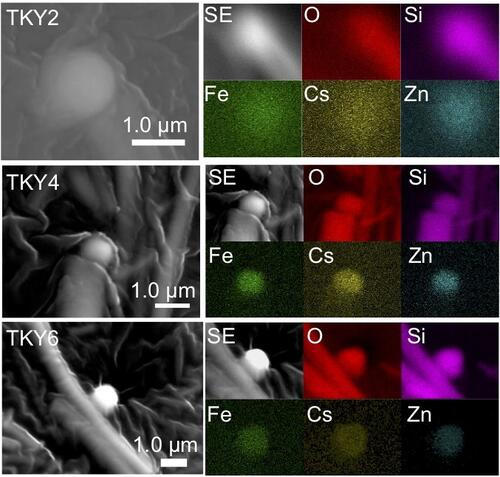
Image above: Secondary electron images from Utsunomiya et al. 2019, of CsMPs discovered in atmospheric particles trapped on a Tokyo air filter from March 15, 2011, with major constituent elements displayed. Via Safecast
An interesting paper was recently published by a team headed by Dr. Satoshi Utsunomiya of Kyushu University on the subject of Fukushima-derived cesium-enriched microparticles (CsMPs). As many readers will know, several researchers have located and analyzed these microparticles, in which the cesium is often bonded within glass-like silicates and therefore generally significantly less soluble than other Cs chemical species in water, though technically not actually “insoluble.” After an accident like Fukushima, it is much more common to find cesium in water-soluble compounds like cesium hydroxide (CsOH), and predictions about how quickly the cesium will be dispersed through the environment, in soil, in watersheds, taken up by plants and animals, etc, are based primarily on this assumption. The discovery of sparingly-soluble Fukushima-derived cesium microparticles, first documented by Adachi et al in 2013, and since then confirmed by many others, has raised a number of questions. How abundant are they? Does their presence increase health risk to humans? How much do they reveal about the process of the accident itself? From the standpoint of researchers the microparticles are very intriguing.
Utsunomiya et al.’s paper is titled “Caesium fallout in Tokyo on 15th March, 2011 is dominated by highly radioactive, caesium-rich microparticles,” and as noted in a recent Scientific American article, it was originally accepted for publication in 2017 by Scientific Reports journal. Weeks before publication, however, Tokyo Metropolitan Industrial Technology Research Institute (TIRI), operated by the Tokyo Metropolitan Government, raised objections with Scientific Reports. However no questions about the quality of the science or the validity of the paper’s findings appear to have been brought forward. This in itself was highly irregular. Two years elapsed without resolution, and in March of this year Scientific Reports took the highly unusual step of withdrawing its offer to publish the paper, despite the lack of confirmed evidence that would warrant it. Utsunomiya and several co-authors decided that the best course of action was to place the study in the public domain by publishing it via arXiv, a highly respected pre-print website. The paper is now open and free to download.
This study makes a valuable contribution to the body of scientific literature regarding the consequences of the Fukushima disaster in general and CsMPs in particular. I think it was a mistake for Scientific Reports not to publish it two years ago, especially considering the rapid pace of research into these particles and the tremendous interest in them. To summarize the findings briefly, the researchers analyzed air filter samples from March 15, 2011, in Setagaya, Tokyo, when the radioactive plume from Fukushima caused a noticeable peak in airborne radioactivity in the city. The researchers used radiographic imaging (placing the filters on a photographic plate) to identify any highly radioactive spots. Using these images as a guide they were able to isolate seven CsMPs, which they subjected to atomic-scale analysis using high-resolution electron microscopy (HRTEM) to identify their nano-scale structure and chemical composition. Based on these detailed measurements and quantitative analysis, the researchers concluded that 80-89% of the total cesium fallout in Tokyo that day was in the form of highly radioactive microparticles. The second half of the paper is devoted to estimates of how long such particles might be retained in the human lungs if inhaled, based on previous studies that reported the effects of inhalation of non-radioactive atmospheric particles, and some possible physical consequences. The paper is valuable for the quantitative analysis of the Tokyo particles alone, since it is one of few studies that deal with the issue for Tokyo specifically. Research into possible health consequences of the particles, meanwhile, has gained momentum while the paper remained unpublished, using approaches such as stochastic biokinetics, and DNA damage studies. In a recent paper, Utsunomiya and colleagues produced estimates of the rate of dissolution of the particles inside the human lung, in pure water, and in seawater. A working group at the Japan Health Physics Society has also devoted attention to the issue, noting the need for further study of the risk from intake of these particles, particularly to the lung. Likewise, others have been studying the particles to learn about the accident progression and possible consequences for decommissioning.
Why did Tokyo Metropolitan Industrial Technology Research Institute object to the paper’s publication? When we first heard that publication of the paper was being held up by Tokyo Metropolitan Government, we thought politically-motivated suppression was a likely explanation. Since then the public has learned that the actual complaint given to Scientific Reports stems from a chain of custody issue of the original air filter samples. We don’t want to speculate further about Tokyo’s motivation, because we have seen no direct evidence yet of political suppression in this case. But based on past occurrences with other government institutions, we would find it plausible. We will let readers know if TIRI responds to our inquiries.
We spoke with Dr. Utsunomiya and co-author Dr. Rodney Ewing recently. I was aware of their co-authorship of several strong papers on CsMPs, including Utsunomiya’s plenary talk at the Goldschmidt Conference in Yokohama in 2016, which I attended. I asked how this new arXiv paper fits in with their other papers, and where they think this research is heading next:
Satoshi Utsunomiya:
Thank you for asking. The Tokyo paper was actually our first paper regarding CsMPs. As I mentioned, the paper was accepted two years ago. There were no previous papers of ours on CsMPs that time. Currently we are working on several topics on CsMPs. I cannot reveal the content yet, as we are thinking about a press release for the next paper. But I think it is important to continue this kind of research, providing some insights for decommissioning at Fukushima Daiichi Nuclear Power Plant.
Azby Brown:
I didn’t realize that this was your first paper on the subject. How does it relate to the one presented at the Goldschmidt Conference in Yokohama in 2016? “Cesium-Rich Micro-Particles Unveil the Explosive Events in the Fukushima Daiichi Nuclear Power Plant.” Didn’t that paper receive a prize?
SU:
My talk at Goldschmidt briefly covered the story described in the two papers that were accepted for publication at the same time. One was published in Scientific Reports. The other one was not published. There was no prize. It was a plenary talk.
AB:
I see. I recall that it received a lot of attention. Now it makes more sense to me.
Can you tell me a little bit about the specific characteristics and focus of your research, and how it differs from papers like Adachi 2013, Abe 2014, etc? Generally speaking, that is. I’d like to help people understand the different aspects of the field.
SU:
Adachi reported the discovery of CsMPs. Abe demonstrated X-ray absorption analysis on the CsMPs. We focused on the nanotexture inside CsMPs. We are particularly interested in the detailed evidence remaining within the microparticle, which can provide useful information on the development of the chemical reactions during the meltdowns, because it is still difficult to directly analyze the materials inside the reactors. We, for the first time, succeeded in performing isotopic analysis on individual CsMPs. More specifically, the occurrence of uranium can directly tell the story of how the fuel melted. Our research has two directions: one is to understand the environmental impact of CsMPs, and the other is to provide useful information on the debris properties to help decommissioning at FDNPP. We are also interested in the implications for health.
AB:
Can you tell me a little bit about your working relationship? Satoshi went to the US to work in your lab, right Rod? When was that, and what were you working on?
Rod Ewing:
Satoshi and I have known each other since 2000, when he joined my research group as a post-doctoral fellow at the University of Michigan. He was a member of the research group until 2007. We collaborated on a wide range of topics that had to do with radioactive materials, such as the transport of plutonium at the Mayak site in Russia to the identification of uranium phases within C60 cages, so called buckyballs, that were formed and released from coal power plants. Once Satoshi returned to Japan to take his position at Kyushu University, we continued to collaborate, particularly on topics related to Fukushima Daiichi.
AB:
How did you both get interested in CsMPs?
RE:
Once discovered, CsMPs were clearly of high interest. They had not been noted in earlier reactor accidents. Satoshi is a master with the transmission electron microscope – exactly the tool/technique needed to study these particles.
AB:
For people who aren’t familiar with what’s involved in a research experiment like yours, can you describe the overall process? What were the technical challenges?
RE:
I would just emphasize that it is very difficult to find and characterize these particles. Considering the full literature and efforts by others as well as our team – the results are impressive. It is rare to have both the TEM characterization and the isotopic data.
SU:
As Rod mentioned, it is difficult to obtain both TEM and isotopic data from a few micron-sized spots. The isolation of CsMPs from soils is a time consuming process. But to date, many scientists have found and isolated CsMPs. The important thing is what information we can obtain from the analysis of CsMPs. We have been taking various approaches to elucidate the properties, environmental impact, and the role in releasing fissile actinides to the environment.
As described above, many papers examining various aspects of Fukushima-derived cesium microparticles have been published since they were first identified in 2013. Even so, important aspects remain only partially documented and understood to date. Below is a partial list of relevant publications.
Papers mentioned in this article:
Caesium fallout in Tokyo on 15th March, 2011 is dominated by highly radioactive, caesium-rich microparticles
Detection of Uranium and Chemical State Analysis of Individual Radioactive Microparticles Emitted from the Fukushima Nuclear Accident Using Multiple Synchrotron Radiation X-ray Analyses
Dissolution of radioactive, cesium-rich microparticles released from the Fukushima Daiichi Nuclear Power Plant in simulated lung fluid, pure-water, and seawater
Monte Carlo Evaluation of Internal Dose and Distribution Imaging Due to Insoluble Radioactive Cs-Bearing Particles of Water Deposited Inside Lungs via Pulmonary Inhalation Using PHITS Code Combined with Voxel Phantom Data
Radioactively-hot particles detected in dusts and soils from Northern Japan by combination of gamma spectrometry, autoradiography, and SEM/EDS analysis and implications in radiation risk assessment
Isotopic signature and nano-texture of cesium-rich micro-particles: Release of uranium and fission products from the Fukushima Daiichi Nuclear Power Plant
Your previous research with this team helped identify the types of radioactive particles that can become airborne and were transported away from Fukushima during the 2011 nuclear disaster.
This most recent paper goes further to show how these Cesium (Cs)-rich silica particles behave in several types of fluids, including simulated human lung fluid, concluding that the particles are fully dissolved in the latter after more than 35 years. What might that mean for human health in the Fukushima area and beyond?
The first breakthrough was the recognition that such particles, a few microns in diameter, existed, a discovery by Japanese scientists at the Meteorological Research Institute, Tsukuba, in 2013. The particles are important because they were dispersed over distances of tens of kilometers and were “carriers” of highly radioactive Cs. Our team’s previous work, led by Professor Satoshi Utsunomiya, mainly focused on the characterization of the particles and their constituents at the atomic-scale and surveyed their distribution in the area away from the Fukushima Daiichi nuclear power plants. Our earliest work from 2016 can be found online. A good summary of the history of the work on these cesium-rich microparticles was recently published in Scientific American.
This latest paper published in Chemosphere is the 6th in a series of papers on the Cs-rich microparticles. We describe the behavior of these particles when exposed to different types of fluids: ultra-pure water, artificial sea water and simulated lung fluid. The microparticles dissolve in all three fluids, reaching a long-term but a continuing, slow rate of release after just three days. Essentially, the calculated release rate of cesium depends on the rate of dissolution of the silica glass matrix and the initial size of the particles. In the simulated lung fluid, the particles are modelled to fully dissolve after more than 35 years.
What is the simulated lung fluid made of, and how does it work in simulation? How do you estimate 35 years?
The constituents of typical lung fluid were simply mixed to simulate its composition based on a recipe reported by previous studies. The lung fluid is different from the other solutions because it contains organic compounds and has a different chemistry, i.e., higher sodium and chlorine content. The estimates of residence time in the body assumes that the particles are inhaled and find their way to the pulmonary system. The calculation of residence time is based on assumptions about the size and composition of the microparticles, and we used the long-term release rate from the experiments. We assumed a spherical shape and a constant decrease in size as the leaching process continued. The rate can vary depending on the actual shape, internal texture, composition (such as occurrence of intrinsic Cs-phase inclusions), and precipitation of secondary phases that may form a “protective” coating on the cesium-rich microparticles (CsMPs). The rate of release was fastest in the simulated lung fluid.
The important result is to realize that the Cs-rich silica particles dissolve slowly in the environment and in the body. Essentially, the release extends for several decades.
How can nuclear energy experts and policy makers use this research to avoid future risk?
Understanding the form and composition of materials that host and disperse radionuclides is the first step in completing a careful dose calculation. Based on these results, the fraction of Cs contained in the silica particles will not be rapidly “flushed” through the environment or the body, but rather will be released over several decades.
Q&A with Rodney C. Ewing, co-director of the Center for International Security and Cooperation, a senior fellow at the Freeman Spogli Institute for International Studies and a Professor in the School of Earth, Energy and Environmental Sciences. Written with Nicole Feldman.
With the Trump-Kim Summit fresh in our minds, Americans are ready to confront nuclear challenges that have been on hold for decades. What many may not realize is that one of the biggest challenges is on the home front. Since the Manhattan Project officially began in 1942, the United States has faced ever-increasing stores of nuclear waste. In Part Three of our series on the consequences of nuclear war, expert Rodney C. Ewing tells us how the U.S.’s failure to implement a permanent solution for nuclear waste storage and disposal is costing Americans billions of dollars a year.
Where does our nuclear waste come from, and what is being done with it?
Broadly speaking, there are two types of nuclear waste.
The first is spent fuel from nuclear reactors used to generate electricity. Those reactors have left us with about 80,000 metric tonnes of used spent fuel, and we don’t have a way forward for the disposal of this waste. It’s stored at more than 75 sites in 35 states around the country, so many of us have some in our state, including California.
The second category is the waste generated by our nuclear weapons complex. That defense waste has accumulated since the earliest days of the Manhattan Project. The highly-radioactive waste from chemical processing is mainly stored in very large metal tanks. They are located at the Savannah River site in South Carolina, the Hanford site in Washington State, at Idaho National Laboratory in Idaho, and Nuclear Fuel Services site at West Valley in New York State.
I think it’s discouraging that we continue to release radioactivity to the environment because after more than 40 years we still have not developed a successful plan for going forward.
What’s wrong with what’s happening now?
This waste is problematic because the volume is large, many hundreds of thousands of cubic meters. The tanks in Hanford and Savannah River are way beyond their design lifetimes, so they’re corroding and some have leaked. The radioactive fluid is being released to the environment. The rates are not high, but I think it’s discouraging that we continue to release radioactivity to the environment because after more than 40 years of effort we still have not developed a successful plan for going forward.
The spent fuel from commercial power plants is much smaller, some 80,000 metric tonnes, but the total amount of radioactivity is roughly 20 to 30 times greater than defense waste. Today, it’s the spent fuel that demands the most attention as an immediate problem, particularly financially.
How much is nuclear waste costing American taxpayers?
The two categories of waste are separated in the budget. At the moment, the budget for the Department of Energy is about $30 billion. Of that budget, about $12 billion is for the nuclear weapons programs. That leaves us $18 billion to use for all things related to energy — nuclear power, fossil fuel, wind, and solar. About $6 billion, one third, is used to deal with the legacy high-level waste from the Manhattan Project. We as taxpayers pay $6 billion every year to address that problem, a huge cost that we will incur for many decades into the future. The projected total cost of clean-up after the Manhattan Project is well over $300 billion. That’s more than the original cost of the weapons programs and the actual total will be even higher. That’s just the defense waste.
What about the waste from nuclear energy? Is that clean-up cost also high?
In short, very. The Nuclear Waste Policy Act of 1982 created a tax on electricity generated by nuclear power plants. This tax would accumulate into the Nuclear Waste Fund for us to build a geologic repository — a mined facility deep within the earth — to safely dispose of the waste. What’s happened to that?
The fund has a balance of more than $40 billion. It’s controlled by Congress on an annual basis, and congressional budget rules make it very difficult to use those funds. It’s not a lockbox where the money goes and waits to be spent. Instead, it’s been applied against our national debt, so even though the fees have been collected, they haven’t been used for their intended purpose.
We pay about half-a-billion dollars a year to the utilities for their simply keeping the fuel because there’s no place for it to go.
The Department of Energy was to take ownership of this fuel on January 1, 1998, but they didn’t because there was no geologic repository. Now the utilities who have the fuel have to continue to deal with it onsite. They have sued the federal government for its failure to take ownership of the fuel, so now we pay about half-a-billion dollars a year to the utilities for their simply keeping the fuel because there’s no place for it to go. The projected cost of this penalty, let’s say, is something on the order of many tens of billions of dollars, depending on how long the spent fuel has to remain at the reactor sites. The cost of doing nothing over time will be equivalent to what we charge the rate payers, $40 billion over time. That doesn’t even include compensation to workers in defense facilities, soldiers exposed during atmospheric testing of nuclear weapons, and so on.
Clearly, the financial cost to taxpayers is high. What about the cost to the environment?
For the spent fuel, the volume — 80,000 metric tons — sounds like a lot, but compared to Gigatonnes of carbon emitted by burning fossil fuels, its volume is not so great. It’s well-contained, but there are some difficulties with how it’s stored. In some cases, the used fuel is kept in pools. Those pools have filled, and they weren’t meant for extended storage. We should be trying to get that fuel into what are called dry casks: obelisks concrete and metal.
Are there other challenges people may not be aware of?
What people don’t realize is that it is actually a serious technical challenge.
It’s very common for people to say there are no technical problems, that it’s just political. They say, “We know how to do it. It’s just a difficult public. Strict regulations. No one will let us solve this problem.”
I think what people don’t realize is that it is actually a serious technical challenge. The half-lives of some of these elements stretch into tens, if not hundreds of thousands of years. We’re asked to design solutions that will last as long as the risk. That’s not something we usually do. The technical and scientific challenge for nuclear waste is, whatever our solution, that we will never see whether we were correct or not. Designing a system where you don’t have feedback is very difficult.
What will happen if we don’t find a solution?
There will not be an immediate catastrophe; I don’t expect anything to explode. There will be environmental contamination, but the biggest problem is financial. We’re spending $6 billion a year trying to deal with the problem, and we’ll continue to spend $4.5 to $5 billion a year without solving the problem. That $5 billion could go to education or research. Imagine if instead of working on waste, we were working on solving our future energy needs.
What’s the best way for us to move forward?
At Stanford, over a two-year period we had a series of meetings to ask just this question: how does the U.S. break out of its gridlock situation and move ahead? We brought in international experts, members of the public, really quite an extraordinary effort, over 75 speakers in five meetings. We have a number of recommendations. We need a new, single purpose nuclear waste management organization. We need a new process for engaging not only the scientific and technical communities, but also the public. We need a new regulatory framework that recognizes the challenges of predicting repository performance over hundreds of thousands of years. Most importantly, we need to realize that dealing with nuclear waste is not only a technical issue, but also requires careful attention to social issues. It is very important to design an approach that engages local communities, states, and tribes. This report, Reset of U.S. Nuclear Waste Management Strategy and Policies, will be released this summer.
Hero Image
Nuclear waste is accumulating at sites across the country, and we have no permanent solution, says nuclear waste expert Rodney Ewing. | Charissa Van Straalen/Getty Images
The following are remarks by Professor David Holloway at the Sid Drell Symposium on Fundamental Physics given at SLAC on 12 January 2018.
I want to thank the organizers for inviting me to speak at this conference. It’s a particular pleasure for me as a historian and political scientist to be a speaker at a symposium on Fundamental Physics. More seriously it is an honor for me to speak at a symposium in memory of Sid Drell, with whom I had the privilege to work for over thirty years. Sid agreed with Einstein that politics was much harder to study than physics. “The laws of physics stay the same,” he said. “The laws of politics change. And besides, you are supping with the Devil.”
Sakharov
My topic is Sid’s friendship with Andrei Sakharov, whom Sid greatly admired and more than once referred to as a saint. Sakharov was born in Moscow in 1921, five years before Sid. He died in 1989. I don’t want to go through Sakharov’s life, but I do want to mention a couple of things to provide context for Sid’s meetings with him and for their friendship. Sakharov’s mentor, Igor Tamm – a Nobel Prize-wining physicist – drew Sakharov into work on the design of thermonuclear weapons in 1948. From 1950 to 1968 Sakharov lived and worked in Arzamas-16 (now Sarov), the Soviet equivalent of Los Alamos. He played a key role in the development of Soviet thermonuclear weapons.
In 1968 Sakharov was removed from secret work after an essay he had written – Reflections on Progress, Peaceful Coexistence, and Intellectual Freedom – was published abroad. In the opening paragraph Sakharov states that his views were formed in the milieu of the scientific-technical intelligentsia, which was very worried about the future of humankind. Their concern, he continued, was all the stronger because what he called "the scientific method of directing politics, economics, art, education, and military affairs" had not yet become a reality. What did he mean by the "scientific method" in this context? His answer: "We consider 'scientific' that method which is based on a profound study of facts, theories, views, presupposing unprejudiced and open discussion, which is dispassionate in its conclusions." In other words, Sakharov wanted open discussion of important policy issues – something that did not happen in the Soviet Union.
Image
In his essay Sakharov expressed ideas he had been coming to for some time, but the immediate stimulus to his writing the essay appears to have been that he was refused permission to publish an article about ABM systems. He (and other senior scientists at Arzamas-16) had come to the conclusion that “creating ABM defenses against massed attacks is not realistic, while for individual missiles it is difficult but possible.” Sakharov had written to Mikhail Suslov, an ideologically rigid Politburo member, whom he had met, expressing this view and asking for permission to publish an article on ABM systems. Suslov had denied him permission.
The publication of the essay abroad converted Sakharov from a scientist engaged in secret work into a world-famous figure. The essay sold 18 million copies in one year (it was printed in full in many newspapers).
I mention this episode and this essay to show that Sakharov, like Sid, was interested not only in physics but also profoundly interested in the application of science to policy, something that Sid had begun to do, starting in 1960 with Panofsky’s encouragement. It was the publication of the essay abroad that got Sakharov expelled from secret work. It is only then that he began to turn his attention to the defense of human rights in the Soviet Union, especially after 1970, when he met Elena Bonner, whom he married in 1972. In 1975 he was awarded the Nobel Peace Prize for his work for human rights. In his 1968 essay he had seen intellectual freedom as crucial for progress – how else could we deal with environmental degradation and the danger of thermonuclear war? In his Nobel lecture, Peace, Progress, and Human Rights, he named over one hundred of the political prisoners being held in the Soviet Union. He also made the general point that peace, progress, and human rights were indissolubly linked. For progress to be beneficial and peace secure, human rights (freedom of conscience, freedom of assembly, freedom of expression etc.) had to be protected. Thus the rights of the individual were intimately linked to our capacity to deal with global problems facing the human race.
Sid and Sakharov meet
In the early 1970s Sakharov was under intense pressure to curtail his activities, This came from the authorities and also from fellow members of the Academy of Sciences. That was the state of affairs in 1974 when he and Sid had their first meeting, which took place in Moscow, at a small conference on composite nucleon structure. Sid recalled “what I considered a great compliment to me, he apparently knew enough about me through whomever to sit down next to me at the meeting.” In his memoirs Sakharov writes of this meeting that Sid was a “young man,” “already a very well-known physicist.” They exchanged notes because Sakharov’s English was very poor and Sid’s Russian even worse. They could both get along a little bit in German. Sakharov then asked Sid about people in the West and invited Sid (and Viki Weisskopf) to dinner at his apartment on Chkalov Street (ulitsa Chkalova) where they met Elena Bonner and Bonner’s daughter Tanya Yankelevich, who was probably the person who made the conversation possible.
At that first meeting Sid and Sakharov formed a bond. They met again two years later at a High Energy International Meeting in Tbilisi. Sakharov and Bonner were both there. Sid spent a week with them, forming a close and warm rapport.
Sid maintained a steady correspondence with both Sakharov and Bonner. In the late 1970s much of this correspondence had to do with the repression of human rights in the Soviet Union and the persecution of physicists (and others). Sid was particularly helpful to Elena Bonner’s children in Boston, Efrem and Tanya Yankelevich. He also did what he could to keep Sakharov’s name – and his plight – in the news. He made sure Sakharov’s papers were published in the West; he helped to organize conferences on Sakharov, and to keep Sakharov’s name in the public mind. He was not alone in this – there was an organization called SOS (Sakharov, Orlov, and Shcharansky) founded at Berkeley – but he was one of a few, and he was persistent.
There is a touching letter from Sakharov to Sid in June 1981:
“Dear Sidney, I want to write to you this time not an ‘open’ but a most ordinary letter, to thank you from the bottom of my heart. Lusia [Elena Bonner] and I feel all the time that in that infinitely distant world to which our children have been mislaid and where they now live, there are some (very few) people who have not forgotten them or us, and you are one of them.” And then Sakharov writes, perhaps rather slyly in view of Sid’s liking for Madras jackets: “I sense that almost physically, seeing you in my mind’s eye in your check suit (although perhaps you now dress differently.)”
In 1978 Sid wrote N.N. Bogoliubov to explain that he would not take part in a Dubna-sponsored symposium on Elementary Particle Theory because of the way the physicist Yuri Orlov was being treated. Orlov had been condemned to seven years in the GULAG for documenting Soviet infringements of human rights, contrary to Soviet commitments in the Helsinki Final Act of 1975. Sid told Bogoliubov that he was very sorry to miss what would doubtless be a stimulating symposium and that he hoped the conditions would soon return for normal scientific collaboration.
The “Open Letter”
Sakharov was arrested in January 1980 and exiled to Gorkii for criticizing the Soviet intervention in Afghanistan. Gorkii was a closed city; foreigners could not travel there. Up to that point Sakharov had been able to use the prestige he had won by his role in nuclear weapons development to avoid arrest, though he had been under considerable social and political pressure from the authorities. In Gorkii he was cut off from Moscow, though Elena Bonner was able, at least initially, to travel back and forth from Gorkii to Moscow.
In 1982 Sid was invited by the Soviet government to visit Moscow to talk to high-level government and military officials about arms control. He made it a condition that he be allowed to see Bonner; and in fact he did so in a meeting arranged by the American Embassy. Sid gave her papers and copies of recent speeches he had made about arms control to take back to Gorkii.
Among those papers was a lecture Sid had given at Grace Cathedral and also recent Congressional testimony. Those statements prompted Sakharov to write one of his most important papers: “On the Danger of Thermonuclear War – an open letter to Dr. Sidney Drell,” which was published in the Summer 1983 issue of Foreign Affairs. The paper caused a great stir, because it intervened on a particular issue in an American debate about strategic weapons policy. Sakharov expressed qualified support for deployment by the US of the heavy MX ICBM.
Sid replied in a letter to Sakharov, pointing out the many areas of agreement between them that Sakharov had discussed in his letter: the dangers and the scale of disaster of nuclear war, which would be an act of suicide with no winners; the sole purpose of nuclear weapons being to deter nuclear aggression; the importance of parity in conventional arms in order not to feel driven to a nuclear “first use” policy; the grave dangers of escalation once the nuclear threshold was crossed; the overriding importance of arms negotiations and reductions; and the unlikelihood that a “star wars” ABM system would be practical.
Sid justified his opposition to the MX by noting that the silo-based system would be vulnerable to destruction in a Soviet first strike and therefore was essentially a first-strike weapon itself, because it would have to be used first if it were to be used at all.
In his memoirs Sakharov wrote: “I consider [Drell] a friend. For many years Drell was an advisor to the US government on questions of nuclear policy and disarmament. In a series of articles and presentations in recent years he has formulated his position on these questions. I fully share Drell’s basic principled positions, but I can’t completely agree with those assertions relating to recent actions, to assessments of the existing military and political situation, to the ways of attaining the goal of all reasonable people of eliminating the danger of nuclear war.” Then, in a note added in October 1983, he wrote that after reading Sid’s response he thought their differences were not so great after all.
After 1986
Through the years of Sakharov’s exile to Gorkii Sid kept up his activities on Sakharov’s behalf. In January 1986 he wrote an eloquent letter to Mikhail Gorbachev, who had become General Secretary in March the year before, urging him to allow Sakharov to return to Moscow from Gorkii. Gorbachev allowed Sakharov to come back to Moscow in December 1986. That Sid’s letter played a role in this decision seems unlikely, but the campaign for Sakharov in which Sid played such a large part surely was an important factor in Gorbachev’s decision, for it kept Sakharov in the public eye and meant that Gorbachev had to make a decision. Sid visited Moscow in the summer of 1987, seeing Sakharov for the first time in eleven years.
Sid made the comment that if you met Sakharov you would know he was an extraordinary person. Thanks to Sid, I had the opportunity to spend an evening with Sakharov in Moscow in June 1987, and my impression confirms Sid’s judgment. I talked to Sakharov about his role in the nuclear weapons program. I remember as I approached his front door thinking, “What am I doing here? This man has very important things to do in Russian public life. Why am I bothering him with my historical research?” Within a minute of his opening the door that feeling was gone. His personal charm made me feel totally at ease and he seemed very happy to talk about his life at Arzamas-16. Two impressions from that meeting: first, Sakharov did not speak quickly. If you asked a question, you could sense his mind turning like a searchlight and illuminating the issue you had brought up. Second, he had a clear, but detached, understanding of his own importance in Soviet history. I recalled at the time that one of the characteristics the Catholic Church looks for in a candidate for sainthood is the person’s awareness of their own holiness, but that awareness should be devoid of all arrogance. Humility does not mean denying one’s own gifts or role in life, but it does mean not taking the credit for oneself.
Drell, Sakharov, and Panofsky at Stanford,1989
In August 1989 Sakharov and Bonner visited Stanford. There was a physics meeting, I think, but what I remember is the talk Sakharov and Elena Bonner gave at CISAC, in Galvez House. 1989 was a tempestuous year in Soviet politics. Sakharov had been elected in March to the new Congress of People’s Deputies and at the first session of the Congress he had been the focal point of several tumultuous debates. He and Elena Bonner talked about that and discussed three broader issues: the constitutional issue; the question of nationalities; and the question of property. It was an extraordinary session. Four months later Sakharov died in his sleep in his apartment, a huge loss for the Soviet Union and the world.
Conclusion
The friendship between Sid and Sakharov was a genuine and close one, though they did not meet often. But they had maintained a correspondence during the difficult years between 1976 and 1987, and Sid had done whatever he could to help Sakharov and his family. The two men were in some ways alike. Physicists of course, and theoretical physicists. They had similar views on nuclear weapons. They were both greatly interested in the implications of new technologies.
The main similarity that strikes me, however, is their integrity. They both took their ethical responsibilities seriously. They thought about what was right, but once they decided what that was, they stuck with it, even if it looked like stubbornness to others. They had a commitment to do what they thought was right, and that was especially important when you engaged in policy or in politics – for then, in Sid’s words, you were “supping with the Devil.” The situations in which Sid and Sakharov found themselves were of course very different, but I think that integrity was there in both of them. Sid greatly admired Sakharov’s moral courage – he saw it as heroic, tantamount to sainthood. And my sense is that Sakharov recognized the same quality in Sid.
I want to end by reading from a poem by Boris Pasternak, which I think captures that quality. It was written in 1956 and addressed to himself. But it can be applied to physicists too. Sakharov organized his obituary of his mentor, Igor Tamm, around this poem. And I hope you will agree that the qualities Sakharov admired in Tamm are qualities we saw in Sid too. It is a short poem, and I will read only part of it, in my own (inadequate) translation.
Abstract: In the fifty years following World War II, Argentina and Brazil constructed advanced nuclear energy programs that far outpaced those of other countries in Latin America. However, their more memorable and lasting contribution to nuclear energy history may well be diplomatic, rather than technical. Beginning in 1974 with an Argentine delegation’s tour of carefully selected Brazilian nuclear facilities, and vice versa, the two countries – under military rule and in a centuries-long competition for regional influence and dominance – began a rapprochement around nuclear energy as gradual as it was unlikely. A watershed presidential summit in 1980 pledged the neighbors to cooperation in specific areas of nuclear energy. It took until 1991, however, for a growing system of informal inspections to coalesce into the world’s only bilateral nuclear safeguards organization, known as ABACC. This talk will focus primarily on the contributions of the scientific and technical communities, and their close work with the two foreign ministries, within this delicate seventeen-year process.
Speaker bio: Chris Dunlap is a Nuclear Security Postdoctoral Fellow at CISAC. His research is funded by the MacArthur Foundation. His book project, developed from his dissertation, focuses on the fundamental role of nuclear energy technology and diplomacy in shaping modern Brazil and Argentina and their bilateral relationship. The paths taken to develop nuclear energy in the South American neighbor countries also illustrate the impact that these nations and their key actors, often left out of global energy history, made upon the physical, legal, and diplomatic structures of the Atomic Age. By 1995, both nations had ceased early-stage efforts toward a nuclear explosion, accepted full safeguards and international verification of all fuel cycle activities, and transformed the "imported magic" of nuclear technology into their own. How this happened, and why, is the history at the heart of the parallel power play that defined Brazil and Argentina's engagement with Atomic Age diplomacy and technology.
Chris received his Ph.D. in history from the University of Chicago in 2017, and also holds a B.A. in history with high distinction, B.S. in biochemistry, and M.A. in history from the University of Virginia.
Christopher Dunlap
CISAC Nuclear Security Postdoctoral Fellow
Abstract: Continuing social concerns over nuclear energy technologies still limit the application of long-term solutions to nuclear waste management in most countries. These concerns result from a lack of public trust in the scientific basis used in the decision-making approach to waste disposal, particularly the siting of a geologic repository. Also, nuclear waste issues have become intertwined with the discussion of the future of nuclear energy. Moreover, setting aside the technical uncertainties about the long-term behavior of the waste materials under extended geologic disposal conditions, a scientific dilemma exists about how to deal with the preferences of future generations that will have to safely manage the waste. This stalemate situation has motivated an effort to frame the discussion from a different and interdisciplinary perspective.
An innovative approach to nuclear waste management called ENTRUST is proposed. The approach consists of an analytical framework for the holistic assessment of nuclear waste management strategies and policies where the primary focus is on building and maintaining public trust. Based on a careful use of quantitative information for technical issues, ENTRUST seeks to support a participative and deliberative analysis of the policy and narratives on strategies for nuclear waste management and disposal.
Speaker Bio: François Diaz-Maurin is a Nuclear Security Visiting Scholar at CISAC (2017-2019) and a European Commission’s Marie Sklodowska-Curie Fellow (2017-2020).
François’ research at CISAC deals with the issue of the long-term management of nuclear waste produced at commercial power plants in a context of uncertain transitions and persisting social concerns over nuclear energy technologies. His interdisciplinary research seeks to merge quantitative and qualitative methods for the holistic study of nuclear waste management systems and policies.
In this talk, François will be presenting the preliminary results of his 3-year research project entitled “Building Trust in Nuclear Waste Management through Participatory Quantitative Story Telling (ENTRUST)”. The project will contribute to CISAC’s “Reset of U.S. Nuclear Waste Management Policy” science-policy initiative.
François received both B.S. (2004, with distinction) and M.S. (2007, with distinction) degrees in civil engineering from the University of Rennes 1, France, and a Ph.D. degree in environmental science and technology (2013, summa cum laude) from the Universitat Autònoma de Barcelona, Spain. Before joining academia, François spent four years as an engineer in the design of nuclear energy technologies in Paris, France (2007-2008) and in Boston, MA (2009-2010) for AREVA Inc. North America and AREVA Federal Services LLC.
Abstract: Since their conception in the 1950s, thorium reactors have been promoted as a promising technology for nuclear energy generation, though they have not yet been successfully commercialized. Proponents of thorium reactors argue that they are safer, produce less waste, and are proliferation-resistant, compared with uranium-fueled light water reactors used around the world today. The central question guiding this research concerns the final claim. Is the thorium fuel cycle inherently more resistant to nuclear weapons proliferation than the traditional uranium fuel cycle?
Advocates argue that the thorium fuel cycle is less vulnerable to proliferation of nuclear weapons technology because little or no plutonium is produced. Additionally, fissile U-233 is claimed to be “self-protected” by U-232, which is produced with U-233 and decays through Tl-208, emitting highly energetic gamma radiation. But the amount of U-232 generated depends on reactor operation. Furthermore, the U-232 content can be further decreased by conducting chemical separations at the back-end of the fuel cycle.
This presentation will discuss the proliferation risks of the thorium fuel cycle. The potential for generating large stockpiles of isotopically pure U-233 by conducting protactinium separations at the back end of the fuel cycle is examined as a new proliferation pathway that current IAEA safeguards may not be prepared to address.
About the Speaker: Eva C. Uribe is a Stanton Nuclear Security Postdoctoral Fellow at CISAC for the 2016-2017 academic year. Her research involves identifying proliferation pathways in the thorium fuel cycle and assessing the potential impact and implications of U-233 stockpile generation on the international nonproliferation regime. Eva received a Ph.D. in Chemistry from the University of California, Berkeley in 2016. Her dissertation research focused on structural analysis of organically-modified porous silica surfaces for the extraction of uranium from aqueous solutions using nuclear magnetic resonance spectroscopy. In 2011 Eva received a B.S. from Yale University with a double major in Chemistry and Political Science. She served as a Next Generation Safeguards Initiative intern with the Nonproliferation Division at Los Alamos National Laboratory in 2008 and 2009.





 Drell, Sakharov, and Panofsky at Stanford,1989