Democracy
-

Abstract:

Image
a different democracy  american government in a 31 country perspective

American democracy differs greatly from other democracies around the world.  But is the American way more or less efficacious than comparable democracies in Asia, Latin America, or Europe?  What if the United States had a prime minister instead of (or in additional to) a president, or if it had three or more parties in Congress instead of two?  Would there be more partisan animosity and legislative gridlock or less?  These are the kinds of questions that thinking about U.S. government in comparative perspective helps us to analyze.


Speaker Bios:

Arend Lijphart 

Image
scan0001

Arend Lijphart is Research Professor Emeritus of Political Science at the University of California, San Diego.  His research has focused on the prospects of democracy in ethnically divided societies like Belgium, Lebanon, South Africa, and India, and on different forms of democracy—especially the contrast between majoritarian and consensus democracy and between presidential and parliamentary systems—and their strengths and weaknesses.  He is the author or editor of more than twenty books; the most recent are Patterns of Democracy (1999, 2nd ed, 2012),  Thinking About Democracy (2008), and A Different Democracy (co-authored with Steven L. Taylor, Matthew S. Shugart, and Bernard Grofman, 2014). 

Lijphart received his Ph.D. from Yale University in 1963, and was awarded honorary doctorates by the University of Leiden in 2001, Queen’s University Belfast in 2004, and the University of Ghent in 2009.  He served as president of the American Political Science Association in 1995-96, and is a member of the American Academy of Arts and Sciences, the British Academy, and the Netherlands Academy of Sciences.


Matthew Shugart

Image
shugart

Professor of Political Science, University of California, Davis


This event is co-sponsored with CDDRL's Program on American Democracy in Comparative Perspective


Arend Lijphart Professor Emeritus of Political Science, University of California, San Diego Professor Emeritus of Political Science, University of California, San Diego
Matthew Shugart Professor of Political Science, University of California, Davis Professor of Political Science, University of California, Davis
Seminars
-

Abstract:

African civil society is grappling with the stagnation of democratization after the highs of the Arab Spring and the crackdowns in its aftermath. Many governments, including several in sub-Saharan Africa, have retreated to repressive laws, big security budgets and expensive patronage that is straining resources and, in some instances, reigniting tensions between communities. More than dealing with bad governance as usual, African civil society is challenged to find new ways to protect the most vulnerable groups. Renowned Ugandan lawyer Nicholas Opiyo, celebrated anti-corruption activist John Githongo, and distinguished scholar of democracy, Larry Diamond, unpack the tool kit for civil society actors to find new ways to confront old dangers to minorities in sub-Saharan Africa.


Bios:

Image
githongo
John Githongo

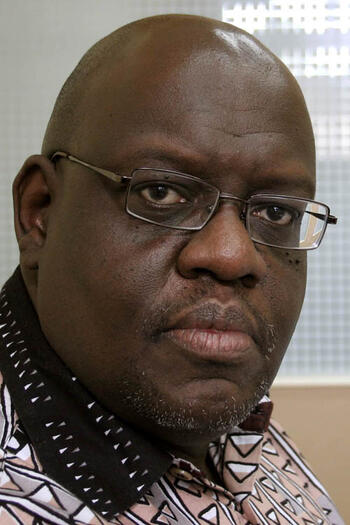
John Githongo, former correspondent for The Economist, is a courageous leader in the struggle to combat corruption and improve governance in Kenya. 

Selected in 2011 as one of the world’s 100 most influential Africans by New African magazine and one of the world’s top 100 global thinkers by Foreign Policy magazine, Mr. Githongo currently serves as CEO of Inuka Kenya, an NGO that works with Kenyan youth to provide civic education and address societal problems.

From 2003 to 2004, he served as permanent secretary for governance and ethics in Kenya’s post-transition government, and risked his life and career to expose one of the biggest government corruption scandals in Kenyan history. 

Mr. Githongo has served as CEO of Transparency International Kenya, vice president of World Vision, senior associate member at St. Antony’s College Oxford, and member of the Kenya Human Rights Commission. 


Image
nicholas opiyo
Nicholas Opiyo

Opiyo is a former Secretary of the Ugandan bar association and a vocal defender of human rights outside the courts as regular commentator on public affairs. He heads Chapter Four Uganda – a legal charity and think tank named after Chapter Four, the bill of rights in Uganda’s constitution. As well as consulting widely on human rights related issues for the World Bank and other international agencies, he leads a team of lawyers seeking out strategic litigation in defense of human rights and providing immediate legal representation to human rights defenders. His public interest cases include challenges to Uganda’s anti-pornography law, discrimination under the HIV Prevention and Control Act, Uganda’s laws on defamation and freedom of expression amongst others. He is also engaged in litigation before the regional East African Court of Justice as well before the African Commission on Human and People’s Rights.


Image
Larry Diamond hs (2)
Larry Diamond

Larry Diamond is a senior fellow at the Hoover Institution and at the Freeman Spogli Institute for International Studies, where he directs the Center on Democracy, Development, and the Rule of Law. Diamond also serves as the Peter E. Haas Faculty Co-Director of the Haas Center for Public Service at Stanford. He is the founding co-editor of the Journal of Democracy and also serves as Senior Consultant (and previously was co-director) at the International Forum for Democratic Studies of the National Endowment for Democracy. During 2002-3, he served as a consultant to the U.S. Agency for International Development (USAID) and was a contributing author of its report Foreign Aid in the National Interest. He has also advised and lectured to the World Bank, the United Nations, the State Department, and other governmental and nongovernmental agencies dealing with governance and development.


Nicholas Opiyo Visiting Ugandan Constitutional and Human Rights Lawyer
John Githongo 2015 Mimi and Peter E. Haas Distinguished Visitor at Stanford University
Larry Diamond Senior Fellow at the Freeman Spogli Institute for International Studies, Director of the Center on Democracy, Development, and the Rule of Law
Seminars
-


Abstract:

The original Civic Culture model portrayed the ideal democratic citizen as an “allegiant” personality who dutifully participates in elections to entrust elites with legitimate power. The allegiant citizen trusts elites, the decision making process and institutions and abstains from disruptive non-electoral participation. The new book, The Civic Culture Transformed, argues that this model is outdated. In established democracies around the world, citizens have turned away from allegiance towards a decidedly “assertive” posture to politics: they are less trustful of politicians, parties and institutions, and are more likely to challenge government with their political demands. Most important, societies in which this transition from an allegiant to an assertive model of citizenship is most advanced are better performing democracies—in terms of both accountable and effective governance.

Speaker Bio:

Image
russ dalton
Russell Dalton's research and teaching has focused on the role of citizens in the political process. He has authored or edited more than twenty books and more than a 160 research articles. Dalton has been awarded the Developing Scholar Award by Florida State University, a Fulbright Research Fellowship, Scholar-in-Residence at the Barbra Streisand Center, German Marshall Fund Research Fellowship, the POSCO Fellowship at the East West Center, and the UCI Emeriti Award for Faculty Mentorship.

He was founding director of the Center for the Study of Democracy at UC Irvine and the Survey Research Center at Florida State University. His current research examines the changing norms of citizenship in the United States and other advanced industrial democracies, and how these norms are reshaping the democratic process in positive and negative ways. This has produced The Apartisan American: Dealignment and Changing Electoral Politics (CQ Press, 2012) and The Good Citizen (CQ Press, 2009). A related research program focuses on comparative electoral politics based on the Comparative Study of Electoral Systems. The first book from this project was Citizens, Choice and Context and a second book, Political Parties and Democratic Linkage, won the GESIS-Klingemann Prize.


Presentation Slides
Russell Dalton Professor of Political Science Professor of Political Science, University of California, Irvine
Seminars
-

AUDIO FROM SEGMENT OF TALK


Abstract:

A democratic recession is underway across much of Africa. Ironically it coincides with sustained economic growth since 1998. Much of this growth derived from political and economic liberalization in the 1990s, that has accelerated over the past 15 years due to an upsurge in demand for Africa’s natural resources. GDP growth does not mean development, however, and deepening inequality is more easily politicised and militarized along identity lines by elites in an era where across the world the politics of identity is resurgent. Both the war against terror and the rise of the Chinese governance model – authoritarian but efficient and compelling politically and economically – have seen elites consolidate power in fewer hands stalling and/or reversing the democratic developments of the last two decades. This elite capture of democratic processes is not limited to the South and has led to a delegitimisation of traditional political parties and players. Additionally, the securitization of geopolitics that has accompanied the ‘war against terror’ has fed a dramatic upsurge in spending on ‘national security’. National security is the last refuge of the corrupt. Indeed, this securitization has been accompanied not only by an upsurge in graft but the ongoing democratic recession. My presentation asks why and how this has come about. Finally, how can democratic gains be protected, consolidated and expanded.


Speaker Bio:

Image
githongo website
John Githongo is the CEO of Inuka, a non-governmental organisation involved in governance issues broadly defined, with an emphasis on working with and for ordinary Kenyans – youth in particular. In doing this Inuka is guided by the principles of heshima (respect), diversity (celebrating the depth and wealth of Kenya’s cultural diversity) and Ni Sisi! (It is us!) – for it is Kenyans who own and will ultimately resolve even the most seemingly intractable of their problems. John is also the Chairman of the Africa Institute for Governing with Integrity; Executive Vice Chair of the Mathare Youth Sports Association (MYSA); Chair board member of the Africa Center for Open Governance (AFRICOG); and a Commissioner of the Independent Commission on Aid Impact (ICAI) of the British government. Previously, he served as Vice President of World Vision, Senior Associate Member, St Antony’s College Oxford; Permanent Secretary in the Office of the President in charge of Governance and Ethics of the Kenya Government; board member Transparency International, Berlin, CEO Transparency International Kenya and a board member of the Kenya Human Rights Commission. In the past he has been a columnist for the EastAfrican, Associate Editor, Executive magazine; and a correspondent for the Economist. In 2004 the German President awarded him the German-Afrika Prize for Leadership. In 2011 he was selected as one of the world’s 100 most influential Africans by New African magazine and one of the world’s top 100 global thinkers by Foreign Policy magazine. In 2012 he was short-listed, alongside US Secretary of State, Hillary Clinton for the prestigious Tipperary International Peace Award.

John Githongo Visiting Anti-Corruption Journalist, Haas Center Visiting Anti-Corruption Journalist, Haas Center Visiting Anti-Corruption Journalist, Haas Center
Seminars
-

Video


Speaker Bio: 

Image
 tmv2447

Mikhail Khodorkovsky is a former Russian businessman and political prisoner of Vladimir Putin’s regime. Prior to his arrest in 2003, Khodorkovsky was the head of Yukos, one of Russia’s largest oil producers, and an increasingly outspoken critic of corruption in Russian life. He began funding opposition parties and established Open Russia, a non-governmental organization promoting a strong civil society. Khodorkovsky was one of the pioneers of Internet in Russia. His company Yukos incubated numerous successful Internet entrepreneurs and investors. He financed educating Russian teachers on new technologies, computerization of schools and broadband Internet connection for schools and libraries in Russian regions. Khodorkovsky was arrested and charged with fraud and tax evasion, and sentenced to nine years in prison, which was prolonged to eleven years after the second trial. Khodorkovsky, declared a prisoner of conscience by Amnesty International, was released in December 2013. Following his release he declared that he will support political prisoners and civil society in Russia. In September 2014 Khodorkovsky re-launched Open Russia as a movement aiming to unite pro-Western Russian citizens. 


[[{"fid":"218596","view_mode":"crop_870xauto","fields":{"format":"crop_870xauto","field_file_image_description[und][0][value]":"","field_file_image_alt_text[und][0][value]":"","field_file_image_title_text[und][0][value]":"","field_credit[und][0][value]":"","field_caption[und][0][value]":"","field_related_image_aspect[und][0][value]":"","thumbnails":"crop_870xauto","pp_lightbox":false,"pp_description":false},"type":"media","attributes":{"height":1113,"width":870,"class":"media-element file-crop-870xauto"}}]]


CEMEX Auditorium

Zambrano Hall/North Building 

Graduate School of Business

Stanford University

641 Knight Way

Mikhail Khodorkovsky Former Russian businessman; Founder, Open Russia
Seminars
-

EVENT AT FULL CAPACITY


Speaker Bio:

Image
anders aslund

Anders Aslund has been a senior fellow at the Peterson Institute since 2006. He is also an adjunct professor at Georgetown University. He examines the economic policy of Russia, Ukraine, and Eastern Europe, as well as focuses on the broader implications of economic transition. He worked at the Carnegie Endowment for International Peace from 1994 to 2005, first as a senior associate and then from 2003 as director of the Russian and Eurasian Program. He also worked at the Brookings Institution and the Kennan Institute for Advanced Russian Studies. He earned his doctorate from Oxford University. Åslund served as an economic adviser to the governments of Russia in 1991–94 and Ukraine in 1994–97. He was a professor at the Stockholm School of Economics and the founding director of the Stockholm Institute of East European Economics. He has worked as a Swedish diplomat in Kuwait, Poland, Geneva, and Moscow. He is a member of the Russian Academy of Natural Sciences and an honorary professor of the Kyrgyz National University. He is chairman of the Advisory Council of the Center for Social and Economic Research (CASE), Warsaw, and of the Scientific Council of the Bank of Finland Institute for Economies in Transition (BOFIT).

Anders Aslund Senior Fellow, Peterson Institute
Seminars
-

Speaker Bio

Tshering Tobgay is a Bhutanese politician who has been Prime Minister of Bhutan since 2013. He is also leader of the People’s Democratic Party and was Leader of the Opposition in the National Assembly from March 2008 to April 2013. Tobgay co-founded the People’s Democratic Party and was responsible for establishing the Party as Bhutan’s first registered political party. Prior to politics, Tobgay was a civil servant, beginning his career in 1991 with the Technical and Vocational Education Section under the Department of Education. In 1998 he established and headed the National Technical Training Authority and served as a director in the Ministry of Labour and Human Resources from 2003 to 2007.

Tobgay received a bachelor of science degree in mechanical engineering from the University of Pittsburgh’s Swanson School of Engineering in 1990 and later received a master’s in public administration from Harvard University in 2004. He received his secondary schooling in India, at Dr. Graham’s Homes School in the city of Kalimpong, near Darjeeling, in the eastern Himalayas.


[[{"fid":"218156","view_mode":"crop_870xauto","fields":{"format":"crop_870xauto","field_file_image_description[und][0][value]":"Democracy Bhutan Flyer","field_file_image_alt_text[und][0][value]":"","field_file_image_title_text[und][0][value]":"","field_credit[und][0][value]":"","field_caption[und][0][value]":"Democracy Bhutan Flyer","field_related_image_aspect[und][0][value]":"","thumbnails":"crop_870xauto","pp_lightbox":false,"pp_description":false},"type":"media","attributes":{"height":1344,"width":870,"class":"media-element file-crop-870xauto"}}]]

Tshering Tobgay Prime Minister, Bhutan
Seminars
-

Abstract:

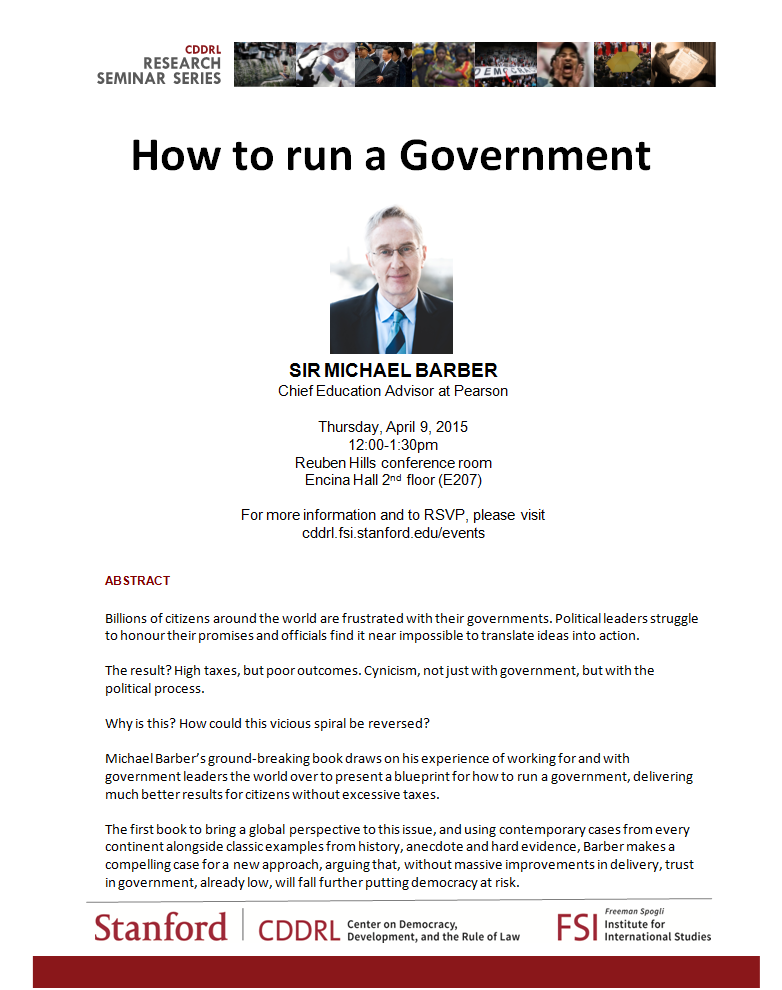
Billions of citizens around the world are frustrated with their governments. Political leaders struggle to honour their promises and officials find it near impossible to translate ideas into action. The result? High taxes, but poor outcomes. Cynicism, not just with government, but with the political process. Why is this? How could this vicious spiral be reversed? Michael Barber’s ground-breaking book draws on his experience of working for and with government leaders the world over to present a blueprint for how to run a government, delivering much better results for citizens without excessive taxes. The first book to bring a global perspective to this issue, and using contemporary cases from every continent alongside classic examples from history, anecdote and hard evidence, Barber makes a compelling case for a new approach, arguing that, without massive improvements in delivery, trust in government, already low, will fall further putting democracy at risk.


Speaker Bio:

barber Sir Michael Barber
Sir Michael Barber is Chief Education Advisor at Pearson – responsible for putting in place a process to ensure that all Pearson's products and services demonstrably deliver improved learner outcomes. He is chair of the Pearson Affordable Learning Fund, aiming to extend opportunities by investing in low-cost private education in the developing world. In 2001, he founded the Prime Minister’s Delivery Unit in No10, Downing Street, which he ran until 2005. From 2005 to 2011 he was a partner at McKinsey and Company. In 2009 he founded, in Washington DC, the Education Delivery Institute. Since 2009, on behalf of the British government, he has visited Pakistan over 30 times to oversee a radical and, so far, successful reform of the Punjab education system. He is the author of numerous books and articles, most notably Instruction to Deliver, and Deliverology 101. In 2005, he was knighted for his services to improving government.

Image
barberflyer

Sir Michael Barber Chief Education Advisor, Pearson Chief Education Advisor, Pearson Chief Education Advisor, Pearson
Seminars
Authors
News Type
News
Date
Paragraphs

CDDRL Visiting Scholar and former Foreign Minister of Mongolia Zandanshatar Gombojav recently published an article in a Mongolian news outlet, Today.mn, commenting on the nation's deteriorating human rights record. Citing an increase in criminal cases involving foreign and domestic workers, Gombojov argues that Mongolia is no longer a secure and protected environment for business and investment. Without more transparent judicial processes, Gombojov believes Mongolia's economic difficulties will continue to worsen. Read more on Gombojav's commentary below, translated to English from Mongolian. For the full article in Mongolian, see the link above.


Lately, websites have been screaming loudly that freedom and human rights are being violated in Mongolia for both foreigners and local people. Those who run businesses are especially concerned, and live and work in constant fear.

It is accurate to say that present-day Mongolia has turned into a real nightmare for foreign investors.  Cases are sensationalized, regardless of whether the alleged perpetrator is guilty or not.  When cases involve politicians or businessmen, they continue until the accused are forced to their knees for the alleged crimes.

In Mongolia, we have an old saying about the sanctity of reputation that has seemingly been forgotten: “Break my bones instead of my reputation.”  Since 2005, there have been numerous cases when peoples’ reputations have been insulted and assaulted.  The system does not adjudicate or resolve cases according to a rule of law or well-established procedures, but rather through unsubstantiated, spurious and unethical allegations that have polluted Mongolian society.  And it doesn’t stop there.

The assault on reputations that is characterized by false accusations is expanding and becoming evermore pervasive, thus creating a huge obstacle to our economy’s development and growth.  It is unfortunate that the authorities are stirring up this circumstance, rather than seeking understanding, and taking firm action to combat mis-information and promote transparency and the rule-of-law.

One of the classic examples is the court verdict recently rendered on the three managers of “SouthGobi Sands (SGS),” which has been the object of sensational international news. If it is true that the three who have been accused are proven to have really committed tax evasion for their employer, SGS, then they should be punished according to the laws and procedures of Mongolia.  No one would argue with this.

But the case is not clear–cut or definitive. Doubt hangs behind the allegations because it is very unclear what kind of reasons or motivation are hiding behind the accusation.  The ex-managers of “SouthGobi Sands” have been sentenced to long prison terms by the criminal court, which makes everyone, foreign and domestic, worried. Foreign experts, including the US embassy, believe that this case has violated the three men’s human rights, and consequently the case has been carried actively by U.S. media.

Fortune.com reports “Rather than symbolizing due process in an emerging democracy, the trial’s numerous irregularities have raised fears that a country struggling with a resource curse has further dulled its economic prospects.”  Bloomberg Business quotes Chuluunbat Ochirbat, an economic advisor to PM Saikhanbileg as saying:  “It is an unusual practice in Mongolia that tax and other disputes are classified as criminal cases, “ and Dale Choi, founder of Independent Mongolia Metals & Mining Research in Ulaanbaatar, adds:  “It would create very negative publicity. Foreign investors and executives would be scared of signing documents in Mongolia.”  Mining.com, in an article entitled “Mongolian verdict sends chill through mining community,” comments that if the court decision is not reversed, “SouthGobi” will be bankrupted.

This is a small sample of the many posts that have appeared in U.S. and international media over the past two weeks regarding the court sentences of U.S. citizen, Justin Kapla and Philippine citizens, Hilarion V. Cajucom JR and Cristobal G. David.

If we look briefly at this world-wide sensational case: “Three ex-employees of foreign the invested company “SouthGobi Sands” have been sentenced to prison.  When, at the outset, the Tax Department detected a potential violation, they should have had independent experts prepare reports and statements in conjunction with the prosecutors and police overseeing the case. But, the Ministry of Finance prepared the reports itself, without expert review.

In addition, the Ministry’s subsequent inspections only fueled exaggerated reports, instead of inviting independent experts to prepare their own report, affirming or rejecting the legitimacy of the Tax Inspectors findings. The foreign-invested “SouthGobi” had an international audit organization inspect and prepare independent reports; but these were ignored by the Mongolian court.

Furthermore, the prosecutor initially requested that the three only pay a penalty, but later added the much stiffer request for prison terms.  What attracts our attention most is the definition of the case as a criminal case, not a civil case.  It is also puzzling that officials from the Tax Department were not present at the trial, and that the case had been returned twice because of insufficient evidence.

Justin Kapla had worked for “SouthGobi” for only 6 months at the time of the trial, though the tax evasion case had been ongoing for 5 years.  It is not very understandable which laws and rules exactly are served in Mongolia. Obviously, we know that telephone justice dominates in our country.

In the end, the three foreign citizens who were convicted were the hired employees of “SouthGobi”.  It is very unfair and unjust that the company owners and directors escaped prosecution for tax evasion, if indeed it is true and proven.  The owners and directors should be held responsible if there is evidence of wrong-doing, instead of sentencing ex-officers employed for only 6 months to 1 year.

The three are imprisoned in a foreign country accused of evading USD 6.8 billion in taxes. The question that they asked in court: “Did we really evade taxes and hide an amount of money that is equal to Mongolia’s GDP?”  These sound like the words of a desperate person, but they highlight the irresponsibility of our country’s courts and monitoring organizations.

The Mongolian authorities also drew a nonsensical and misleading parallel with the United States, arguing that if the same fraction of GDP was embezzled in the U.S. each politician would have USD 2.2 billion.

U.S. citizen Justin Kapla filed a complaint with the UN High Commission on Human Rights last summer.  Since then, he has noted repeatedly that his treatment and the irresponsible court decision will negatively affect foreign investment in Mongolia. If this negative news and reports continue to spread in international media, the reputation and credibility of the Mongolian courts will be further comprised, and fears will be fueled among people whose trust Mongolia needs.

Several years ago, there was case involving a Japanese investor who was sentenced to prison for drug abuse.  He was ultimately released, but only after having to address and overcome many issues.  First, the court had been playing around with investors from the Republic of China, Korea, and Japan.  Then, as the mining industry grew bigger, the court started harassing other large foreign investors.  It is no secret that small Chinese, Korean, and Vietnamese investors are commonly robbed, threatened, and slandered in cases brought on false charges.

Private and public property is sacred in countries where a market economy exists.  The government, or some faction on behalf of the government, are invading private and public property and taking it for themselves. This is a very poisonous and unfortunate chain of events, that communicates to domestic and foreign investors that their businesses and investments in Mongolia are not secure or protected.

We know well that not only foreigners, but also our own people, are struggling to make a living.  They are nonetheless being labeled “criminals” nation-wide, and are accused of unproven crimes associated of “bribery and corruption.”  What we don’t know is how many father’s, son’s, mother’s and daughter’s reputations, work, and lives are being tarnished and damaged by this variant of modern-day repression?

Arresting, imprisoning, and punishing those who create wealth has become a sadness that plagues our society.  This issue has elicited much criticism from law-makers as well. During an interview on Mongol television and News.mn, Member of Parliament U. Enkhtuvshin said: “Rich mining and business owners are the intentional main targets. The authorities conceal the reputation of the individual, his/her family and business through paid media tools.  After that, they sentence him/her to imprisonment. The public is brain-washed by the media and think: “Oh, as expected, this guy has been sentenced for his “you know!!!” crime”.

These kinds of baseless accusations have sadly become commonplace in our society. My successor and now-former Minister of Foreign Affairs Lu. Bold once asked: “Who would want to live or work in a country where the authorities take away investors’ passports, ban them from traveling, and then arrest them for investing after desperately inviting them to come in?”  He added, “Mongolia has turned into a prison”.

In fact, the time has come for us to understand that Mongolia’s current economic difficulties derive from a crisis of politics and from our political structure.  Whose game is it, squeezing the foreign investors out at the same time that the whole world is speculating that Mongolia will go bankrupt from its debt crisis? Whose strategy is it?

Hero Image
mongolia flag Wikipedia Creative Commons
All News button
1
-

Conference Description 


There is currently a worldwide debate regarding the transformation of democracy. The representative system (political parties, parliamentary bodies, and the executive government) has been weakened and in some cases displaced by non-electoral representative actors (mass media, judicial magistrates, public commissions, etc.) and by intense manifestations of civic empowerment that remain politically active well after elections. As a result, the legitimacy of government decisions is consistently called into question. This evolution of democracy at the beginning of the 21st century is particularly apparent in Latin America, but it is affecting the quality and stability of democracy in many countries around the globe.

One element of the transformation has been the repeated emergence of populist governments, characterized by the informal practice of power. These movements, which frequently include marginalized sectors of society and identify with charismatic leadership, exert substantial power in a number of countries. The expansion of regimes with populist features in the context of electoral democracies has led to several unresolved questions that will be discussed in the seminar.


Agenda


9:15     Coffee 

9:30     Introduction, Isidoro Cheresky, Full Professor, University of Buenos Aires; CLAS Tinker Professor

9:40     “The Global Democratic Recession and Its Implications for Latin America”

             Larry Diamond, CDDRL, Stanford

10:15   “Populism and the Politics of the Extraordinary”

             Carlos de la Torre, Professor of Sociology, University Kentucky, Lexington

11:15   “Latin America and the Theological, Epistemological and Aesthetic Regimes of Politics,” Martin Plot, School of Critical Studies, California Institute of the Arts

12:15-12:30  Concluding Discussion          


Discussants


Isidoro Cheresky

Alberto Diaz-Cayeros, Senior Fellow, Freeman Spogli Institute for International Studies


[[{"fid":"217989","view_mode":"crop_870xauto","fields":{"format":"crop_870xauto","field_file_image_description[und][0][value]":"","field_file_image_alt_text[und][0][value]":"","field_file_image_title_text[und][0][value]":"","field_credit[und][0][value]":"","field_caption[und][0][value]":"","field_related_image_aspect[und][0][value]":"","thumbnails":"crop_870xauto","pp_lightbox":false,"pp_description":false},"type":"media","attributes":{"height":1344,"width":870,"class":"media-element file-crop-870xauto"}}]]

CDDRL
Stanford University
Encina Hall, C147
616 Jane Stanford Way
Stanford, CA 94305-6055

(650) 724-6448 (650) 723-1928
0
Mosbacher Senior Fellow in Global Democracy at the Freeman Spogli Institute for International Studies
William L. Clayton Senior Fellow at the Hoover Institution
Professor, by courtesy, of Political Science and Sociology
diamond_encina_hall.png MA, PhD

Larry Diamond is the William L. Clayton Senior Fellow at the Hoover Institution, the Mosbacher Senior Fellow in Global Democracy at the Freeman Spogli Institute for International Studies (FSI), and a Bass University Fellow in Undergraduate Education at Stanford University. He is also professor by courtesy of Political Science and Sociology at Stanford, where he lectures and teaches courses on democracy (including an online course on EdX). At the Hoover Institution, he co-leads the Project on Taiwan in the Indo-Pacific Region and participates in the Project on the U.S., China, and the World. At FSI, he is among the core faculty of the Center on Democracy, Development and the Rule of Law, which he directed for six and a half years. He leads FSI’s Israel Studies Program and is a member of the Program on Arab Reform and Development. He also co-leads the Global Digital Policy Incubator, based at FSI’s Cyber Policy Center. He served for 32 years as founding co-editor of the Journal of Democracy.

Diamond’s research focuses on global trends affecting freedom and democracy and on U.S. and international policies to defend and advance democracy. His book, Ill Winds: Saving Democracy from Russian Rage, Chinese Ambition, and American Complacency, analyzes the challenges confronting liberal democracy in the United States and around the world at this potential “hinge in history,” and offers an agenda for strengthening and defending democracy at home and abroad.  A paperback edition with a new preface was released by Penguin in April 2020. His other books include: In Search of Democracy (2016), The Spirit of Democracy (2008), Developing Democracy: Toward Consolidation (1999), Promoting Democracy in the 1990s (1995), and Class, Ethnicity, and Democracy in Nigeria (1989). He has edited or coedited more than fifty books, including China’s Influence and American Interests (2019, with Orville Schell), Silicon Triangle: The United States, China, Taiwan the Global Semiconductor Security (2023, with James O. Ellis Jr. and Orville Schell), and The Troubling State of India’s Democracy (2024, with Sumit Ganguly and Dinsha Mistree).

During 2002–03, Diamond served as a consultant to the US Agency for International Development (USAID) and was a contributing author of its report, Foreign Aid in the National Interest. He has advised and lectured to universities and think tanks around the world, and to the World Bank, the United Nations, the State Department, and other organizations dealing with governance and development. During the first three months of 2004, Diamond served as a senior adviser on governance to the Coalition Provisional Authority in Baghdad. His 2005 book, Squandered Victory: The American Occupation and the Bungled Effort to Bring Democracy to Iraq, was one of the first books to critically analyze America's postwar engagement in Iraq.

Among Diamond’s other edited books are Democracy in Decline?; Democratization and Authoritarianism in the Arab WorldWill China Democratize?; and Liberation Technology: Social Media and the Struggle for Democracy, all edited with Marc F. Plattner; and Politics and Culture in Contemporary Iran, with Abbas Milani. With Juan J. Linz and Seymour Martin Lipset, he edited the series, Democracy in Developing Countries, which helped to shape a new generation of comparative study of democratic development.

Download full-resolution headshot; photo credit: Rod Searcey.

Former Director of the Center on Democracy, Development and the Rule of Law
Faculty Chair, Jan Koum Israel Studies Program
Date Label
Isidoro Cheresky Full Professor University of Buenos Aires; CLAS Tinker Professor
Carlos de la Torre Professor of Sociology University of Kentucky, Lexington
Martin Plot School of Critical Studies, California Institute of the Arts

Encina Hall, C149
616 Jane Stanford Way
Stanford, CA 94305

(650) 725-0500
0
Senior Fellow, Freeman Spogli Institute for International Studies
Professor, by courtesy, of Political Science
alberto_diaz-cayeros_2024.jpg MA, PhD

Alberto Díaz-Cayeros is a Senior Fellow at Stanford University's Freeman Spogli Institute for International Studies (FSI), and co-director of the Democracy Action Lab (DAL), based at FSI's Center on Democracy, Development and Rule of Law (CDDRL). His research interests include federalism, poverty relief, indigenous governance, political economy of health, violence, and citizen security in Mexico and Latin America.

He is the author of Federalism, Fiscal Authority and Centralization in Latin America (Cambridge, reedited 2016), coauthored with Federico Estévez and Beatriz Magaloni, of The Political Logic of Poverty Relief (Cambridge, 2016), and of numerous journal articles and book chapters.

He is currently working on a project on cartography and the developmental legacies of colonial rule and governance in indigenous communities in Mexico.

From 2016 to 2023, he was the Director of the Center for Latin American Studies at Stanford University, and from 2009 to 2013, Director of the Center for US-Mexican Studies at UCSD, the University of California, San Diego.

Affiliated faculty at the Center on Democracy, Development and the Rule of Law
Co-director, Democracy Action Lab
Director of the Center for Latin American Studies (2016 - 2023)
CV
Date Label
Discussant
Conferences
Subscribe to Democracy