Policy Roundup: April 2026
All Publications button
1
Publication Type
Policy Briefs
Publication Date


Colombians will vote for a new president on May 31, 2026, with a runoff scheduled for June 21 if no candidate secures more than 50 percent of the vote. These elections take place at a critical juncture for the country’s security strategy, institutional trajectory, and democratic resilience. While concerns about violence and public security remain central to voter decision-making, the electoral debate also encompasses broader, equally critical issues, including economic development, poverty reduction, institutional strength, victims' rights, and the stability and effectiveness of the presidency.
Democracy at the Ballot Box: The 2026 Electoral Cycle in Latin America is a new series, hosted by The Democracy Action Lab (DAL) at the Center on Democracy, Development and the Rule of Law (CDDRL) and DAL's Academic Consortium. This panel will examine the stakes of the 2026 election and the alternatives before voters. It will analyze the main dynamics shaping the electoral cycle, including the leading candidates, the coalitions and groups competing for power, and the broader political context in which the contest is unfolding. The discussion will also assess the likely implications of competing policy agendas, evaluate the principal risks facing the electoral process, identify the sources of democratic resilience that may help sustain it, and draw lessons for other Latin American countries confronting similar challenges.
SPEAKERS
MODERATOR
Alberto Díaz-Cayeros — Senior Fellow at the Freeman Spogli Institute for International Studies, Professor, by courtesy, of Political Science, and Co-Director of DAL
Webinar open to the public via Zoom, if prompted for a password, use: 123456
Encina Hall, Suite 052
616 Jane Stanford Way
Stanford, CA 94305-6055
María Ignacia Curiel is a Research Scholar at the Center on Democracy, Development and the Rule of Law and Research Affiliate of the Poverty, Violence and Governance Lab at Stanford University. Curiel is an empirical political scientist using experimental, observational, and qualitative data to study questions of violence and democratic participation, peacebuilding, and representation.
Her research primarily explores political solutions to violent conflict and the electoral participation of parties with violent origins. This work includes an in-depth empirical study of Comunes, the Colombian political party formed by the former FARC guerrilla, as well as a broader analysis of rebel party behaviors across different contexts. More recently, her research has focused on democratic mobilization and the political representation of groups affected by violence in Colombia, Mexico, and Venezuela.
Curiel's work has been supported by the Folke Bernadotte Academy, the Institute for Humane Studies, and the APSA Centennial Center and is published in the Journal of Politics. She holds a Ph.D. in Political Science and dual B.A. degrees in Economics and Political Science from New York University.
Encina Hall, C151
616 Jane Stanford Way
Stanford, CA 94305-6055
Oliver Kaplan is an Associate Professor at the Josef Korbel School of International Studies at the University of Denver. He is the author of the book, Resisting War: How Communities Protect Themselves (Cambridge University Press, 2017), which examines how civilian communities organize to protect themselves from wartime violence. He is a co-editor and contributor to the book, Speaking Science to Power: Responsible Researchers and Policymaking (Oxford University Press, 2024). Kaplan has also published articles on the conflict-related effects of land reforms and ex-combatant reintegration and recidivism. As part of his research, Kaplan has conducted fieldwork in Colombia and the Philippines.
Kaplan was a Jennings Randolph Senior Fellow at the U.S. Institute of Peace and previously a postdoctoral Research Associate at Princeton University and at Stanford University. His research has been funded by the Carnegie Corporation of New York, the International Committee of the Red Cross, the Smith Richardson Foundation, and other grants. His work has been published in The Journal of Conflict Resolution, Journal of Peace Research, Conflict Management and Peace Science, Stability, The New York Times, Foreign Affairs, Foreign Policy, CNN, and National Interest.
At the University of Denver, Kaplan is Director of the Korbel Asylum Project (KAP). He has taught M.A.-level courses on Human Rights and Foreign Policy, Peacebuilding in Civil Wars, Civilian Protection, and Human Rights Research Methods, and PhD-level courses on Social Science Research Methods. Kaplan received his Ph.D. in political science from Stanford University and completed his B.A. at UC San Diego.

Miriam Golden’s presentation in CDDRL’s Research Seminar on April 23, 2026, addressed a central puzzle in democratic politics: why are incumbent reelection rates systematically higher in richer democracies? Drawing on cross-national data, she demonstrates a strong positive relationship between national income and reelection rates, a pattern that is both statistically robust and theoretically unexpected. This empirical finding motivates a reassessment of two dominant frameworks — accountability theory, associated with John Ferejohn, and selection theory, associated with James Fearon. Accountability models suggest that voters reward good performance and punish poor performance, but they do not explain cross-national variation in reelection rates. Selection models argue that elections filter out low-quality politicians, implying that poorer countries with lower reelection rates must have dishonest or incompetent politicians, yet empirical evidence does not align well with these inferences.
Golden proposes an alternative framework centered on “capacity gaps,” introducing the resources that politicians have available and voters' ability to discern political performance as key missing parameters. In poorer countries, both state capacity and voter interpretive capacity are constrained. Governments face fiscal and administrative limitations that restrict policy delivery, while voters struggle to distinguish whether poor outcomes result from incompetence, corruption, or structural constraints. As a result, the informational conditions necessary for effective accountability break down. Golden further argues that informational signals are asymmetric: markers of “bad” types, such as corruption scandals, criminal convictions, or dynastic ties, are visible and salient, whereas markers of “good” types, such as competence or honesty, are diffuse and easily mimicked. In these settings, even honest, competent, and well-intentioned politicians are likely to lose office because they are indistinguishable to voters from the malfeasant and incompetent. Even high-performing politicians may not be rewarded electorally, and good types gain no consistent advantage in reelection.
To evaluate this framework, Golden presents multiple empirical investigations. First, she examines whether voters reward economic performance using within-country variation in GDP growth. The results show that higher growth increases reelection rates, but only in countries with high literacy levels. Since literacy roughly proxies voter discernment capacity, this suggests that performance matters electorally only when voters can interpret it. Second, she analyzes survey data from legislators in Italy and Pakistan to assess whether elections filter out low-quality politicians. She finds that politicians with “bad-type” markers, such as dynastic backgrounds or long tenure, exhibit higher tolerance for corruption yet continue to survive electorally, contradicting selection theory. Third, she tests whether poorer democracies have lower-quality politicians by examining education levels and relative salaries. She finds no meaningful differences in legislator quality across income levels and no relationship between salaries and reelection rates, further weakening selection-based explanations.
Overall, Golden’s approach reconciles several empirical anomalies: the income–reelection relationship, the conditional effect of economic performance, and the persistence of low-quality politicians. At the same time, important questions remain regarding causal identification and measurement, as proxies like literacy may capture broader development effects. Nonetheless, the framework offers a compelling shift in focus from politicians to voters, highlighting how limits in information processing can undermine both accountability and selection in democratic systems.

Miriam Golden presents a new framework linking state capacity and fiscal capacity to reelection patterns across countries.
On Thursday, April 16, Daniel Kelemen (UC Merced) and CDDRL predoctoral fellow Hanna Folsz discussed the consequential outcome of the April 2026 Hungarian election: the victory of Peter Magyar’s Tisza Party over Viktor Orbán’s Fidesz Party in a Rethinking European Development and Security (REDS) seminar co-hosted by the Center on Democracy, Development and the Rule of Law and The Europe Center.
Daniel Kelemen opened the talk, first offering an overview of Viktor Orbán's rise to power. In 2010, Orbán won Hungary’s nationwide election with over two-thirds majority, a majority large enough to allow him to amend the constitution. Having suffered an electoral defeat in the past, Orbán worked to centralize his power. He captured referees — courts and independent bodies — seized control of the media, and demonized and undermined the opposition. Orbán effectively changed the rules of the game, tilting the electoral playing field.
Kelemen states that there are cases in which smaller authoritarian groups within a larger system are tolerated or protected by national parties because they deliver votes. Orbán operated with the support of Angela Merkel, the former Chancellor of Germany, who largely stopped the EU from taking action against Orbán. Orbán’s party, the Fidesz Party, was a part of Merkel’s EU-wide party, the European People’s Party (EPP), a center-right, Christian party. This support, along with the emigration of dissatisfied voters and continued funding from the EU, helped Orbán stay in power.
However, Orbán’s Fidesz Party was kicked out of the EPP in 2021. Merkel, who was a strong supporter of Orbán, left office in 2022. Orbán’s policy also became more extreme, raising more concern from European member states. In 2022, the EU Commission cut funding to Hungary, suspending 32 billion euros. Kelemen identifies this suspension of funds as an effective step against Hungary’s regime.
Kelemen then outlined the implications of Orbán’s fall for Hungary, the EU, and international actors, including Russia and the United States. For Hungary, it means full regime change, as the Tisza Party will likely take efforts to undo Orbán’s autocratic policy changes. For the EU, it means that policy on Ukraine and Russia will be different, because Orbán was using his veto to prevent support for Ukraine and sanctions on Russia. For the US and Russia, Russia lost its supporter and ear in the EU, and the Trump administration lost its closest ally in Europe. On a global note, Orbán was a key figure in trying to bring together far-right populists. After he was kicked out of the EPP, he formed a more autocratic-focused party called MEGA (Make Europe Great Again).

Hanna Folsz then took a closer, domestic look at the Tisza Party and how they triumphed over Orbán. As Kelemen discussed, Orbán's new electoral rules strongly favored large parties with rural bases, the characteristics of the Fidesz party. The Fidesz Party also controlled the media and enjoyed advantages in party financing. However, the Tisza Party, led by Peter Magyar, dominated the 2026 election, despite the electoral system being stacked against opposition parties.
Economic woes, corruption, and scandals surrounding Fidesz created broad voter discontent and set the stage for the Tisza Party’s victory. Tisza worked to create a broad coalition through extensive group-level campaigning, messaging that focused on competent economic governance and anti-corruption, and the idea of reclaiming patriotism. Magyar also extensively campaigned, holding rallies all over Hungary in localities of all sizes. The district candidates within the Tisza Party campaigned in a similar manner.
The Tisza Party focused its policy proposals on extensive welfare, public services improvement, the elimination of corruption, strengthening relationships with the EU and neighbors, and largely avoided divisive topics. The Party also distanced itself from the discredited and divisive established opposition parties, and they did not coordinate with past opposition parties.
Folsz outlined the lessons Hungary’s electoral outcome shows for democratic resistance against autocratization. The Hungarian case demonstrated the importance of connecting with voters and building credibility by campaigning a lot and across the country, including in rural constituencies. The Tisza Party also smartly presented a vision for a better future with concrete proposals, rooted in citizens’ core concerns– in this case, the economy and corruption, and distanced themselves from divisive opposition politicians and parties. The Tisza Party focused its messaging on unity and reclaiming patriotism from the far right.

The 2026 Hungarian election offered a rare example of democratic recovery in a system widely considered entrenched, raising important lessons for opposition movements confronting democratic erosion.

Scholars Daniel Keleman and Hanna Folsz examine the defeat of Viktor Orbán’s Fidesz Party and the implications for Hungary and Europe.

In a Rethinking European Development and Security (REDS) seminar held on April 9, 2026, and co-hosted by CDDRL and The Europe Center, Konstantin Sonin, a John Dewey Distinguished Service Professor at the University of Chicago Harris School of Public Policy, presented his research on “The Reverse Cargo Cult: Why Authoritarian Governments Lie to Their People,” offering a theoretical explanation for why regimes such as the Soviet Union would knowingly tell citizens visibly false statements. According to Sonin’s research, authoritarian propaganda is much more complex than simple misinformation or manipulation, as it is often designed not to convince people of a single claim, but to shape how they evaluate information more broadly.
Sonin begins with a personal anecdote, reflecting on his own experience participating in Soviet elections where there was only one candidate on the ballot, despite the process being presented as a meaningful choice. Using this example, he questions why regimes like the Soviet Union invest so heavily in clearly staged elections or exaggerated portrayals of Western life, even when citizens recognize these distortions. From this, he introduces the idea that such actions are not meant to persuade citizens of a specific falsehood, but instead to influence how they interpret all incoming information. Drawing on the metaphor of a “reverse cargo cult,” he suggests that just as some communities misinterpret the source of Western goods, citizens in authoritarian systems may come to believe that institutions in other countries are equally performative or deceptive. In this sense, narratives about foreign countries become an integral tool for reinforcing domestic political stability.
He further explores how citizens evaluate elections and the decision to replace an incumbent under uncertainty about both competence and trustworthiness. He recognizes that in these regimes, citizens are not entirely naïve and may often recognize when a leader is lying. However, Sonin shows that even obvious lies can be effective. When a domestic leader lies about conditions that citizens already know to be bad, it signals not only that the leader is untrustworthy but also raises the perceived likelihood that foreign leaders are similarly dishonest. As a result, citizens downgrade their expectations of potential replacements, concluding that alternatives may not be any better. This dynamic ultimately reduces the incentive to replace the incumbent.
As his theory suggests, negative information about conditions abroad, or even skepticism toward foreign success, can benefit authoritarian leaders. For example, Sonin points to Soviet reactions to the American National Exhibition in Moscow, where displays of a typical American home were dismissed by officials as unrealistic or misleading. This kind of framing encouraged citizens to question whether life in the United States was truly better, reinforcing the idea that shortcomings at home were not unique. As a result, domestic failures appear less exceptional, helping explain why authoritarian propaganda frequently emphasizes criticism of other countries and why such narratives often reinforce one another.
Sonin concludes by emphasizing that lying in this context is not primarily about persuading citizens of a particular false claim, but about shaping their broader beliefs about the reliability of information. By weakening trust in information overall, leaders can make bad conditions at home seem like the safer or more reliable option compared to the uncertainty of change.

Professor Konstantin Sonin explores the power of misinformation in shaping public perception and political decision-making in a recent Rethinking European Development and Security (REDS) seminar.

On April 2, FSI Center Fellow Didi Kuo opened CDDRL’s Spring Research Seminar Series with a presentation titled “Beyond Policy: The Rise of Non-Programmatic Party Competition in Advanced Democracies.” The seminar examined whether policy continues to serve as the primary basis of political competition and voter-party linkage in advanced democratic systems.
Kuo began by outlining the traditional “programmatic” model of party competition, which assumes that political parties compete by offering distinct policy platforms and that voters make choices based on these policy differences. In this framework, democratic responsiveness emerges from the alignment between public preferences and party positions. Historically, such programmatic competition has been closely associated with democratic consolidation, strong institutions, and effective governance.
However, Kuo challenged this assumption by asking whether policy still plays a central role in contemporary politics. She presented evidence suggesting that political discourse, particularly in the United States, has shifted away from policy-focused communication. For example, recent political speeches were shown to contain fewer policy references and more grievance-based and retrospective language. This shift raised concerns that parties may increasingly rely on alternative strategies to mobilize voters.
The seminar then explored several non-programmatic forms of political competition. These included identity-based appeals, grievance politics, populism, and affective polarization. Kuo explained that these strategies emphasize emotional resonance, group identity, and symbolic representation rather than concrete policy proposals. In such contexts, voters may be motivated less by policy preferences and more by partisan identity or perceived cultural alignment. Importantly, these dynamics do not fully replace programmatic competition but instead reduce its relative importance.
Kuo also discussed theoretical and empirical research showing that many voters possess limited policy knowledge and often hold unstable or weakly structured policy preferences. As a result, factors such as party identification, emotion, and social identity can play a more significant role in shaping political behavior. This complicates the traditional view that democratic accountability operates primarily through policy evaluation.
To assess whether programmatic competition is declining, Kuo introduced new measurement strategies. These included expert surveys evaluating party cohesion and policy salience, as well as analyses of voter responses over time to determine whether individuals reference policy when expressing political preferences. The findings suggested a gradual decline in policy-based reasoning among voters, even in countries like the United States that have historically been highly programmatic.
Kuo concluded by considering the broader implications of this shift. A decline in programmatic competition may weaken democratic accountability, as voters become less likely to evaluate governments based on policy performance. It may also contribute to increased polarization and reduced willingness to compromise, as identity-driven politics tends to be more zero-sum. Ultimately, the seminar suggested that if policy is no longer the dominant mode of political competition, scholars may need to rethink core assumptions about how democracy functions.
In sum, Kuo’s presentation highlighted a significant transformation in advanced democracies: the growing importance of non-programmatic strategies in party competition and the potential consequences this shift holds for democratic governance.

Didi Kuo explores how non-programmatic competition is changing the relationship between voters, parties, and democratic institutions.
The crisis in American democracy is inseparable from the failings of our political parties. Parties are essential to organizing citizens’ engagement in democracy, managing debate and compromise, nurturing candidates, and setting out competing national and local agendas. But our major parties have largely failed to fulfill these responsibilities, albeit in different ways.
In October 2025, New America’s Political Reform program brought together 42 political scientists and sociologists, political practitioners, and organizational leaders for a first-of-its-kind convening to consider two questions: What would a healthier system of political parties look like, and how can we build it?
We would like to thank the participants of the “Blueprint for a Healthier Party System” convening hosted by New America’s Political Reform program in October 2025. The convening and resulting report were made possible by the generous support of the William and Flora Hewlett Foundation.
Thanks also to Maresa Strano and Sarah Jacob of the Political Reform program, as well as our New America events and communications colleagues, for their organizational and editorial support throughout the project.
Editorial disclosure: The views expressed in this report are solely those of the authors and do not reflect the views of New America, its staff, fellows, funders, or board of directors.
A convening organized by New America's Political Reform program reveals pathways to rebuild America’s political parties.
As people increasingly turn to large language models for political tasks, including voting guidance, the political neutrality of AI chatbots has emerged as a major policy concern. American AI chatbots are used globally, yet little is known about their behavior as tools for political decision-making and potential political bias in non-U.S. contexts.
To address this gap, researchers ran an experiment during the final week of Japan’s February 8, 2026, general election. The experiment reveals a striking pattern: when asked which party to support in the election, five major AI models from three companies overwhelmingly directed voter profiles with left-leaning policy positions toward the Japanese Communist Party (JCP). The reason, according to the researchers, has to do with the information environment AI systems can access.
These findings, published in a working paper titled Why Do AI Models Tell Left-Wing Voters to Support the Communist Party?, “suggest that AI voting advice may be shaped as much by the information-retrieval environment as by model training, with implications for governance frameworks that rely on U.S.-centric assumptions,” write the researchers, Andrew Hall, the Davies Family Professor of Political Economy at the Stanford Graduate School of Business and a senior fellow at the Hoover Institution, and Sho Miyazaki, a visiting researcher at Waseda Institute of Political Economy, an incoming Ph.D. student in public policy at Harvard University, and a former predoctoral research fellow at Stanford University. Miyazaki is also a core member of the Stanford Japan Barometer, a project of the Japan Program at Stanford’s Shorenstein Asia-Pacific Research Center.
Sign up for APARC newsletters to receive our scholars' research updates >
To understand how AI models provide political recommendations in the Japanese context, Hall and Miyazaki created 36,300 synthetic voter profiles with varying gender, region, and stated political views on 12 policy issues spanning security (constitutional amendment, defense spending, espionage law), diplomacy and immigration (China relations, foreign workers, permanent residency), energy (nuclear power), economic (consumption tax, social insurance), and social domains (dual surnames, restrictions on corporate donations, Diet seat reduction).
They then queried five models from three AI companies (OpenAI, Google, and xAI) during Japan’s February 8, 2026, Lower House election, asking each model to recommend a political party based on the voter profiles. All five models were queried with web search enabled and could access current information.
The researchers found that policy positions overwhelmingly dominated the models' party recommendations, producing swings of 50 to 98 percentage points in party choice, compared to just 0.5 to 7 percentage points for demographic factors. Thus, demographic effects are an order of magnitude smaller than policy effects.
Furthermore, left-leaning policy views in voter profiles caused all five AI models to converge overwhelmingly on recommending the Japan Communist Party, even though other parties hold broadly similar positions on the issues tested. The concentration on recommending JCP under left-leaning policy stances is therefore not explained by ideological distinctiveness.
In the control condition without policy input, models showed no uniform left-wing bias: three of the five models recommended the Liberal Democratic Party at high rates, and JCP shares were low for four of the five models.
“The key finding is that JCP recommendation rates rise sharply when policy positions are provided, which is the typical scenario when voters use these tools in practice,” write Hall and Miyazaki.
Why the JCP? The researchers traced the pattern to the sources AI models cite when making recommendations.
The JCP operates Akahata, a self-described daily newspaper published on a fully open website that AI web-search tools can freely access. In contrast, Japan's major news outlets have implemented technical barriers (known as robots.txt restrictions) that block AI crawlers from accessing their content, a move driven by copyright concerns.
The researchers found that the JCP's open website and party newspaper were among the most-cited sources in the AI models’ recommendations. Unable to distinguish between editorially independent journalism and partisan content, the models treated the JCP content as a credible news source. Thus, the information environment available to AI is systematically skewed toward the JCP's partisan sources that are designed to persuade rather than to scrutinize and inform.
“A model that retrieves information from jcp.or.jp/akahata and simultaneously classifies that site as news media is not simply making a labeling error: it is operating in an information environment where the boundary between party communication and journalism is genuinely blurred, and where the consequences of that blurring flow directly into its recommendations,” Hall and Miyazaki write.
The researchers also found that incorporating X search amplified left-leaning recommendations in Japan, the opposite of expectations based on the U.S. discourse environment.
The study's findings carry significant implications:
“If AI systems are going to act as political intermediaries more broadly, two problems need to be addressed,” writes Hall in an article about the research via his Substack. “The first is informational: ensuring that what the sources models read reflects the same balance of scrutiny and debate that voters encounter in a healthy media ecosystem. The second is advisory: deciding how an AI system should even translate a voter’s values into political guidance in the first place.”
Learn more about the Stanford Japan Barometer and its work >

In an experiment during Japan’s February 2026 Lower House election, policy stances dominated AI chatbots’ voting guidance, and left-leaning stances caused five AI models to recommend the Japanese Communist Party. The results are driven by which sources models can access and have significant implications for democratic systems as they grapple with the future of elections in the AI era.
Most people move for economic or personal reasons, such as attending college, starting a new job, or being closer to family. Accordingly, residential moves are often beneficial for movers: they can improve life satisfaction, offer movers new economic opportunities, and increase long-term earnings. However, what is often little acknowledged is that moving can generate significant political costs: movers may have to learn about the political issues salient in their new place of residence while simultaneously facing the daunting task of settling into a new place of residence. It is because of these challenges that moving can change the extent to which someone engages in politics.
In “The local costs of moving,” Hans Lueders proposes that to understand how moving affects political engagement, we need to distinguish between national and local engagement. Studying political engagement among movers in Germany, he finds that German movers remain similarly engaged in national politics but become considerably less engaged in local politics. Lueders argues that national engagement is unlikely to change much after a move because the political context remains the same. Intuitively, the same political candidates run for national office no matter where one lives, and the country’s most pressing political issues remain the same as well. By contrast, the political context changes significantly when it comes to local engagement: living in a new place means that movers have less political knowledge (e.g., of local political candidates or salient issues), limited social networks to facilitate local engagement, and a weaker sense of civic duty to engage. Lueders finds no evidence that movers adopt new norms or political ideas — mainly because Germans tend to move to places that are socially and politically similar.
Lueders draws our attention to how moving — and the disengagement it generates — can undermine local democratic accountability. Indeed, when movers cannot communicate their preferences to local leaders, what follows is “representational inequality” between movers and “stayers.” That domestic migration can add or remove 5-10% of a county’s population over a decade, thus has serious consequences for the quality of democracy.
Importantly, Lueders broadens the geographic scope of research on political engagement. Social science research on moving has been heavily informed by data from the US, where “strict voter registration requirements…have been described as more costly than the act of voting itself.” Indeed, the US’s unique — and uniquely burdensome — voting regime has been shown to weaken both local and national engagement for movers. Lueders’s research suggests that these findings do not travel beyond the US. In Germany and much of the Western democratic world, movers are legally required to register their new address with local authorities, and are then automatically added to the electoral rolls. This removes a key barrier to political engagement, at least at the national level. American readers may rightfully ask which interests are advanced or undermined by the current status quo.
Lueders introduces two competing accounts of how moving affects political engagement. On the first account, moving imposes serious epistemological and social costs: movers must learn new information about politics, form new social networks, and come to see themselves as members of a new community. Not only does all of this take time, but movers usually prioritize more urgent personal matters — e.g., finding housing or childcare — such that politics takes a back seat.
Weakened social ties mean that movers interact less often with people who could inform them about local issues, candidates, or initiatives — which are hard enough for longtime residents to grasp. Members of social networks also enforce norms of participation on each other; movers who lack social ties will thus be more content to abstain from voting or volunteering for campaigns. It could be inferred from this account that the further away one moves, the less engaged one will be with one's new home: candidates and issues seem even more novel, while social networks become even more fractured.
A second account highlights how the context of a new place can change engagement, as movers are exposed to new political ideas or norms around participation. This may be because movers are persuaded to approach politics differently, or for more instrumental reasons (e.g., if one’s preferred party already wins by large margins in the new place, engagement will seem less pressing). The contextual account assumes that moving entails a big change in one’s political environment.
Lueders uses German household panel data collected between 1984 and 2020, which totals over 500,000 “respondent-year observations.” By comparing how engagement varies over time between movers and stayers, he can home in on the changes in engagement caused by moving itself, accounting for any baseline differences caused by the kinds of people who choose to move or stay. National engagement is measured by self-reported levels of national political interest, whether respondents voted in the last national election, and whether they plan to vote in the upcoming one. Local engagement is measured by self-reported attachments to one’s place of residence, how frequently they participate in local political and citizen initiatives, and their frequency of volunteering in local associations and organizations.
Lueders’ findings are consistent with the first account, in which local engagement declines due to lower-quality information and weaker social ties. He finds no evidence that Germans’ levels of national engagement change, regardless of the distance of one’s move.
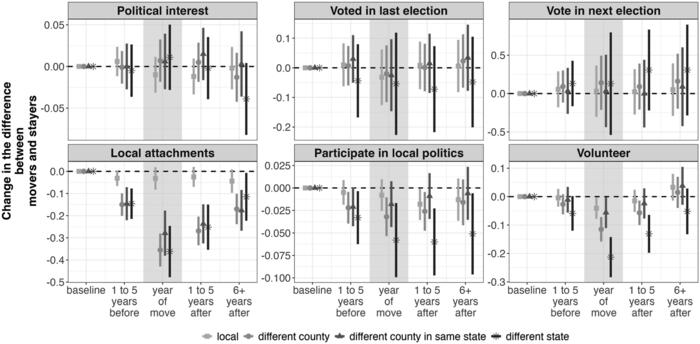
Figure 2. Changes in engagement around moves of varying distances. This figure explores whether movers’ engagement in national (top panel) and local engagement (bottom panel) changes around moves of varying distance. Each coefficient reflects the estimated change in engagement among movers compared to the baseline (all stayers plus movers six or more years before a move). Vertical bars are 95% confidence intervals. Data from the German Socio-Economic Panel (Goebel et al., 2019).
By contrast, the V-shaped patterns in the lower panel show that local engagement changes significantly, declining in the lead-up (around five years) before a move, reaching its lowest point in the year of a move, and then slowly returning to pre-move levels in subsequent years, but without fully recovering. Importantly, engagement declines with distance, as the most local moves (i.e., within the same town or county) leave engagement largely unchanged.
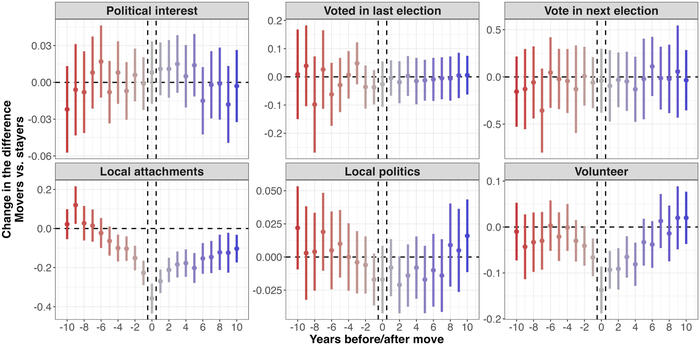
Figure 1. Changes in engagement before and after a move. This figure explores whether movers’ engagement in national (top panel) and local engagement (bottom panel) changes around a move. Each coefficient reflects the extent to which movers depart from the overall trend in engagement in a particular year before or after their move. Vertical bars are 95% confidence intervals. Data from the German Socio-Economic Panel (Goebel et al., 2019).
Against the “contextual” account, Lueders finds that the majority of German moves occur over short distances, which makes it unlikely that contexts differ dramatically. And indeed, most of the places to which Germans move are sociopolitically similar (to where they left) in terms of levels of turnout and federal election outcomes.
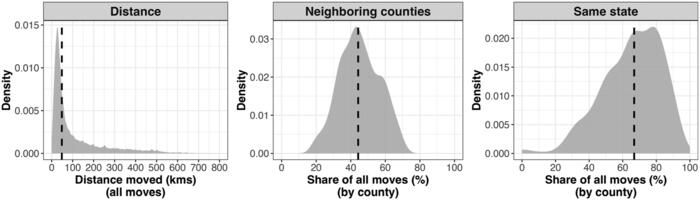
Figure 3. Most moves occur over short distances. This figure uses data on all cross-county moves in Germany in 2015 to compute various metrics of the distance of such moves. Left panel: distribution of the distance between origin and destination counties. Center panel: share of all moves from a particular county that go to neighboring counties. Right panel: share of all moves from a particular county that lead movers to other counties in the same state. Own calculations using data from FDZ der Statistischen Amter des Bundes und der Lander (2019). The vertical dashed line indicates the median move (left) or median county (center and right).
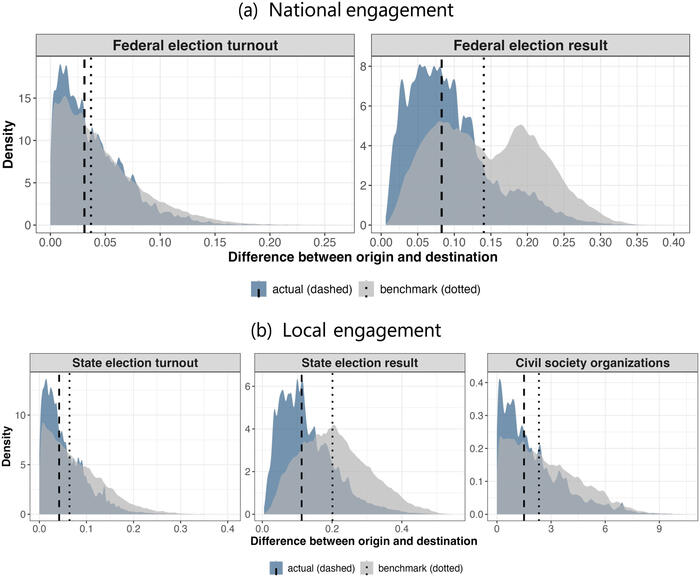
Figure 4. Movers tend to move between politically similar environments. This figure reports the distribution of the change in environments that movers experience upon a move (dark blue). This distribution is contrasted with the distribution of change in environments one would expect when simply considering population totals between county pairs (grey). The vertical lines indicate the medians for the actual (dashed line) and benchmark (dotted line) distributions, respectively.
Ultimately, “The local costs of moving” underscores how highly individual life events can undermine the quality of collective governance.
*Brief prepared by Adam Fefer

CDDRL Research-in-Brief [4-minute read]
On Wednesday, January 14, the Jan Koum Israel Studies Program at the Center on Democracy, Development and the Rule of Law welcomed Ambassador Dennis Ross — a veteran U.S. negotiator in Arab-Israeli peace negotiations and advisor on Middle East policy — to discuss his latest book, Statecraft 2.0: What America Needs to Lead in a Multipolar World. Ambassador Ross joined former U.S. Ambassador to Russia Michael McFaul, the Ken Olivier and Angela Nomellini Professor of International Studies in the Department of Political Science, Senior Fellow at the Hoover Institution, FSI, and the Woods Institute for the Environment, in a conversation moderated by Amichai Magen, director of the Jan Koum Israel Studies Program.
Magen explained that Ambassador Ross’s book focuses on Russia and China, and McFaul’s latest book, Autocrats Vs. Democrats: China, Russia, America, and the New Global Disorder, focuses on several locations, with an emphasis on the Middle East. Both former ambassadors, Magen explained, sought to make sense of an era of geopolitical fluidity, approaching from a liberal internationalist perspective. The former ambassadors discussed the place of America in the world order, the decline of a rule-based international order and the development of a disorderly world, and the meaning of liberalism. The seminar concluded with a focus on Iran’s role in the Middle East and the roles of force and diplomacy in the geopolitical landscape.
Former ambassadors discuss statecraft, autocracy versus democracy, and the future of liberal internationalism in an era of geopolitical upheaval


