FSI's research on the origins, character and consequences of government institutions spans continents and academic disciplines. The institute’s senior fellows and their colleagues across Stanford examine the principles of public administration and implementation. Their work focuses on how maternal health care is delivered in rural China, how public action can create wealth and eliminate poverty, and why U.S. immigration reform keeps stalling.
FSI’s work includes comparative studies of how institutions help resolve policy and societal issues. Scholars aim to clearly define and make sense of the rule of law, examining how it is invoked and applied around the world.
FSI researchers also investigate government services – trying to understand and measure how they work, whom they serve and how good they are. They assess energy services aimed at helping the poorest people around the world and explore public opinion on torture policies. The Children in Crisis project addresses how child health interventions interact with political reform. Specific research on governance, organizations and security capitalizes on FSI's longstanding interests and looks at how governance and organizational issues affect a nation’s ability to address security and international cooperation.
For spring quarter 2022, CISAC will be hosting hybrid events. Many events will offer limited-capacity in-person attendance for Stanford faculty, staff, fellows, visiting scholars, and students in accordance with Stanford’s health and safety guidelines, and be open to the public online via Zoom. All CISAC events are scheduled using the Pacific Time Zone.
About the event: A panel of Stanford experts presents an update on the war in Ukraine. What are the costs of war and what are the prospects for peace?
Speakers:
Scott Sagan - Co-director of the Stanford Center for International Security and Cooperation
Kathryn Stoner - Mosbacher Director of the Stanford Center on Democracy, Development and the Rule of Law
Roman Badanin - Journalist, Researcher, and Founder of Proekt
Yuliia Bezvershenko - Visiting Scholar, Stanford Ukrainian Emerging Leaders Program
Bechtel Conference Center
Encina Hall
616 Jane Stanford Way
Stanford, CA 94305
(Virtual to Public. Only those with an active Stanford ID may attend in person.)
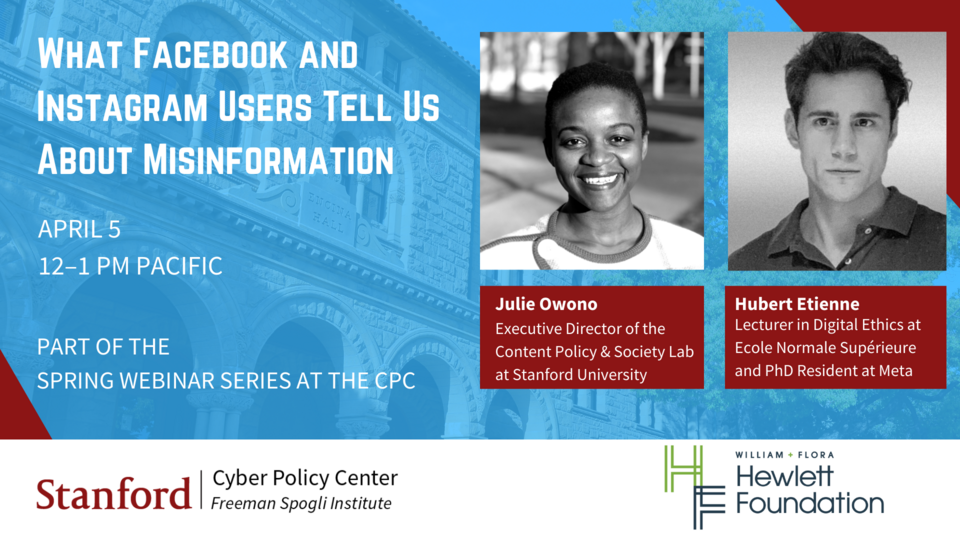
Join us on Tuesday, April 5th from 12 PM - 1 PM PT for “What Facebook and Instagram Users Tell Us About Misinformation” featuring Hubert Etienne, Philosopher and Researcher, Ecole Normale Supérieure and Meta AI in conversation with Julie Owono, Executive Director of the Content Policy & Society Lab. This weekly seminar series is jointly organized by the Cyber Policy Center’s Program on Democracy and the Internet and the Hewlett Foundation’s Cyber Initiative.
About The Seminar:
Social media users who report content are key allies in the management of online misinformation. However, no research has been conducted yet to understand their role and the different trends underlying their reporting activity. Hubert Etienne presents an original approach to studying misinformation by examining it from the reporting users’ perspective at the content-level and comparatively across regions and platforms. This leads Etienne to propose the first classification of reported content pieces, resulting from a review of items reported on Facebook and Instagram in France, the UK, and the US in June 2020 to observe meaningful distinctions regarding misinformation reporting between countries and platforms as it significantly varies in volume, type, topic, and manipulation technique. Etienne identifies four reporting behaviors, from which he derives four types of noise capable of explaining the majority of the inaccuracy in misinformation reporting. He finally shows that breaking down the user reporting signal into a plurality of behaviors allows us to build a simple classifier trained on a small dataset with a combination of basic users-reports capable of identifying these different types of noise.
Speakers:
Hubert Etienne is a philosopher conducting research in AI ethics and computational philosophy at École Normale Supérieure and Meta AI. His research focuses on social interactions, especially the moderation of problematic interactions in cyberspace. He is a lecturer in AI ethics à Sciences Po, in data economics at HEC Paris and in digital regulation at the National School of Administration. He is currently a visiting fellow at Harvard University.
Julie Owono is the Executive Director of the Content Policy & Society Lab (CPSL) and a fellow of the Program on Democracy and the Internet (PDI) at Stanford University. She is also the Executive Director of digital rights organization Internet Sans Frontières, one of the inaugural members of the Facebook Oversight Board, and an affiliate at the Berkman Klein Center at Harvard University. She holds a Master’s degree in International Law from la Sorbonne University in Paris, and practiced as a lawyer at the Paris Bar.
This event is made possible by generous support from the Korea Foundation and other friends of the Korea Program.
Gender politics were a front and center issue in South Korea's March 9th presidential election. What does the outsized role that anti-feminism played in electoral politics and public discourse convey about the politics of gender in Korea today? This panel will examine contemporary public perception and institutional tolerance of gender equality in South Korea and provide a historical overview of women's numerical and substantive political representation since women's suffrage in 1948. The panelists will also draw on their experiences conducting multi-country studies to provide comparative regional insight.
Speakers:
Image
Young-Im Lee is an Assistant Professor of Political Science at California State University, Sacramento, where she teaches gender politics and East Asian politics. Her research primarily focuses on gender and elections in South Korea and Taiwan. Dr. Lee is a chief researcher at the Institute of Political Studies at Sogang University in Seoul and was a visiting scholar at National Chengchi University in Taiwan. Her research has been supported by the Academy of Korean Studies, the Ministry of Foreign Affairs of Taiwan, and the American Political Science Association. Dr. Lee is currently working on a book project analyzing the election and impeachment of South Korea's first female president Park Geun-hye. Her research appeared in Electoral Studies, Politics & Gender, Feminist Media Studies, and Washington Post, among other outlets.
Image
Min Hee Go is an Associate Professor of Political Science and International Relations at Ewha Woman's University in Korea. Prior to joining Ewha, Dr. Go earned her Ph.D. from the University of Chicago in 2012 and taught as assistant professor at Brooklyn College, the City University of New York. Her research interests broadly concern key issues in diversity and sustainability, including gender and racial inequalities and sustainable development. Her first book, Rethinking Community Resilience: The Politics of Disaster Recovery in New Orleans (2021, NYU Press), investigates how civic capacity may compromise, rather than facilitate, the process of building resilience after crisis. She is currently working on her second book project which examines gender equality in East Asia. Focusing on three democratic countries—Taiwan, South Korea, and Japan— she investigates why Asian countries show different levels of public perception and institutional tolerance on gender equality.
Moderator: Kelsi Caywood, Research Associate in Korea Program at APARC, Stanford University
While the number of women in political office around the world is on the rise, men continue to outnumber women at high rates in top leadership positions. There are many reasons why it remains difficult for women to reach, and keep, powerful positions within politics that cover a myriad of electoral, institutional, and individual conditions. Women often become leaders of organizations precisely when leadership conditions are most difficult, and therefore less attractive to powerful men (i.e. the glass cliff). Under these conditions, we might expect women to face greater challenges during their leadership, potentially affecting how long they are able to maintain their leadership roles. Thus, it is impossible to investigate how gender impacts leadership without accounting for selection conditions that place leaders in power. In this paper we take a holistic approach to examining the gendered nature of leadership survival. We investigate how the conditions under which party leaders are chosen, coupled with party performance while in office, impact how long men and women serve as party leaders. In order to do so, we construct a two-stage model that accounts for the endogeneity of the selection process alongside the impact of party performance on the survival of leaders. Using data from 212 leadership terms in eleven industrialized democracies between 1979 and 2018, we find that while women leaders are selected under similar conditions to men, their leadership tenure is more vulnerable to shifts in vote share. Vote share appears to be the main driver of women’s replacement. Men are less susceptible to changes in votes share than women but are also punished for poor poll performance and government loss.
Image
Andrea S. Aldrich is a lecturer in the Department of Political Science at Yale University and her research interests are focused on political representation, gender, and comparative political institutions. Her work examines the relationship between internal political party dynamics and legislative representation. She is particularly interested in investigating the influence of internal party organization on gender equality in elections and party leadership, and her research has recently been published in JCMS: the Journal of Common Market Studies, Party Politics, and Politics & Gender. Before arriving at Yale, she was a Postdoctoral Research Fellow at the University of Houston with the Political Parties Database under the direction of Dr. Susan Scarrow, a visiting scholar at Texas A&M University, and Fulbright Scholar at the University of Zagreb in Croatia.
*If you need any disability-related accommodation, please contact Shannon Johnson at sj1874@stanford.edu. Requests should be made by April 21, 2022.
Co-sponsored by:
Image
Image
Hybrid -- William J. Perry Conference Room and Online via Zoom
Dr. Andrea S. Aldrich, Yale University
spealer
Yale University
AHPP “Aligning incentives” series final webinar: May 12th 6pm PDT, May 13th 9am in Hong Kong and Singapore
How has Myanmar’s health system dealt with the devastation caused by the coup and the pandemic, and what are the current opportunities and challenges for response and recovery? In this panel of two experts, Dr. Thin Zaw will first discuss how Myanmar’s health system and health workforce are endeavoring to respond to the syndemic crisis, a deadly combination of the global pandemic, the military coup, and post-coup civil conflicts. She will also discuss how stakeholders are working together to try to mitigate the crisis, and how a federal health system could be built up to align incentives for effective collaboration among ethnic health organizations. Second, Dr. Tun will provide a grassroots medical humanitarian perspective on what is happening in Myanmar. He will present results of a mixed-methods survey conducted in non-military-controlled areas from October to December 2021, discussing how Myanmar professionals including healthcare workers are spearheading the Civil Disobedience Movement, helping internally displaced people, and trying to address the healthcare needs of populations in conflict areas.
Image
Phyu Phyu Thin Zaw (MBBS, MPP, PhD), who is a Burmese national, is a medical doctor, epidemiologist and health systems researcher currently working as a Lecturer in the School of Public Health in the Li Ka Shing Faculty of Medicine, University of Hong Kong. She is also a member of the Steering Committee of the Science in Exile initiative, which brings together at-risk, displaced and refugee scientists along with like-minded organizations who work together to strengthen systems that support, protect and integrate such affected scientists. Phyu Phyu’s research interests are equity, health and education policies, Southeast Asia health systems and policies, sexual and reproductive health, gender equality, poverty eradication, and human rights issues. Dr. Thin Zaw is also a public health and policy consultant giving technical advice to think tanks and non-governmental organizations.
Image
Nay-Lin Tun (MD, MPP) is a medical doctor by training, and recently earned a Master in Public Policy from the National University of Singapore. He works as a program manager for a local organization that focuses on social cohesion and pluralism among diverse communities. In this role, he manages programs that help vulnerable communities in remote, hard-to-reach, and conflict-affected areas of Myanmar to get access to health services and provide financial assistance to injured civilians who need emergency referrals to private hospitals. Dr. Tun experienced a turning point in his career in 2017 when he went to the conflict-riven northern Rakhine areas. Witnessing people’s suffering and discrimination firsthand compelled him to initiate mobile health clinics and speak out in the media about health care challenges. On a voluntary basis, he is coordinating international donations and grants to field medical teams in conflict-affected areas of the country.
Most studies on China’s relations with Southeast Asian states focus on China’s power and how such power has been used to achieve influence in the region. The emphasis is on intention and causation: how China willingly uses its power to coerce, coopt, or persuade others to behave in a certain way. Professor Han will acknowledge but go beyond this conventional approach to explore the unintended outcomes and ripple effects that are also associated with China’s presence in Southeast Asia. His talk will feature a typology for use in thinking about China’s regional presence and the various everyday forms that it takes. He will argue that we need to understand such nuance and complexity if we are to make sense of China’s relations with Southeast Asia and what they imply.
Image
Enze Han is APARC's 2021-2022 Lee Kong Chian NUS-Stanford Fellow on Contemporary Southeast Asia for the spring quarter of 2022. Dr. Han is also an associate professor at the University of Hong Kong's Department of Politics and Public Administration. His research interests include ethnic politics in China, Southeast Asia’s relations with China, and the politics of state formation in the borderland area shared by China, Myanmar, and Thailand. His many publications include “Non-State Chinese Actors and Their Impact on Relations between China and Mainland Southeast Asia,” ISEAS Trends in Southeast Asia (2021); Asymmetrical Neighbours: Borderland State Building between China and Southeast Asia (2019); and Contestation and Adaptation: The Politics of National Identity in China (2013). Positions and affiliations prior to his professorship at UHK include the University of London (SOAS), Princeton University, the Institute for Advanced Study (Princeton), and the East Asia Institute (Seoul). His 2010 doctorate in Political Science is from George Washington University.
Myanmar’s junta is more than a year old. The vast majority of the country’s people oppose the junta and favor democracy. But the devil is in the details. Many in the opposition want some form of multi-ethnic federal democracy. But levels of disagreement and distrust among different communities, including some of the Ethnic Armed Groups, are impeding a unified vision to push the military out of power and establish civilian rule. This webinar will examine the choices and challenges faced by the opponents of the regime as they try to unite these communities against it on behalf of a better future for Myanmar.
Image
Nyantha Maw Lin is an independent analyst with more than a decade of interdisciplinary experience in government affairs, public policy, and political risk assessment related to Myanmar. Prior to the February 2021 coup, he supported community and stakeholder engagement efforts in Myanmar’s Rakhine State and served on a voluntary panel of industry and civil society representatives who advised the government on initiatives to fight corruption. He also helped to lead several innovative non-profit entities based in Yangon engaged in philanthropy, business, and social-impact activity. In addition to convening multi-sectoral dialogues with government, the private sector, and civil society in Myanmar, Nyantha has also participated in semi-official conversations elsewhere in Southeast Asia. A former Eisenhower Fellow (2018), he earned his BA in Political Science/International Relations from Carleton College (2008).
Image
Scot Marciel has had a long career as an American diplomat serving in multiple countries, most recently as US Ambassador to Myanmar (2016-2020). Earlier postings included as Ambassador to Indonesia (2010-2013) and concurrently as Ambassador for ASEAN affairs and Deputy Assistant Secretary of State for Southeast Asia (2007-2010). He has also served in the Philippines and Vietnam. His assignments at the State Department in Washington DC have included as Principal Deputy Assistant Secretary of State for East Asian Affairs and as Deputy Assistant Secretary of State of Southeast Asia. Based on these experiences, he has been writing a book entitled “Imperfect Partners: The United States and Southeast Asia.” He earned his MA at the Fletcher School of Law and Diplomacy (1983) and his BA in International Relations at the University of California at Davis (1981).
Scot Marciel was the Oksenberg-Rohlen Fellow at the Freeman Spogli Institute for International Studies, affiliated with the Walter H. Shorenstein Asia-Pacific Research Center from 2022-2024. Previously, he was a 2020-22 Visiting Scholar and Visiting Practitioner Fellow on Southeast Asia at APARC. A retired diplomat, Mr. Marciel served as U.S. Ambassador to Myanmar from March 2016 through May 2020, leading a mission of 500 employees during the difficult Rohingya crisis and a challenging time for both Myanmar’s democratic transition and the United States-Myanmar relationship. Prior to serving in Myanmar, Ambassador Marciel served as Principal Deputy Assistant Secretary for East Asia and the Pacific at the State Department, where he oversaw U.S. relations with Southeast Asia.
From 2010 to 2013, Scot Marciel served as U.S. Ambassador to Indonesia, the world’s fourth most populous country. He led a mission of some 1000 employees, expanding business ties, launching a new U.S.-Indonesia partnership, and rebuilding U.S.-Indonesian military-military relations. Prior to that, he served concurrently as the first U.S. Ambassador for ASEAN Affairs and Deputy Assistant Secretary of State for Southeast Asia from 2007 to 2010.
Mr. Marciel is a career diplomat with 35 years of experience in Asia and around the world. In addition to the assignments noted above, he has served at U.S. missions in Turkey, Hong Kong, Vietnam, Brazil and the Philippines. At the State Department in Washington, he served as Director of the Office of Maritime Southeast Asia, Director of the Office of Mainland Southeast Asia, and Director of the Office of Southern European Affairs. He also was Deputy Director of the Office of Monetary Affairs in the Bureau of Economic and Business Affairs.
Mr. Marciel earned an MA from the Fletcher School of Law and Diplomacy, and a BA in International Relations from the University of California at Davis. He was born and raised in Fremont, California, and is married with two children.
Hide publication sections
Off
Date Label
Visiting Practitioner Fellow on Southeast Asia, APARC, Stanford University
Major: Political Science Minor: Economics Hometown: Cozumel, Mexico Thesis Advisor: James Fearon
Tentative Thesis Title:Making Friends with the Enemy: A Study of Cooperation Between Drug Cartels and Local Politicians in Mexico
Future aspirations post-Stanford: After Stanford, I hope to pursue a PhD in political science focusing on Latin American politics and Economic development. My dream is to return to my home country of Mexico and help create a better future for all my fellow citizens. I am unsure whether this would be through academia, journalism, or public office, but I am excited to see what the future holds. Above all, I hope to follow the footsteps of academics and reporters who have devoted their lives to improving conditions in Latin America.
A fun fact about yourself: I am obsessed with the Nobel Prize in Literature. I can name half of the people who have won the award at the top of my head and in my free time, I always read as many laureates as I can (currently at 40 out of 117).
As reports of leveled mosques, detention camps, and destroyed cultural and religious sites in China's Xinjiang province emerged in the mid-to-late 2010s, the world took notice of the Chinese Communist Party's (CCP) flagrant oppression of Uighur Muslims and other minorities. Under the Xi Jinping administration, the Xinjiang region in northwestern China has experienced what is perhaps the greatest period of cultural assimilation since the Cultural Revolution. This massive state repression represents a primary research focus for Dr. James Millward, Professor of Inter-societal History at the Walsh School of Foreign Service at Georgetown University, who joined both APARC's China Program and the Stanford History Department as a visiting scholar for winter quarter 2022.
Millward's specialties include the Qing empire, the silk road, and historical and contemporary Xinjiang. In addition to his numerous academic publications on these topics, he follows and comments on current issues regarding Xinjiang, the Uyghurs and other Xinjiang indigenous peoples, PRC ethnicity policy, and Chinese politics more generally. We caught up with Millward to discuss his work and experience at Stanford this past winter quarter. Listen to the conversation:
Millward emphasizes the importance of documenting the scope and scale of the crisis in Xinjiang. "What's happened in the last four or five years in Xinjiang is of great global importance and interest to people," he says, and although it is still early to write the history of this period of repression, "it's important at least to try and get an organized draft of it down and to try to begin to interpret rather than just narrate the litany of things going on: the camps, the digital surveillance, forced labor, birth depressions, and try and put it all into some kind of framework where we can understand it."
China’s crackdown on Uyghur Muslims and other minorities in Xinjiang is part of aggressive intolerance of cultural and political diversity that is emerging as a central feature of Xi Jinping’s tenure, explains Millward. The shift in the CCP's assimilationist policies constitutes a complete "reversal of what had been an earlier approach to diversity in China," which allowed for 56 different nationalities to have regional autonomy. His aim is to "point out a really aggressive assimilating thrust under the Xi Jinping regime [...] and then also to look more clearly at settler colonialism in Xinjiang."
In this talk, Millward explains how PRC assimilationist policies, if most extreme in Xinjiang, are related to the broader Zhonghua-izing campaign against religion and non-Mandarin language and perhaps even to intensified control over Hong Kong and efforts to intimidate Taiwan.
U.S.-China Cooperation Amid Strained Ties
The Xinjiang crisis has affected how the United States views China, bringing an unexpected unity to the usually-polarized American foreign policy arena. "The Xinjiang issue has contributed to the broad-spectrum feeling in the American political sphere that engagement with China has failed," notes Millward. The parallels between China's repression of minorities and some of the worst events in the 20th century in Europe "have brought together the political sides in America and rallied them around a much stronger anti-China stance," he says.
From Millward's perspective, however, it is not only possible but also necessary for the United States to act on Xinjiang and press China on its human rights record while cooperating with China on other issues. "This is the art of diplomacy, you have to compartmentalize and deal with different issues, particularly with two countries as large as the United States and China." In Millward's view, areas pertinent to U.S.-China collaboration are varied and transcend global challenges such as climate change or pandemics. Those are simplistic dichotomies," he says. "We have 300,000 Chinese students in our universities and we welcome them and learn a lot from them [...] We benefit from Chinese expertise in all sorts of ways."
Millward spent a productive winter quarter at APARC. Returning to Stanford as a visiting scholar provided him a unique opportunity to reconnect with his past on The Farm and survey all that has changed in the years since he completed his doctorate under the tutelage of the late Professor Harold Kahn. "The trailer park where I lived as a first-year graduate student is no more, and I couldn't even find the footprint of where it was."
Bargaining Behind Closed Doors: Why China’s Local Government Debt Is Not a Local Problem
New research in 'The China Journal' by APARC’s Jean Oi and colleagues suggests that the roots of China’s massive local government debt problem lie in secretive financing institutions offered as quid pro quo to localities to sustain their incentive for local state-led growth after 1994
APARC Visiting Scholar James Millward discusses PRC ethnicity policy, China's crackdown on Uyghur Muslims and other minorities in Xinjiang province, and the implications of the Xinjiang crisis for U.S. China strategy and China's international relations.
Congress has just passed legislation requiring owners and operators of critical infrastructure to notify the federal government following a cyber breach. The requirement, made more urgent by fears that Russia’s war with Ukraine will spill over into attacks on America's energy, financial, and other critical infrastructure, is the latest entry to the growing catalog of cybersecurity-related laws, including new state measures and proposed Securities and Exchange Commission disclosure requirements.
Policymakers at the state and federal level continue to search for the right balance of collaboration and enforcement. This one-hour session will explore recent developments in cybersecurity law, offering both pragmatic advice on compliance and litigation strategy as well as big picture insights on the direction of U.S. cybersecurity policy.
Image
Travis LeBlanc is the vice chair of the cyber/data/privacy practice at Cooley and a Senate-confirmed member of the U.S. Privacy and Civil Liberties Oversight Board. He has guided leading tech corporations through enforcement proceedings and class action lawsuits.
Image
Alicia Lowery Rosenbaum is Vice President and Associate General Counsel for Cybersecurity Technology and Trust at Salesforce, where she provides strategic counsel on risk management and governance to the company's security engineering and operations teams.
Image
Jim Dempseyis a Senior Policy Advisor for the Program on Geopolitics, Technology and Governance at Stanford’s Cyber Policy Center. He is the author of Cybersecurity Law Fundamentals, a handbook for practitioners published in 2021 by the International Association of Privacy Professionals (IAPP).
Image
Moderating the session will be Andrew J. Grotto, Director of the Program on Geopolitics, Technology, and Governance and former Senior Director for Cyber Policy at the White House in both the Obama and Trump Administrations.
Jim Dempsey is senior policy advisor to the Stanford Program on Geopolitics, Technology and Governance and a lecturer at the UC Berkeley School of Law, where he teaches a course on cybersecurity law in the LLM program. Until May 2021, Jim was Executive Director of the Berkeley Center for Law & Technology. In 2012, after Senate confirmation, he was appointed by President Barack Obama as a part-time member of the U.S. Privacy and Civil Liberties Oversight Board, an independent agency within the federal government charged with advising senior policymakers and overseeing the nation’s counterterrorism programs. He served in that position until January 2017, while also running BCLT.
From 1997 to 2014, Dempsey was at the Center for Democracy & Technology (CDT), a non-profit public policy organization focused on privacy and other issues affecting the internet, where he held a number of leadership positions. Prior to that he was deputy director of the Center for National Security Studies (1995-1997) and assistant counsel to the House Judiciary Committee (1985-1995), focusing on privacy, FBI oversight, and surveillance issues.
Jim graduated from Yale College and Harvard Law School.