FSI's research on the origins, character and consequences of government institutions spans continents and academic disciplines. The institute’s senior fellows and their colleagues across Stanford examine the principles of public administration and implementation. Their work focuses on how maternal health care is delivered in rural China, how public action can create wealth and eliminate poverty, and why U.S. immigration reform keeps stalling.
FSI’s work includes comparative studies of how institutions help resolve policy and societal issues. Scholars aim to clearly define and make sense of the rule of law, examining how it is invoked and applied around the world.
FSI researchers also investigate government services – trying to understand and measure how they work, whom they serve and how good they are. They assess energy services aimed at helping the poorest people around the world and explore public opinion on torture policies. The Children in Crisis project addresses how child health interventions interact with political reform. Specific research on governance, organizations and security capitalizes on FSI's longstanding interests and looks at how governance and organizational issues affect a nation’s ability to address security and international cooperation.
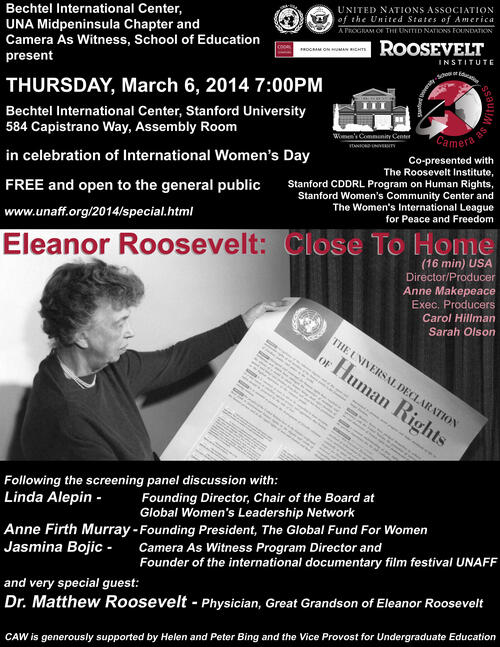
Eleanor Roosevelt: Close to Home is an overview of the inspirational life of Eleanor Roosevelt and highlights her dedication as champion of social justice and racial equality. The film introduces viewers to Val-Kill, the home of this extraordinary American who became a world leader in human rights and creator of the Universal Declaration of Human Rights. The remarkable modesty, independence and humanitarian leadership that made Eleanor Roosevelt the "First Lady of the World" are reflected in the Cottage's rooms, furnishings and surroundings. No other place allows visitors to connect with, rediscover and appreciate anew this woman whose influence is still so widely felt.
Following the screening, there will be a panel discussion.
This event is co-presented with the CDDRL Program on Human Rights, Roosevelt Institute, Stanford Women's Community Center and Women's International League for Peace and Freedom and sponsored by the Bechtel International Center, UNA Midpeninsula Chapter and Camera As Witness, Stanford Graduate School of Education in celebration of International Women's Day.
This presentation traces the origins and evolution of the Republic of China (ROC)’s policies towards its overseas constituents since its founding in 1912, and its transfer to Taiwan in 1949. While discussing the ideological and legal principles underpinning the POC’s policies toward the overseas community, the talk also focuses on how the changing international and domestic political circumstances have affected the degree and nature of involvement of overseas citizens in homeland political and economic decision-making. More essentially, democratization and the rise of Taiwanese-centered identity and consciousness have, since the mid-1990s, driven the ROC government to re-define and re-conceptualize its relations to Taiwan as well as to its overseas citizens, thus resulting in the transformation of the political and legal policies toward the overseas compatriot community. The implications of these changes on the future of Taiwan’s domestic politics and foreign relations will also be examined.
Speaker Bio:
Dean P. Chen received his doctorate from the University of California, Santa Barbara in 2010. He is Assistant Professor of Political Science at the Salameno School of Humanities and Global Studies, Ramapo College of New Jersey. His research and teaching interests are international politics, U.S.-China-Taiwan relations, and governance and institutions in China and Taiwan. His most recent publications include Sustaining the Triangular Balance: The Taiwan Strait Policy of Barack Obama, Xi Jinping, and Ma Ying-jeou (University of Maryland School of Law, 2013), "The Evolution of Taiwan’s Policies toward the Political Participation of Citizens Abroad in Homeland Governance" (with Pei-te Lien) in Tan Chee-Bang, ed. Routledge Handbook of the China Diaspora (Routledge, 2013) and U.S> Taiwan Strait Policy: The Origins of Strategic Ambiguity (Lynne Rienner, 2012).
Philippines Conference Room
Dean P. Chen
Assistant Professor of Political Science
Speaker
Salameno School of Humanities and Global Studies
The Europe Center invites you to the inaugural annual lectures of this series by Adam Tooze, Barton M. Briggs Professor of History, Yale University. On the centenary of the outbreak of the First World War, Adam Tooze will deliver three lectures about the history of the transformation of the global power structure that followed from Imperial Germany’s decision to provoke America’s declaration of war in 1917. Tooze advances a powerful explanation of why the First World War rearranged political and economic structures across Eurasia and the British Empire, sowed the seeds of revolution in Russia and China, and laid the foundations of a new global order that began to revolve around the United States and the Pacific. These lectures will present an argument for why the fate of effectively the whole of civilization changed in 1917, and why the First World War’s legacy continues to shape our world today.
Titles and venues are listed below.
Wednesday, Apr 30, 2014, 4:00 pm - 5:30 pm Location: Koret Taube Room, Gunn-SIEPR “Making Peace in Europe 1917-1919: Brest-Litovsk and Versailles”
Recent events in Ukraine pose the question, is a comprehensive peace for Europe, both East and West, possible? This lecture will address the first moment in which that question was posed, during and after World War I. In light of current events the lecture will focus on the influence of Russian power and powerlessness in shaping both the abortive effort to make peace in the East between Imperial Germany and Soviet Russia at Brest Litovsk - the first treaty to recognize the existence of an independent Ukraine - and the efforts to make peace in the West at Versailles and after. Returning to the period 1917-1923 suggests sobering conclusions about the stability of the order that we have taken for granted since 1991.
Thursday, May 1, 2014, 4:00 pm - 5:30 pm Location: Koret Taube Room, Gunn-SIEPR
“Hegemony: Europe, America and the Problem of Financial Reconstruction, 1916-1933”
Having established itself in the 19th century as the financial center of the world, Europe's sudden impoverishment by World War I came as a dramatic shock. The ensuing trans-Atlantic crises of the 1920s and early 1930s were not only the most severe but the most consequential in the history of Europe and the wider world. But, to this day there is substantial disagreement amongst both social scientists and historians as to the causes of the disaster. Was it American leadership or a failure of cooperation that was to blame? This lecture will argue the case for a revised and historicized version of the hegemonic failure thesis. The absence presence of American influence was crucial in determining Europe's fate.
Friday, May 2, 2014, 4:00 pm - 5:30 pm Location: Bechtel Conference Center Followed by a reeception, 5:30 pm - 6:15 pm “Unsettled Lands: The Interwar Crisis of Agrarian Europe”
Until the middle of the twentieth century Europe, like the rest of the world, was majority agrarian. And yet the most influential accounts of the interwar crisis, framed as they were by the industrial and urban world of the later twentieth-century Europe, tended to ignore this evident fact, focusing instead on workers and business-men, politicians and soldiers. This lecture will illustrate how brining the peasantry back in has the potential not only to throw new light on Europe's great epoch of crisis, but to open that history, beyond the Bloodlands to the wider world.
Tooze is the author of The Wages of Destruction: The Making and Breaking of the Nazi Economy (2006) and Statistics and the German State 1900-1945: The Making of Modern Economic Knowledge (2001), among numerous other scholarly articles on modern European history.
April 30th and May 1st: Koret-Taube Conference Center in the Gunn–SIEPR Building (366 Galvez Street).
May 2nd: Bechtel Conference Center in Encina Hall (616 Serra Street).
Adam Tooze
Barton M. Briggs Professor of History
Speaker
Yale University
Lectures
The Europe Center Lectureship on Europe and the World
SCID and SCP present a special seminar with Professor Xiaonian Xu
The Chinese economy has grown so fast and for so long. But the “miracle” has started fading in recent years. Why? Prof. Xu argues that the reform era can be divided into two fundamentally different phases. Phase I, from 1978 to the mid-1990s, is characterized by market-oriented reforms, whereas Phase II, from the mid-1990s onward, is dominated by government-led investment and interventions. Though China’s growth performance looks identical in numbers over the two phases, the source of growth has changed from efficiency gains to increased use of resources. Phase II growth is thus unsustainable, and worse, it has brought about structural distortions that severely undermine the economy’s growth potential. To maintain growth even at a moderate level, China needs to go beyond what the leadership has promised and planned.
Dr. Xiaonian Xu is Professor of Economics and Finance at CEIBS. He worked for China International Capital Corporation Limited (CICC) since 1999 as Managing Director and Head of Research. The research team under Dr. Xu was ranked No. 1 in 2002 among domestic brokerage firms by Chinese institutional investors. And Dr. Xu himself was voted in the same survey as the best in economics research. Prior to CICC, Dr. Xu was Senior Economist with Merrill Lynch Asia Pacific based in Hong Kong from 1997 to 1998. He worked as a consultant of the World Bank in Washington DC in 1996. Dr. Xu was appointed Assistant Professor of Amherst College, Massachusetts, from 1991 to 1995, teaching Economics and Financial Markets. He was employed by the State Development Research Center of China as a research fellow from 1981 to 1985.
Dr. Xu obtained Ph.D. in Economics, University of California, Davis, in 1991, and MA in Industrial Economics in 1981 from People's University of China . He received Sun Yefang Economics Prize in 1996, the highest Chinese award in the field, for his research on China 's capital markets. His research interests include: Macroeconomics, Finance, Financial Institutions and Financial Markets, Transitional Economies, and China 's Economic Reform. Dr. Xu is the recipient of the 2005 and 2006 CEIBS Teaching Excellence Award. Dr. Xu received the prestigious CEIBS Medal for Teaching Excellence in 2010.
Philippines Conference Room
Xiaonian Xu
Professor of Economics and Finance
Speaker
CEIBS
For security reasons: ~No backpacks or oversized purses will be allowed ~All persons subject to search ~No food or beverages allowed inside the room
~RSVPs for this event are required and will be strictly enforced at check-in
Born in Paris in 1956, Christine Lagarde completed high school in Le Havre and attended Holton Arms School in Bethesda (Maryland, USA). She then graduated from law school at University Paris X, and obtained a Master’s degree from the Political Science Institute in Aix en Provence.
After being admitted as a lawyer to the Paris Bar, Christine Lagarde joined the international law firm of Baker & McKenzie as an associate, specializing in Labor, Anti-trust, and Mergers & Acquisitions. A member of the Executive Committee of the Firm in 1995, Christine Lagarde became the Chairman of the Global Executive Committee of Baker & McKenzie in 1999, and subsequently Chairman of the Global Strategic Committee in 2004.
Christine Lagarde joined the French government in June 2005 as Minister for Foreign Trade. After a brief stint as Minister for Agriculture and Fisheries, in June 2007 she became the first woman to hold the post of Finance and Economy Minister of a G-7 country. From July to December 2008, she also chaired the ECOFIN Council, which brings together Economics and Finance Ministers of the European Union.
As a member of the G-20, Christine Lagarde was involved in the Group's management of the financial crisis, helping to foster international policies related to financial supervision and regulation and to strengthen global economic governance. As Chairman of the G-20 when France took over its presidency for the year 2011, she launched a wide-ranging work agenda on the reform of the international monetary system.
In July 2011, Christine Lagarde became the eleventh Managing Director of the IMF, and the first woman to hold that position.
Christine Lagarde was named Officier in the Légion d'honneur in April 2012. A former member of the French national team for synchronized swimming, Christine Lagarde is the mother of two sons.
Bechtel Conference Center
Christine Lagarde
Managing Director
Speaker
International Monetary Fund
CABANATUAN, Philippines – CISAC Senior Research Fellow Joe Felter co-teaches the popular class, “Face of Battle,” which dissects several of the great American battles such as Gettysburg and Little Bighorn.
Few of his students, however, likely know of his connection to the little-known, ongoing battles raging across the world in southern Philippines.
Felter was awarded the Assaulter Badge on Feb. 8 by the Philippines Army in recognition of his support in forming the country’s first counterterrorism unit. The Light Reaction Battalion has been battling terrorists and rebels in the Southeast Asian nation for a decade.
Felter, a retired U.S. Army Special Forces colonel, worked closely with Brig. Gen. Dionisio Santiago, the now-retired Philippine Armed Forces chief of staff, to form the elite unit during his stint as a U.S. military attaché in Manila.
Brig. Gen. (Ret.) Dionisio Santiago, former chief of staff of the Armed Forces of the Philippines, looks on as Felter receives his award.
Brig. Gen. (Ret.) Dionisio Santiago, former chief of staff of the Armed Forces of the Philippines, looks on as Felter receives his award.
Brig. Gen. (Ret.) Dionisio Santiago, former chief of staff of the Armed Forces of the Philippines, looks on as Felter receives his award.
Brig. Gen. (Ret.) Dionisio Santiago, former chief of staff of the Armed Forces of the Philippines, looks on as Felter receives his award.
Brig. Gen. (Ret.) Dionisio Santiago, former chief of staff of the Armed Forces of the Philippines, looks on as Felter receives his award. Photo Credit: James Christopher Tee
The battalion, which fights communist and Islamic militants in the restive south – where more than 40 years of insurgency has taken thousands hostage and claimed more than 150,000 lives – will be expanded to a regiment of 1,500 soldiers.
Felter received the honor during a 10th anniversary celebration of the unit, which was initially trained, equipped and sustained by the U.S. Special Forces.
“It was a real privilege to help the Philippine military establish this counterterrorist unit,” Felter said. “I have so much respect for all they do here and the challenging missions they take on, so it feels great to receive this honor on this special day.”
The ceremony was held at Fort Magsaysay in Cabanatuan, the storied city where the Japanese imprisoned Filipino and American survivors of the brutal Bataan Death March. Filipino and U.S. forces liberated some 500 POWs at the end of World War II in what has become known as The Great Raid. The two militaries remain closely allied today.
The certificate that accompanied his badge of honor says Felter “exerted tremendous effort” in convincing the U.S. government of the need for a counterterrorism unit in the Philippines. Once he did so, he helped activate and train the unit – and kept on the U.S. Special Forces to remain involved.
“Col. Felter has exemplified the essence of soldiery in the fight against terrorism, earning him the admiration, gratitude and respect of the officers, men and women of the Light Reaction Battalion and making him worthy of the honor of being a member of the Counter Terrorist Brotherhood,” reads the certificate.
Felter has spent a decade building an unprecedented database with Filipino military colleagues and coders which tracks tens of thousands of terrorist attacks in the Philippines since 1975. His Empirical Studies of Conflict project is also building insurgency data in Afghanistan, Colombia, Iraq, Pakistan and Vietnam.
Hero Image
Flowers in honor of the nine Light Reaction Battalion soldiers killed by Islamic militants in the southern port of Zamboanga last September.
Flowers in honor of the nine Light Reaction Battalion soldiers killed by Islamic militants in the southern port of Zamboanga last September.
Flowers in honor of the nine Light Reaction Battalion soldiers killed by Islamic militants in the southern port of Zamboanga last September.
Flowers in honor of the nine Light Reaction Battalion soldiers killed by Islamic militants in the southern port of Zamboanga last September.
Flowers in honor of the nine Light Reaction Battalion soldiers killed by Islamic militants in the southern port of Zamboanga last September.
Flowers in honor of the nine Light Reaction Battalion soldiers killed by Islamic militants in the southern port of Zamboanga last September. | Ricky GayRicky GayRicky GayRicky GayRicky GayRicky Gay



 Brig. Gen. (Ret.) Dionisio Santiago, former chief of staff of the Armed Forces of the Philippines, looks on as Felter receives his award.