Event Recap: Human Rights and Refugees in Europe
 Pictured: Kenneth Scheve, Jenny Martinez, Emily Arnold-Fernàndez, and James Cavallaro.
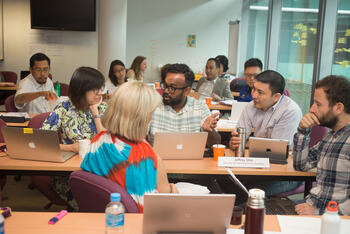
Following the talk, The Europe Center Director, Kenneth Scheve, led a discussion featuring commentary by Stanford Law professors James Cavallaro and Jenny Martinez. Cavallaro spoke of the need to think more broadly about human migration and the potential deleterious effects of state immigration controls on both human rights and security. Martinez noted the tension between the clarity of the non-refoulement principle and the ambiguity of safe third country principles, and questioned the ability of legal norms to compel states to change policy or reallocate resources. To watch this event in full, please visit our website.
Featured Faculty Research: Cécile Alduy
We would like to introduce you to some of The Europe Center's faculty affiliates. Our featured faculty member this month is Cécile Alduy, who is an Associate Professor of French literature and culture and the Director of the French and Italian Department at Stanford University.
 Cécile earned her Ph.D. in French Literature from the University of Reims in France in 2003 and joined the faculty at Stanford University that same year. Her research interests include the history and mythology of national and ethnic identities since the Renaissance, far right ideology and rhetoric, the relations between cultural, literary, and medical discourses on gender and the body in early modern Europe, poetry and poetics, narrative forms and their discontent, French cinema, and contemporary French literature. Cécile's most recent book, Marine Le Pen prise aux mots. Décryptage du nouveau discours frontiste [Marine Le Pen taken to her words. Decoding the new national front discourse], co-authored with Stephanie Wahnich, examines the rhetoric used by the National Front leader, Marine Le Pen, and compares it to that of her father and former National Front leader, Jean-Marie Le Pen. Casual observation of far right politics in France suggests that there has been a significant change in the National Front program following the 2011 leadership change to Marine Le Pen from Jean-Marie Le Pen and his 2015 ouster from the party. Marine Le Pen has taken great efforts to distance herself from her father, who infamously and repeatedly characterized gas chambers as "a detail in the history of World War II." The party has also enjoyed increasing electoral support in recent years. Against this backdrop, the book examines two fundamental questions: what is Marine Le Pen actually saying, and why does her speech resonate with French society today? To answer these questions, Alduy and Wahnich have analyzed over 500 speeches given by Marine and Jean-Marie Le Pen. This analysis reveals that there is significant continuity between the political agenda and ideological content of the Le Pens. In contrast with her father's blatantly radical speech, however, the younger Le Pen employs careful phraseology, replete with allusions, ambiguities, and double entendres, in order to "de-demonize" the party and make its platform appear more palatable to a modern French audience. In spite of programmatic continuity, this rhetorical rebranding appears to have facilitated greater electoral support for the National Front. Marine Le Pen prise aux mots has received significant media coverage, including a feature in Le Monde [article in French] and on NPR. In her ongoing research, supported in part by The Europe Center, Cécile is building upon the methodologies devised for Marine Le Pen prise aux mots and examining the development of political discourse of French political parties across the ideological spectrum in the period leading up to the 2017 presidential election. The initial results of this study will be published by Seuil in 2017 in a book preliminarily entitled Les Mots des présidentiables. Sémantique d'une triangulaire annoncée [The words of presidential candidates. Semantics of a three-candidate race]. We invite you to visit our website for additional information about this research.
Publication Details: Alduy, Cécile, and Stephanie Wahnich. 2015. Marine Le Pen prise aux mots. Décryptage de nouveau discours frontiste. Paris: Seuil.
Featured Graduate Student Research: Camilla Mazzucato
We would like to introduce you to some of the graduate students that we support and the projects on which they are working. Our featured graduate student this month is Camilla Mazzucato (Anthropology). Camilla is a Ph.D. student in the Department of Anthropology at Stanford University. Before beginning her Ph.D. studies at Stanford, Camilla earned a BA and an MA in Archaeology from the University of Bologna and an MSc in GIS and Spatial Analysis in Archaeology from the University College London.
 Camilla is an anthropologist who is interested in using network analysis to examine the social arrangements "mega-sites" - large settlements that originated with small, settled hunter-gatherer communities - during the Pre-Pottery Neolithic B (PPNB) and Pottery Neolithic periods. In her current research, Camilla is evaluating these social arrangements with new evidence from Çatalhöyük, a dense agglomeration of mudbrick houses occupied for 1,400 years and located in modern-day Turkey. Approximately the size of a town, Çatalhöyük lacks many of the characteristics of a modern town, including specialized areas, communal buildings, and centralized functions. Moreover, the spatial arrangement differs significantly from other PPNB settlements. In summer 2015, Camilla conducted field research, partially funded by The Europe Center, at the site of Çatalhöyük. During her four weeks at the site, she explored ways of modeling the site's networks by collecting data focused on patterns of similarity of material culture features. This data will be used to examine the site's internal organization as well as the arrangements of social relationships therein. In addition, she spent time studying some of the recently-excavated buildings, using architectural features to study ties among entities.
Reminder: The Europe Center will be accepting applications for the Graduate Student Grand Competition March 28, 2016 - April 15, 2016. For more information please visit our website.
The Europe Center Programs: Minor in European Studies
As previously announced, The Europe Center and Stanford Global Studies are offering a minor in Global Studies with a concentration in European Studies. The minor is designed for undergraduate students who have an interdisciplinary interest in the history, culture, politics, societies, and institutions of Europe, past and present. The requirements of the minor include coursework, advanced proficiency in a modern European language, and a capstone experience such as a research paper with a focus on European Studies, completion of an overseas study program in Europe, or completion of an overseas internship in Europe.
This quarter, Christophe Crombez, Consulting Professor at The Europe Center, is offering the minor's core seminar class: Introduction to European Studies. In this survey course, students are introduced to important themes in the study of European politics, economics, and culture. The course begins with a discussion of European identity and culture, focusing on what makes Europe unique and how recent history has shaped this identity. In the second section, students analyze European politics by learning about Europe's predominant political institutions - parliamentary government and proportional representation electoral systems - and examining the effect of these institutions on public policy. The course then turns to the economy and understanding the challenges and opportunities that European economies face today. The fourth section focuses on the European Union, including its history, functioning, and policies. In the final section, the class discusses transatlantic relations.
We invite you to visit our website for more information about the Minor in European Studies.
Visiting Student Researcher: Lina Eriksson
 The Europe Center is pleased to introduce to you Lina Eriksson, a Fulbright Scholar who is visiting Stanford University from the Department of Government at Uppsala University and the Center for Natural Disaster Science (CNDS), Sweden. Lina holds an MA in Ethnic Conflicts and Conflict Resolutions, Asylum Immigration and Integration from University of Waterloo, Canada and an MSc in Political Sciences, Economics and International Development from Jönköping International Business School (JIBS), Sweden. She is broadly interested in the politics of natural disasters. In her dissertation, entitled Natural Disasters and National Politics, Lina examines the electoral effects of the 2004 Boxing Day Tsunami and the 2005 Storm Gudrun on Swedish parliamentary elections. Part of this research, forthcoming in Electoral Studies, finds that the Swedish Social Democratic Party's poor crisis response to Storm Gudrun resulted in a significant decrease in support for the Social Democratic Party in the affected regions, leading to the largest change in partisan support in Swedish history. We invite you to visit our website for additional information about this research.
Publication Details: Eriksson, Lina M. 2016. "Winds of Change: Voter Blame and Storm Gudrun in the 2006 Swedish Parliamentary Election." Electoral Studies 41(1): 129-142.
The Europe Center Sponsored Events
February 18-19, 2016
8:00AM - 5:00PM
Workshop: Heritage Bureaucracies: Theoretical and Practical Perspectives
Stanford Archaeology Center
This conference is co-sponsored by The Europe Center, Stanford Archaeology Center, Cantor Arts Center, Department of Anthropology, Center for Russian, East European & Eurasian Studies, Stanford Humanities Center, The Europe Center, France-Stanford Center for Interdisciplinary Studies, and The Mediterranean Studies Forum.
Please visit our website for more information.
March 28, 2016
12:00PM - 1:30PM
Adam Tooze, Columbia University
NATO Expansion and the Swap Lines: the Unspoken Geopolitics of the Financial Crisis in Europe, 2007-2013
Reuben Hills Conference Room, Encina Hall East
RSVP by 5:00PM March 24, 2016.
April 25, 2016
11:30AM - 1:00PM
Torben Iversen, Harvard University
Workshop Title TBD
Room 400 (Graham Stuart Lounge), Encina Hall West
No RSVP required.
This seminar is part of the Comparative Politics Workshop in the Department of Political Science and is co-sponsored by The Europe Center.
Save the Date: April 28-29, 2016
9:00AM - 5:00PM
Conference: Networks of European Enlightenment
Levinthal Hall, Stanford Humanities Center
This conference is co-sponsored by The Europe Center, the French Cultural Workshop, the Stanford Humanities Center, and the Division of Literatures, Cultures, and Languages.
May 9, 2016
11:30AM - 1:00PM
Monica Martinez-Bravo, Centro de Estudios Monetarios y Financieros (CEMFI), Madrid
Workshop Title TBD
Room 400 (Graham Stuart Lounge), Encina Hall West
No RSVP required.
This seminar is part of the Comparative Politics Workshop in the Department of Political Science and is co-sponsored by The Europe Center.
May 16, 2016
11:30AM - 1:00PM
Daniel Stegmueller, University of Mannheim
Workshop Title TBD
Room 400 (Graham Stuart Lounge), Encina Hall West
No RSVP required.
This seminar is part of the Comparative Politics Workshop in the Department of Political Science and is co-sponsored by The Europe Center.
European Security Initiative Events
March 3, 2016
12:00PM - 1:30PM
Vygaudas Ušackas, European Union Ambassador to Russia
Russia and the West: Handling the Clash of World Views
CISAC Central Conference Room, Encina Hall
RSVP by 5:00PM March 1, 2016.
March 10, 2016
12:00PM - 1:30PM
Kathryn Stoner, Senior Fellow, Freeman Spogli Institute for International Studies, Stanford University
Resurrected? The Domestic Determinants of Russia's Conduct Abroad
Room E008 (Ground Floor Conference Room), Encina Hall East
RSVP by 5:00PM March 9, 2016.