FSI's research on the origins, character and consequences of government institutions spans continents and academic disciplines. The institute’s senior fellows and their colleagues across Stanford examine the principles of public administration and implementation. Their work focuses on how maternal health care is delivered in rural China, how public action can create wealth and eliminate poverty, and why U.S. immigration reform keeps stalling.
FSI’s work includes comparative studies of how institutions help resolve policy and societal issues. Scholars aim to clearly define and make sense of the rule of law, examining how it is invoked and applied around the world.
FSI researchers also investigate government services – trying to understand and measure how they work, whom they serve and how good they are. They assess energy services aimed at helping the poorest people around the world and explore public opinion on torture policies. The Children in Crisis project addresses how child health interventions interact with political reform. Specific research on governance, organizations and security capitalizes on FSI's longstanding interests and looks at how governance and organizational issues affect a nation’s ability to address security and international cooperation.
This five day intensive program for a select group of mid- and high-level African government officials and business leaders is designed to address how government can encourage and enable the private sector to play a larger, more constructive role as a force for economic growth and development. A driving principle of this LAD-Strathmore program is that policy reform is not like engineering or other technical fields that have discrete skills and clear, optimal solutions. Instead, successful reformers must be politically aware and weigh a broad range of factors that influence policy outcomes. For example, they must have a solid grasp of country-specific economic, financial, political and cultural realities. Most importantly, they must have a sense of how to set priorities, sequence actions and build coalitions. This program is designed to provide participants with an analytical framework to build these leadership abilities and operate effectively under adverse conditions.
This workshop course is designed to develop skills that faculty in policy-focused universities and training institutions can use both to develop interactive and participant-centered teaching styles and to help faculty develop skills in case writing. The first two days mostly involve "how to" lessons on both teaching and writing, interspersed with activities where the participants work in teams to do things like prepare case teaching plans and class openings that they present to all of the participants. The initial emphasis is on case teaching, since before participants can write a successful case, they must understand how learning in a case-oriented classroom takes place. The workshop includes case discussions on several existing cases, combined with a “post-mortem” of what worked and what did not in both the written case and the case discussion. We discuss core teaching strategies including development of time management plans, whiteboard management plans, how to pose opening questions, “cold-calling” versus “warm calling,” and how to close a case-discussion class with “Take-Aways." In discussing case-writing, the course addresses issues such as how to decide on a case theme and learning objectives, what material should be included and left out (or relegated to appendices), and how to build participant engagement into the way a case is written. Later workshop sessions will include topics such as how to write multi-player simulation exercises that have students play roles of participants in the policy situation.
FSI HOSTS PANEL ON MIDDLE EAST BUSINESSES DURING GLOBAL ENTREPRENEURSHIP SUMMIT AT STANFORD
Startup culture is growing fast in the Middle East, despite what you have (or more likely, haven’t) heard about the region.
“There have been at least two startup conferences this year that got 5,000 people each,” said venture investor Christopher Schroeder. “If it had been 10,000 people in the Middle East getting together to talk about the Muslim Brotherhood, I guarantee you would have heard about it.”
FSI director McFaul, formerly the US ambassador to Russia, welcomed the audience to Stanford (this year’s GES host) and introduced former secretary of state Condoleezza Rice. Rice described the connection between prosperity and democratic development – which, as she pointed out, is not a quick or easy process. “Today people think of the US as a consolidated democracy, but they forget that it took us time to get there,” she said. “The Constitution I swore to uphold as Secretary of State originally treated my ancestors as three-fifths of a man.”
Hadley, who served as national security advisor to President George W. Bush, moderated a discussion with successful entrepreneurs from the MENA (Middle East and North Africa) region to challenge stereotypes, candidly discuss problems, and offer solutions for growth. Rice noted in her introduction that countries like Saudi Arabia must include the half of their potential workforce – women – whose economic participation is currently restricted. However, panelist Ruba Al Hassan, a UAE entrepreneur and founder of the Global Youth Empowerment Movement, reminded the audience that about 25% of MENA entrepreneurs are women, compared to 18% in Silicon Valley.
The panel discussed the roles that policy can and cannot play in economic development. “The government can help the private sector by focusing on education,” said Ahmed Alfi, whose Cairo-based venture capital firm Sawari Ventures has funded an online education platform used by millions of refugees around the region. “There is no such thing as ‘not enough money for education’ – only the misallocation of funds.”
Ala’ al Sallal, who grew up a refugee in Jordan and founded online retailer Jamalon, cautioned against resting all hopes for change in the private sector. “Businesses are not social problem solvers; when we can’t operate in one market, we move to another,” he said. While the panelists agreed with an audience member’s comment that economic growth in the Middle East is bottom-up, not top-down, they also pointed out that policy issues such as open borders, special economic zones and public infrastructure play a critical role in creating the conditions for entrepreneurship to flourish.
Follow @fsistanford on Twitter for details of this and other events at the Freeman Spogli Institute for International Studies at Stanford University.
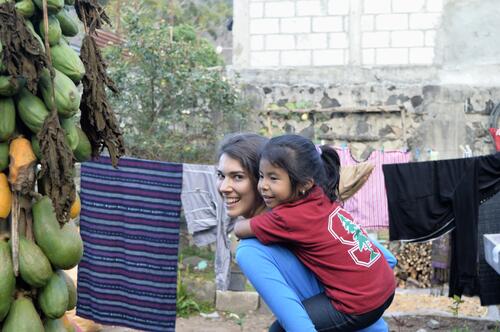
“Vic-TOR-ia!” Fátima cried, a grin lighting up her face. The 5-year-old had become fast friends with Stanford medical student Tori Bawel almost instantly after Bawel arrived in San Lucas Tolimán. After giving piggy-back rides to Fátima, a career in global pediatrics changed from a distant wish to a developing reality for Bawel.
Bawel is one of a few lucky medical students to travel with Stanford pediatrician Paul Wise, MD, MPH, to San Lucas Tolimán, a town in the mountains of rural Guatemala that serves as a base for his work to improve nutrition for local children. Once she completes her medical training, Bawel plans to devote her life to improving health in underserved areas.
“As an elementary school student, I was really compelled by issues of social justice,” she said. “I hope that over the course of my lifetime, I’m able to make a difference like physicians have done here in Guatemala and around the world.”
Every summer, Wise, a professor of pediatrics and a Stanford Health Policy core faculty member, takes a handful of undergraduates to the communities around San Lucas to learn about the Rural Guatemala Child Health and Nutrition Program. A collaboration between Stanford and a group of local health promoters, the program uses nutritional supplements and health education to save the lives of children under five. The students follow the promoters on house visits, help them measure the weight and height of children and gain an understanding of how the program helps the rural communities.
“We feel it is part of our educational mission,” said Wise. “We want to grow people who will make a difference, and part of that is providing them opportunities to do so.”
Bawel’s experience reinforced her desire to engage in global health work: “It’s inspired me and motivated me to want to give my life, like Wise, to… serving in areas of the world with the greatest need.”
Meeting Guatemalan students who overcame economic difficulties to study medicine — like Flor Julajuj — was also deeply moving for Bawel. Very few in rural Guatemala have the opportunity to pursue higher education or good health care. But with some help from Wise, Julajuj was able to attend medical school; just this month, she graduated from the University of San Carlos in Guatemala City.
Image
“It’s been a great opportunity,” said Julajuj. “It’s changed my life.”
Most, though, are not so lucky; Bawel also encountered two young women who dream of becoming physicians but cannot afford medical school. Meeting the young, ambitious women “makes me want to empower them with the education and opportunities I have had,” said Bawel.
Wise, meanwhile, will continue to each Stanford students about ways to help these communities.
“They see the poverty, but they also begin to understand why being a great doctor or a great diplomat or a great economist will serve the interests of people down here if done well,” he said. “We want them to go back to whatever field they’re interested in, committed to gaining skills and then using them to serve the needs and the rights of people in places like San Lucas.”
FSI SENIOR FELLOWS FRANCIS FUKUYAMA & LARRY DIAMOND DISCUSS DEMOCRACY IN THE JULY/AUGUST ISSUE OF FOREIGN AFFAIRS
Larry Diamond and Francis Fukuyama, senior fellows at the Freeman Spogli Institute, have both written essays in the July/August 2016 issue of Foreign Affairs. Follow the links below to read the full articles without a subscription block:
Diamond, who is also the former director of the Center for Democracy, Development and the Rule of Law (CDDRL), takes stock of the global democratic recession and urges the next president to make democracy promotion a pillar of his or her foreign policy agenda in his article "Democracy in Decline."
In "American Political Decay or Renewal?" Fukuyama, the Olivier Nomellini Senior Fellow at FSI and the Mosbacher Director of CDDRL, analyzes the rising tide of populism as represented by the current candidates for the US Presidential elections.
Geir H. Holom, MD, is a Visiting Scholar at Stanford School of Medicine (CHP/PCOR) from the University of Oslo. His research focuses on the expansion of private for-profit hospitals in the Nordic countries and its effect on prices, quality of care and selection of patients. He received a BSc in Economics and Business Administration from the Norwegian School of Economics and an MD from the University of Bergen. While in medical school, he conducted research on patients diagnosed with head and neck cancer who underwent head and neck reconstruction using microsurgery. Since receiving his MD, he has worked as a physician in both primary care and specialized health services. Prior to entering the field of medicine, he worked in the business and finance sector.
Adjunct Affiliate at the Center for Health Policy and the Department of Medicine
Stanford pediatrician Paul Wise stooped below the black tarp roof of a cinderblock house in Guatemala to offer his condolences to a mother who had just lost her child.
“Doctor Pablo,” as he is known in the communities around San Lucas Tolimán, talked softly as he relayed his sympathies to the mother, whose 9-year-old son had been a patient of his.
Stanford’s Children in Crisis Initiative seeks to save the lives of children in areas of poor governance. In Guatemala, their efforts work toward eliminating death by malnutrition for children under 5.
The boy’s genetic disorder would have been terminal anywhere, but thanks to Wise and local health promoters, the boy’s family had years with him instead of months.
While Wise spoke to the heartbroken mother, his Stanford research assistant Alejandro Chavez helped the promoters set up inside a local community center to measure the weight and height of local kids to determine their nutrition level.
Chavez and the promoters had worked together for months to create an app for tablets that will make it easier to find malnourished children.
The app they designed will decrease training time for new health promoters and allow the program to expand. The goal is to distribute the app globally to help programs in other countries tackle malnutrition.
Children in crisis
As recently as 2005, about one of every 20 children in this rural area of Guatemala died before their 5th birthday. Almost half the deaths were associated with severe malnutrition.
“The death of any child is always a tragedy, but the death of any child from preventable causes is always unjust,” said Wise, a Stanford Health Policy core faculty member.
Along with other faculty from the Freeman Spogli Institute for International Studies (FSI) and the School of Medicine, Wise created the Children in Crisis Initiative to save the lives of children in areas of poor governance. The program brings together Stanford researchers and students across disciplines.
Nowhere are their efforts better illustrated than in the rural communities around San Lucas Tolimán, in the central mountains of Guatemala.
The program’s effectiveness rests on a deep respect for the local communities merged with innovation by Stanford researchers.
“It’s absolutely essential to any program that the people in need be part of the solution,” said Wise. Unlike many nongovernmental organizations and health programs, Wise believes the way to create a sustainable health system is for the locals to run it, so the health promoters manage the program’s day-to-day activities.
Image
This leaves the Stanford team free to focus on innovation – such as the new app. They believe the technology could change child health programs around the world. Wise’s team has partnered with Medic Mobile – a nonprofit that creates open-source software for health care workers – which plans to distribute the app to other areas suffering from malnutrition.
The six Android tablets purchased by Children in Crisis are enough to monitor the program’s 1,500 kids through the app.
Role of nutrition
When done well, nutrition surveillance is very effective at decreasing child mortality in poor countries.
“Nutrition contributes enormously to health and well-being,” Wise said as he walked through Tierra Santa, a small community near San Lucas, making house calls. “So the focus of our work turned to improving young child nutrition. It’s not an easy thing to do in a place that’s extremely poor.”
Wise and his colleagues – Stanford medical student Tori Bawel and Stanford professor of pediatrics Lisa Chamberlain – made their rounds during their visit in March. Evidence of poverty was everywhere.
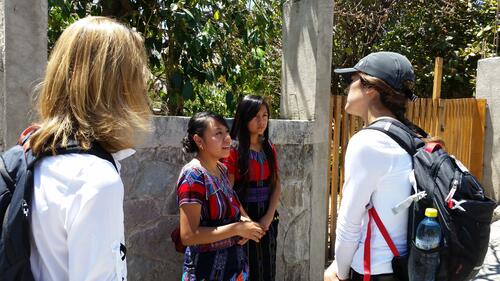
Here, clean tap water is a dream and even the sturdier homes often lack four walls or paned windows, though the children were neatly dressed in T-shirts or colorful traje, traditional Mayan clothing.
It’s hard to provide proper nutrition when most families can’t find enough work to buy adequate food. But a little help can make a big difference.
Bawel, a first-year medical student who plans a career improving health in areas of poverty, was struck by the impact the promoter program has had on the community.
“There are children who need supplements and nutrition to stay alive,” she said. “Without this program, that infrastructure does not exist.”
With FSI’s assistance, the nutrition program distributes Incaparina, a supplement of cornmeal, soy and essential nutrients. The sweet, mealy drink helps the program’s most malnourished children get back on track.
Image
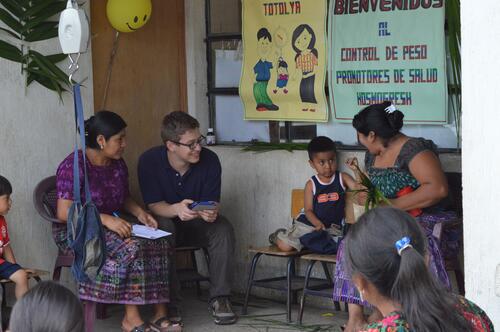
Every two months, the promoters gather each community’s children to measure their weight and height. Children and their mothers sit patiently, waiting for their turn. The children enjoy a cup of Incaparina, and their mothers eagerly listen to the promoters’ tips for keeping their children healthy.
“It’s very important to me,” said Elsira Rosibel Samayoa, who brought her 2-year-old to be measured. “There are mothers who don’t understand the importance of monitoring their children’s weight, but I do.”
Since its implementation in 2009, the Stanford program has slashed nutrition-based mortality in the participating communities by about 80 percent and decreased severe malnutrition by more than 60 percent – saving hundreds of children’s lives.
However, nutrition surveillance and intervention isn’t easy. Tracking nutrition takes training and expertise, and when the local population rarely exceeds a fourth-grade education, learning these skills is especially challenging. Detailed graphs on a standard growth chart are essential to identifying malnourished children.
“The community health workers are extremely capable and smart, but some have never seen a graph before,” said Wise. “Think about what it is to try to explain a graph to someone for the first time.”
It takes the health workers about three years to learn to graph and then interpret the results for intervention.
Wise said, “So we all got together and said, ‘How do we make this easier to do?’”
The app was the answer.
‘Let’s create an app’
Enter Alejandro Chavez, a recent Stanford computer science graduate and Stanford Health Policy research assistant. He developed the app to collect child health data, then determine the child’s degree of malnutrition and suggest intervention.
“The major goal was to lower training requirements and make programs like this simpler to start and maintain,” said Chavez, who now lives and works in Guatemala, where he gets daily feedback from the health promoters.
“I feel like they’ve been very honest with me about things I need to improve,” he said.
Cesia Lizeth Castro Chutá is a senior coordinator for the program who has worked with Chavez to ensure that the app meets the promoters’ needs.
“The tablet automatically generates the information we need to know,” she said. “It becomes easier to confirm that a child is malnourished and needs supplements.”
Looking forward
Image
With the app’s launch, it looks like training time for the promoters will be reduced from three years to less than six months. That means new communities can be incorporated into the program quickly, creating broader access to care.
Meanwhile, many health programs around the world are waiting to see how well the Stanford app works in Guatemala.
Josh Nesbit, a Stanford alumnus and Medic Mobile CEO, said, “As more health programs recognize the importance of nutrition and implement community-based interventions, screening and surveillance tools will be critical. We must learn from Dr. Wise’s success.”
In the July/August edition of Foreign Affairs, Larry Diamond takes stock of the global democratic recession, and urges the next president to make democracy promotion a pillar of his or her foreign policy agenda.
Turkey's Prime Minister Recep Tayyip Erdogan addresses members of parliament from his ruling AK Party (AKP) during a meeting at the Turkish parliament in Ankara on June 11, 2013. | Adem Altan / Stringer - Getty Images
The United States is exceptionally secure. No country today presents a clear and imminent security threat in the way that Germany, Japan, or the Soviet Union did in the 20th century. In the short and medium term, there is also no alternative value system that could displace America’s conception of individual liberty and a market-oriented economy—principles that have been embraced by all of the world’s wealthy industrialized countries in Western Europe, North America, and East Asia.
Everyone at CISAC loves the beginning of summer.... and yet, summer brings a tinge of nostalgia because that is also when many of our fellows leave for new adventures. We are proud of their successes and wish them great times ahead. Our lives have been enriched by their presence at CISAC and we will miss them all dearly. We thought that, like us, you would like to know where they are headed.
After two years at Stanford, Erin Baggott and fiancé Brett Carter, who joined a terrific panel on field research in late March, are headed off to the warmer shores of Southern California. They will join the Trojans' ranks and both will be assistant professors at the University of Southern California's School of International Relations. Topping the list of what Erin will miss are the people, as she found CISAC "full of welcoming, collegial, sunny folks. It was a pleasure to get to know you all." Her parting advice to new fellows is to get to know everyone and to enjoy the area.
John will call Fort Benning, GA, home but, as Deputy Commander of the 75th Ranger Regiment, he will spend most of the next year in Afghanistan. In that context, it makes sense that one of the moments he will miss most are coffee breaks with friends at Coupa! John valued the freedom to choose his courses "and the opportunity to meet so many brilliant people." He is grateful for the chance to work in the classroom with Scott Sagan, Joe Felter, and Karl Eikenberry and feels future military fellows should take advantage of similar teaching opportunities. In addition, he wrote, "Get started on your research early. By the time classes start you're already getting close to your first deadline on the USAWC strategy paper."
Kate will continue her research at Harvard's Belfer Center next year. Other than the policy workshop, where she enjoyed both the substance and the brownies, she will miss GLOW, the Global Local Workshop. GLOW, a reading group created by this year's fellows to discuss international security issues nestled at the intersection of global and local politics - terrorism, counter-terrorism, state terror, war crimes, insurgency, counter-insurgency. If Kate has any regrets, it is that she still hasn't made it up Hoover Tower.
Now completing his second year as a CISAC fellow, Edward values the interdisciplinary nature of CISAC, which has afforded him "the opportunity to branch out to write and think about new fields." He admits that the people are what he will miss the most about his time here but wishes he had spent more time in the Hoover Archives. Incoming fellows must maximize the resources that are made available to them: "Make the most of it while you can." Edward is moving to Los Angeles and will be a Associate Policy Analyst at the RAND Corporation.
Morgan is traveling east to become a postdoctoral fellow at the Harvard's Belfer Center for Science and International Affairs. His two regrets are not spending more time both in the Hoover Archives and exploring the Bay Area. In typically exuberant Morgan fashion, his parting words of advice to incoming fellows are this: "Take advantage of Stanford's academic resources, be pro-active in reaching out to faculty inside and outside of CISAC, and enjoy the amazing weather!" Morgan's gratitude goes to the people who make up CISAC: "Everyone is so incredibly helpful, fun, and intelligent. Everyone supports each other personally and professionally, and I could not have asked for a better work environment to complete my dissertation research." Morgan, a GLOW member, will defend his dissertation on "Persuading Power: Insurgent Diplomacy and the International Politics of Rebellion" at the University of Chicago on July 13.
Andreas will spend the summer working at RAND in Washington, D.C. He is finishing his second year at CISAC and has relished his time on the Farm, in particular "the incredibly community and opportunity that CISAC and Stanford offered. I got to know many great people and experts within and outside of my field of research. I loved this experience and it shaped how I think about national/international security!" Based on his experience, members of the new cohort should strive to "find a good balance between your work and the seminars and all the other events that are offered at Stanford."
Marshall is leaving CISAC after two years but can still be found on campus where he will be finishing his dissertation in the Department of Management Science & Engineering. He's enjoyed the science seminars in particular but recommends that new fellows "get off campus and enjoy California!" Though Marshall did not take his own advice often enough and regrets that he did not have more time to ski in Tahoe, he has enjoyed working with other excellent researchers.
Next up for Scott is USSTRATCOM in Omaha. Scott has enjoyed his time in the civilian world and will miss "discussing the problems I work on with people from other worldviews." He recommends that new fellows "consider how the Senior Military Fellows can help you with your research."
Terry is moving across the country to the Sunshine State to join the faculty ranks as Assistant Professor in the Department of History at Florida International University. A dedicated member of the GLOW workshop, he is deeply appreciative of "the other fellows, faculty, and staff that I got to collaborate with." He will miss CISAC's collaborative atmosphere and regrets that there was not enough time for a fellows' camping trip. As parting advice, he says: "Get out and get in touch with anyone of interest right away, so that you can take full advantage of your short time here at Stanford."
The University of Pittsburgh is welcoming William as a new Assistant Professor in the Department of Political Science. Although he wishes he had spent more time driving around the area, in particular Napa, Santa Cruz, and Monterey, William reminds new fellows that "the job market comes first. Spend all of your energy on that in the fall. Everything else can come later." Another stalwart GLOW member, he will miss having all the fellows in one place, working with them, and splitting the famous Rush Hour brownies.
Carrboro, NC, will be Magda's new home when she joins the Sociology and Anthropology Department at North Carolina State University as a Teaching Scholar this fall. She will miss her "amazing colleagues and friends, and the interdisciplinary research opportunities Stanford has to offer." Magda has thrived in her two years at CISAC "meeting and working with accomplished and inspiring scholars." To those following in her footsteps, Magda advises, "Get to know your cohort and make connection with scholars across campus."
Nina Silove is heading back home to Australia. She will be Lecturer (Assistant Professor) in the Strategic and Defense Studies Centre at the Australian National University in Canberra.
Ivanka was one of six winners of a call for proposals on new technologies and the future of deterrence. She currently manages and serves as the lead researcher of a Carnegie-sponsored project "Understanding How Missile Defense Will Affect Nuclear Deterrence and Stability in the New Strategic Environment."