Save the Date: US Ambassador to Poland - Paul Jones
-

FSI's research on the origins, character and consequences of government institutions spans continents and academic disciplines. The institute’s senior fellows and their colleagues across Stanford examine the principles of public administration and implementation. Their work focuses on how maternal health care is delivered in rural China, how public action can create wealth and eliminate poverty, and why U.S. immigration reform keeps stalling.
FSI’s work includes comparative studies of how institutions help resolve policy and societal issues. Scholars aim to clearly define and make sense of the rule of law, examining how it is invoked and applied around the world.
FSI researchers also investigate government services – trying to understand and measure how they work, whom they serve and how good they are. They assess energy services aimed at helping the poorest people around the world and explore public opinion on torture policies. The Children in Crisis project addresses how child health interventions interact with political reform. Specific research on governance, organizations and security capitalizes on FSI's longstanding interests and looks at how governance and organizational issues affect a nation’s ability to address security and international cooperation.
[[{"fid":"225277","view_mode":"crop_870xauto","fields":{"format":"crop_870xauto","field_file_image_description[und][0][value]":"","field_file_image_alt_text[und][0][value]":"","field_file_image_title_text[und][0][value]":"","field_credit[und][0][value]":"","field_caption[und][0][value]":"","field_related_image_aspect[und][0][value]":"","thumbnails":"crop_870xauto"},"type":"media","attributes":{"style":"width: 300px; height: 410px;","class":"media-element file-crop-870xauto"}}]]
[[{"fid":"225277","view_mode":"crop_870xauto","fields":{"format":"crop_870xauto","field_file_image_description[und][0][value]":"","field_file_image_alt_text[und][0][value]":"","field_file_image_title_text[und][0][value]":"","field_credit[und][0][value]":"","field_caption[und][0][value]":"","field_related_image_aspect[und][0][value]":"","thumbnails":"crop_870xauto"},"type":"media","attributes":{"style":"width: 300px; height: 410px;","class":"media-element file-crop-870xauto"}}]]
[[{"fid":"225276","view_mode":"crop_870xauto","fields":{"format":"crop_870xauto","field_file_image_description[und][0][value]":"","field_file_image_alt_text[und][0][value]":false,"field_file_image_title_text[und][0][value]":false,"field_credit[und][0][value]":"","field_caption[und][0][value]":"","thumbnails":"crop_870xauto"},"type":"media","field_deltas":{"2":{"format":"crop_870xauto","field_file_image_description[und][0][value]":"","field_file_image_alt_text[und][0][value]":false,"field_file_image_title_text[und][0][value]":false,"field_credit[und][0][value]":"","field_caption[und][0][value]":"","thumbnails":"crop_870xauto"}},"link_text":null,"attributes":{"style":"font-size: 13.008px; height: 342px; width: 250px; float: left; margin-right: 15px;","class":"media-element file-crop-870xauto","data-delta":"2"}}]]
The Ambassador's remarks will address:
Paul Jones was confirmed by the United States Senate as U.S. Ambassador to the Republic of Poland on August 5, 2015, and sworn in by Secretary Kerry on September 11, 2015.
Amb. Jones has a wide-ranging background in Europe. As Principal Deputy Assistant Secretary of State for European and Eurasian Affairs from 2013-15, he was responsible for all aspects of U.S. policy and operations in Europe, particularly Russia and Ukraine. He was also Deputy Chief of Mission at the U.S. Mission to the Organization for Security and Cooperation in Europe (OSCE), and at the U.S. Embassy in Skopje, Republic of Macedonia (1996-99).
Ambassador Jones’ service in Asia and South Asia has complemented his European focus. As U.S. Ambassador to Malaysia, 2010-13, he led significant growth in the U.S.-Malaysian relationship, becoming the first U.S. Ambassador to be conferred the honorary title of Dato’. Ambassador Jones is a career member of the State Department’s Senior Foreign Service. His awards include the Presidential Meritorious Service Award, the Robert C. Frasure Memorial Award for peace building, and several Superior Honor Awards.
The Shorenstein Asia-Pacific Research Center (APARC), in pursuit of training the next generation of scholars on contemporary Asia, has selected two postdoctoral fellows for the 2017-18 academic year. The fellows will begin their year of academic study and research at Stanford this fall.
Shorenstein APARC has for more than a decade sponsored numerous junior scholars who come to the university to work closely with Stanford faculty, develop their dissertations for publication, participate in workshops and seminars, and present their research to the broader community.
The 2017-18 cohort includes two Shorenstein Postdoctoral Fellows; they carry a broad range of interests from labor migration policy in China to regional institutions in East Asia. Their bios and research plans are listed below:



Scholars at Stanford's Shorenstein Asia-Pacific Research Center in the Freeman Spogli Institute for International Studies assess the strategic situation in East Asia to be unsettled, unstable, and drifting in ways unfavorable for American interests. These developments are worrisome to countries in the region, most of which want the United States to reduce uncertainty about American intentions by taking early and effective steps to clarify and solidify U.S. engagement. In the absence of such steps, they will seek to reduce uncertainty and protect their own interests in ways that reduce U.S. influence and ability to shape regional institutions. This 23-page report entitled “President Trump’s Asia Inbox” suggests specific steps to achieve American economic and security interests.
Scholars at Stanford's Shorenstein Asia-Pacific Research Center in the Freeman Spogli Institute for International Studies assess the strategic situation in East Asia to be unsettled, unstable, and drifting in ways unfavorable for American interests. These developments are worrisome to countries in the region, most of which want the United States to reduce uncertainty about American intentions by taking early and effective steps to clarify and solidify U.S. engagement. In the absence of such steps, they will seek to reduce uncertainty and protect their own interests in ways that reduce U.S. influence and ability to shape regional institutions. The recommendations summarized below, and elaborated in a 23-page report entitled “President Trump’s Asia Inbox,” suggest specific steps to achieve American economic and security interests.
» Full Report with Preface from Director Gi-Wook Shin and Introduction by Amb. Michael H. Armacost
Key Recommendations.
Trade and Economic Relations
The dynamic economies of East Asian countries are increasingly integrated and interdependent. The United States is an important market and source of investment and technology, but this is no longer sufficient to ensure that future arrangements and rules will protect American interests. The region is moving toward more formal, rule-based arrangements and the United States must be an active shaper of those institutions.
Most in the region want the United States to play a leading role in the establishment and enforcement of free and fair international economic transactions, and want the rules and mechanisms governing trade to be multilateral ones. If we do not play such a role, China, and possibly others, will seek arrangements that disadvantage American firms.
Defense and Security
China’s military buildup and North Korea’s growing arsenal of missiles and nuclear weapons have fueled concerns about U.S. will and ability to honor its security commitments in the region. No one wants a regional arms race or tit-for-tat moves that increase the danger of accidental conflict or escalation, but many believe concrete steps are needed to check perceptions that the United States is becoming less willing to maintain the peace and stability that undergirds regional prosperity.
China
People in the region worry about China’s actions and intentions but they worry more about the prospect of confrontation and conflict between the United States and the People’s Republic. They look to the United States as a counterbalance to China but fear that Washington will overreact or underreact to actions by Beijing, or take provocative actions that jeopardize their own interests. The U.S. should:
Korean Peninsula
North Korea is threatening an ICBM test in 2017, possibly in the next few weeks or months. There is a political vacuum in South Korea, and Seoul is being pressured and punished by Beijing to reverse its decision to accept the deployment of a U.S. THAAD missile defense in South Korea. Under these circumstances, these are our priority recommendations for the administration
Japan
The Abe administration is the most stable government Japan has had for many years. The prime minister wants to work with Washington, is prepared to deepen defense cooperation with the United States and others in the region, and is eager to lock in the commitments and arrangements negotiated in the TPP. There is a real opportunity to secure access for U.S. firms greater than achieved by any previous administration.
Southeast Asia and the South China Sea
Southeast Asia is most vulnerable to and concerned about China’s actions and intentions. Countries in the region want the United States to counterbalance and constrain China but worry equally that the United States is unreliable and unequal to the challenge of protecting their interests while preserving American interests vis-à-vis China. Unless given a better option, they will lean toward China for economic and security reasons.
The U.S. should remain engaged with the process of regional and trans-Pacific institution building, including but not limited to the Association of Southeast Asian Nations (ASEAN) annual meetings, the East Asian Summit, and the Asia Pacific Economic Cooperation (APEC) forum, which will be hosted by Vietnam in 2017.
Full Report with Preface from Gi-Wook Shin and Introduction by Amb. Michael H. Armacost.
The policy recommendations published above are a summary included in the beginning of a 23-page report entitled “President Trump’s Asia Inbox.” You may view the full report here.
About the Contributors
Michael H. Armacost is a Shorenstein APARC Fellow and former U.S. ambassador to Japan and the Philippines.
Karl Eikenberry is the Oksenberg-Rohlen Fellow at Shorenstein APARC; director of the U.S.-Asia Security Initiative; former U.S. ambassador to Afghanistan, and Lieutenant General (Ret.), U.S. Army.
Donald K. Emmerson is a senior fellow emeritus at FSI; director of the Southeast Asia Program at Shorenstein APARC; and affiliated with FSI’s Abbasi Program in Islamic Studies.
Thomas Fingar is a Shorenstein APARC Fellow and has served as former first deputy director of national intelligence for analysis and chairman of the National Intelligence Council, among other positions.
Takeo Hoshi is the Henri H. and Tomoye Takahashi Senior Fellow in Japanese Studies and director of the Japan Program.
Gi-Wook Shin is the director of the Walter H. Shorenstein Asia-Pacific Research Center; senior fellow at the Freeman Spogli Institute for International Studies; director of the Korea Program; and the Tong Yang, Korea Foundation, and Korea Stanford Alumni Chair of Korean Studies, all at Stanford.
Daniel C. Sneider is the associate director for research at Shorenstein APARC, co-director of the Divided Memories and Reconciliation project and a former foreign correspondent.
Kathleen Stephens is the William J. Perry Fellow in the Korea Program at Shorenstein APARC and former U.S. ambassador to the Republic of Korea.
Information for Press.
The contributors are open to comment, interview and provide background information on the contents of the report, “President Trump’s Asia Inbox.” To inquire about availability, please contact Lisa Griswold, Shorenstein APARC Communications and Outreach Coordinator, at lisagris@stanford.edu or (650) 736-0656.
Related Press Coverage
Stanford report offers policy insights for the Trump administration, Caixin Media (in Chinese), Feb. 13, 2017
"Trump, do not bring up KORUS FTA and US forces cost-sharing until S. Korea's next presidential election," Yonhap News and various other outlets (in Korean), Feb. 13, 2017
China looks to US to resolve N. Korea nuclear issue, The Straits Times (in English), Feb. 15, 2017
Stanford experts offer policy proposals, insights on US-Asia relations, Stanford News Service (in English), Feb. 15, 2017
Unsettled, unstable and drifting: Today's US-East Asia relationship, Medium (in English), Feb. 16, 2017
Why Japan will also be "convenient" for the Trump administration, Tokyo Business Today (in Japanese), Feb. 18, 2017
Study: Managing China relationship most consequential to US, China Daily USA (in English), Feb. 21, 2017
How the Trump administration should address China, Tokyo Business Today (in Japanese), Feb. 23, 2017
Fears of Trump giving China free reign in Asia misplaced, Asia Times (in English), Feb. 24, 2017

Unchecked greed is the primary driver of conflict and mass atrocities in Africa. Most often, it manifests itself in the form of violent kleptocracies, in which governments are hijacked by networks of senior officials, military officers, bankers, mining and oil company representatives, and arms dealers. Conventional foreign policy approaches have failed to address the hell on earth that these networks have created. The principal vulnerability of the networks is their exposure in the international financial system, as most corrupt actors use that system to move their money and hide their wealth. The tools of financial pressure that have been honed in the aftermath of 9/11 hold great promise for countering the kleptocrats that are destroying parts of Africa through war and resource pillaging. Examining how those policies can be used and how a hopeful political constituency is being built is a major focus of this presentation.
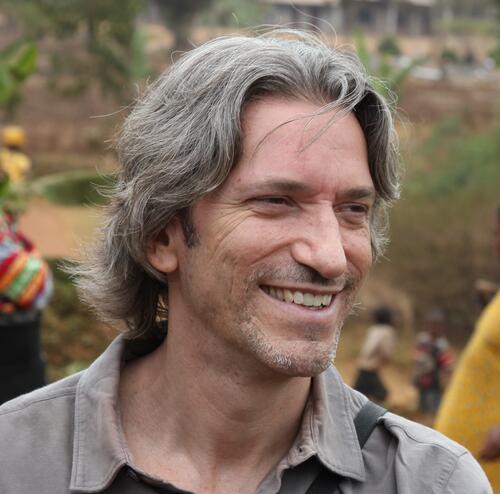
John Prendergast is a human rights activist and New York Times best-selling author who has focused on peace in Africa for over thirty years. He is the Founding Director of the Enough Project, an initiative to end genocide and crimes against humanity. With George Clooney, he also co-founded The Sentry, a new investigative initiative focused on dismantling the networks financing conflict and atrocities. John has worked for the Clinton White House, the State Department, two members of Congress, the National Intelligence Council, UNICEF, Human Rights Watch, the International Crisis Group, and the U.S. Institute of Peace. He has been a Big Brother for three decades, as well as a youth counselor and a basketball coach. John is the author or co-author of ten books. John also co-founded the Satellite Sentinel Project, which used satellite imagery to spotlight mass atrocities. With NBA stars, John launched the Darfur Dream Team Sister Schools Program to fund schools in Darfuri refugee camps. He also created Enough’s Raise Hope for Congo Campaign, highlighting the issue of conflict minerals, and its student arm the Conflict-Free Campus Initiative. John also runs Not On Our Watch, the organization founded by Matt Damon, Don Cheadle, Brad Pitt and George Clooney. John has been awarded six honorary doctorates. He has been a visiting professor at Yale Law School, Stanford University, Columbia University, Dartmouth College, Duke University, and others. John has appeared in four episodes of 60 Minutes, for which the team won an Emmy Award, and helped create African stories for two episodes of Law and Order: Special Victims Unit. John has also traveled to Africa with NBC’s Dateline, ABC’s Nightline, PBS’ NewsHour, CNN’s Inside Africa, and Newsweek and The Daily Beast. He also appears in the motion picture “The Good Lie,” starring Reese Witherspoon and Emmanuel Jal, as well as documentaries including Merci Congo, When Elephants Fight, Blood in the Mobile, Sand and Sorrow, Darfur Now, 3 Points, and War Child.Image
In March 2014 Russian Armed Forces managed to deploy thousands troops on Ukrainian bordere in less than 48hs. This fact was crucial in capturing Crimea. In 2015 Russia showed rapid and surprise deployment of its forces in Syria. Such success was the result of very painful military reform of former Defense Minister Anatoly Serdyukov. As the result of the reform President Putin received in his disposal up to 40 units of permanent readiness. Russia got total military superiority in post-Soviet space. All this puts important questions to answer. What are the results of progressive “sectoral” reform in authoritarian society? Does it weaken the regime or strengthen it? What are the consequences for European and world security? Can Kremlin preserve the results of the reform in situation of new confrontation with the West?

THIS EVENT HAS REACHED FULL CAPACITY, PLEASE CONTACT MAGDALENA FITIPALDI (magdafb@stanford.edu) TO GET ON THE WAITLIST.
Reuben Hills Room
Encina Hall, 2nd floor East wing
Lunch will be served.

