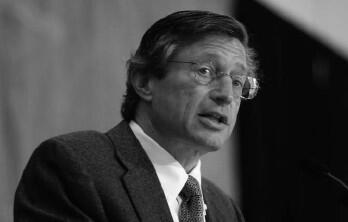
On November 15, 2007, FSI held its third annual international conference, Power and
Prosperity: New Dynamics, New Dilemmas, examining seismic shifts in power, wealth,
security, and risk in the global system. Acting FSI Director Michael A. McFaul, former Secretary
of State Warren Christopher, and former Secretary of Defense William J. Perry offered stagesetting
remarks before a capacity crowd of business and civic leaders, diplomats, policymakers,
faculty, and students. Interactive panel sessions encouraged exploration of contemporary
issues with Stanford faculty and outside experts.
“For more than two centuries , a debate has raged in
our country over whether the Congress or the president has the power to
start, conduct, and terminate a war,” stated former Secretary of State Warren
Christopher. The issue has been made urgent by what is called the “War on Terror,”
regarded by many as almost unlimited in duration and geographic scope. “One
frontier issue is whether the commander-in-chief authority gives the president the
power to override the Constitution,” he said, specifically “whether or not the president
can authorize torture that may offend the Constitution, wiretap American citizens,
and suspend habeas corpus.”
Christopher and former Secretary of State Jim Baker are heading a new National
War Powers Commission to study and resolve these issues. Planning to do something
of a prospective nature, they will focus their recommendations on the 2009 Congress,
seeking to bring to bear the collective judgment of both the president and a Congress
traditionally reluctant to exercise the power it has under the Constitution.
“I spent most of my adult life under the dark cloud of a nuclear holocaust, a war
that threatened no less than the annihilation of humanity,” said former Secretary of
Defense William Perry. Now the Cold War is over, but its end did not bring about
the end of history. “History is being written every day in the streets of Bagdad, in
the deserts of Darfur, in the nuclear test range of North Korea, and in the nuclear
laboratories of Iran.”
Perry identified four potential security threats: the danger of a nuclear terrorist
attack, drifting into a new Cold War, drifting into an environmental disaster, and the
danger that radical fundamentalists will gain ascendancy in the Islamic world. “There
is a fundamental conflict between our need to keep nuclear bombs out of the hands
of terrorists and our need to reduce carbon emissions,” he stated, for the global
movement to increase nuclear power could increase terrorists’ ability to get fissile
materials. “The solution must lie,” he advised, “in establishing international protocols
for how nuclear plants are operated and nuclear fuel supplies are controlled.”
A complementary route is to work to reduce and then eliminate nuclear weapons.
Getting to the political will to take those steps was a major objective of a January 4,
2007, Wall Street Journal op-ed, “A World Free of Nuclear Weapons,” published by
Perry, George Shultz, Henry Kissinger, and Sam Nunn, and conferences at Stanford.
“This conference can teach us what to do,” Perry said, “what is needed is the
political will to do it.”
Gi-Wook Shin, director of FSI’s Walter H. Shorenstein Asia-Pacific Research Center,
chaired Plenary I, “Asia’s Triple Rise: How China, India, and Japan Will Shape our
Future.” “While our policymakers are preoccupied with the Middle East, Asia is going
to have much more impact on our future,” Shin said. Asia is experiencing a unique
moment in Asian and world history. Can three great nations rise simultaneously, creating
a regional architecture for stability and security? What role can the United States play?
“There are two defining characteristics of today’s world,” said J. Stapleton Roy,
former U.S. ambassador to China, “America’s role as the sole superpower and China’s
precipitous rise to power and influence.” Roy traced China’s resource demands,
military development, and global economic impact and evaluated China’s influence
on U.S. foreign policy. “While we see a more powerful and prosperous China as a
security threat,” he stated, “the case could be made for a more optimistic scenario in
which growth creates a sizable middle class, greater global dependence, and a more
open society as the fifth generation of Chinese leaders takes over, the first to mature
in a period of openness to the world and the power of modern democracies.”
“The only democracy in the world with which the United States had endemically
bad relations during the Cold War was India. Happily that has changed,” said
Robert Blackwill, former U.S. ambassador to India. He addressed our many areas
of common interest: the fight against global terrorism, energy security, a healthy
global economy, and shared democratic values. Analyzing the pending civil nuclear
cooperation deal, he placed India’s need for 15–20 new nuclear reactors in the
context of domestic growth. Some 450 million people make less than $1.50 per day;
India will not tolerate outside direction to slow growth. “The United States and India
are natural allies,” he concluded.
“The India entering its seventh decade as an
independent country is one that is open to
the contention of ideas and interests within
it and outside … wedded to the democratic
pluralism that is its greatest strength and
determined to fulfill the creative energies
of its people. Such an India truly enjoys
soft power in today’s world.”
former under secretary-general of the
united nations shashi tharoor“Japan has resumed a solid growth track,” said Michael H. Armacost, Shorenstein
Distinguished Fellow and former U.S. ambassador to Japan. The country seeks
respect and wants a permanent seat on the U.N. Security Council, which it deserves.
Japan’s economy is four times the size of China’s; Japan’s military budget is just 1 percent of GDP, yet it is the third largest in the world and the most sophisticated
in Asia. Japan has the resources of a great power—huge financial reserves, modern
science and technology, and enormous aid and investment flows. As Japan assumes
a more robust international role, we should expect the Japanese to “hedge their
bets,” he said, balancing strong U.S. ties with other nations and competing with
China in pan-Asian community building efforts. Japan-U.S. relations should not be
forgotten, he advised, as we focus on China and India.
Shashi Tharoor, diplomat, historian, and former U.N. under secretary-general,
mused about “India’s Future as a Great Power.” Asking what makes a country a
world leader, he acknowledged that India has the world’s second largest population,
fourth largest military, status as a nuclear power, and the fifth largest economy. Yet
a nation that cannot feed, educate, or employ its people cannot be termed a “great
power,” Tharoor noted. He suggested that India’s greatest asset is its “soft power”—
its liberal democracy, social and cultural diversity, and enormously popular culture.
All hold important lessons. “The India entering its seventh decade as an independent
country,” he said, “is open to the contentions of ideas and interests within it and
outside … wedded to the democratic pluralism that is its greatest strength and
determined to liberate and fulfill the creative energies of its people. Such an India
truly enjoys soft power in today’s world.”
Lynn Eden, associate director for research at CISAC, chaired Plenary II, “Critical
Connections: Faces of Security in the 21st Century,” examining security risks posed
by Iraq, nuclear weapons, and food security and the environment—issues, she noted,
“that are also central themes of the Stanford International Initiative: improving
governance, pursuing security, and advancing human well-being.”
“There are now multiple indications that conditions on the ground in Iraq have
improved quite substantially,” said Hoover Institution denior fellow and CDDRL faculty
member Larry Diamond. Violence is down and there is a return to something approaching
normalcy, as a result of the 30,000 “surge” in U.S. troops and a more effective counterinsurgency
strategy adopted by General David Petraeus. The new military-sized force
and strategy come at a propitious moment, when the Sunni Arab heartland has turned
against Al Qaeda. As Al Qaeda has been weakened, fear, fatal bombings, and Iraqi
and U.S. fatalities have declined significantly. The problem is that strategic military
gains have not been matched with requisite political progress: enacting an oil revenue
sharing bill, reversing de-Baathification, and scheduling provincial elections. “The
harsh fact is that military progress on the ground is not sustainable,” warned Diamond,
“without political progress toward reconciliation in Bagdad and the provinces.”
“As Americans, we have not thought systematically
about what it means when we use the
phrase ‘Islamic fundamentalism.’ We tend to
treat it holistically. If we are going to understand
this threat, we have to disaggregate that
big thing called ‘the Muslim world’—we
have to know the difference between Islamic
fundamentalist, Islamist, and liberal Muslims.”
acting fsi director and political science
professor michael a. mcfaulAssessing nuclear proliferation, CISAC Co-Director Scott D. Sagan said, “In 1963,
John F. Kennedy famously relayed his nuclear nightmare that by the 1970s there
might be 15–20 nuclear weapons states. Was Kennedy’s fear inaccurate or only
premature?” Today there are nine nuclear states, but the Non-Proliferation Treaty
(NPT) is cracked and challenges abound. The A.Q. Khan network in Pakistan
exported nuclear technology to Libya, North Korea, and Iran. North Korea withdrew
from the NPT and conducted a 2006 test, before agreeing to dismantle its nuclear
program. Iran has rejected international demands to suspend uranium enrichment.
The United States has not lived up to its NPT commitment to work toward eventual
elimination of nuclear weapons. For Sagan, keys to nonproliferation include a
successful U.N. 2010 NPT Review Conference, peaceful resolution of the North
Korean and Iranian crises, developing control of the international fuel cycle, and
American ratification of the Comprehensive Test Ban Treaty.
Turning to human security, Rosamond L. Naylor, the Julie Wrigley Senior Fellow at
FSI and the Woods Institute for the Environment, reported that 1 billion people face
acute risks every day from hunger, infectious disease, resource depletion, climate
change, and civil conflict. Incredibly, 15 percent of the world’s population lives on less
than $1 per day and 50 percent live on less than $2 a day. Three billion people are
vulnerable to disruptions in food prices because of competing biofuels and climate
change. While terrorism kills 3,000 people each year and battle deaths claim 20,000,
more than 6–8 million people die every year from hunger and malnutrition. “What
can be done?” asked Naylor. We urgently need to conserve our genetic crop resources
and invest in rural development, agriculture, and education.
Gilles Kepel, professor and chair, Middle East and Mediterranean Studies, at
Sciences Po, delivered the dinner keynote, “Islamic Fundamentalism: On the Rise
or the Decline?” “As Americans we have not thought systematically about what it
means when we use the phrase ‘Islamic fundamentalism,’” said Acting FSI Director
Michael McFaul. “If we are going to understand this threat, we have to disaggregate
that big thing called ‘the Muslim world’—we have to know the difference between
Islamic fundamentalist, Islamist, and liberal Muslims.” Gilles Kepel, a leading author
and scholar of the Middle East, who has “invested tremendously in the study of
Islam,” was invited to fill that void. “When it comes to understanding Islamic
fundamentalism, Paris is the 21st century,” said McFaul. “I see it as a real challenge
to all of us to learn from our French colleagues, and tonight I promise you, you will
learn from one of our French colleagues.”
In a December 2001 manifesto, Knights Under the Prophet’s Banner, Ayman
al-Zawahiri, Osama bin Laden’s mentor and Al Qaeda ideologue, admitted Islamic
jihadists had failed to mobilize the masses to overthrow their corrupt rulers, “the
nearby enemy,” and establish Islamic states, Kepel began. By inflicting a massive blow
on 9/11 on “the far enemy,” the United States, they would demonstrate that America
was weak, Islamic militants were strong, and the masses could revolt against their
leaders without fear. The Muslim world and then the whole world would become
ruled by Shariah under Islamist aegis. Kepel then asked, “Have they succeeded in
what they set out to do?”
“After 9/11, we had a clash of two grand
narratives: ‘jihad and martyrdom’ where the
apostate regimes of the West and the Middle
East were about to fall and ‘the War on
Terror’ in which the roots of terrorism
would be eradicated and autocratic regimes
would tumble, bringing about democracy
and a transformation of the Middle East.”
professor gilles kepel,
institute of political studies, parisKepel’s answer was no. Since 9/11, he said, “There have been two grand narratives:
the narrative of jihad and martyrdom preached by Zawahiri and bin Laden, arguing
that the rotten regimes of the West and the Middle East would fall, as jihadists waged
copy-cat bombings in Africa, Europe, and the Middle East, suicide operations, and
so forth” and “the narrative of the American-led War on Terror,” hammering that
the roots of terrorism would be eradicated and autocratic regimes would tumble,
bringing about democracy and the transformation of the Middle East.
The 2003 invasion of Iraq opened a new area for radical Islamic mobilization.
But the two clashing narratives gave ground to something unexpected: the rise of
Iranian influence in the region and “a golden opportunity not for Sunni Islamic
fundamentalists but for the radical Shia in Iran,” who after the 2005 election of
President Ahmadinejad found they could engage in nuclear blackmail with the world
and threaten the United States with the activation of Shiite militias in Iraq, where
American forces would be at a disadvantage fighting two enemies at the same time.
While Zawahiri continues to paint the “triumphal march of Sunni fundamentalism,”
Kepel stated, “the discrepancy between his world view and reality is growing bigger
and bigger.” To date, the bigger winner from 9/11 is not Al Qaeda but the Islamic
Republic of Iran. Iran and Hezbollah have become the heroes and champions of the
Muslim world. This fragmentation in the Muslim world, pitting Shia against Sunni, has
weakened the Sunni radical movements’ ability to mobilize. How the confrontation
plays out, he concluded, will determine the future of the Middle East.
POWER AND PROSPERITY: NEW DYNAMICS, NEW DILEMAS
INTERACTIVE PANEL DISCUSSIONS ON CRITICAL ISSUES
In an FSI conference highlight, participants engaged in spirited debate on leading issues with Stanford faculty and outside experts. Audio recordings of the plenary and panel discussions are available below.
IS DEMOCRACY GOOD FOR HEALTH?
Alan M. Garber, Grant Miller, Douglas K. Owens, and Paul H. Wise
NUCLEAR POWER WITHOUT NUCLEAR PROLIFERATION?
Scott D. Sagan, David G. Victor, Robert Rosner, and Siegfried S. Hecker
A CHANGING CONTINENT? OPPERTUNITIES AND CHALLENGES FOR EUROPEAN UNION EXPANSION
Katherine Jolluck, Mark Leonard, Monica Macovei, and Wolfgang Münchau
GROWING PAINS - GROWTH AND TENISIONS IN CHINA
Andrew G. Walder, Jean C. Oi, Scott Rozelle, and Xueguang Zhou
AUTOCRATIC HEGEMONS AND THE NATIONAL INTEREST: DEALING WITH CHINA, IRAN, AND RUSSIA
Kathryn Stoner, Larry Diamond, Michael A. McFaul, and Abbas Milani
FOOD SECURITY, CLIMATE CHANGE, AND CIVIL CONFLICTf
Rosamond L. Naylor, David Lobell, and Edward A. Miguel
FACES OF ENGERY SECURITY
David G. Victor, Bryan J. Hannegan, and Chris Mottershead
OVERCOMING BARRIERS TO CONFLICT RESOLUTION: THE MIDDLE EAST
Allen S. Weiner, Byron Bland, Bruce Jones, and Lee D. Ross