Business
-

China Chats with Stanford Faculty


USA vs China:  A New Cold War? Great Power Relations and Competition in the 21st Century

Thirty years ago, the Cold War ended. Today, great power competition is back – or so it seems – with many describing our present era as a “New Cold War” between the United States and China (and Russia). But is this label an illuminating or distorting analogy? More importantly, what should the U.S. do to meet the challengers of great power competition in the 21st century? 

In analyzing contemporary relations, we must trace the historical origins of the U.S.-China relationship, then assess the similarities and differences between the Cold War and U.S.-China relations today along dimensions such as power, ideology, and multilateralism, in order to effectively devise unilateral, bilateral, and multilateral policy prescriptions for U.S. policymakers.

This Stanford alumni event featured Stanford professor Michael McFaul, director at the Freeman Spogli Institute for International Studies. He was joined by professor Hongbin Li, co-director of Stanford Center on China's Economy, who moderated a discussion about the major themes of the research. 

Watch the event recording:


About the Speakers:

Image
Headshot of Michael McFaul - 3x4
Michael McFaul is Director at the Freeman Spogli Institute for International Studies, the Ken Olivier and Angela Nomellini Professor of International Studies in the Department of Political Science, and the Peter and Helen Bing Senior Fellow at the Hoover Institution. He joined the Stanford faculty in 1995.

Dr. McFaul also is as an International Affairs Analyst for NBC News and a columnist for The Washington Post. He served for five years in the Obama administration, first as Special Assistant to the President and Senior Director for Russian and Eurasian Affairs at the National Security Council at the White House (2009-2012), and then as U.S. Ambassador to the Russian Federation (2012-2014).

He has authored several books, most recently the New York Times bestseller From Cold War to Hot Peace: An American Ambassador in Putin’s Russia. Earlier books include Advancing Democracy Abroad: Why We Should, How We Can; Transitions To Democracy: A Comparative Perspective (eds. with Kathryn Stoner); Power and Purpose: American Policy toward Russia after the Cold War (with James Goldgeier); and Russia’s Unfinished Revolution: Political Change from Gorbachev to Putin.

His current research interests include American foreign policy, great power relations, and the relationship between democracy and development. Dr. McFaul was born and raised in Montana. He received his B.A. in International Relations and Slavic Languages and his M.A. in Soviet and East European Studies from Stanford University in 1986. As a Rhodes Scholar, he completed his D. Phil. in International Relations at Oxford University in 1991.


Image
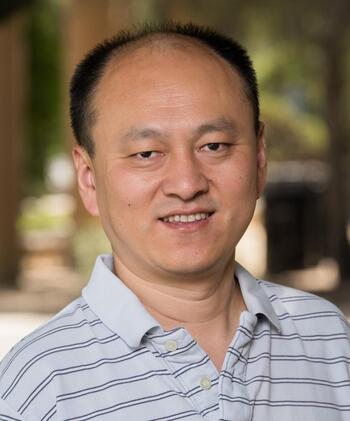
hongbin li headshot
Hongbin Li is the Co-Director of the Stanford Center on China's Economy and Institutions (SCCEI) and a Senior Fellow of Stanford Institute for Economic Policy Research (SIEPR). Hongbin obtained his Ph.D. in economics from Stanford University in 2001 and joined the economics department of the Chinese University of Hong Kong (CUHK), where he became full professor in 2007. He was also one of the two founding directors of the Institute of Economics and Finance at the CUHK. He taught at Tsinghua University in Beijing 2007-2016 and was C.V. Starr Chair Professor of Economics in the School of Economics and Management. He also founded and served as the Executive Associate Director of the China Social and Economic Data Center at Tsinghua University. He founded the Chinese College Student Survey (CCSS) in 2009 and the China Employer-Employee Survey (CEES) in 2014.

Hongbin’s research has been focused on the transition and development of the Chinese economy, and the evidence-based research results have been both widely covered by media outlets and well read by policy makers around the world . He is currently the co-editor of the Journal of Comparative Economics.


Seminars
Paragraphs
Graph lines and bar charts overlaid on a shipping port in China.

Below is an excerpt from the SIEPR policy brief published online.

"As the United States and China enter a new and contentious phase of their relationship, Stanford scholars are setting and expanding research agendas to analyze China’s economic development and its impact on the world. The newly launched Stanford Center on China’s Economy and Institutions (SCCEI, pronounced “sky”) was formed by the Stanford Institute for Economic Policy Research (SIEPR) and the Freeman Spogli Institute for International Studies (FSI) to support their work.

The goal of SCCEI and its affiliated faculty is to provide a dispassionate, fact-based architecture that can help policymakers, business leaders and the general public navigate the fraught relationship between the U.S. and China.

This policy brief outlines the scholarship already underway by some of SCCEI’s affiliates. It includes a range of research on the world’s most populous country: education and wage disparities; workforce transformation; emissions trading; China’s one-child policy; and the effect that racism against Chinese students in America has upon their views about authoritarian rule. As the center matures, research agendas will expand and focus on trade, global supply chains, technology, intellectual property rights, worker productivity, and a range of developing issues affecting the connection between Washington, D.C., and Beijing and the rest of the world."


Read the Full Policy Brief

All Publications button
1
Publication Type
Policy Briefs
Publication Date
Subtitle
Stanford scholars are setting and expanding research agendas to analyze China’s economic development and its impact on the world. The newly launched Stanford Center on China’s Economy and Institutions — co-directed by SIEPR senior fellows Hongbin Li and Scott Rozelle — is supporting their work. In this SIEPR Policy Brief, Li and Rozelle outline the research underway by the new center's affiliates.
Authors
Hongbin Li
Scott Rozelle
-

This is a virtual event. Please click here to register and generate a link to the talk. 
The link will be unique to you; please save it and do not share with others.


Corrupt countries are usually poor, yet China is an exception. President Xi Jinping acknowledges that corruption in the country has reached crisis proportions. If this is true, why has China nevertheless sustained 40 years of economic growth and deep transformation?

In this talk, Professor Yuen Yuen Ang will analyze how different types of corruption exert different effects on the economy.  Reminiscent of America’s Gilded Age during the 19th century, reform-era China has steadily evolved toward a particular type of corruption: access money (elite exchanges of power and wealth).  Starting in the 2000s, the central government effectively curbed directly growth-damaging types of corruption such as embezzlement and bureaucratic extortion. But access money fueled commerce by rewarding politicians for aggressively promoting growth and connected capitalists for taking on increasingly risky ventures. Such corruption has also produced systemic risks, distortions, and inequality, however—problems that define China's Gilded Age under Xi Jinping’s leadership. As a result, China today is a high-growth but risky and imbalanced economy. 

Despite popular perceptions that China and the United States are two polar opposites, therefore, contemporary China and 19th century America share some striking commonalities.


Image
Portrait of Yuen Yuen Ang
Yuen Yuen Ang is a PhD graduate of Stanford University, where she studied comparative political economy with a focus on China. She is the inaugural recipient of the Theda Skocpol Prize, awarded by the American Political Science Association for “impactful empirical, theoretical and/or methodological contributions to the study of comparative politics.” She was also named an Andrew Carnegie Fellow for “high-caliber scholarship that applies fresh perspectives to the most pressing issues of our times.” Her first, award-winning book, How China Escaped the Poverty Trap (2016), is acclaimed as “game changing” and “field shifting.” It received the Peter Katzenstein Prize in Political Economy, the Viviana Zelizer Prize in Economic Sociology, and was named “Best of Books 2017″ by Foreign Affairs. The sequel to this book, China’s Gilded Age: the Paradox of Economic Boom & Vast Corruption, is released in 2020. It was featured in The DiplomatThe Economist, and The Wire China. She is an associate professor in political science at the University of Michigan and previously a faculty member at Columbia University SIPA.

Image
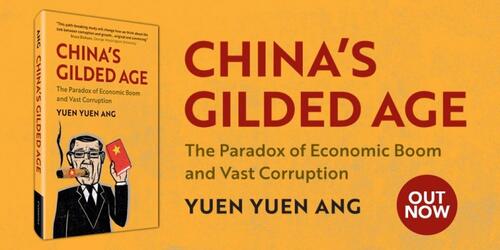
Cover of "China's Gilded Age" by Yuen Yuen Ang


Image
American and Chinese flags
This event is part of the 2021 Winter/Spring Colloquia series, Biden’s America, Xi’s China: What’s Now & What’s Next?, sponsored by APARC's China Program.


Via Zoom Webinar. Register at: https://bit.ly/3cEtX5f

Yuen Yuen Ang Associate Professor of Political Science, University of Michigan
Seminars
-

China Chats with Stanford Faculty

The Rise of Robots in China with Professor Hongbin Li

China’s production and adoption of robotic technology have accelerated rapidly in recent years, surpassing Japan, US, and Germany. Stanford professor Hongbin Li and a team of scholars draw on multi-year field research data to show fresh insights into China’s aggressive push into automation—specifically, the increasing use of robots—to maintain its status as the “world’s factory.” His analysis offers an unprecedented look at what’s happening at the factory level, and fresh insight into how rising labor costs, an aging population and government policies are reshaping Chinese manufacturing.

In this Stanford alumni event, Hongbin Li, co-director of Stanford Center on China's Economy and Institutions and senior fellow at the Stanford Institute for Economic Policy Research, was joined by Scott Rozelle, co-director of Stanford Center on China's Economy and Institutions and senior fellow at the Freeman Spogli Institute for International Studies, who moderated a discussion about the major themes of the research. 

Watch the event recording:


About the Speakers:

Image
hongbin li headshot

Hongbin Li is the Co-Director of the Stanford Center on China's Economy and Institutions (SCCEI) and a Senior Fellow of Stanford Institute for Economic Policy Research (SIEPR). Hongbin obtained his Ph.D. in economics from Stanford University in 2001 and joined the economics department of the Chinese University of Hong Kong (CUHK), where he became full professor in 2007. He was also one of the two founding directors of the Institute of Economics and Finance at the CUHK. He taught at Tsinghua University in Beijing 2007-2016 and was C.V. Starr Chair Professor of Economics in the School of Economics and Management. He also founded and served as the Executive Associate Director of the China Social and Economic Data Center at Tsinghua University. He founded the Chinese College Student Survey (CCSS) in 2009 and the China Employer-Employee Survey (CEES) in 2014.

Hongbin’s research has been focused on the transition and development of the Chinese economy, and the evidence-based research results have been both widely covered by media outlets and well read by policy makers around the world . He is currently the co-editor of the Journal of Comparative Economics.


Image
Headshot of Dr. Scott Rozelle
Scott Rozelle is the Helen F. Farnsworth Senior Fellow and the co-director of Stanford Center on China's Economy and Institutions in the Freeman Spogli Institute for International Studies and Stanford Institute for Economic Policy Research at Stanford University.  For the past 30 years, he has worked on the economics of poverty reduction. Currently, his work on poverty has its full focus on human capital, including issues of rural health, nutrition and education. For the past 20 year, Rozelle has been the chair of the International Advisory Board of the China Center for Agricultural Policy in Peking University. In recent years Rozelle spends most of his time co-directing the Rural Education Action Project (REAP). In recognition of this work, Dr. Rozelle has received numerous honors and awards. Among them, he became a Yangtse Scholar (Changjiang Xuezhe) in Renmin University of China in 2008. In 2008 he also was awarded the Friendship Award by Premier Wen Jiabao, the highest honor that can be bestowed on a foreigner. 

Seminars
-

This is a virtual event. Please click here to register and generate a link to the talk. 
The link will be unique to you; please save it and do not share with others.

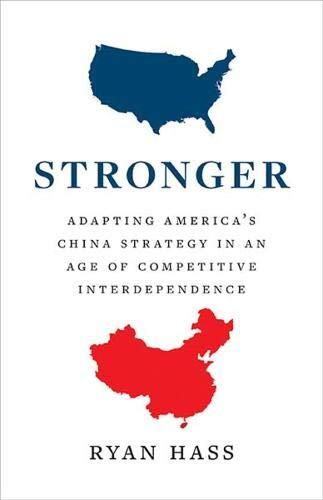
How can the U.S. best manage its relationship with China? The country is at once a major and increasingly hostile competitor to the U.S., a formidable challenger to U.S.’ regional and global leadership, and an important partner on a range of transnational challenges. Will it be possible for both sides to coexist amidst intensifying competition? How great is the risk of US-China conflict, including over Taiwan? Ryan Hass, author of Stronger: Adapting America’s China Strategy in an Age of Competitive Interdependence, will address these questions and more in opening comments before engaging in an open Q&A on the future of the world’s most consequential bilateral relationship.


Image
Portrait of Ryan Hass
Ryan Hass is a senior fellow and the Michael H. Armacost Chair in the Foreign Policy program at Brookings, where he holds a joint appointment to the John L. Thornton China Center and the Center for East Asia Policy Studies. He is also the Interim Chen-Fu and Cecilia Yen Koo Chair in Taiwan Studies. Hass focuses his research and analysis on enhancing policy development on the pressing political, economic, and security challenges facing the United States in East Asia. He is the author of Stronger: Adapting America’s China Strategy in an Age of Competitive Interdependence, published by Yale University Press.

Image
"Stronger" Book Cover
From 2013 to 2017, Hass served as the director for China, Taiwan and Mongolia at the National Security Council (NSC) staff. In that role, he advised President Obama and senior White House officials on all aspects of U.S. policy toward China, Taiwan, and Mongolia, and coordinated the implementation of U.S. policy toward this region among U.S. government departments and agencies. He joined President Obama’s state visit delegations in Beijing and Washington respectively in 2014 and 2015, and the president’s delegation to Hangzhou, China, for the G-20 in 2016, and to Lima, Peru, for the Asia-Pacific Economic Cooperation (APEC) Leaders Meetings in 2016. Prior to joining NSC, Hass served as a Foreign Service Officer in U.S. Embassy Beijing, where he earned the State Department Director General’s award for impact and originality in reporting. Hass also served in Embassy Seoul and Embassy Ulaanbaatar, and domestically in the State Department Offices of Taiwan Coordination and Korean Affairs. 


Image
American and Chinese flags
This event is part of the 2021 Winter/Spring Colloquia series, Biden’s America, Xi’s China: What’s Now & What’s Next?, sponsored by APARC's China Program.


Via Zoom Webinar. Register at: https://bit.ly/3c3v10W

Ryan Hass Senior Fellow, Michael H. Armacost Chair in Foreign Policy Studies, Brookings Institution
Seminars
Paragraphs
Book cover showing a robotic hand holding an older human hand.

Demographic transition, along with the economic and geopolitical re-emergence of Asia, are two of the largest forces shaping the twenty-first century, but little is known about the implications for innovation. The countries of East Asia have some of the oldest age structures on the planet: between now and 2050, the population that is age 65 and older will increase to more than one in four Chinese, and to more than one in three Japanese and Koreans. Other economies with younger populations, like India, face the challenge of fully harnessing the “demographic dividend” from large cohorts in the working ages.

This book delves into how such demographic changes shape the supply of innovation and the demand for specific kinds of innovation in the Asia-Pacific. Social scientists from Asia and the United States offer multidisciplinary perspectives from economics, demography, political science, sociology, and public policy; topics range from the macroeconomic effects of population age structure, to the microeconomics of technology and the labor force, to the broader implications for human well-being. Contributors analyze how demography shapes productivity and the labor supply of older workers, as well as explore the aging population as consumers of technologies and drivers of innovations to meet their own needs, as well as the political economy of spatial development, agglomeration economies, urban-rural contrasts, and differential geographies of aging.

Desk, examination, or review copies can be requested through Stanford University Press.

Table of contents and chapter 1, introduction
Download pdf
All Publications button
1
Publication Type
Books
Publication Date
Authors
Karen Eggleston
Gi-Wook Shin
Book Publisher
Shorenstein APARC
All Publications button
1
Publication Type
Working Papers
Publication Date
Subtitle
A burgeoning literature has documented the importance of elite colleges. Yet, little is known about access to elite education and its labor market implications in China, a country that produces one in every five college graduates in the world. College admission in China is governed by a single exam—the national college entrance exam, and the government sets admission cutoff scores for elite colleges. We examine the impacts of scoring above the elite-tier cutoff on a student's access to elite colleges and wage outcomes after graduation, using the discontinuity around the cutoff score. By employing hand-collected survey data, we find that scoring above the cutoff not only increases the chance of entering an elite college but also raises a young person's first-job wages after graduation. We also find that those just above the cutoff have peers with higher scores and better social networks than those below the cutoff, but it is less clear whether the two groups use their time differently in college.
Journal Publisher
National Bureau of Economic Research
Authors
Hongbin Li
News Type
News
Date
Paragraphs

The Benefits of Acing China's Most Important Academic Exam: High Scorers in the Gaokao Go to Better Universities and Earn Higher Wages

"Chinese students hoping for a reprieve from this year’s gruelling university-entrance exams are out of luck. Unlike America, where many top-tier universities have waived standardised testing requirements amid the covid-19 pandemic, China is keeping its students’ noses to the grindstone. On February 20th the Ministry of Education announced that the national exam, which determines which universities students can attend, will be held as planned on June 7th and 8th.

The annual assessment, known as the gaokao, is the biggest in the world. Every summer some 10m students in China trek to 7,000 testing centres around the country to sit the nerve-racking exam, which lasts for nine hours over two to four days. Pupils study for years, and for good reason. Those who score well on the test are eligible to apply to the country’s best universities, a prerequisite for many good jobs. The high-stakes exam is designed to be meritocratic: anyone can take it; for children from poor families, a good score can offer an escape from a life toiling on the farm or in a factory.

The gaokao influences students’ economic prospects for years to come, according to a recent working paper by Hongbin Li of Stanford University and Ruixue Jia of the London School of Economics. The authors looked at the cut-off score for qualification to enter China’s top 100 universities. Using hand-collected data from over 10,000 people, they found that, whereas students who score just below the cut-off have only a 6% chance of attending a top-tier university, those who score at or above it have a 20-40% chance. They also earn 5-9% more in their first job out of school (see chart)."


Read the full article from The Economist. 

Hero Image
These figures plot the probability of attending an elite (national first-tier) college against distance to the cutoff scores (which vary by province-year-track). Panel (a) is based on raw data; each point corresponds one point in the exam. "Just above the exam cut-off score: elite college admission and wages in China", by Ruixue Jia and Hongbin Li
All News button
1
Subtitle

SCCEI Co-Director Hongbin Li's research on elite college admissions and wages in China provides the basis for this article from The Economist.

-

This is a virtual event. Please click here to register and generate a link to the talk. 
The link will be unique to you; please save it and do not share with others.


This event is co-sponsored by the Center on Democracy, Development, and the Rule of Law.

How does autocratic lobbying affect political outcomes and media coverage in democracies? This talk focuses on a dataset drawn from the public records of the US Foreign Agents Registration Act. It includes over 10,000 lobbying activities undertaken by the Chinese government between 2005 and 2019. The evidence suggests that Chinese government lobbying makes legislators at least twice as likely to sponsor legislation that is favorable to Chinese interests. Moreover, US media outlets that participated in Chinese-government sponsored trips subsequently covered China as less threatening. Coverage pivoted away from US-China military rivalry and the CCP’s persecution of religious minorities and toward US-China economic cooperation. These results suggest that autocratic lobbying poses an important challenge to democratic integrity.


Portrait of Erin Baggott CarterErin Baggott Carter is an Assistant Professor at the Department of Political Science and International Relations at the University of Southern California. There, she is also a Co-PI at the Lab on Non-Democratic Politics. She received a Ph.D. in Government from Harvard University, is currently a visiting scholar at the Stanford Center on Democracy, Development and the Rule of Law, and was previously a Fellow at the Stanford Center for International Security and Cooperation.

Dr. Carter's research focuses on Chinese politics and propaganda. She recently completed a book on autocratic propaganda based on an original dataset of eight million articles in Arabic, Chinese, English, French, Russian, and Spanish drawn from state-run newspapers in nearly 70 countries. She is currently working on a book on how domestic politics influence US-China relations. Her other work has appeared or is forthcoming in the British Journal of Political ScienceJournal of Conflict Resolution, and International Interactions. Her work has been featured by the New York Times, the Brookings Institution, and the Washington Post Monkeycage Blog.


Image
American and Chinese flags
This event is part of the 2021 Winter/Spring Colloquia series, Biden’s America, Xi’s China: What’s Now & What’s Next?, sponsored by APARC's China Program.


Via Zoom Webinar. Register at: https://bit.ly/3beG7Qz

Erin Baggott Carter Assistant Professor, Department of Political Science and International Relations, University of Southern California; Visiting Scholar, Center on Democracy, Development and the Rule of Law, Stanford University
Seminars
All Publications button
1
Publication Type
Working Papers
Publication Date
Subtitle
This paper studies how the COVID-19 pandemic has affected labor demand using over 100 million posted jobs on one of the largest online platforms in China. Our data reveals that, due to the effects of the pandemic both in China and abroad, the number of newly posted jobs within the first 13 weeks after the Wuhan lockdown on January 23, 2020 was about one third lower than that of the same lunar calendar weeks in 2018 and 2019. Using econometric methods, we show that, via the global supply chain, COVID-19 cases abroad and in particular pandemic-control policies by foreign governments reduced new job creations in China by 11.7%. We also find that Chinese firms most exposed to international trade outperformed other firms at the beginning of the pandemic but underperformed during recovery as the Novel Coronavirus spread throughout the world.
Journal Publisher
National Bureau of Economic Research
Authors
Hongbin Li
Subscribe to Business