International Development

FSI researchers consider international development from a variety of angles. They analyze ideas such as how public action and good governance are cornerstones of economic prosperity in Mexico and how investments in high school education will improve China’s economy.

They are looking at novel technological interventions to improve rural livelihoods, like the development implications of solar power-generated crop growing in Northern Benin.

FSI academics also assess which political processes yield better access to public services, particularly in developing countries. With a focus on health care, researchers have studied the political incentives to embrace UNICEF’s child survival efforts and how a well-run anti-alcohol policy in Russia affected mortality rates.

FSI’s work on international development also includes training the next generation of leaders through pre- and post-doctoral fellowships as well as the Draper Hills Summer Fellows Program.

-

THIS EVENT STARTS AT 2:40PM. Introductions will start at 2:40pm. Each presentation will be 20 minutes with a 10 minute discussion.


* Please note all CISAC events are scheduled using the Pacific Time Zone.


Register in advance for this webinar: https://stanford.zoom.us/webinar/register/WN_C-7gXRifSDWhhfZ2yBCkTg


About the Event: Why do certain Latin American countries receive substantially more Chinese investment than others? Various reports, books, and statements from officials argue that Chinese investments, notably ones from its Belt and Road Initiative, seek to augment Chinese global influence through corruption, political influence, and debt diplomacy. Since 2005, the People’s Republic of China has increased its interest in Latin America, as evidenced by its upward trend of investment with the region now receiving nearly 10% of total Chinese investment, or $200bn. Using the American Enterprise Institute’s China Global Investment Tracker, this thesis aims to identify some potential factors for the distribution of Chinese investment across different Latin American nations and test the veracity of such claims, and explain why Argentina, Brazil, Ecuador, Peru, and Venezuela receive such high levels of investment compared to regional peers like Colombia and Mexico. The data suggests that Latin American corruption is not an influential factor in Chinese investment destinations, but rather the primary motive is more likely the potential for commodity exports like soybeans, petroleum, and copper. As China raises its economic influence in Latin America, Beijing will likely obtain greater political and diplomatic influence. The United States government must understand Beijing’s intentions in the region and compete accordingly rather than maligning the PRC’s actions in Latin America without providing a competitive alternative.


About the Speaker: Carter is a senior studying International Relations with specializations in international security and East and South Asia, as well as German studies. Growing up in Phoenix, Arizona, he extended his affinity for Latin America into his thesis by writing about Chinese investments across various Latin American states. After graduation, he will be moving to Bologna, Italy and Washington, DC for a Masters in International Relations at Johns Hopkins University's School of Advanced International Studies.

Virtual Seminar

Carter Clelland CISAC Honors Student Stanford University
Seminars
-

Introductions will start at 1:50pm. Each presentation will be 20 minutes with a 10 minute discussion.


* Please note all CISAC events are scheduled using the Pacific Time Zone.


Register in advance for this webinar: https://stanford.zoom.us/webinar/register/WN_Uoa_Nef3RAu1JAfPRDTg2A


About the Event: When and under what circumstances does the US government publicly attribute state-backed cyber intrusions? Over the past decade, the US government has become increasingly willing to publicly attribute the state adversaries behind cyber incidents. Yet the timing of public attribution appears to vary significantly. Much of the existing work on public attribution of cyber incidents is theoretical – examining when states should publicly attribute – without providing a systematic study of the circumstances in which it actually takes place. This thesis seeks to fill this gap by compiling a data set of every public attribution by the U.S. government to another state from 2010-2021, in addition to data on timing. My analysis suggests that the U.S. government is not a unitary actor; instead, public attribution operates through four distinct channels – technical alerts, criminal charges, and official and unofficial policy statements. Bilateral relations between the U.S. and adversary state, U.S. domestic politics, and attribution by private sector entities have no systematic effect on the timing of public attribution. Moreover, case studies of public attribution for Iran’s Operation Ababil and Russia’s Dragonfly 2.0 campaign demonstrate that organizational factors matter more than the public discourse would suggest. As the government pursues whole-of-government strategies of “persistent engagement” and “defend forward,” this thesis suggests that policymakers must think systematically across government about when and under what circumstances to publicly attribute cyber incidents to other states.


About the Speaker: June is a senior studying International Relations and minoring in Computer Science. Her course of study has focused on cyber policy and international law, inspired by her experiences at the Atlantic Council’s Cyber Statecraft Initiative and State Department. Her thesis extends these interests, by examining the US government's approach to public attribution in cyberspace.

Virtual Seminar

June Lee CISAC Honors Student Stanford University
Seminars
-

THIS EVENT STARTS AT 1:50PM. Introductions will start at 1:50pm. Each presentation will be 20 minutes with a 10 minute discussion.


* Please note all CISAC events are scheduled using the Pacific Time Zone.


Register in advance for this webinar: https://stanford.zoom.us/webinar/register/WN_Uoa_Nef3RAu1JAfPRDTg2A


About the Event: Russia harbors both real and imagined grievances against the West. Since the end of the Cold War, the Kremlin has accumulated a litany of complaints – spanning NATO enlargement to liberal hegemony, economic sanctions to cultural degeneracy – and amplified them with renewed fervor at home and abroad. Despite the resurgence of resentment politics in Russia, China, and Iran, few studies have examined the phenomenon of national grievance narratives. This thesis fills the gap with a study on the sources and strategic aims of Russia’s grievances against the West. An original dataset of 471 grievances, created by surveying hundreds of Russian presidential speeches, interviews, and strategic documents, charts Russia’s grievance narrative since 1991. Contrary to conventional assumptions, grievance narratives do not reflect the genuine foreign policy interests of the state. A fifth of the grievances in the dataset are neither reliable nor merely rhetorical, but rather instrumental to a revisionist Russian foreign policy. Instrumental grievances, a term this thesis introduces, are tactical complaints that state actors exploit to undermine, challenge, or gain leverage over an adversary. An in-depth case study on Russia’s long-standing grievance against NATO suggests the Russian political elite inflate national security threats to serve their geopolitical ambitions and domestic political interests. Consequently, policymakers should interpret Russia’s grievance narrative with caution and skepticism. When policymakers mistake an instrumental grievance for harmless rhetoric or, worse, genuine offense, they overlook the subversive ways that Russia exploits the grievance to deceive and undermine the West.


About the Speaker: Yasmin is an international student from the UK studying History and Economics at Stanford. Since visiting Russia three times and studying the language, she has developed a deep interest in the country and turned to historical analysis to help make sense of Russian foreign policy.

Virtual Seminar

Yasmin Samrai CISAC Honors Student Stanford University
Seminars
-

Introductions will start at 2:40pm. Each presentation will be 20 minutes with a 10 minute discussion.


* Please note all CISAC events are scheduled using the Pacific Time Zone.


Register in advance for this webinar: https://stanford.zoom.us/webinar/register/WN_Y4kF9dTJTJinogbJqvNSpw


About the Event: How do Chinese state media partnerships impact perceptions of China in East Asia and the Pacific? Chinese state media groups form partnerships to publish content in local outlets, reaching foreign audiences through trusted sources. Previous scholars identify media partnerships as the most impactful form of Beijing’s public diplomacy, but do not investigate which factors moderate this influence. This thesis analyzes the relationship between partnerships and approval of China in 12 countries using an original dataset of 98 partnerships from 2006-2020. By recording the size of partner groups, strength of ties, and language of publication, this this investigation differentiates itself from previous studies. Partnerships are collectively associated with increasing approval and decreasing disapproval of China, but surprisingly the most influential partnerships are with small, Chinese language media groups. These results contradict the conventional logic that partnerships with larger, multilingual media would have greater impact. An interview with a Xinhua journalist and case studies of media organizations in Thailand and Australia suggest that small, Chinese language platforms are uniquely vulnerable to influence from PRC state media. Policymakers must support independent publishers to prevent the consolidation of the Chinese language media ecosystem.


About the Speaker: Dylan is a senior studying international relations and human rights. After researching disinformation for the Department of Defense and working for a journalism-tech startup, Dylan chose to investigate Chinese state media partnerships in East Asia and the Pacific. After graduation, he will move to D.C. and work as a Junior Fellow at the Stimson Center.

Virtual Seminar

Dylan Junkin CISAC Honors Student Stanford University
Seminars
-

THIS EVENT STARTS AT 2:40PM. Introductions will start at 2:40pm. Each presentation will be 20 minutes with a 10 minute discussion.


* Please note all CISAC events are scheduled using the Pacific Time Zone.


Register in advance for this webinar: https://stanford.zoom.us/webinar/register/WN_Y4kF9dTJTJinogbJqvNSpw


About the Event: How do U.S. and UN targeted sanctions impact the behavior and strategies of militant groups? Despite several theories on the use of sanctions to punish non-state actors, scholars have largely neglected the impact of targeted sanction application on militant group behavior. This thesis combines an original dataset of 160 U.S. and UN sanction regimes with data on the activity of over 600 militant groups to examine the relationship between sanction imposition and militant activity. The results show mixed impact of sanctions on militant activity. While UN targeted sanctions precipitate falls in militant activity, unilateral U.S. sanctions are associated with a significant increase in violence committed by sanctioned groups. Comparative analysis of two militant groups in India –The National Democratic Front of Bodoland and Hizbul Mujahideen– explores the causality of this finding. U.S. sanctions strip militant groups of international legitimacy but often fail to limit their availability to resources. As a result, U.S. sanctions reduce the incentives of non-state actors to seek international recognition and constrain the forms of violence and insurgency they employ. This thesis illustrates the importance of international cooperation in ensuring targeted sanctions effectively limit the operating capabilities of militant groups.


About the Speaker: Nathalie is a senior from Kansas City, Kansas, studying Economics and Political Science. Her experiences working for the World Bank and studying at Oxford have made her passionate about the intersection of economic development, human rights, and violence prevention. After graduation, she plans on conducting economic analysis for the Ludwig Institute for Shared Economic Prosperity in Washington, D.C.

Virtual Seminar

Nathalie Kiersznowski CISAC Honors Student Stanford University
Seminars
-

Please note the event time has been changed to 10:30AM (PT) to 12:00PM (PT).


This is a virtual event. Please click here to register for the talk. 


This event is presented in partnership with Global:SF and the State of California Governor’s Office of Business and Economic Development.
 

U.S.-China economic relations have grown increasingly fraught and competitive.  Even amidst intensifying tensions, however, our two major economies remain intertwined.  While keeping alert to national security concerns, the economic strength of the United States will depend on brokering a productive competition with China, the world’s fastest growing economy.  Precipitous decoupling of trade, investment, and human talent flows between the two nations will inflict unnecessary harm to U.S. economic interests -- and those of California.  

Chinese trade and investments into California have grown exponentially over the last decade.  But they have come under increasing pressure following geopolitical and economic tensions between the two nations, particularly in the science and technology sectors.  This session will explore the role of Chinese economic activity in California in the context of the greater US-Chinese relationship. 


Portrait of Ambassador Craig AllenCraig Allen began his tenure in Washington, DC, as the sixth President of the United States-China Business Council, a private, nonpartisan, nonprofit organization representing over 200 American companies doing business with China. Ambassador Allen began his government career in 1985 at the Department of Commerce’s International Trade Administration (ITA) where, from 1986 to 1988, he worked as an international economist in ITA’s China Office. In 1988, Allen transferred to the American Institute in Taiwan, where he served as Director of the American Trade Center in Taipei. He returned to the Department of Commerce for a three-year posting at the US Embassy in Beijing as Commercial Attaché in 1992. In 1995, Allen was assigned to the US Embassy in Tokyo where he was promoted to Deputy Senior Commercial Officer in 1998. Allen became a member of the Senior Foreign Service in 1999. Starting from 2000, he served a two-year tour at the National Center for APEC in Seattle where he worked on the APEC Summits in Brunei, China, and Mexico. In 2002, Allen first served as the Senior Commercial Officer in Beijing where he was later promoted to the Minister Counselor rank of the Senior Foreign Service. After a four-year tour in South Africa, Ambassador Allen became Deputy Assistant Secretary for Asia at the US Department of Commerce’s International Trade Administration. He later became Deputy Assistant Secretary for China. Ambassador Allen was sworn in as the United States ambassador to Brunei Darussalam on December 19, 2014 where he served until he transitioned to take up his position as President of the US-China Business Council.
 

Image
Portrait of David Cheng
David Cheng is the chair and managing partner of Nixon Peabody’s China and Asia-Pacific practice. He is qualified in both the United States and Hong Kong. He focuses on cross-border transactions, litigations and investigations, advising on issues ranging from acquisitions, capital financing (initial public offering), intellectual property protection and disputes to fraud, FCPA and SEC investigations. He has a client portfolio from all over the world, including the United States, Middle East, Europe, Japan, Singapore, Taiwan, mainland China and Hong Kong.
 

james greenJames Green has worked for over two decades on U.S.-Asia relations. For five years, Green was the Minister Counselor for Trade Affairs at the U.S. Embassy in Beijing (2013-2018).  As the senior official in China from the Office of the United States Trade Representative (USTR), Green was deeply involved in all aspects of trade negotiations, trade enforcement, and in reducing market access barriers for American entities.  In prior government service, Green worked on the Secretary of State’s Policy Planning Staff and at the State Department’s China Desk on bilateral affairs. He also served as the China Director of the White House’s National Security Council.  In the private sector, Green was a senior vice president at the global strategy firm founded by former Secretary of State Madeleine Albright and was the founding government relations manager at the American Chamber of Commerce in Shanghai, Asia’s largest AmCham.  Currently, Green is a Senior Research Fellow at Georgetown University's Initiative for U.S.-China Dialogue on Global Issues and hosts a U.S.-China Dialogue Podcast.  He was most recently named as APARC's inaugural China Policy Fellow
 

Image
Portrait of Anja Manuel
Anja Manuel is Co-Founder and Principal, along with former Secretary of State Condoleezza Rice, former National Security Advisor Stephen Hadley and former Secretary of Defense Robert Gates, in Rice, Hadley, Gates & Manuel LLC, a strategic consulting firm that helps US companies navigate international markets. She currently serves on two corporate boards: Overseas Shipping Group, Inc., a NYSE listed energy transportation company, and Ripple Labs Inc., a leading blockchain payments company. Manuel also serves on several advisory boards, including Former Governor Brown’s California Export Council. From 2005-2007, she served as an official at the U.S. Department of State, responsible for South Asia Policy. She is a frequent commentator on foreign policy and technology policy, for TV and radio (NBC/MSNBC, Fox Business, BBC, Bloomberg, Charlie Rose, NPR, etc.) and writes for publications ranging from the New York Times, to the Financial Times, Fortune, The Atlantic, and Newsweek, among others. She is the author of the critically acclaimed This Brave New World: India, China and the United States, published by Simon and Schuster in 2016. A graduate of Harvard Law School and Stanford University, Manuel now also lectures and is a Research Affiliate at Stanford University. She is the Director of the Aspen Strategy Group and Aspen Security Forum -- the premier bipartisan forum on foreign policy in the U.S. -- and is a member of the Council on Foreign Relations.


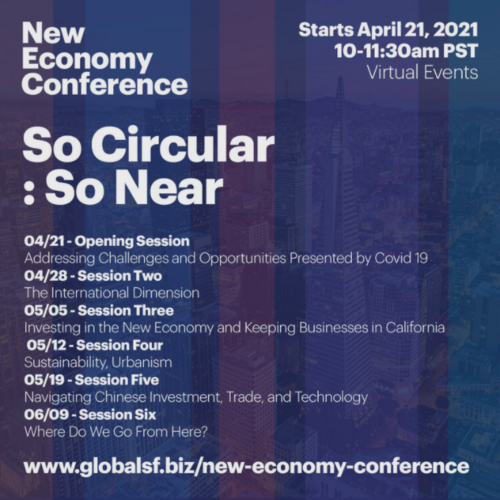
This Session is part of a larger conference series titled “The New Economy Conference – California’s Place in the New Global Economy”.   The New Economy Conference will broadcast public programs from April 21-May 25 on a weekly basis, designed to inform and identify the impact of COVID-19 on the economic competitiveness and resilience of the State of California.  Topics addressed will include Challenges and Opportunities Post-COVID in California (4/21); the International Dimension (4/28), Investing in the New Economy and Keeping Businesses in California (5/5); Sustainability and Urbanism (5/12); Navigating Chinese Investment, Trade and Technology (5/19); and Where do We Go from Here? (6/09).

 

Via Zoom Webinar. Register at: https://www.globalsf.biz/session-5-nec 

Amb. Craig Allen <br><i>President of US-China Business Council</i><br><br>
David K. Cheng <br><i>Chair and Managing Partner of China & Asia Pacific Practice, Nixon Peabody LLP</i><br><br>
James Green <br><i>Senior Research Fellow, Initiative for U.S.-China Dialogue on Global Issues, Georgetown University</i><br><br>
Anja Manuel <br><i>Co-Founder and Principal, Rice, Hadley, Gates & Manuel LLC</i><br><br>
Seminars
-

Tuesday, May 25, 2021 | 11:00am-12:15 pm Pacific Time

Institutional Genes: Confucianism vs. Christianity

This talk was based on a chapter of my ongoing book project titled “Institutional Genes: A Comparative Analysis of Origins of China’s Institutions.” Confucianism / Imperial-Exam-System is one of three what I called institutional genes of China's institutions. As a comparison, Christianity is an institutional gene for other institutions, including constitutional democracy (in the West) on the one hand and totalitarianism (in the Soviet Union), which is implanted into China on the other hand.  In this talk, I’ll explain how Confucianism/  Imperial-Exam-System is created and evolved, and why it is an institutional gene that affects today’s institutions in China.   

Watch the Recorded Event:


Image
Headshot of Dr. Chenggang Xu.
About the Speaker

Chenggang Xu is Visiting Professor at Finance Department, Imperial College London. He is one of the first recipients (joint with Yingyi Qian) of China Economics Prize for contributions in understanding government and enterprise incentive mechanisms for the transition economy of China. 

Dr Xu received his PhD in Economics from Harvard in 1991. He is currently a board member of the Ronald Coase Institute (RCI) and a research fellow of the CEPR. He has previously taught at the London School of Economics (1991-2009) as a Reader, at the University of Hong Kong (2009-2016) as Chung Hon-Dak Professor in Economic Development and as Quoin Professor in Economic Development (2008-2016), and as Special-Term Visiting Professor at Tshinghua University (2002-). He has also taught and worked at Harvard (1992-2002), the IMF (1997-1999) and the Chinese Academy of Social Sciences (1982-1992). He was the President of the Asian Law and Economics Association (2010-2012) and World-Class University Professor at Seoul National University (2009-2013). He won the Sun Yefang Economics Prize in 2013. In 2016, he was the joint winner of the China Economics Prize.


Seminar Series Moderators:

Image
Headshot of Dr. Scott Rozelle

Scott Rozelle holds the Helen Farnsworth Endowed Professorship at Stanford University and is Senior Fellow in the Food Security and Environment Program and the Shorenstein Asia-Pacific Research Center, Freeman Spogli Institute (FSI) for International Studies. For the past 30 years, he has worked on the economics of poverty reduction. Currently, his work on poverty has its full focus on human capital, including issues of rural health, nutrition and education. For the past 20 year, Rozelle has been the chair of the International Advisory Board of the Center for Chinese Agricultural Policy, Chinese Academy of Sciences (CAS). In recent years Rozelle spends most of his time co-directing the Rural Education Action Project (REAP). In recognition of this work, Dr. Rozelle has received numerous honors and awards. Among them, he became a Yangtse Scholar (Changjiang Xuezhe) in Renmin University of China in 2008. In 2008 he also was awarded the Friendship Award by Premiere Wen Jiabao, the highest honor that can be bestowed on a foreigner. 

Image
hongbin li headshot
Hongbin Li is the James Liang Director of the China Program at the Stanford King Center on Global Development, and a Senior Fellow of Stanford Institute for Economic Policy Research (SIEPR). Hongbin obtained his Ph.D. in economics from Stanford University in 2001 and joined the economics department of the Chinese University of Hong Kong (CUHK), where he became full professor in 2007. He was also one of the two founding directors of the Institute of Economics and Finance at the CUHK. He taught at Tsinghua University in Beijing 2007-2016 and was C.V. Starr Chair Professor of Economics in the School of Economics and Management. He founded the Chinese College Student Survey (CCSS) in 2009 and the China Employer-Employee Survey (CEES) in 2014.

Hongbin’s research has been focused on the transition and development of the Chinese economy, and the evidence-based research results have been both widely covered by media outlets and well read by policy makers around the world. He is currently the co-editor of the Journal of Comparative Economics.


Zoom Meeting

Seminars
-

Tuesday, May 11, 2021 | 11:00am-12:15 pm Pacific Time

The Political Economy of Policy Experimentations in China

Policy learning, often involving experimentations, is an essential component of government's decision making. In this project, we aim to describe and understand China's policy experimentations, which are speculated by many to have played a vital role in fostering China's reform and growth. We collect comprehensive data on policy experimentations conducted in China over the past 4 decades by 139 ministries and commissions. In sum, our results suggest that policy experimentations take place under various political and bureaucratic constraints, which could limit the scope and bias the direction of policy learning.

Watch the Recorded Event:


Image
Headshot of Dr. David Yang
About the Speaker

David Yang is an Assistant Professor of Economics at Harvard University, as well as a Faculty Research Fellow at the National Bureau of Economic Research (NBER) and Global Scholar at the Canadian Institute for Advanced Research (CIFAR). His research focuses on political economy, behavioral and experimental economics, economic history, and cultural economics. In particular, David studies the forces of stability and forces of changes in authoritarian regimes, drawing lessons from historical and contemporary China.


Seminar Series Moderators:

Image
Headshot of Dr. Scott Rozelle

Scott Rozelle holds the Helen Farnsworth Endowed Professorship at Stanford University and is Senior Fellow in the Food Security and Environment Program and the Shorenstein Asia-Pacific Research Center, Freeman Spogli Institute (FSI) for International Studies. For the past 30 years, he has worked on the economics of poverty reduction. Currently, his work on poverty has its full focus on human capital, including issues of rural health, nutrition and education. For the past 20 year, Rozelle has been the chair of the International Advisory Board of the Center for Chinese Agricultural Policy, Chinese Academy of Sciences (CAS). In recent years Rozelle spends most of his time co-directing the Rural Education Action Project (REAP). In recognition of this work, Dr. Rozelle has received numerous honors and awards. Among them, he became a Yangtse Scholar (Changjiang Xuezhe) in Renmin University of China in 2008. In 2008 he also was awarded the Friendship Award by Premiere Wen Jiabao, the highest honor that can be bestowed on a foreigner. 

Image
hongbin li headshot
Hongbin Li is the James Liang Director of the China Program at the Stanford King Center on Global Development, and a Senior Fellow of Stanford Institute for Economic Policy Research (SIEPR). Hongbin obtained his Ph.D. in economics from Stanford University in 2001 and joined the economics department of the Chinese University of Hong Kong (CUHK), where he became full professor in 2007. He was also one of the two founding directors of the Institute of Economics and Finance at the CUHK. He taught at Tsinghua University in Beijing 2007-2016 and was C.V. Starr Chair Professor of Economics in the School of Economics and Management. He founded the Chinese College Student Survey (CCSS) in 2009 and the China Employer-Employee Survey (CEES) in 2014.

Hongbin’s research has been focused on the transition and development of the Chinese economy, and the evidence-based research results have been both widely covered by media outlets and well read by policy makers around the world. He is currently the co-editor of the Journal of Comparative Economics.

Zoom Meeting

Seminars
-

China Chats with Stanford Faculty


USA vs China:  A New Cold War? Great Power Relations and Competition in the 21st Century

Thirty years ago, the Cold War ended. Today, great power competition is back – or so it seems – with many describing our present era as a “New Cold War” between the United States and China (and Russia). But is this label an illuminating or distorting analogy? More importantly, what should the U.S. do to meet the challengers of great power competition in the 21st century? 

In analyzing contemporary relations, we must trace the historical origins of the U.S.-China relationship, then assess the similarities and differences between the Cold War and U.S.-China relations today along dimensions such as power, ideology, and multilateralism, in order to effectively devise unilateral, bilateral, and multilateral policy prescriptions for U.S. policymakers.

This Stanford alumni event featured Stanford professor Michael McFaul, director at the Freeman Spogli Institute for International Studies. He was joined by professor Hongbin Li, co-director of Stanford Center on China's Economy, who moderated a discussion about the major themes of the research. 

Watch the event recording:


About the Speakers:

Image
Headshot of Michael McFaul - 3x4
Michael McFaul is Director at the Freeman Spogli Institute for International Studies, the Ken Olivier and Angela Nomellini Professor of International Studies in the Department of Political Science, and the Peter and Helen Bing Senior Fellow at the Hoover Institution. He joined the Stanford faculty in 1995.

Dr. McFaul also is as an International Affairs Analyst for NBC News and a columnist for The Washington Post. He served for five years in the Obama administration, first as Special Assistant to the President and Senior Director for Russian and Eurasian Affairs at the National Security Council at the White House (2009-2012), and then as U.S. Ambassador to the Russian Federation (2012-2014).

He has authored several books, most recently the New York Times bestseller From Cold War to Hot Peace: An American Ambassador in Putin’s Russia. Earlier books include Advancing Democracy Abroad: Why We Should, How We Can; Transitions To Democracy: A Comparative Perspective (eds. with Kathryn Stoner); Power and Purpose: American Policy toward Russia after the Cold War (with James Goldgeier); and Russia’s Unfinished Revolution: Political Change from Gorbachev to Putin.

His current research interests include American foreign policy, great power relations, and the relationship between democracy and development. Dr. McFaul was born and raised in Montana. He received his B.A. in International Relations and Slavic Languages and his M.A. in Soviet and East European Studies from Stanford University in 1986. As a Rhodes Scholar, he completed his D. Phil. in International Relations at Oxford University in 1991.


Image
hongbin li headshot
Hongbin Li is the Co-Director of the Stanford Center on China's Economy and Institutions (SCCEI) and a Senior Fellow of Stanford Institute for Economic Policy Research (SIEPR). Hongbin obtained his Ph.D. in economics from Stanford University in 2001 and joined the economics department of the Chinese University of Hong Kong (CUHK), where he became full professor in 2007. He was also one of the two founding directors of the Institute of Economics and Finance at the CUHK. He taught at Tsinghua University in Beijing 2007-2016 and was C.V. Starr Chair Professor of Economics in the School of Economics and Management. He also founded and served as the Executive Associate Director of the China Social and Economic Data Center at Tsinghua University. He founded the Chinese College Student Survey (CCSS) in 2009 and the China Employer-Employee Survey (CEES) in 2014.

Hongbin’s research has been focused on the transition and development of the Chinese economy, and the evidence-based research results have been both widely covered by media outlets and well read by policy makers around the world . He is currently the co-editor of the Journal of Comparative Economics.


Seminars
News Type
News
Date
Paragraphs

Stanford e-Japan is an online course that teaches Japanese high school students about U.S. society and culture and U.S.–Japan relations. The course introduces students to both U.S. and Japanese perspectives on many historical and contemporary issues. It is offered biannually by the Stanford Program on International and Cross-Cultural Education (SPICE). Stanford e-Japan is currently supported by the Yanai Tadashi Foundation.

In Summer 2021, top students of the Spring 2020 and the Fall 2020 Stanford e-Japan courses will be honored through an event at Stanford University.

The three Spring 2020 honorees—Minami Matsushima (Senri & Osaka International Schools of Kwansei Gakuin), Yuna Naoi (Tokyo Metropolitan Hibiya High School), and Kenta Yoshii (Shukutoku Junior and Senior High School)—will be recognized for their coursework and exceptional research essays that focused respectively on “The Price We Pay for Men to be Men: Toxic Masculinity in the United States,” “Online Secondary School Education in Japan and the U.S. Amid the COVID-19 Crisis,” and “In Search of a Realistic Substitute for U.S. Extended Deterrence for Japan.”

Risako Nomura (Yokohama Senior High School of International Studies) received an Honorable Mention for her research paper on “How Untranslatability Between Japanese and English Fosters the U.S.–Japan Relationship.”

The three Fall 2020 honorees—Coco Kawaguchi (Keio Girls Senior High School), Sotaro Kunieda (Suwa Seiryo High School), and Yun-Tzu (Allison) Lin (Canadian Academy)—will be recognized for their coursework and exceptional research essays that focused respectively on “To Infinity and Beyond! National Survival in the Era of Venture Space Development,” “Fostering Social Enterprises in Japan: Lessons from the United States,” and “Nuclear Deterrence Theory: An Evaluation of Its Effectiveness in Preventing Future Deployment of Nuclear Weapons.”

Satoru Uchida (Tokyo Metropolitan High School) received an Honorable Mention for his coursework and research paper on “What the Japanese Government Should Do Immediately to Protect Children’s Human Rights.”

In the Spring 2020 session of Stanford e-Japan, students from the following schools completed the course: Aoba Japan International School (Tokyo); Clark Memorial International High School (Osaka); Hiroshima Jogakuin Senior High School (Hiroshima); Hiroshima Prefectural Junior/Senior High School (Hiroshima); Kaijo High School (Tokyo); Kamakura Gakuen High School (Kamakura); Katoh Gakuen Gyoshu Senior High School (Shizuoka); Keio Girls Senior High School (Tokyo); Kurume University Senior High School (Fukuoka); Meikei High School (Ibaraki); Municipal Urawa High School (Saitama); Musashino University Chiyoda High School (Tokyo); Nirayama High School (Shizuoka); Okayama Prefectural Okayama Asahi High School (Okayama); Seigakuin High School (Tokyo); Senior High School at Komaba, University of Tsukuba (Tokyo); Senior High School at Otsuka, University of Tsukuba (Tokyo); Senri & Osaka International Schools of Kwansei Gakuin (Osaka); Shibuya Makuhari Senior High School (Chiba); Shukutoku Junior and Senior High School (Tokyo); Tokyo Gakugei University International Secondary School (Tokyo); Tokyo Metropolitan Hibiya High School (Tokyo); Tokyo Metropolitan Ryogoku High School (Tokyo); Urawa Minami High School (Saitama); Waseda University Senior High School (Tokyo); Yokohama Senior High School of International Studies (Kanagawa); Yonezawa Kojokan High School (Yamagata); and Zero High School (Fukushima).

In the Fall 2020 session of Stanford e-Japan, students from the following schools completed the course: Canadian Academy (Hyogo), Doshisha International High School (Kyoto), Fukushima Prefectural High School (Fukushima), Hamamatsu Nishi High School (Shizuoka), Hiroo Gakuen High School (Tokyo), Hiroshima Prefectural Hiroshima Senior High School (Hiroshima), Fukuoka Prefectural Kaho High School (Fukuoka), Kaichi Junior/Senior High School (Wakayama), Kamakura Jogakuin (Kanagawa), Keio Girls Senior High School (Tokyo), Kyoto Prefectural Rakuhoku Senior High School (Kyoto), Miyagi Prefectural Sendai Nika High School (Miyagi), Musashino University Chiyoda High School (Tokyo), N-High School (Okinawa), Otaru Choryo High School (Hokkaido), Seikei High School (Tokyo), Seisho High School (Nara), Senior High School at Otsuka, University of Tsukuba (Tokyo), Shibuya Makuhari Senior High School (Tokyo), Suwa Seiryo High School (Nagano), Takada Senior High School (Mie), Tokyo Gakugei University International Secondary School (Tokyo), Tokyo Metropolitan Hitotsubashi High School (Tokyo), Tokyo Metropolitan Ryogoku High School (Tokyo), Tsurumaru Senior High School (Kagoshima), and Waseda University Senior High School (Tokyo).

For more information about the Stanford e-Japan Program, please visit stanfordejapan.org.

To stay informed of news about Stanford e-Japan and SPICE’s other programs, join our email list and follow us on FacebookTwitter, and Instagram.


SPICE offers separate courses for U.S. high school students. For more information, please see the Reischauer Scholars Program (online course about Japan)Sejong Scholars Program (online course about Korea), and China Scholars Program (online course about China).

Read More

John Roos
Blogs

Ambassador John Roos and the Importance of Student-to-Student Exchange

Just over ten years after becoming the first U.S. ambassador to Japan to participate in the Hiroshima Peace Memorial Ceremony in 2010, Ambassador John Roos spoke about his experiences with 26 high school students in Stanford e-Japan from throughout Japan.
Ambassador John Roos and the Importance of Student-to-Student Exchange
female student standing in front of Akamon in Japan
Blogs

Stanford e-Japan: A Turning Point in My Life

The following reflection is a guest post written by Hikaru Suzuki, a 2015 alumna and honoree of the Stanford e-Japan Program, which is currently accepting applications for Spring 2021.
Stanford e-Japan: A Turning Point in My Life
Hero Image
Sakura (cherry blossoms) in Kobe City
Sakura (cherry blossoms); photo courtesy Tomoko Nakamura, Fukiai High School, Kobe City
All News button
1
Subtitle

Congratulations to the eight students who have been named our top honorees and Honorable Mention recipients for 2020.

Subscribe to International Development