The 20th National Congress of the Chinese Communist Party is scheduled to begin on October 16, 2022. Its outcomes will determine the country’s trajectory for years to come. Join APARC’s China Program for an expert panel covering the Congresses’ context, coverage, and policy implications for the future. This panel discussion will provide expert analyses of what was expected, what was unexpected, how the policies announced may play out over the coming years, and some lesser-covered policy changes that may herald implications for China and the world.
Speakers
Jude Blanchette holds the Freeman Chair in China Studies at the Center for Strategic and International Studies (CSIS). Previously, he was engagement director at The Conference Board’s China Center for Economics and Business in Beijing, where he researched China’s political environment with a focus on the workings of the Communist Party of China and its impact on foreign companies and investors. Prior to working at The Conference Board, Blanchette was the assistant director of the 21st Century China Center at the University of California, San Diego.
Emily Feng is NPR’s Beijing correspondent. Feng joined NPR in 2019. She roves around China, through its big cities and small villages, reporting on social trends as well as economic and political news coming out of Beijing. Feng contributes to NPR’s news magazines, newscasts, podcasts, and digital platforms. Emily is the recipient of the 2022 Shorenstein Journalism Award for excellence in coverage of the Asia-Pacific region.
Qingguo Jia is professor of the School of International Studies of Peking University. Currently, he is a Payne Distinguished Fellow at the Freeman Spogli Institute for International Studies at Stanford University. He received his Ph.D. from Cornell University in 1988. He is a member of the Standing Committee of the National Committee of the Chinese People’s Political Consultative Conference. He is vice president of the China American Studies Association,vice president of the China Association for International Studies, and vice president of the China Japanese Studies Association. He has published extensively on US-China relations, relations between the Chinese mainland and Taiwan and Chinese foreign policy.
Alice L. Miller is a historian and a research fellow at the Hoover Institution. From 2001 to 2018, she was editor and contributor to Hoover’sChina Leadership Monitor.
Listen to a conversation with Marciel on the Insight Myanmar podcast, below.
About the book
Scot Marciel is widely considered the State Department’s top Southeast Asia hand, the result of decades of experience working in and on the region and the key role he has played in shaping and implementing U.S. policy. He was on the ground in the Philippines during the historic People Power revolt in the 1980s, became the first U.S. diplomat to serve in Hanoi in the early 1990s, was appointed the first U.S. ambassador to ASEAN in the 2000s, and spent the last 15 years twice serving as the State Department’s point person on Southeast Asia policy, and as U.S. ambassador to Indonesia and then to Myanmar during that country’s democratic experiment and its horrific ethnic cleansing of the Rohingya.
Imperfect Partners encapsulates Marciel’s experiences, providing the perspective of an American diplomat who has dealt with the dual challenges of working with foreign governments and also within the U.S. government. Noting that the United States “has a history of not quite knowing how to engage with Southeast Asia,” he highlights the ups and downs of critical U.S. relationships in the region. Marciel explores not only diplomatic successes, but challenges faced, missteps made, and opportunities missed in U.S. diplomacy with Southeast Asia. His on-the-ground witness account of the normalization of U.S.-Vietnam relations is essential reading, as is his passionate analysis of the gains and the failures of Myanmar’s decade-long opening.
While China’s rise has re-injected a long-absent strategic element into U.S. policy toward Southeast Asia, Marciel warns against making China the focus of that policy. He argues that the United States can best advance its own interests—and support the freedom of maneuver of Southeast Asia—through a strategy of consistent engagement based on a positive agenda and by focusing on the region’s dynamic younger generation.
"What we have in this very readable book are the reflections of an eminent American diplomat on issues of particular significance for Australia as it continues to ponder how it should be responding to China’s rise, and how those responses are likely to affect its alliance with the US." — Dr. Allan Patience
"A new book by longtime U.S. diplomat Scot Marciel, Imperfect Partners, argues that if the United States wants to transcend its “imperfect partnership” with Southeast Asia, it will need to step up its efforts in the region viewing the region as significant for its own sake, as opposed to its relevance to other threats and challenges [...]. The book’s blend of memoir and foreign policy analysis succeeds in providing a rich and nuanced take on U.S. policy in the region. Marciel provides some details on key policy inflection points that will be of interest to Southeast Asia practitioners, experts and watchers, be it being closely scrutinized by Vietnam’s internal security apparatus while setting up the initial U.S. diplomatic presence in the country amid the normalization process in the 1990s, or what he characterizes as puzzling disinterest in communications and messaging by democracy icon Aung San Suu Kyi as hopes faded for reform in Myanmar in the late 2010s, which coincided with his time as ambassador there. Readers who are less familiar with Marciel’s diplomatic finesse also get a sense of how he helped advance ties in important ways, with a case in point being his literal elevator pitch that eventually saw then U.S. Secretary of State Hillary Clinton pay a historic visit to the ASEAN Secretariat in Jakarta in 2009." — Prashanth Parameswaran
Read the complete review at ASEAN Wonk >
"Some of the most fascinating parts of the book are when Marciel shares the lessons he learned about US foreign policy and makes key recommendations of strategies policymakers should consider when confronted with future diplomatic challenges. He is not reserved about criticizing US mistakes and is a full-throated advocate for stronger US engagement with Southeast Asia as Washington’s ties with Beijing deteriorate." — Murray Hiebert
"It is rare that a diplomat or scholar can be so well-versed in a region as diverse and expansive as Southeast Asia, but Scot Marciel’s new book offers an authoritative account of this critical region’s complexities while also being an entertaining memoir of his career in the United States’ government [...] The book makes a compelling case for American policymakers to engage more seriously with Southeast Asia and provides clear guidelines for the best way to do it." — Hunter Marston
"Marciel has created a masterful overview of the diplomatic history of the US and Southeast Asia. Recognizing that US policy has not been unified since the region itself is not a cohesive unit, he argues that neither the US nor the countries of Southeast Asia were perfect partners, engaging one another based on various external and internal stimuli as they collaborated. The author relates personal experiences from his 35 years of diplomatic service in the region to illuminate the ebb and flow of US policy, making this tome part autobiography and part history. Rather than thoroughly reviewing every event, he highlights each relationship with the different countries through interweaving stories. Marciel then examines the Association of Southeast Asian Nations (ASEAN) and how the US has worked with this weaker but still important regional organization. He finishes by discussing China's rising influence in Southeast Asia and provides thoughts on how the US can better engage with the region. Even though the book is rich with insight and thoroughly documented, readers should find it a quick and easy read because of its personal narrative style."—David Bath
"Imperfect Partners is a major addition to our understanding of the complicated relationship between the US and Southeast Asia over several decades. Part memoir and multiple parts deft analysis of the delicate art of diplomacy in a highly diverse region of 10 countries, 600 million people, the world’s fifth-largest economy, a key strategic region for global trade in China’s backyard [...], this book’s scope makes it hard to fathom why there isn’t more interest in Southeast Asia in Washington D.C." — David Scott Mathieson
"As a career diplomat, [Scot Marciel] had a distinctive vantage point as an expert on Southeast Asia within the US government regardless of the political stripes of the president in the White House. In Imperfect Partners, he brings readers through the evolution of US involvement and interest in Southeast Asia from Reagan through Trump." — Chong Ja Ian
"The former diplomat says the US needs to keep showing up and boost relations in Southeast Asia. In an area 'long skeptical of US staying power in the region, showing up consistently at the highest levels is essential,' he writes, adding that Washington needs to be a 'consistent, reliable and good partner.' Marciel is extremely qualified to write about the US and Southeast Asia. Over 35 years, he held senior Asia posts in Washington, and was ambassador to ASEAN, to Indonesia, and to Myanmar — before the calamitous February 2021 coup. His book is part-memoir and part-primer, with a background that would be helpful to potential investors or people new to Southeast Asia." — Richard Borsuk
"U.S. policymakers, including me, have struggled for years to figure out how best to work with Southeast Asia as a region. This reflects both the lack of expertise (in academia and government) about the region and the inherent difficulty of dealing with a highly diverse group of countries that has neither a powerful central institution nor a dominant member that can speak on behalf of the members."—Scot Marciel
"For the United States, Southeast Asia is one of the most important and least understood parts of the world. Scot Marciel draws on his vast diplomatic experience to bring a wealth of illuminating stories, hard-earned insights, and wise analysis to bear on a region that will help determine our capacity to deal with the most pressing issues of the 21st century. . . . Imperfect Partners is an indispensable resource for anyone seeking to understand Southeast Asia and America’s relationship with its countries and people." —Ben Rhodes, former deputy national security advisor and author of After the Fall
"Drawing on his 35 years of diplomatic experience, Scot Marciel has written an illuminating survey of the United States' relations with Southeast Asia. . . . This is an excellent primer on a part of the world whose significance has grown substantially in recent years with the rise of neighboring China." —John Negroponte, career diplomat, former U.S. Permanent Representative to the United Nations and the first director of national intelligence
"Ambassador Scot Marciel has written a gem of a book. His thoughtfully researched account is brought to life with fascinating insights and captivating, on-the-scene anecdotes. . . . Imperfect Partners is a must-read for U.S. policymakers, business leaders, academics, humanitarians, and everyday Americans engaging with the nations of Southeast Asia." —Kristie Kenney, former State Department counselor and U.S. ambassador to Thailand, the Philippines, and Ecuador
"A master practitioner has provided us with a ring-side view of how our diplomats pursue American interests in Southeast Asia. This is must reading for aspiring Southeast Asia hands who want to familiarize themselves with American regional diplomacy. It’s also indispensable reading for American strategists, who will ignore Ambassador Marciel’s policy prescriptions at their peril." —Dave Shear, former assistant secretary of defense for Asian and Pacific Security Affairs and U.S. ambassador to Vietnam
Established in 1980 and presented by the Ishibashi Tanzan Memorial Foundation, the annual award recognizes excellence in the fields of politics, economics, international relations, society, and culture. It honors individuals who have contributed to advancing the legacy of former Japanese Prime Minister Ishibashi Tanzan and his ideas on liberalism, democracy, and international peace. Tsutsui’s book explores the paradox underlying the global expansion of human rights, examines Japan’s engagement with human rights ideas and instruments, and assesses their impacts on domestic politics around the world.
“I’m deeply honored to receive this prestigious award, especially in this historical moment in which commitment to the international liberal order is ever more critical,” says Tsutsui, who is also director of APARC’s Japan Program, APARC’s deputy director, a senior fellow at the Freeman Spogli Institute for International Studies, and the co-director of the Center for Human Rights and International Justice. “Among all the Japanese Prime Ministers in history, no one demonstrated a more unwavering commitment to liberalism than Ishibashi Tanzan, and I’m especially pleased that my book on global human rights has received this recognition bearing his name. There’s also a personal connection for me, as my father is the author of the first social science book on Ishibashi Tanzan and I helped with his research as a middle school student, making copies of relevant newspapers.”
In an APARC interview about the book, Tsutsui explains the tension inherent in the diffusion of global human rights, which is rooted in states’ embracing these universal rights although they are grounded in principles that constrain their sovereignty. “The end of the Cold War enabled the United Nations to engage in human rights activities free from Cold War constraints, and now those states that committed to human rights without thinking about the consequences have to face a world in which their violations can become a real liability for them,” he notes.
Tsutsui believes that Japan has an opportunity to become a global leader in human rights. “The more inwardly oriented United States is creating a vacuum in promotion and protection of liberal values, especially with China’s influence surging, and Japan should carry the torch taking the mantle of human rights, democracy, and rule of law,” he argues.
Tsutsui’s research interests lie in political and comparative sociology, social movements, globalization, human rights, and Japanese society. His current projects examine issues including changing conceptions of nationhood and minority rights in national constitutions and in practice, populism and the future of democracy, the global expansion of corporate social responsibility, and Japan’s public diplomacy and perceptions of Japan in the world.
Read More
Q&As
New Book by Stanford Sociologist Kiyoteru Tsutsui Probes the Decoupling of Policy and Practice in Global Human Rights
In his new book, Shorenstein APARC’s Japan Program Director Kiyoteru Tsutsui explores the paradox underlying the global expansion of human rights and Japan’s engagement with human rights ideas and instruments. Japan, he says, has an opportunity to become a leader in human rights in Asia and in the world.
Reflections on the Assassination of Former Prime Minister of Japan Shinzo Abe
Abe was one of the most transformative political leaders in modern Japanese history, and his passing will change Japanese politics in a number of ways, most immediately shaking up internal politics within the ruling Liberal Democratic Party. To honor Abe’s legacy, we all need to reassert our resolve to protect our democracy in Japan, the United States, and all over the world.
APARC Invites Fall 2023 Asia Studies Fellowship Applications
The Center offers a suite of fellowships for Asia researchers to begin fall quarter 2023. These include postdoctoral fellowships on contemporary Japan and the Asia-Pacific region, inaugural postdoctoral fellowships and visiting scholar positions with the newly launched Stanford Next Asia Policy Lab, and fellowships for experts on Southeast Asia.
The Ishibashi Tanzan Memorial Foundation recognizes Tsutsui, the Henri H. and Tomoye Takahashi Professor and Senior Fellow in Japanese Studies at the Shorenstein Asia-Pacific Research Center, for his book 'Human Rights and the State.'
Against the backdrop of Ukraine's counteroffensive and the Kremlin's efforts to illegally annex additional territory, a delegation of members from the NATO Parliamentary Assembly arrived at Stanford to meet with experts and weigh considerations about the ongoing conflict. First on their circuit was a panel hosted by the Freeman Spogli Institute for International Studies (FSI) chaired by FSI Director Michael McFaul, with Marshall Burke, Francis Fukuyama, Anna Grzymala-Busse, Scott Sagan, and Kathryn Stoner participating.
The delegates represented thirteen of NATO's thirty member nations, including Belgium, the Czech Republic, France, Greece, Hungary, Italy, Latvia, Luxembourg, Portugal, Romania, Spain, Turkey, and the United Kingdom. Top of mind were questions about the possibility of nuclear escalation from the Kremlin, and appropriate repsonses from the alliance, as well as questions about the longevity of Putin's regime, the nature of international authoritarian alliances, and the future of Ukraine as a European nation.
Drawing from their expertise on state-building, democracy, security issues, nuclear enterprise, and political transitions, the FSI scholars offered a broad analysis of the many factors currently playing out on the geopolitical stage. Abbreviated versions of their responses are given below.
Kathryn Stoner, Francis Fukuyama, Marshall Burke, Scott Sagan, Anna Grzymala-Busse, and Michael McFaul present at a panel given to memebers of the NATO Parliamentary Assembly on September 26, 2022. | Melissa Morgan
The following commentary has been edited for clarity and length, and does not represent the full extent of the panel’s discussion.
Rethinking Assumptions about Russia and Putin
Kathryn Stoner
Right now, Putin is the most vulnerable he's ever been in 22 years in power. But I don’t believe he's under so much pressure at this point that he is about to leave office anytime soon. Autocracies do not usually die by popular mobilization, unfortunately. More often they end through an elite coup or turnover. And since the end of WWII, the research has shown that about 75% of the time autocracies are typically replaced by another autocracy, or the perpetuation of the same autocracy, just with a different leader. So, if Putin were replaced, you might get a milder form of autocracy in Russia, but I don't think you are suddenly going to create a liberal democracy.
This means that we in the West, and particularly in the U.S., need to think very hard about our strategies and how we are going to manage our relationships with Putin and his allies. This time last year, the U.S. broadcast that we basically wanted Russia to calm down so we could pivot to China. That’s an invitation to not calm down, and I think it was a mistake to transmit that as policy.
We need to pay attention to what Russia has been doing. They are the second biggest purveyor of weapons globally after the United States. They will sell to anyone. They’ve been forgiving loans throughout Sub Saharan Africa from the Soviet period and using that as a way of bargaining for access to natural resources. They’re marketing oil, selling infrastructure, and building railroads. Wherever there is a vacuum, someone will fill it, and that includes Russia every bit as much as China. We need to realize that we are in competition with both Russia and China, and develop our policies and outreach accordingly.
Kathryn Stoner
Mosbacher Director of the Center on Democracy, Development, and the Rule of Law
Why is Putin in Ukraine? Because the fact that there is a democratic country right next door to Russia is an affront to him. Putin doesn’t care that much about NATO. The fact that nothing happened when Sweden joined is some evidence of this. That’s something to keep in mind as people are debating NATO and Ukraine and Ukraine’s possible future as a member.
NATO membership and EU membership are both wonderful things. But more fundamental that that, this war has to be won first. That’s why I think it’s necessary in the next six months to speed up the support for Ukraine by ensuring there’s a steady stream of armaments, training personnel, and providing other military support.
There’s been incredible unity on Ukraine over the last seven months across the EU, NATO, and amongst our allies. But our recent history with President Trump reminds us how fragile these international commitments can be. In foreign policy, it used to be understood that America stands for liberal democracy. But we had a president of the United States who was more than happy to sidle up to some of the worst autocrats in the world. That’s why we can’t afford to leave rising populism around the world unaddressed and fail to engage with voters. When we do that, we allow far right parties to grab those votes and go unopposed. Whatever happens domestically impacts what happens internationally.
We have to very clear-eyed when we’re talking about the threat, however improbable, of the use of a nuclear weapon. When it comes to the deployment of a tactical nuclear weapon, its kinetic effects depend on both the size of the weapon, the yield, and the target. Tactical weapons range in yield from very low — 5-10% of what was in the Hiroshima bomb — to as large as what was used against Hiroshima and Nagasaki. If that kind of weapon was used on an urban target, it would produce widescale effects. In a battlefield or rural area, it would have a relatively small impact.
But in the bigger picture, what any use of a weapon like this does is break a 70+ year tradition of non-use. Those seventy years have been dicey and fragile, but they have held so far. A tradition that is broken creates a precedent, and once there’s a precedent, it makes it much easier for someone to transgress the tradition again. So even if a decision was made to use a tactical weapon with little kinetic importance for strategic effect, I think we still need to be worried about it.
Personalistic dictators surround themselves with yes men. They make lonely decisions by themselves, often filled with vengeance and delusion because no one can tell them otherwise. They don't have the checks and balances. But I want to make one point about a potential coup or overthrow. Putin has done a lot to protect himself against that. But improbable events happen all the time, especially when leaders make really, really bad decisions. That’s not something we should be calling for as official U.S. policy, but it should be our hope.
Scott Sagan
FSI Senior Fellow at the Center for International Security and Cooperation
Cycles of Conflict, Climate Change, and Food Insecurity
Marshall Burke
The estimates right now project that there are 350 million people around the world facing acute food insecurity. That means 350 million people who literally don’t have enough to eat. That’s roughly double what it was pre-COVID. The factors driving that are things like supply chain disruptions from the pandemic and climate shocks, but also because of ongoing conflict happening around the world, Ukraine included.
There was an early concern that the war in Ukraine would be a huge threat to global food security. That largely has not been the case so far, at least directly. Opening the grain corridors through the Black Sea has been crucial to this, and it’s critical that we keep those open and keep the wheat flowing out. Research shows that unrest increases when food prices spike, so it’s important for security everywhere to keep wheat prices down.
What I’m worried about now is natural gas prices. With high global natural gas prices, that means making fertilizer is also very expensive and prices have increased up to 300% relative to a few years ago. If they stay that high, this is going to be a long-term problem we will have to find a way of reckoning with on top of the other effects from climate change already impacting global crop production and the global economy.
Marshall Burke
Deputy Director of the Center on Food Security and the Environment
I've been more optimistic about the prospects for Ukraine taking back territory for more of this war, just because of the vast difference in motivation between the two sides and the supply of modern weapons that Ukraine has been getting. But I don’t know what the conditions on the ground will look like when the decision to negotiate comes. Will Russia still be sitting on occupied territory? Are they kicked out entirely? Or are the frontlines close to where they are now?
As I’ve observed, Ukraine's demands have shifted depending on how they perceive the war going on. There was a point earlier this summer where they hinted that a return to the February 23 borderlines would be acceptable. But now with their recent successes, they're saying they want everything back to the 2014 lines. What actually happens will depend on what the military situation looks like next spring, by my guess.
However the war does end, I think Ukraine actually has a big opportunity ahead of them. Putin has unwittingly become the father of a new Ukrainian nation. The stresses of the war have created a very strong sense of national identity in Ukraine that didn’t exist previously. It’s accurate that Ukraine had significant problems with corruption and defective institutions before, but I think there’s going to be a great push to rout that out. Even things like the Azov steel factory being bombed out of existence is probably a good thing in the long run, because Ukraine was far too dependent on 20th-century coal, steel, and heavy industry. Now they have an opportunity to make a break from all of that.
There are going to be challenges, obviously. We’ll have to watch very carefully what Zelenskyy chooses to do with the commanding position he has at the moment, and whether the government will be able to release power back to the people and restore its institutions. But Europe and the West and our allies are going to have a really big role in the reconstruction of Ukraine, and that should be regarded by everyone as a tremendous opportunity.
Nobody likes a loser, and right now, Putin is losing strategically, tactically, and morally. Now, he doesn’t really care about what Biden or NATO or the West think about him. But he does care about what the autocrats think about him, especially Xi Jinping. And with reports coming out of the Shanghai Cooperation Organization that Xi has “concerns” about what’s happening in Ukraine, Putin is feeling that pressure. I think that's why he has decided he needs to double down, not to negotiate, but to try and “win” in some way as defined by him.
In my view, that’s what’s behind the seizure of these four regions. If he feels like he can unequivocally claim them as part of Russia, then maybe he will sue for peace. And that’s exactly what President Zelenskyy fears. Why? Because that’s exactly what happened in 2014. Putin took Crimea, then turned around to the countries of the world and said, “Aren’t we all tired of war? Can’t we just have peace? I’m ready to end the war, as long as you recognize the new borders.” And, let’s be honest, we did.
We keep hearing politicians say we should put pressure for peace negotiations. I challenge any of them to explain their strategy for getting Putin to talk about peace. There is no doubt in my mind that President Zelenskyy would sit down tomorrow to negotiate if there was a real prospect for peace negotiations. But there's also no doubt in my mind right now that Putin has zero interest in peace talks.
Like Dr. Fukuyama, I don’t know how this war will end. But there's nobody inside or outside of Russia that thinks it’s going well. I personally know a lot of people that believe in democracy in Russia. They believe in democracy just as much as you or I. I’ve no doubt of their convictions. But they’re in jail, or in exile today.
If we want to help Russia in the post-Putin world, we have to think about democracy. There’s not a lot we can do to directly help democracy in Russia right now. But we should be doing everything to help democracy in Ukraine. It didn’t happen in 1991. It didn’t happen in 2004. It didn’t happen in 2014. They had those breakthroughs and those revolutionary moments, but we as the democratic world collectively didn’t get it right. This is our moment to get it right, both as a way of helping Ukraine secure its future, and to give inspiration to “small-d” democrats fighting for rights across the world.
Michael McFaul
Director of the Freeman Spogli Institute for International Studies
NATO-Russia: It’s time to suspend the Founding Act
During a period of greater hope for Russia tempered by uncertainties, President Bill Clinton sought both to enlarge NATO and build a strategic partnership between the Alliance and Moscow.
Pushing Back on Putin: The Fight for Democracy Within Russia
Lyubov Sobol, an activist and current visiting scholar at CDDRL, explains the roots of Russia's pro-democracy movement and the importance of its success to Russia, Ukraine, and the future stability of the global democratic community.
A delegation representing thirteen countries from the NATO Parliamentary Assembly visits Stanford to hear perspectives on the war in Ukraine and its geopolitical impacts from scholars at the Freeman Spogli Institute for International Studies. | Melissa Morgan
All News button
1
Subtitle
FSI Director Michael McFaul, Kathryn Stoner, Francis Fukuyama, Scott Sagan, Anna Grzymala-Busse, and Marshall Burke answered questions from the parliamentarians on the conflict and its implications for the future of Ukraine, Russia, and the global community.
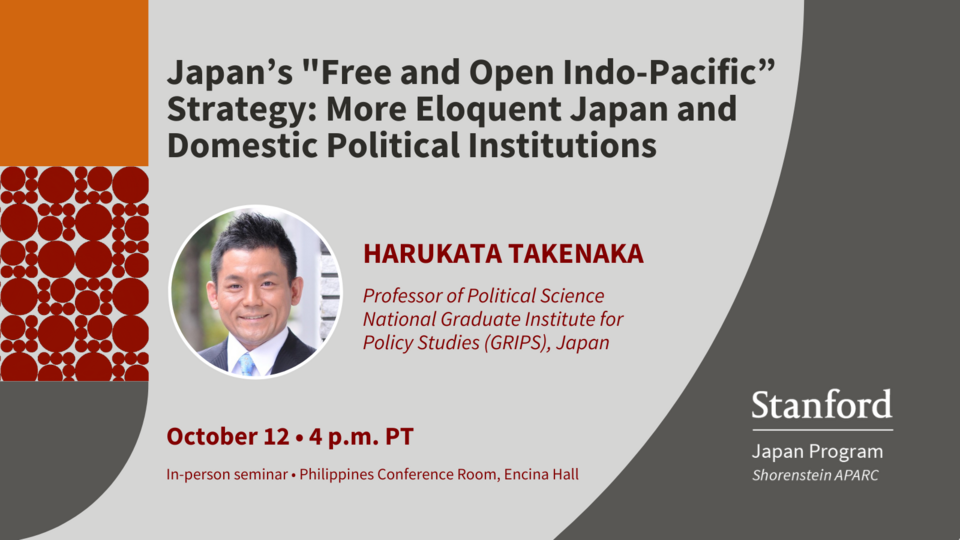
Since Prime Minister Shinzo Abe has advocated “Free and Open Indo-Pacific (FOIP)” Vision in 2016, various scholars have analyzed policy formulation process of FOIP. Most of them refer to the rise of China as an influential power in the Indo-Pacific region with its own initiative, namely, the Belt and Road Initiative as a major factor which prompted the Second Abe Administration to launch FOIP.
It is the contention of this presentation that the current configuration of the Japanese political institutions has made it possible for the Second Abe administration to launch and pursue such a comprehensive strategy while an international factor is important. It demonstrates that a series of political reforms since 1990s have strengthened the power of the prime minister as an institution to initiate key cabinet policies and coordinate policy formulation among different ministries. The strong institutional foundation of the Japanese prime ministerial power has made it possible for the Abe administration to effectively pursue such a broad vision, engaging various ministries and organizations.
The existing research on Japan's diplomacy often evaluates Japan as a passive state. It considers that in the past Japan only responded to foreign pressure while it did not proactively push forward its own policies. The presentation suggests that Japan has changed and become more eloquent as a result of changes in domestic political institutions.
Speaker
Image
Harukata Takenaka is a professor at the National Graduate Institute for Policy Studies (GRIPS) in Tokyo. He holds a PhD from Stanford University and a Bachelor of Laws from the University of Tokyo.
His key research areas are the role the prime minister in Japanese politics, changes in Japanese external policy, and democratization in Pre-war Japan.
Prof. Takenaka’s recent publications include: “Kyokoku Chugoku” to Taijisuru Indo-Taiheiyo Shokoku [Indo-Pacific Nations facing China aspiring to be a “Great Country”](edited) (Tokyo: Chikura Shobo, 2022), “Evolution of Japanese security policy and the House of Councilors,” Japanese Journal of Political Science, 22:2, (June 2021), 96-115, Korona Kiki no Seiji [Politics of Covid 19 Crisis](Tokyo: Chuo Koron Shinsha, 2020), “Expansion of the Japanese prime minister’s power in the Japanese parliamentary system: Transformation of Japanese politics and the institutional reforms,”Asian Survey,59:5:844-869 (September 2019); Futatsu no Seiken Kotai [Two Changes of Government] (edited) (Tokyo: Keiso Shobo, 2017); Failed Democratization in Prewar Japan (Stanford University Press 2014),
How is India posturing to manage strategic competition in the Indian Ocean? Thus far US-China security competition has been most acute in the western Pacific, but Chinese capability growth and strategic policies suggest that it also seeks a leading role in the northern Indian Ocean, in the not-too-distant future. India has traditionally considered itself the natural dominant power in the Indian Ocean region, but it has never faced the scale and types of competition that China will present. Does India have the wherewithal to maintain its leadership in the region? How will India work with the United States, bilaterally and through groupings such as the Quad, as they seek to maintain the status quo in the face of Chinese challenges? Is the Indian Ocean bound for militarized competition, or can India, the US, and China find a pathway to strategic coexistence?
Panelist
Image
Dr. Sinderpal Singh is Senior Fellow and Assistant Director, Institute of Defence and Strategic Studies, and concurrently Coordinator of the South Asia Programme at the S. Rajaratnam School of International Studies, Nanyang Technological University, Singapore. In the fall of 2022, he has been appointed as the McCain Fulbright Scholar in Residence at the United States Naval Academy. His research interests include the international relations of South Asia with a special focus on Indian foreign policy, the geopolitics of the Indian Ocean Region, and India-Southeast Asia relations. He is currently writing a book on India’s role in the Indian Ocean since 1992 and is the author of India in South Asia: Domestic Identity Politics and Foreign Policy from Nehru to the BJP (Routledge 2013). He received his Ph.D. from the University of Wales, Aberystwyth, his MA from the Australian National University, and his BA from the National University of Singapore.
Moderator
Image
Dr. Arzan Tarapore is the South Asia research scholar at the Shorenstein Asia-Pacific Research Center at Stanford University, where he leads the newly-restarted South Asia Initiative. His research focuses on military strategy, Indian defense policy, and contemporary Indo-Pacific security issues. Prior to his scholarly career, he served as an analyst in the Australian Defence Department. Arzan holds a Ph.D. in war studies from King’s College London.
Sinderpal Singh
Institute of Defense and Strategic Studies, and South Asia Programme
Senior Fellow, Assistant Director
S. Rajaratnam School of International Studies, Nanyang Technological University
Visiting Student Researcher, The Europe Center, 2022
photo_fanny_schardey.png
Fanny Schardey, M.A., is a PhD student in international relations and foreign policy at Heidelberg University, Germany. In 2021, she was a visiting doctoral student at the European University Institute in Florence, Italy. Previously, she studied Political Science at Sciences Po Paris, Heidelberg, Würzburg and Geneva University.
Fanny’s doctoral thesis contributes to the research strand on comparative liberal alliance politics using East Central Europe as a case study. The first part of her thesis deals with the development of dominant societal preference configurations. The unintended consequences of Europeanization processes on societal values take a central position in her explanatory approach.
The second part of her thesis focuses on the functionality of representation mechanisms. The question of representation concerns less the political regimes per se but rather dynamic processes of preference transmission in these countries.
Fanny explores these assumptions on dominant preference configurations, their representation as well as their impact on alliance behavior in East Central Europe by using quantitative and qualitative methods of causal inference.
Following the launch of his new book, America's Great-Power Opportunity: Revitalizing U.S. Foreign Policy to Meet the Challenges of Strategic Competition, Wyne joins the China Program’s Author Series to discuss how the United States must avoid complacency and consternation in appraising China and Russia. Rather than attempting the unfeasible—countering their current and future initiatives and forestalling subsequent provocations—Wyne argues that Washington should formulate a more practical, creative, and sustainable foreign policy that can advance U.S. national interests regardless of what steps Beijing and Moscow take, and that recent competitive missteps give the U.S. space to undertake this task.
For more information about America's Great-Power Opportunity or to purchase a copy, please click here.
Speaker
Image
Ali Wyne is a Senior Analyst at the Eurasia Group’s Global Macro Geopolitics practice and Author of the brand-new book America’s Great Power Opportunity: Revitalizing U.S. Foreign Policy to Meet the Challenges of Strategic Competition.
Laura M. Stone joined the Walter H. Shorenstein Asia-Pacific Research Center (Shorenstein APARC) as Visiting Scholar and China Policy Fellow for the 2022-2023 and 2023-2024 academic years. She currently serves the U.S. Department of State, recently as Deputy Coordinator for the Secretary's Office for COVID Response and Health Security. While at APARC, she conducted research with the China Program and Professor Jean Oi regarding contemporary China affairs and U.S.-China policy.
Professor Jia Qingguo joined the Freeman Spogli Institute for International Studies (FSI) and the Walter H. Shorenstein Asia-Pacific Research Center (Shorenstein APARC) as Visiting Scholar and Payne Distinguished Fellow for the 2022 fall quarter. He currently serves as Professor at the School of International Studies at Peking University. While at APARC, he conducted research on the state and future development of U.S.-China policy.