The Europe Center Newsletter November 2017
News Type
News
Date
Hero Image

All News button
1

FSI scholars produce research aimed at creating a safer world and examing the consequences of security policies on institutions and society. They look at longstanding issues including nuclear nonproliferation and the conflicts between countries like North and South Korea. But their research also examines new and emerging areas that transcend traditional borders – the drug war in Mexico and expanding terrorism networks. FSI researchers look at the changing methods of warfare with a focus on biosecurity and nuclear risk. They tackle cybersecurity with an eye toward privacy concerns and explore the implications of new actors like hackers.
Along with the changing face of conflict, terrorism and crime, FSI researchers study food security. They tackle the global problems of hunger, poverty and environmental degradation by generating knowledge and policy-relevant solutions.
Abstract: In 1945, our homeland was inviolate. Since then, we have invested trillions of dollars to improve our national security, yet we now can be destroyed in under an hour. In mathematics, such an absurd result from otherwise logical reasoning proves that at least one assumption must be in error. This talk therefore examines a number of assumptions that form the foundation of our thinking about national security, starting with the very concept itself: In the nuclear age, is national security separable from global security?
Speaker bio: Martin Hellman is best known for his invention, joint with Whitfield Diffie and Ralph Merkle, of public key cryptography, the technology that enables secure Internet transactions. He has been a key player in the computer privacy debate, won three “outstanding professor” awards from minority student organizations, and pioneered a risk-informed framework for nuclear deterrence. His current work “Rethinking National Security” critically examines the assumptions that form the foundation of our national security. Hellman’s many honors include election to the National Academy of Engineering and receiving (jointly with Diffie) the million dollar ACM Turing Award, the top prize in computer science.
Not in residence
Please note that this event is canceled. We regret the inconvenience.
Abstract: Clean energy provides a number of benefits at scales from household to village to city and region. An unrealized and under-appreciated opportunity is to transition conflict regions from external fuel supply chains to local, clean and unpolluting energy. The benefits of this transition include local energy security to shared benefits from sustaining local generation capacity, which we term 'peace through grids'.
Speaker bio: Daniel M. Kammen is a Professor of Energy at the University of California, Berkeley, with parallel appointments in the Energy and Resources Group where he serves as Chair, the Goldman School of Public Policy where he directs the Center for Environmental Policy, and the department of Nuclear Engineering. Kammen is the founding director of the Renewable and Appropriate Energy Laboratory (RAEL; http://rael.berkeley.edu), and was Director of the Transportation Sustainability Research Center from 2007 - 2015.
He was appointed by then Secretary of State Hilary Clinton in April 2010 as the first energy fellow of the Environment and Climate Partnership for the Americas (ECPA) initiative. He began service as the Science Envoy for U. S. Secretary of State John Kerry in 2016, but resigned over President Trump’s policies in August 2017. He has served the State of California and US federal government in expert and advisory capacities, including time at the US Environmental Protection Agency, US Department of Energy, the Agency for International Development (USAID) and the Office of Science and Technology Policy
Dr. Kammen was educated in physics at Cornell (BA 1984) and Harvard (MA 1986; PhD 1988), and held postdoctoral positions at the California Institute of Technology and Harvard. He was an Assistant Professor and Chair of the Science, Technology and Environmental Policy Program at the Woodrow Wilson School at Princeton University before moving to the University of California, Berkeley. Dr. Kammen has served as a contributing or coordinating lead author on various reports of the Intergovernmental Panel on Climate Change since 1999. The IPCC shared the 2007 Nobel Peace Prize.
Kammen helped found over 10 companies, including Enphase that went public in 2012, Renewable Funding (Renew Financial) a Property Assessed Clean Energy (PACE) implementing company that went public in 2014. Kammen played a central role in developing the successful bid for the $500 million energy biosciences institute funded by BP.
During 2010-2011 Kammen served as the World Bank Group’s first Chief Technical Specialist for Renewable Energy and Energy Efficiency. While there, Kammen worked on the Kenya-Ethiopia “green corridor” transmission project, Morocco’s green transformation, the 10-year energy strategy for the World Bank, and on investing in household energy and gender equity. He was appointed to this newly created position in October 2010, in which he provided strategic leadership on policy, technical, and operational fronts. The aim is to enhance the operational impact of the Bank’s renewable energy and energy efficiency activities while expanding the institution’s role as an enabler of global dialogue on moving energy development to a cleaner and more sustainable pathway. Kammen’s work at the World Bank included funding electrified personal and municipal vehicles in China, and the $1.24 billion transmission project linking renewable energy assets in Kenya and Ethiopia.
He has authored or co-authored 12 books, written more than 300 peer-reviewed journal publications, and has testified more than 40 times to U.S. state and federal congressional briefings, and has provided various governments with more than 50 technical reports. For details see http://rael.berkeley.edu/publications. Dr. Kammen also served for many years on the Technical Review Board of the Global Environment Facility. He is the Specialty Chief Editor for Understanding Earth and Its Resources for Frontiers for Young Minds.
Kammen is a frequent contributor to or commentator in international news media, including Newsweek, Time, The New York Times, The Guardian, and The Financial Times. Kammen has appeared on ‘60 Minutes’ (twice), NOVA, Frontline, and hosted the six-part Discovery Channel series Ecopolis. Dr. Kammen is a Permanent Fellow of the African Academy of Sciences, a fellow of the American Academy for the Advancement of Science, and the American Physical Society. In the US, he has served on several National Academy of Sciences boards and panels.
The Lee Shau Kee World Leaders Forum on “US and the Asia Pacific” was held on November 13th, 2017. This event that brought 250 participants to the Center also marked the 5th anniversary of the Stanford Center at Peking University’s (SCPKU) anniversary and 10th anniversary of the Stanford China Program. Stanford Political Science Professor and SCPKU Director Jean Oi welcomed the audience with remarks highlighting Stanford’s initiative to build China studies at the home campus with the creation of the China Program and in China with the construction of SCPKU -- Stanford’s “Bridge Across the Pacific.” Professor Michael McFaul, Director of the Freeman Spogli Institute for International Studies at Stanford University, opened the forum with a stimulating keynote address on “The Historical Origins and Contemporary Consequences of President Trump’s Worldview.” In his talk, Prof. McFaul examined the President’s views and characterized them as fitting within but standing on the extreme end of long-standing foreign policy traditions. Combining his scholarly expertise with his experience in the Obama administration, Prof. McFaul offered the audience a sharp, wide-ranging but balanced overview of the continuities between Obama’s and Trump’s policies and the stark difference in rhetoric between these two Presidents. He used dynamic representations of isolationists versus internationalists, and realists versus liberals to explain that foreign policy differences exist within political parties rather than between them. Prof. McFaul took the audience around the globe, with timely accounts of the continuities, the positive changes and the adverse changes in US foreign policy under President Trump in, for example, the Middle East, Europe and Asia. Overall, he argued that democratic institutions in the US are open to evolution and renewal; that the structures of American leadership are still robust; and pointed to different historical periods (as during the inter-war period in the 1930’s; the rise of communism in the 1950’s; the rise of the Soviet Union in the 1970’s and Japan’s rapid ascendance in the 1980’s) when pundits declared America’s demise only to be proven wrong. Prof. McFaul asserted that current “predictions of permanent American decline is premature.” Prof. McFaul, however, did point to North Korea as a major point of worry, which segued into the panel discussion that followed.
[[{"fid":"229210","view_mode":"crop_870xauto","fields":{"format":"crop_870xauto","field_file_image_description[und][0][value]":"Professor Michael McFaul, Director of Stanford's Freeman Spogli Institute for International Studies, keynotes SCPKU's Lee Shau Kee World Leaders Forum.","field_file_image_alt_text[und][0][value]":false,"field_file_image_title_text[und][0][value]":false,"field_credit[und][0][value]":"Stanford University","field_caption[und][0][value]":"Professor Michael McFaul, Director of Stanford's Freeman Spogli Institute for International Studies, keynotes SCPKU's Lee Shau Kee World Leaders Forum.","thumbnails":"crop_870xauto","alt":"","title":""},"type":"media","field_deltas":{"4":{"format":"crop_870xauto","field_file_image_description[und][0][value]":"Professor Michael McFaul, Director of Stanford's Freeman Spogli Institute for International Studies, keynotes SCPKU's Lee Shau Kee World Leaders Forum.","field_file_image_alt_text[und][0][value]":false,"field_file_image_title_text[und][0][value]":false,"field_credit[und][0][value]":"Stanford University","field_caption[und][0][value]":"Professor Michael McFaul, Director of Stanford's Freeman Spogli Institute for International Studies, keynotes SCPKU's Lee Shau Kee World Leaders Forum.","thumbnails":"crop_870xauto","alt":"","title":""}},"link_text":null,"attributes":{"style":"height: 400px; width: 600px;","class":"media-element file-crop-870xauto","data-delta":"4"}}]]
Professor Michael McFaul, Director of Stanford's Freeman Spogli Institute for International Studies,
keynotes SCPKU's Lee Shau Kee World Leaders Forum.
Courtesy of Stanford University.
What will happen with North Korea was a focus of the lively high-level panel discussion chaired by Professor Jean C. Oi on “The US, China and Asia Pacific” with Karl Eikenberry, Former US Ambassador to Afghanistan, Director of US-Asia Security Initiative at Stanford; Kathleen Stephens, Former US Ambassador to the Republic of Korea and William J. Perry Fellow at Shorenstein APARC of Stanford; Thomas Fingar, Former chairman, National Intelligence Council; Former Assistant Secretary of State for Intelligence and Research; Shorenstein APARC Fellow; Yu Tiejun, Associate Professor and Vice President of the Institute of International and Strategic Studies at Peking University; and Zhu Feng, Executive Director, China Center for Collaborative Studies of the South China Sea and Director, Institute of International Studies at Nanjing University.
[[{"fid":"229211","view_mode":"crop_870xauto","fields":{"format":"crop_870xauto","field_file_image_description[und][0][value]":"SCPKU World Leaders Forum panelists discuss future of US-Asia Pacific relations.","field_file_image_alt_text[und][0][value]":false,"field_file_image_title_text[und][0][value]":false,"field_credit[und][0][value]":"Stanford University","field_caption[und][0][value]":"SCPKU World Leaders Forum panelists discuss future of US-Asia Pacific relations.","thumbnails":"crop_870xauto","alt":"","title":""},"type":"media","field_deltas":{"8":{"format":"crop_870xauto","field_file_image_description[und][0][value]":"SCPKU World Leaders Forum panelists discuss future of US-Asia Pacific relations.","field_file_image_alt_text[und][0][value]":false,"field_file_image_title_text[und][0][value]":false,"field_credit[und][0][value]":"Stanford University","field_caption[und][0][value]":"SCPKU World Leaders Forum panelists discuss future of US-Asia Pacific relations.","thumbnails":"crop_870xauto","alt":"","title":""}},"link_text":null,"attributes":{"style":"height: 400px; width: 600px;","class":"media-element file-crop-870xauto","data-delta":"8"}}]]
SCPKU World Leaders Forum panelists discuss future of US-Asia Pacific relations.
Courtesy of Stanford University
Prof. Fingar started the discussion on US-China relations, flatly rejecting the realist theory of conflict between rising and declining powers and the notion that “two tigers cannot get along.” He pointed out that interdependencies between the US and China have grown and that the US and China have more in common than ever before. Yet, with growing interdependence, chances for friction have also increased; thus, “having more issues,” he stated, “does not necessarily mean that the relationship is more fragile – perhaps the opposite [is true].” He also stated that China faces enormous challenges domestically and internationally, and that the US will be reacting to China rather than the other way around.
Amb. Stephens, Prof. Yu and Prof. Zhu all turned the discussion more squarely towards the intensifying North Korea missile crisis. The panelists all characterized this as a critical moment not only on the Korean peninsula but in all of Northeast Asia. Amb. Stephens stressed how important this is in the working relationship of the US and China as they strive to manage future crises and issues. While everyone found agreement on one common point – i.e., the implausible prospects of a “complete, verifiable, irreversible denuclearization” of North Korea -- each gave unique perspectives on what might happen on the Korean peninsula as the situation unfolds. Prof. Yu outlined three possible scenarios of (i) accepting North Korea as a nuclear power de facto; (ii) imposing increasingly draconian sanctions; and (iii) turning towards the military option against North Kore. But he did not express much optimism that any of these options would, in the end, provide good outcomes. Amb. Stephens, on the other hand, emphasized the strength and resilience of the US-ROK relationship stating “I wouldn’t underestimate [the US’] commitment to the ROK.” She also foresaw a future in which the US will conduct more military exercises, and install more anti-missile defense systems across Northeast Asia as a result of the North Korean threat – a prospect which, she surmised, the PRC would not welcome.
Prof. Zhu, on the other hand, offered a more optimistic perspective on the North Korean nuclear standoff by pointing to the increasing cooperation between the US and China. Asking the listeners to “please take the report that China is actively opposing North Korea seriously” he held out the hope that North Korea might return to the negotiating table once it saw that China was supporting the United States.
Amb. Eikenberry, as the final panelist to share his remarks, took the discussion to the broader Asia Pacific level and drew distinctions on “Asia Pacific” and “Indo Pacific,” as the latter description better reflects maritime flows, the geographical layout as well trade flows more accurately. He invited panelists to depict what would happen in different possible scenarios and outcomes relating to military crisis in the region. The panelists shared their views on action options involving sanctions and multilateral agreements, and agreed that countries should focus on achieving shared goals.

Abstract: Despite decades of research on organizational disasters, such events remain too common. Scholars across a wide range of disciplines agree that one of the most viable approaches to preventing such catastrophes is to observe near-misses and use them to identify and eliminate problems before they produce large failures. Unfortunately, these important warning signals are too often ignored because they are perceived and interpreted as successes rather than near-misses, near-failures, or simply failures. Through a series of studies, we explore how organizational messages might nudge more recognition of a near-miss event as something other than a success. The intent is not to make organizations more risk-averse, per se, but to make leaders with decision power more aware of the risks they assume and how the low probabilistic nature of high risk decisions facilitates our tendency to become more risk-tolerant over time.
Speaker Bio: Catherine Tinsley, Ph.D., is the Raffini Family Professor of Management at Georgetown University’s McDonough School of Business, Faculty Director of the Georgetown University Women’s Leadership Institute, Academic Director of Georgetown McDonough’s Executive Master’s in Leadership program, and a Senior Policy Scholar at the Georgetown Center for Business and Public Policy. Tinsley is an expert on principled leadership, workforce development, negotiations, and decision making. She looks at how and why people make decisions, especially when managing risk, and empowering employees. She applies decision analytic frameworks to understand leadership challenges, and expert and novice responses to natural disasters (such as hurricanes) and man-made disasters (terrorist attacks).
For the past three years, she participated in The World Economic Forum’s annual meeting in Davos, Switzerland where she spoke about the interplay between confidence and economic empowerment. Tinsley has collaborated with the White House and U.S. State Department on developing programs related to gender and workforce development, including partnering with the Council of Women World Leaders to convene the first ever world-wide meeting of the Ministers of Women’s Affairs.
Tinsley has served on three committees for the National Academy of Sciences— The Committee to Improve Intelligence Analysis for National Security, The Committee on Unifying Social and Cultural Frameworks in the Military, and the Committee on The Context of Military Environments (where she served as vice-Chair). She has received several awards for her research as well as grants from NASA, the National Science Foundation, the Department of Homeland Security, the Department of Defense and Army Research Office.
Tinsley has published more than 50 articles and book chapters in peer-reviewed journals and her research has been covered extensively in the popular media.
The same logic that kept a nuclear war from breaking out between the United States and former Soviet Union is the best strategy to now pursue with North Korea, several scholars said Tuesday at Stanford.
The panel, convened at Stanford’s Center for International Security and Cooperation (CISAC), included political scientist Scott D. Sagan of CISAC; political scientist Mira Rapp-Hooper of Yale University; and political scientist Vipin Narang of MIT. The moderator was James D. Fearon, a political scientist at the Freeman Spogli Institute for International Studies. The event was titled “Can the U.S. Deter a Nuclear North Korea” and held in the William J. Perry Conference Room in Encina Hall.
Nuclear decision-making
The discussion revolved around whether North Korea will have the ability to strike the U.S. with nuclear warheads, and can the U.S. depend on a deterrence strategy like it did during the Cold War?
Deterrence theory holds that nuclear weapons are intended to deter other states from attacking with their nuclear weapons, through the promise of retaliation and possibly mutually assured destruction
Sagan, who recently wrote an essay in Foreign Affairs magazine on the North Korea nuclear crisis, said he has come to decide deterrence is the best approach to the issue.
“I am not one who gladly listens to the siren song of nuclear deterrence,” he said, noting that while he is a self-described dove on disarmament issues, he is more hawkish on allowing countries to obtain nuclear weapons, which deterrence implies. “I accept deterrence reluctantly.”
In North Korea, he said, no military alternatives exist to solve the problem. For example, even if a decapitation strike were successful – and several U.S. attempts have failed in the past with regard to Saddam Hussein and Muammar Gaddafi – there’s no way to know if North Korean leader Kim Jong-un has already given his generals the green light to unleash nuclear or powerful conventional attacks in the case of his demise.
For Sagan, deterrence is a more complicated issue today than during the Cold War when the U.S. and U.S.S.R. were rational actors with thousands of nuclear weapons. He is especially concerned with the rhetoric and the preventive war suggestions emanating from the Trump Administration.
Senior U.S. military leaders, Sagan said, have a duty not to follow “impaired-decision making” that might come from the president. He invoked the prospect of using the Cabinet and the 25th Amendment to halt such an order and remove the president from office. Currently, he belives the nuclear decision process is problematic, as the president alone can directly order the Strategic Air Command to launch nuclear weapons.
Sagan advises that a revised nuclear chain of command should include both the U.S. Secretary of Defense and the U.S. Attorney General. A U.S. Senate hearing, led by Sen. Bob Corker, is actually studying the nuclear authorization process due to concerns with Trump's rhetoric and escalation of the North Korean issue.
“We need more checks on how we decide to use nuclear weapons,” said Sagan, who studies nuclear strategy, ethics and war, public opinion about the use of force, and nuclear non-proliferation and arms control.
He noted that U.S. National Security Advisor H.R McMaster recently criticized his predecessor, Susan Rice, for saying the U.S. could "tolerate" nuclear weapons in North Korea the same way we tolerated nuclear weapons in the Soviet Union.
He quoted McMaster: “'A regime that poses a continuous threat to the its neighbors in the region and now may pose a threat, direct threat, to the United States with weapons of mass destruction? A regime that imprisons and murders anyone who seems to oppose that regime, including members of his own family, using sarin nerve gas in a public airport?'”
But Sagan said we have long tolerated such authoritarian regimes that have nuclear weapons.
Stumbling accidentally into war with North Korea also seems like a rising risk. On Sept. 27, several U.S. service members and their families received a fraudulent “noncombatant evacuation operation” order via text and social media, he said. The fake notices were quickly reported up the chain of command and the U.S. issued a statement denouncing their validity – the perpetrators have not been found. But Sagan says it illustrates how easy it is to create a situation where North Korea felt a U.S. invasion and attack is imminent – and as a result, could choose to unleash a nuclear first strike.
‘Western fantasy’
Narang, who was once a CISAC visiting assistant professor, studies nuclear proliferation and strategy, South Asian security, and general security studies.
“Deterrence is your friend,” he said in explaining why it can work with North Korea. If the U.S. believes North Korea seeks to preserve its regime – a status quo intention – then deterrence theory works much like it did with the former Soviet Union.
On the other hand, if the U.S. believes North Korea has darker motives, such as reunifying the Korean peninsula through an invasion, then that perspective could lead to a U.S. first strike. Also, the existing U.S. demand of rolling back North Korea’s nuclear program – “denuclearization” – is a “Western fantasy.” They will not give up nuclear weapons, he said.
He said the U.S. does not like to be deterred from making a first strike – as in preventive war – but that is what it must accept if it decides to follow the deterrence course. North Korea, once it possesses an ICBM capable of hitting the U.S. mainland, would pose such a deterrence in the balance of power between the two countries.
“The good news is that deterrence can work, coupled with coercive diplomacy,” Narang said. “We know how to play this game.”
He believes Jong-un is a rational actor, though a cruel dictator. “There’s nothing to suggest he’s crazy.” Ultimately, he said, an effective deterrence policy depends on clarity, consistency, coherence and communications.
U.S. nuclear shield, alliances
An expert on security in the Asia-Pacific region and alliance politics, Rapp-Hooper talked about the U.S. relationships, especially with Japan and South Korea, and the “nuclear shield” over these countries that those agreements offer. As a result, neither country has developed nuclear weapons.
This dynamic, however, could change if a North Korean missile could reach the U.S., said Rapp-Hooper, who earned a bachelor’s degree in history at Stanford.
“North Korea is eroding U.S. security guarantees over time,” she said, adding that once those missiles are capable of hitting a U.S. city, would the U.S. government still protect Seoul from attack and let an American city be hit?
The Korean situation, Rapp-Hooper said, is much different than Europe in the Cold War, when such an American nuclear shield existed against a Soviet invasion. Many different U.S. agreements exist now than during that time; no U.S. nuclear weapons are forwardly deployed in northeast Asia, like in Europe then; and the unilateral threats coming from the Trump Administration are unprecedented in nuclear diplomacy.
On the latter point, she called it the “Trump multiplier” effect. “That’s the most exacerbating thing of all,” she said, noting that elements of the White staff are pushing a “better-use-it-now” or preventive attack approach, whereas Secretary of Defense James Mattis and Secretary of State Rex Tillerson see North Korea as more concerned with preserving its regime.
Sagan also pointed out how President Trump’s speech at the United Nations in September led to a realization among the North Koreans that they had no choice but to continue to develop nuclear weapons.
That’s when the president said, “’Rocket Man is on a suicide mission for himself and for his regime,’” Sagan noted.
He then recalled Kim Jong Un’s response to Trump’s speech, quoting the North Korean leader: “’His remarks which described the U.S. option through straightforward expression of his will have convinced me, rather than frightening or stopping me, that the path I chose is correct and that it is the one I have to follow to the last.’”

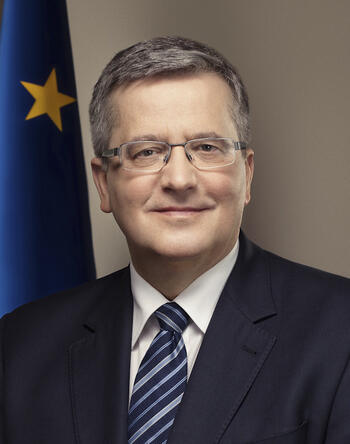
Bronisław Komorowski, a former anti-communist opposition activist, member of Parliament, Minister of National Defence, and Marshal of the Sejm of the Republic of Poland, was President of Poland from 2010-2015.
Koret-Taube Conference Center
Gunn-SIEPR Building
366 Galvez Street
This event has reached capacity. Please email sj1874@stanford.edu to be placed on the waitlist.
NOTE: Due to the overwhelming response for this event, we have moved it to the GSB Common, a larger venue, located at the Schwab Residential Center.
Relations between the two countries are at the lowest level since the Cold War. Their improvement will take time and great efforts. But, as major world powers, Russia and the United States are
"doomed" to dialogue in order to try to solve some of the biggest global challenges.

Anatoly Antonov was appointed Ambassador of the Russian Federation to the United States and Permanent Observer of the Russian Federation at the Organization of American States in August 2017. Prior to that, he served as Deputy Foreign Minister of the Russian Federation, Deputy Minister of Defense, Director of the Department of Security, and Disarmament and Ambassador-at- Large of the Russian Foreign Ministry. Antonov holds a PhD in Political Science and is fluent in Russian, English and Burmese.
In this eighteenth session of the Strategic Forum, former senior American and South Korean government officials and other leading experts will discuss current developments in the Korean Peninsula and North Korea policy, the future of the U.S.-South Korean alliance, and a strategic vision for Northeast Asia. The session is hosted by the Korea Program in association with The Sejong Institute, a top South Korean think tank.
 Colleagues, policymakers, and other friends of John W. Lewis

