Security

FSI scholars produce research aimed at creating a safer world and examing the consequences of security policies on institutions and society. They look at longstanding issues including nuclear nonproliferation and the conflicts between countries like North and South Korea. But their research also examines new and emerging areas that transcend traditional borders – the drug war in Mexico and expanding terrorism networks. FSI researchers look at the changing methods of warfare with a focus on biosecurity and nuclear risk. They tackle cybersecurity with an eye toward privacy concerns and explore the implications of new actors like hackers.

Along with the changing face of conflict, terrorism and crime, FSI researchers study food security. They tackle the global problems of hunger, poverty and environmental degradation by generating knowledge and policy-relevant solutions. 

Authors
News Type
Q&As
Date
Paragraphs

Following the abrupt ending of the highly anticipated second bilateral summit between President Donald Trump and North Korean leader Kim Jong-un in Hanoi, APARC and CISAC scholars evaluate the result of the summit, its implications for regional relations in Northeast Asia, and the opportunities moving forward towards the goal of denuclearization of the Korean peninsula.

This Q&A with Noa Ronkin features Andray Abrahamian, the 2018-19 Koret Fellow in Korean Studies at APARC, whose work with the nonprofit Choson Exchange has taken him to the DPRK nearly 30 times; Siegfried S. Hecker, top nuclear security expert, former Director of the Los Alamos National Laboratory, Research Professor of Management Science and Engineering, Emeritus, and Senior Fellow at CISAC/FSI, Emeritus; and Gi-Wook Shin, Professor of Sociology, William J. Perry Professor of Contemporary Korea, Director of APARC, and founding Director of the Korea Program.

Q: What is your assessment of the summit outcome? Considering Trump's decision to end the summit early, do you support that “no deal is better than a bad deal?” Do you think the summit would have been better off with even a small deal just significant enough to keep the momentum going? 
 
Abrahamian: It's a disappointment, but we don't know yet if it is a catastrophe. I think that, ideally, once it was clear that both sides were escalating towards a grand bargain no one was ready for, the U.S. and DPRK teams could have taken a break and reconvened to attempt something less ambitious. For both sides it is better domestically to go back and be able to look tough rather than concede too much, but I do wonder why there was no intermediary position available between no deal and something too big.
 
Hecker: I am disappointed, but still optimistic. Disappointed because the opportunity to take concrete steps toward denuclearization and normalization was missed. Optimistic, because Trump and Kim did not return to the ‘fire and fury’ days of 2017. They left Hanoi on good terms. I don’t believe it was a question of bad deal or no deal. Rather, it appears the two sides were actually quite close to taking important steps, but couldn’t quite get there this time. It is not clear whether time just ran out or if President Trump’s challenge to Kim Jong-un to “go bigger” moved the goal posts at the last minute. 
 
Shin: Trump made the right move. No deal is better than a small or pointless deal that could hamper future negotiations. His decision sent a warning signal to North Korea that he wouldn’t let the country continue to set the tone and pace for the negotiations. Also, he gained more domestic political slack than the alternative would have gained him. The misfortune in Hanoi may impart a new, different kind of momentum to what is destined to be a fluctuating, arduous diplomatic process.
 
Q: So what's next? What do you expect from the US and DPRK given this new dynamic? What do you think needs to be done at the working level and at the leadership level? And what do you think will be the biggest hurdle in future negotiations? 
 
Abrahamian: Both sides carefully left future talks open through their statements after the summit. If one is searching for a positive outcome, it's that the leaders perhaps now realize that much, much more will have to be agreed upon before they meet again. This should help empower working-level talks. But time is short: a U.S. election looms next year and Donald Trump faces political challenges at home. This was a missed opportunity to consolidate a relationship-building process.
 
Hecker: The American and North Korean statements following the summit paint different pictures of the final bargaining positions, but both were positive and committed to return to the bargaining table. These differences should be surmountable at the bargaining table, but it will take time and a more concerted effort. So long as North Korea ends nuclear and missile testing, we have time to come to a proper compromise, but it must clearly involve some sanctions relief for the North Korean economy. One of the biggest hurdles on the American side is to overcome internal political divisions.
 
Shin: A return to hostility is unlikely. Both sides have refrained from escalating tension and are still committed to a diplomatic solution. The negotiations will resume. The Hanoi summit served as an opportunity for a much-needed reality check, for both sides, of the lingering divergences. The biggest hurdle continues to be how to define the terms and scope of denuclearization and the U.S. corresponding measures (simultaneous and parallel actions). Now that the discrepancies have become more apparent and starker, the working-level discussions need to agree on basic yet fundamental concepts and principles, while Trump and Kim should continue the process of trust-building; confidence and trust are a must in a top-down setting.
 
Q: Are there some roles that other key players can play, such as South Korea and China? Are there any impacts of this outcome on regional relations in Northeast Asia, such as inter-Korean and China-DPRK relations? 
 
Abrahamian: Perhaps South Korea can play a bridging role again, the way it did before the Singapore summit, when Trump "pre-emptively pulled out." In that case, President Moon's intervention helped get things back on track. It is unclear if he has the political capital with either side to make that happen again, but I suspect he will try. The collapse impacts a Kim Jong-un visit to Seoul, as now it would seem to be pressure on the US, rather than operating in space the US created. China is relatively marginalized, but happy to see no secondary sanctions threats or additional testing of missiles. Japan is perhaps the most pleased of all, given how isolated it has become on North Korea issues.
 
Hecker: The Moon Jae-in administration was hoping for a more positive outcome to allow it to promote economic cooperation with the North, which I consider to be one of the most important elements of achieving a peaceful Korean Peninsula. The Hanoi outcome may require an intensified North-South dialogue to assist the North-U.S. deliberations. I am not sure how all of this will affect China-DPRK relations. I would have preferred an outcome that allows DPRK to move closer to South Korea through some sanctions relief, than to have it depend more on China through continued maximum pressure. 
 
Shin: The outcome is clearly a major setback for South Korea, as it was anticipating progress on core issues that could jumpstart inter-Korean projects. It also became unclear whether Kim would make the planned visit to Seoul anytime soon. At the same time, this might be a perfect time for South Korea to play a meaningful role. So far, the country has been seen as advocating North Korea’s position with regards to an end-of-war declaration and to a lifting or easing of sanctions. This time around, President Moon needs to convince Chairman Kim that North Korea’s bold move toward denuclearization cannot be delayed if he wishes not to lose this rare opportunity with a U.S. president who is eager to make a “big” deal.
 
###
For more U.S.-DPRK diplomacy analysis and commentarty by APARC scholars, see our recent media coverage.
 
Hero Image
South Koreans watch TV screen reporting on the U.S. President Donald Trump press conference at Seoul Railway Station on February 28, 2019 in Seoul, South Korea
South Koreans watch TV screen reporting on the U.S. President Donald Trump press conference at Seoul Railway Station on February 28, 2019 in Seoul, South Korea.
Chung Sung-Jun/Getty Images
All News button
1
News Type
Q&As
Date
Paragraphs

We sat down with our 2018-19 Koret Fellow in Korean Studies Andray Abrahamian to discuss North Korea denuclearization and the approaching Trump-Kim second summit in Hanoi; Abrahamian's work with the nonprofit organization Choson Exchange that took him to North Korea nearly thirty times; his book that compares North Korea and Myanmar; and his fellowship experience. Watch: 


Hero Image
Andray Abrahamian sitting down for an interview at Stanford.
All News button
1
Authors
Gi-Wook Shin
News Type
Commentary
Date
Paragraphs

This post was originally published on Axios.

While President Trump and North Korean leader Kim Jong-un’s June 2018 meeting ended with a broad statement — committing to “establish new U.S.-DPRK relations” for “a lasting and stable peace regime on the Korean Peninsula” — they will aim to take more concrete steps forward at their second summit in Hanoi this week.

Between the lines: To keep up the diplomatic momentum, Trump and Kim will need to minimize existing ambiguities and divergences on key issues — including the definition of denuclearization — and produce a comprehensive road map that lays out the specifics of their proclaimed shared vision. Without these agreements, the Hanoi summit could be easily denigrated as “just another show.”

Where it stands: Trump and Kim each face immense pressure, both international and domestic, to make progress.

  • Trump needs to earn political trust back in Washington to continue negotiating with North Korea. His strategy so far has been to convince Kim that North Korea’s denuclearization would bring the country a “bright future.”
  • At the same time, Trump must address Kim’s concerns about whether any agreement reached with his administration will withstand the Democrat-controlled House and survive the post-Trump era.

Between the lines: Successful diplomacy sometimes entails purposeful ambiguities, and the ambiguities of the first Trump-Kim summit might indeed have been strategic. At this critical juncture, however, a failure on Trump’s and Kim’s part to commit to defined objectives could hurt the bilateral relationship.

The bottom line: Trump and Kim need support more than ever to advance their diplomatic endeavors. While spectators have good reason to be skeptical, and one can only be cautiously hopeful with North Korea, a return to confrontation or "strategic patience" is in no one’s interest.

Gi-Wook Shin is the William J. Perry Professor of Contemporary Korea and director of the Walter H. Shorenstein Asia-Pacific Research Center at Stanford University.

Hero Image
Banner welcoming Kim and Trump to Vietnam
A banner hung opposite the Marriott Hotel in Hanoi, Vietnam, where President Trump is expected to stay during his summit with Kim Jong-un, on Feb. 25.
Carl Court via Getty Images
All News button
1
-

Image
vincent brooks 2x3
About the speaker: Vincent K. Brooks is a career Army officer who recently retired from active duty as the four-star general in command of all U.S. Forces in Korea, where he concurrently commanded United Nations Command – continuously serving since 1950 and initially commanded by General of the Army Douglas MacArthur; and the Republic of Korea-U.S. Combined  Forces Command comprising over 625,000 Koreans and Americans under arms.

General Brooks, who goes by “Vince,” is a 1980 graduate of the United States Military Academy at West Point, the first class to include women, and he led the 4,000 cadets as the cadet brigade commander or “First Captain.”  He is the first African American to have been chosen for this position, and he was also the first cadet to lead the student body when women were in all four classes (freshman or “plebe” to senior or “first classman”).

General Brooks is from a career military family and claims Alexandria, Virginia as home given the long roots in maternal and paternal branches of the family tree. His areas of expertise are national security, policy, strategy, international relations, military operations, combating terrorism and countering the proliferation of weapons of mass destruction, diversity and inclusion, leadership in complex organizations, crisis leadership, and building cohesive trust-based teams. He is a combat veteran and a member of the Council on Foreign Relations.

Image
karl eikenberry 3x2 crop
Ambassador Karl Eikenberry, currently director of U.S.-Asia Security Initiative at Stanford's Shorenstein Asia-Pacific Research Center, will moderate the discussion. He served as the U.S. Ambassador to Afghanistan from 2009 until 2011. Before appointment as Chief of Mission on Kabul, Ambassador Eikenberry had a thirty-five year career in the United States Army, retiring in April 2009 with the rank of Lieutenant General.
 

This keynote event is part of the 11th annual Koret Workshop, "North Korea and the World in Flux," and open to the general public with registration.

The event is made possible through the generous support of the Koret Foundation


Oksenberg Conference Room
Encina Hall, 3rd floor
616 Serra Mall, Stanford University
 

General Vincent Brooks <i>former Commander of U.S. Forces Korea</i>
Moderated by Ambassador Karl Eikenberry
Seminars
News Type
Commentary
Date
Paragraphs

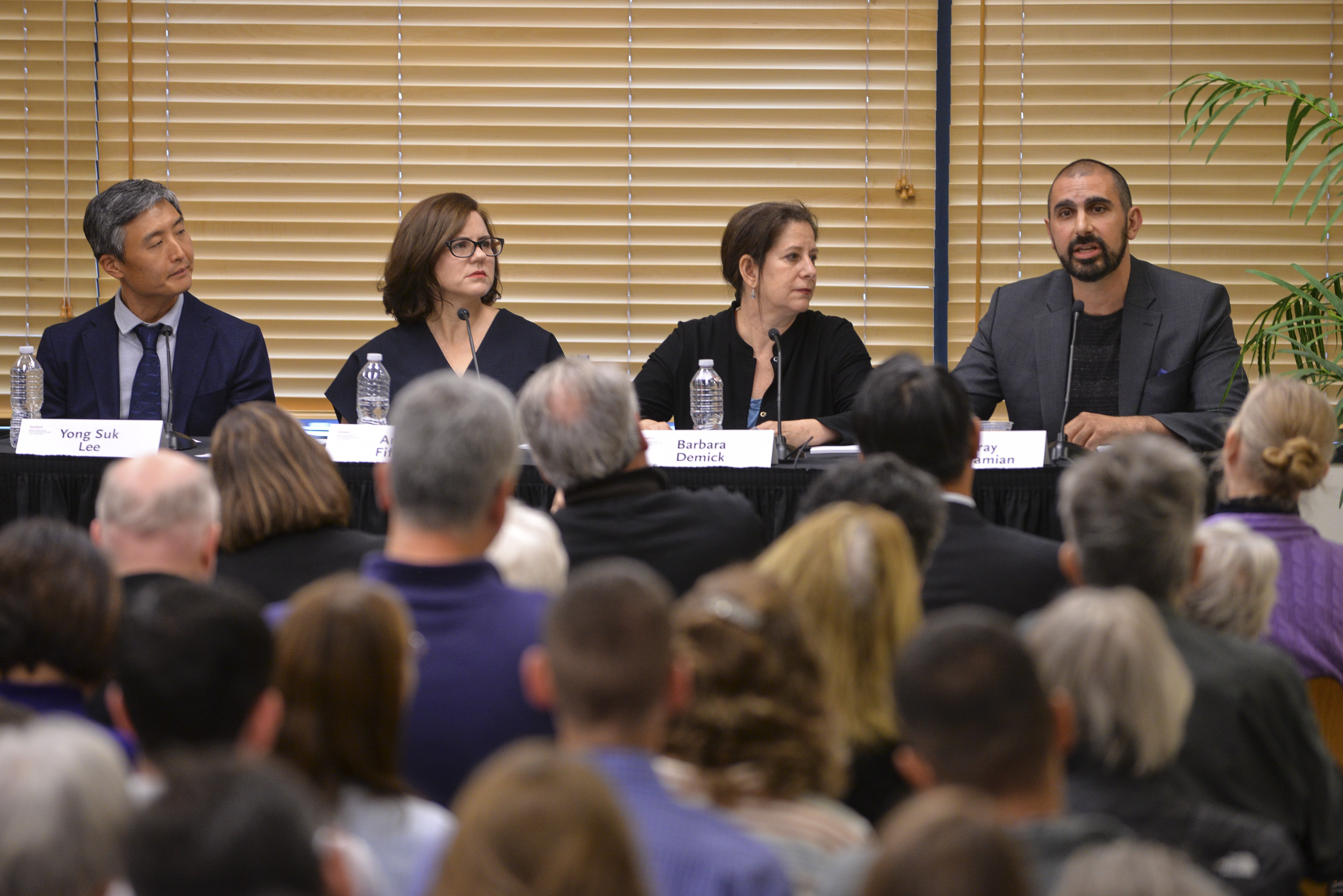
What does it take to make progress on the denuclearization of the Korean Peninsula? Five FSI scholars offer their perspective.

Siegfried S. Hecker, FSI Senior Fellow Emeritus, with Elliot A. Serbin, at the Center for International Security and Cooperation (CISAC)
Looking back at 2018, we judge the first Trump-Kim summit in Singapore to have been a step in the right direction and bought time and space for diplomacy. But since the first summit, little progress has been made toward new relations and a peace regime in part because the Trump administration continues to insist on maximum pressure and sanctions until North Korea denuclearizes, in contrast with Pyongyang’s insistence on a step-by-step process requiring corresponding U.S. actions. At the same time, North Korea has not denuclearized, but it has halted key elements of what was a rapidly expanding nuclear and missile program in 2017. This halt represents an important step in the right direction as explained in our recent update on North Korea’s nuclear history, which examines the trade-offs and interplay between key components of the nuclear program. Our findings show that North Korea has been expanding its bomb fuel inventory, allowing it to potentially increase the size of its arsenal. But the end of nuclear and missile testing has reduced the overall threat posed by the North’s arsenal, significantly limiting the potential sophistication, destructive power and reach of the arsenal by impairing the North’s ambitions for hydrogen bombs and nuclear-tipped intercontinental ballistic missiles, both of which are still very much in the developmental stage. At the upcoming summit Washington should push to further reduce the threat posed by North Korea’s arsenal. A key goal is to lock in the end of nuclear and missile testing and have North Korea agree to end the production of bomb fuel in a verifiable manner. Clearly, this will require Washington to move decisively toward normalization, with some form of sanction relief.

Gi-Wook Shin, FSI Senior Fellow, Director of the Walter H. Shorenstein Asia-Pacific Research Center (APARC) and founding Director of the Korea Program
The leaders of the United States and North Korea should use the Vietnam summit as an opportunity to minimize existing ambiguities and divergences in central questions, before they can make any meaningful progress toward denuclearization and whatever measures for the progress of denuclearization. The most basic yet urgent task is to come to a shared understanding of what denuclearization would entail. The ambiguity and obscurity of the term “denuclearization” only exacerbates the skepticism about both the U.S. and North Korean commitments to denuclearization. The future of the U.S.-Republic of Korea (ROK) alliance is another critical issue that needs to be addressed, not avoided, in Hanoi. The Vietnam meeting should leave no ambiguity in its affirmation that the U.S.-ROK alliance is not to be jeopardized in the context of U.S.-DPRK (Democratic People’s Republic of Korea) rapprochement; nor is it to be used as a reward for North Korea’s denuclearization. Lastly, the Trump administration’s vision for a “more stable and peaceful, and ultimately, a more legal peace regime” in Korea will need to be explained fully to, and understood clearly by, the North Korean leadership. Whether the means used to establish this regime will be a peace treaty, a formal end to the armistice, a combination of both, or something yet unknown is an issue that needs to be discussed and agreed upon up front in order to avoid further confusions and complications. Only bold and meaningful moves that resolve these ambiguities will enable a timely, historic breakthrough on the Korean Peninsula and will add much-needed momentum to the diplomatic endeavors of all countries involved.

Yong Suk Lee, SK Center Fellow and Deputy Director of the Korea Program at Shorenstein APARC
To hypothesize about the outcomes of the second Trump-Kim summit and what lies ahead for U.S.-North Korea relations, we should reflect on how the two leaders met in the first place. One could argue that their first meeting was somewhat accidental, an artifact of Trump’s spontaneity following a period of heightened hostility between the U.S. and North Korea. The first summit between the two leaders was historic in its own right and it put on a good show. However, there hasn’t been much progress on denuclearization since then. Despite little progress the two are meeting again, and this second meeting is no accident. After their first meeting Trump and Kim must have struck a chord. In fact, Trump mentioned that the two had “fallen in love” after receiving a “beautiful” letter from Kim last October. What triggers their mutual attraction? Certainly not their distaste for nuclear weapons. The common interest that brings the two together is their desire for development – economic development in the case of Kim Jong Un and property development in the case of Donald Trump. Of the many unconventional aspects in the Trump-Kim relationship, what I find most extraordinary is Trump’s showing of a short film on North Korea’s potential for property development during their first summit meeting. It was truly an unusual diplomatic pitch. I believe that economic and property development will be on their agenda when they meet in Hanoi. There may even be a sequel to that short film. Trump and Kim may emerge with a joint property development agenda, while deferring denuclearization to be sorted out by their diplomatic teams.

Colin Kahl, FSI Senior Fellow and Co-director at CISAC
Diplomacy is essential for resolving the nuclear crisis on the Korean Peninsula, and President Trump should get credit for keeping the high-level dialogue with Kim Jong Un going. However, last year’s Singapore summit, while producing great theater, produced little of substance. North Korea has frozen its missile and nuclear testing, but its program continues to grow. In the eight months since the two leaders met in Singapore, little tangible progress has been made, and the two sides still appear very far apart on basic concepts like the meaning of “denuclearization” and the proper sequencing among nuclear steps, moves toward normalization, the signing of a peace treaty and sanctions relief. The big worry going into the summit is that it will produce either “too little” or “too much.” One fear is that President Trump will accept “too little” – that is, more diplomatic symbolism to continue the appearance of progress while North Korea takes few concrete steps to roll back its nuclear program. Another risk is that President Trump will give “too much” in exchange for North Korean actions, in particular by taking steps that weaken the alliance with South Korea or drastically downsize the U.S. military presence on the Peninsula (which Trump has never liked).

Thomas Fingar, Shorenstein APARC Fellow
The issues dividing the United States and the DPRK are so complicated and our mutual animosity so deep that resolution will take time and require extensive negotiations to build trust and deepen understanding of one another’s concerns and objectives. The most that should be expected from the Hanoi summit is agreement – and commitment – to continue the process of engagement by instructing and empowering subordinates to meet regularly, listen carefully and seek ways to both build a better relationship and to resolve specific issues in the context of transforming the relationship from one of distrust and animosity to one that identifies mutual interests and manages issues that cannot be resolved immediately.

Related: Andrew Kim on North Korea Denuclearization and U.S.-DPRK Diplomacy
Former head of the CIA’s Korea Mission Center Andrew Kim, currently the William J. Perry Visiting Scholar at APARC, provides insights into the process of diplomatic engagement with the DPRK and outlines a roadmap for achieving the U.S. goal of North Korea denuclearization.

This post is based on the Stanford News article What’s next for North Korea? Stanford scholars discuss the diplomacy of denuclearization, published February 25, 2019.

Hero Image
T-shirts with Trump and Kim for sale in Vietnam Linh Pham/Getty Images
All News button
1
Authors
Beth Duff-Brown
News Type
News
Date
Paragraphs

Opioids overdoses now kill more Americans than car accidents or guns, with more than 350,000 Americans having succumbed to the painkillers since 2000.

“The opioid misuse and overdose crisis touches everyone in the United States,” Health and Human Services Secretary Alex Azar said in this recent report. “The effects of the opioid crisis are cumulative and costly for our society — an estimated $504 billion a year in 2015 — placing burdens on families, workplaces, the health care system, states, and communities.”

Now, new research led by Stanford shows that not only have opioid-related deaths jumped fourfold in the last 20 years, but that those most affected by the epidemic, and where they live, has also shifted dramatically. In fact, the District of Columbia has had the fastest rate of increase in mortality from opioids, more than tripling every year since 2013.

“Although opioid-related mortality has been stereotyped as a rural, low-income phenomenon concentrated among Appalachian or midwestern states, it has spread rapidly, particularly among the eastern states,” writes Mathew V. Kiang, ScD, a research fellow at the Center for Population Health Sciences at the Stanford University School of Medicine, in an original investigation published in JAMA Network Open.

The study found the highest rates of opioid-related deaths and more rapid increases in mortality were observed in eight states: Connecticut, Illinois, Indiana, Massachusetts, Maryland, Maine, New Hampshire and Ohio. Two states, Florida and Pennsylvania, had opioid-related mortality rates that were doubling every two years — and tripling in Washington, D.C.

Kiang and his co-authors, including Stanford Health Policy’s Sanjay Basu, MD, PhD,an assistant professor of medicine at Stanford Medicine, used data from the National Center for Health Statistics and corresponding population estimates from the U.S. Census. The other authors are Jarvis Chen, ScD, at the Harvard T.H. Chan School of Public Health, and Monica Alexander, PhD, in the Department of Sociology at the University of Toronto.

“It seems there has been a vast increase in synthetic opioid deaths in the eastern states and especially in the District of Columbia because illicit drugs are often tainted with fentanyl or other synthetic opioids,” Kiang said in an interview.  “People aren’t aware their drugs are laced and more potent than they expected — putting them at higher risk of overdose.”

Image

Synthetic opioid deaths now outnumber heroin deaths in these eastern states, which suggests fentanyl has spread to other illegal drugs and is no longer limited to heroin.

“The identification and characterization of opioid `hot spots’ — in terms of both high mortality rates and increasing trends in mortality — may allow for better-targeted policies that address the current state of the epidemic and the needs of the population,” the authors write.

The research suggests the opioid epidemic has evolved as three intertwined, but distinct waves, based on the types of opioids associated with mortality:

  1. The first wave of opioid-related deaths was associated with prescription painkillers from the 1990s until about 2010.
  2. From 2010 until the present, the second wave was associated with a large increase in heroin-related deaths.
  3. And in the third and current wave, which began around 2013, the rapid increase is associated with illicitly manufactured synthetic opioids, such as tramadol and fentanyl.

“The evolution has also seen a wider range of populations being affected, with the spread of the epidemic from rural to urban areas and considerable increases in opioid-related mortality observed in the black population,” they write.

The Centers for Disease Control and Prevention reports that African-Americans experienced the largest increase in opioid overdose deaths among any racial group from 2016 to 2017, with a 26 percent surge.

“The identification and characterization of opioid ‘hot spots’ — in terms of both high mortality rates and increasing trends in mortality — may allow for better-targeted policies that address the current state of the epidemic and the needs of the population,” the researchers write.

States are trying to combat the epidemic by enacting policies, such as restricting the supply of prescription drugs and expanding treatment and access to the overdose-reversing drug naloxone.

“Treating opioid use as a disorder should be our top priority to curb the problem,” said Kiang. “Similarly, we have the ability that counteract the effects of an overdose — these life-saving drugs should be easily accessible and widely available.”

Hero Image
opioids
A man uses heroin under a bridge where he lives with other addicts in the Kensington section of Philadelphia which has become a hub for heroin use on January 24, 2018 in Philadelphia, Pennsylvania. Over 900 people died in 2016 in Philadelphia from opioid overdoses, a 30 percent increase from 2015.
Spencer Platt/Getty Images
All News button
1
-

Abstract: Multilateral conferences are the bread-and-butter of international politics. In such settings, countries may pursue their interests individually, but most of the time they prefer to act through coalitions. Such coalitions are overlapping, creating a network structure. States build and utilize networks to get agenda items pushed through or to block unfavorable ones. While sometimes they are formed on the basis of formal institutions (such as the NAM or the EU), frequently their membership is based on either ad hoc cooperation, or existing informal bodies (such as the NSG, New Agenda Coalition, or Zangger Committee). The attention to such networks is, however, still in its infancy. This paper looks at how state networks within one of the most important recurring diplomatic conferences – the quinquennial NPT Review Conference – develop and transform over time. By doing so, the paper maps the existing networks, and explains their transformation as an instrument of global governance.


Speaker Bio: Michal Onderco is a Junior Faculty Fellow at CISAC (2018-2019), and his research focuses on politics of multilateral nuclear diplomacy. His current project tries to understand how states build coalitions in multilateral diplomacy, and why are some coalitions more successful than others.

Michal is currently on leave from Erasmus University Rotterdam, where he is Assistant Professor of International Relations. Previously, he was a Max Weber Fellow at the European University Institute, Fulbright Visiting Researcher at Columbia University in New York, and a short-term Stanton Fellow at Fundação Getúlio Vargas in São Paulo. He received his LLM in Law and Politics of International Security and PhD in Political Science from Vrije Universiteit Amsterdam. His earlier work was published in International Studies Quarterly, European Journal of Political Research, Cooperation & Conflict, The Nonproliferation Review, and European Political Science Review.

Michal Onderco MacArthur Junior Faculty Fellow CISAC, Stanford University
-

*This event is co-sponsored with the Hamid and Christina Moghadam Program in Iranian Studies.


Jason Rezaian discusses his new book, Prisoner: My 544 Days in an Iranian Prison, with Brett McGurk, the former Special Envoy to Defeat ISIS. Rezaian was the Washington Post’s Tehran bureau chief when he was imprisoned and McGurk led 14 months of secret negotiations with Iran that helped free him in 2016.


Jason Rezaian is one of the few Western journalists to have been based in Tehran in recent years. From 2009 until his arrest in 2014 he covered stories that tried to explain Iran to a general American audience, first as a freelancer for a variety of outlets and later as The Washington Post’s Tehran bureau chief.

He reported on two presidential elections, Iran’s nuclear negotiations with global powers, the effects of one of the most punitive sanctions regimes in modern times and environmental issues. In between those momentous topics he told the stories of everyday Iranians which sought to make them more accessible to readers, reporting on Iran’s small community of baseball players, the quest for the best high end hamburger in Tehran, and a clinic for female drug addicts.

In July of 2014 Rezaian and his wife were detained in their home and he went on to spend 545 in Tehran’s Evin prison, released on the same day that the historic nuclear deal between Iran and world powers was implemented. 


Brett McGurk is joining Stanford University’s Freeman Spogli Institute for International Studies as the Frank E. and Arthur W. Payne Distinguished Lecturer.

McGurk recently served as special presidential envoy for the Global Coalition to Defeat ISIS at the U.S. Department of State. He helped build and then led the coalition of seventy-five countries and four international organizations and was responsible for coordinating all aspects of U.S. policy in the campaign against the Islamic State in Iraq, Syria, and globally.

McGurk previously served in senior positions in the George W. Bush and Barack Obama administrations, including as Special Assistant to President Bush and Senior Director for Iraq and Afghanistan, and then as Deputy Assistant Secretary of State for Iraq and Iran and Special Presidential Envoy for the U.S. campaign against the Islamic State under Obama.

McGurk has led some of the most sensitive diplomatic missions in the Middle East over the last decade, including negotiations with partners and adversaries to advance U.S. interests. In 2015 and 2016, McGurk led 14 months of secret negotiations with Iran to secure the release of Washington Post reporter Jason Rezain, U.S. Marine Amir Hekmati, and Pastor Saad Abadini, as well as three other American citizens.


Hauck Auditorium, David & Joan Traitel Building, Hoover Institution

435 Lasuen Mall, Stanford University

Jason Rezaian Iranian-American journalist
Seminars
-

We are sorry that the registration is now closed. It has reached the limit of the room capacity.

Brent Christensen is the Director of the American Institute in Taiwan’s Taipei office. Mr. Christensen has been in the United States Foreign Service for more than 29 years and has extensive experience in senior positions related to Taiwan and China.  Mr. Christensen previously served as Deputy Director of the American Institute in Taiwan’s Taipei office.  Prior to that, he was Director of the State Department’s Office of Taiwan Coordination, where he had a primary role in formulating U.S. policy toward Taiwan.  He has served three assignments at the U.S. Embassy in Beijing, the most recent being Environment, Science, Technology and Health Counselor.

Mr. Christensen has also served as a Senior Level Career Development Advisor in the State Department’s Human Resources Bureau.  Prior to that assignment, he served as the Foreign Policy Advisor at the Asia-Pacific Center for Security Studies (APCSS).  Other overseas postings include Hong Kong and South Africa.  Mr. Christensen also served as a Congressional Fellow on the staff of Senator Olympia Snowe.  Prior to joining the Foreign Service, he was a captain in the U.S. Air Force.

Mr. Christensen is a career member of the Senior Foreign Service and holds the personal rank of Minister-Counselor.  Mr. Christensen earned an M.A. in East Asian Studies from the George Washington University, a B.A. in Chinese language and literature from Brigham Young University, and a Doctor of Medical Dentistry degree from the Oregon Health and Sciences University.  Mr. Christensen is married to Brenda Barrus Christensen and has three children.  He is a native of Provo, Utah.

Oksenberg Conference Room Encina Hall, 3rd Floor 616 Serra Mall, Stanford, CA 94305
Brent Christensen Director, American Institute in Taiwan
Seminars
-

Abstract: Many scholars and policymakers argue that drone proliferation will be destabilizing. By removing pilots from harm’s way, drones allow states to launch military operations without the political risks of sending troops into battle. Although these reduced risks may increase the likelihood of conflict onset, technology that removes warfighters from the battlefield may actually help states avoid escalatory spirals. To identify the effect of drones on escalation dynamics, I develop a theory of technology-enabled escalation control: when used as a substitute for manned assets, drones increase the frequency of conflict between actors, but limit the intensity of these disputes by decreasing pressures for retaliation. This restrained retaliation prevents crises from spiraling into more destabilizing conflicts. To test this argument, I develop a novel methodological approach – embedding experimental manipulations into wargames played by military personnel. The wargames demonstrate that drones can limit escalation and showcase wargaming as a tool for international relations research. 


Speaker Bio: Erik Lin-Greenberg is a Predoctoral Fellow at CISAC and a PhD candidate in political science at Columbia University. His dissertation assesses the effects of emerging technology on military escalation. In other work, Erik examines alliance dynamics, the interaction of technology and international law, and the determinants of military force structure. His research has appeared or is forthcoming in a variety of outlets including Security Studies, International Peacekeeping, War on the Rocks, and The Washington Post. Erik previously served as an active duty U.S. Air Force officer, and he continues to serve as a reservist assigned to the Joint Staff.


Erik Lin-Greenberg Predoctoral Fellow CISAC
Seminars
Subscribe to Security