Security

FSI scholars produce research aimed at creating a safer world and examing the consequences of security policies on institutions and society. They look at longstanding issues including nuclear nonproliferation and the conflicts between countries like North and South Korea. But their research also examines new and emerging areas that transcend traditional borders – the drug war in Mexico and expanding terrorism networks. FSI researchers look at the changing methods of warfare with a focus on biosecurity and nuclear risk. They tackle cybersecurity with an eye toward privacy concerns and explore the implications of new actors like hackers.

Along with the changing face of conflict, terrorism and crime, FSI researchers study food security. They tackle the global problems of hunger, poverty and environmental degradation by generating knowledge and policy-relevant solutions. 

Authors
News Type
News
Date
Paragraphs

CISAC senior fellow Siegfried Hecker has been awarded an honorary membership by ASM International – one of the most prestigious awards from the world’s largest association of materials scientists and engineers who study and work with metals.

The ASM International board of trustees cited professor Hecker “for scientific enlightenment of Plutonium technology; for leadership of Los Alamos National Laboratory and for leadership in international control of nuclear arms.”

Hecker said he was proud to join a list of honorees that included many of his “old metallurgical heroes,” including Arden Bemet (former director of the National Science Foundation and the National Institute of Standards and Technology), and Thomas Edison (inventor of the phonograph, movie camera and light bulb) who was awarded an honorary membership in 1929.

ASM International established its honorary membership award in 1919 to recognize “truly outstanding individuals who have significantly furthered the purposes of the Society through an evidenced appreciation of the importance of the science of materials and through distinguished service to the materials science and engineering profession and the progress of mankind.”

Hecker was also invited this week to deliver the Alpha Sigma Mu International Professional Honor Society for Materials Science and Engineering distinguished lecture in Columbus, Ohio, where he recounted highlights from his storied career, from his time as a student at Ohio’s Case Institute of Technology, rising up the ranks to become director of the Los Alamos National Laboratory, leading cleanup efforts at Russia’s former nuclear test site Semipalatinsk, and his current track-two diplomacy and nuclear non-proliferation initiatives with scientists from Russia, Pakistan, North Korea and Iran.

He concluded his lecture expressing the hope that scientists would use nuclear power to contribute to global peace and prosperity, rather than create war and disaster.

Hero Image
14899483315 30dbb791b6 k Rod Searcey
All News button
1
-
This is the second meeting of the workshop series on Civility, Cruelty, Truth. A one-day event hosted by the Stanford Humanities Center, the workshop will explore the genealogies, promises, and limits of civic virtue—at the heart of which is the city, the classical polis, itself— as a universal ideal. European in its moral contours, constituted by a deep fascination with the rule of law, borders, and security, at once coercive and oblique in whom it excludes and includes, how it punishes and protects, the city held out the promise of a humane center for ethical and sovereign life, one upon which anticolonial struggles against European empires too were first conceived and mounted. This workshop will examine the ambiguous foundations and resolutions of that vision in Asia, Europe, and the fatal waters in between; a vision that has come to be marked today by extreme violence and tragic displacements, and which now presses new questions against the very limit of modern political imagination.
 
Faculty Organizer: Aishwary Kumar (Department of History)
Student Assistant: Ahoo Najafian (Department of Religious Studies)
 
Schedule (coming soon)
 

Co-sponsored by the Department of History, Department of Religious Studies, The Europe Center, The France- Stanford Center for interdisciplinary Studies, Program in Global Justice, McCoy Family Center for Ethics in Society, Stanford Global Studies, School of Humanities and Sciences, Stanford Humanities Center, Center for South Asia


Stanford Humanities Center
424 Santa Teresa St.
 

Conferences
Authors
News Type
News
Date
Paragraphs

In a new book, David Straub explains why massive anti-American protests erupted across South Korea in 2002 and considers whether it could happen again.

South Korea is often seen as a pro-American ally, a model country that went from a poor, postwar nation into a maturing democracy in just four short decades.

But despite a historic alliance between South Korea and the United States, anti-Americanism flared throughout the Asian nation between 1999-2002 when a series of events and longstanding tensions aligned, according to Stanford researcher David Straub.

“It was a sort of venting of steam,” said Straub, an associate director at Stanford’s Walter H. Shorenstein Asia-Pacific Research Center.

“Many Koreans at the time were grossly overinterpreting issues and incidents involving the United States. And this was because they were viewing the U.S.-Korea relationship through a lens of historic victimization by other nations, including the United States,” he added.

Straub, who held a thirty-year diplomatic career in the State Department, headed the political section of the American embassy in Seoul during those years and was deeply involved in managing problems in the bilateral relationship.

Boiling point

Since the end of the Korean War, the United States Forces Korea (USFK) has been stationed in Seoul – now about 28,500 uniformed personnel.

In June 2002, a USFK vehicle struck two Korean students in a tragic accident. In December of that same year, after a U.S. court martial found the drivers of the vehicle not guilty of wrongdoing, hundreds of thousands of people protested in Seoul and other major Korean cities. Not only did activists partake but ordinary citizens too, he said.

Straub said the South Korean public had been “unintentionally primed” for such a reaction to the USFK traffic accident; it was the “spark that lit the firestorm” after years of escalation. A series of events led-up to the mass protests, they included:

  • A few months before the USFK traffic accident, a Korean athlete was disqualified at the Winter Olympics in Salt Lake City during a speed skating competition. American athlete Apolo Anton Ohno instead won gold after a disputed call.
  • A non-governmental organization in May 2000 revealed that USFK personnel dumped formaldehyde into a drain that ran into the Han River in Seoul.
  • In Sept. 1999, the Associated Press published its first investigative story examining the Nogun-ri incident of 1950, when hundreds of Korean refugees were killed in an alleged massacre by U.S. service members.

Asymmetry of attention

Straub said the shaping of Koreans’ views of Americans and fanning of tensions could be attributed in part to an “asymmetry of attention” on the part of the Korean and American publics to the U.S.-Korean relationship.

While the Korean public put tremendous focus on U.S.-Korean relations and the presence of U.S. military personnel in Korea, the American public was unaware of Korean attitudes and feelings, he said.

Similarly during the 1999-2002 period, Korean media reported hypercritical views of the United States and USFK, while the American media paid far less attention.

In negotiating with U.S. officials, South Korean officials would often allude to strong Korean public opinion and demand U.S. concessions. With no American public opinion on Korea issues to point to, U.S. officials were at a major disadvantage, Straub said.

U.S. officials would sometimes note opinions shared by members of Congress, he said, “however, for Korean officials, those claims weren’t as powerful as having a social movement literally on the front doorstep.”

In plain terms, the United States is much larger than South Korea. This very imbalance – which translates to military and economic power – added to Koreans’ assumption that they were “getting the worse end of the bargain,” he added.

“Most Koreans saw Korea as a victim of great powers,” Straub said. “It’s not just the media. It’s more than that, it was – and still is – a shared national narrative.”

Koreans’ sense of national vulnerability is magnified by their historic victimization to neighbors. South Koreans do not want to become a de facto tributary state of China or a colony of Japan again, he said.

Will anti-Americanism return?

USFK incidents were a main focus of Korean attention during the 1999-2002 period, and while there is always a possibility of problems arising, the intensity is gone now, Straub said.

“Some steam is under the lid again,” Straub said. “But I don’t think it’s nearly at the level like it was back then. I’m doubtful that we’d see an exact repeat.”

The media landscape in South Korea has improved and shifted away from its earlier position of “criticize the United States first and ask questions later,” Straub said.

Today, South Korea and the United States are in good standing at the government-level and among the people. President Obama and Korean President Park Geun-hye have an established rapport.   

What troubles Koreans now is North Korea, a Japan focused on collective defense, and the strategic rivalry between the United States and China and its possible implications for Korea, he said.

“South Korea being sandwiched between the United States and China – based on a perception that China is going to be the world’s dominant power – is a real worry for many Koreans,” Straub said, and a large number of Koreans – albeit still a minority – feel that their country must find a more equidistant ground between the two.

Most Koreans, however, still believe in the need for the continued presence of USFK personnel, at least for the time being, said Straub, and must be reassured of their strategic alliance with the United States.

Obama and Park are expected to meet in Washington in mid-October, and Straub said it will be used as an opportunity for both sides to reinforce the importance they attach to the alliance and to pressing North Korea to abandon its nuclear weapons and long-range missile programs.

Links to related articles

NK News: South Korean anti-Americanism dwindles, but roots remain: diplomat

NK News: South Korean anti-Americanism: a thing of the past?

Anti-Americanism in Democratizing South Korea, July 2015

Asia Times: American faces Seoul court over infamous unsolved murder

The Christian Science Monitor: South Korea: 20 years later, Californian son faces trial for Seoul murder

JoongAng Ilbo: Is anti-Americanism dead?

JoongAng Ilbo (Korean): 한미동맹은 빈틈없이 튼실한가 전 미국 국무부 한국과장의 진단

Hero Image
rtrpaj1
A South Korean protestor holds an American flag on which protesters left their footprints at a Seoul rally in June 2003.
Reuters/Lee Jae-Won
All News button
1
-

Taiwan’s claims in the South China Sea are often regarded as virtually indistinguishable from China’s. On paper, Taiwan and China appear to be making substantially the same claims and the controversial U-shaped dashed line may be found on ROC and PRC maps alike. Neither government has officially clarified the dashed line’s meaning or assigned its coordinates.

Dr Kuok, however, argues that Taiwan has in the past year taken small but significant steps toward clarifying its claims. It has also adopted a more conciliatory approach best illustrated by President Ma’s official launch of a South China Sea Peace Initiative in May 2015. These moves imply possible daylight between Taiwan and China regarding the South China Sea. Dr. Kuok will examine these developments, as well as the costs, benefits, and chances of widening or narrowing that daylight in the larger context of Taipei-Beijing relations, domestic considerations including the January 2016 election in Taiwan, and the responses of other actors in the region.

Image
kuokl 1x1
Lynn Kuok’s latest publication is Tides of Change: Taiwan’s Evolving Position in the South China Sea (2015). She was recently a senior visiting fellow at the Centre for International Law (Singapore), and has held fellowships at the Harvard Kennedy School and the Center for Strategic and International Studies. Her research interests include ethnic and religious relations and nationalism in Southeast Asia and the politics and security of the Asia-Pacific region. She has served as editor-in-chief of the Cambridge Review of International Affairs and the Singapore Law Review. She holds degrees from the University of Cambridge (PhD), the Fletcher School of Law and Diplomacy (MALD), and the National University of Singapore (LLB).

Lynn Kuok Center for East Asia Policy Studies, Brookings Institution
Seminars
Authors
Denise Masumoto
News Type
News
Date
Paragraphs

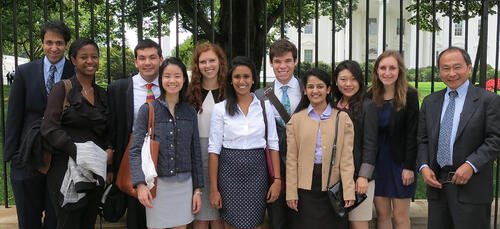
As the new academic year gets underway, the Walter H. Shorenstein Asia-Pacific Research Center’s Corporate Affiliates Program is excited to welcome its new class of fellows to Stanford University:

  • Yuta AikawaMinistry of Economy, Trade & Industry, Japan
  • Wataru FukudaShizuoka Prefectural Government
  • Huang (Catherine) HuangBeijing Shanghe Shiji Investment Company
  • Avni JethwaReliance Life Sciences
  • Satoshi Koyanagi, Ministry of Economy, Trade & Industry, Japan
  • An Ma, PetroChina
  • Huaxiang Ma, Peking University
  • Yuichiro Muramatsu, Mitsubishi Electric
  • Tsuzuri Sakamaki, Ministry of Finance, Japan
  • Tsuneo SasaiThe Asahi Shimbun
  • Ravishankar Shivani, Reliance Life Sciences
  • Aki Takahashi, Nissoken
  • Mariko Takeuchi, Sumitomo Corporation
  • Hideaki Tamori, The Asahi Shimbun
  • Ryo Washizaki, Japan Patent Office
  • Hung-Jen (Fred) Yang, MissionCare

During their stay at Stanford University, the fellows will audit classes, work on English skills, and conduct individual research projects; at the end of the year they will make a formal presentation on the findings from their research. During their stay at the center, they will have the opportunity to consult with Shorenstein APARC's scholars and attend events featuring visiting experts from around the world. The fellows will also participate in special events and site visits to gain a firsthand understanding of business, society and culture in the United States.


Hero Image
rsd15 070 0045a Rod Searcey
All News button
1
-

**Reservations for this event is closed**  We are at capacity and cannot accept further reservations.


Twenty-four years ago the Soviet Union collapsed. Since then, Russia has been transformed in many dimensions but it is difficult to describe the country today.  According to its Constitution, Russia is a democratic republic and federation, but modern Russia looks more like an absolute monarchy. The Russian economy is dominated by state corporations, the oligarchs of the 90's, and the cronies of the 2000’s. The economy has been in recession for more than a year and hasn’t exhibited any signs of recovery. Is the country stable? Can it face its governance and economic challenges? Can we forecast the medium-term future of the Russian economy? Could the economy collapse?


Sergey Aleksashenko is a Senior Fellow at the Development Center (a Moscow-based think tank) and Nonresident Senior fellow at the Brookings Institution. Since graduating Moscow State University in 1986, he has been involved in academia, the public sector, and in business. From 1990-1991 he was appointed to the Commission on Economic reforms of the Government of the USSR as one of the "500 days" plan members. In 1993-1995 he worked as deputy Minister of Finance of Russia in charge of budgetary planning, macroeconomic, and tax policy. From 1995-1998 he was responsible for monetary policy as the first deputy Governor of the Central bank of Russia. From 2000 to 2004 he was the deputy CEO of the Interros Holding where he lead the strategy and business development teams. In 2006-2008 he was the Chairman and CEO of Merrill Lynch Russia, the largest financial institution in Moscow, where he greatly increased the bank's scope and presence. Before the financial crisis of 2008, he returned to academia and became the Director of Macroeconomic Research at the Higher School of Economics in Moscow. At the same time, he sat on the boards of Aeroflot, United Grain company, United Aircraft Corporation, and the National Reserve bank. At the end of 2012 he faced political persecution and in September 2013 he left Russia for Washington D.C. where he currently resides. 

Sergey Aleksashenko Former Deputy Chairman of the Russian Central Bank
Lectures
-

Abstract: Nuclear risks changed dramatically when the Soviet Union collapsed at the end of 1991. Suddenly the world was threatened more by Russia’s weakness than its strength. Never before had a country with the capacity to destroy the world experienced such dramatic political, economic and cultural turmoil. The United States and much of the world was concerned about loose nukes, loose nuclear materials, loose nuclear expert knowledge, and loose nuclear exports. I will describe how scientists and engineers at the U.S. nuclear weapons laboratories joined forces with counterparts in the Russian nuclear weapons complex for more than 20 years to avoid what looked like the perfect nuclear storm. I will also reflect on how today’s strained political relations between Washington and Moscow have curtailed that cooperation to the detriment of a safer and more secure world. 

About the Speaker: Siegfried S. Hecker is a professor (research) in the Department of Management Science and Engineering and a senior fellow at the Freeman Spogli Institute for International Studies (FSI). He was co-director of CISAC from 2007-2012. From 1986 to 1997, Dr. Hecker served as the fifth Director of the Los Alamos National Laboratory. Dr. Hecker is an internationally recognized expert in plutonium science, global threat reduction, and nuclear security.

Dr. Hecker’s current research interests include plutonium science, nuclear weapons policy, nuclear security, and the safe and secure expansion of nuclear energy. Over the past 20 years, he has fostered cooperation with the Russian nuclear laboratories to secure and safeguard the vast stockpile of ex-Soviet fissile materials.

Dr. Hecker’s research projects at CISAC focus on reducing the risks of nuclear terrorism worldwide and the challenges of nuclear India, North Korea, Pakistan, and the nuclear aspirations of Iran. Dr. Hecker is also compiling and editing a book with two of his Russian colleagues on the history of Russian-U.S. laboratory-to-laboratory cooperation since 1992.

Dr. Hecker joined Los Alamos National Laboratory as graduate research assistant and postdoctoral fellow before returning as technical staff member following a tenure at General Motors Research. He led the laboratory's Materials Science and Technology Division and Center for Materials Science before serving as laboratory director from 1986 through 1997, and senior fellow until July 2005.

Among his professional distinctions, Dr. Hecker is a member of the National Academy of Engineering; foreign member of the Russian Academy of Sciences; fellow of the TMS, or Minerals, Metallurgy and Materials Society; fellow of the American Society for Metals; fellow of the American Physical Society, honorary member of the American Ceramics Society; and fellow of the American Academy of Arts and Sciences.

His achievements have been recognized with the Presidential Enrico Fermi Award, the American Physical Society’s Leo Szilard Prize, the American Nuclear Society's Seaborg Medal, the Department of Energy's E.O. Lawrence Award, the Los Alamos National Laboratory Medal, among other awards including the Alumni Association Gold Medal and the Undergraduate Distinguished Alumni Award from Case Western Reserve University, where he earned his bachelor's, master's, and doctoral degrees in metallurgy.

CISAC
Stanford University
Encina Hall, C220
Stanford, CA 94305-6165

(650) 725-6468 (650) 723-0089
0
Senior Fellow, Freeman Spogli Institute for International Studies, Emeritus
Research Professor, Management Science and Engineering, Emeritus
hecker2.jpg PhD

Siegfried S. Hecker is a professor emeritus (research) in the Department of Management Science and Engineering and a senior fellow emeritus at the Freeman Spogli Institute for International Studies (FSI). He was co-director of CISAC from 2007-2012. From 1986 to 1997, Dr. Hecker served as the fifth Director of the Los Alamos National Laboratory. Dr. Hecker is an internationally recognized expert in plutonium science, global threat reduction, and nuclear security.

Dr. Hecker’s current research interests include nuclear nonproliferation and arms control, nuclear weapons policy, nuclear security, the safe and secure expansion of nuclear energy, and plutonium science. At the end of the Cold War, he has fostered cooperation with the Russian nuclear laboratories to secure and safeguard the vast stockpile of ex-Soviet fissile materials. In June 2016, the Los Alamos Historical Society published two volumes edited by Dr. Hecker. The works, titled Doomed to Cooperate, document the history of Russian-U.S. laboratory-to-laboratory cooperation since 1992.

Dr. Hecker’s research projects at CISAC focus on cooperation with young and senior nuclear professionals in Russia and China to reduce the risks of nuclear proliferation and nuclear terrorism worldwide, to avoid a return to a nuclear arms race, and to promote the safe and secure global expansion of nuclear power. He also continues to assess the technical and political challenges of nuclear North Korea and the nuclear aspirations of Iran.

Dr. Hecker joined Los Alamos National Laboratory as graduate research assistant and postdoctoral fellow before returning as technical staff member following a tenure at General Motors Research. He led the laboratory's Materials Science and Technology Division and Center for Materials Science before serving as laboratory director from 1986 through 1997, and senior fellow until July 2005.

Among his professional distinctions, Dr. Hecker is a member of the National Academy of Engineering; foreign member of the Russian Academy of Sciences; fellow of the TMS, or Minerals, Metallurgy and Materials Society; fellow of the American Society for Metals; fellow of the American Physical Society, honorary member of the American Ceramics Society; and fellow of the American Academy of Arts and Sciences.

His achievements have been recognized with the Presidential Enrico Fermi Award, the 2020 Building Bridges Award from the Pacific Century Institute, the 2018 National Engineering Award from the American Association of Engineering Societies, the 2017 American Nuclear Society Eisenhower Medal, the American Physical Society’s Leo Szilard Prize, the American Nuclear Society's Seaborg Medal, the Department of Energy's E.O. Lawrence Award, the Los Alamos National Laboratory Medal, among other awards including the Alumni Association Gold Medal and the Undergraduate Distinguished Alumni Award from Case Western Reserve University, where he earned his bachelor's, master's, and doctoral degrees in metallurgy.

Date Label
FSI Senior Fellow, Research Professor of Management Science and Engineering Stanford University
Seminars
-

Abstract: TBA

About the Speaker: Amy Zegart is co-director of CISAC and Professor of Political Science, by courtesy. She is also the Davies Family Senior Fellow at the Hoover Institution. 

Before coming to Stanford in 2011, Zegart served as professor of public policy at UCLA’s Luskin School of Public Affairs and as a fellow at the Burkle Center for International Relations. Her research examines the organization of American national security agencies and their effectiveness. She is the author of two award-winning books. Flawed by Design, which chronicles the development of the Central Intelligence Agency, Joint Chiefs of Staff, and National Security Council, won the highest national dissertation award in political science. Spying Blind, which examines why American intelligence agencies failed to adapt to the terrorist threat before 9/11, won the National Academy of Public Administration’s Brownlow Book Award. She has also published in International SecurityPolitical Science Quarterly, and other leading academic journals. She serves on the editorial boards of Terrorism and Political Violence and Intelligence and National Security. Her most recent book is Eyes on Spies: Congress and the United States Intelligence Community.

Zegart was featured by the National Journal as one of the ten most influential experts in intelligence reform. She served on the Clinton administration's National Security Council staff and as a foreign policy adviser to the Bush-Cheney 2000 presidential campaign. She has testified before the Senate Intelligence Committee, provided training to the Marine Corps, and advised officials on intelligence and homeland security matters. From 2009 to 2011 she served on the National Academies of Science Panel to Improve Intelligence Analysis. Her commentary has been featured on national television and radio shows and in the New York TimesWashington Post, and Los Angeles Times.

Before her academic career, Zegart spent three years at McKinsey & Company advising Fortune 100 companies about strategy and organizational effectiveness.

A former Fulbright scholar, Zegart received an AB in East Asian studies magna cum laude from Harvard University and an MA and PhD in political science from Stanford University. She served on the FBI Intelligence Analysts Association National Advisory Board and the Los Angeles Police Department’s Counter-terrorism and Community Police Advisory Board. She also served on the Secretary of Energy Advisory Board Task Force on Nuclear Nonproliferation and is a lifetime member of the Council on Foreign Relations. She was appointed to the board of directors of Kratos Defense and Security Solutions in September 2014.

CISAC
Stanford University
Encina Hall, E216
Stanford, CA 94305-6165

(650) 725-9754 (650) 723-0089
0
Senior Fellow at the Freeman Spogli Institute for International Studies
Morris Arnold and Nona Jean Cox Senior Fellow at the Hoover Institution
Senior Fellow at the Stanford Institute for Human-Centered AI
Professor, by courtesy, of Political Science
amyzegart-9.jpg PhD

Dr. Amy Zegart is the Morris Arnold and Nona Jean Cox Senior Fellow at the Hoover Institution. The author of five books, she specializes in U.S. intelligence, emerging technologies, and national security. At Hoover, she leads the Technology Policy Accelerator and the Oster National Security Affairs Fellows Program. She also is an associate director and senior fellow at the Stanford Institute for Human-Centered AI; a senior fellow at the Freeman Spogli Institute; and professor of political science by courtesy, teaching 100 students each year about how emerging technologies are transforming espionage.

Her award-winning research includes the leading academic study of intelligence failures before 9/11: Spying Blind: The CIA, the FBI, and the Origins of 9/11 (Princeton, 2007) and the bestseller Spies, Lies, and Algorithms: The History and Future of American Intelligence (Princeton, 2022), which was nominated by Princeton University Press for the Pulitzer Prize. She also coauthored Political Risk: How Businesses and Organizations Can Anticipate Global Insecurity, with Condoleezza Rice (Twelve, 2018). Her op-eds and essays have appeared in Foreign Affairs, Politico, the New York Times, the Washington Post, and the Wall Street Journal.

Zegart has advised senior officials about intelligence and foreign policy for more than two decades. She served on the National Security Council staff and as a presidential campaign foreign policy advisor and has testified before numerous congressional committees. Before her academic career, she spent several years as a McKinsey & Company consultant.

Zegart received an AB in East Asian studies from Harvard and an MA and a PhD in political science from Stanford. She serves on the boards of the Council on Foreign Relations, Kratos Defense & Security Solutions, and the American Funds/Capital Group.

Date Label
Amy Zegart Co-director CISAC
Seminars
-

Political life in most democratic systems centers on the presidency or the parliament.  In countries that have begun to shift from authoritarian to democratic rule, American and Western aid programs typically place a high priority on strengthening the capacities of parliaments.  Superficial evidence in Myanmar and Indonesia suggests that these efforts by democratic donors have contributed to the emergence of legislatures that are more of an obstacle to economic progress than a driver of it.  Lex Rieffel will offer his perspective on this phenomenon in Myanmar and Indonesia with particular attention to Myanmar in the run-up to its November 8 election.  The two countries will also be compared with regard to geography, ethnic conflict, and communal tension, and their implications for the political process.

Image
rieffell full protrait 1x1
Lex Rieffel has written widely on the political economies of Myanmar and Indonesia.  His latest publication is "Improving the Performance of the State Economic Enterprise Sector in Myanmar" (ISEAS Perspective #36, 2015).  Notable among his many other writings are:  Too Much Too Soon? The Dilemma of Foreign Aid to Myanmar/Burma (co-authored, 2013); Myanmar/Burma: Inside Challenges, Outside Interests (edited, 2010); and Out of Business and On Budget: The Challenge of Military Financing in Indonesia (co-authored, 2007).  His career prior to joining Brookings in 2002 included positions with the Institute of International Finance, the U.S. Treasury Department, and USAID.  Universities where he has taught courses in economics and finance include Johns Hopkins (SAIS), George Washington (Elliott School), and the University of Yangon.  His MA in law and diplomacy and his BA in economics are respectively from Tufts (Fletcher School) and Princeton.

Do Parliaments Help or Hurt Economic Progress in Democratizing Countries? The Case of Myanmar, with Notes on Indonesia Primary tabs View Edit(active tab) Revisions Nodequeue
Download pdf
Lex Rieffel Nonresident Senior Fellow, Brookings Institution
Seminars
-

Indonesian President Joko (“Jokowi”) Widodo was inaugurated in October 2014.  He is the country’s seventh president, but only its second to be directly elected and its first from both a non-elite and non-military background.  He won the election by a narrow margin over a hard-line ex-general accused of violating human rights.

Human rights abuses have long marred Indonesian rule in western Papua.  Candidate Jokowi promised to improve conditions there.  He traveled to the area twice during the election campaign.  His predecessor visited Papua only three times during his entire ten-year presidency.  Jokowi also promised to protect religious minorities from violence, intolerance, and discrimination, and to help reconcile survivors of the mass bloodletting in 1965-66.  Has he kept these and other commitments to improve human rights conditions in Indonesia?  Or not?  And why?

Image
andreas harsono
Andreas Harsono has covered Indonesia for Human Rights Watch since 2008. Organizations that he has helped to establish include a journalist-training organization, the Pantau Foundation (Jakarta, 2003); the South East Asia Press Alliance (Bangkok, 1998); and the Alliance of Independent Journalists (Jakarta, 1994).  He began his career as a reporter for The Nation (Bangkok) and the Star newspapers (Kuala Lumpur), and has edited a monthly magazine on media and journalism, Pantau (Jakarta).  He was a Nieman Fellow at Harvard University in 2000.

Andreas Harsono Indonesia Researcher, Human Rights Watch
Seminars
Subscribe to Security