Security

FSI scholars produce research aimed at creating a safer world and examing the consequences of security policies on institutions and society. They look at longstanding issues including nuclear nonproliferation and the conflicts between countries like North and South Korea. But their research also examines new and emerging areas that transcend traditional borders – the drug war in Mexico and expanding terrorism networks. FSI researchers look at the changing methods of warfare with a focus on biosecurity and nuclear risk. They tackle cybersecurity with an eye toward privacy concerns and explore the implications of new actors like hackers.

Along with the changing face of conflict, terrorism and crime, FSI researchers study food security. They tackle the global problems of hunger, poverty and environmental degradation by generating knowledge and policy-relevant solutions. 

Authors
News Type
News
Date
Paragraphs

Martin Hellman is not your average cryptography pioneer.

Hellman, who is known for his invention of public key cryptography (along with Whitfield Duffie and Ralph Merkle), has a life’s journey to share in story form, one that weaves together the most complex global flashpoints of our age with the deeply personal of any age. He and his wife’s new bookA New Map for Relationships: Creating True Love at Home and Peace on the Planet, spans far and wide, covering nuclear risks in North Korea, Iran, and America’s Middle Eastern wars.

But that is not all. He and his wife Dorothie Hellman open up about their marital struggles to show how they eventually reached a point of harmony and true love for each other. As Martin Hellman sees it, conflict in the international and interpersonal arenas has much in common.

“You can’t separate nuclear war from conventional war and conventional war from personal war,” he said in an interview. Hellman is a professor emeritus of electrical engineering and faculty affiliate at Stanford’s Center for International Security and Cooperation.  

Just as he and Dorothie (self-acknowledged polar opposites) often butted heads during the first 10 or 15 years of marriage, nations too navigate dangerously outmoded “maps” to protect their national security and interests. Yet these “maps” are soon outdated, whether on the global stage or in the home. Hellman said, however, that differences of opinion, which revolve around fights to prove who is “right,” could instead be transformed into opportunities to learn from one another – and to expand peace in the world.

“You have to believe in the seemingly impossible gifts of unconditional love and greater peace in the world, and then dedicate yourself to discovering how to achieve them,” he said.

Cultivating inner, outer peace

He said that society only truly changes based on individual changes, so he calls for action in how people live their everyday lives. When countries fail to respect each other – and ignore the influence of history on those countries – then conflict is more likely, and it is similar to a person disrespecting another.

“You will see an immediate payoff as your relationships flower,” he wrote in the book. “The small impact that each of us can have on changing the world does not feel concrete enough to most people, but seeing progress in your personal relationships is very concrete.”

That dedication to unconditional love, he said, is the way that individuals can become models for what is needed globally.

And the time is now, he suggests, for such change if our living generations are to leave a more peaceful world for those who follow us. From Afghanistan to Cuba, Russia, Iraq to North Korea and beyond, the countries of the world need a journey of healing and reconciliation, as he writes in the book.

Today, the stakes could not be higher, Hellman noted. Long-running strategies like nuclear deterrence are risky and illogical – over time, given probability theory and the chances of mistake or malice, they won’t work.

“The United States thinks it’s a superpower, but how can we be when Russia or China could destroy us in less than a hour?” he said. “How is that being a superpower?”

As William J. Perry, the former U.S. Secretary of Defense and Stanford professor emeritus at CISAC, said on behalf of the Hellmans’ book, “The struggle for interpersonal dominance can lead to the end of a marriage, but the struggle for geopolitical dominance can lead to the end of civilization.”


Hero Image
peace
A man adjusts a spotlight above the stage before world leaders' family picture during the Nuclear Security Summit in The Hague March 25, 2014. In his new book, CISAC's Martin Hellman writes that when nations and people get together to talk and learn from one another, peace can be the result.
REUTERS/Robin Van Lonkhuijsen/Pool.
All News button
1
-

Sorry, we've reached registration capacity. Please contact us if you would like to be added to the waitlist.

Two decades after the integration of much of Eastern Europe into the EU, Europe is faced with increasingly complex security challenges—refugee migrations from the mid-East and north-Africa;  Russia’s cross territorial incursions, hybrid warfare, and war on information; strains on social welfare economies; shifting sources of energy; and of course the daily threat of terrorism.    On each of these issues, Germany has embraced a leadership role, representing a paradigm shift for a nation that even 70 years after the end of the Second World War is still reluctant to assert itself.  US Ambassador to Germany John B. Emerson will address how Germany is reshaping its security policy as it relates to military engagement, intelligence and counter-terrorism, technology, energy, transatlantic trade, and the longer-term threats posed by a changing climate.   In addition, he will discuss the emerging political dynamic in Germany and in particular the challenges Chancellor Merkel is facing domestically as Germany seeks to integrate well over a million refugees. 

John Emerson was appointed U.S. Ambassador to Germany in 2013. Prior to that, he served as President Clinton’s Deputy Director of Presidential Personnel, and Deputy Director of Intergovernmental Affairs, where he was the President’s liaison to the nation’s governors senior staff. Mr. Emerson also coordinated the Economic Conference of the Clinton-Gore transition team and led the Administration’s efforts to obtain congressional approval of the GATT Uruguay Round Agreement in 1994, and the extension of China’s MFN trading status in 1996. In 2010, President Obama appointed Mr. Emerson to serve on the President’s Advisory Committee for Trade Policy and Negotiations.  Ambassador Emerson was the 2015 recipient of the State Department's prestigious Sue M. Cobb Award for Exemplary Diplomatic Service, which is given annually to one non-career Ambassador who has used their private sector leadership and management skills to make a substantive impact on bilateral or multilateral relations through proactive diplomacy.


John Emerson, US Ambassador to Germany US Ambassador to Germany Speaker
Lectures
-

Abstract: Current technologies and practices have created large stores of medical data, including electronic medical records, genomic data, and mobile-health measurements.  There is great promise for discovery and implementation of more efficient and effective health care, but there are also tensions between the sharing of data and the ability to make assurances about security and privacy to patients and study participants.  I will discuss these challenges in the setting of genomic research and medical record data mining.  In many cases, social mechanisms are likely to be the more reliable safeguards than technical mechanisms for privacy, security, and obfuscation.

About the Speaker: Russ Biagio Altman is a professor of bioengineering, genetics, medicine, and biomedical data science (and of computer science, by courtesy) and past chairman of the Bioengineering Department at Stanford University. His primary research interests are in the application of computing and informatics technologies to problems relevant to medicine. He is particularly interested in methods for understanding drug action at molecular, cellular, organism and population levels.  His lab studies how human genetic variation impacts drug response (e.g. http://www.pharmgkb.org/). Other work focuses on the analysis of biological molecules to understand the actions, interactions and adverse events of drugs (http://feature.stanford.edu/).  He helps lead an FDA-supported Center of Excellence in Regulatory Science & Innovation (https://pharm.ucsf.edu/cersi). Dr. Altman holds an A.B. from Harvard College, and M.D. from Stanford Medical School, and a Ph.D. in Medical Information Sciences from Stanford. He received the U.S. Presidential Early Career Award for Scientists and Engineers and a National Science Foundation CAREER Award. He is a fellow of the American College of Physicians (ACP), the American College of Medical Informatics (ACMI), the American Institute of Medical and Biological Engineering (AIMBE), and the American Association for the Advancement of Science (AAAS). He is a member of the National Academy of Medicine (formerly the Institute of Medicine, IOM) of the National Academies.  He is a past-President, founding board member, and a Fellow of the International Society for Computational Biology (ISCB), and a past-President of the American Society for Clinical Pharmacology & Therapeutics (ASCPT).  He has chaired the Science Board advising the FDA Commissioner, currently serves on the NIH Director’s Advisory Committee, and is Co-Chair of the IOM Drug Forum.  He is an organizer of the annual Pacific Symposium on Biocomputing (http://psb.stanford.edu/), and a founder of Personalis, Inc.  Dr. Altman is board certified in Internal Medicine and in Clinical Informatics. He received the Stanford Medical School graduate teaching award in 2000, and mentorship award in 2014.

Encina Hall, 2nd floor

Russ Altman Professor of Bioengineering, of Genetics, of Medicine Stanford University
Seminars
-

Photo courtesy of wbur.org April 2015Northeast Asia is now a central arena to determine the future of nuclear safety and security. The Fukushima nuclear accident, and its ongoing aftermath, is at the forefront of the debate over the utility of nuclear energy in resolving global issues of climate change and energy security. And North Korea’s headlong rush towards acquisition of nuclear weapons and delivery systems has sparked talk of going nuclear in both South Korea and Japan and discussion over how to provide extended deterrence, including the role of missile defense.

The Shorenstein Asia-Pacific Research Center has brought together the representatives of the three principle powers in the region – China, Japan and South Korea – together with our own academic expert to discuss these issues.


Panelists:

Liyou Zha, Deputy Consul General of the Peoples Republic of China, San Francisco

Born in 1964, Jiangsu Province, Consul Zha began his career in 1987 at the State Economic Commission and moved from there to work in the Organization Department of the Communist Party of China. He began his service in the Foreign Ministry in 1990 with the Department of Consular Affairs and the Department of Personnel. From 2012 he served at Chinese Embassy in the United States as Counselor and Deputy Head of Office for Congressional and State Government Affairs. He has served as Deputy Consul General of the People's Republic of China in San Francisco since March 2015. 

Shouichi Nagayoshi, Deputy Consul General of Japan, San Francisco

Deputy Consul General Shoichi Nagayoshi began his career with the Ministry of Foreign Affairs of Japan in 1988. His assignments overseas have included posts in the United Kingdom, Ghana, New York, and Malaysia. His assignments in Tokyo have included works at European Affairs Bureau, Disarmament, Non-Proliferation and Science Department and Foreign 

Jimin Kim, Deputy Consul General of the Republic of Korea, San Francisco

Has been Deputy Consul General of the Republic of Korea in San Francisco since August 2016. Most recently, he served as Director of Protocol from 2015 to 2016. He has been a career diplomat for almost 20 years. His prior foreign mission posts include First Secretary at the Korean Embassy in Japan from 2008-2011 and Counselor at the Korean Embassy in the Dominican Republic from 2011 to 2013. Consul Kim received a B.S. in Foreign Service from Georgetown University and an M.A. in International Affairs from Columbia University. He was awarded the Citation of the Foreign Minister in 2011.

Phillip Lipscy, The Thomas Rohlen Center Fellow at the Freeman Spogli Institute for International Studies, Assistant Professor of Political Science

Takeo Hoshi (moderator), Henri H. and Tomoye Takahashi Senior Fellow in Japanese Studies at the Freeman Spogli Institute for International Studies

Panel Discussions
Authors
News Type
News
Date
Paragraphs

With each passing day, computer hacking against countries, organizations and people is forcing the subject of cybersecurity to the top of national security agendas.

An estimated 42.8 million cyber attacks will take place this year, according to experts. Scaling up to meet this challenge is why more than 140 people from science, politics, business and the military attended the fourth annual Cyber Security Summit at Stanford’s Center for International Security and Cooperation (CISAC) on Sept. 19-20.

The Munich Security Conference and Deutsche Telekom sponsored the event. CISAC is in the Freeman Spogli Institute for International Studies. Participants delved deep into issues associated with today’s online world, including how to balance privacy and civil liberties with the need for intelligence, for example. Discussions ranged on questions such as:

• What will the future of warfare look like – human soldiers or killer robots?

• How do we ensure that technological progress does not escape human control?

• What are the biggest challenges combatting the online activities of groups like the Islamic State?

• What are the possible cyberspace conflicts between the U.S., Russia and China?

• Are countries ready for cyber attacks against key infrastructure such as energy, water and utilities, or the U.S. election system, for example?

Electoral impact

In a talk on cyber attacks and the U.S. elections, panelists discussed how such electoral manipulation in the ongoing presidential campaign might happen, and what could be done about it. While it was noted that foreign adversaries could undermine the American public’s confidence in its election system, one expert pointed out that it’s unlikely to occur undetected on a widespread basis.

Credibility is now the battlefield, one panelist said. If hacking occurs, how will an election be validated? The track record shows that Russian has attempted to influence elections in Eastern Europe, so hacking into U.S. political entities is their way to sow doubt among voters.

The economic costs of cyber attacks – $400 to $500 billion a year was one participant’s estimate – and “cyberspace norms” were other issues explored. Countries and companies are grappling with the losses associated with these incursions, and with how – and who – should set the rules for the “digital game.”

On encryption, questions in one discussion revolved around how the public and private sectors can resolve such issues, how far data privacy could be compromised for effective intelligence work, and vice versa.

Online jihadism was another subject. The conference panelists talked about which tools are most effective in countering jihadist propaganda and recruitment on the Internet. Also, the need for Europe and the U.S. to work together on such fronts was mentioned.

CISAC and FSI participants included Amy Zegart, co-director of CISAC and senior fellow at the Hoover Institution; Michael McFaul, director of the Freeman Spogli Institute and senior fellow at the Hoover Institution; Martin Hellman, professor emeritus of electrical engineering; among others. Other attendees hailed from U.S. and European Union agencies and businesses, and local Silicon Valley companies.

Zegart said a collaborative spirit and drive for innovation characterizes Stanford. “In the past three years, we have built an exciting program dedicated to educating current and future cyber leaders, producing policy-driven knowledge, and convening leaders across sectors and borders,” she wrote in the program guide.

McFaul, in his opening statement, noted the origins of CISAC – it was created when there was a different technological concern – nuclear materials. Then, scientists and social scientists at CISAC got together to work on nuclear proliferation. Today, the threat is cyber attacks, and CISAC is confronting this challenge. He said the scariest briefing he had in his ambassador position at the U.S. Department of State was on cybersecurity.

For his discussion on terrorism, Hellman brought pages of pro-encryption quotes from government officials. He suggested end-to-end encryption was good for Americans.

Crossing borders

The Munich Security Conference is considered to be the most important informal meeting on security policy. Outside speakers included Michael Cherthoff, former secretary of Homeland Security; Jane Holl Lute, the under secretary general for the United Nations; and Christopher Painter, coordinator for cyber issues at the U.S. Department of State.

Wolfgang Ischinger, the chair of the Munich Security Conference, said at the press conference that, “cybersecurity has over the last few years evolved to be one of the most indispensable agenda items.”

The “quest for rules” in cyberspace, he noted, is overwhelmingly difficult and vitally important.

Thomas Kremer, board member for co-sponsor Deutsche Telekom AG, said, “cyber attacks don’t accept national borders.” Cybersecurity has become a global issue, he explained, with ramifications for countries, companies and everyday people.

He added, “Our chances to fight cyber crime are far better when we collaborate.”

Stanford and CISAC are at the forefront of the national discussion on cybersecurity. The university launched the Stanford Cyber Initiative; hosted President Obama’s cybersecurity summit and defense secretary Ashton Carter’s unveiling of a new U.S. cyber strategy; and CISAC and the Hoover Institution have teamed up in recent years for media roundtables and Congressional bootcamps on cybersecurity.

Finally, CISAC senior research scholar Joe Felter and other experts held Hacking for Defense & Diplomacy class for educators and sponsors on Sept. 7-9. (See the final class presentations here). In spring 2016, they held the first such class to train students in cybersecurity for defense purposes. Steve Blank, a consulting associate professor in the Stanford School of Engineering’s Department of Management Science and Engineering, helped develop the class. This fall, they will prototype a Hacking for Diplomacy course at Stanford.

Click here for the Munich Security Conference’s agenda for this event and a list of participants. 

Hero Image
cybersecurity summit
Michael McFaul, second from the left and the executive director of the Freeman Spogli Institute, talks with other panelists at the Cyber Security Summit on Sept. 19. On the far left is Amy Zegart, co-director of CISAC, and in the middle is Michael Chertoff, former director of the U.S. Department of Homeland Security. On the far right is Vinh Nguyen, a national intelligence officer for the U.S. federal government, and to his left is Dmitri Alperovich, co-founder of CrowdStrike.
Rod Searcey
All News button
1
-

Ambassador Osius will make remarks on U.S.-Vietnam relations in the wake of President Obama’s May 2016 visit. He will focus on the unfinished task of reconciliation. Relations were normalized in 1995. Yet many in Vietnam’s diaspora community, especially those most affected by the legacies of the war, oppose rapprochement and engagement. Overseas communities can play important and constructive roles in relations between their countries of origin and the rest of the world. Ambassador Osius will argue that a fully engaged Vietnamese-American community could and would contribute a lot toward growing the U.S. partnership with Vietnam, including helping to shape a beneficial future of greater trade, improved regional stability, and an expanded role for civil society.

Image
ted osius
Ted Osius is the sixth U.S. ambassador to Vietnam (December 2014-Present). Previously he was an associate professor and a senior fellow, respectively, at the National War College and the Center for Strategic and International Studies; deputy chief of mission at the U.S. Embassy in Jakarta; and political minister-counselor at the U.S. Embassy in New Delhi. His earlier career included service as regional environment officer for Southeast Asia and the Pacific in the U.S. State Department and as senior advisor on international affairs in the Office of the Vice President. 

This event is co-sponsored by the U.S. - Asia Security Initiative and the Southeast Asia Program
Ted Osius U.S. Ambassador to Vietnam
Seminars
-

Image
Accidental State

Abstract

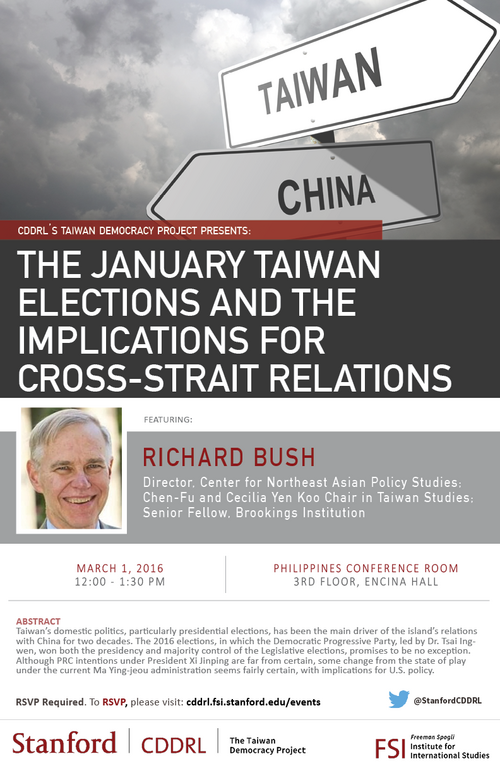
The existence of two Chinese states—one controlling mainland China, the other controlling the island of Taiwan—is often understood as a seemingly inevitable outcome of the Chinese civil war. Defeated by Mao Zedong, Chiang Kai-shek’s Nationalists fled to Taiwan to establish a rival state, thereby creating the “Two Chinas” dilemma that vexes international diplomacy to this day. Accidental State challenges this conventional narrative to offer a new perspective on the founding of modern Taiwan.

Hsiao-ting Lin marshals extensive research in recently declassified archives to show that the creation of a Taiwanese state in the early 1950s owed more to serendipity than careful geostrategic planning. It was the cumulative outcome of ad hoc half-measures and imperfect compromises, particularly when it came to the Nationalists’ often contentious relationship with the United States.

Taiwan’s political status was fraught from the start. The island had been formally ceded to Japan after the First Sino–Japanese War, and during World War II the Allies promised Chiang that Taiwan would revert to Chinese rule after Japan’s defeat. But as the Chinese civil war turned against the Nationalists, U.S. policymakers reassessed the wisdom of backing Chiang. The idea of placing Taiwan under United Nations trusteeship gained traction. Cold War realities, and the fear of Taiwan falling into Communist hands, led Washington to recalibrate U.S. policy. Yet American support of a Taiwan-based Republic of China remained ambivalent, and Taiwan had to eke out a place for itself in international affairs as a de facto, if not fully sovereign, state.


Biography

Hsiao-ting Lin is a research fellow and curator of the East Asia Collection at the Hoover Institution. He holds a BA in political science from National Taiwan University (1994) and an MA in international law and diplomacy from National Chengchi University in Taiwan (1997). He received his DPhil in oriental studies in 2003 from the University of Oxford, where he also held an appointment as tutorial fellow in modern Chinese history. In 2003–4, Lin was a postdoctoral fellow at the Institute of East Asian Studies, University of California at Berkeley. In 2004, he was awarded the Kiriyama Distinguished Fellowship by the Center for the Pacific Rim, University of San Francisco. In 2005–7, he was a visiting fellow at the Hoover Institution, where he participated in Hoover’s Modern China Archives and Special Collections project. In April 2008, Lin was elected a fellow of the Royal Asiatic Society of Great Britain and Ireland for his contributions to the studies of modern China’s history.

Lin’s academic interests include ethnopolitics and minority issues in greater China, border strategies and defenses in modern China, political institutions and the bureaucratic system of the Chinese Nationalist Party (Kuomintang), and US-Taiwan military and political relations during the Cold War. He has published extensively on modern Chinese and Taiwanese politics, history, and ethnic minorities, including Accidental State: Chiang Kai-shek, the United States, and the Making of Taiwan (Harvard University Press, 2016); Modern China’s Ethnic Frontiers: A Journey to the West (Routledge, 2011); Breaking with the Past: The Kuomintang Central Reform Committee on Taiwan, 1950–52 (Hoover Press, 2007); Tibet and Nationalist China’s Frontier: Intrigues and Ethnopolitics, 1928–49 (UBC Press, 2006), nominated as the best study in the humanities at the 2007 International Convention of Asia Scholars; and over a hundred journal articles, book chapters, edited volumes, reviews, opinion pieces, and translations. He is currently at work on a manuscript that reevaluates Taiwan’s relations with China and the United States during the presidency of Harry Truman to that of Jimmy Carter.


This event is sponsored by the Taiwan Democracy Project in the Center on Democracy, Development, and the Rule of Law. It is free and open to the public, and lunch will be served. Please RSVP by November 28.

Reuben Hills Conference Room

2nd Floor, Encina Hall East

Hsiao-ting Lin Librarian, East Asian Archives, Hoover Institution
Lectures
News Type
News
Date
Paragraphs

The Shorenstein Asia-Pacific Research Center (APARC) at Stanford is now accepting applications for the Shorenstein Postdoctoral Fellowship in Contemporary Asia, an opportunity made available to two junior scholars for research and writing on Asia.

Fellows conduct research on contemporary political, economic or social change in the Asia-Pacific region, and contribute to Shorenstein APARC’s publications, conferences and related activities. To read about this year’s fellows, please click here.

The fellowship is a 10-mo. appointment during the 2017-18 academic year, and carries a salary rate of $52,000 plus $2,000 for research expenses.

For further information and to apply, please click here. The application deadline is Dec. 16, 2016.

Hero Image
27193530153 58630c4828 o
All News button
1
Authors
News Type
News
Date
Paragraphs

Biosecurity leaders gathered at Stanford this week to offer new ideas and perspectives on a wide range of issues critical to societal health.

The conference, “Emerging Leaders in Biosecurity,” began Sept. 13 with a trip to Lawrence Livermore National Laboratory in the East Bay. The second day featured a series of panel discussions on the Stanford campus. The fellows, chosen by the UPMC Center for Health Security, hailed from a wide array of backgrounds, including biological science, medicine, policy, the military, law, public health and the private sector.

Biosecurity and its relationship to global health is a key issue for Stanford’s Center for International Security and Cooperation (CISAC), which hosted and helped organize the conference along with the sponsoring UPMC Center. The conference was sponsored by the Defense Threat Reduction Agency and the emerging leaders program run by the UPMC. 

With rapid advances in technology and science, biosecurity is increasingly focused on how harmful biological agents could become national security threats and risks.

‘A changing world’

David Relman, co-director of CISAC, addressed the fellows on Wednesday with remarks on the origins of CISAC’s involvement in biosecurity. Relman, a professor in the departments of medicine, and microbiology and immunology, later served as a panelist in a discussion on biosecurity and national and international policy.

Megan Palmer, a fellow and CISAC senior research scholar on biosecurity, panel moderator and organizer of the conference, described the program as one that “brings together some of the most talented and committed rising leaders from multiple organizations and disciplines critical to national and international biosecurity.”

She noted, “Stanford's biosecurity programs are focused on developing strategies for biosecurity in a changing world. Today we face complex biosecurity challenging ranging from emerging infectious diseases, intentional misuse of biotechnology, and potential accidents and unintentional consequences of our increasing ability to manipulate living systems.”

At the same time, biotechnology continues to be an important and growing part of the global economy, Palmer said. “Our scholarship and engagement work seeks to developing new ways to think about and act in this changing environment.”

Research focus

Through the “emerging leaders” program, fellows deepen their expertise in biosecurity, build leadership skills, and forge networks of lasting professional relationships, she added.

The two-day conference included talks on threat awareness, biodetection, a “viral storm” exercise, bioengineering research, computational biology and national security, biosecurity and national and international policy, the evolving biotechnology field, among other topics.

Stanford participants and speakers included CISAC’s William Perry, the former secretary of defense; Drew Endy, a Stanford associate professor of bioengineering; Tim Stearns, chair of the biology department; Milana Trounce, clinical associate professor of emergency medicine; and Manu Prakash, assistant professor of bioengineering.

CISAC activity in biosecurity includes research on:

  • Risks in misusing the emerging life sciences;
  • Social and political factors behind drug-resistant antibiotics, leading to an tight pipeline for new drugs;
  • Examining the ethical responsibilities of scientists in this field and the needs for regulation;
  • Anticipating and pre-empting the misuse of biotechnology by people with the intent to do harm.

Matthew Watson, a senior analyst for the UPMC Center, said, “It is difficult to imagine a more fitting venue for the fall Emerging Leaders in Biosecurity workshop than Stanford. Few institutions can bring together this array of world class talent, including leaders from national security, the life sciences, and the private sector.”

Back in February, the UPMC Center for Health Security chose its 2016 fellows and launched the program with a Washington, D.C. workshop in March.


Hero Image
mosquitos are seen in containers at a lab
Biosecurity experts gathered at Stanford on Sept. 13-14 as part of the conference, “Emerging Leaders in Biosecurity."
Nelson Almeida, AFP (Getty Images)
All News button
1
News Type
News
Date
Paragraphs

Last month, Admiral Scott H. Swift, the commander of U.S. Pacific Fleet, spoke to an audience at the Stanford Center at Peking University (SCPKU) and at Stanford via their linked Highly Immersive Classrooms (HIC). Against the backdrop of increasing tensions and hostility in the South China Sea, Swift stressed the importance of building a trust-based relationship between China and the United States. Stanford professor Jean Oi opened the roundtable by introducing Swift at SCPKU while Karl Eikenberry, director of the U.S.-Asia Security Initiative and former U.S. ambassador to Afghanistan, chaired the session at Stanford’s Graduate School of Business.

After his formal remarks, Swift engaged in a roundtable discussion with Chinese and American scholars on both sides of the Pacific. The participants at SCPKU included experts from Peking University and Chinese think tanks. Participants at Stanford included a diverse group of scholars from across campus with a number from the Shorenstein Asia-Pacific Research Center. The HIC allowed a lively interactive session where Swift fielded questions from SCPKU and Stanford.


Image
dsc 1361


Hero Image
dsc 1386
All News button
1
Subscribe to Security