International Relations

FSI researchers strive to understand how countries relate to one another, and what policies are needed to achieve global stability and prosperity. International relations experts focus on the challenging U.S.-Russian relationship, the alliance between the U.S. and Japan and the limitations of America’s counterinsurgency strategy in Afghanistan.

Foreign aid is also examined by scholars trying to understand whether money earmarked for health improvements reaches those who need it most. And FSI’s Walter H. Shorenstein Asia-Pacific Research Center has published on the need for strong South Korean leadership in dealing with its northern neighbor.

FSI researchers also look at the citizens who drive international relations, studying the effects of migration and how borders shape people’s lives. Meanwhile FSI students are very much involved in this area, working with the United Nations in Ethiopia to rethink refugee communities.

Trade is also a key component of international relations, with FSI approaching the topic from a slew of angles and states. The economy of trade is rife for study, with an APARC event on the implications of more open trade policies in Japan, and FSI researchers making sense of who would benefit from a free trade zone between the European Union and the United States.

Authors
News Type
Commentary
Date
Paragraphs

President Volodymyr Zelensky visits Washington next week, with the highlight being a White House call on President Joe Biden. That offers the opportunity to reinvigorate the U.S.-Ukraine relationship at the highest level, following four years of Donald Trump.

This can be a very good meeting for the Ukrainian president. He should, however, take care in what he seeks. If he wants to return home with a clear success and having boosted U.S.-Ukraine relations, he should not ask for things he knows—or should know—he cannot get. Moreover, the more convincing the message that he brings regarding Kyiv’s commitment to domestic reform, the better will be his time in Washington.

Aug. 31 will be Mr. Zelensky’s first time to the White House, even though Trump offered him such a visit more than two years ago. Sadly, the former president showed no understanding of the import of Ukraine for American national interests and instead sought to extort Kyiv into interfering in U.S. politics.

When it comes to Ukraine, Biden gets it. The discussions between the presidents will undoubtedly focus on the two central challenges facing Kyiv. First, the conflict that Russia has inflicted on Ukraine since 2014, which has claimed some 14,000 lives. Zelensky can expect a strong reiteration of American support for Ukraine, including for non-recognition of Moscow’s illegal seizure of Crimea and for a settlement in Donbas that restores Ukrainian sovereignty.

The tricky part for Zelensky will turn on the specific asks he makes.

In the past, the Ukrainian president has called for a NATO membership action plan (MAP). In one sense, that is not unreasonable. Ukraine has made as much progress as many other new alliance members had made when they received MAPs.

NATO members, however, remain reluctant to put Ukraine, when it is engaged in a low-intensity war with Russia, on a membership track—despite the fact that NATO has stated that the question of membership is between the alliance and the prospective member, not any third party, i.e., not the Kremlin. That may seem unfair in Kyiv, but it is the reality.

So Zelensky should not seek a MAP. He could ask for an intensified and continuing discussion on the practical steps that Kyiv should take now so that, when a window opens for progress toward membership, Ukraine is fully ready to seize it. Mr. Zelensky can, in effect, have a MAP … if he accepts that it will not be called a MAP.

Ukraine—the biggest potential loser when Nord Stream 2 begins operation—understandably opposes it. Biden opposes it as well but remains unready to sanction German or European companies and risk a rift with Berlin and Brussels. (Kyiv should not want such a rift, which would erode U.S.-European Union unity on supporting Ukraine and sanctions against Russia.)

Zelensky thus should not urge sanctioning European companies to block the pipeline. He should instead ask how Washington, working with Berlin, intends to build with specifics on the July U.S.-German statement on supporting Ukraine, Europe’s energy security and climate goals and ensure that Russia will not use the pipeline against Kyiv. He could also propose continuing the discussion begun on Aug. 23 by the Ukrainian, German and American energy ministers about steps to strengthen Ukraine’s energy security.

Many in Kyiv have expressed frustration with the lack of progress toward settling the Donbas conflict in the “Normandy process” led by the Germans and French, and some even suggest alternative formats. Washington does not want to displace Berlin and Paris, and it benefits Kyiv to keep those key European Union members engaged. Still, Zelensky can and should press Biden to engage U.S. diplomacy more forcefully in support of the Germans and French.

He also may have an opening to ask for more. Washington reportedly has considered contingency military assistance for Ukraine. Given the Russian build-up last April, which was only partially drawn down, and the prospect that the September Zapad exercise will bring even more Russian troops close to Ukraine’s border, new U.S. military assistance would send a powerful signal of U.S. commitment to Ukraine as well as bolster its defensive capabilities.

The second central challenge facing Kyiv is putting in place the critical mass of reforms that will allow Ukraine’s economy to accelerate growth and realize its full potential, including encouraging open competition, strengthening the rule of law, curbing the outsized political and economic influence of the oligarchs, and beating back corruption. Kyiv’s record over the past two years has been mixed. These questions concerned  Biden when he had the senior lead on Ukraine in the Obama administration. If  Zelensky brings a credible, compelling message of his commitment to reform accompanied by specific ideas, he will find a receptive audience.

Zelensky’s U.S. visit can produce a major success for him and for U.S.-Ukraine relations. He should position himself to achieve such an outcome. That requires not overreaching by setting the bar impossibly high. And it means bringing a persuasive vision for how Kyiv will realize the ambitions of the Ukrainian people to become a prosperous democracy and a “normal” European state.

Steven Pifer is an affiliate of Stanford’s Center for International Security and Cooperation and a former U.S. ambassador to Ukraine.

Originally for Kyiv Post

Hero Image
Ukraine President Volodymyr Zelensky
Anastasia Vlasova/Getty Images
All News button
1
Subtitle

President Volodymyr Zelensky visits Washington next week, with the highlight being a White House call on President Joe Biden. That offers the opportunity to reinvigorate the U.S.-Ukraine relationship at the highest level, following four years of Donald Trump.

Authors
Colin H. Kahl
News Type
News
Date
Paragraphs

The COVID-19 crisis is the greatest shock to world order since World War II. Millions have been infected and killed. The economic crash caused by the pandemic is the worst since the Great Depression, with the International Monetary Fund estimating that it will cost over $9 trillion of global wealth in the next few years. Many will be left impoverished and hungry. Fragile states will be further hollowed out, creating conditions ripe for conflict and mass displacement. Meanwhile, international institutions and alliances already under strain before the pandemic are teetering, while the United States and China, already at loggerheads before the crisis, are careening toward a new Cold War. China’s secrecy and assertiveness have shattered hopes that it will become a responsible stakeholder in the international order.

Read the rest at Brookings

Hero Image
dominoes with different country flags
All News button
1
Subtitle

Thomas Wright and Colin Kahl detail the COVID-19 pandemic as the greatest shock to world order since World War II, with millions infected and killed, the worst economic crash since the Great Depression, and international institutions and alliances already under strain before the pandemic now teetering while the United States and China are careening toward a new Cold War.

Shorenstein APARC
Stanford University
Encina Hall, Room E301
Stanford, CA 94305-6055

(650) 736-0656 (650) 723-6530
0
mike_breger.jpg

Michael (Mike) Breger joined APARC in 2021 and serves as the Center's communications manager. He collaborates with the Center's leadership to share the work and expertise of APARC faculty and researchers with a broad audience of academics, policymakers, and industry leaders across the globe. 

Michael started his career at Stanford working at Green Library, and later at the Center for Russian, East European and Eurasian Studies, serving as the event and communications coordinator. He has also worked in a variety of sales and marketing roles in Silicon Valley.

Michael holds a master's in liberal arts from Stanford University and a bachelor's in history and astronomy from the University of Virginia. A history buff and avid follower of international current events, Michael loves learning about different cultures, languages, and literatures. When he is not at work, Michael enjoys reading, painting, music, and the outdoors.

Communications Manager
Date Label
-

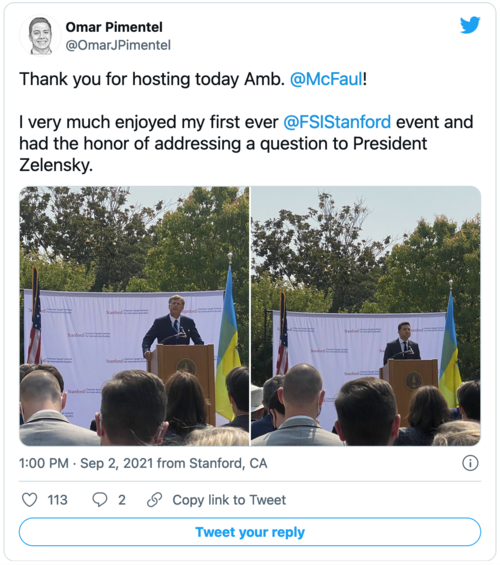
The Freeman Spogli Institute for International Studies (FSI) is honored to host the President of Ukraine, Volodymyr Zelensky, for an address on U.S.-Ukrainian relations. President Zelensky's visit to Stanford follows his August 31 meeting with United States President Joe Biden, and is the first visit to California by a Ukrainian president.

This event is publically available via Zoom. Please register in advance.

Lectures
Authors
News Type
Commentary
Date
Paragraphs

How will US-Russia relations develop within the next few years? Are we on the verge of a new cold war? What is needed to maintain strategic stability after the New START expires in 2026? What should be the format and aspects of the follow-on treaty? Do we really need depoliticization of negotiations? Is the elimination of all nuclear weapons is a realistic goal today? Can a nuclear-weapons-free world be really achieved? What will be the US policy on China within the next few years?

Pifer addresses these key international security questions.

Watch with LuxembourgForum

Hero Image
Man smiling
All News button
1
Subtitle

Steven Pifer, an affiliate of the Center for International Security and Cooperation, answers questions on strategic stability and arms control for the International Luxembourg Forum.

Authors
Noa Ronkin
News Type
News
Date
Paragraphs

The Pacific islands are known for their tropical climate, lush landscape, and rich cultures, but as coterminal student Ma’ili Yee has learned, they also form a backdrop to multiple geostrategic agendas in the Pacific Ocean region. In her recent research, Yee focuses on the vital economic, military, and geopolitical roles the Pacific island nations play at a time when the U.S.-China great power competition is generating renewed interest in the region.

Yee received her BA in International Relations in 2020 and is completing her MA in East Asian Studies this summer. She has been interested in Sino-U.S. relations in the South Pacific and noticed the scarcity of materials that incorporate Pacific Islander perspectives on the geopolitical developments in the region and how the island nations are affected by and responding to the tensions in the U.S.-China relation. She set out to study these issues.

Yee’s research over the past year has been supported by the Shorenstein APARC Diversity Grant. As part of its commitment to promoting inclusion and racial justice at Stanford, APARC established the grant in summer 2020 to support students from underrepresented minorities interested in studying contemporary Asia. Yee is the grant’s inaugural recipient.

Yee originally intended to use the grant to conduct field research in Fiji and Tonga but had to adjust her plans due to restrictions imposed by the COVID-19 pandemic. She ended up studying primary source materials shared online by country members of the Pacific Islands Forum (PIF), an inter-governmental organization that aims to enhance cooperation between countries and territories of the Pacific Ocean region, including the formation of a trade bloc and regional peacekeeping operations.

Multiple Islands, One “Blue Continent”

Yee’s research reveals that Pacific island nations do not share the same strategic and diplomatic agendas of traditional powers. Rather, in recent years, they have developed a more assertive diplomatic posture, becoming highly involved in promoting blueprints that are vital to their objectives and creating their own framework for defining strategic priorities in the Pacific region. Most importantly, as Yee explained in a recent presentation to the APARC community, Pacific island nations reject being viewed as pawns in a power game by larger states, particularly amidst the intensifying U.S.-China competition.

Against the framework of the Free and Open Indo-Pacific, island nations have endorsed a collective framework they call the Blue Pacific. The Free and Open Indo-Pacific, which was introduced by Japan and later formalized by the United States, is a strategic vision that often privileges the Indian Ocean over the Pacific Ocean and prioritizes U.S.-led maritime concerns.

By contrast, the Blue Pacific vision is grounded in Pacific island nations’ perspectives. It emphasizes the opportunity to leverage their collective oceanic presence and focuses on their concerns, foremost of which are climate change and sustainable development. The Blue Pacific advocates for a long-term foreign policy commitment to act as one “Blue Continent” while also calling for greater international coordination. PIF member countries are currently developing these priorities in their vision for the future, the 2050 Strategy for the Blue Pacific Continent. “The uncertainty of COVID-19,” write PIF Members, “only reinforces the need for a long-term strategy for how we work together as one Blue Pacific.”

By consolidating their interests as a unified political bloc, Yee concludes, Pacific Island nations now exercise significant agency in determining the trajectory of their region and using their voices to shape multilateral initiatives such as the Paris Agreement. External powers who seek to exercise influence in the Pacific Ocean region would do well to develop reciprocal relationships with island nations and consider their goals, she says.

Yee's research also examines the opportunities for fintech to promote sustainable development in the Pacific Ocean region and as an area for potential collaboration and competition amongst world powers as U.S.-China tensions continue to unfold.

“I am grateful to APARC for this Diversity Grant and for allowing me to do this kind of work,” says Yee. “It really would not be possible without such support, so it was cool to see this resource come out last summer.”

Read More

Figures of Kuomintang soldiers are seen in the foreground, with the Chinese city of Xiamen in the background, on February 04, 2021 in Lieyu, an outlying island of Kinmen that is the closest point between Taiwan and China.
Commentary

Strait of Emergency?

Debating Beijing’s Threat to Taiwan
Strait of Emergency?
Logo of the New South Wales Ministry of Health's podcast Future Health
News

Robotics and the Future of Work: Lessons from Nursing Homes in Japan

On the Future Health podcast, Karen Eggleston discusses the findings and implications of her collaborative research into the effects of robot adoption on staffing in Japanese nursing homes.
Robotics and the Future of Work: Lessons from Nursing Homes in Japan
Hero Image
Portrait of Ma'ili Yee, 2020-21 APARC Diversity Fellow
All News button
1
Subtitle

With support from Shorenstein APARC’s Diversity Grant, coterminal student Ma’ili Yee (BA ’20, MA ’21) reveals how Pacific island nations are responding to the U.S.-China rivalry by developing a collective strategy for their region.

-

*For fall quarter 2021, CISAC will be hosting hybrid events. Many events will offer limited-capacity in-person attendance for Stanford faculty, staff, fellows, visiting scholars, and students in accordance with Stanford’s health and safety guidelines, and be open to the public online via Zoom. All CISAC events are scheduled using the Pacific Time Zone.


REGISTRATION


Seminar Recording

About the Event: According to the Theory of the Nuclear Revolution (TNR), nuclear weapons have stabilized relations between great powers, making deterrence easier than compellence. This view is currently under attack. Recent work has documented Washington’s competitive approach to arms control agreements and the fragility of the nuclear stalemate. However, these critiques have not explained how policymakers could hope to extract coercive benefits from nuclear weapons. This paper revisits this question using a game-theoretic model. It shows that if the compellent state is able to bolster the credibility of its threat through standard techniques, i.e. burning bridges, probabilistic threats, or the rationality of irrationality, then compellence may succeed. However, greater military capabilities bolster coercion by increasing the risk of disaster, with first-strike capabilities being especially destabilizing. TNR was correct to warn about the risks of nuclear competition.

View paper


About the Speaker: 

Alexandre Debs is Associate Professor of Political Science at Yale University. 

His research focuses on the causes of war, nuclear proliferation, and democratization, and it has appeared in top journals such as the American Political Science Review, the American Journal of Political Science, the Journal of PoliticsInternational Organization, and International Security. He wrote with Nuno Monteiro the book Nuclear Politics: The Strategic Causes of Proliferation (2017, Cambridge University Press).

Alexandre received a Ph.d. in Economics from M.I.T., an M.Phil. in Economic and Social History from the University of Oxford as a Rhodes scholar, and a B.Sc. in Economics and Mathematics from Universite de Montreal.

Virtual Only. This event will not be held in person.

​Alexandre Debs Associate Professor Yale University
Seminars
-

About the Seminar: US response to 9/11 included a major focus on peace building through democracy promotion. The seminar examines the rationale and milestones for American engagement in distant lands. How will such an approach work in future foreign policy implementation is also discussed with some conclusions about future engagement.


For Fall Quarter 2021, we will be hosting a hybrid weekly Research Seminar Series. All events will be open to the public online via Zoom, and a limited-capacity in-person element for Stanford affiliates may be added in accordance with the County's health and safety guidelines.


Image
Shirin Tahir-Kheli
About the Speaker: Dr. Shirin Tahir-Kheli is a Senior Fellow and Founding Director of the South Asia Program at the Foreign Policy Institute of the Johns Hopkins University School of Advanced International Studies (SAIS). In 2011, Tahir-Kheli was named by Newsweek as one of the "150 Women Who Shake the World." She specializes in South Asia, nuclear non-proliferation, United Nations and U.S. foreign policy, and women's empowerment.

She is the author and editor of several monographs, including Pakistan Today: The Case for U.S.-Pakistan Relations (with Shahid Javed Burki, Foreign Policy Institute, 2017); Manipulating Religion for Political Gain in Pakistan: Consequences for the U.S. and the Region (Foreign Policy Institute, 2015); and India, Pakistan and the United States: Breaking with the Past (Council on Foreign Relations, 1997).

Democracy Promotion in U.S. Foreign Policy: Looking Back, Looking Forward
Download pdf

Online, via Zoom

Shirin Tahir-Kheli Ambassador & Senior Fellow, Foreign Policy Institute, Johns Hopkins School of Advanced International Studies, Washington DC Organization
Seminars
-

* Please note all CISAC events are scheduled using the Pacific Time Zone.

This event is hosted by the Hoover Institution and co-sponsored by CISAC.

Registration required to attend in person.

Event and Registration Link: https://www.hoover.org/events/spies-lies-and-algorithms

About the Event: Spying has never been more ubiquitous―or less understood. The world is drowning in spy movies, TV shows, and novels, but universities offer more courses on rock and roll than on the CIA and there are more congressional experts on powdered milk than espionage. This crisis in intelligence education is distorting public opinion, fueling conspiracy theories, and hurting intelligence policy. In Spies, Lies, and Algorithms, Amy Zegart separates fact from fiction as she offers an engaging and enlightening account of the past, present, and future of American espionage as it faces a revolution driven by digital technology.

Drawing on decades of research and hundreds of interviews with intelligence officials, Zegart provides a history of U.S. espionage, from George Washington’s Revolutionary War spies to today’s spy satellites; examines how fictional spies are influencing real officials; gives an overview of intelligence basics and life inside America’s intelligence agencies; explains the deadly cognitive biases that can mislead analysts; and explores the vexed issues of traitors, covert action, and congressional oversight. Most of all, Zegart describes how technology is empowering new enemies and opportunities, and creating powerful new players, such as private citizens who are successfully tracking nuclear threats using little more than Google Earth. And she shows why cyberspace is, in many ways, the ultimate cloak-and-dagger battleground, where nefarious actors employ deception, subterfuge, and advanced technology for theft, espionage, and information warfare.

Order Now


About the Speaker: 

Amy Zegart is the Morris Arnold and Nona Jean Cox Senior Fellow at the Hoover Institution and Professor of Political Science (by courtesy) at Stanford University. She is also a Senior Fellow at Stanford’s Freeman Spogli Institute for International Studies, Chair of Stanford’s Artificial Intelligence and International Security Steering Committee, and a contributing writer at The Atlantic. She specializes in U.S. intelligence, emerging technologies and national security, grand strategy, and global political risk management.

In person at Hauck Auditorium Hoover Institution and Livestreamed at https://www.hoover.org/events/spies-lies-and-algorithms

Hoover Institution
Stanford University
Stanford, CA 94305-6010

0
Senior Fellow, by courtesy, at the Freeman Spogli Institute for International Studies
Professor of Political Economy in the Graduate School of Business
Professor of Political Science
Thomas and Barbara Stephenson Senior Fellow on Public Policy at the Hoover Institution
2214-small_C_RICEMI60239-004078r5X7..jpg PhD

Condoleezza Rice is the Tad and Dianne Taube Director of the Hoover Institution and a Senior Fellow on Public Policy. She is the Denning Professor in Global Business and the Economy at the Stanford Graduate School of Business. In addition, she is a founding partner of Rice, Hadley, Gates & Manuel LLC, an international strategic consulting firm.

From January 2005 to January 2009, Rice served as the 66th Secretary of State of the United States, the second woman and first black woman to hold the post. Rice also served as President George W. Bush’s Assistant to the President for National Security Affairs (National Security Advisor) from January 2001 to January 2005, the first woman to hold the position.

Rice served as Stanford University’s provost from 1993 to 1999, during which time she was the institution’s chief budget and academic officer. As Professor of Political Science, she has been on the Stanford faculty since 1981 and has won two of the university’s highest teaching honors.

From February 1989 through March 1991, Rice served on President George H.W. Bush’s National Security Council staff. She served as Director, then Senior Director, of Soviet and East European Affairs, as well as Special Assistant to the President for National Security. In 1986, while an International Affairs Fellow of the Council on Foreign Relations, Rice also served as Special Assistant to the Director of the Joint Chiefs of Staff.

She has authored and co-authored numerous books, most recently To Build a Better World: Choices to End the Cold War and Create a Global Commonwealth (2019), co-authored with Philip Zelikow. Among her other volumes are three bestsellers, Democracy: Stories from the Long Road to Freedom (2017); No Higher Honor: A Memoir of My Years in Washington (2011); and Extraordinary, Ordinary People: A Memoir of Family (2010). She also wrote Political Risk: How Businesses and Organizations Can Anticipate Global Insecurity (2018) with Amy B. Zegart; Germany Unified and Europe Transformed: A Study in Statecraft (1995) with Philip Zelikow; edited The Gorbachev Era (1986) with Alexander Dallin; and penned The Soviet Union and the Czechoslovak Army; 1948-1983: Uncertain Allegiance (1984).

In 1991, Rice co-founded the Center for a New Generation (CNG), an innovative, after-school academic enrichment program for students in East Palo Alto and East Menlo Park, California. In 1996, CNG merged with the Boys & Girls Club of the Peninsula, an affiliate club of the Boys & Girls Clubs of America (BCGA). CNG has since expanded to local BGCA chapters in Birmingham, Atlanta, and Dallas. Rice remains an active proponent of an extended learning day through after-school programs.

Since 2009, Rice has served as a founding partner at Rice, Hadley, Gates, & Manuel LLC, an international strategic consulting firm based in Silicon Valley and Washington, D.C. The firm works with senior executives of major companies to implement strategic plans and expand in emerging markets. Other partners include former National Security Advisor Stephen J. Hadley, former Secretary of Defense Robert M. Gates, and former diplomat, author, and advisor on emerging markets, Anja Manuel.

In 2022, Rice became a part-owner of the Denver Broncos as a part of the Walton-Penner Family Ownership Group. In 2013, Rice was appointed to the College Football Playoff Selection Committee, formerly the Bowl Championship Series. She served on the committee until 2017.

Rice currently serves on the boards of C3.ai, an AI software company; and Makena Capital Management, a private endowment firm. In addition, she is Vice Chair of the Board of Governors of the Boys & Girls Clubs of America and a trustee of the Aspen Institute. Previously, Rice served on various boards, including Dropbox; the George W. Bush Institute; the Commonwealth Club; KiOR, Inc.; the Chevron Corporation; the Charles Schwab Corporation; the Transamerica Corporation; the Hewlett-Packard Company; the University of Notre Dame; the Foundation of Excellence in Education; the John F. Kennedy Center for the Performing Arts; and the San Francisco Symphony.

Born in Birmingham, Alabama, Rice earned her bachelor’s degree in political science, cum laude and Phi Beta Kappa, from the University of Denver; her master’s in the same subject from the University of Notre Dame; and her Ph.D., likewise in political science, from the Graduate School of International Studies at the University of Denver.

Rice is a Fellow of the American Academy of Arts and Sciences and has been awarded over fifteen honorary doctorates.

Seminars
Subscribe to International Relations