International Relations

FSI researchers strive to understand how countries relate to one another, and what policies are needed to achieve global stability and prosperity. International relations experts focus on the challenging U.S.-Russian relationship, the alliance between the U.S. and Japan and the limitations of America’s counterinsurgency strategy in Afghanistan.

Foreign aid is also examined by scholars trying to understand whether money earmarked for health improvements reaches those who need it most. And FSI’s Walter H. Shorenstein Asia-Pacific Research Center has published on the need for strong South Korean leadership in dealing with its northern neighbor.

FSI researchers also look at the citizens who drive international relations, studying the effects of migration and how borders shape people’s lives. Meanwhile FSI students are very much involved in this area, working with the United Nations in Ethiopia to rethink refugee communities.

Trade is also a key component of international relations, with FSI approaching the topic from a slew of angles and states. The economy of trade is rife for study, with an APARC event on the implications of more open trade policies in Japan, and FSI researchers making sense of who would benefit from a free trade zone between the European Union and the United States.

-

Henry S. Rowen, a Stanford economist and professor emeritus of public policy and management, died in Palo Alto on Nov. 12, 2015. He was 90. Rowen, known affectionately as “Harry” to colleagues and friends, led a long, notable career in academia and public service. Having served in three U.S. administrations, he shaped the construction of American policy on a range of issues from entrepreneurship to intelligence. He was the Edward B. Rust Professor of Public Policy and Management, emeritus, at Stanford’s Graduate School of Business, a senior fellow at the Hoover Institution, a senior fellow, emeritus, at the Freeman Spogli Institute for International Studies (FSI), and a director emeritus of the Walter H. Shorenstein Asia-Pacific Research Center (APARC).

Over the course of his career, Rowen twice held positions at the RAND Corporation, first as an economist, and later as its president for five years from 1967 to 1972.

In Washington, he held several prominent positions in the Kennedy, Reagan and George H. W. Bush administrations. From 1981 to 1983, he was the chairman of the U.S. National Intelligence Council (NIC), and the assistant secretary of defense for international security affairs from 1989 to 1991.

Rowen’s interdisciplinary experiences yielded a deep knowledge of the social and political factors in nations struggling with a sustainable peace, weighing nuclear proliferation issues, and considering new forms of governance.


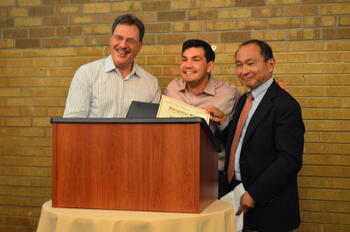
Please join us for a special celebration of Professor Rowen’s life with remarks and memories shared by a distinguished group of Harry’s professional colleagues and personal friends, including:

William Perry, 19th U.S. Secretary of Defense, Director of the Preventive Defense Project,CISAC, Stanford University

Francis Fukuyama, Director, Center on Democracy, Development, and the Rule of Law, Senior Fellow FSI, Stanford University

Thomas Fingar, Shorenstein APARC Distinguished Fellow, Stanford University

Alain Enthoven, Professor of Public and Private Management, Emeritus, Graduate School of Business, Stanford University

William Miller, Professor of Public and Private Management, Emeritus, Professor of Computer Science, Emeritus, School of Engineering, Senior Fellow Emeritus, FSI, Stanford University

Kenneth Arrow, Professor of Economics and Professor of Operations Research, Emeritus

Michael Armacost, (moderator) Shorenstein APARC Distinguished Fellow, Stanford University

A reception will follow in the Encina Hall Lobby

Conferences
Paragraphs

Following her signing of an open letter registering concerns about potential privacy abuses with Digital India and her op-ed "How to Think About Modi's Visit to Silicon Valley," Stanford historian Priya Satia addresses the hate mail and criticism those actions precipitated, ironically enough from defenders of India's Hindus' "particular tolerance."

All Publications button
1
Publication Type
Commentary
Publication Date
Journal Publisher
Perspectives on History
Authors
Paragraphs

As Christmas celebrations for 2015 wind down, Stanford historian and archaeologist Ian Morris discusses the global reach of different aspects of the Christmas holiday, and compares theories of the relative influence of "soft power" cultural exports and "hard power" military and economic intervention on world societies.

All Publications button
1
Publication Type
Commentary
Publication Date
Journal Publisher
Stratfor
Authors
Ian Morris
-

Less than four years after Mao Zedong’s death, Deng Xiaoping declared that China needed to move away from an “over-concentration of power” by an individual leader to establish a more institutionalized system of governance. Xi Jinping’s ascension to power in 2013 promised a new era of reform of the Communist Party of China (CCP), specifically intended to preserve the party’s power.  Rather than addressing governance issues, however, Xi’s actions, such as the anti-corruption campaign, have served to concentrate power in his hands, showing the weakness of political institutionalization in China after decades of collective leadership.  While decision-making processes continue to be a black box, by reclaiming the CCP’s authority over policy-making, and by chairing CCP small leading groups, Xi appears to have moved China back to Mao-style personalistic rule.   The puzzles that remain are how personalistic authoritarian rule has returned to a country characterized by a growing middle class and a modern open market economy; and what this reversion to personalistic leadership tells us about the ambiguities of institutions in communist ruling parties.  


Susan Shirk is the Chair of the 21st Century China Program and Research Professor at the School of Global Policy and Strategy at the University of California - San Diego. She is also director emeritus of the University of California’s Institute on Global Conflict and Cooperation (IGCC). Susan Shirk first visited China in 1971 and has been teaching, researching and engaging China diplomatically ever since. 

From 1997-2000, Shirk served as Deputy Assistant Secretary of State in the Bureau of East Asia and Pacific Affairs, with responsibility for China, Taiwan, Hong Kong and Mongolia.

In 1993, she founded, and continues to lead, the Northeast Asia Cooperation Dialogue (NEACD), a Track II forum for discussions of security issues among defense and foreign ministry officials and academics from the U.S., Japan, China, Russia, South Korea and North Korea.

Shirk's publications include her books, China:  Fragile Superpower; How China Opened Its Door: The Political Success of the PRC's Foreign Trade and Investment Reforms; The Political Logic of Economic Reform in China; Competitive Comrades: Career Incentives and Student Strategies in China; and her edited book, Changing Media, Changing China.

Shirk served as a member of the U.S. Defense Policy Board, the Board of Governors for the East-West Center (Hawaii), the Board of Trustees of the U.S.-Japan Foundation, and the Board of Directors of the National Committee on United States-China Relations. She is a member of the Trilateral Commission, the Council on Foreign Relations, and an emeritus member of the Aspen Strategy Group. Dr. Shirk received her BA in Political Science from Mount Holyoke College, her MA in Asian Studies from the University of California, Berkeley, and her PhD in Political Science from the Massachusetts Institute of Technology.


This event is off the record.

Feb 19, 2016 Event Flyer
Download pdf
Susan Shirk, UC San Diego
Seminars
-

Abstract

After five years of political support for the regime of Bashar Al-Asad in its war against the opposition, Russia intervened militarily on his behalf in September 2015 and suddenly later this year Russian President Vladimir Putin announced the withdrawal of the Russian troops from Syria. While Moscow claims that its intervention was aimed at destroying ISIS and other terrorists groups, but the vast majority of its air strikes seem to target the moderate armed opposition, which has fought ISIS on the ground. This presentation assesses the outcome of Russia’s intervention, arguing that it neither achieved its goal of destroying ISIS nor did it tip the balance favor of Asad. Instead, the intervention had resulted in the killing of Syrian civilians, complicated the conflict in Syria, and constrained the prospects for a political solution by empowering Asad on the ground.

Speaker Bio

Image
radwan
Radwan Ziadeh is a senior analyst at the Arab Center in Washington D.C. He is the founder and director of the Damascus Center for Human Rights Studies in Syria and co-founder and executive director of the Syrian Center for Political and Strategic Studies in Washington, D.C. He is a Visiting Scholar at the Center for the Study of Human Rights at Columbia University, and Fellow at the Institute for Social Policy and Understanding (ISPU) in Washington D.C. Ziadeh was the managing editor of the Transitional Justice Project in the Arab World, and the Head of the Syrian Commission for Transitional Justice, which was established on November 14, 2013 by the Syrian Interim Government. He was also involved in the Syrian political opposition. He was elected in October 2011 as director of the Foreign Relations Office of the Syrian National Council until he resigned from the position in November 2012. He wrote more than twenty books in English and Arabic. His most recent book is Syria's Role in a Changing Middle East: The Syrian-Israeli Peace Talks (I.B.Tauris, 2016). Ziadeh holds a D.D.S in Dentistry from Damascus University, Diploma in international Human Rights Law from College of Law at the American University in Washington D.C, an MA in Democracy and Governance from Georgetown University in Washington D.C, and an MS in Finance from Kogod School of Business at the American University in Washington D.C.


[[{"fid":"222587","view_mode":"crop_870xauto","fields":{"format":"crop_870xauto","field_file_image_description[und][0][value]":"Radwan Ziadeh flyer","field_file_image_alt_text[und][0][value]":"","field_file_image_title_text[und][0][value]":"","field_credit[und][0][value]":"","field_caption[und][0][value]":"","field_related_image_aspect[und][0][value]":"","thumbnails":"crop_870xauto"},"type":"media","attributes":{"width":"870","style":"width: 870px;","class":"media-element file-crop-870xauto"}}]]


CISAC Central Conference Room
Encina Hall, 2nd Floor
616 Serra St
​Stanford, CA 94305

Radwan Ziadeh Arab Center, Washington, DC
Seminars
-

Abstract

After nearly five years since the start of the uprising, Syria finds itself divided and embattled, with no end in sight. More significantly, more than half of the Syrian population is displaced and the death toll surpassed 300,000 by all counts. The Syrian tragedy persists and, more than any other case of mass uprising in the region, continues to be shrouded in political power-plays and contradictions at the local, regional, and international levels. Defined increasingly by an absence of a clear favorable outcome, considering existing parties to the conflict, the logic of the lesser evil reigns supreme. This lecture is an attempt to understand the roots and dynamics of the tragic Syrian uprising, with particular attention to its background and to the recent Russian intervention.

Speaker Bio

Image
unnamed
Bassam Haddad is Director of the Middle East Studies Program and Associate Professor in the Department of Public and International Affairs at George Mason University, and is Visiting Professor at Georgetown University. He is the author of Business Networks in Syria: The Political Economy of Authoritarian Resilience (Stanford University Press, 2011). Haddad is currently editing a volume on Teaching the Middle East After the Arab Uprisings, a book manuscript on pedagogical and theoretical approaches. His most recent books include two co-edited volumes: Dawn of the Arab Uprisings: End of an Old Order? (Pluto Press, 2012) and Mediating the Arab Uprisings (Tadween Publishing, 2013). Haddad serves as Founding Editor of the Arab Studies Journal a peer-reviewed research publication and is co-producer/director of the award-winning documentary film, About Baghdad, and director of the critically acclaimed film series, Arabs and Terrorism, based on extensive field research/interviews. More recently, he directed a film on Arab/Muslim immigrants in Europe, titled The "Other" Threat. Haddad is Co-Founder/Editor of Jadaliyya Ezine and serves on the Editorial Committee of Middle East Report. He is the Executive Director of the Arab Studies Institute, an umbrella for five organizations dealing with knowledge production on the Middle East and Founding Editor of Tadween Publishing.


This event is co-sponsored by The Markaz: Resource Center at Stanford University.


[[{"fid":"221861","view_mode":"crop_870xauto","fields":{"format":"crop_870xauto","field_file_image_description[und][0][value]":"Bassam Haddad January 21","field_file_image_alt_text[und][0][value]":"","field_file_image_title_text[und][0][value]":"","field_credit[und][0][value]":"","field_caption[und][0][value]":"","field_related_image_aspect[und][0][value]":"","thumbnails":"crop_870xauto"},"type":"media","attributes":{"width":"870","class":"media-element file-crop-870xauto"}}]]


CISAC Central Conference Room
Encina Hall, 2nd Floor
616 Serra St
Stanford, CA 94305

Bassam Haddad Associate Professor George Mason University
Seminars
-


Image
Joseph Z. Perkins, a partner in Orrick's Silicon Valley office, is a member of the Technology Companies Group, which advises emerging companies and venture capital firms. Mr. Perkins focuses his practice on providing private venture financing and merger and acquisition services to Internet, high tech, and clean technology companies in the United States and Japan.


Some of Mr. Perkins's current and former clients include the following:
• Bleacher Report (Sports media; acquired by Turner Broadcasting)
• Doki Doki (stealth)
• FOVE (Virtual reality hardware)
• Getaround (Car sharing community)
• Instagram (Photo social media; acquired by Facebook)
• iSpace (Robotics)
• Life360 (Family connectivity and safety)
• Orchestra - aka Mailbox (e-mail management; acquired by Dropbox)
• Ooma (VoiP hardware)
• Pinterest (Social Media)
• Say Media - fka VideoEgg (Advertising)
• Social Finance (social lending)
• UniversityNow (Online education)
• WHILL (Personal Mobility)

Prior to receiving his Juris Doctor from Harvard Law School, Mr. Perkins spent four years as an officer of a company that provides language and travel services to Japanese travelers.

Seminar Description

The idea of raising money through venture capital can be daunting if you’ve never gone through that process before.  In this presentation, we will discuss various aspects of the fundraise process, including how to choose your investor and prepare for a term sheet, key terms to look for in the financing, and how to get to close as quickly as possible.  Learn about different types of investors, what they look for in their potential investments, and what they bring to the table in accelerating a startup’s growth.  We’ll also review specific scenarios and how various liquidation preferences can impact your company’s exit.

 
RSVP Required

NOTE: The date for this seminar has changed to February 23, 2016.

Agenda
4:15pm: Doors open
4:30pm-5:30pm: Lecture, followed by discussion
5:30pm-6:00pm: Networking

For more information about the Silicon Valley-New Japan Project please visit: http://www.stanford-svnj.org/

Philippines Conference RoomEncina Hall, 3rd Floor616 Serra SteetStanford, CA 94305
Joseph Z. Perkins, Partner, Technology Companies Group, Orrick, Herrington & Sutcliffe LLP
Seminars
Paragraphs

The fifteenth session of the Korea-U.S. West Coast Strategic Forum, held in Korea on November 17, 2015, convened senior South Korean and American policymakers, scholars and regional experts to discuss North Korea policy and recent developments on the Korean Peninsula. Hosted by the Korea Program at the Walter H. Shorenstein Asia-Pacific Research Center at Stanford University, the Forum is also supported by the Sejong Institute.

All Publications button
1
Publication Type
Policy Briefs
Publication Date
-

For scholars of corruption, the ferocious anti-corruption campaign launched by Xi Jinping since the end of 2012 has provided a wealth of fresh evidence of corruption in the Chinese body politic and economy.  The revelations from media accounts and court documents suggest that crony capitalism -- defined by the incestuous relationship between government officials and private businessmen -- has penetrated key Chinese political institutions and economic sectors.  Based on detailed examinations of 50 high-profile cases, many of them prosecuted in the last three years, this study investigates the institutional origins of crony capitalism, identifies principal modes of collusion between political and economic elites, and analyzes its behavioral patterns.  The insights from this study imply that Xi's anti-corruption drive will have only limited success if it does not treat the causes of corruption in contemporary China.


Minxin PEI is the Tom and Margot Pritzker '72 Professor of Government and George R. Roberts Fellow and Director of the Keck Center for International and Strategic Studies. Dr. Pei’s areas expertise includes China, Comparative Politics, Pacific Rim, U.S./Asia Relations, and U.S./China Relations. Dr. Pei’s published work includes China’s Transition: The limits of developmental autocracy (Harvard University Press, 2006), and From Reform to Revolution: The demise of communism in China and the Soviet Union (Harvard University Press, 1994).


This event is off the record.

Minxin Pei Claremont McKenna College
Seminars
Subscribe to International Relations