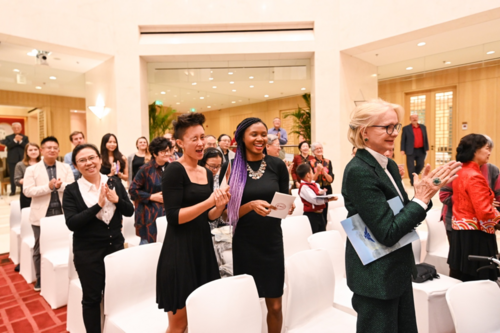
FSI researchers strive to understand how countries relate to one another, and what policies are needed to achieve global stability and prosperity. International relations experts focus on the challenging U.S.-Russian relationship, the alliance between the U.S. and Japan and the limitations of America’s counterinsurgency strategy in Afghanistan.
Foreign aid is also examined by scholars trying to understand whether money earmarked for health improvements reaches those who need it most. And FSI’s Walter H. Shorenstein Asia-Pacific Research Center has published on the need for strong South Korean leadership in dealing with its northern neighbor.
FSI researchers also look at the citizens who drive international relations, studying the effects of migration and how borders shape people’s lives. Meanwhile FSI students are very much involved in this area, working with the United Nations in Ethiopia to rethink refugee communities.
Trade is also a key component of international relations, with FSI approaching the topic from a slew of angles and states. The economy of trade is rife for study, with an APARC event on the implications of more open trade policies in Japan, and FSI researchers making sense of who would benefit from a free trade zone between the European Union and the United States.
Using behavioral web-tracking data collected over the 2016 U.S. general election, Matthew Tyler, Justin Grimmer and Shanto Iyengar demonstrate that partisans direct their attention at congenial sources and apolitical portal sites, while ignoring more antagonistic news outlets. While users of all-purpose sites such as Yahoo and MSN come from across the political spectrum, users of dedicated news sites diverge by their partisanship. The authors further demonstrate that partisans tend to consume more news when campaign events favor their party's candidate. They show that the release of the Access Hollywood tape increased news consumption among Democrats, while the announcement of the Comey letter bolstered news consumption among Republicans. These short-term effects on news consumption proved asymmetric. While partisans became more engaged in the aftermath of “good news,'' the authors find no evidence that they avoided exposure to the news in the aftermath of “bad news.'' Overall, the results show that partisans engage with the news more frequently when the news favors their side, and they engage at sites that attract like-minded partisans.
This talk describes the disinformation campaign targeting the Syria Civil Defense (or “White Helmets”), a humanitarian response group that works in rebel held areas of Syria. The White Helmets provide medical aid, search, and rescue to people affected by the civil war in Syria. They also document the impacts of atrocities — including airstrikes and chemical weapons attacks — perpetrated by the Syrian regime and their Russian allies. For several years, the White Helmets have been the target of a campaign to undermine and delegitimize their work. In this talk, I describe a multi-study research effort that reveals how this multi-dimensional, cross-platform campaign “works” — including a look at the media ecosystems that support the campaign, the networks of actors who collaborate to produce and spread its narratives (including government agents and “unwitting crowds” of online activists), and the “work” that these actors participate in, using the affordances of social media platforms to connect, recruit, organize, promote their messages, attack opposing messages, and otherwise advance the goals of their campaign.
On October 1st, with a massive National Day parade down Chang’an Avenue in Beijing, the People’s Republic of China celebrated the 70th anniversary of its establishment in 1949. Like a split-screen T.V., however, on the other side of the border in Hong Kong, black-clad protesters wearing gas masks and goggles undertook one of the most violent protests in Hong Kong SAR since the 1997 handover.
With those contrasting images still fresh on everyone’s minds, FSI, Shorenstein APARC, Stanford China Program, and the Center for East Asian Studies jointly sponsored a conference on October 2nd titled “Hong Kong: A City in Turmoil” to an overflow audience. Jean Oi, Director of the Stanford China Program who moderated the program opened the conference by quoting Stanford President Marc Tessier-Lavigne and Provost Persis Drell who, in a campus-wide message, had recently encouraged the university community to not shy away from difficult conversations. “We have an extraordinary opportunity [at Stanford],” she quoted from their email, “to learn from each other, to have our thinking challenged, to sharpen our arguments and to develop better ideas from a thoughtful debate.” Even while explicitly aware, therefore, that differing opinions rage on both sides of the debate regarding Hong Kong’s protests, but trusting that “there are thoughtful people on both sides of the debate,” she continued, “we have decided to organize this special event.”
The former Chief Secretary for Administration of the Hong Kong Government (1993-2001) Anson Chan gave the keynote speech followed by a panel discussion featuring Harry Harding, University Professor and Professor of Public Policy, University of Virginia; David M. Lampton, Oksenberg-Rohlen Fellow, FSI, Stanford University; and Ming Sing, Associate Professor, The Hong Kong University of Science and Technology.
The Honorable Anson Chan speaks at Hong Kong: A City in Turmoil conference.
The Honorable Anson Chan gives the keynote speech at the "Hong Kong: A City in Turmoil" conference.
Keynote Speech
In her keynote, Anson Chan first recalled the handover ceremony in 1997, which she attended as Hong Kong SAR’s Chief Secretary, bridging the transition from British sovereignty to Chinese sovereignty. Chan spoke of her dawning realization at the time that the transition of sovereignty “would call Hong Kong people to forge a new identity” that “reconciled our community both with its past and future.” She noted “that many Hong Kong people, particularly the young, have indeed forged a new identity, but not as loyal, submissive Chinese patriots that Beijing had hoped for.” The central government had “singularly failed to win hearts and minds,” Chan added, especially of its young people. Hong Kong is, indeed, now at a crossroads and, she admitted, is a “city in turmoil.”
In Chan’s recollection, the central government exercised its power with “great restraint” following the handover. At first, the SAR government, too, was vigilant in protecting Hong Kong’s high degree of autonomy. Gradually, however, the city’s autonomy and civil liberties, she asserted, suffered increasing erosion. In particular, “[o]ver the past fifteen years, things changed drastically.” Describing the series of events that have caused Hong Kong’s residents increasing alarm -- including the forced abduction of Hong Kong-based booksellers; disappearance of a mainland Chinese billionaire from a luxury hotel in Hong Kong; Legislative Council members’ oath-taking controversy; the resulting disqualification of six legislative members; and the political screening of pro-democracy electoral candidates, etc. -- she further noted that the “snail’s pace of progress” in implementing full universal suffrage for the election of the Chief Executive and all members of the legislature promised in the Basic Law also brought on mounting popular frustration and despair.
“Was this progressive erosion of Hong Kong’s autonomy inevitable?” Chan asked. “I don’t think so,” she answered. Since 1997, Hong Kong SAR’s successive Chief Executives, she countered, have progressively failed to reassure the Hong Kong people that, first and foremost, they will do their utmost to uphold “one country, two systems,” and to defend Hong Kong’s autonomy. In an unsparing critique, she noted, they have instead increasingly come across as “mouthpieces of the central government, toeing the Beijing line.” Chan also suggested that “some years back, Beijing began to both lose confidence in the judgment and competence of the Hong Kong administration and to fear that growing sense of people’s identity as ‘Hong Kongers’ rather than Chinese citizens could pose a threat to the long-term, successful integration of Hong Kong into the motherland.” This growing distrust, then, proved catalytic to increasing tensions and difficulties in Hong Kong-PRC relations.
Characterizing 2003 as the first watershed moment when large public demonstrations – Hong Kong people’s “first taste of people power” -- forced the SAR government to withdraw its proposed bill under Hong Kong Basic Law Article 23, Chan recounted the failure of the constitutional reform consultation process in 2013-2014, the decision of the Standing Committee of the National People’s Congress on August 31, 2014 to set institutional limits on universal suffrage, and the resulting 2014 Occupy Movement, which later morphed into the Umbrella Movement. These popular movements failed to yield genuine universal suffrage, however, and this failure, Chan stated, “left wounds that went unhealed and festered quietly.”
The million-strong protests on June 9th and 16th to register popular opposition to Hong Kong SAR government’s introduction of its extradition bill “broke all records,” Chan noted. Recounting the five demands of the current protesters, Chan voiced support for the establishment of an independent commission with “carefully crafted terms of reference” that could objectively examine the handling of the current unrests. Such a commission could go a long way towards pacifying the protesters, she suggested, and “[s]top the violence, at least for the time being.” She also urged the reopening of broad-based consultation on political reforms, lain dormant since the collapse of the Umbrella Movement in 2014; and to even consider a measure of amnesty to exonerate a subset of both the protesters and the police. Recognizing how problematic such a recommendation might be in the face of spiraling violence and vandalism, she noted, “we are in an unprecedented crisis, and for society to heal, unprecedented measures such as an amnesty applying to certain actions by the protesters and the police force may well prove to be necessary.”
Calling herself an “unrepentant optimist” even against formidable odds, Chan highlighted how Hong Kong has come through many challenges before and after the handover. She sought to emphasize how “[t]he majority [of Hong Kong people] are not anti-China and accepts that Hong Kong is a part of China.” However, she continued, “they are also proud of their Hong Kong identity and fiercely protective of the rights and freedoms they enjoy and which are guaranteed by the Joint Declaration and the Basic Law.” Condemning the violence committed by both the police and the protesters, Chan ended her speech with the following words.
So, on this seventieth anniversary of the founding of the People’s Republic of China, we in Hong Kong recognize the huge progress that our country has made in a breathtakingly short time, lifting hundreds of millions out of poverty, improving living standards and achieving economic growth and social advancement that are the envy of the world. We are proud of the unique contribution that Hong Kong has made to our nation’s spectacular achievements and modernization. But we are distressed that the central government feels it necessary to be increasingly repressive towards its Hong Kong subjects. I urge the Beijing leadership to act with greater confidence and to trust us more completely with stewardship of our own future by allowing us to elect our own leaders. In these troubled times, we ask Beijing respectfully to listen with greater understanding to the voices of Hong Kong’s upcoming generations, to recognize and respond to their fears and aspirations and, above all, to harness their talent, their energy and commitment for the benefit of the city we all love and for the benefit of our nation as a whole.
Panel Commentary
Harry Harding, University Professor and Professor of Public Policy, University of Virginia, next spoke from the panel. He applauded the clear and concise rendering that Chan provided of how Hong Kong arrived at the current crisis but noted that his was “a more pessimistic forecast” of Hong Kong’s future. With “one country, two systems” due to expire in 2047, he surmised that Beijing will further whittle away at Hong Kong’s key institutions, such as the judiciary, the press, and universities, and, perhaps, even the freedom of expression of its business community. With respect to Taiwan, Harding noted the increasing urgency in President Xi Jinping’s call for Taiwan to be reunified with the motherland. Yet, Harding noted, the developments in Hong Kong have made “one country, two systems” increasingly unpalatable to even those traditionally favorably disposed towards Beijing. For the U.S., the recent protests have enabled Hong Kong to take center stage with legislative action around the Hong Kong Human Rights and Democracy Act, the PROTECT Hong Kong Act, and debates surrounding the Hong Kong Policy Act. The recent unrest has also contributed to declining favorability ratings for the PRC from all sectors of the United States, he noted.
Harry Harding, one of the panelists at the conference, gives his thoughts on the situation in Hong Kong.
Harry Harding, one of the panelists for the conference, gives his thoughts on the situation in Hong Kong.
Ming Sing, Associate Professor, The Hong Kong University of Science and Technology, first delineated the increasing levers of political and economic controls imposed by the PRC government upon Hong Kong SAR since 2003; and the corresponding rise in intensity of political protests in Hong Kong. He then provided a fine-grained analysis of the different phases of the 2019 protests, which began as a peaceful mobilization of public resistance, then grew in violence and counter-violence. He further presented a number of surveys that showed how the majority of the protesters are, indeed, well-educated and young with many of the frontline protesters being university and secondary students. Despite media reports that have suggested that economic discontent lies at the heart of protesters’ grievances, Sing presented survey data that the demonstrators’ grievances are, in fact, mainly political, including Hong Kong’s lack of universal suffrage and central government intervention, among others. Such data, he concluded, further highlights the gaping distrust between Hong Kong’s youth and the central government.
Ming Sing speaks during the Hong Kong: A City in Turmoil conference.
Ming Sing explains the information presented in his slides.
David M. Lampton Oksenberg-Rohlen Fellow, FSI, Stanford University, characterized himself as “hopeful but worried” about the situation in Hong Kong. Raising five observations in particular, Lampton noted the first worrying sign: i.e., neither the outside world nor the SAR have a “road map to the future” with the PRC. Neither the Basic Law nor the Joint Declaration of 1984 can now serve as such a “roadmap,” Lampton asserted, and without a “shared vision,” he stated, “[i]t’s hard to be optimistic.” Secondly, in this “leaderless” protest movement, Lampton asked whether anyone can authoritatively negotiate with and enforce upon its followers any agreement reached with Beijing, should any transpire, so that it can lead to an effective resolution. Thirdly, as evidenced by the PRC’s mass display of “muscular nationalism” on October 1st, Lampton questioned whether Xi Jinping has any incentives to accommodate Hong Kong protesters’ demands, especially when Beijing’s leadership may have its own worries about domestic stability in the PRC. Fourth, with constitutional crises engulfing both the U.S. and Great Britain, Lampton noted, Western democracies are also hampered from effectively and responsibly addressing the situation in Hong Kong. And lastly, Lampton acknowledged how, in the policy vacuum left by the Trump White House with respect to Hong Kong, U.S. Congress was speeding towards adopting punitive legislation against the PRC. But Lampton again expressed doubts as to whether sanctions and threats are effective tools to extract concessions from the PRC government under Xi Jinping.
David M. Lampton shares his viewpoint with the other panelists.
David M. Lampton shares his viewpoint with the other panelists.
Image
The Honorable Anson Chan gives summarizing remarks to close out the "Hong Kong: A City in Turmoil" conference.
Watch the entire conference below. You can also listen to the audio version below, selecting individual tracks.
Hero Image
Professor Thomas Fingar (left) introduces the "Hong Kong: A City in Turmoil" conference keynote speaker, The Honorable Anson Chan.
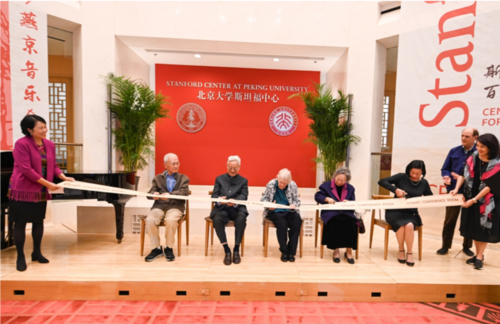
In connection with the 100th anniversary of Yenching University, the opening ceremony of the Stuart Conference Room (SCR) was held at the Stanford Center at Peking University (SCPKU) on October 8. We were honored by the attendance of Isabel Crook, recent recipient of the Medal of Friendship awarded by President Jinping Xi, Mr. Liliang He, former Deputy Director of the Ministry of Foreign Affairs, and Mingyi Wei, an alumnus of Yenching University and former president of the CITIC Group.
The Executive Director of SCPKU Mr. Jiashu Cheng delivered a welcoming speech and pointed out that the Stanford Center, as a bridge of cultural communication between China and US, is committed to promoting the mutual understanding and the mutual progress between the two countries. He also stated that the ceremony was being held in appreciation of Dr. John Leighton Stuart’s great efforts and his contributions to furthering US-China relations, especially the establishment of Yenching University, which are legendary and remain an inspiration to this day.
Jean Oi, a chaired professor in the political science department of Stanford University and Director of SCPKU expressed her sincere gratitude to Mr. Jiashu Cheng and his wife Mrs. Wan Xu for their generous donations. She emphasized that this multi-functional video conference room has the means to greatly advance the efforts started by Yenching University and Dr. Stuart to further strengthen cross-straits development and cooperation in education, science and technology, culture and many other fields.
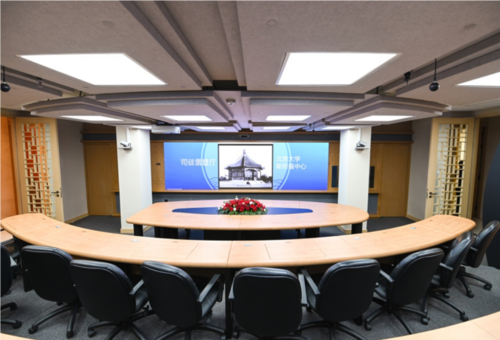
The technology of SCR is a US-China joint effort. The state-of-the-art telecommunication / video conference technology is a product of Cisco Corporation of the United States, while the LED screen display technology comes from China’s Leyard Group. The SCR allows faculties and students from Chinese Universities who are sitting at SCPKU to connect, in real time, with more than 250 classrooms, labs, conference facilities and offices at Stanford University. Classes can be taught with teachers and students interacting in real time on both sides of the Pacific. The Stanford Graduate School of Business (GSB) performed an inaugural trial run of the system a couple weeks ago, when students at the GSB held a joint class with Peking University’s Yenching Academy students who attended the class in the SCR.
Beijing Campus
Stanford Center at Peking University The Lee Jung Sen Building Langrun Yuan Peking University No.5 Yiheyuan Road Haidian District Beijing, P.R.China 100871
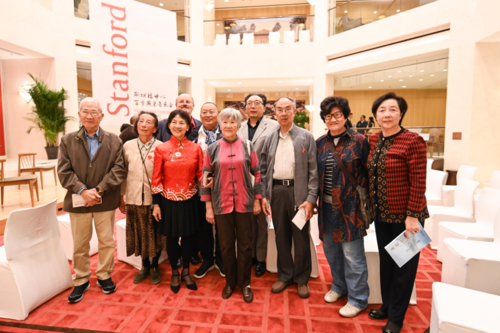
Distinguished alumni, their relatives, and friends gathered at SCPKU on October 8, 2019 to celebrate the 100th Anniversary of Yenching University, which until 1952 operated on the current site of Peking University. We were honored by the attendance of so many illustrious guests, including Isabel Crook, recent recipient of the Medal of Friendship awarded by President XI Jinping; He Liliang, a senior diplomat and wife of Yenching graduate, Huang Hua (former vice chairman of National People’s Congress); and Wei Mingyi, an alumnus of Yenching University and former president of the CITIC Group.
Image
Xu Wan, Han Jialin, Wei Mingyi, Isabel Crook, He Liliang, Jean Oi, Michael Crook, Xu Lian cutting the ribbon for the Stuart Room
Image
Front row: Children and friends of famous Yenching faculty. Back row: Carl Crook, artists Zhu Cheng and Li Bin.
Image
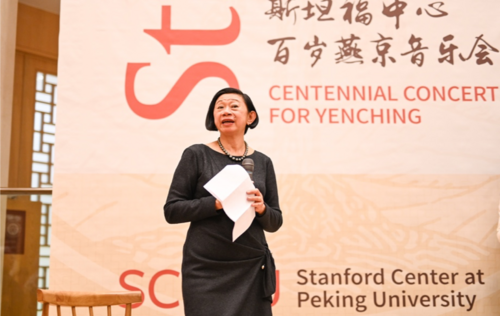
Jean C. Oi, the Lee Shau Kee Director of SCPKU
Jean C. Oi, the Lee Shau Kee Director of SCPKU, spoke about Yenching University as a model of collaboration and friendship between the US and China. She used the occasion of the 100 Anniversary of Yenching University to announce the opening of a new state-of-the-art conference room at SCPKU.
Image
John Leighton Stuart Room allows state of the art, real time connectivity to over 250 classrooms, labs, conference facilities, and offices at Stanford University.
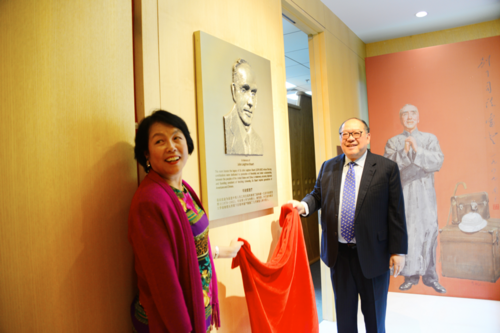
The room was made possible by a generous gift by Cheng Jiashu (Josh), Executive Director at SCPKU, and his wife, Xu Wan, who named the room in honor of the first Yenching University President, John Leighton Stuart. Oi in thanking Josh and his wife stated that the John Leighton Stuart Room (the Stuart Room) would greatly advance the efforts begun by Yenching University and Dr. John Leighton Stuart to further US-China relations. Dr. Stuart’s efforts in furthering US-China relations are legendary and remain an inspiration to this day. Josh Cheng and his wife have deep ties to Yenching University and to Stuart. Stuart personally recommended Xu Wan’s father, Xu Xianyu, when he graduated from Yenching University to study for a Ph.D. in mathematics in the United States in 1936. After receiving a doctorate in the United States, Dr. Xu returned to teach at Yenching University as a professor of mathematics. Xu Wan’s mother, Han Dechang, was a Yenching University music department graduate, and Josh Cheng’s mother and uncle all studied at Yenching University.
Image
CHENG Jiashu (Josh) and his wife, Xu Wan, unveiling the relief of John Leighton Stuart, with the copy of Li Bin’s painting of Stuart in the background
Mr. Li Bin, eminent artist of Chinese modern history, provided a wall sized copy of his famous painting “Farewell, Leighton Stuart” (see picture above) to help celebrate the occasion.
Image
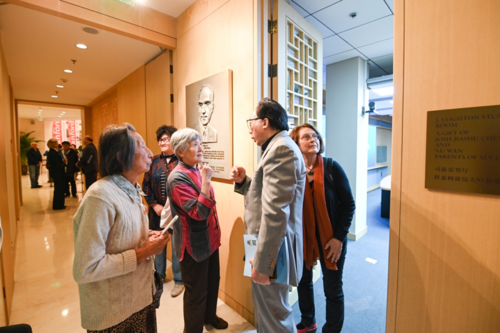
Artist Li Bin chatting with Professor Wu Qing, whose parents were faculty at Yenching University where President John Leighton Stuart attended their wedding
Image
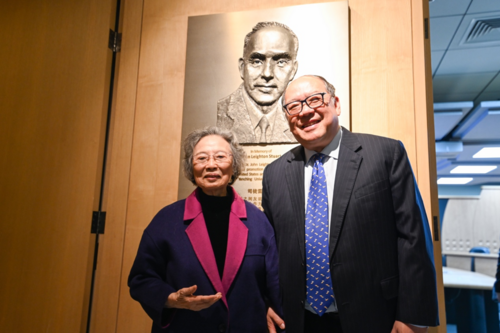
Cheng Jiashu (Josh) and He Liliang in front of John Leighton Stuart Room
Cheng Jiashu (Josh), in giving a brief history of Yenching University, noted the renewed attention Stuart has recently received from top leaders in China. He shows a clip of President XI Jinping at the G20 Summit in Hangzhou on September 4, 2016, when he identified John Leighton Stuart as one of the three historic bridge builders who helped to further establish the relationship and interaction between China and the world. President XI further added that “140 years ago, in June 1876, Mr. Stuart, who had served as US ambassador to China, was born in Hangzhou, in China. After living for more than 50 years in China, his ashes are placed in the Anxian Garden in the mid-levels of Hangzhou.”
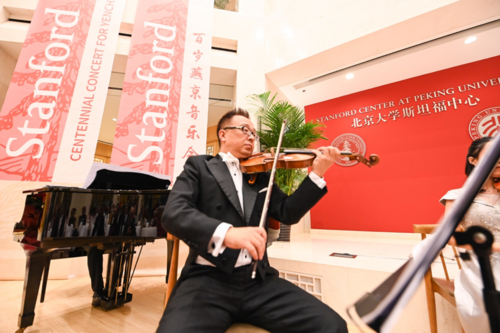
After the ceremony and short presentation by Josh Cheng on the history of Yenching University, the audience was treated to a jubilant concert, performed by Zhao Kunyu, the Concert Master of the China National Symphony Orchestra, and an ensemble of leading young Chinese musicians.
Image
Zhao Kunyu, Concert Master of the China National Symphony Orchestra
Image
Listening to the concert and giving applause at the end of the evening
The outcome of the 2016 American presidential election surprised many observers,but it provides an opportunity to reflect on both its historical and current determinants. This lecture will explore some of the deep structural features that have long characterized the American political system, as well as the social, economic, technological, and cultural issues that are shaping American politics today.
David Kennedy is the Professor of History Emeritus at Stanford University. He was awarded the Pulitzer Prize in history in 1999 for Freedom From Fear: The American People in Depression and War.
His teaching has included courses in the history of the twentieth-century United States, American political and social thought, American foreign policy, national security strategies, American literature, and the comparative development of democracy in Europe and America.
Reflecting his interdisciplinary training in American Studies, which combined the fields of history, literature, and economics, Kennedy's scholarship is notable for its integration of economic and cultural analysis with social and political history, and for its attention to the concept of the American national character.
David Kennedy是斯坦福大学历史系荣休教授。1999年,他的著作《免于恐惧的自由: 处于萧条和战争中的美国人民》获得普利策奖。
Stanford Center at Peking University The Lee Jung Sen Building Langrun Yuan Peking University No.5 Yiheyuan Road Haidian District Beijing, P.R.China 100871
Ambassador Susan Rice, the 2019 S.T. Lee Lecturer, will discuss her book, "Tough Love: My Story of the Things Worth Fighting For." This event is open to the public and books will be available for sale. Amb. Rice has graciously agreed to sign books after the talk. RSVP is required: https://www.eventbrite.com/e/book-talk-with-ambassador-susan-e-rice-registration-71722539045
Image
Recalling pivotal moments from her dynamic career on the front lines of American diplomacy and foreign policy, Susan E. Rice — National Security Advisor to President Barack Obama and U.S. Ambassador to the United Nations — reveals her surprising story with unflinching candor.
Mother, wife, scholar, diplomat, and fierce champion of American interests and values, Rice powerfully connects the personal and the professional. Taught early, with tough love, how to compete and excel as an African American woman in settings where people of color are few, Rice now shares the wisdom she learned along the way.
She is currently Distinguished Visiting Research Fellow at the School of International Service, American University, and a Non-Resident Senior Fellow at the Belfer Center for Science and International Affairs at Harvard’s Kennedy School of Government. She is also a Contributing Opinion Writer for the New York Times.
Previously, Rice served President Barack Obama as National Security Advisor and U.S. Permanent Representative to the United Nations. In her role as National Security Advisor from July 1, 2013, to January 20, 2017, Rice led the National Security Council Staff of approximately 400 defense, diplomatic, intelligence and development experts. She chaired the Cabinet-level National Security Principals Committee, provided the President daily national security briefings, and was responsible for coordinating the formulation and implementation of all aspects of the Administration's foreign and national security policy, including all diplomatic, intelligence, homeland security and military efforts.
Over the past two weeks, a CIA whistleblower’s complaint, a White House record of a July 25 telephone conversation between President Donald Trump and Ukrainian President Volodymyr Zelensky, and texts exchanged by American diplomats have dominated the news and raised questions about the president’s handling of policy toward Ukraine. Here are five observations: SECOND PARAGRAPH First, President Trump was not doing the nation’s business on July 25. Trump has described the call as “perfect,” but the memorandum of conversation shows that he did not seek to advance U.S. interests. He did not ask Zelensky about progress in ending Russia’s war against Ukraine. He did not propose steps to facilitate more American trade. He did not raise how U.S. liquified natural gas might strengthen Ukraine’s energy security (something of interest to Secretary of Energy Rick Perry, whom Trump now says instigated a call that he did not want to make).
This event is at full capacity and we are no longer accepting registrations.
China, U.S. Universities and the U.S. Science and Technology Workforce
The US is presently searching for the wisest policies relevant to the relationships between US universities and China. China is the only country that can supplant the United States as the economic, scientific, technological, military and ideological world leader. Consciousness of that, coupled with reports of serious misappropriations of US intellectual property, have led federal leaders to propose and, in some cases, to implement serious limits on collaborations between US and Chinese scientists and engineers in “strategic” research fields as well as to introduce serious impediments to the education of Chinese nationals by US higher education institutions. These actions are aimed at protecting US intellectual property and scientific ideas. In this talk, the proposals are briefly summarized. Analyses of scientific R&D, international scientific collaboration and the US scientific workforce are then presented. These analyses indicate that the limitations and impediments could very well weaken US capabilities and standing in some of the fields the nation is most anxious to protect unless those limitations and impediments are very carefully crafted. Some policy recommendations are provided.
Image
Arthur Bienenstock is co-chair, with Peter Michelson, of the American Academy of Arts and Sciences’ Committee on International Scientific Partnerships. He has also been a member of the National Science Board, the governing body of the National Science Foundation, since 2012. From November, 1997 to January, 2001, he was Associate Director for Science of the White House Office of Science and Technology Policy. At Stanford, he is Special Assistant to the President for Federal Research Policy, Associate Director of the Wallenberg Research Link and a professor emeritus of Photon Science, having joined the faculty in 1967. He was Vice Provost and Dean of Research and Graduate Policy during the period September 2003 to November 2006, Director of the Stanford Synchrotron Radiation Lightsource from 1978 to 1977 and Vice Provost for Faculty Affairs from 1972 to 1977.
Philippines Conference Room 616 Jane Stanford Way Encina Hall, Central, 3rd Floor Stanford, CA 94305
Arthur Bienenstock
<br><i>Co-chair, American Academy of Arts and Sciences’ Committee on International Scientific Partnerships; Professor of Photon Science, Emeritus, Stanford University</i><br><br>
CISAC’s Steven Pifer, former U.S. Ambassador to the Ukraine, looks at the dueling US foreign policies toward Ukraine – one aimed at U.S. national interests, the other at President Donald Trump’s reelection – and the risk that poses for Ukraine. “Ukrainian President Volodymyr Zelenskiy and Kyiv should take care, lest their country become a political football in America’s domestic politics,” writes Pifer in a piece for Brookings. Read the rest at Brookings.edu.

 FSI researchers strive to understand how countries relate to one another, and what policies are needed to achieve global stability and prosperity. International relations experts focus on the challenging U.S.-Russian relationship, the alliance between the U.S. and Japan and the limitations of America’s counterinsurgency strategy in Afghanistan.
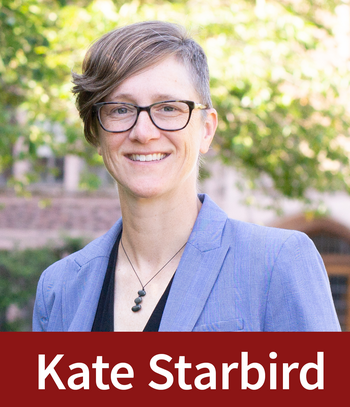
 The Honorable Anson Chan speaks at Hong Kong: A City in Turmoil conference.
 Harry Harding, one of the panelists at the conference, gives his thoughts on the situation in Hong Kong.
 Ming Sing speaks during the Hong Kong: A City in Turmoil conference.
 David M. Lampton shares his viewpoint with the other panelists.