FSI researchers strive to understand how countries relate to one another, and what policies are needed to achieve global stability and prosperity. International relations experts focus on the challenging U.S.-Russian relationship, the alliance between the U.S. and Japan and the limitations of America’s counterinsurgency strategy in Afghanistan.
Foreign aid is also examined by scholars trying to understand whether money earmarked for health improvements reaches those who need it most. And FSI’s Walter H. Shorenstein Asia-Pacific Research Center has published on the need for strong South Korean leadership in dealing with its northern neighbor.
FSI researchers also look at the citizens who drive international relations, studying the effects of migration and how borders shape people’s lives. Meanwhile FSI students are very much involved in this area, working with the United Nations in Ethiopia to rethink refugee communities.
Trade is also a key component of international relations, with FSI approaching the topic from a slew of angles and states. The economy of trade is rife for study, with an APARC event on the implications of more open trade policies in Japan, and FSI researchers making sense of who would benefit from a free trade zone between the European Union and the United States.
At any given moment there are hundreds of international negotiations being undertaken in numerous institutions and forums, touching upon every legal and social aspect, including cyber, trade, terrorism, telecommunications, environment and human rights, just to name a few. International investigation and monitoring groups, and international committees and specialized bodies, are routinely created, subjecting states to investigations and reviews. States are subject to strict reporting requirements, having to submit hundreds of detailed reports a year to different institutions. International courts and over 160 international dispute settlement mechanisms are at work in their respective areas– creating new bodies of law, and thousands of professional committees whether in economic blocs, international institutions, or other forums, are revising and creating new international norms. Black lists are being formed, alliances changing, and new actors, including multinational corporations, are now an integral player of the international arena.
The challenges states are facing in building capacity and training personnel to deal with this vast and evolving international scene are formidable, requiring substantial funds, human capital, leadership, strategic planning, specialized education, and extensive inter ministerial cooperation, just to name a few. Ramifications for a state for lack of capacity may be huge.
This talk will seek to take a birds eye view of the evolving international arena, and focus on some of the challenges states, particularly developing countries, have in building their capacity to enable effective navigation in this sphere. The talk will showcase the International Rule Making Project, which seeks to assist in the development of global tools and policies. The talk will also address the increasing participation of China, who openly seeks to reshape global governance, as a strong player in the international space, and the possible interconnections between all of these issues.
Speaker Bio:
Image
Dr. Shavit Matias was Deputy Attorney General of Israel in charge of international issues. She and the teams she led formed and implemented a strategic plan for Israel to deal with globalization and the numerous international institutions and forums. She formed and headed the Department for International Agreements and International Litigation, which deals with policy and law, globalization, international institutions, negotiations of bilateral and multilateral international agreements, joining international organizations, international investigations, and international litigation and arbitration in international forums. She spearheaded changes in inter-ministerial cooperation, training, and decision-making processes throughout government.
Dr. Matias regularly advised Prime Ministers and the Government on policy and law regarding international matters. She was a member of Israeli National Security Council teams on a range of national security challenges, national strategy building, international law, Middle East policy, counter-terrorism, and international conflicts. She headed inter ministerial committees, and worked with colleagues from around the world to develop international mechanisms, international tools, and law.
Matias represented the State of Israel in United Nations committees, international investigations of Israel, international and foreign courts, and co-headed Israel’s inter ministerial task force on matters relating to universal jurisdiction and issues relating to the laws of war. She represented the state in numerous bilateral and multilateral negotiations, including complex trade matters with the EU, joining the OECD, permanent-status issues with the Palestinians, and as a member of Israeli-Palestinian joint committees. She was also a member of Israeli government teams working with the international donor community on matters of Palestinian institution and capacity building, and a member of numerous policy teams.
Since 2014 she heads the Global Affairs and Conflict Resolution program at the Lauder School of Government IDC, and teaches courses on globalization, diplomacy, law, and conflict resolution. She is also on the Professional Advisory Board of the International Institute for Counter Terrorism. She is a recipient of the 2008 Award from Georgetown University Law Center for Outstanding Achievements in the Profession, and in 2017-2018 served on the President of Israel’s Committee for Doctoral Grants for Academic Excellence and Scientific Innovation.
Between 2013-2018 she was a fellow at the Hoover Institution and since 2018 is a visiting scholar at CDDRL heading the International Rule Making Project geared at developing global international tools enhancing good governance, rule of law, capacity building, and economic growth particularly in developing countries and areas of conflict.
Matias is a member of the Israeli bar and the New York bar. She clerked at the Supreme Court of Israel, received her LLB from Tel-Aviv University, her LLM from Georgetown University, and her Doctorate in International Law (S.J.D.) from George Washington University under the supervision of Judge Thomas Buergenthal.
About this Event: Israel’s relations with the Arab countries of the Persian Gulf, and particularly Saudi Arabia, have been improving for many years. Saudi King Faysal famously handed out copies of the anti-Semitic Czarist forgery, The Protocols of the Elders of Zion, to his visitors, but today the leaders of Saudi Arabia, Bahrain, Oman, often make positive statements about Israel and the Jewish people. Prime Minister Binyamin Netanyahu paid an official visit to Oman in October 2018. Unofficial meetings are reportedlyheld often with Saudi leaders. A synagogue now operates openly in Dubai, and EXPO 2020 Dubai will feature a full-blown Israeli pavilion. Qatar will likely let Israelis attend the FIFA World Cup in 2022. The Gulf countries are interested in access to Israeli technology for civil and military use. Never full-fledged supporters of the Palestinians, particularly after the Palestinian leadership supported Saddam Husayn in the Gulf War, Gulf leaders see an opportunity to cooperate with Israel against their common enemy –Iran. With doubts about US commitments to the region getting even stronger, the Arab countries of the Persian Gulf will look to increased cooperation with Israel, as well as Russia and China.
Speaker's Biography: Prof. Joshua Teitelbaum is a Visiting Scholar at CISAC. He is a leading historian and expert on the modern Middle East. Teitelbaum teaches modern Middle Eastern history in the Department of Middle Eastern Studies and is Senior Research Associate at the Begin-Sadat Center for Strategic Studies (BESA), at Bar-Ilan University in Ramat Gan, Israel. For many years he was a Visiting Fellow and Contributor to the Herbert and Jane Dwight Working Group on Islamism and the International Order at the Hoover Institution, a Visiting Associate Professor in the Department of Political Science, and Visiting Scholar at the Center on Democracy, Development and the Rule of Law, all at Stanford. He has also held visiting positions at Cornell University, the University of Washington, and the Washington Institute for Near East Policy. His latest book is Saudi Arabia and the New Strategic Landscape (Stanford: Hoover Press), and his latest article is "Saudi Arabia, Egypt, and the Longue Durée Struggle for Islam's Holiest Places,” in The Historical Journal.
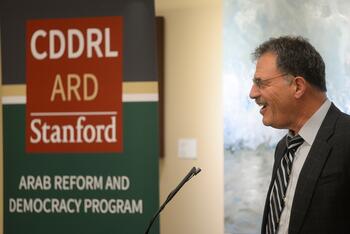
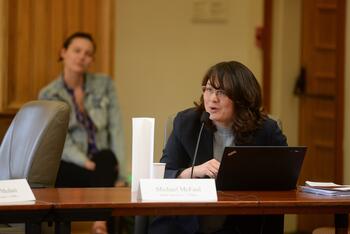
CDDRL’s Program on Arab Reform and Democracy held its annual conference at Stanford University on October 11 and 12, titled “The Struggle for Political Change in the Arab World.” The conference is an outgrowth of ARD’s efforts to support new research on the dynamics of political change in the countries of the Arab world. Scholars from across different disciplines sought to understand how social, economic, and political dynamics at the national level, as well as international and regional conflict and power rivalries, impact struggles for political and social change in the region.
Overview of Panels and Speakers
Image
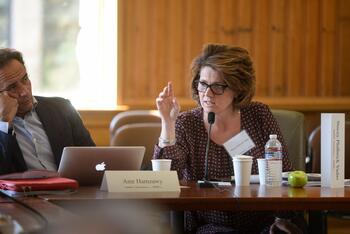
Following opening remarks by FSI Senior Fellow Larry Diamond, the first panel titled “The Boundaries of Authoritarianism post-Arab Uprisings” featured CDDRL Senior Research Scholar Amr Hamzawy. His paper examined how the regime of Abdel Fattah Al-Sisi has employed discursive strategies to discredit calls for democratic change in the country. Sean Yom, Associate Professor of Political Science at Temple University, outlined how the protest strategies of Jordanian youth have limited their effectiveness in advancing meaningful political change. University of California, Davis Scholar Samia Errazzouki discussed the failure of state-led political and economic reform in Morocco.
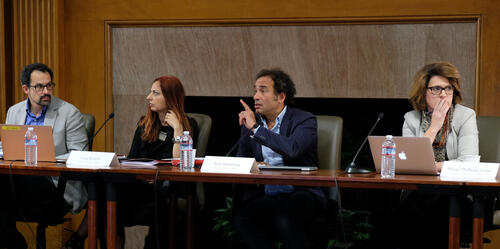
Chaired by Harvard University Fellow Hicham Alaoui, the second panel was titled “Popular Uprisings and Uncertain Transitions.” University of California, Santa Cruz Political Scientist Thomas Serres provided an overview of the economic disruptions that contributed to Algeria’s uprising. Lindsay Benstead, who is an Associate Professor of Political Science at Portland State University, analyzed the electoral successes of Tunisia’s Ennahda Party. Khalid Medani, Professor of Political Science at McGill University, explained how Sudanese protesters leveraged new strategies of contention to force Omar Al-Bashir out of power.
Farah Al-Nakib (right) and Michael Herb (left)
The third panel, titled “Politics, Succession and Sectarianism in the GCC States,” included Oxford University Fellow Toby Matthiesen, who discussed how Saudi Arabia and the GCC states have increasingly sought to protect their regimes by actively molding the politics of their autocratic patrons in the region, and by using new technologies to upgrade the effectiveness of their surveillance states. Georgia State University Political Scientist Michael Herb explained how the aging of the Saudi line of succession contributed to the political ascendancy of Crown Prince Mohammad Bin Salman and the decay of family rule in the country. Cal Poly Historian Farah Al-Nakib described how Kuwait’s royal family has used its sponsorship of large-scale development projects to sidestep the country’s political polarization, undermine the power of the parliament, and weaken public access to spaces of political contestation.
Image
The fourth panel focused on “Social Strife and Proxy Conflict in the Middle East.” Chatham House Scholar Lina Khatib described Syria’s transformation during the civil war from a highly centralized security state to a transactional state in which the regime depends heavily on local powerbrokers. Stacey Philbrick Yadav, Associate Professor and Chair of the Department of Political Science at Hobart and William Smith Colleges, discussed differences in how local communities in Yemen have been affected by the country’s conflict. David Patel, who serves as Associate Director for Research at the Crown Center for Middle East Studies at Brandeis University, argued that Iraq’s democratic institutions have been impressively robust to a series of existential challenges, but he also highlighted a widespread feeling among the Iraqi public that its parliamentary system is failing to deliver.
Image
Finally, the fifth panel examined the topic of “International Forces in the Arab Political Arena.” Stanford University Political Scientist Lisa Blaydes suggested that China’s efforts to involve itself in the regional economy may improve its reputation among economically-frustrated Arab citizens, but that such efforts also spell trouble for democracy and human rights in the Middle East. Hamid & Christina Moghadam Director of Iranian Studies at Stanford University Abbas Milani argued that Iran’s ideological commitment to exporting the Islamic Revolution has been remarkably consistent for several decades. Colin Kahl, Co-director of the Center for International Security and Cooperation at FSI, reviewed the strategies of US administrations toward the Middle East, and posited that President Trump’s approach of pursuing maximalist objectives with minimal commitments is particularly likely to heighten instability in the region. FSI Scholar Ayca Alemdaroglu emphasized that Turkey’s neo-Ottoman foreign policy has failed to achieve its objectives in the face of mounting regional upheaval.
Common Themes of Political Change and Continuity
Image
Several themes emerged from conference presentations. First, across the panels, scholars discussed the lessons learned by autocrats and activists alike in the aftermath of the Arab Spring, and the ways in which these lessons have transformed regional politics. Hamzawy emphasized that the Sisi regime in Egypt has increasingly relied on intensive repression over cooptation to maintain stability, while at the same time refusing to grant even limited political openings as existed under Hosni Mubarak’s presidency. In part, this change appears to be rooted in the regime’s belief that relaxing the state’s authoritarian posture had contributed to the revolutionary upheaval of 2011. Likewise, Matthiesen suggested that Saudi Arabia and the Gulf Cooperation Council States have learned to become more aggressive in strengthening their surveillance apparatus and policing popular discourse transnationally. By contrast, Serres discussed how the Algerian military and bureaucracy have responded to mass protests not by intensifying repression, but instead by attempting to coopt anti-corruption initiatives and democratic reforms to limit political and economic change. Similarly, regarding Kuwait, Al-Nakib illustrated how the restructuring of urban spaces has proved itself a subtle but successful strategy for the royal family to rehabilitate its reputation while limiting geographic focal points for popular politics.
Image
Activists have also learned their own lessons from the aftermath of the Arab Spring. According to Yom, Jordanian activists continue to look to the leaderless revolutions of Tunisia and Egypt as a model to be emulated. As a result, they prioritize agility and horizontality in their protests, and they forgo the organization of formal political movements. This approach has succeeded in acquiring short-term concessions from the regime but has failed to generate broader structural changes. On the other hand, activists in Sudan appear to have been more successful at using lessons from the Arab Spring to push for systematic transformations of their political system. According to Medani, Sudanese protesters developed novel tactics to avoid the repression of the coercive apparatus, and they were effective at gradually forging a counterhegemonic discourse that clearly exposed the regime’s failures to the public. Following the overthrow of Omar Al-Bashir, activists in Sudan have also insisted on dismantling the political and economic might of the deep state to avoid following Egypt’s path.
Image
Second, the conference discussion indicated widespread dissatisfaction with formal political institutions across the region. For instance, Hamzawy suggested that Sisi’s regime has been relatively successful at discrediting civilian political institutions, including the legislature and civilian-led ministries. Errazzouki highlighted widespread dissatisfaction in Morocco with existing political institutions. Likewise, Yom’s discussion of activists in Jordan emphasized their lack of interest in entering formal politics. In Kuwait, the royal court has found an opening to pursue urban development projects outside of normal institutions in part because of the public’s frustration with gridlock in the legislature. Patel speculated that frustration with the parliament and muhasasa system in Iraq may finally prompt major changes to the country’s political process.
Image
Third, despite this disillusionment with formal politics, these political institutions have proved remarkably durable in countries across the region. For example, though current frustrations may finally prompt change in Iraq, Patel also highlighted the resilience of the parliamentary system in the face of a sectarian civil war, US troop withdrawal, the rise of ISIS, and a number of other major challenges. For both Algeria and Sudan, Serres and Medani stressed that militaries continue to exercise significant influence despite the popular uprisings. Meanwhile, for Egypt, Hamzawy noted the firm grip of the current military regime on power, and for Morocco, Errazzouki described the lack of systematic changes to the country’s ruling monarchy, even after years of popular pressure.
Image
Fourth, this durability has not precluded a number of important shifts within existing political institutions. Regarding Syria, for instance, Khatib explained how the survival of Bashar al-Asad’s presidency has depended on moving state institutions away from a centralized security state to a transactional state reliant on local actors with a degree of independence from the regime. Herb described how the consensus-based family rule of the Saudi monarchy fell victim to deaths among the aging senior princes, which opened up opportunities for the king to appoint more officials in a manner that heightened his direct influence. Herb suggested that Mohammad Bin Salman recognized this change and knew that he would likely lose relevance upon his father’s death; as a result, he was motivated to gamble on consolidating his control while his father still held the power to issue royal decrees. In Algeria, the influence of the military and bureaucracy may remain paramount for now, but Serres also pointed out that protesters have succeeded in stripping away the civilian intermediaries who used to protect these institutions. Regarding the durability of local institutions, Yadav noted how pre-conflict and even pre-unification institutions in Yemen have continued to operate effectively in a number of local communities around the country.
Image
Fifth, foreign interventions will continue to destabilize the region and impede prospects for democratization or post-conflict reconstructions in the coming years. Khatib noted that Russia has positioned itself as the agenda setter who can bring the Syrian state back to its feet, but also that Russia and Iran are competing to profit off the country’s reconstruction. For Yemen, Yadav argued that fragmentation at the local level has important implications for best practices in the international community’s reconstruction efforts, but that current actors are not well positioned to understand these trends. Kahl predicted that the Middle East strategy of the Trump administration would likely contribute to further destabilization of the region because of its emphasis on empowering allies to do what they want and go after Iran while the United States maintains its distance. Meanwhile, Blaydes’ presentation on China’s regional involvement, Milani’s discussion of Iran’s efforts to export the Islamic Revolution, and Matthiesen’s observations about the GCC States’ authoritarian coordination all illustrated how intervening states are reducing prospects for democratic political change.
Image
Sixth, even as interventionist countries have contributed to the destabilization of the region, they have also confronted major obstacles themselves – and in some cases have failed outright to achieve their primary objectives. Khatib noted that Iran has faced backlash in Syria, while Abbas Milani and David Patel pointed to backlash against Iran in Iraq. Kahl emphasized that the Trump administration’s Middle East policy was unlikely to achieve its goals. Blaydes observed that China has not acquired greater salience in the Middle East despite its more active economic involvement, and individuals in many of the region’s countries – particularly those that are more developed – do not see China’s growth as a positive force. She also stressed the reputational risks China is taking in pursuing potentially unpopular investments through the Belt and Road Initiative. The GCC States are attempting to prop up strongmen in both Libya and Sudan, but this strategy has struggled in the face of local political dynamics; furthermore, the intervention in Yemen has been a disaster for Saudi Arabia and the UAE. Finally, Alemdaroglu stressed that Turkey’s ambitious “neo-Ottoman” foreign policy, which reflects a desire to revive Turkish influence in areas ruled by the Ottoman Empire, has largely failed. In particular, the architect of the policy, former foreign minister Ahmet Davutoglu, lost his job; the country miscalculated badly in how it handled the aftermath of the Arab Spring; and Turkey’s relations with many of its neighbors have soured.
Hero Image
ARD 2019 Annual Conference participants. Front row (from left): Sean Yom, Stacey Philbrick Yadav, Lindsay Benstead, David Patel, Michael Herb. Middle row (from left): Colin Kahl, Lina Khatib, Hicham Alaoui, Larry Diamond, Samia Errazzouki, Lisa Blaydes, Hesham Sallam. Back row (from left): Toby Matthiesen, Ayca Alemdaroglu, Abbas Milani, Amr Hamzawy, Michael McFaul, Scott Williamson
The Elgin Heinz Outstanding Teacher Award recognizes exceptional teachers who further mutual understanding between Americans and Japanese. EngageAsia administers the Elgin Heinz Outstanding Teacher Award, which is funded by the United States-Japan Foundation. The 2019 Award focused on the humanities and the 2020 Award will focus on Japanese language. It is named in honor of Elgin Heinz for his commitment to educating students about Asia as well as for the inspiration he has provided to the field of pre-collegiate education.
On December 5, 2019, SPICE’s Stanford e-Japan Instructor and Manager Waka Takahashi Brown was presented with the 2019 Elgin Heinz Outstanding Teacher Award for her teaching excellence with Stanford e-Japan, an online course that introduces U.S. society and culture and U.S.–Japan relations to high school students in Japan. Stanford e-Japan is currently supported by the Yanai Tadashi Foundation. Initial funding for Stanford e-Japan was provided by the U.S.-Japan Foundation.
“Waka walks in the footsteps of Elgin Heinz as a key leader in educating the next generation about the U.S.–Japan relationship,” stated David Janes, Chair of the Board, EngageAsia. Heinz was born in China in 1913 and taught in the San Francisco Unified School District for 40 years. Challenging Americans’ lack of knowledge about Asia was central to Elgin’s life’s work. Janes has overseen the Elgin Heinz Outstanding Teacher Award since its inception in 2001. Daniel Tani, Director of Foundation Grants at the U.S.-Japan Foundation, and Janes formally presented the award to Brown.
In addition to teaching Stanford e-Japan for the last five years, Brown previously served as instructor for SPICE’s Reischauer Scholars Program (RSP). The RSP is an online course that introduces Japanese society and culture and U.S.–Japan relations to high school students in the United States. Current RSP Instructor and Manager Naomi Funahashi is a 2017 Elgin Heinz Outstanding Teacher Award recipient.
Waka Brown, Professor Daniel Okimoto, and Miles Brown (husband of Waka)
Congratulatory comments were made by the Honorable Tomochika Uyama, Consul General of Japan in San Francisco, who underscored the importance of Brown’s efforts and the significance of Stanford e-Japan and the RSP to enhancing U.S.–Japan relations from the grassroots level. Consul General Uyama and Stanford Professor Emeritus Daniel Okimoto, who was also present at the ceremony, serve as advisors to Stanford e-Japan and the RSP. Okimoto is Brown’s former professor and longtime mentor.
Prior to joining SPICE, Brown taught Japanese language at Silver Creek High School in San Jose and served as a Coordinator for International Relations (CIR) on the Japan Exchange and Teaching (JET) Program. Brown obtained both her undergraduate and graduate degrees from Stanford University.
In her acceptance speech, Waka noted: “As a Japanese American growing up in Kansas in the 1970s and 80s, and then as a Japanese American woman working in Japan, I’ve felt the need and immediacy for fostering cross-cultural understanding for my entire life. I feel extremely fortunate that I am able to work toward this goal through my professional work. My students and their knowledge and passion humble me. I am constantly in awe of them and their accomplishments. It is a true honor to receive the Elgin Heinz Award, and I am grateful for the opportunity to use these funds to foster connections between the future leaders in U.S.–Japan relations.”
Through Stanford e-Japan, Brown has engaged Japanese high school students from throughout Japan in an intensive study of U.S. society and culture. Since its first session in 2015, over 200 Japanese students have successfully completed the course. Some of her students have matriculated to universities in the United States.
In a very meaningful moment of the ceremony, Ryoga Umezawa, one of Brown’s former Stanford e-Japan students and now a university student at the Minerva Schools at KGI in San Francisco, expressed his gratitude to Brown, noting that the online format of Stanford e-Japan eased his transition to the online format of his university studies and also noted that the knowledge he gained from Stanford e-Japan has been invaluable to his transition to life in the United States.
The ceremony ended with a duet by Norman Masuda, an inaugural recipient of the Elgin Heinz Outstanding Teacher Award in 2002 (Japanese language category), and Irene Nakasone, instructor of kutu (Okinawan koto). Nakasone played the kutu and Masuda, the sanshin (Okinawan shamisen). They performed “Akanma Bushi” (red horse folk song), which was symbolic to the occasion as it is a congratulatory classical piece from the Yaeyama Islands, Okinawa Prefecture.
Irene Nakasone and Norman Masuda play a duet at the 2019 Elgin Heinz Outstanding Teacher Award ceremony.
For more information on the Stanford e-Japan Program, visit stanfordejapan.org. The Spring 2020 application period is open now until January 8, 2020. To be notified when the next Stanford e-Japan application period opens, join our email list or follow us on Facebook, Twitter, and Instagram.
Legal compliance has gotten a bad rap in international relations research. Compliance – the state of being on the “legal” side of a legal/illegal binary – has been largely set aside as a variable of interest in empirical studies of international law in favor of more substantive measures of behavioral change. Nevertheless, efforts to frame political science inquiry in terms of law’s effects have not succeeded in sidestepping compliance. To the contrary, none of the core functions of law (guiding behavior, assessing it, attributing responsibility, or assigning remedies) is possible without an applied concept of legal compliance as an orienting point on the horizon.This paper reclaims compliance as an essential concept for the empirical study of international law—albeit in a transformed state that emphasizes its potential for contextual variability and its essentially legal-political character.
Speaker Bio:
Image
Tonya Putnam (Ph.D., Stanford, 2005; J.D., Harvard 2002) is an Associate Professor of Political Science at Columbia University. Her work exploresthe intersectionsof international relations and international law in relation tointernational and transnational regulationand jurisdiction, human rights, international humanitarian law, migration, international dispute resolution, institutional design, and judicial politics.Professor Putnamis the author ofCourts Without Borders:Law, Politics, and U.S. Extraterritoriality(Cambridge University Press 2016). Herresearch has appeared inInternational Organization, International Security,Human Rights Review, Journal of Physical Securityand in edited volumes.She was a Post-DoctoralFellow at the Niehaus Center for Globalization and Governance at Princeton University and a Pre-and Post-Doctoral Fellow at CISAC.She is currently completing a second book on why and how social scientists should factor basic properties of law, such as its semantic indeterminacy, into theories and empirical models of its impact on behavior.Professor Putnam is also a member (inactive) of the California State Bar.
Resurrecting Compliance in Assessing Law's Impact on Behavior
Andrew Shaver is an assistant professor of political science at the University of California, Merced. Prior to that, he completed postdoctoral research fellowships at Stanford University's Political Science Department and, separately, at Dartmouth College, where he was also a lecturer. Professor Shaver earned his PhD in Public Affairs (security studies) from Princeton University's School of Public and International Affairs and completed his final year of the doctoral program as a predoctoral fellow at Harvard University's John F. Kennedy School of Government. He is also the founding director of the Political Violence Lab. His research focuses broadly on contemporary sub-state conflict and appears in the American Political Science Review, American Economic Review, Annual Review of Sociology, and Journal of Politics, amongst other outlets. Professor Shaver previously served in different foreign affairs/national security positions within the U.S. Government, including spending nearly one and a half years in Iraq during the U.S.-led war with the Pentagon.
About this Event: In the last 50 years, the United States and Soviet Union/Russia have pursued arms control negotiations and signed numerous treaties in an effort to restrain and reduce the number and capabilities of their nuclear weapons. However, the recent collapse of the 1987 Intermediate-range Nuclear Forces (INF) Treaty and the possible expiration of the 2010 New Strategic Arms Reduction Treaty (New START) in 2021 may signal the end to treaty-based limits. This raises questions about the future form and content of bilateral nuclear arms control. While near-term questions focus on whether the United States and Russia can salvage the benefits of these two treaties and, possibly, expand them to include more types of weapons and additional countries, longer-term questions are less specific. Does the past bilateral arms control process represent more than just an effort to negotiate legally binding treaties that limit or reduce nuclear weapons? Can the United States and Russia pursue agreements and cooperate in reducing weapons if they cannot conclude the process by signing formal agreements? Can they maintain stability, exhibit restraint, and reduce the risk of war if the era of arms control treaties has ended? Can this new era of arms control expand to address concerns about new types of weapons and the risks posed by a greater number of countries?
Speaker's Biography: Amy F. Woolf is a Specialist in Nuclear Weapons Policy in the Foreign Affairs, Defense, and Trade Division of the Congressional Research Service at the Library of Congress. She provides Congress with information and expert analysis on issues related to U.S. and Russian nuclear forces and arms control. She has authored many studies on these issues and has spoken often, outside Capitol Hill, about Congressional views on arms control and U.S. nuclear weapons policy. Ms. Woolf received a Masters in Public Policy from the Kennedy School of Government at Harvard University and a BA in Political Science from Stanford University.
About this Event: Scholars and practitioners have long argued that compliance with international rules often requires building institutions or other mechanisms to ease access to information about possible violations. This book introduces a different information problem -- disclosure dilemmas -- that requires equipping IOs with secrecy. States and firms often possess private information that sheds detailed light on the compliance of others with international rules. Yet fears of revealing intelligence sources or helping commercial rivals can deter them from disclosing it. Building a “confidentiality system” in an international organization can allow the institution to receive and protect such sensitive details, enabling disclosure without wider dissemination. This, in turn, elicits the sharing of unique and sensitive information which fills evidentiary gaps and makes cooperation more effective. For example, targeted intelligence disclosures to the IAEA can fill in gaps about hidden nuclear weapons programs. Similarly, targeted disclosures of internal firm documentation to the WTO can clarify whether trade barriers have caused damage to foreign firms. The book offers a unified, multi-method approach to understanding international cooperation and how institutions work, spanning economic and security domains from nuclear proliferation to trade to human rights. In addition to practical lessons about how to improve compliance with international rules, the book recasts the role of institutions in International Relations and identifies a source of tension between cooperation and normative goals like global governance transparency.
Speaker's Biography: Austin Carson is assistant professor in the Department of Political Science at the University of Chicago. His first book, Secret Wars: Covert Conflict in International Politics (Princeton UP 2018), argues that secrecy helps great powers meddle in conflicts while keeping war limited. It was recently award the Lepgold Book Prize for best book in 2018. A second book with Allison Carnegie, Secrets in Global Governance: Disclosure Dilemmas and the Challenge of International Cooperation (Cambridge UP forthcoming), shows how secrecy allows international organizations to use sensitive information to assess compliance. His research has appeared in International Organization, American Journal of Political Science, and Security Studies.
Abstract: By most accounts, the most important political space in the world's largest country is the four inches between Vladimir Putin’s ears. In a new book, Graeme Robertson and Sam Greene challenge the idea that Putin has shaped Russia in his own image, arguing instead that it his power flows from a particular relationship he has developed with his citizens -- and that his citizens have developed with one another. The result is a view of Russian politics as something much more fluid and fragile than we generally understand, a shifting landscape in which Putin's power -- and that of whoever succeeds him -- is continually negotiated and renegotiated between the Kremlin and the public, even in the confines of an increasingly authoritarian state. In this discussion, Greene and Robertson explore the social and political imperatives, challenges and dilemmas Putin and Russia face as he rounds out his fourth term and wonders about a fifth.
Speakers' Biography:
Sam Greene is reader in Russian politics and Director of the Russia Institute at King's College London. His research focuses on the relationships between citizens and the state in Russia, and in societies experiencing social, economic and political transformation more broadly. His first book, Moscow in Movement: Power and Opposition in Putin's Russia, was published by Stanford University Press in 2014. More recently, he is co-author with Graeme Robertson of Putin v the People: The Perilous Politics of a Divided Russia, published by Yale University Press in 2019. He also serves as Associate Fellow in the Russian and Eurasian Programme of the International Institute for Security Studies and a Visiting Professor at the UK Defence Academy.
Graeme Robertson is a Professor of Political Science at the University of North Carolina at Chapel Hill and Director of the Center for Slavic, Eurasian and East European Studies. His work focuses on political protest and regime support in authoritarian regimes.
Graeme’s new book (with Samuel A. Greene) is Putin v. The People, published by Yale University Press in June 2019. The book presents a fresh new look at the social bases of support for and opposition to authoritarian rule in Russia. Graeme is also the author of Revolution and Reform in Ukraine, published by PONARS Eurasia (with Silviya Nitsova and Grigore Pop-Eleches) and The Politics of Protest in Hybrid Regimes: Managing Dissent in Post-Communist Russia, published by Cambridge University Press. He has published articles in many academic journals including the American Political Science Review, the American Journal of Political Science, The Journal of Politics and the British Journal of Political Science, as well as contributing regularly to the media on Russia and Ukraine. Graeme currently serves as the Associate Editor for Comparative Politics for the American Journal of Political Science.
Sam Greene
King's College London
Graeme Robertson
University of North Carolina
Seminars
Russian Power and Purpose in the 21st Century Seminars
Abstract: Over the last fifteen years, the Russian government has invested significantly in improving Russia’s education and health care systems and in reversing the health and demographic catastrophes of the 1990s. This discussion will assess the extent to which those investments have paid off and the continued challenges Putin faces in aligning Russia’s human capital resources with his political, economic, and foreign policy ambitions. It will also examine the ways that health and social policy have been used as political tools – not always successfully – by the Putin regime.
Speaker Biography: Judy Twigg is a professor of political science at Virginia Commonwealth University; senior associate (non-resident) with the Center for Strategic and International Studies; consultant for the evaluation units of the World Bank and the Inter-American Development Bank; and adjunct professor at the Walsh School of Foreign Service, Georgetown University. Twigg’s work focuses on issues of health, human capital, and health systems reform in Eurasia, as well as evaluations of human development and public sector management assistance projects globally. She has been a consultant for John Snow, Inc., UNICEF, USAID, the Eurasia Foundation, and the Social Science Research Council. Twigg was a 2005 recipient of the State Council on Higher Education in Virginia Outstanding Faculty Award. She holds a B.S. in physics from Carnegie Mellon University, an M.A. in political science and Soviet studies from the University of Pittsburgh, and a Ph.D. in political science and security studies from MIT.
Judy Twigg
Professor of Political Science
Virginia Commonwealth University
Seminars
Russian Power and Purpose in the 21st Century Seminars

 FSI researchers strive to understand how countries relate to one another, and what policies are needed to achieve global stability and prosperity. International relations experts focus on the challenging U.S.-Russian relationship, the alliance between the U.S. and Japan and the limitations of America’s counterinsurgency strategy in Afghanistan.
 Farah Al-Nakib (right) and Michael Herb (left)





 Waka Brown, Professor Daniel Okimoto, and Miles Brown (husband of Waka)
 Irene Nakasone and Norman Masuda play a duet at the 2019 Elgin Heinz Outstanding Teacher Award ceremony.