CDDRL Research in-brief
Authors
News Type
News
Date
Paragraphs

Introduction and Contribution


Democracies face a host of ongoing challenges, including the rise of elected autocrats, income inequality, mainstreamed forms of xenophobic nationalism, and political apathy. All of these challenges pose threats to democratic participation — elected autocrats restrict it, inequality makes it easier for oligarchs to sway election outcomes, and xenophobia can discourage cultural outsiders from voting.

Apart from practical threats to democratic participation, an established intellectual tradition has viewed participation with deep skepticism. In this view, democracy is good simply because it ensures peaceful transfers of power and protects individual rights. Collective decisions, however, cannot be meaningfully viewed as representing the “will of the people” owing to manipulation, apathy, and the high costs of acquiring political knowledge. Is this “realist” vision the best one can hope for in democratic life?

In “Can deliberation have lasting effects?,” James FishkinValentin Bolotnyy, Joshua Lerner, Alice Siu, and Norman Bradburn show how a three-day deliberative experiment in late 2019 had large and long-term effects on turnout and voting behavior. Those most likely to exhibit these civic behaviors nearly a year later had come to follow politics more closely and see their political opinions as valuable. At the same time, the experiment’s effects on participants’ policy views were significant only in the short term — most deliberators eventually reverted to their previously held policy positions.

That three days of deliberation had such lasting civic effects suggests that efforts to create more inclusive forms of democratic participation are both possible and scalable. Moreover, it suggests that academic skepticism about democratic participation is not an argument against citizens’ capacities for reasonable decision-making; rather, it is an argument against our imperfect contexts of participation. Deliberative experiments may offer hope for improving these contexts.

Academic skepticism about democratic participation is not an argument against citizens’ capacities for reasonable decision-making; rather, it is an argument against our imperfect contexts of participation.

The Deliberative Experiment and Its Effects on Policy Views


In September 2019 — one week prior to the experiment — a treatment group (i.e., those who would deliberate) of 523 registered voters from around the US and a control group of 844 voters were surveyed on their political attitudes. Members of the treatment group then deliberated on five issue domains (the economy, environment, immigration, health care, foreign policy) in small groups and on 47 policy proposals (e.g., redistributing wealth in some way). 26 of these proposals were characterized by extreme partisan polarization, meaning significant numbers of those who identified as Democrats or Republicans held the most extreme views. After the deliberations ended, both the treatment and control groups were surveyed. Then, three subsequent surveys were conducted in late 2020.

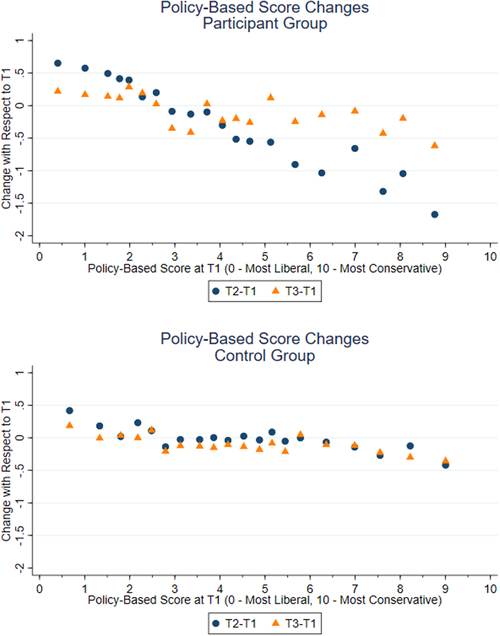
Among the treatment group, deliberation produced significant, short-term depolarization on 20 of the 26 (polarized) policy proposals. In other words, the averages for participants who identified with each party moved closer together (though not necessarily toward the center). These changes were large, sometimes 40 percentage points, as in the case of Republicans abandoning extreme positions on immigration. Meanwhile, the control group’s policy positions changed hardly at all — pointing to the key role played by deliberation. Within the five issue areas, averages among deliberators shifted leftward on all but the economy.


Image
Figure 1. Policy-Based Score (PBS) Changes over Time


Figure 1. Policy-Based Score (PBS) Changes over Time
Note: Policy-based score (PBS) is constructed for each individual based on responses to 26 questions identified as the most polarizing. The upper chart shows the participant group, and the lower chart shows the control group. T1 is the survey wave prior to the deliberations, T2 is right after the deliberations, and T3 is 10 months after, in July 2020.


By late 2020, however, the treatment group’s policy positions mostly reverted to their pre-deliberation levels. The differences between these two points in time were still significant compared with the control group, yet relatively small in absolute terms. These policy reversions are perhaps unsurprising: deliberators returned to an environment of heightened polarization and aggressive campaigning during the 2020 election cycle. (To be sure, and from the standpoint of finding solutions to collective problems, policy reversion is not especially concerning — the aim of deliberation is to bring citizens together to reason and compromise, which the experiment accomplished.)

A Civic Awakening?


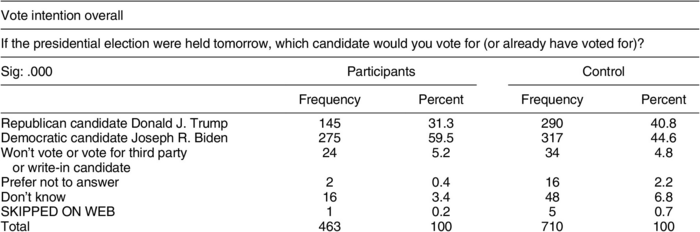
The lack of long-term policy effects suggests that three-day deliberations may be limited in their ability to create a more encompassing, participatory society. However, the treatment group demonstrated large and persistent changes in their intention to vote (i.e., turnout) and their candidate of choice. Among the control group, Joe Biden was favored over Donald Trump by about four percentage points — very close to Biden’s actual margin in the popular vote. Among the treatment group, however, Biden was favored by 28 percentage points. The gaps in turnout were similarly large. (Note that these are intentions, not reports of actual decisions. However, Tables 6 and 7 in the article show similar effects for recollected votes after the election.)


Image
Table 2. Voting Intention for Participant and Control Groups, Time 4


Table 2. Voting Intention for Participant and Control Groups, Time 4


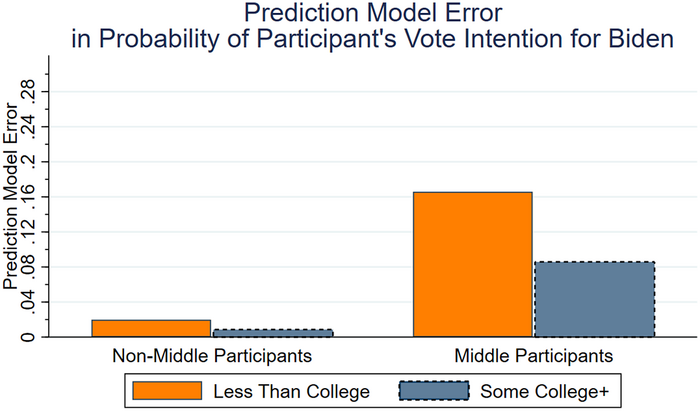
These civic outcomes are especially surprising because (a) voting behavior is thought to be stable and deeply rooted in one’s psychology and social context, and (b) experimental efforts to increase turnout have been most successful when undertaken shortly before elections, as opposed to one whole year prior. The effects were most pronounced among political moderates and those without college degrees — perhaps pointing to the educative effects of deliberation.


Image
Figure 5. Effects on Vote Intention Captured by Predictive Modeling, by Education


Figure 5. Effects on Vote Intention Captured by Predictive Modeling, by Education
Note: Middle are those participants who have Policy-Based Scores between 3 and 5 (inclusive) at Time 1. Non-middle participants are all other participants. Positive prediction error shows that, on average, participants were more likely to vote for Biden than predicted by the model. Vote intention data are collected at Time 4, in October, 2020. Full calibrated model used to construct this figure can be found in the APSR Dataverse.


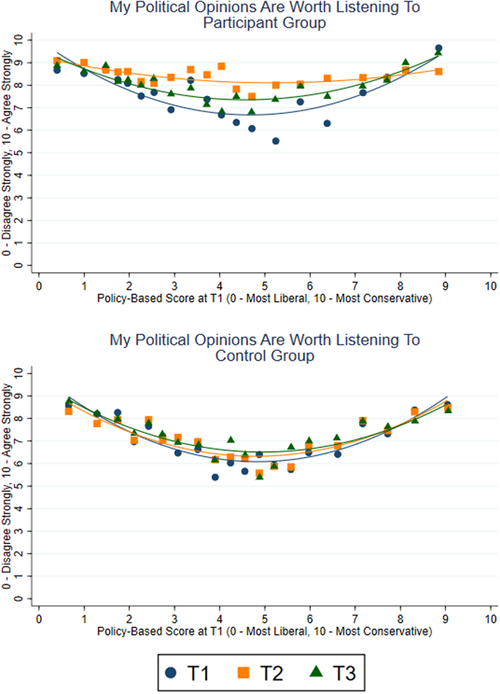
Why did deliberation produce only short-term policy effects but long-term effects on voting behavior? The authors posit that deliberation caused an “awakening of civic capacities.” They reason that deliberation was a transformative experience in terms of stimulating political engagement and a sense of efficacy. And indeed, the treatment group was, in the long term, more likely than the control group to follow the 2020 election campaign, believe their political opinions mattered, and acquire general information about American politics. (The latter is measured in terms of knowing which party controlled the House and Senate.)


Image
Figure 9. Having “Political Opinions Worth Listening to”


Figure 9. Having “Political Opinions Worth Listening to”
Note: Policy-based score is constructed for each individual based on responses to 26 questions identified as the most polarizing. Responses to the question “How strongly would you disagree or agree with the following statement?”[I have opinions about politics that are worth listening to.] were collected at T1 (just before deliberations), T2 (just after), and T3 (10 months later, July 2020).


The authors close by discussing efforts to scale up civic engagement, such as the Stanford Online Deliberation Platform. In all, “Can deliberation have lasting effects?” provides a rigorous case for the value of deliberation in strengthening democratic participation.

*Brief prepared by Adam Fefer.

Hero Image
Group of people deliberating around a table
A group deliberating during the America in One Room national Deliberation Poll in Dallas, TX, 2019
All News button
1
Subtitle

CDDRL Research-in-Brief [4-minute read]

Date Label
Display Hero Image Wide (1320px)
No
Authors
News Type
News
Date
Paragraphs

Introduction and Contribution:


The recognition of indigenous territory or rights to self-governance is often viewed as intrinsically valuable: indigenous peoples (or comunidaded campesinas) deserve to be recognized as such, especially in light of the violence and discrimination they have endured. However, recognition can also be extrinsically good, insofar as it makes indigenous life more secure or sustainable in the face of political encroachment or environmental degradation.

Indigenous recognition has often occurred during, and because of, conflict and violence. In “Adhering Indigenous Communities to the State,” Michael Albertus shows that recognition during Peru’s infamous 1980-2000 “internal conflict” itself reduced violence: formally recognized communities had systematically fewer conflict deaths than those not recognized. He argues that recognition (a) made property rights more secure, thus “restrict[ing] what could be won and held with violence” (p.7), and (b) supplied the Peruvian government with detailed information about and connections into indigenous communities, thus improving state intelligence during the war. Marshaling a large and original dataset on recognition, property rights, fatalities, state capacity, and more, Albertus demonstrates how recognition can empower not only indigenous communities but also central governments.

Marshaling a large and original dataset on recognition, property rights, fatalities, state capacity, and more, Albertus demonstrates how recognition can empower not only indigenous communities but also central governments.

Peru’s “Internal Conflict”:


Between 1980 and 2000, the Peruvian state fought an extremely brutal war against the Shining Path (Sendero Luminoso), which sought to overthrow the government and establish an agrarian communist society. The Shining Path’s insurgency was anchored in indigenous communities, whose members suffered economic hardships and political exclusion. Nearly 75% of the estimated 70,000 people killed were indigenous, despite them constituting just 26% of the population. Some insurgents learned Quechua, married into indigenous families, and dismantled unpopular state agricultural cooperatives. 

Over time, however, Shining Path’s growing violence and village authoritarianism alienated many indigenous communities, who formed self-defense committees in response. Initially, the Peruvian government dealt with the insurgency through indiscriminate violence. However, the failure of these strategies prompted a search for alternatives within indigenous communities themselves.

How Recognition Reduced Violence:


Regarding property rights, because disputes over land and resources — those between communities and private landholders — often turned violent, recognition enabled more peaceful, state-led resolutions. Indeed, “the state invited parties for conciliation, checked public registries, examined the de facto occupation of land, and, in the case of disagreements, would begin a judicial proceeding for the disputed territory…outlining a process to identify specific community lands, to map them, and to record the responses of neighbors” (p.7). These varied activities led to a thorough “penetration” of the state into indigenous life.

Recognition was not simply a one-way grant but a mutual agreement, one that imposed clear legal conditions on indigenous communities. These included enrolling community members, forming leadership bodies, and making territorial claims. The state then verified these claims by communicating with leaders and collecting geographical data. Recognized communities also had to adapt their traditional governing institutions to a standardized framework. All of this greatly enhanced the state’s ability to gather information and coordinate counterinsurgency efforts at the community level. It also enabled the training and arming of self-defense committees, many of whose leaders became local authorities.

Research Design and Findings:


It follows from Albertus’ logic not only that (1) recognition should have decreased violence; in addition, and given the importance of property rights and state-community relations, decreases in conflict deaths should have been more pronounced in places with greater (2) land insecurity and (3) state penetration. To see this, imagine the opposite case: where land was plentiful, and ownership was clear, state recognition would have had little added value — and, in turn, minimal effects on violence. The same is true if the state had been unable to build connections with local communities and coordinate its counterinsurgency.

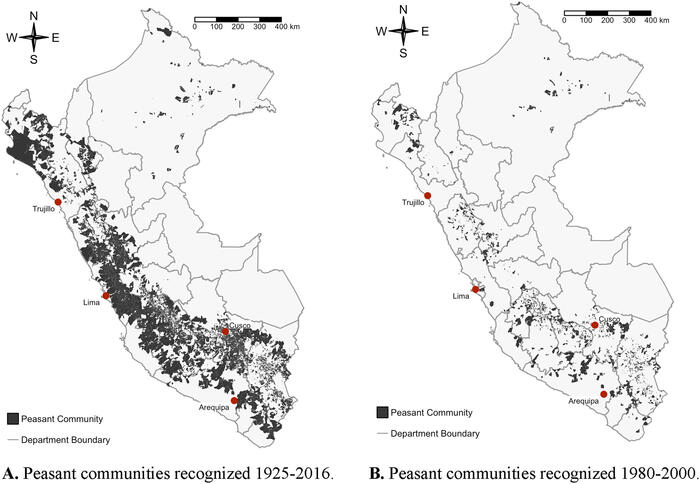
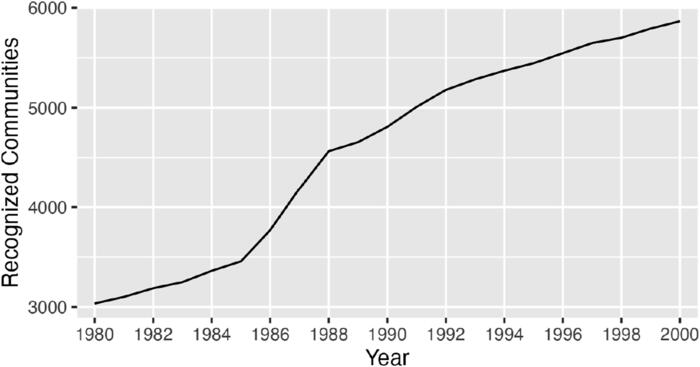
To measure the impact of recognition on violence, Albertus compares 2,475 recognized communities (i.e., those “treated” with recognition) between 1980 and 2000 with their pre-recognition trends, and an additional 228 communities recognized after the war — the “control” group.


Image
Figure 1. Recognized indigenous communities across Peru.


Figure 1. Recognized indigenous communities across Peru.


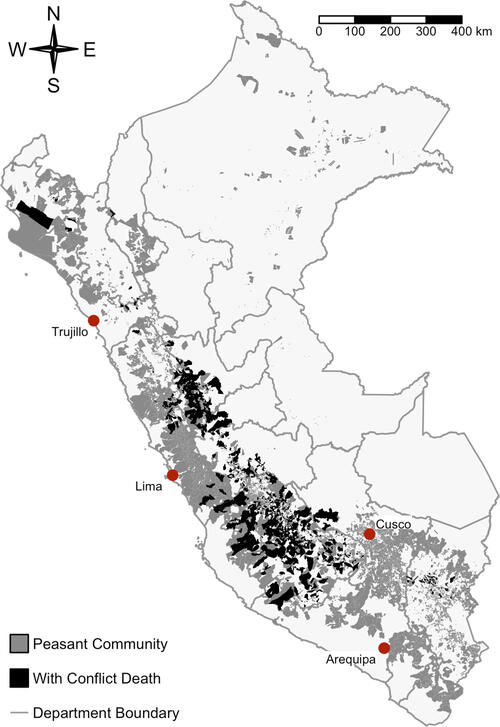
The findings confirm Albertus’ general hypothesis: the average number of deaths per year in a given community during the war was 0.086. (This may sound low, but the violence was heavily concentrated.) In formally recognized indigenous communities, however, the average number of deaths was 0.055 per year, about a 36 percent decline.


Image
Figure 2. Indigenous community recognition from 1980 to 2000.


Figure 2. Indigenous community recognition from 1980 to 2000.


The findings confirm Albertus’ general hypothesis: the average number of deaths per year in a given community during the war was 0.086. (This may sound low, but the violence was heavily concentrated.) In formally recognized indigenous communities, however, the average number of deaths was 0.055 per year, about a 36 percent decline.


Image
Figure 3. Indigenous communities that experienced conflict deaths.


Figure 3. Indigenous communities that experienced conflict deaths.


Albertus then assesses the importance of property rights, comparing places with different levels of land security: Insecure communities were those that had tenuously acquired land as part of state-run cooperatives under Peru’s 1960-80 military government, or who had bought pieces of that land as the cooperatives broke up; secure communities were those with longer-standing land claims. Albertus finds that the insecure communities experienced much greater declines in violence, again pointing to the state’s importance in peacefully resolving land disputes. In addition, those communities with greater state penetration — measured by road density — also experienced more pronounced declines. Recognition was also associated with greater participation in self-defense committees, perhaps unsurprising given that many of these were state-trained and -funded. 

Finally, Albertus finds that recognition had different effects on the kinds of wartime violence observed. In recognized communities, there were lower levels of violence by civilian and state actors, consistent with the logics of legibility, coordination, and penetration. By contrast, recognition initially had little effect on violence by the Shining Path — perhaps because recognized communities became targets. Over time, however, guerrilla violence also declined. In all, readers come away with an understanding that recognition is not merely symbolic but can be politically quite consequential, enhancing the state’s reach into peripheral areas and improving its intelligence capabilities.

*Brief prepared by Adam Fefer

Hero Image
Two native women sit atop a rock wall in Peru.
Alex Lenz
All News button
1
Subtitle

CDDRL Research-in-Brief [4-minute read]

Date Label
Display Hero Image Wide (1320px)
No
Authors
News Type
News
Date
Paragraphs

Introduction and Contribution:


Indigenous peoples constitute at least 8% of Latin America's population, well over 40 million in total, depending on whether one measures this by self-identification or proficiency in an indigenous language. Over the five centuries since Latin America’s colonization, indígenas have been subjected to myriad injustices, from genocide and linguicide to dispossession, forced assimilation, and political exclusion. However, during the last two decades, indigenous identities have entered Latin America’s political mainstream, indigenous candidates and parties have grown in popularity, and traditional political debates — for example, over fair economic development — have been increasingly addressed using the language of indigenous rights and autonomy.

Social scientific knowledge about indigenous peoples has improved considerably, and in ways that reflect many of these ongoing processes. Yet gaps persist, partly owing to the neglect of scholarship written by indigenous peoples (and in non-English languages) as well as the shoehorning of indigenous life into categories such as “peasants” or “poor masses.” The time is thus ripe for a critical examination.

In “Original Peoples Count,” Alberto Díaz-Cayeros and Irma Alicia Velasquez Nimatuj systematically review current scholarship on indigenous peoples in Latin America. The authors demonstrate how much has been learned about trends in indigenous language use, the virtues of indigenous political institutions, the dangers of indigenous environmental activism, and much more. Looking ahead, the authors call for greater attention to the threats posed by the rapid growth of artificial intelligence, as well as to the persistence of disparities in indigenous health outcomes.

Counting Indigenous Peoples and Languages:


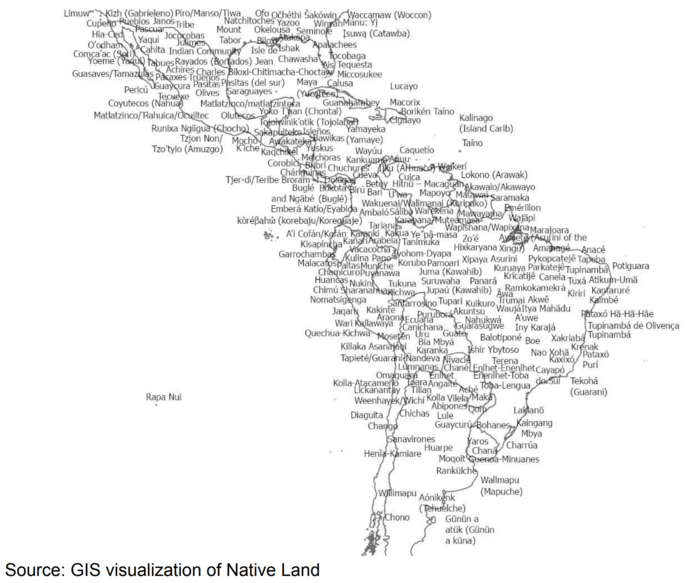
One important cause of indigenous marginalization is that many colonial and post-colonial governments simply refused to recognize their existence. Nation-building elites privileged Spanish and Portuguese and made deliberate choices about which identities to include in censuses. Relatedly, the very category “indigenous” reflects colonial efforts to homogenize millions of diverse peoples, and many indigenous peoples do not identify as such. There is tremendous variation in terms of the languages that indigenous peoples speak and the demographics of where they live. Not only do these territories cut across national borders, but many indigenous peoples have a distinctive understanding of borders, as representing sacred — rather than merely administrative — divisions.


Image
Figure 2. Unceded Territories of Indigenous Peoples in Latin America


Figure 2. Unceded Territories of Indigenous Peoples in Latin America


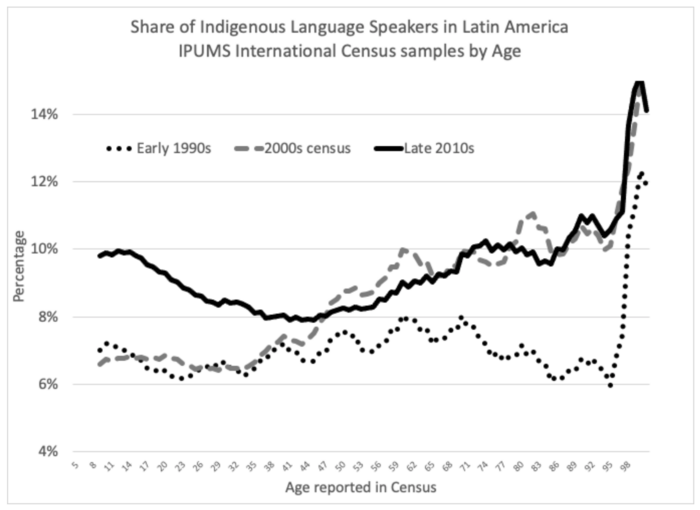
Despite the visibility of language loss and extinction, panel data collected since the 1990s paint a more nuanced picture. Diaz-Cayeros and Nimatuj highlight several important trends along these lines. For one, the number of indigenous language speakers has increased across every age cohort. Second, there was a dramatic increase in indigenous language speakers around age 40 in the 2000s, followed by an increase in speakers under 40 in the 2010s. What this suggests is not that more people are learning indigenous languages, but that more speakers are willing to reveal their identities to surveyors. The latter is itself a political phenomenon that reflects growing indigenous consciousness.


Image
Figure 1. Identity Revelation in Latin American Census Data


Figure 1. Identity Revelation in Latin American Census Data


Indigenous Politics and Economics:


Over the last two decades, indigenous politics has moved from street protests to the highest levels of government, with Evo Morales winning Bolivia’s presidency. Yet these improvements in indigenous peoples’ descriptive representation have not always produced substantive reductions in poverty and discrimination. This is one reason why indigenous parties cannot automatically rely on indigenous vote blocs; understanding why these parties enjoy more or less consistent support is a key question for future research.

Outside of mainstream politics, traditional institutions such as indigenous assemblies have grown in number and prominence. Scholars have documented cases where these institutions exhibited highly democratic properties. These include high competitiveness and turnout, which arguably produce greater accountability to ordinary people. Indigenous governance may thus provide insights into how Latin American politics can become more encompassing and participatory, moving beyond simply electing and removing candidates once every few years.

In terms of socioeconomic trends, indigenous rates of poverty, infant mortality, and school enrollment lag behind the rest of the population. These outcomes are usually worse for women, partly owing to the persistence of indigenous patriarchal norms. Meanwhile, indigenous economies have been substantially reshaped by large-scale industrial activity, especially mining and logging. The authors caution, however, against assuming that indigenous peoples uniformly oppose these activities. At the same time, local efforts to rein in industrial activity are often met with extremely punitive state action — leading to the imprisonment or death of key indigenous leaders. Latin America is now the world’s most dangerous region for environmental activism.

Directions for Future Research:


One likely cause of indigenous marginality is ‘historical trauma,’ or rather the ways that colonialism and post-colonial discrimination have transmitted social and psychological harm across generations. The authors call for greater attention to the varied political effects of historical trauma, including depressed indigenous participation, lower levels of trust in political institutions, and worse life outcomes. Similarly, despite visible efforts by Latin American governments to undertake health interventions, substantial gaps persist within indigenous communities, particularly in mental health.

Another topic for further research concerns the lives of indigenous youth, especially those who migrate to urban centers for work. Migration generates multiple overlapping challenges, including cultural adjustment, political marginality, and economic precarity. Finally, the growth of ‘digital colonialism’ demands greater attention. Artificial intelligence has generated a host of injustices, such as environmental degradation, algorithmic discrimination against indigenous languages, and the nonconsensual extraction of indigenous knowledge. The authors close by noting that indigenous peoples may use AI to make their histories ever more visible. In all, “Original Peoples Count” is an ambitious review that will likely inform the next generation of scholarship on indigenous politics.

*Brief prepared by Adam Fefer.

Hero Image
Woman working on a loom wearing traditional dress in Peru.
Adrian Dascal
All News button
1
Subtitle

CDDRL Research-in-Brief [4-minute read]
Date Label
Display Hero Image Wide (1320px)
No
Authors
News Type
News
Date
Paragraphs

Introduction and Contribution:


Tax policy is an important means through which governments reward their (potential) supporters and disadvantage opponents. Adjusting tax rates, subsidies, or audit practices can affect which groups gain economic advantages and, in turn, political power. Yet these dynamics are not always transparent, especially in semi-democratic and authoritarian settings, where selective, ambiguous, and corrupt tax policies are common.

Observers of recent Turkish history have documented sophisticated efforts by Recep Tayyip Erdoğan and the Justice and Development Party (AKP) to deepen its authoritarian rule. These include staging politically motivated trials, spreading fake news, and surveilling its opponents. AKP has also used the tax system to empower or exclude select Turkish foundations (vakıfs). However, the scope of these tax practices, as well as the extent to which the AKP has departed from its predecessors, is unclear. Focusing on one or a few visible cases of regime-friendly vakıfs gaining tax advantages may ignore larger patterns.

In “Mechanisms of privilege,” Elise Massicard and Ayça Alemdaroğlu focus specifically on vakıfs that have received tax exemptions across Turkey’s modern history. Assembling an original dataset on over 300 such vakıfs between 1967 and 2022, the authors show that the AKP is not unique in terms of how it has used exemptions to achieve its political goals. However, and especially since Turkey became a presidential system in 2018, the process has become more centralized, nepotistic, and favorable towards Islamist-aligned vakıfs

Massicard and Alemdaroğlu draw our attention to the important role of tax exemptions in fostering regime support.

The reader comes away with a sense of policy continuity across Turkish regime changes, which are sometimes characterized as dramatic “ruptures.” More generally, Massicard and Alemdaroğlu draw our attention to the important role of tax exemptions in fostering regime support. National and subnational partnerships have considerably enriched Turkish vakıfs, empowering them to advance both secular and religious goals and to substitute for state provision in the face of neoliberal policy reforms. “Mechanisms of privilege” extends our understanding of a shadowy policy lever that has been widely criticized by both the European Union and the Turkish opposition. 

Tax Exemption in Modern Turkey:


Vakıfs have provided a range of services across Turkey, including education, healthcare, and infrastructure projects. A 1967 law stipulated that foundations could gain tax exemption so long as they allocated at least 80% of their income to services included in the state budget, underscoring the law’s clear political objectives. During the 1970s, exempted vakıfs followed state-led efforts at social and economic development. Beginning in the 1980s, neoliberal policies led to an increase in Islamist-aligned vakıfs, which aimed to offset growing inequality and a shrinking state. 

The Turkish government has, on multiple occasions, altered the legal landscape of exemptions to further its interests. For example, a 2003 law excluded human rights-focused vakıfs from exemption, as these were likely to challenge the new AKP government. After 2018, Turkey’s adoption of a presidential system placed exemptions under direct presidential control, and a 2021 law removed the Ministry of Finance from the exemption process. These centralizing measures have rendered tax-exempt vakıfs increasingly unaccountable. 

Only a few hundred foundations are approved for tax exemption (out of several thousand that apply), and these are rarely revoked. This situation contrasts with, e.g., the United States, where foundations are automatically exempted upon meeting clear legal requirements.

Data and Findings:


The authors’ database includes 331 exempted vakıfs since 1967, several of which subsequently lost their status. It also contains information on each foundation’s political orientation, which is drawn from news reports, website descriptions, and original interview data. Massicard and Alemdaroğlu use this data to describe the pace and politics of exemption: Is AKP a glaring outlier in modern Turkish history? And does it, in fact, restrict exemption to a narrow set of Islamist foundations? 

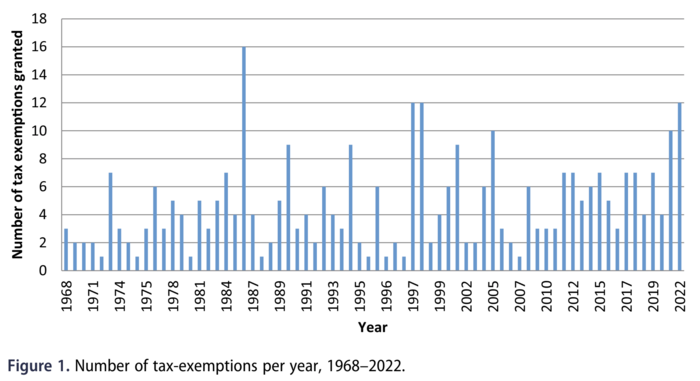
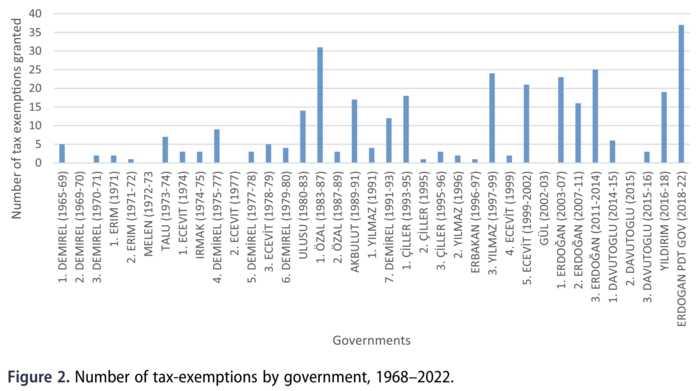
The data reveal that tax exemptions have continuously and gradually expanded over time. Governments have differed considerably from one another, but AKP — at least prior to the transition to a presidential system — has not uniformly granted more exemptions. In fact, AKP governments have importantly differed from one another in this respect. (These findings also hold when considering the duration of each government, given that shorter tenures tend to generate fewer exemptions.)


Image
Figure 1. Number of tax-exemptions per year, 1968–2022.


Image
Figure 2. Number of tax-exemptions by government, 1968–2022.


In terms of the politics of tax exemption, Massicard and Alemdaroğlu document a pattern of growing ambiguity and cronyism. For example, although foundations are legally required to be national in scope, strictly local vakıfs occasionally receive exemptions. Secular governments have tended to limit or reverse exemptions granted to Islamist-aligned foundations, and vice versa. One notable pattern under secular rule between 1997 and 2002 was growing exemptions to foundations representing the highly marginalized Alevi community, which Turkish Sunni leaders have tended to view as heretical. 

Interestingly, AKP’s first term in government was characterized by relatively broad exemptions, not solely to religious organizations. Since 2010, however, not only have Islamist vakıfs received an increasing number of exemptions. There is also a growing pattern of nepotism — foundations linked to Erdoğan’s family members receiving exemptions. 

Despite the growing centralization of exemption policy, AKP rivals at the subnational level have also used their power to undercut national priorities. For example, in 2019, the opposition-led Istanbul government canceled its agreements with AKP-aligned foundations. In sum, Massicard and Alemdaroğlu both deepen our understanding of five decades of Turkish politics and illustrate an overlooked item on the authoritarian “menu of manipulation.”

*Brief prepared by Adam Fefer.

Hero Image
Spread of Turkish Lira bills
Getty Images
All News button
1
Subtitle

CDDRL Research-in-Brief [3.5-minute read]

Date Label
Display Hero Image Wide (1320px)
No
Authors
News Type
News
Date
Paragraphs

Introduction and Contribution:


There is a growing recognition, both in and outside of the academy, that democracy requires more than simply voting for and removing incumbents during elections. For one, relying solely on elected representatives deprives those being represented of direct control over decisions that affect them. In addition, it can also generate — as it has in the United States and elsewhere — large gaps in responsiveness and representation, particularly for historically disenfranchised and marginal groups. 

Participatory budgeting (PB) represents one influential attempt to overcome these gaps in democratic practice. First introduced in the 1980s by the Brazilian Workers’ Party (PT), PB empowers voters to allocate public funds to projects that benefit them. Since then, ordinary citizens in thousands of places across the world have helped determine the content of local budgets.

Despite its successes, academics and practitioners remain unclear about how to address and balance considerations related to budget constraints and ease of participation. This coincides with well-known mathematical difficulties surrounding the aggregation of votes, for example, that individually consistent preferences can yield inconsistent group outcomes.

Participatory budgeting empowers voters to allocate public funds to projects that benefit them.

In “Rank, Pack, or Approve,” Lodewijk Gelauff and Ashish Goel introduce a dataset drawn from the novel and comprehensive Stanford Participatory Budgeting platform. The data span over 150 real participatory budgeting processes, or “elections.” Importantly, the elections vary in terms of how ballots are designed and how participants make budgeting decisions. Gelauff and Goel ask how such variation shapes important budgeting outcomes, such as when participants are more likely to become fatigued and abandon the process. 

Two key findings from the study are as follows: First, more complex PB designs lead voters to, perhaps unsurprisingly, spend more time participating; however, this does not significantly increase abandonment or “dropout” rates. Second, voting methods that force participants to deal with cost trade-offs — as opposed to merely indicating their preferences — have been found to generate less expensive projects. 

The reader comes away with a sense of how subtle differences in the design of budgeting elections meaningfully shape the allocation of resources. This will resonate with social scientists who are familiar with how, for example, different kinds of electoral rules shape political competition. To understand Gelauff and Goel’s findings, it helps to first outline how PB elections differ from one another.

Ballot Design and Voting Methods:


The basic PB setup involves organizers choosing a voting method, a list of projects to potentially be funded, and an authentication process (i.e., checking that participants are valid voters). Voters then select or rank projects given the constraints of each voting rule or method. These three rules, captured in the paper’s title, are as follows: 

The first, “K-approval,” asks voters to select up to “K” projects. The top-voted projects receive funding until the budget runs out. K-approval is simple, but its main drawback is that it ignores the costliness of each project: voters only indicate which projects they like, rather than how those choices fit within a fixed budget. The second method, “K-ranking,” asks voters to rank their preferred projects, capturing their preferences in a more fine-grained manner. As votes are aggregated using the Borda scoring method, higher-ranked projects receive greater weight or value. Finally, the “knapsack” method asks voters to choose projects that fit within a fixed budget. This method best allows participants to balance costs in a way that mimics real city councils. However, knapsack is more complex and time-consuming than K-approval or K-ranking, although the online interface design, which mimics a shopping cart, is already much simpler than it would be on paper. 

Data Collection and Findings:


As mentioned, Gelauff and Goel’s data is drawn from the open-source Stanford PB platform. This tool enables cities to conduct online PB elections with a great deal of customizability, including location, budget, language of operation, authentication process (e.g., requiring personal information or sending SMS messages), as well as methods, phases, and windows of voting. Key for the authors’ purposes, it also tracks (anonymous) voters’ choices and how much time they spend during the election. Data collection began in 2014. 

The first key finding is motivated by the fact that election organizers often prefer K-approval for its simplicity. As such, Gelauff and Goel analyze how much time participants spend on their ballots and how often they quit. Although more complex ballots — those with a larger budget and number of projects — are shown to predict longer completion times, they do not significantly increase dropout rates. The authors note that more research is needed to assess whether knapsack specifically affects dropout.

The authors also find that voters select more expensive projects with K-approval compared to the knapsack methods. However, voters indicate similarly expensive preferences for their most-preferred projects under both methods; the key difference appears lower down the list of preferences, where the knapsack constraint forces them to be more cost-conscious. In other words, the knapsack cost constraint doesn’t affect which expensive project participants most prefer. Rather, it limits how many extra expensive projects they can add.

Overall, “Rank, Pack, or Approve” deepens our understanding of how PB can improve direct democratic engagement while reducing burdens on participants. It does this while providing a large quantity of real-world data, compared with prior research that has relied on crowdworkers without a real stake in the budgeting outcome. The authors helpfully illustrate how local governments can design PB processes that are clearer and more inviting to ordinary voters. Subsequent research will benefit from using this powerful data resource, as will organizers seeking to expand local engagement.

*Brief prepared by Adam Fefer.

Hero Image
Building with glass doors and polling station signage out front
Marilyn Tran via Unsplash
All News button
1
Subtitle

CDDRL Research-in-Brief [3.5-minute read]

Date Label
Display Hero Image Wide (1320px)
No
Authors
News Type
News
Date
Paragraphs

Introduction and Contribution:


Russia’s 2022 invasion of Ukraine has significantly undermined European security and Ukraine’s sovereignty, claimed hundreds of thousands of lives, and arguably solidified Vladimir Putin’s authoritarian grip on power. Aside from these more obvious consequences, around one million Russians have emigrated, changing the domestic politics of dozens of countries across Europe, Asia, and North America. 

Russian emigrants not only face discrimination, integration difficulties, and economic precarity in their host countries, but also the threat of “transnational repression.” This includes Russia seizing their property or revoking their citizenship, harassing their relatives who stayed behind, and surveilling them in their host countries. There have even been reports of activists and journalists being poisoned outside of Russia. What does transnational repression mean for the lives of ordinary Russian migrants?

In “Invisible costs of exiting autocracy,” Ivetta Sergeeva and Emil Kamalov show that these varied challenges and threats — especially fear of Russian repression and host country discrimination — have had a considerable impact on emigrants’ subjective well-being. Using original survey and interview data collected as part of the ambitious OutRush project, the authors draw our attention to the many psychological hardships faced by Russians abroad simply because they are citizens of a belligerent authoritarian state.

The authors draw our attention to the many psychological hardships faced by Russians abroad simply because they are citizens of a belligerent authoritarian state.

Data and Variables:


Surveys and interviews were conducted between August and September 2022 with over 2,500 emigrants. “Invisible Costs” focuses on Russians living across more than 60 countries, with interviews conducted in five popular destinations: Georgia, Kazakhstan, Kyrgyzstan, Armenia, and Serbia.

Sergeeva and Kamalov draw on a standard conception of subjective well-being as having ‘affective’ and ‘cognitive’ components. Affective well-being is operationalized in terms of how often survey respondents have felt sadness, depression, and happiness over the last three months, and cognitive well-being in terms of levels of life satisfaction. Migrant experiences ought to affect these two components differently; for example, the threat of transnational repression may significantly reduce happiness while leaving life satisfaction unchanged. As prior research has shown the importance of economic and social variables for migrant integration, the authors also include measures of income, employment, and interaction with locals. 

Results:


The survey data paint a fairly bleak picture of the emigrant experience. Over 60% of respondents reported being somewhat or very afraid of transnational repression, while only 9% expressed no such fear. Interviewees often linked these fears to at least two factors: (1) concern for the well-being of relatives still in Russia and (2) awareness of the presence of Russian agents in host countries. The statistical analysis shows that fear of transnational repression had a statistically significant (negative) correlation with affective well-being. However, it is not a significant predictor of cognitive well-being, which makes sense, as the high risks of repression in Russia make emigration seem like a rational life choice. 

Meanwhile, 22% reported experiencing discrimination. This is much higher than the OECD-wide average of 15% for migrants — the highest single-country percentage in these surveys is just 21%. In Poland and Georgia — both having a history of violent conflict with Russia — 36% and 39% of emigrants reported experiencing discrimination, respectively. For example, one interviewee reported walking into a Georgian coffee shop, scanning a QR code, and then pictures with captions saying “you’re terrorists, go away” popping up on their phone instead of the menu. Self-reported discrimination is shown to have a statistically significant effect on both types of well-being.


Image
Figure 3. Effect of discrimination, experienced and feared, on subjective well-being.


Figure 3. Effect of discrimination, experienced and feared, on subjective well-being. The index of affective well-being represents an affective component of subjective well-being, while satisfaction with one’s life represents the cognitive component. Variables are presented in their original scales without standardization. Models with original scales are presented in online appendix D.


41% of respondents merely feared discrimination. This fear appears driven less by migrants’ negative experiences in their host countries and more by the risk of discrimination leading to deportation. Interviewees seem to assess this risk with reference to the high number of visa rejections they observe. Not only does fear of discrimination have a large and statistically significant effect on well-being, but its effects on affective well-being in particular are nearly twice as large as those of unemployment.

Consistent with prior research, spending time with locals has a statistically significant (positive) effect on well-being, with these effect sizes being nearly as large as those of discrimination, suggesting that social intimacy can help offset its negative effects. And indeed, several interviewees attested to this. One described an encounter with Georgians who said, “If there are any conflicts [related to discrimination]…please call me, because we understand that this is wrong and such things should not happen.”

Finally, 49% of respondents reported feeling high levels of guilt over Russia’s aggression, while 59% felt some level of responsibility. These factors are both statistically significant predictors of affective, but not cognitive, well-being. The authors explain this in terms of migrants adapting to living with emotions such as guilt; their migration choices are still seen as justified in spite of the negative psychological costs. For instance, one interviewee said, “gradually, life somehow clawed its way back…and now it has entered into some strange routine of suspension and timelessness.”


Image
Figure 4. Effect of feelings of collective guilt and responsibility on subjective well-being.


Figure 4. Effect of feelings of collective guilt and responsibility on subjective well-being. The index of affective well-being represents an affective component of subjective well-being, while satisfaction with one’s life represents the cognitive component. Variables are presented in their original scales without standardization. Models with original scales are presented in online appendix D.


These distressing findings have implications for the priorities of host country governments. For one, even economically successful migrants still need legal protections against discrimination and physical insecurity in order to thrive. Second, because fear is itself sufficient to undermine well-being, host countries must (a) take measures to deter transnational repression and (b) make migrants aware that these measures are in place, so as to decrease their fears.

*Brief prepared by Adam Fefer.

Hero Image
Russian passport on a gray stone background
Getty Images
All News button
1
Subtitle

CDDRL Research-in-Brief [3.5-minute read]

Date Label
Display Hero Image Wide (1320px)
No
Authors
News Type
News
Date
Paragraphs

Introduction and Contribution:


Gossip — sharing information, both positive and negative, about absent third parties — plays a major role in social life. Two friends spread a rumor about their neighbor’s infidelity, an employee’s hard work is praised at a manager's meeting, and so on. 

From an evolutionary standpoint, however, the origins and proliferation of gossip are somewhat puzzling. Not only is it costly — acquiring personal information, sharing it with others, perhaps risking ostracism for being a yenta — but the evolutionary benefits are not clear. Indeed, gossiping may be entertaining, but it seems like a stretch to think it could improve human adaptation, let alone survival.

In “Explaining the evolution of gossip,” Xinyue Pan, Vincent Hsiao, Dana S. Naub, and Michele J. Gelfand conduct a series of computer simulations to model the gossiping process and shed light on the benefits it generates for both society and gossipers. The authors posit two such benefits that help explain its evolution: First, gossip spreads information about others’ reputations, helping people identify those who will (not) cooperate with them. Second, gossip reduces selfishness, as those who otherwise would not cooperate will choose to do so with gossipers in order to manage their reputations. These are called the “reputation dissemination” and “selfishness deterrence” functions, respectively.

Readers come away with a sense of the power of agent-based modeling to solidify our intuitions about complex social processes. Indeed, gossip involves dynamics of communication, cooperation, geographical proximity, as well as both personal and collective gain. Models help simplify these dynamics. In addition, the authors illustrate how an ostensibly non-strategic activity has very important strategic dynamics and implications. 

Gossip involves dynamics of communication, cooperation, geographical proximity, as well as both personal and collective gain…The authors illustrate how an ostensibly non-strategic activity has very important strategic dynamics and implications.

The Simulation Setup:


Agents in the simulation develop a strategy based on two decisions: whether or not to gossip and how exactly to cooperate with other agents. The former is a binary choice, whereas the latter permits six choices. Of these six, three are especially important: The “exploitive” agent is one who only chooses to cooperate if they believe their partner cannot easily be taken advantage of in the game. In other words, exploiters condition their choice on the other agent’s reputation. Next, the “virtuous” agent cooperates if it believes the other agent will and otherwise defects. Finally, the “opportunist” agent will only cooperate with gossipers and never with non-gossipers.


Image
Plot (B) illustrates an agent’s action as a function of their own strategy and their belief about the interaction partner’s strategy.


Figure 2b. Plot (B) illustrates an agent’s action as a function of their own strategy and their belief about the interaction partner’s strategy.


The other three cooperation strategies are as follows: “unconditional defectors” and “unconditional cooperators” are, as the names imply, insensitive to information about others’ reputations. Meanwhile, “reverse opportunists” only cooperate with non-gossipers and never with gossipers. Perhaps unsurprisingly, the authors will show that agents tend to discard these three strategies over time. If gossip is, in fact, beneficial from an evolutionary standpoint, then both cooperative and gossiping strategies must increase over time.

To model the gossiping process requires that agents respond to new information and update their strategies accordingly. This will help them maximize their success and avoid being exploited by others. Information can thus be obtained in two ways: either agents observe each other’s behavior during the game and use it to infer their strategy, or information is disseminated to them via gossip.

The simulation proceeds in three steps. First, agents play a “cooperation game,” whereby each player simultaneously decides whether to cooperate or defect. (The rules are as follows for two agents, A and B: A incurs a cost of 1 for cooperating while B’s benefit is 3, and vice versa. A thus gains by cooperating, but is tempted to defect to gain 3 while B pays a cost of 1, and vice-versa.) The second step involves the dissemination of gossip. Finally, strategies are updated based on the first and second steps. 

Simulation Results:


The authors show that over time, the vast majority of agents (90%) choose to gossip and to cooperate (78%). The three most common cooperation strategies are “exploitive” (57%), “opportunistic” (18%), and “virtuous.” By contrast, none of the other three cooperation strategies is chosen more than 5% of the time.


Image
The evolutionary trajectories of different strategies and behaviors. The lines are average trajectories from 30 simulation runs with all the six cooperation strategies under the default parameter choice. The shadows show the SEs of the average trajectories. Plot (A) illustrates the evolution of gossipers. Plot (B) illustrates the evolution of different cooperation strategies. Plot (C) illustrates the evolution of cooperation.


Figure 3. The evolutionary trajectories of different strategies and behaviors. The lines are average trajectories from 30 simulation runs with all the six cooperation strategies under the default parameter choice. The shadows show the SEs of the average trajectories. Plot (A) illustrates the evolution of gossipers. Plot (B) illustrates the evolution of different cooperation strategies. Plot (C) illustrates the evolution of cooperation. 


At first glance, the high prevalence of cooperation and exploitive/opportunistic strategies may appear puzzling. However, the growth of gossip helps guard against exploitation and opportunism. In other words, it remains strategically rational to exploit when feasible, but doing so simply becomes less feasible over time. 

One surprising finding is that gossipers and opportunists actually need each other. Opportunists cooperate with gossipers to protect their reputations, and in doing so give gossipers a real survival advantage over non-gossipers. As co-author Michele J. Gelfand said in a recent interview, “Opportunistic agents kind of get a bad rap. They’re seen as kind of sneaky…But in fact, they’re actually helping a lot in the population.”

The final aspect of the simulation involves showing that both functions of gossip, (1) disseminating reputations and (2) deterring selfishness, are jointly necessary to explain its evolution. To do this, the authors begin by analyzing solely function (1). Yet, this provides no direct benefit to gossipers: they spend time and energy disseminating information that helps others, but without deterring opportunists, who are not necessarily more likely to cooperate with them. In this situation, gossiping strategies will not proliferate. This is why function (2) must be part of the explanation. Gossipers directly benefit when opportunistic agents must manage their reputations by cooperating with them. In this way, they can deter the prospect of defection, which non-gossipers still face.


Image
Figure 4


Figure 4. Results of Steps 1 and 2. Each condition is the average of 30 simulation runs. The value is calculated as the average value from the 4,000th to the 5,000th iterations of each simulation run. The error bars show the SEs. On the Left side of each plot are the results from Step 1; on the Right are the results from Step 2. Plot (A) shows that gossipers evolve only when both reputation dissemination and selfishness deterrence functions exist (i.e., with-gossip and with-rep-manage). Plots (B and C) show that the existence of gossipers (yellow) increases reputation accessibility and cooperation. Plot (D) shows that opportunists evolve only when both reputation dissemination and selfishness deterrence functions exist. Plots (E and F) show that the existence of gossipers increases the proportion of reputation-sensitive agents.


In all, “Explaining the evolution of gossip” is an insightful exercise in “abductive reasoning.” No historical account could ever hope to conclusively show how gossip actually developed. Instead, the simulation shows readers how gossip could possibly have developed in order to provide us with better information and encourage cooperation.

*Brief prepared by Adam Fefer.

Hero Image
Two people in contemporary, neutral clothing quietly converse in a professional hallway. They are framed from behind and in profile, with no identifiable facial features visible. One leans in to share information, while the other listens attentively with a subtle shift in posture. The background features blurred figures hinting at a wider social context. The lighting is subdued and natural, creating an intimate, analytical mood.
AI-generated image created with Gemini (Google AI), April 2026
All News button
1
Subtitle

CDDRL Research-in-Brief [4-minute read]

Date Label
Display Hero Image Wide (1320px)
No
Authors
News Type
News
Date
Paragraphs

Introduction and Contribution:


Wars have wide-ranging effects on the political attitudes and behaviors of citizens and elites. For example, European leaders were pressured to make democratic reforms and build large welfare states during World War II in order to stabilize their countries and encourage wartime sacrifice. After the 9/11 attacks and the initial Afghanistan invasion, George W. Bush’s approval ratings soared to 90%.

The Russo-Ukrainian War has been one of the defining wars of this century. Its consequences for the politics of both countries — such as Ukrainian national unity or the repression of Russian dissidents — are beginning to be understood. Yet it is less clear how the war has affected third-party states. In light of Russia’s imperial ambitions, as well as Ukraine’s need for international support to combat a regional hegemon, this is a pressing issue.

Leaders of third-party states have responded to the war in a range of ways, including imposing sanctions on Russia and mediating between the two countries. Wars also affect how rulers communicate with their citizens: they may be motivated to emphasize their shared connections with either warring party, their need for national self-reliance in a hostile international system, and so on.

In “Between wars and words,” Ana Paula Pellegrino, Benjamin R. Burnley, and Laia Balcells show that leaders of third-party states increased their nationalist rhetoric on X (formerly known as Twitter) after the invasion. The authors analyze over 10,000 tweets from the heads of 130 states both before and after the invasion, mapping these along a nationalist-cosmopolitan spectrum. The effects of Russia’s invasion on nationalist tweets were strongest among North Atlantic Treaty Organization (NATO) members and weaker among members of the pro-Russia Collective Security Treaty Organization (CSTO).

“Between wars and words” provides evidence that leaders react to wars in similar ways as do masses, whose sense of national identity tends to increase during periods of global uncertainty and conflict. As politicians increasingly use X to communicate, a more precise understanding of their tweets before and after major conflicts may help social scientists better understand their beliefs and threat perceptions. 

As politicians increasingly use X to communicate, a more precise understanding of their tweets before and after major conflicts may help social scientists better understand their beliefs and threat perceptions.

Methodology:


The authors collect tweets from the 14 days before and after the invasion using an unsupervised learning algorithm called GloVe. This process is diagrammed in Fig. 1 below. GloVe identifies relationships between words by analyzing how often they appear together, grouping together words with similar meanings. This enables the authors to code each tweet according to its topic and sentiment (e.g., positive vs. negative).


Image
Figure 1: Data collection and measurement procedures


To code the level of nationalism versus cosmopolitanism, the authors employ the Concept Mover’s Distance (CMD) approach. CMD measures how closely the words in each tweet align with sets of ‘anchor terms’ representing each concept, placing tweets along a continuum between the two. Briefly, nationalism refers to a set of beliefs about the reality and value of nations, the obligations that members of a nation have to one another, and the right of that nation to determine its political affairs, whether as its own state or within an existing state. By contrast, cosmopolitanism is the view that all humans, irrespective of their national memberships, ought to be seen as part of a single world (kosmos) community. Returning to CMD, nationalist tweets are those that align with anchor terms such as ‘pride, glory, patriot, forefathers, homeland,’ and ‘heritage.’ Cosmopolitan anchors include ‘cooperation, humanity, multilateral,’ and ‘universal.’ 

Importantly, nationalistic tweets need not bear an obvious relationship to (inter)national security — the authors hypothesize that Russia’s invasion merely increased nationalist rhetoric, not rhetoric of a specific kind. For example, 10 days after the invasion, Bolivian President Luis Alberto Arce Catacora tweeted, “In 2019, the glorious Alteño people once again showed us their courage and love for our country.” Conversely, 12 days prior to the invasion, Argentine President Alberto Fernández espoused several cosmopolitan sentiments when he tweeted: “With the logic of multilateralism, Argentina has discussed with Russia the possibility of deepening financial assistance and increasing bilateral investment and trade between the two countries.” 

Findings:


The authors show that Russia’s invasion did significantly increase nationalist rhetoric by third-party heads of state, whether or not one controls for topic and sentiment. As an example of this, consider Austrian Chancellor Karl Nehammer: Three days prior to the invasion, he tweeted, “Austria continues to rely on diplomacy and de-escalation to prevent war. The OSCE…is the appropriate framework.” On the day of the invasion, by contrast, Nehammer tweeted “I promise that I will do everything to protect the people who live in Austria.” Other international leaders, such as Joe Biden and Justin Trudeau, tweeted out more cosmopolitan statements about the importance of collectively pressuring Putin and respecting international law.


Image
Table 1: Impact of Russian invasion on nationalism of tweets (high ascriptive – scaled)


Why might an international war prompt the leaders of third-party states to use more nationalist rhetoric? The authors provide a number of hypotheses. For one, wars lead to feelings of uncertainty, and nationalist rhetoric by elites can afford citizens a sense of safety. Third parties might also make nationalist statements to signal their support of (or opposition to) one of the belligerent parties; for example, “our proud nation will not stand idly by as Russia attacks Ukraine.”

Although the invasion increased nationalist discourse on average, these effects are driven primarily by the behavior of NATO members. This is likely because the alliance has historically taken a strong stand against Russian aggression. As mentioned above, CSTO members did not tweet in a more nationalistic way, nor did leaders of states with histories of territorial armed conflicts resembling the Russo-Ukrainian War.


Image
Table 2: Impact of Russian invasion on nationalism of tweets – military alliances


*Brief prepared by Adam Fefer.

Hero Image
Close-up of a person in a suit and red patterned tie using a smartphone, with a wristwatch visible on their left wrist.
Getty Images
All News button
1
Subtitle

CDDRL Research-in-Brief [4-minute read]

Date Label
Display Hero Image Wide (1320px)
No
Authors
News Type
News
Date
Paragraphs

Introduction and Contribution:


The ongoing Russo-Ukrainian War has been one of the most devastating conflicts of the 21st century. Since Russia’s 2022 invasion, Ukraine has experienced not only mass casualties but immense cultural destruction, as well as the forcible deportation and adoption of thousands of Ukrainian children to Russian families. Ending the war requires understanding its causes, particularly from the point of view of Vladimir Putin and other key Russian decision-makers. 

Some observers of Russian and global politics — as well as Putin and his allies — have claimed that the prospect of Ukraine joining NATO caused the war. The argument here is that as a superpower, Russia could not tolerate the security implications of a country on its border joining a rival alliance. Russia’s war, then, was a preventive one — less a choice than a strategic necessity. Any superpower in such a situation would do the same.

In “NATO Did Not Cause Putin’s Imperial War,” James Goldgeier and Brian D. Taylor convincingly challenge the NATO hypothesis, showing it to be more a piece of Kremlin propaganda than a plausible account of Putin’s decision-making process. Instead, the authors draw our attention to Putin’s most deeply held and longstanding beliefs: that Ukraine is not a legitimate nation state, that Ukrainians would not freely associate with the West and its alliances (unless they were being manipulated), and that dominating Ukraine is essential to Russia reclaiming its status as a global superpower, one that is constantly disrespected by the West. 

As many social scientists focus on improving the causal power of their statistical inferences, Goldgeier and Taylor helpfully focus our attention on the beliefs and reasons of political actors who cause political outcomes such as wars and revolutions. More importantly, the authors provide a starting point for thinking about ending the Russo-Ukrainian war, one focused not on the distraction that is NATO arguments but on Putin’s imperial ambitions.

The authors provide a starting point for thinking about ending the Russo-Ukrainian war, one focused not on the distraction that is NATO arguments but on Putin’s imperial ambitions.

Pitfalls of the NATO Explanation:


The authors begin by noting that NATO enlargement clearly played a role in the deterioration of relations between Russia and the West over the past 25 years. In part, this is because many Russian elites — owing to their imperialistic beliefs, more on this below — never accepted that former Soviet Republics were free to join the alliance. However, NATO enlargement was but one item in a long list of Russian grievances, some based in reality and others fictional. These include the 2003-04 Color Revolutions — mainly reflecting widespread domestic sentiment, not Western machinations — and alleged American support for the 2011-13 Russian protests in the aftermath of Putin’s rigged elections, which were similarly homegrown.

There is good evidence that Putin and his inner circle neither feared NATO aggression nor believed that Ukraine could realistically join the alliance. After George W. Bush’s failed bid for Ukrainian membership in 2008, no American president has seriously entertained or pushed for Ukraine’s admission. NATO took minimal action after Russia’s 2014 invasion of Ukraine, before which time Ukrainians themselves didn’t support joining the alliance (likely because they anticipated the negative consequences for Russia-Ukraine relations). NATO itself has worked against admitting Ukraine; indeed, much of its security assistance has been designed to make it possible for Ukraine to defend itself without formal admission. What’s more, no country bordering Russia joined NATO after 2004 until Finland did so in 2023.

When Putin decided on war in 2021, his invasion plan was based on the assumption that victory would be quick and easy, evidencing his lack of concern for NATO intervention. Further, he knew that NATO lacked the troops and would be extremely wary of confronting nuclear Russia. 

Putin’s Imperial Beliefs and Goals:


For several decades, Putin has expressed the belief that Ukraine is not a genuine nation-state and that Russia both gave away and was “robbed” of much of its territory. One of Putin’s key goals is arguably to rebuild Russian greatness via imperial conquest. The West is not merely intervening in Eastern European politics but, according to Putin, actively working to downgrade Russia to a second-class country and undermine its sovereignty. Putin views the war as key to reversing Russia’s declining status.

Because Putin and his inner circle view Ukraine to be a natural part of Russia, the possibility that Ukrainians would freely tie their fortunes to the West is inconceivable — Ukrainian elites must have been tricked, co-opted, or bribed. Some Russian propagandists have even described the war as one of “Russians killing Russians.”

Putin’s imperialism is not only confined to privately held beliefs. During COVID-19, he spent a great deal of time reading historical texts to prepare a 5000-word article on the alleged historic inseparability of Russia and Ukraine. What could such an undertaking have to do with NATO expansion?

Russia’s wartime conduct also provides strong evidence for the imperialism explanation. As mentioned above, Russia has gone to great lengths to destroy Ukrainian culture. It has rejected multiple peace deals that would have prevented Ukraine from joining NATO.

Russia’s wartime conduct also provides strong evidence for the imperialism explanation. As mentioned above, Russia has gone to great lengths to destroy Ukrainian culture. It has rejected multiple peace deals that would have prevented Ukraine from joining NATO. Putin saw these as failing to address the conflict’s “root causes,” arguably a euphemism for Ukrainian sovereignty. Instead, Russian conditions for peace include making Russian an official language, disbanding “nationalist” political parties, and ensuring the influence of Moscow’s Orthodox Church. These conditions smack of Russian chauvinism.

Of course, elites’ imperial beliefs do not necessarily lead to war. And indeed, Putin initially sought to control Ukraine through political measures, such as election interference. However, the authors argue that when President Volodymyr Zelenskyy seized the assets of a key Putin ally, Putin realized his position was weakening. Russian security officials then assured Putin — likely out of fear — that overthrowing Ukraine’s government would be easy. This flawed decision-making process led to war. Readers will come away struck by how many lives have been lost while policy and scholarly debates remained focused on the NATO hypothesis.

*Brief prepared by Adam Fefer.

Hero Image
Vladimir Putin at a Victory Day rally in Moscow.
Vladimir Putin at a Victory Day rally in Moscow. | Getty
All News button
1
Subtitle

CDDRL Research-in-Brief [4-minute read]
Date Label
Display Hero Image Wide (1320px)
No
Authors
News Type
News
Date
Paragraphs

Overview and Contribution:


The rule of law (RoL) is an important component of democracy, key to protecting individual rights and ensuring that representatives follow the same rules as those being represented. As countries become more democratic, one would expect corresponding increases in the rule of law.

In “Fabricated Justice,” Beatriz Magaloni and Esteban Salmón show how these expectations must be seriously qualified. Beginning in 2008, Mexico gradually implemented RoL reforms. Thereafter, citizens witnessed some important gains in due process and individual rights, in particular, a dramatic decline in torture. However, these changes coincided with rising insecurity, violence, and popular demands for retribution against criminals. Owing to these pressures — as well as their own desire to work with fewer constraints — police and prosecutors found ways to circumvent the new reforms, particularly by planting evidence (drugs and weapons) on suspects, a serious RoL violation. 

However laudable its reforms, Mexican authorities failed to equip justice system officials with the tools and capacities to properly fight crime. Facing similar social and professional pressures as they had prior to the reforms, fabricated evidence struck them as a reasonable adaptation to new procedures. 

Marshalling an impressive array of quantitative and qualitative data, Magaloni and Salmón show how these legal changes can be said to have led to changes in police tactics and in the categories of arrests made. Interviews with police and prosecutors make clear just how much RoL reforms have left justice system officials feeling impotent and compelled to “fabricate justice.”

Marshalling an impressive array of quantitative and qualitative data, Magaloni and Salmón show how these legal changes can be said to have led to changes in police tactics and in the categories of arrests made.

Mexico’s (Staggered) Legal Changes:


Prior to 2008, Mexico’s legal system was an “inquisitorial” one inherited from Spanish colonial rule. This meant that judges largely based their rulings on an often-secretive case file assembled by police and prosecutors. Case files contained confessions frequently obtained by torture, which Mexico’s Supreme Court upheld on multiple occasions. After 2008, however, Mexico adopted an “adversarial” system with greater procedural oversight of detention and the early stages of investigation (when torture was more likely), stricter standards on the use of force and collection of evidence, and so on.

Importantly, Mexico’s RoL constitutional amendment set an 8-year period to fully implement the reforms. This led to a high degree of variation in when individual states adopted the reforms, as well as whether they adopted all of the reforms at once or in a piecemeal fashion. From a statistical point of view, this created a “quasi-experimental” scenario in which outcomes (e.g., whether prisoners reported being tortured) in “treated” states or municipalities (i.e., those that reformed) could be compared with “control” units that had not yet reformed. This helps ensure that other differences between states and municipalities (e.g., levels of economic development or state capacity) do not bias the results.

Quantitative and Qualitative Findings:


Magaloni and Salmón first draw on a 2021 survey of 60,000 prisoners conducted by Mexico’s National Institute of Statistics and Geography. The authors document (1) a substantial decline in reports of torture after 2014 (when many states and municipalities implemented the RoL reforms), (2) a rise in drug and weapons convictions by 2016 (likely the product of evidence fabrication), and (3) a decline in homicide convictions (because [a] homicide confessions could no longer be elicited through torture and [b] corpses are difficult to fabricate). These findings are largely borne out when the authors conduct their “difference in differences” analysis using the aforementioned geographical and temporal variation. As the authors show, declines in torture are likely driven by greater judicial oversight of cases, a key goal of the 2008 reforms.


Image
Fig. 1. Torture and objects (drugs and weapons).


Fig. 1. Torture and objects (drugs and weapons).


Image
Fig. 4. Event study plots with imputation estimator: torture, objects, judicial oversight, and drug trafficking.


Fig. 4. Event study plots with imputation estimator: torture, objects, judicial oversight, and drug trafficking.


To show that these quantitative findings have some basis in the beliefs of criminal justice actors, the authors conducted extensive fieldwork across Mexico. This included interviewing over 100 police officers and prosecutors, observing the activities of investigative agencies for 18 months, and following dozens of cases from arrest to hearing. This generated some remarkably honest reflections about how arrests are systematically based on false accusations and the planting of evidence on suspects. 

Interviews with police reveal a widespread belief that the RoL reforms profoundly disrupted their work. To be sure, some of these “disruptions” simply concern how police can no longer torture suspects. For example, “With arrests, we used to investigate, we could pressure them, get information. Now we are just transporters. We catch them and deliver them. That’s all” (p.10, italics added). 

Another important aspect of these changes concerns just how much time it takes to complete arrest paperwork to meet new legal requirements. This highlights officers’ limited capacity to perform since the reforms were implemented. Many reported simply not making arrests, while others bluntly admitted:

Before, we pressured the person. Now we pressure the paperwork…chain of custody has to be perfect. If it’s not, the judge will throw it out. So…[w]e fix it. Sometimes that means planting what’s missing, sometimes writing what didn’t happen (p.10). 


Meanwhile, some prosecutors expressed nostalgia for the days when their authority was less constrained and, for example, they could raid homes without warrants. Prosecutors spoke openly about the strains on police capacity and the corresponding need for fabricated evidence: “If the police officers really investigated properly, they could get the criminals for what they actually did. They’ve just been instructed to take them out of circulation no matter what” (p.12). 

Finally, the authors show that evidence fabrication is consistent with the strong desire for retribution held by ordinary Mexicans. There is a widespread perception that the new criminal justice system is too lenient, a source of impunity for criminals. Accordingly, cases that prosecutors deem especially likely to anger the public are classified as “relevant,” compelling prosecutors to resolve them at all costs, especially by encouraging officers to plant evidence. Prosecutors who don’t accept these cases may be demoted or fired. In sum, Magaloni and Salmón deepen our understanding of just how difficult it is to democratize in places where criminal justice systems are poorly resourced and where citizens demand a specific kind of retributive justice that often sidesteps individual rights.

*Brief prepared by Adam Fefer.
 

Hero Image
Evidence at the crime scene.
Getty Images
All News button
1
Subtitle

CDDRL Research-in-Brief [4-minute read]
Date Label
Display Hero Image Wide (1320px)
No
Subscribe to CDDRL Research in-brief