
Continuity and Change in Tax Exemptions: New Data from Turkey
Continuity and Change in Tax Exemptions: New Data from Turkey
CDDRL Research-in-Brief [3.5-minute read]

Introduction and Contribution:
Tax policy is an important means through which governments reward their (potential) supporters and disadvantage opponents. Adjusting tax rates, subsidies, or audit practices can affect which groups gain economic advantages and, in turn, political power. Yet these dynamics are not always transparent, especially in semi-democratic and authoritarian settings, where selective, ambiguous, and corrupt tax policies are common.
Observers of recent Turkish history have documented sophisticated efforts by Recep Tayyip Erdoğan and the Justice and Development Party (AKP) to deepen its authoritarian rule. These include staging politically motivated trials, spreading fake news, and surveilling its opponents. AKP has also used the tax system to empower or exclude select Turkish foundations (vakıfs). However, the scope of these tax practices, as well as the extent to which the AKP has departed from its predecessors, is unclear. Focusing on one or a few visible cases of regime-friendly vakıfs gaining tax advantages may ignore larger patterns.
In “Mechanisms of privilege,” Elise Massicard and Ayça Alemdaroğlu focus specifically on vakıfs that have received tax exemptions across Turkey’s modern history. Assembling an original dataset on over 300 such vakıfs between 1967 and 2022, the authors show that the AKP is not unique in terms of how it has used exemptions to achieve its political goals. However, and especially since Turkey became a presidential system in 2018, the process has become more centralized, nepotistic, and favorable towards Islamist-aligned vakıfs.
The reader comes away with a sense of policy continuity across Turkish regime changes, which are sometimes characterized as dramatic “ruptures.” More generally, Massicard and Alemdaroğlu draw our attention to the important role of tax exemptions in fostering regime support. National and subnational partnerships have considerably enriched Turkish vakıfs, empowering them to advance both secular and religious goals and to substitute for state provision in the face of neoliberal policy reforms. “Mechanisms of privilege” extends our understanding of a shadowy policy lever that has been widely criticized by both the European Union and the Turkish opposition.
Tax Exemption in Modern Turkey:
Vakıfs have provided a range of services across Turkey, including education, healthcare, and infrastructure projects. A 1967 law stipulated that foundations could gain tax exemption so long as they allocated at least 80% of their income to services included in the state budget, underscoring the law’s clear political objectives. During the 1970s, exempted vakıfs followed state-led efforts at social and economic development. Beginning in the 1980s, neoliberal policies led to an increase in Islamist-aligned vakıfs, which aimed to offset growing inequality and a shrinking state.
The Turkish government has, on multiple occasions, altered the legal landscape of exemptions to further its interests. For example, a 2003 law excluded human rights-focused vakıfs from exemption, as these were likely to challenge the new AKP government. After 2018, Turkey’s adoption of a presidential system placed exemptions under direct presidential control, and a 2021 law removed the Ministry of Finance from the exemption process. These centralizing measures have rendered tax-exempt vakıfs increasingly unaccountable.
Only a few hundred foundations are approved for tax exemption (out of several thousand that apply), and these are rarely revoked. This situation contrasts with, e.g., the United States, where foundations are automatically exempted upon meeting clear legal requirements.
Data and Findings:
The authors’ database includes 331 exempted vakıfs since 1967, several of which subsequently lost their status. It also contains information on each foundation’s political orientation, which is drawn from news reports, website descriptions, and original interview data. Massicard and Alemdaroğlu use this data to describe the pace and politics of exemption: Is AKP a glaring outlier in modern Turkish history? And does it, in fact, restrict exemption to a narrow set of Islamist foundations?
The data reveal that tax exemptions have continuously and gradually expanded over time. Governments have differed considerably from one another, but AKP — at least prior to the transition to a presidential system — has not uniformly granted more exemptions. In fact, AKP governments have importantly differed from one another in this respect. (These findings also hold when considering the duration of each government, given that shorter tenures tend to generate fewer exemptions.)
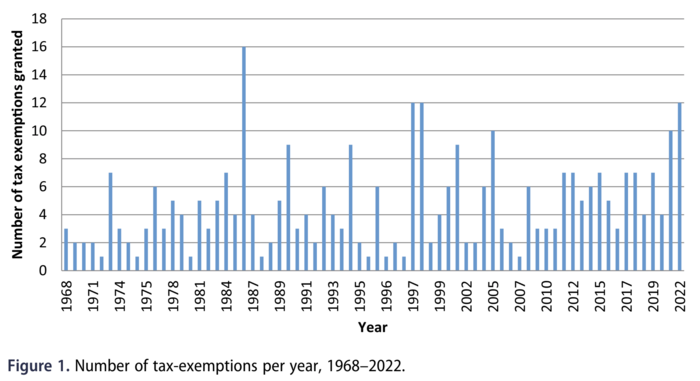
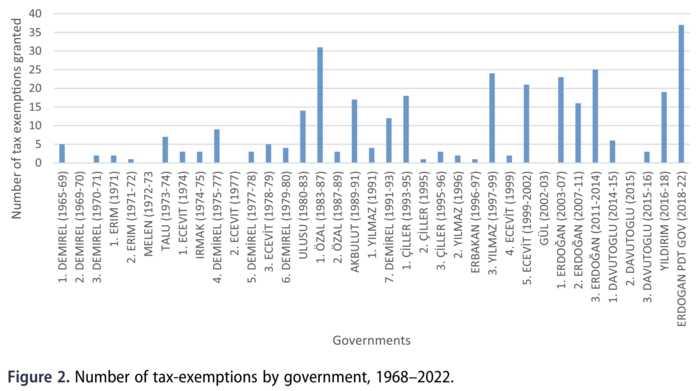
In terms of the politics of tax exemption, Massicard and Alemdaroğlu document a pattern of growing ambiguity and cronyism. For example, although foundations are legally required to be national in scope, strictly local vakıfs occasionally receive exemptions. Secular governments have tended to limit or reverse exemptions granted to Islamist-aligned foundations, and vice versa. One notable pattern under secular rule between 1997 and 2002 was growing exemptions to foundations representing the highly marginalized Alevi community, which Turkish Sunni leaders have tended to view as heretical.
Interestingly, AKP’s first term in government was characterized by relatively broad exemptions, not solely to religious organizations. Since 2010, however, not only have Islamist vakıfs received an increasing number of exemptions. There is also a growing pattern of nepotism — foundations linked to Erdoğan’s family members receiving exemptions.
Despite the growing centralization of exemption policy, AKP rivals at the subnational level have also used their power to undercut national priorities. For example, in 2019, the opposition-led Istanbul government canceled its agreements with AKP-aligned foundations. In sum, Massicard and Alemdaroğlu both deepen our understanding of five decades of Turkish politics and illustrate an overlooked item on the authoritarian “menu of manipulation.”
*Brief prepared by Adam Fefer.