Authors
News Type
News
Date
Paragraphs

Introduction and Contribution:


Authoritarian regimes are often reluctant to let their citizens leave: 79% of autocracies restrict emigration compared to only 4% of democracies. This reluctance is understandable, as migration deprives rulers of talent, resources, and implied consent to the system. Yet autocracies do change their emigration laws. What are the consequences of these changes? 

In “A Little Lift in the Iron Curtain,” Hans Lueders examines how a 1983 emigration reform in socialist East Germany (German Democratic Republic, GDR) affected crime rates in the country. The reform permitted about 62,500 citizens to exit the GDR over a short period of time — mostly to reunite with their families in West Germany. Lueders asks how this emigration affected crime. This is a natural outcome to consider because the former GDR, like many autocracies, used the emigration system to filter out individuals seen as criminals or  “undesirables.” Unauthorized exit was criminalized, and some citizens committed crimes precisely to signal that they should be allowed to leave.


Image
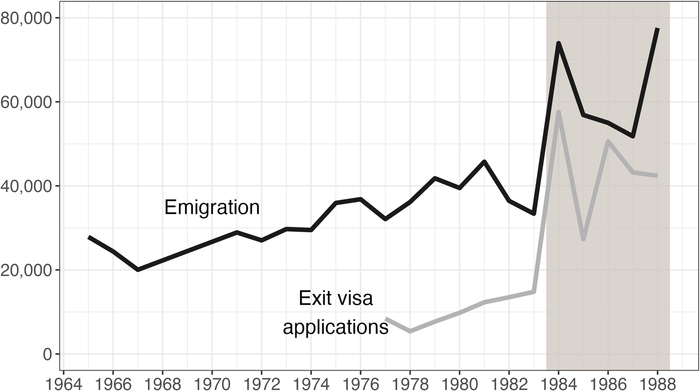
Figure 1: Consequences of the 1983 Emigration Reform


Figure 1: Consequences of the 1983 Emigration Reform
Note. This figure reports the number of first-time exit visa applications per year (gray line [Eisenfeld 1995, 202]) and annual emigration from the former GDR (black line; data collected by the author). The period after the emigration reform is emphasized.


Lueders shows that the effects of emigration following the 1983 reform on criminal activity depended on the type of crime. Ordinary kinds of crime — those not committed for political motifs — declined after the reform. However, border-related crimes increased sharply. This is ostensibly because those “left behind” (i.e., unable to take advantage of the 1983 reforms) resumed lawbreaking in order to pressure the regime to let them out as well. An analysis of petitions submitted to the state supports the idea that emigration raised demand for emigration.

The paper makes important contributions to our knowledge of authoritarianism and migration. For one, it shows how policies enacted to temporarily satisfy domestic or international audiences can backfire, later increasing the state’s burden. Autocrats may behave strategically in the short run, yet their choices can have powerful, unanticipated consequences in the years ahead. Otherwise, “strong” and repressive autocracies like the former GDR may struggle to address migratory pressures and be too inflexible to switch course after negative consequences become apparent. 

Safety Valves and Reform in East Germany:


Social scientists have argued that emigration policy under authoritarianism can serve as a “safety valve,” allowing or forcing the exit of those who threaten the stability of the regime. In addition, requiring citizens to apply for exit visas acts as a “screening mechanism” because applying is politically costly; those who keep applying reveal themselves to be potential troublemakers whose exit ought to be permitted. Lueders provides evidence that the costs of applying for exit visas were indeed high in the former GDR: applicants (and sometimes their families) were intimidated and harassed by secret police, expelled from universities, and demoted or fired. The state also tried to “win over” prospective emigrants, showing them reports about the allegedly dismal living conditions in West Germany or letters from East German refugees begging authorities to return to the GDR.

Importantly, officials considered how emigration would influence the GDR’s stability, looking for those who opposed the country and its socialist vision. Many applicants realized this and thus sought to publicly challenge the regime, for example, by leaving socialist mass organizations or abstaining from voting. Committing crimes thus raised one’s chances of successfully emigrating. East Germans watched peers and family members break the law to force their exit, learning that the system encouraged and rewarded criminality. 

After Germany’s division into two, many East Germans preferred the economic and political freedoms found in democratic West Germany. The government thus grew concerned: most émigrés were young and educated, and their exit undermined the GDR’s claims that it was popular and that socialism was the superior politico-economic system. Accordingly, emigration was criminalized in 1952, and the GDR began erecting physical barriers, culminating in the construction of the Berlin Wall in 1961. Emigration plummeted to between 25,000 and 40,000 per year thereafter.

Emigration remained severely limited until the early 1980s, when international pressure — from both West Germany and the Soviet Union — to reform its emigration system began to build. Ultimately, in September 1983, the GDR conceded and recognized the right of all citizens with family abroad to apply for an exit visa. 

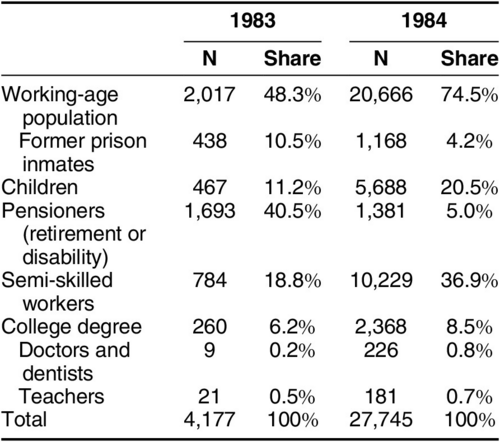
After the reform, exit visa applications and departures surged, the largest wave since the Berlin Wall’s construction. Emigration patterns evidenced a clear demographic shift: émigrés were less likely to be retired or to have formerly served in prison, while working-age East Germans made up 75% of emigrants, up from 49%. The state viewed this emigration wave as a welcome opportunity to get rid of criminals and political enemies. However, it underestimated the long-term consequences of offering some citizens a way out.


Image
Table 1: Comparison of Emigrants in 1983 and 1984 (January to June of each year)


Table 1: Comparison of Emigrants in 1983 and 1984 (January to June of each year)


Data and Findings:


To measure the effects of the 1983 policy on crime, Lueders presents crime data from 1976 to 89. He divides crime into “ordinary,” e.g., against state property or persons, and “political” crimes, e.g., the use of force against state officials, treason, and, importantly, illegal border crossings. Two of Lueders’ key hypotheses for our purposes are that emigration reform led to (1) a decline in ordinary crime, because the GDR effectively removed so-called troublemakers (the safety valve mechanism), and (2) a rise in border crimes, because those left behind were willing to break the law in order to exit (the demand mechanism).

The statistical analysis — consisting of comparing places with varying emigration rates — is consistent with both hypotheses. For the most part, ordinary crime declined after 1983. By contrast, border crime also initially declined, but this pattern dramatically reversed within two years. By 1987, border crimes began to rise significantly in places that had experienced a lot of emigration in the initial wave. Lueders thus provides evidence that in the short run, emigration indeed functioned as a safety valve (i.e., criminals were successfully identified). But thereafter, emigration had severe repercussions: rather than alleviating pressure on the regime, it created even greater demand for emigration — and thus more criminal activity.

A final piece of evidence comes from detailed data on petitions. The GDR encouraged citizens to communicate a range of demands and grievances to state officials, including the desire to emigrate. Lueders shows that in 1984, over 16,000 petitions were written specifically about emigration, which constituted nearly 28% of the total number of exit visa applications. And these petitions for exit visas increased substantially more in areas with above-average emigration during the initial emigration wave, suggesting that greater emigration in one period was associated with greater demand for it in subsequent periods. An understanding of East Germany illustrates how autocrats face a delicate balance between permitting migration and managing its consequences.

*Research-in-Brief prepared by Adam Fefer.

Hero Image
DDR Border, Germany
DDR Border, Germany.
Getty Images
All News button
1
Subtitle

CDDRL Research-in-Brief [4.5-minute read]

Date Label
Paragraphs

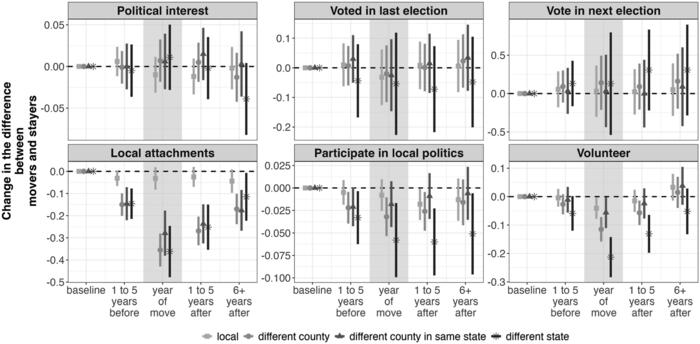
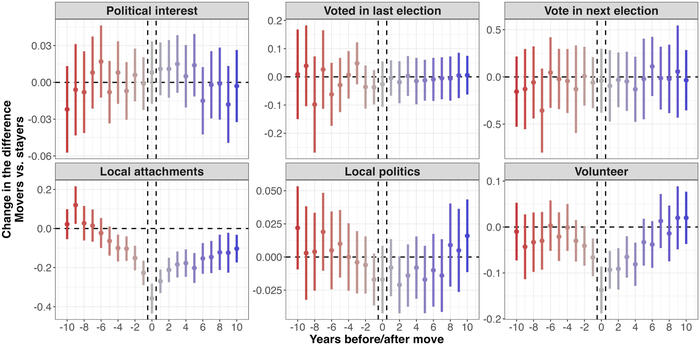
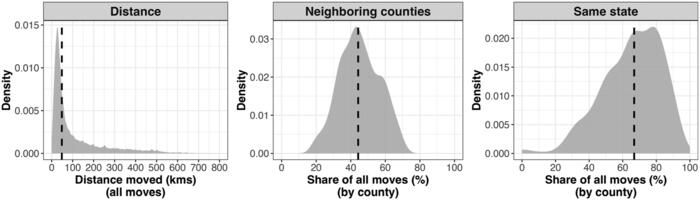
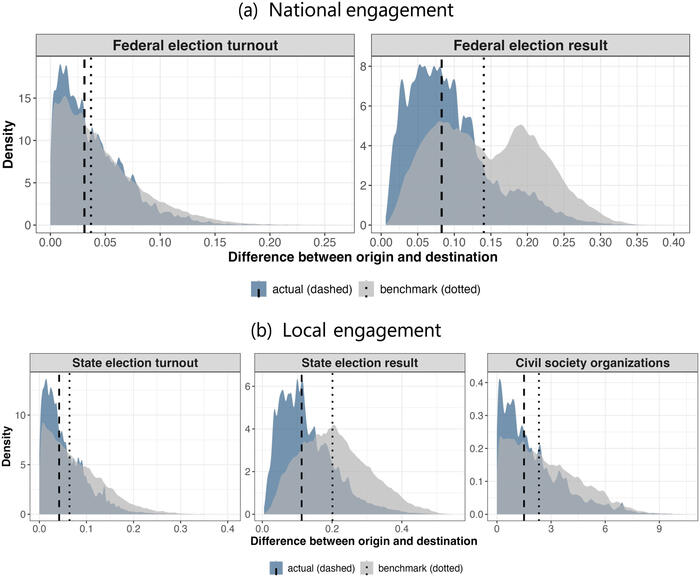
How do residential moves influence movers’ engagement? Drawing on German household panel data, I demonstrate that moving leads to a temporary decline in local engagement but leaves national engagement unchanged. I theorize that this drop stems from weaker attachments to place, reduced local political knowledge, and disrupted social ties. Consistent with this interpretation, longer-distance moves — which tend to exacerbate these barriers — are especially disruptive to movers’ local engagement. I then use comprehensive administrative data on all moves in Germany to rule out an alternative mechanism: most moves occur between socio-politically similar environments, limiting opportunities for moves to influence engagement through contextual change. These findings depart from the prevailing focus in related scholarship on the United States, national engagement, and partisanship. By documenting the political consequences of domestic migration for local engagement, this study contributes to research on residential mobility and local democratic accountability.

All Publications button
1
Publication Type
Journal Articles
Publication Date
Journal Publisher
Comparative Political Studies
Authors
-
GRIP Info Session

The Europe Center, with support of the Stanford Club of Germany, sponsors summer research visits and internships with German companies and research institutions. Selected graduate students spend 8-12 weeks in Germany pursuing projects such as lab exchanges, artists-in-residence, and collaborative research.

  • Students identify target institutions based on curricular expertise and career goals; GRIP provides support in negotiating hosting arrangements.
  • While not required, priority is given to students who have identified an internship/research host prior to applying.
  • Applicants are encouraged to consider the full range of potential hosts, from startups to established industry players to research institutions.
  • Exact start and end dates are determined by the host and student.
  • Grants of $8000-$9,000 (prorated by length of travel) are awarded with each internship/research visit.
Anna Grzymała-Busse

Online via Zoom

Encina Hall
616 Jane Stanford Way
Stanford, CA  94305


(650) 723-4270
0
Senior Fellow at the Freeman Spogli Institute for International Studies
Michelle and Kevin Douglas Professor of International Studies
Professor of Political Science
Senior Fellow, Hoover Institution
anna_gb_4_2022.jpg

Anna Grzymała-Busse is a professor in the Department of Political Science, the Michelle and Kevin Douglas Professor of International Studies, senior fellow at the Freeman Spogli Institute for International Studies and the director of The Europe Center. Her research interests include political parties, state development and transformation, informal political institutions, religion and politics, and post-communist politics.

In her first book, Redeeming the Communist Past, she examined the paradox of the communist successor parties in East Central Europe: incompetent as authoritarian rulers of the communist party-state, several then succeeded as democratic competitors after the collapse of these communist regimes in 1989.

Rebuilding Leviathan, her second book project, investigated the role of political parties and party competition in the reconstruction of the post-communist state. Unless checked by a robust competition, democratic governing parties simultaneously rebuilt the state and ensured their own survival by building in enormous discretion into new state institutions.

Anna's third book, Nations Under God, examines why some churches have been able to wield enormous policy influence. Others have failed to do so, even in very religious countries. Where religious and national identities have historically fused, churches gained great moral authority, and subsequently covert and direct access to state institutions. It was this institutional access, rather than either partisan coalitions or electoral mobilization, that allowed some churches to become so powerful.

Anna's most recent book, Sacred Foundations: The Religious and Medieval Roots of the European State argues that the medieval church was a fundamental force in European state formation.

Other areas of interest include informal institutions, the impact of European Union membership on politics in newer member countries, and the role of temporality and causal mechanisms in social science explanations.

Director of The Europe Center

616 Jane Stanford Way
Stanford, CA 94305

0
RSD23_078_0771a-fotor-2023120883918_1.jpg M.A. International Comparative Education

Alyssa received her M.A. in International Comparative Education at Stanford University where she explored the educational challenges she encountered while teaching English First Additional Language as a Peace Corps Volunteer in rural South Africa. She also received a B.S. in Global Studies and a B.A. in Spanish and Portuguese from the University of Arizona. Prior to joining the team at The Europe Center, Alyssa worked at Stanford Pre-Collegiate Studies, bringing high quality enrichment opportunities to academically talented pre-college students around the world and at the Utah Valley University Women's Success Center where she assisted woman identifying students towards degree completion. Alyssa speaks Spanish, Portuguese, and (some) Setswana and loves to do the Sunday crossword or get outside for a hike with her dog, Cooper. 

Program Administrator
Anna Grzymała-Busse
Seminars
Date Label
Paragraphs

Scholars increasingly ask how place shapes citizens’ attitudes and behavior. Despite growing interest in place-based politics, recent work engages with only a subset of the potential roles for place in politics. In this paper, we take up three questions that are crucial in understanding how a place might affect its residents’ behavior: what does it mean for a person to feel attached to a place, how can such place attachment be measured, and how does it influence political engagement? We develop a concept of place attachments and present a flexible measure that can capture strength of attachment to a variety of places. We present evidence from the United States and Germany that many people feel attached to the place where they live, that this attachment is distinct from an identity formed around the place, and that the strength of this attachment is related to how they engage with politics.

All Publications button
1
Publication Type
Journal Articles
Publication Date
Journal Publisher
Political Behavior
Authors
Authors
News Type
News
Date
Paragraphs

Motivation


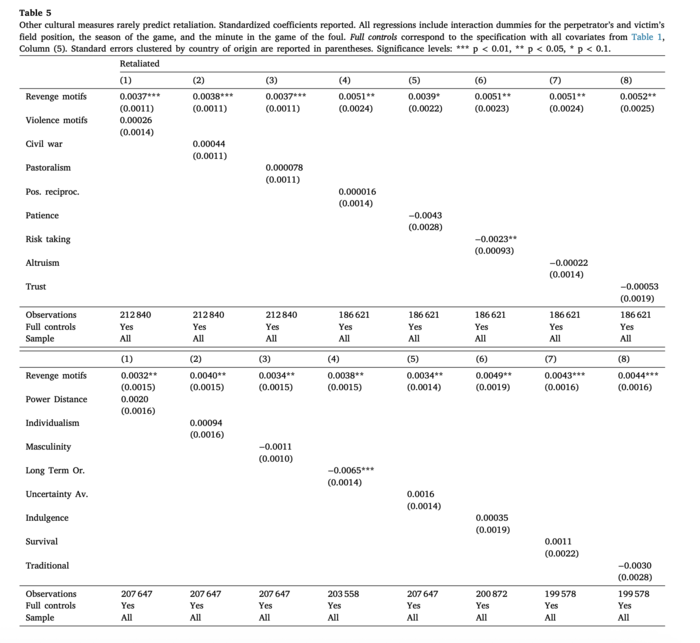
Retaliation (or the threat thereof) is a central component of human behavior. It plays a key role in sustaining cooperation — such as in international organizations or free trade agreements — because those known to retaliate come to acquire a reputation of being hard to exploit. But how does the use and function of retaliation vary across cultures, and how does it interact with formal forms of punishment?

In “Cross-cultural differences in retaliation: Evidence from the soccer field,” Alain Schläpfer tackles these questions using data on retaliation from association football. Retaliation is simply defined in terms of fouling: player B retaliates against player A if and only if, after A fouls B, B then fouls A. Among other findings, Schläpfer shows that players from cultures emphasizing revenge are more likely to retaliate on the football field. This form of ‘informal punishment’ by players also interacts with ‘formal punishment’ by referees: retaliation by B is less likely when A is sanctioned with a yellow card. Schläpfer’s paper increases our knowledge of the causes and consequences of retaliation, while showing how informal cultural norms interact with the formal rules of football.  

Data


Schläpfer creates a data set of fouls committed over three football seasons (2016-2019) in nine of the world’s top professional men’s leagues. This includes the European leagues of Premier League (England), Serie A (Italy), Bundesliga (Germany), LaLiga (Spain), and Ligue 1 (France), as well as Série A (Brazil), Liga Profesional (Argentina), Liga MX (Mexico), and Major League Soccer (United States). The dataset comprises 9,531 games, 230,113 fouls committed by 10,928 unique perpetrators from 139 countries against 11,115 unique victims from 137 countries.

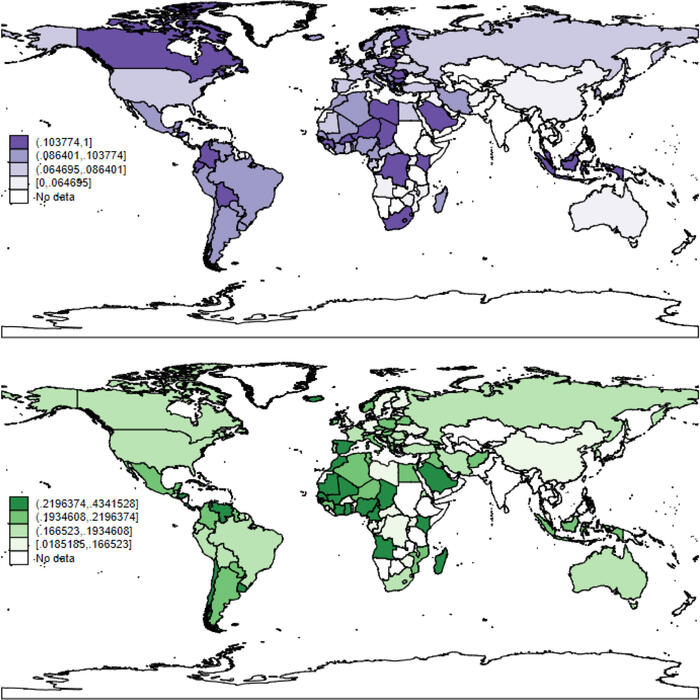
Because Schläpfer hypothesizes that being from more revenge-centric cultures explains on-field retaliation, the key independent variable is measured using a dataset from Stelios Michalopoulos and Melanie Meng Xue that identifies revenge motifs in a culture’s folklore. Examples of this include supernatural forces avenging human murders or animals avenging the death of their friends by humans. Schläpfer uses a host of other independent variables, such as country-level survey data about the desire to punish — as opposed to rehabilitate — criminals, which is also theoretically linked to revenge. As stated above, retaliation is measured in terms of fouls committed. Schläpfer shows that there is substantial variation in retaliation rates among players from different countries, from Gabon (8%) to Iceland (31%). Can the folklore in the country of origin explain the behavior of players on the field?


Image
Fig. 1. The share of fouls retaliated in soccer games (top) and the prevalence of revenge motifs in folklore (bottom). Both variables tend to have higher values for players and folklore from the Middle East, Central Africa, Eastern Europe, and parts of South America.


Fig. 1. The share of fouls retaliated in soccer games (top) and the prevalence of revenge motifs in folklore (bottom). Both variables tend to have higher values for players and folklore from the Middle East, Central Africa, Eastern Europe, and parts of South America.


Findings


Retaliation:

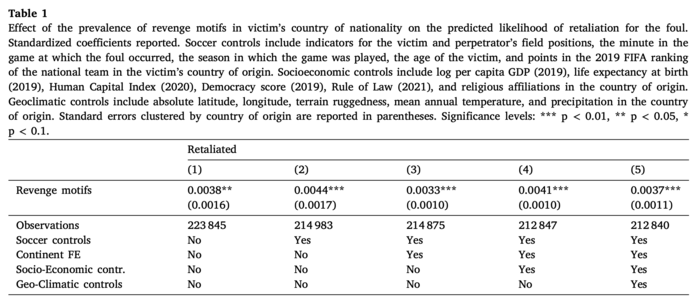
Schläpfer finds evidence that players from cultures that value revenge are indeed more likely to retaliate for fouls. However, they are not more likely to commit fouls overall, cautioning us against conflating the concepts of retaliation and violence. Indeed, Schläpfer demonstrates that motifs of violence in a culture's folklore do not predict retaliation. Players are also found to be more retaliatory early on in a game, which is consistent with its use as a signal or aspect of one’s reputation. In other words, retaliation serves to deter future fouls. Victims of fouls also retaliate quickly. Indeed, retaliation rates are stable or slightly increasing during the first 30 minutes of a game, but then fall consistently thereafter.


Image
Table 1. Effect of the prevalence of revenge motifs in victim’s country of nationality on the predicted likelihood of retaliation for the foul.


Evidence is also provided to show that retaliation deters future transgressions: perpetrators are less likely to foul again if victims retaliate for the initial foul. However, this deterrence finding is only observed when the perpetrator is from a revenge culture. In other words, for retaliation to support cooperation (the absence of fouls), players must share a similar cultural background.

Schläpfer’s findings hold even when soccer-related or socioeconomic factors are taken into account. Further, the paper considers, but finds little support for, alternative explanations of why retaliation varies. These include that some teams encourage players to retaliate more or employ more players from revenge cultures. Further, retaliation does not appear to be driven by emotions; otherwise, it would be less likely to occur after halftime when players have had a chance to cool down, but this is not the case.


Image
Table 5. Other cultural measures rarely predict retaliation. Standardized coefficients reported.


Informal and Formal Sanctioning:

Finally, Schläpfer analyzes the interaction between player retaliation and refereeing. Most importantly, retaliation is significantly less likely if a foul is sanctioned with a yellow card. This illustrates the theoretical principle of formal punishment “crowding out” informal punishment, such as religious excommunication, which carries greater weight than social shunning or police fines compared to peer pressure. Both retaliation and referee sanctioning are shown to reduce the frequency of repeated offenses by perpetrators, especially among players from revenge cultures. However, Schläpfer finds that formal sanctioning is roughly three times more effective than retaliation. This suggests that football referees are doing a better job managing conflict between players than players themselves. 

Schläpfer concludes by mentioning a few of the paper’s limitations. First of all, retaliation is measured only by what referees sanction. However, referees may miss crucial incidents for which retaliation is a response, such as Zinedine Zidane’s 2006 World Cup headbutt after a verbal insult (that was not sanctioned). This is important because individuals from revenge cultures are likely to be particularly offended by verbal insults. Second, the paper does not capture retaliation that occurs across games played by the same teams over time, particularly when rivalries and hostilities have intensified. Similarly, it does not account for preemptive retaliation that does not follow a foul. Ultimately, Schläpfer deepens our understanding of retaliation in a domain where many would expect it not to operate or to do so with minimal significance. The article impressively marshals large-scale data from both sports and cultural history to clarify the causes and consequences of retaliation.

*Research-in-Brief prepared by Adam Fefer.

Hero Image
A person in a red and blue football uniform on a field Jona Møller via Unsplash
All News button
1
Subtitle

CDDRL Research-in-Brief [4-minute read]

Date Label
Paragraphs

What are the consequences of selective emigration from a closed regime? To answer this question, I focus on socialist East Germany and leverage an emigration reform in 1983 that led to the departure of about 65,200 citizens. Analyzing panel data on criminal activity in a difference-in-differences framework, I demonstrate that emigration can be a double-edged sword in contexts where it is restricted. Emigration after the reform had benefits in the short run and came with an initial decline in crime. However, it created new challenges for the regime as time passed. Although the number of ordinary crimes remained lower, border-related political crimes rose sharply in later years. Analysis of emigration-related petitioning links this result to a rise in demand for emigration after the initial emigration wave. These findings highlight the complexities of managing migration flows in autocracies and reveal a key repercussion of using emigration as a safety valve.

All Publications button
1
Publication Type
Journal Articles
Publication Date
Journal Publisher
Perspectives on Politics
Authors
Paragraphs

Citizens in authoritarian regimes frequently communicate grievances to the government. While there is some evidence that governments respond to such petitions, little is known about the nature of this responsiveness: can petitions influence resource allocation and yield tangible improvements to citizens’ livelihoods? To answer this question, we assemble a novel panel of housing-related petitions to the government of the German Democratic Republic (GDR) and all housing constructed between 1945 and 1989. Exploiting the timing of the largest housing program in 1971, we employ a difference-in-differences approach to show that construction was targeted at regions with higher rates of petitioning. We then use a variance decomposition method to benchmark petitions against objective indicators of housing need. Our results suggest that petitions allow citizens to meaningfully influence the allocation of public resources. The paper contributes to nascent scholarship on responsiveness in non-democratic regimes by linking responsiveness to tangible improvements in citizens’ livelihoods.

All Publications button
1
Publication Type
Journal Articles
Publication Date
Journal Publisher
Comparative Political Studies
Authors
Authors
Nora Sulots
News Type
News
Date
Paragraphs

The Stanford Deliberative Democracy Lab, housed within the Center on Democracy, Development and the Rule of Law (CDDRL) at the Freeman Spogli Institute for International Studies (FSI), in collaboration with Meta and the Behavioral Insights Team, has unveiled the results of the Meta Community Forum on Generative AI, based on the method of Deliberative Polling®. This groundbreaking event, part of a series of efforts by Meta to consult the public, engaged 1,545 participants in scientific samples from Brazil, Germany, Spain, and the United States. In each country, it offered the public’s views, both before and after deliberation, about future directions for the development of AI chatbots and how they should interact with humans.

“AI poses novel challenges, and these four national experiments revealed the public’s considered judgments about what it should — or should not — be able to use it for. National samples grappled with the pros and cons of each proposal and had their questions answered by panels of competing experts. This report shows what they concluded,” said James Fishkin, Senior Fellow at FSI and Director of the Stanford Deliberative Democracy Lab.

AI poses novel challenges, and these four national experiments revealed the public’s considered judgments about what it should — or should not — be able to use it for.
James Fishkin
Director, Stanford Deliberative Democracy Lab

Much of the agenda focused on specific proposals answering ten basic questions, including:

  • Which sources should AI chatbots draw information from?
  • Should AI chatbots use the user’s past conversations to improve user experience?
  • Should AI chatbots use the user’s online activity to personalize interactions?
  • Should AI chatbots be designed to be human-like?
  • Should users be allowed to use AI chatbots for romantic relationships?


The deliberators in each country were convened on the Stanford Online Deliberation Platform, developed by the Stanford Crowdsourced Democracy Team. This platform is AI-assisted and moderates video-based discussions in small groups of ten. 

Participants noted a generally positive impact of AI, with an increase in positive perceptions post-forum. "This shift in viewpoint, especially notable among those previously unfamiliar with AI, underscores the value of informed discussion in shaping public opinion," remarked Alice Siu, Senior Research Scholar at FSI and Associate Director of the Stanford Deliberative Democracy Lab.

The forum's methodical approach, with deliberations in 166 small groups and a separate control group for each country, ensured that the outcomes accurately reflected the effects of the deliberative process. Findings indicated that users and non-users of AI began to bridge their differences, aligning closer in their attitudes towards AI after the forum.

Siu also emphasized the significance of the event’s feedback, noting that "the high ratings from participants affirm the forum’s success in making complex discussions accessible and relevant. It is an encouraging sign for the future of democratic engagement with technology."

The Stanford Deliberative Democracy Lab is dedicated to deepening our understanding of deliberative democracy processes and their application to critical contemporary issues like AI. The insights from this forum will inform ongoing research and policy recommendations, ensuring that AI evolves in a manner that considers diverse values and voices across the globe.

The project report is available below:

For detailed information on the forum’s conclusions or forthcoming projects, please reach out to James Fishkin (Director, Stanford Deliberative Democracy Lab) or Alice Siu (Associate Director, Stanford Deliberative Democracy Lab) or visit the Deliberative Democracy Lab website.

Read More

Collage of modern adults using smart phones in city with wifi signals
News

Results of First Global Deliberative Poll® Announced by Stanford’s Deliberative Democracy Lab

More than 6,300 deliberators from 32 countries and nine regions around the world participated in the Metaverse Community Forum on Bullying and Harassment.
Results of First Global Deliberative Poll® Announced by Stanford’s Deliberative Democracy Lab
A voter casts their ballot in the Kentucky Primary Elections at Central High School on May 16, 2023 in Louisville, Kentucky.
Q&As

New National Deliberative Poll Shows Bipartisan Support for Polarizing Issues Affecting American Democracy

"America in One Room: Democratic Reform" polled participants before and after deliberation to gauge their opinions on democratic reform initiatives, including voter access and voting protections, non-partisan election administration, protecting against election interference, Supreme Court reform, and more. The results show many significant changes toward bipartisan agreement, even on the most contentious issues.
New National Deliberative Poll Shows Bipartisan Support for Polarizing Issues Affecting American Democracy
Alice Siu delivers a TEDxStanford talk
News

Deliberative Polling: A Path to Bridging Divides

In a TEDxStanford talk, Alice Siu discusses how applying and spreading deliberative democracy can better engage us all in our shared public problems.
Deliberative Polling: A Path to Bridging Divides
Hero Image
Chatbot powered by AI. Transforming Industries and customer service. Yellow chatbot icon over smart phone in action. Modern 3D render
Chatbot powered by AI. Photo: Da-Kuk / Getty Images
Da-Kuk / Getty Images
All News button
1
Subtitle

A multinational Deliberative Poll unveils the global public's nuanced views on AI chatbots and their integration into society.

Date Label
Authors
Rachel Owens
News Type
News
Date
Paragraphs

How does a nation grapple with the history of past atrocities? In a CDDRL research seminar series talk, Stanford Associate Professor of Political Science Vicky Fouka examined how public recognition of collective culpability has affected German national identity. In a new paper, Fouka and co-authors explore the origins of muted public nationalism among German citizens, investigating whether it hails from socialization or stigmatization.

In the shadow of the Nazi regime, post-WWII Germany was forced to contend with its past. The resulting narrative was critical — a self-righteous self-hate. The prevailing view entailed Germany assuming responsibility for WWII and the atrocities committed. This shift occurred in two stages. During the first stage (WWII- 1970), denazification was imposed by the Allied powers, and many Germans perceived it unjust — seeing themselves as victims. However, post-1970, teachings about the Holocaust were introduced in schools, and new generations were socialized to accept a message of responsibility.

Fouka began with two possible explanations for Germany’s muted nationalism. The first was stigmatization, or the idea that people may not be expressing their true views for fear of social sanctions imposed by broader society. The second is socialization. This explanation centers on shared internationalized values, a violation of which generates a strong emotional response on the part of the violator.

To determine which of these theories drives Germany’s weak national spirit, Fouka designed a survey to compare publicly and privately held views. A representative sample of 5,363 respondents was randomly assigned a “private” or “public” condition. Those given the “public” condition were informed that the survey results would be posted to a website, whereas those with the “private” condition were given assurances as to the anonymity of their responses. The team also asked a variety of controversial questions as a baseline — to gauge the difference between private and public preferences.

In the survey itself, Fouka asked respondents a variety of questions on national identity, emotions about German history, attitudes toward German vs. Allied crimes during WWII, and the importance of teaching the holocaust in school. She found that there was no difference in the public and private conditions on national pride — suggesting socialization was the primary driving force behind weak nationalism.

The only statement that seemed to move the needle on falsified preferences was one asserting that the crimes of the German past should be left alone. However, this only occurred in respondents living in West Germany. Additionally, the researchers did find evidence for falsified preferences on national pride, but primarily for Germans socialized in the East but living in the West. As East Germany only shifted their educational rhetoric after German reunification, those socialized in the East but living in the West seemed to censor more toward the West German norm.

This research holds important implications. If there is a divergence between what people feel privately and what they feel like they can express publicly, there can be rapid changes in public opinion and the status quo in response to small changes in information about people’s true preferences. This is especially important with the recent rise of the right-wing populist party, which may provide a platform for the expression of latent preferences.

Read More

Şener Aktürk presents his research during a CDDRL research seminar
News

When Do Religious Minority Politicians Secure High Political Offices?

Şener Aktürk presented his research on the subject in a recent CDDRL research seminar series talk.
When Do Religious Minority Politicians Secure High Political Offices?
Miriam Golden presents during a CDDRL research seminar
News

Civil Service Reform and Reelection Rates in the United States

Miriam Golden argues that a decline in patronage appointments to state bureaucracies due to civil service legislation increased reelection rates in state legislatures.
Civil Service Reform and Reelection Rates in the United States
Pauline Jones REDS Seminar
News

Kazakhstan’s Public Opinion and Russia’s War Against Ukraine

Professor of Political Science Pauline Jones explored how Russia’s renewed aggression in Ukraine will affect Moscow’s relations with its Eurasian neighbors in a recent REDS Seminar talk, co-sponsored by CDDRL and TEC.
Kazakhstan’s Public Opinion and Russia’s War Against Ukraine
Hero Image
Vicky Fouka
Vicky Fouka presents her research during a CDDRL research seminar on February 15, 2024.
Rachel Cody Owens
All News button
1
Subtitle

Stanford Associate Professor of Political Science Vicky Fouka shares her research on how public recognition of collective culpability has affected German national identity.

Date Label
Authors
Melissa Morgan
News Type
News
Date
Paragraphs

On June 12, students, friends, faculty, and family gathered for a much anticipated in-person graduation ceremony for the 2022 graduating class of the Ford Dorsey Master’s in International Policy (MIP) at the Freeman Spogli Institute for International Studies (FSI).

Two years ago, the 2020 graduating class participated in a fully digital, online graduation ceremony in response to the COVID-19 pandemic and requisite healthcare precautions. While students of the 2021 graduating class were able to gather briefly in-person outside of Encina Hall last year, the majority of their commencement activities also took place online. This year, with high vaccination rates and decreasing COVID cases, both the 2020 and 2022 classes of the Master’s in International Policy were able to attend in-person commencement ceremonies at Stanford.

The Class of 2022 cohort is comprised of 21 students strong from nine different countries, including Chile, Estonia, Germany, Israel, Korea, Kosovo, Myanmar, Peru, and the United States. Outside Encina Hall, the graduates were welcomed by MIP Director Francis Fukuyama, who cheered the graduates for their hard work and applauded the many friends and family members gathered to support them.

Following an impromptu video shoot of the audience and brief introduction, Dr. Fukuyama turned the time over to FSI Director Michael McFaul, who delivered the keynote remarks to the graduating class.

Dr. McFaul reflected on the unique journey the 2022 class, from beginning with Zoom classes and remote learning to finally reconvening in-person for projects like the Policy Change Studio capstones and events like former president Barack Obama’s visit to FSI in April 2022.

“You all look better in three dimensions compared to two dimensions,” McFaul assured everyone. He went on to share four lessons he hopes will resonate with the newest FSI alumni:

1. Do Something, Don’t Be Something

The first lesson Dr. McFaul imparted to the graduates was to frame their goals and careers in terms of actions, not titles.

“Don’t think of your career as a place to be,” he said. “Think of your career as an action verb. Figure out what you want to do, then fit the jobs, the companies, and future degrees around those action verbs, not the other way around.” He stressed that any particular job title matters much less than a commitment to a mission, a set of values, or clear, concrete policy things you want to do.

2. Embrace both Uncertainty and Rejection

Speaking from his personal experience, Dr. McFaul shared how his first career plan following his DPhil degree from Oxford ended as a complete bust. As a fresh, young academic, he applied to 22 jobs, and was rejected from all of them. But while his immediate plans may have stalled, the rejections gave him a front row seat to the 1990-91 protests in Moscow, the fall of the Soviet Union, and the burgeoning calls for democratic change in Russia, all which altered the course of his academic, professional, and political life.

“From uncertainty can come opportunity, and from setbacks can come second — and dare I say, better  — chances,” he reminded the graduates.

Don’t think of your career as a place to be. Think of your career as an action verb. Figure out what you want to do, then fit the jobs, the companies, and future degrees around those action verbs.
Michael McFaul
FSI Director

3. Continue to Invest in Connections

McFaul’s third piece of advice was a cautionary story of what not to do. “After my time at Stanford and Oxford, I didn’t invest time in maintaining friendships, and I regret that,” he candidly told the audience.

He stressed that these connections are not only for the purpose of networking and professional development, though those kinds of connections can lead to instrumental things. But more importantly, McFaul advised the students to develop and nurture relationships with fantastic, interesting people for the sake of allowing those connections to enrich and deepen the well-being and richness of their lives.

4. Keep in Touch with Stanford

Looking across the crowd, Dr. McFaul said, “Most of you are second years. Some of you are fifth years. I am a forty-first year student here at Stanford. I really love learning, and there’s no better place to learn than Stanford.”

He urged the graduates to remain active and invested in the community they have been a part of the last two years. “You have access to some of the most talented professors in the world. Use it! Don’t forget about it,” counseled McFaul.

On to the Future


Building on Dr. McFaul’s remarks, Soomin Jun, the student speaker at the diploma ceremony, asked her fellow classmates to look to the future with a determination to stand up for values and rights, and to not lose the compassion and empathy that have bonded them together as a cohort.

“Let’s not forget to humble ourselves and do good for those next to us and in our communities,” she said. Jun continued, “Let’s not forget that we are far more capable of achieving anything beyond anyone’s imagination. Voice up and stand up for your values and ideas.”

This is a terrific MIP class. This is the first class that entered the program since I’ve been the director. I know them well and I know them personally, and they are a truly special group of people.
Francis Fukuyama
MIP Director

As the 2022 class moves on from their time as MIP students at FSI, five will be staying at Stanford to pursue further studies in political science, environment and resources, public policy, and journalism. Others will remain in the greater Bay Area working on technology policy, energy policy, digital privacy, and statistical programming. Others are heading from the West Coast to the East to work in government, international development, and policy analysis, while four of the class members will be continuing their military careers in Texas, Washington State, Kentucky, and Kosovo.

Wherever they’re bound, the Master’s of International Policy Class of 2022 will not soon be forgotten.

“This class is special to me,” Michael McFaul said. “We here at FSI and MIP have tried to lean into you, and you have repeatedly shown that you are a special class and special group of people together at a special time, and we all feel bonded with you.”

Read More

Students and faculty from the Ford Dorsey Master's in International Policy gather outside of the Freeman Spogli Institute for International Studies at Encina Hall, Stanford University.
Blogs

A Look Back at Two Years as a Master's of International Policy Student

As the 2022 cohort of Master’s in International Policy students prepares to graduate, four classmates — Sylvie Ashford, David Sprauge, Shirin Kashani, and Mikk Raud — reflect on their experiences being part of the FSI community.
A Look Back at Two Years as a Master's of International Policy Student
Students from the 2022 cohort of the Ford Dorsey Master's in International Policy have been working all over the world with policy partners as part of their capstone projects.
Blogs

Off the Farm and Into the Field: Master's Students Practice Hands-on Policymaking

The 2022 cohort of the Ford Dorsey Master's in International Policy has been busy this quarter getting out of the classroom and into hands-on policymaking with partner organizations in Tunisia, Estonia, India and beyond.
Off the Farm and Into the Field: Master's Students Practice Hands-on Policymaking
Hero Image
The 2022 graduating class of the Ford Dorsey Master's in International Policy.
After two years of hard work, the 2022 class of the Ford Dorsey Master's in International Policy celebrated an in-person graduation ceremony on June 12, 2022 at the Freeman Spogli Institute for International Studies.
Meghan Moura
All News button
1
Subtitle

After two years of online ceremonies due to the pandemic, the Ford Dorsey Master’s in International Policy program celebrated with a fully in-person graduation ceremony for the 2022 graduating class.

Subscribe to Germany