-

This is a virtual event. Please click here to register and generate a link to the talk. 
The link will be unique to you; please save it and do not share with others.


Presented by the Stanford China Program and the Stanford Center at Peking University.

Tuesday, April 27 
6:00 pm – 7:15 pm (PST) 
Wednesday, April 28 
9:00 am – 10:15 am (China) 

A large amount of ink has been spilled in the last few years--and even more so since COVID-19--in the U.S. regarding American perceptions of the P.R.C.  Relatively little, however, has been conveyed regarding how China might view the U.S. today.  In this talk, we bring together two eminent professors, Professor Jia Qingguo and Professor Wang Dong, from the School of International Studies, Peking University, to examine how policymakers, professionals, and average citizens in China might perceive the United States and what that might imply for the U.S.-China bilateral relationship.  Dr. Thomas Fingar, Shorenstein APARC Fellow, will moderate the conversation.

This event is part of Shorenstein APARC's spring webinar series.


Image
Portrait of Thomas Fingar
Thomas Fingar is a Shorenstein APARC Fellow in the Freeman Spogli Institute for International Studies at Stanford University. He was the inaugural Oksenberg-Rohlen Distinguished Fellow from 2010 through 2015 and the Payne Distinguished Lecturer at Stanford in 2009. From 2005 through 2008, he served as the first deputy director of national intelligence for analysis and, concurrently, as chairman of the National Intelligence Council. Fingar served previously as assistant secretary of the State Department’s Bureau of Intelligence and Research (2000-01 and 2004-05), principal deputy assistant secretary (2001-03), deputy assistant secretary for analysis (1994-2000), director of the Office of Analysis for East Asia and the Pacific (1989-94), and chief of the China Division (1986-89). Between 1975 and 1986 he held a number of positions at Stanford University, including senior research associate in the Center for International Security and Arms Control. Fingar's most recent books are Fateful Decisions: Choices that will Shape China’s Future, co-edited with Jean Oi (Stanford, 2020), and From Mandate to Blueprint: Lessons from Intelligence Reform (Stanford University Press, 2021).
 

Image
Portrait of Jia Qingguo
Jia Qingguo acquired his PhD at the Department of Government, Cornell University. He has been a member of the Standing Committee of the 11th, 12th and 13th National Committees of the Chinese People’s Political Consultative Conference (CPPCC), and was elected in March 2013 as a member of the Committee of Foreign Affairs of the 13th CPPCC. He is a professor and doctoral supervisor, and the former Dean of the School of International Studies at Peking University. He is a member of the Standing Committee of the Central Committee of the China Democratic League and the Director of its Education Committee. He is the Vice Chairman of the Beijing Municipal Committee, Director of the Research Center for International Economic Strategy of China, a member of the Academic Evaluation Committee of the China Foundation for International and Strategic Studies, a member of the Academic Committee of Quarterly Journal of International Politics of Tsinghua University, as well as an adjunct professor at Nankai University and Tongji University. Jia is also a senior researcher of the Hong Kong and Macao Research Institute under the Development Research Center of the State Council. His research mainly focuses on international politics, China-U.S. relations, China’s diplomacy, Cross-Strait relations, China’s rise, and the adjustment of China’s diplomacy. His major publications include: China’s Diplomacy in the 21st Century; Unrealized Reconciliation: China-U.S. Relations in the Early Cold War; and Intractable Cooperation: Sino-U.S. Relations After the Cold War.
 

Image
Portrait of Wang Dong
Wang Dong obtained his PhD in Politics at the University of California, Los Angeles (UCLA). He is now a full professor and doctoral supervisor at the School of International Studies, Executive Director of the Institute for Global Cooperation and Understanding, Vice President of the Office of Humanities and Social Sciences, and Deputy Secretary-General of the American Studies Center (National and Regional Research Base of the Ministry of Education) of Peking University. In addition, he is also the Secretary-General of the Academic Committee of the Pangoal Institution, member of the Steering Committee of the East Asia Security Forum of Western Returned Scholars Association, a member of the Advisory Committee of the Global Times and The Carter Center “Forum for Young Chinese and American Scholars” and a researcher of the Peace in East Asia Program of the Department of Peace and Conflict Research at Uppsala University, Sweden. Wang has led major programs of the National Social Science Fund of China, undertaken major projects of the Ministry of Education, Ministry of Foreign Affairs, and Ministry of Science and Technology, and been funded by the National Social Science Fund of China many times. He was shortlisted for “Munich Young Leader” in 2016 and Beijing “Outstanding Young Scientist” in 2018. He is interested in research on international relations theory, the Cold War, US diplomacy, China-US relations, etc.

Via Zoom Webinar. Register at: https://bit.ly/3rAcwXC

Thomas Fingar <br>Shorenstein APARC Fellow, Stanford University<br><br>
Jia Qingguo (贾庆国) <br>Former Dean and Professor, School of International Studies, Peking University<br><br>
Wang Dong (王栋) <br>Professor, School of International Studies, Peking University; Executive Director, Institute for Global Cooperation and Understanding (iGCU), Peking University<br><br>
Seminars
-

China Chats with Stanford Faculty

The Rise of Robots in China with Professor Hongbin Li

China’s production and adoption of robotic technology have accelerated rapidly in recent years, surpassing Japan, US, and Germany. Stanford professor Hongbin Li and a team of scholars draw on multi-year field research data to show fresh insights into China’s aggressive push into automation—specifically, the increasing use of robots—to maintain its status as the “world’s factory.” His analysis offers an unprecedented look at what’s happening at the factory level, and fresh insight into how rising labor costs, an aging population and government policies are reshaping Chinese manufacturing.

In this Stanford alumni event, Hongbin Li, co-director of Stanford Center on China's Economy and Institutions and senior fellow at the Stanford Institute for Economic Policy Research, was joined by Scott Rozelle, co-director of Stanford Center on China's Economy and Institutions and senior fellow at the Freeman Spogli Institute for International Studies, who moderated a discussion about the major themes of the research. 

Watch the event recording:


About the Speakers:

Image
hongbin li headshot

Hongbin Li is the Co-Director of the Stanford Center on China's Economy and Institutions (SCCEI) and a Senior Fellow of Stanford Institute for Economic Policy Research (SIEPR). Hongbin obtained his Ph.D. in economics from Stanford University in 2001 and joined the economics department of the Chinese University of Hong Kong (CUHK), where he became full professor in 2007. He was also one of the two founding directors of the Institute of Economics and Finance at the CUHK. He taught at Tsinghua University in Beijing 2007-2016 and was C.V. Starr Chair Professor of Economics in the School of Economics and Management. He also founded and served as the Executive Associate Director of the China Social and Economic Data Center at Tsinghua University. He founded the Chinese College Student Survey (CCSS) in 2009 and the China Employer-Employee Survey (CEES) in 2014.

Hongbin’s research has been focused on the transition and development of the Chinese economy, and the evidence-based research results have been both widely covered by media outlets and well read by policy makers around the world . He is currently the co-editor of the Journal of Comparative Economics.


Image
Headshot of Dr. Scott Rozelle
Scott Rozelle is the Helen F. Farnsworth Senior Fellow and the co-director of Stanford Center on China's Economy and Institutions in the Freeman Spogli Institute for International Studies and Stanford Institute for Economic Policy Research at Stanford University.  For the past 30 years, he has worked on the economics of poverty reduction. Currently, his work on poverty has its full focus on human capital, including issues of rural health, nutrition and education. For the past 20 year, Rozelle has been the chair of the International Advisory Board of the China Center for Agricultural Policy in Peking University. In recent years Rozelle spends most of his time co-directing the Rural Education Action Project (REAP). In recognition of this work, Dr. Rozelle has received numerous honors and awards. Among them, he became a Yangtse Scholar (Changjiang Xuezhe) in Renmin University of China in 2008. In 2008 he also was awarded the Friendship Award by Premier Wen Jiabao, the highest honor that can be bestowed on a foreigner. 

Seminars
-

This seminar has been cancelled. Please join us for our next seminar in the series with Professor Albert Park on April 27, 2021.

Controlling the Narrative with Professor Joseph Piotroski, Stanford University

This seminar provides an overview of corporate news reporting in China, with a focus on understanding the political and market-based incentives behind Chinese newspapers' biased coverage of China's listed companies. And, given these prevailing incentives, we will explore how politicians in China use the Party's flagship newspaper, the People’s Daily, to coordinate the reporting of corporate news in China.


Image
Headshot of Dr. Joseph Piotroski
About the Speaker

Joseph Piotroski is the Robert K. Jaedicke Professor of Accounting at Stanford University’s Graduate School of Business, and a Senior Fellow at the Asian Bureau of Finance and Economic Research (ABFER). Professor Piotroski earned his PhD from the University of Michigan in 1999, an MBA from Indiana University in 1994, a BS in Accounting from the University of Illinois in 1989, and worked as a tax consultant for Coopers and Lybrand in Chicago. His research focuses on corporate transparency, governance, and regulation in a global context. His current research examines the impact of legal, political, and regulatory forces on capital market behavior and corporate decision-making, most notably in China and other emerging economies. His research has been published in scholarly journals in the areas of accounting, finance, and economics, and his research on value investing has been frequently cited in the popular press and is widely used in practice. 


Seminar Series Moderators:

Image
Headshot of Dr. Scott Rozelle

Scott Rozelle holds the Helen Farnsworth Endowed Professorship at Stanford University and is Senior Fellow in the Food Security and Environment Program and the Shorenstein Asia-Pacific Research Center, Freeman Spogli Institute (FSI) for International Studies. For the past 30 years, he has worked on the economics of poverty reduction. Currently, his work on poverty has its full focus on human capital, including issues of rural health, nutrition and education. For the past 20 year, Rozelle has been the chair of the International Advisory Board of the Center for Chinese Agricultural Policy, Chinese Academy of Sciences (CAS). In recent years Rozelle spends most of his time co-directing the Rural Education Action Project (REAP). In recognition of this work, Dr. Rozelle has received numerous honors and awards. Among them, he became a Yangtse Scholar (Changjiang Xuezhe) in Renmin University of China in 2008. In 2008 he also was awarded the Friendship Award by Premiere Wen Jiabao, the highest honor that can be bestowed on a foreigner. 

Image
hongbin li headshot
Hongbin Li is the James Liang Director of the China Program at the Stanford King Center on Global Development, and a Senior Fellow of Stanford Institute for Economic Policy Research (SIEPR). Hongbin obtained his Ph.D. in economics from Stanford University in 2001 and joined the economics department of the Chinese University of Hong Kong (CUHK), where he became full professor in 2007. He was also one of the two founding directors of the Institute of Economics and Finance at the CUHK. He taught at Tsinghua University in Beijing 2007-2016 and was C.V. Starr Chair Professor of Economics in the School of Economics and Management. He founded the Chinese College Student Survey (CCSS) in 2009 and the China Employer-Employee Survey (CEES) in 2014.

Hongbin’s research has been focused on the transition and development of the Chinese economy, and the evidence-based research results have been both widely covered by media outlets and well read by policy makers around the world. He is currently the co-editor of the Journal of Comparative Economics.


Register Here

Register once to receive the Zoom meeting link that will be used for all lectures in this series.

Seminars
Authors
Callista Wells
News Type
News
Date
Paragraphs

The China Program at Shorenstein APARC had the privilege of hosting Jude Blanchette, the Freeman Chair in China Studies at the Center for Strategic and International Studies (CSIS). The program, entitled "What’s ‘Communist’ about the Communist Party of China?," explored the goals and ideology of the Chinese Communist Party (CCP), as well as what they might mean for the future of China in the global community. Professor Jean Oi, William Haas Professor of Chinese Politics and director of the APARC China Program, moderated the event.

After the death of Mao Zedong in 1976, the goals of the CCP became less clear. As the country began to adopt market reforms in the 1980s and 1990s, CCP theorists were forced into contortions providing ideological justifications for policies that appeared overtly capitalist. Deng Xiaoping’s concept of “Socialism with Chinese characteristics” came to be seen as a theoretical fig leaf rather than a description of an egalitarian economic system, and by the 2000s, a consensus emerged that the CCP had completely abandoned any pretense of pursuing the Marxist vision it purported to hold. With the rise of Xi Jinping, however, the Party talks with renewed vigor about Marxism-Leninism and the goal of achieving actual, existing socialism. Has the CCP re-discovered communism?  In his talk, Blanchette discussed the abandoned and existing legacies of Mao Zedong, Marxism-Leninism, and the CCP’s vision of socialism. Watch now: 

Read More

Min Ye speaking
News

Domestic or International? The Belt and Road Initiative Is More Internally Focused Than We Think, Says Expert Min Ye

Domestic or International? The Belt and Road Initiative Is More Internally Focused Than We Think, Says Expert Min Ye
Banner of Hau L. Lee
News

The Pandemic, U.S.-China Tensions and Redesigning the Global Supply Chain

The Pandemic, U.S.-China Tensions and Redesigning the Global Supply Chain
American and Chinese flags
News

U.S.-China Relations in the Biden Era

Dr. Thomas Wright examines the recent history of US-China relations and what that might mean for the new administration.
U.S.-China Relations in the Biden Era
Hero Image
National Emblem of the People's Republic of China on the Great Hall of the People
All News button
1
Subtitle

Is the Chinese Communist Party really communist at all? Expert Jude Blanchette, Freeman Chair in China Studies at the Center for Strategic and International Studies, weighs in.

All Publications button
1
Publication Type
Journal Articles
Publication Date
Subtitle
The home language environment is critical to early language development and subsequent skills. However, few studies have quantitatively measured the home language environment in low-income, developing settings. This study explores variations in the home language environment and child language skills among households in poor rural villages in northwestern China. Audio recordings were collected for 38 children aged 20–28 months and analyzed using Language Environment Analysis (LENA) software; language skills were measured using the MacArthur–Bates Mandarin Communicative Developmental Inventories expressive vocabulary scale. The results revealed large variability in both child language skills and home language environment measures (adult words, conversational turns, and child vocalizations) with 5- to 6-fold differences between the highest and lowest scores. Despite variation, however, the average number of adult words and conversational turns were lower than found among urban Chinese children. Correlation analyses did not identify significant correlations between demographic characteristics and the home language environment. However, the results do indicate significant correlations between the home language environment and child language skills, with conversational turns showing the strongest correlation. The results point to a need for further research on language engagement and ways to increase parent–child interactions to improve early language development among young children in rural China.
Journal Publisher
International Journal of Environmental Research and Public Health
Authors
Yue Ma
Scott Rozelle
Authors
Noa Ronkin
News Type
News
Date
Paragraphs

China and the United States are usually cast as fierce rivals, but there are broad areas of society where the two nations share profound similarities. As they confront growing demands to provide their citizens with goods and services such as healthcare, education, housing, and transportation, both the Chinese and U.S. governments engage the private sector in the pursuit of public value, although they do so in different ways.

This type of engagement, in which the government calls on the private sector to meet public goals, is known as collaborative governance and it is becoming an increasing share of the economy in both China and the United States. A new book, The Dragon, the Eagle, and the Private Sector (Cambridge University Press), analyzes the application of collaborative governance in a wide range of policy arenas in China and the United States.

The book itself is the result of collaborative research by three co-authors: APARC Deputy Director Karen Eggleston, Harvard Kennedy School Raymond Vernon Senior Lecturer in Public Policy John Donahue, and Harvard Kennedy School’s Frank P. Ramsey Professor of Political Economy Richard Zeckhauser. On March 5, 2021, the three co-authors gathered for a virtual book launch, an event co-sponsored by Shorenstein APARC and the Mossavar-Rahmani Center for Business and Government at the Harvard Kennedy School.

[Sign up for APARC newsletters to receive the latest updates from our experts.]

Introducing the new book, Lawrence H. Summers, president emeritus of Harvard University and the Charles W. Eliot University Professor at the Kennedy School, called the co-authors’ analysis of collaborative governance “micro microeconomics” that shows how particular tasks and particular commitments of resources, once decided on, are going to be best accomplished. This work, Summers noted, sheds light on situations involving both cooperation and competition — aspects that affect almost any complex problem yet are rarely considered by economists.

A key element of collaborative governance, noted Zeckhauser, is the sharing of discretion. Rather than contracting at one pole and complete laissez-faire at the opposite pole, in a collaborative governance process, the two parties involved play a role in determining what is produced and how it is produced. It is a process that calls on the best capabilities of both the private and public sectors and that grants each of them an element of control. Sometimes that process results in triumphs, sometimes in tragedies, and other times in outcomes that are “in-between.” The book analyses cases of this entire gamut. “We hope that this volume provides guidance on how the triumphs can become more common, the tragedies more scarce, and the in-between outcomes improved,” said Zeckhauser.

This book provides a key to understanding how to achieve [...] quality-public-private collaboration, done right. Delving deep into two very different societies, the US and China, the authors provide lessons that illuminate and should inform scholars and policymakers alike.
Fareed Zakaria
Journalist and Author

Collaborative Governance in the Time of COVID-19

The unfolding of the COVID-19 pandemic provides dramatic current illustrations of collaborative governance. The urgent need for an effective vaccine created the conditions for a successful partnership between the U.S. government and the pharmaceutical sector, with the former offering both regulatory processes and significant financing, the latter its innovation. Consider the Moderna vaccine, which, based on evidence from clinical trials, is over 90% effective at preventing laboratory-confirmed COVID-19 illness. The vaccine was created within less than a year using a new approach, based on Messenger RNA technology, by a company that had never before produced a commercial product. “This is a triumph of collaborative governance,” said Zeckhauser.

The vaccine distribution process in the United States, however, has proved to be challenging and chaotic. Zeckhauser contrasted this experience with China’s activation of technology giant Tencent, which is using its ubiquitous WeChat application to allow individuals to easily find where the vaccine is distributed and sign up for vaccination appointments. “There is probably a lesson here in the way these two outcomes came about. We hope that individuals in both China and the United States will examine the lessons in this volume to see how they can achieve outcomes for their citizens that produce public benefits more effectively.”

A Spectrum of Policy Domains

The book details how China and the United States grapple with the complexity of producing the goods and services they need to meet a broad array of public goals. Eggleston surveyed the five broad policy domains she and her co-authors examine in the book through detailed historical legacies and case studies of the application of collaborative governance in both countries.

These domains include the railroads that build the nation historically in both countries and China’s high-speed rail network; real estate's intricate tangle of public and private partnerships; hosting the Olympic Games and the experience of the public and private sectors in that endeavor in both countries; education provision; and state and market in population health and health care in both countries. The book spotlights the different ways in which both countries produce public goods and services in these broad policy domains.

It is crucial for China to embrace the transparency imperative because the evil twin of collaborative governance is cronyism or corruption.
John Donahue
Harvard University

East and West

Professor Yijia Jing of Fudan University, an expert on privatization, governance, and collaborative service delivery, participated in the discussion with the book co-authors and shared insights on public-private relationships in China. Collaborative governance in the country, he said, has undergone a gradual process of institutionalization. He observed that Chinese local governments apply different strategies in collaborating with private companies. For example, local governments like Guangdong and Shanghai partner in different ways with digital giants Tencent and Alibaba to build up their digital capacities — collaborations through which they have been learning how to balance their multiple roles as partners, policymakers, and market regulators.

Jing noted that China uses collaborative governance not only in domestic arenas but also in areas of international development, through entities such as the BRICS Development Bank and the Asian Infrastructure Investment Bank. China is also promoting collaborative governance as part of its Belt and Road initiative.

A Call for Transparency

The Dragon, the Eagle, and the Private Sector helps decision-makers apply the principles of collaborative governance to effectively serve the public. The book's overarching conclusion is that transparency is the key to the legitimate growth of collaborative governance. In the United States, said Donahue, the principle of governmental transparency is widely accepted as a broad-spectrum accountability device. He recognized that he and his co-authors do not expect China to adopt the U.S. approach to transparency, but expressed their hope to see more transparency “with Chinese characteristics.” “It is crucial for China to embrace the transparency imperative because the evil twin of collaborative governance is cronyism or corruption,” Donahue argued.

In many countries and policy arenas, collaborative governance could effectively increase innovation but is not available because the populace is convinced that any interaction between the public and private sectors amounts to corruption on the part of elites against the public interest. The potential in China to create public value through interaction between its public and private sectors is enormous, concluded Donahue. ”It would be a shame to squander that.”

Read More

Demographics and Innovation in the Asia-Pacific
News

New Book Explores the Intersection of Demographic Shifts and Innovation, Offering Lessons from Asian Nations

Contributing authors to the new volume 'Demographics and Innovation in the Asia-Pacific' convened for a virtual book launch and discussion of the challenges facing aging societies in East Asia and the roles technology and innovation may play in rebalancing them.
New Book Explores the Intersection of Demographic Shifts and Innovation, Offering Lessons from Asian Nations
A Japanese robot prototype lifts a dummy patient
News

Robot Adoption Brings Benefits to Japan’s Aging Society

In one of the first studies of service sector robotics, APARC scholars examine the impacts of robots on nursing homes in Japan. They find that robot adoption may not be detrimental to labor and may help address the challenges of rapidly aging societies.
Robot Adoption Brings Benefits to Japan’s Aging Society
Hero Image
3D mockup of the book 'The Dragon, the Eagle, and the Private Sector'
All News button
1
Subtitle

In their new book, APARC Deputy Director Karen Eggleston and co-authors John Donahue and Richard Zeckhauser of Harvard University seek to empower decision-makers to more wisely engage the private sector in the pursuit of public value by analyzing how China and the United States use collaborative governance strategies to meet growing demands for public services.

-

* Please note all CISAC events are scheduled using the Pacific Time Zone.


Seminar Recording:  https://youtu.be/-hERfg-DCYw


About the Event: 

This presentation explores two topics at the nexus of technology and international security: interstate influence operations and technological revolutions.

After Russian interference in the 2016 U.S. election, influence operations have become a central focus among American policymakers, foreign policy pundits, and publics alike. Yet, Goldstein argues that they remain under-explored and under-theorized in international security studies, with disagreement over how to define the phenomenon implicit in the existing literature. Goldstein will introduce a conceptual framework for foreign influence operations and argue that security studies scholars should pay greater attention to the subject for two reasons. First, they are policy-relevant and likely to remain so; they are cost effective, propagandists are prone to inflate their impact, and they are difficult to deter. Second, studying influence operations can contribute to the academic discipline of security studies by helping to expand restrictive notions of state power and challenge dominant models of foreign policy decision-making.

How do emerging technologies affect the rise and fall of great powers? Scholars have long observed that rounds of technological revolution disrupt the economic balance of power, bringing about a power transition in the international system. However, there has been limited investigation of how this process occurs. The standard explanation emphasizes a country’s ability to dominate innovation in leading sectors, seizing monopoly profits in new, fast-growing industries centered around major technological breakthroughs. Investigating historical cases of industrial revolutions followed by economic power transitions, Ding will present an alternative mechanism based on the diffusion of general-purpose technologies. The findings have direct implications for how recent breakthroughs in artificial intelligence could affect the U.S.-China power balance.


About the Speakers: 

Jeffrey Ding is a Ph.D. candidate in the Department of Politics and International Relations at the University of Oxford. Jeffrey’s current research is centered on how technological change affects the rise and fall of great powers. Through investigating historical cases of industrial revolutions, Jeffrey traces causal mechanisms that connect significant technical breakthroughs and economic power transitions — with an eye toward the implications of advances in AI for a possible U.S.-China power transition. Jeffrey’s previous research covered related topics, including China's development of AI, identifying strategic goods and technologies, and technical standards as a vehicle of AI governance.


Josh A. Goldstein is a PhD Candidate and Clarendon Scholar in the Department of Politics and International Relations at the University of Oxford. For the 2020-2021 year, he is a pre-doctoral fellow with the Stanford Internet Observatory and part of the inaugural class of non-resident Hans J. Morgenthau Fellows at the Notre Dame International Security Center. Josh’s 3-paper doctoral dissertation takes a multi-method approach to studying the challenges that democracies face from influence operations. His broader research interests lie in international security, political psychology, and foreign policy-decision making.


Virtual Seminar

0
Postdoctoral Fellow, Stanford Internet Observatory (2021-2022)
Predoctoral Fellow, Stanford Internet Observatory (2020-2021)
Josh-Goldstein.jpeg

Josh A. Goldstein is a past postdoctoral scholar at the Stanford Internet Observatory. He received his PhD in International Relations from the University of Oxford, where he studied as a Clarendon Scholar. At the Stanford Internet Observatory, Dr. Goldstein investigated covert influence operations on social media platforms, studied the effects of foreign interference on democratic societies, and explored how emerging technologies will impact the future of propaganda campaigns. He has given briefings to the Department of Defense, the State Department, and senior technology journalists based on this work, and published in outlets including Brookings, Lawfare, and Foreign Policy.

Prior to joining SIO, Dr. Goldstein received an MPhil in International Relations at Oxford with distinction and a BA in Government from Harvard College, summa cum laude. He also assisted with research and writing related to international security at the Belfer Center, Brookings Institution, House Foreign Affairs Committee, and Department of Defense.

0
ding.png

Jeff is an Assistant Professor of Political Science at George Washington University. Previously, he was a postdoctoral fellow at Stanford's Center for International Security and Cooperation, sponsored by Stanford's Institute for Human-Centered Artificial Intelligence. His research agenda centers on technological change and international politics. His book project investigates how past technological revolutions influenced the rise and fall of great powers, with implications for U.S.-China competition in emerging technologies like AI. Other research papers tackle how states should identify strategic technologies, assessments of national scientific and technological capabilities, and interstate cooperation on nuclear safety and security technologies. Jeff's work has been published in Foreign Affairs, Security Studies, The Washington Post, and other outlets. Jeff received his PhD in 2021 from the University of Oxford, where he studied as a Rhodes Scholar. He has also worked as a researcher for Georgetown's Center for Security and Emerging Technology and the Centre for the Governance of AI at the University of Oxford.

Affilate
Seminars
Authors
Callista Wells
News Type
News
Date
Paragraphs

On February 24, 2021, the China Program at Shorenstein APARC hosted Dr. Thomas Wright, director of the Center on the United States and Europe and a senior fellow in the Project on International Order and Strategy at the Brookings Institution. Professor Jean Oi, William Haas Professor of Chinese Politics and director of the APARC China Program, moderated the event.

The program, entitled "U.S.-China Relations in the Biden Era," explored the future of US-China relations based on experience from past administrations. Under former President Trump, U.S. relations with China evolved into outright rivalry. In his talk, Dr. Wright discussed whether this rivalry will continue and evolve during a Biden administration by analyzing the roots of strategic competition between the two countries and various strands of thinking within the Biden team. According to Wright, the most likely outcome is that the competition between the two countries will evolve into a clash of governance systems and the emergence of two interdependent blocs where ideological differences become a significant driver of geopolitics. Cooperation is possible but it will be significantly shaped by conditions of rivalry. Watch now:

Read More

Min Ye speaking
News

Domestic or International? The Belt and Road Initiative Is More Internally Focused Than We Think, Says Expert Min Ye

Domestic or International? The Belt and Road Initiative Is More Internally Focused Than We Think, Says Expert Min Ye
Banner of Hau L. Lee
News

The Pandemic, U.S.-China Tensions and Redesigning the Global Supply Chain

The Pandemic, U.S.-China Tensions and Redesigning the Global Supply Chain
Photograph of Xi Jinping and Vladmir Putin walking in front of two lines of armed Chinese soldiers
News

Military Competition with China: Harder to Win Than During the Cold War?

On February 10th, the APARC China Program hosted Professor Oriana Mastro to discuss military relations between the US and China, and why deterrence might be even more difficult than during the Cold War.
Military Competition with China: Harder to Win Than During the Cold War?
Hero Image
American and Chinese flags
All News button
1
Subtitle

Dr. Thomas Wright examines the recent history of US-China relations and what that might mean for the new administration.

-

This is a virtual event. Please click here to register and generate a link to the talk. 
The link will be unique to you; please save it and do not share with others.

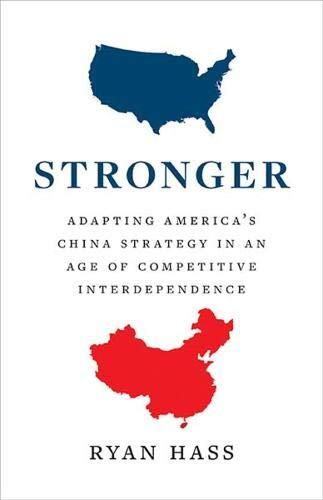
How can the U.S. best manage its relationship with China? The country is at once a major and increasingly hostile competitor to the U.S., a formidable challenger to U.S.’ regional and global leadership, and an important partner on a range of transnational challenges. Will it be possible for both sides to coexist amidst intensifying competition? How great is the risk of US-China conflict, including over Taiwan? Ryan Hass, author of Stronger: Adapting America’s China Strategy in an Age of Competitive Interdependence, will address these questions and more in opening comments before engaging in an open Q&A on the future of the world’s most consequential bilateral relationship.


Image
Portrait of Ryan Hass
Ryan Hass is a senior fellow and the Michael H. Armacost Chair in the Foreign Policy program at Brookings, where he holds a joint appointment to the John L. Thornton China Center and the Center for East Asia Policy Studies. He is also the Interim Chen-Fu and Cecilia Yen Koo Chair in Taiwan Studies. Hass focuses his research and analysis on enhancing policy development on the pressing political, economic, and security challenges facing the United States in East Asia. He is the author of Stronger: Adapting America’s China Strategy in an Age of Competitive Interdependence, published by Yale University Press.

Image
"Stronger" Book Cover
From 2013 to 2017, Hass served as the director for China, Taiwan and Mongolia at the National Security Council (NSC) staff. In that role, he advised President Obama and senior White House officials on all aspects of U.S. policy toward China, Taiwan, and Mongolia, and coordinated the implementation of U.S. policy toward this region among U.S. government departments and agencies. He joined President Obama’s state visit delegations in Beijing and Washington respectively in 2014 and 2015, and the president’s delegation to Hangzhou, China, for the G-20 in 2016, and to Lima, Peru, for the Asia-Pacific Economic Cooperation (APEC) Leaders Meetings in 2016. Prior to joining NSC, Hass served as a Foreign Service Officer in U.S. Embassy Beijing, where he earned the State Department Director General’s award for impact and originality in reporting. Hass also served in Embassy Seoul and Embassy Ulaanbaatar, and domestically in the State Department Offices of Taiwan Coordination and Korean Affairs. 


Image
American and Chinese flags
This event is part of the 2021 Winter/Spring Colloquia series, Biden’s America, Xi’s China: What’s Now & What’s Next?, sponsored by APARC's China Program.


Via Zoom Webinar. Register at: https://bit.ly/3c3v10W

Ryan Hass Senior Fellow, Michael H. Armacost Chair in Foreign Policy Studies, Brookings Institution
Seminars
Subscribe to China