Health and the Environment
0
Lecturer, Medicine - Primary Care and Population Health
key-image-gordon-m-bloom-mba1987.jpg.jpeg

Gordon founded the Social Entrepreneurship Collaboratory (SE Labs) at Stanford, Harvard and Princeton. He teaches about the design, development and leadership of innovative social impact ventures in global health and environmental sustainability.

At Stanford, Gordon is director of the Social Entrepreneurship and Innovation Lab (SE Lab)- Human & Planetary Health and is a faculty fellow of the Center for Innovation in Global Health. He is a Lecturer in the School of Medicine, Division of Primary Care and Population Health/Dept. of Medicine, and an advisor in the Distinguished Careers Institute (DCI), and the Knight-Hennessy Scholars Program, and cofounder of the Stanford Sustainable Societies Lab.

At Harvard, Gordon taught jointly on the faculties of the Harvard T. H. Chan School of Public Health (Health Policy & Management) and the Harvard Kennedy School (Management, Leadership & Decision Sciences) and served as an Expert-in-Residence (EiR) at the Harvard Innovation Lab (i-Lab), and affiliated faculty at the Center for Primary Care, Harvard Medical School (HMS). He was faculty director of the Social Entrepreneurship and Innovation Lab (SE Lab) for US & Global Health, an incubator course taught in a new interdisciplinary, collaborative model based at the i-Lab. He has also served as an Entrepreneur-in-Residence (2013-2014) at Harvard Business School in the Rock Center for Entrepreneurship, on the Faculty of Arts & Sciences in the Sociology Department, at the Harvard Kennedy School, on the Leadership & Management faculty, and as a principal of the Hauser Center for Non-Profit Organizations (2004-2007). Gordon served as one of the founding faculty of the $10 million Reynolds Fellows Program in Social Entrepreneurship, a Center for Public Leadership and Harvard President’s interdisciplinary fellowship initiative that paid full tuition and stipend for graduate students from the Harvard Kennedy School, School of Public Health and Graduate School of Education.

At Princeton, Gordon served as Dean’s Visiting Professor in Entrepreneurship in 2009-2010. Working together with the School of Engineering & Applied Science, the [Woodrow Wilson] School of Public & International Affairs, and the Faculty of Arts & Sciences, he launched a new set of programs and prizes in social innovation and entrepreneurship in collaboration with students, faculty and alumni.

At Stanford in 2001-2002, Gordon created the SE Lab, a Silicon Valley and technology–influenced, interdisciplinary incubator for social impact ventures and global problem solving. Gordon taught on the Public Policy Program and Urban Studies Program faculties (School of Humanities & Sciences) and served as a faculty affiliate at the Center for Social Innovation at Stanford Graduate School of Business, and a Program Officer at Stanford’s Freeman Spogli Institute for International Studies.

Many of the talented students and fellows in Gordon’s SE Labs have won the top awards of prestigious idea and business plan competitions, including those at Stanford, Harvard, Princeton and MIT.

Gordon is a co-author in the edited volume Frontiers in Social Innovation (N. Malhotra, ed., Harvard Business Review Press, 2022) and Social Entrepreneurship: New Models of Sustainable Social Change (A. Nicholls, ed., Oxford University Press, 2006/2008) and served as a founding member of the Oxford/Ashoka led University Network for Social Entrepreneurship. His interest in entrepreneurship is informed by work in both the private and nonprofit sectors in the U.S. (New York, Cambridge, Palo Alto), Europe (London, Paris) and Asia (Hong Kong), as CEO of a medical technology company (EDAP Technomed, USA) and in international strategy consulting (Bain & Co. Ltd.).

Gordon is married to Sara Singer- they on occasion teach together at Stanford, have a daughter Audrey and son Jason, and live in the Frenchman's Hill residential section of campus.

Co-founder, Stanford Sustainable Societies Lab
Director, Stanford Social Entrepreneurship and Innovation Lab (SE Lab)- Human & Planetary Health
Date Label
Authors
News Type
News
Date
Paragraphs

Motivation & Overview:


The effects of the climate crisis are thought to be extremely far-reaching, from declining economic growth and agricultural productivity to housing displacement and job loss. An important set of consequences are psychological, relating to how climate change can exacerbate anxiety and one’s sense of hopelessness about an uninhabitable future. These psychological impacts are heightened for members of vulnerable and marginalized groups, as well as for those in poor and underdeveloped places that struggle to address climate change.

In “Adolescent psychological health, temporal discounting, and climate distress under increased flood exposure in Bangladesh,” Liza Goldberg and her coauthors examine the psychological well-being of 15 to 18-year-olds in two Bangladeshi cities that have been differentially affected by floods. The authors conduct surveys and focus groups with adolescents in the low-flood-risk capital city of Dhaka and the high-flood-risk city of Barisal. They find that although adolescents in both cities fear the personal impacts of climate change, rates of anxiety and depression are significantly higher in Barisal. In addition, those with anxiety and depression exhibit greater temporal discounting, meaning that short-term consequences are favored over longer-term ones. Discounting is an important — if neglected — consequence because adolescents will emerge as household decision-makers who must plan to adapt to climate change. The article is notable in increasing our knowledge of how floods harm members of an already vulnerable population.

Case Selection and Hypotheses:


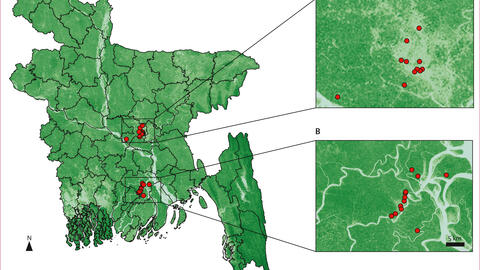
Bangladesh is among the world’s most climate-vulnerable countries. This is due to its “deltaic” geography (i.e., its low, flat land, crossed by many rivers) and consequent flood exposure, extreme temperature and humidity, and poor air quality. Barisal — a city of over 500,000 that is roughly 115 kilometers from Dhaka — is highly vulnerable to flooding, as well as being poorer (relative to Dhaka) and limited in its “climate adaptation infrastructure.” Partly for these reasons, rates of migration from Barisal to Dhaka are the highest in Bangladesh. By contrast, Dhaka — the capital city of over 24 million — is less flood-exposed and is slightly wealthier. Respondents in Barisal and Dhaka reported around four floods and one flood per year, respectively.


Figure. Study site locations in Bangladesh. Study sites at Dhaka (A) and Barisal (B) are shown in red.


Figure. Study site locations in Bangladesh. Study sites at Dhaka (A) and Barisal (B) are shown in red.


The authors hypothesize that Barisal’s greater flood exposure would be associated with more anxiety and depression among its adolescents, and that anxiety and depression would be associated with greater temporal discounting. (In other words, they do not expect that flood exposure would be directly associated with discounting.) In addition, the authors expect that these negative psychological effects would be especially pronounced among poor Bangladeshis, girls, and those with a greater awareness of the climate crisis.

Data and Findings:


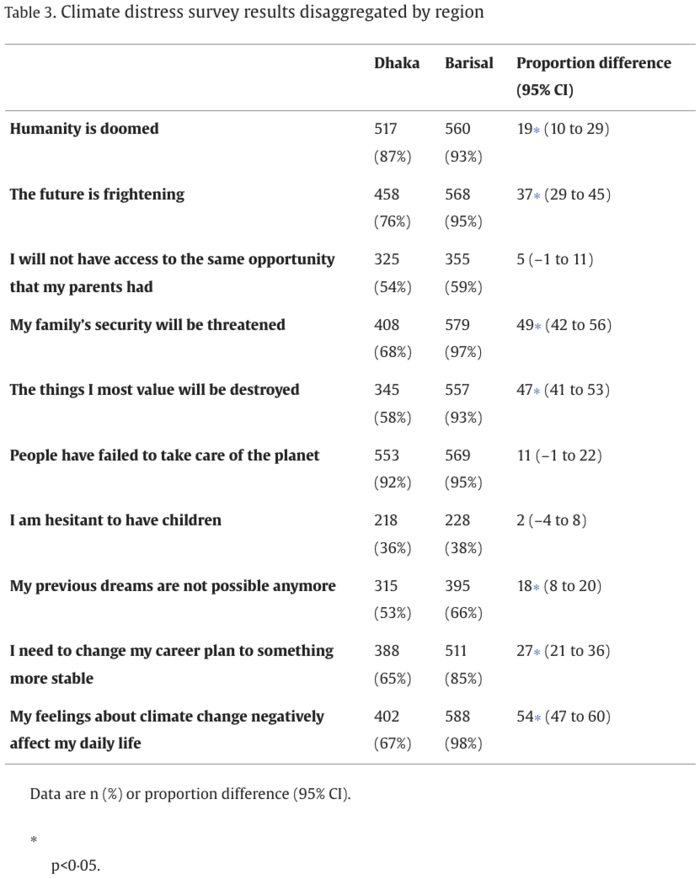
The authors surveyed 1200 Bangladeshi adolescents in 24 schools immediately after the flood season, which usually runs from May to September. In addition, 16 focus groups were conducted with around 160 total participants. Adolescents in both cities expressed a high familiarity with climate change. However, and consistent with the authors’ expectations, those in Barisal expressed significantly higher levels of agreement with statements about climate distress. For example 97% of those in Barisal compared to just 68% in Dhaka agreed that “My family’s security will be threatened,” 93% in Barisal and 58% in Dhaka agreed that “The things I most value will be destroyed,” and 98% in Barisal and 67% in Dhaka agreed that “My feelings about climate change negatively affect my daily life.” 


Image
Table 3. Climate distress survey results disaggregated by region.


Table 3. Climate distress survey results disaggregated by region.


The focus groups corroborated this unequal sense of despair, especially concerning the future and one’s educational and career goals. In Barisal, a boy said, “We expect that we will have to continue withstanding this [flooding] for many years to come,” while a girl said, “I used to want to become a teacher myself, but now I believe I will need to get married immediately after school because my father keeps losing his job during the floods.” By contrast, and because flooding in Dhaka is so infrequent, adolescents did not expect climate change to meaningfully threaten their life trajectories.

In terms of anxiety and depression, 86% of those in Barisal reported anxiety symptoms, compared to 71% in Dhaka, while 98% in Barisal and 88% in Dhaka reported depressive symptoms. After adjusting for factors like sex, wealth, and climate change awareness, the odds of being anxious and depressed in Barisal were nearly twice as high and more than 3.5 times as high, respectively. Across both cities, females were more than 1.75 times as likely to experience anxiety. And the odds of being depressed were over 1.85 times as high for those with a greater awareness of climate change.

I used to want to become a teacher myself, but now I believe I will need to get married immediately after school because my father keeps losing his job during the floods.

Girls in the Barisal focus groups revealed that flooding was linked to domestic violence. Fathers facing financial insecurity were reported to engage in violence against their mothers as a consequence of this stress. As one girl put it, “The floods keep getting worse and worse. So, I may experience even more violence than my mother does.” By contrast, few girls in Dhaka expressed worsening family dynamics, and none reported domestic violence owing to flooding. Adolescents in Dhaka believed that floods in their region were simply too fleeting to result in such abuse.

Finally, only 7% and 6% of adolescents in Barisal and Dhaka showed signs of temporal discounting. However, the odds of discounting were twice as high for those with anxiety and almost 2.5 times as high for those with depression. The authors find some evidence of discounting in the focus groups, but no meaningful differences across cities. This absence may be due to discounting behaviors emerging around adulthood, which is older than the adolescent study population. Taken together, the authors’ findings imply that mental health support will be essential for those affected by climate change — especially in impoverished areas — to help them manage stress and to improve their ability to plan for the future.

*Research-in-Brief prepared by Adam Fefer.

Hero Image
A woman stands on sandbags stacked to protect against flooding in Barisal, Bangladesh.
Liza Goldberg
All News button
1
Subtitle

CDDRL Research-in-Brief [4-minute read]

Date Label
Paragraphs

Chronic exposure to climate stress disproportionately affects low-income households; however, the psychological health and climate distress levels of climate-vulnerable adolescents in low-resource settings has rarely been explored. We investigated the association between increased flood exposure and adolescent psychological health, climate distress, and temporal discounting (long-term planning capacity).

All Publications button
1
Publication Type
Journal Articles
Publication Date
Journal Publisher
The Lancet Planetary Health
Authors
Stephen P. Luby
Erik Jensen
News Type
News
Date
Paragraphs

Both Southern California and Israel suffered disastrous wildfires this year.

In January, the Palisades and Eaton fires in Los Angeles killed 29 people and destroyed thousands of buildings, spurring a United Nations report titled “Once-in-a-generation events now happen frequently.”

In late April, a huge wildfire in central Israel threatened Jerusalem, caused nearby towns to evacuate and led to a national emergency.

The fires are just one example of the devastating effects of climate change experienced by California and Israel, said Alon Tal, an environmental scholar, former Knesset member and part of the Visiting Fellows in Israel Studies program at Stanford University’s Center on Democracy, Development and the Rule of Law, which co-hosted the conference.

Read the full story from J. The Jewish News of Northern California.

Hero Image
The gathering included a tour of the Stanford Central Energy Facility
The gathering included a tour of the Stanford Central Energy Facility.
Rod Searcey
All News button
1
Subtitle

More than 200 academics and political leaders met last week at Stanford for “Climate Resilience and Local Governmental Policy: Lessons from Los Angeles and Tel Aviv,” a groundbreaking conference organized by CDDRL's Visiting Fellows in Israel Studies program.

Date Label
Paragraphs

We present results from a randomized controlled trial in Bangladesh that introduced operational practices to improve energy efficiency and reduce emissions in 276 “zigzag” brick kilns. Of all intervention kilns, 65% adopted the improved practices. Treatment assignment reduced energy use by 10.5% (P-value <0.001) and decreased CO2 and PM2.5 emissions by 171 and 0.45 metric tons, respectively, per kiln per year. Valuing the CO2 reductions using a social cost of carbon of 185 USD per metric ton, we find that the social benefits outweigh costs by a factor of 65 to 1. The intervention, which required no new capital investment, also decreased fuel costs and increased brick quality. Our results demonstrate the potential for privately profitable, as well as publicly beneficial, improvements to address environmental problems in informal industries.

All Publications button
1
Publication Type
Journal Articles
Publication Date
Journal Publisher
Science
Authors
Stephen P. Luby
Number
No. 6747
-
Portrait of Huixia Wang.

We examine the intergenerational persistence of health in a low- and middle-income country, using longitudinal datasets from Indonesia. Our study evaluates both objective and self-reported health outcomes including self-reported health (SRH), hemoglobin levels, anemia, pulse, hypertension, and adiposity measures (BMI, overweight and waist-hip ratio) to assess the persistence of these conditions across generations.

Linking the health of adult children to their parents, we find significant differences in persistence between objective and subjective health measures. SRH and adiposity show stronger persistence, especially through maternal health, with daughters more susceptible. In contrast, objective measures like waist-hip ratio show minimal intergenerational persistence, suggesting individual lifestyle factors play a larger role. Daughters are more affected by maternal health in hemoglobin, anemia, pulse rate and BMI, while paternal health has a weaker but notable influence.

Our results remain robust across regions and ethnic groups. We conclude that the persistence of intergenerational health significantly hinders socioeconomic mobility, underscoring the need for maternal health-oriented health policies, including prenatal care, nutrition, and family-based interventions to reduce the transmission of chronic diseases such as anemia and obesity.

Huixia Wang 110724

Currently, Dr. Huixia Wang is an associate professor at Hunan University. Her research interests encompass health economics, environmental economics, and development economics, with a particular focus on assessing the health impacts of pollution, climate change, and economic fluctuations in developing countries. She earned both her PhD and MA in economics from the University of Hawaii at Manoa.

Huixia Wang, 2024 Visiting Scholar, Shorenstein APARC, Stanford University
Seminars
Date Label
Paragraphs

Food adulteration with toxic chemicals is a global public health threat. Lead chromate adulterated spices have been linked with lead poisoning in many countries, from Bangladesh to the United States. This study systematically assessed lead chromate adulteration in turmeric, a spice that is consumed daily across South Asia. Our study focused on four understudied countries that produce >80 % of the world's turmeric and collectively include 1.7 billion people, 22 % of the world's population. Turmeric samples were collected from wholesale and retail bazaars from 23 major cities across India, Pakistan, Sri Lanka, and Nepal between December 2020 and March 2021. Turmeric samples were analyzed for lead and chromium concentrations and maximum child blood lead levels were modeled in regions where samples had detectable lead. A total of 356 turmeric samples were collected, including 180 samples of dried turmeric roots and 176 samples of turmeric powder. In total, 14 % of the samples (n = 51) had detectable lead above 2 μg/g. Turmeric samples with lead levels greater than or equal to 18 μg/g had molar ratios of lead to chromium near 1:1, suggestive of lead chromate adulteration. Turmeric lead levels exceeded 1000 μg/g in Patna (Bihar, India) as well as Karachi and Peshawar (Pakistan), resulting in projected child blood lead levels up to 10 times higher than the CDC's threshold of concern. Given the overwhelmingly elevated lead levels in turmeric from these locations, urgent action is needed to halt the practice of lead chromate addition in the turmeric supply chain.

All Publications button
1
Publication Type
Journal Articles
Publication Date
Journal Publisher
Science of The Total Environment
Authors
Stephen P. Luby
Number
2024, 175003
-
Flyer for AHPP event: Navigating Trade-Offs of Technological Innovation in Healthcare

Co-sponsored by Peking University's Institute for Global Health and Development and the Asia Health Policy Program

This event delves into the complex landscape of technological advancements in healthcare, focusing on the critical balance between embracing innovative tools and managing their implications for provider skills and patient outcomes. It presents two pivotal papers that collectively shed light on the nuanced trade-offs inherent in the adoption of new technologies like robotic surgery. The first paper utilizes a Roy model to articulate the coexistence of new and incumbent technologies, emphasizing the trade-offs between different quality dimensions and productivity. The second paper examines the adoption of surgical robots in England's healthcare system. It offers an insightful analysis of how such technologies can bridge the skill gap among healthcare providers, potentially leading to more equitable patient outcomes. The study underscores a significant variance in the benefits of robotic surgery based on the surgeon's expertise, highlighting an uneven landscape of technology utilization. Through these discussions, the event aims to navigate the intricate interplay between technological innovation, healthcare provider skill enhancement, and the ultimate goal of improved patient care.

Image
Breg 20240312

Nathaniel Breg earned his PhD at Carnegie Mellon University and his BA at Tufts University. His interest in health care providers intersects with questions from labor economics and industrial organization. Nate's current research investigates how providers respond to incentives, how they decide to adopt new technology, and how health care services affect local economies and local health. He is a 2020-2021 recipient of the Fellowship in Digital Health from CMU's Center for Machine Learning and Health. He previously worked at RTI International on evaluations of government health care initiatives, prospective payment systems, and health care delivery quality measures.

Image
Tafti 20240312

Elena Ashtari Tafti is an applied microeconomist working on topics at the intersection of innovation, health, and personnel economics. In September 2023, she joined the Ludwig Maximilian University of Munich as an Assistant Professor in Economics. Elena holds a PhD in Economics from University College London and is a Scholar at the Institute of Fiscal Studies (IFS) and the Centre for Microdata Methods and Practice (CeMMAP).


Jianan Yang, Assistant Professor of Economics, Institute for Global Health and Development, Peking University

Via Zoom Webinar

Nathaniel Breg, Postdoctoral Scholar, Stanford University; and the U.S. Veterans Health Administration
Elena Ashtari Tafti, Assistant Professor, Ludwig Maximillian University
Seminars
-
Bringing AI from Code to Clinic

Please note that this event is now webinar only

In this seminar, three presenters from Google Health will share their perspectives on what it takes to bring a medical AI product from “code to clinic” in Southeast Asia. Google Health’s mission is to help everyone, everywhere be healthier, applying cutting-edge artificial intelligence (AI) technologies to improve patient outcomes and care delivery and incubate new AI-based products from initial research to clinical deployment. Representing different facets of a multidisciplinary team of experts (Product, Partnerships, and Program Management), the presenters will discuss the journey of developing and deploying a diagnostic AI solution that addresses an unmet need for the detection of diabetic blindness in Southeast Asia, real-world challenges and opportunities (particularly in the context of low- and middle-income countries), and the importance of building strategic partnerships and trust.

Tiwari 012324

Richa Tiwari's work focuses on driving research on Google’s health innovations and working with partners on real-world deployment of digital and AI solutions in APAC and Africa. Richa holds a PhD in Molecular Biology and has over a decade of experience in Pharma, bringing cancer treatments to market and running clinical trials. An accidental technologist and a scientist at heart, Richa is passionate about bringing forward cutting-edge health tech innovations to address healthcare challenges

Virmani 012324

Sunny Virmani, during his time at Google and Verily Life Sciences, has focused on translating machine learning research into real-world clinical applications working with key opinion leaders and partners globally. His team’s pioneering research in the field of diabetic retinopathy screening using machine learning has helped advance the technology in this field significantly. Previously, he has held Product Management positions at Carl Zeiss Meditec and Philips Healthcare building products in the field of medical imaging. By education, he is an engineer with a Masters degree in Biomedical Engineering.

Sawhney 012324

Rajroshan Sawhney leads Partnerships for Google Research (Health AI & Sustainability). During his time at Google, Raj has focused on catalyzing the adoption of human-centered AI in healthcare by driving strategic partnerships across both public and private sector in APAC, working closely with regulators, policy makers and academic partners to improve health outcomes in low-resource environments, and to develop go-to-market strategies to graduate research into real-world deployments.  Prior to Google, Raj was the Head of Strategic Partnerships and Corporate Development at a leading Computer Vision startup based out of San Francisco and Singapore. Raj holds a Computer Science BE (Hons) degree from BITS-Pilani, is a member of Mensa International and the India Young Leaders Forum.

Karen Eggleston

Webinar via Zoom

Richa Tiwari, Sunny Virmani, Rajroshan Sawhney
Seminars
Subscribe to Health and the Environment