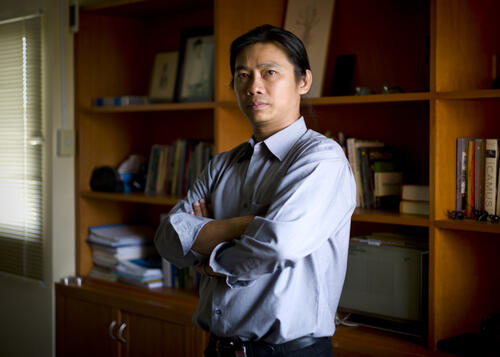
Ties That Bind: Cultural Identity, Class, and Law in Vietnam's Labor Resistance
Vietnamese news accounts of labor-management conflicts, including strikes, and even reports of owners fleeing their factories raise potent questions about labor activism in light of this self-proclaimed socialist country’s engagement in the global market system since the late 1980s. In explaining Vietnamese labor resistance, how important are matters of cultural identity (such as native-place, gender, ethnicity, and religion) in different historical contexts? How does labor mobilization occur and develop? How does it foster “class moments” in times of crisis? What types of "flexible protests" have been used by workers to fight for their rights and dignity, and how effective are they?
Based on her just-published book, Ties that Bind: Cultural Identity, Class, and Law in Vietnam's Labor Resistance, Prof. Trần will highlight labor activism since French colonial rule in order to understand labor issues and actions in Vietnam today. Her analysis will focus on labor-management-state relations, especially with key foreign investors/managers (such as from Korea, Taiwan, and Hong Kong) and ethnic Chinese born and raised in Vietnam. She will convey the voices and ideas of workers, organizers, journalists, and officials and explain how migrant workers seek to empower themselves using cultural resources and appeals to state media and the rule of law. Copies of her book will be available for sale at her talk.
Prof. Trần's current research on global south-south labor migration focuses on Vietnamese migrants working in Malaysia and returning to Vietnam. In 2008 she was a Lee Kong Chian NUS-Stanford Distinguished Fellow on Southeast Asia. Her co-authored 2012 book, Corporate Social Responsibility and Competitiveness for SMEs in Developing Countries: South Africa and Vietnam, compared the experiences of small-and-medium enterprises in these two countries. Her many other writings include (as co-editor and author) Reaching for the Dream: Challenges of Sustainable Development in Vietnam (2004). She earned her PhD in Political Economy and Public Policy at the University of Southern California in 1996 and an MA in Developmental Economics at USC in 1991.
Copies of Ties that Bind: Cultural Identity, Class, and Law in Vietnam's Labor Resistance will be available for signing and sale by the author following her talk.
Daniel and Nancy Okimoto Conference Room
Angie Ngoc Trần
Shorenstein APARC
Stanford University
Encina Hall E301
Stanford, CA 94305-6055
Angie Ngoc Trần is a professor in the Division of Social and Behavioral Sciences and Global Studies at California State University, Monterey Bay (CSUMB). Her plan as the 2008 Lee Kong Chian National University of Singapore-Stanford University Distinguished Fellow is to complete a book manuscript on labor-capital relations in Vietnam that highlights how different identities of investors and owners—shaped by government policies, ethnicity, characteristics of investment, and the role they played in global flexible production—affect workers’ conditions, consciousness, and collective action differently.
Tran spent May-July 2008 at Stanford and will return to campus for the second half of November 2008. She will share the results of her project in a public seminar at Stanford under SEAF auspices on November 17 2008.
Prof. Trần’s many publications include “Contesting ‘Flexibility’: Networks of Place, Gender, and Class in Vietnamese Workers’ Resistance,” in Taking Southeast Asia to Market (2008); “Alternatives to ‘Race to the Bottom’ in Vietnam: Minimum Wage Strikes and Their Aftermath,” Labor Studies Journal (December 2007); “The Third Sleeve: Emerging Labor Newspapers and the Response of Labor Unions and the State to Workers’ Resistance in Vietnam,” Labor Studies Journal (September 2007); and (as co-editor and author) Reaching for the Dream: Challenges of Sustainable Development in Vietnam (2004). She received her Ph.D. in Political Economy and Public Policy at the University of Southern California in 1996 and an M.A. in Developmental Economics at USC in 1991.
Emily Arnold-Fernández
Asylum Access
1611 Telegraph Avenue
Suite #1111
Oakland, CA 94612
Emily Arnold-Fernández was a social entrepreneur in residence during the fall 2012 quarter with CDDRL's Program on Social Entrepreneurship. She will be spending the 2013/14 academic year as a practitioner-in-residence with the Program on Social Entrepreneurship.
She is the founder and executive director of Asylum Access, is a social entrepreneur and human rights pioneer. Recognizing that refugees throughout Africa, Asia and Latin America – some of whom flee with nothing more than the clothes on their backs – were almost always unequipped to go into a legal proceeding in a foreign country, alone, and explain why they should not be deported, Emily founded Asylum Access to advocate on behalf of refugees seeking to assert their rights.
“For half a century, international law has given refugees the rights to live safely,
seek employment, send children to school and rebuild their lives. But those rights are
meaningless unless they are respected on the ground,” she says. “Asylum Access
provides a rare opportunity to fill a gaping hole in our human rights system – by making
refugee rights a reality for real people.”
For her innovative approach to the global refugee crisis, Emily was honored by the
Dalai Lama as one of 50 “Unsung Heroes of Compassion” from around the world (2009)
and Waldzell Institute’s Architects of the Future Award (2012). She has also been
recognized as Pomona College’s Inspirational Young Alumna (2006), awarded the
prestigious Echoing Green fellowship (2007), and recognized as the New Leaders
Council’s 40 Under 40 (2010), among others. Emily’s ground-breaking work with
Asylum Access has earned her international speaking invitations and widespread media
attention, including the Rotary International Peace Symposium (2008, 2009), the UN
High Commissioner for Refugees’ Annual Consultations (2008, 2009), a cover feature in
the Christian Science Monitor (September 2009), and the San Francisco Examiner’s
Credo column (July 2011). She holds a B.A. cum laude from Pomona College and a J.D.
from Georgetown University Law Center.
Committed to sharing her knowledge with young and aspiring social
entrepreneurs, Emily serves as an adjunct professor at the University of San Francisco,
teaching a course in social entrepreneurship. In Fall 2012, Emily was selected as one of
three Social Entrepreneurs in Residence at Stanford where she participated as “expert
respondent” in Stanford Law School’s Law, Social Entrepreneurship and Social Change
course, and in Spring 2013, Emily led an intensive skills-building course on social
entrepreneurship at Pomona College.
A visionary human rights activist, Emily Arnold-Fernández takes her inspiration
from a line in a June Jordan poem: “We are the ones we have been waiting for.”
2013 Robert G. Wesson Lecture - The Poetics of Protest and Policy: Poet and Activist Javier Sicilia on Peace Beyond the Drug War
Javier Sicilia is a poet, essayist, novelist, and journalist from Mexico. He contributes to various print media such as the Mexico City daily La Jornada and Proceso magazine. After his son was killed by drug traffickers in 2011, Sicilia founded an anti-violence called Movement for Peace with Justice and Dignity. The group has campaigned against the spreading criminal and state violence in Mexico through massive street mobilizations, caravans and marches. Because of this movement, Sicilia was named as one of Time Magazine's Protestors of the Year for 2011. For his writing, he was awarded the Aguascalientes National Award of Poetry in 2009.
The lecture will be followed by a reception.
Bechtel Conference Center
Alberto Díaz-Cayeros
Encina Hall, C149
616 Jane Stanford Way
Stanford, CA 94305
Alberto Díaz-Cayeros is a Senior Fellow at Stanford University's Freeman Spogli Institute for International Studies (FSI), and co-director of the Democracy Action Lab (DAL), based at FSI's Center on Democracy, Development and Rule of Law (CDDRL). His research interests include federalism, poverty relief, indigenous governance, political economy of health, violence, and citizen security in Mexico and Latin America.
He is the author of Federalism, Fiscal Authority and Centralization in Latin America (Cambridge, reedited 2016), coauthored with Federico Estévez and Beatriz Magaloni, of The Political Logic of Poverty Relief (Cambridge, 2016), and of numerous journal articles and book chapters.
He is currently working on a project on cartography and the developmental legacies of colonial rule and governance in indigenous communities in Mexico.
From 2016 to 2023, he was the Director of the Center for Latin American Studies at Stanford University, and from 2009 to 2013, Director of the Center for US-Mexican Studies at UCSD, the University of California, San Diego.
Research Presentation - Corporate Affiliate Visiting Fellows
Il Rae Cho, "Preparing Financially for Aging and Retirement"
Recently, many issues related to aging have become more serious in both economic and social aspects all over the world. Aging is something that nobody can avoid or neglect. However, most people tend to consider the issue of aging and retirement less serious than needed in real situations. The lack of preparation for retirement may cause an economic turmoil to an individual's retirement life and national finance for social security. In this presentation, Cho will show the current situations about aging and retirement and will offer practical solutions.
Yong Je Kim, "Next Generation Multimedia - What Will That Be?
Can you imagine the future TV and mobile phone? What will they look like?
Only a few years ago, the main feature of a mobile phone was to make simple voice calls. Today, we can do so much more - watch drama shows, sports and movies; take pictures and send them anywhere; and stay up-to-date checking the news and stock information of all countries in real time. Through social media, we can share our opinion with many people regardless of location. We can purchase goods or buy tickets for a concert simply using our mobile phones - without needing actual money or credit cards. At the same time, TVs are getting smarter - providing useful functions like online shopping, remote video calls and watching movies without going to the movie theater.
There are many technologies to enable these improvements, but the key technology is multimedia. In this presentation, Kim will introduce some noticeable multimedia components and their progress, including examples of possible future TV and mobile phones.
Philippines Conference Room
Yong Je Kim
Yong Je Kim is a corporate affiliate visiting fellow at the Walter H. Shorenstein Asia-Pacific Research Center (Shorenstein APARC) for 2013. Kim has been working at Samsung Electronics for 28 years in the R&D Center. His work has focused mainly in the area of multimedia signal processing for digital TV and mobile phones, serving most recently as the Senior Vice President of the multimedia R&D team. Kim received his bachelor's degree in electronic engineering from Sogang University and his master's degree from Ajou University.
The Unintended Consequences of Internet Diffusion: Evidence from Malaysia
Luke Miner recently completed his PhD in economics from the London School of Economics. He was also a postdoctoral fellow at the Center on Democracy, Development and the Rule of Law in the Liberation Technology Program. He is currently working as a data scientist in the techology sector.
Wallenberg Theater
Sunny Seong-Hyon Lee
Shorenstein APARC
Encina Hall E310
616 Serra Street
Stanford University
Stanford, CA 94305-6055
Sunny Seong-hyon Lee, a journalist based in Beijing, China, is the 2013-14 Pantech Fellow in Korean Studies at the Walter H. Shorenstein Asia-Pacific Reseach Center.
Dr. Lee has lived in China for 11 years, including as chief correspondent and later as director of China Research Center of the Korea Times. He served as an internal reviewer of the North Korean reports by the International Crisis Group (ICG) on multiple occasions. A fluent Chinese speaker and writer, he is a frequent commentator on China-Korea relations as well as on North Korea in Chinese newspapers and on TV. He has also appeared on CNN, Al Jazeera, and the Chinese state CCTV.
Dr. Lee taught at Salzburg Global Seminar, gave lectures to members of Harvard Kennedy School, the Confucius Institute, Seoul National University, Yonsei University, Korea University, Tsinghua University, Guo JI Guan Xi Xue Yuan, Korea Economic Institute, The Korea-China Future Forum, the Korea Journalists’ Association, and the Korea-China Leadership Program of the Korea Foundation for Advanced Studies.
Dr. Lee will use his Pantech Fellowship at Stanford to write a book manuscript on the latest China-Korea relations, especially since the death of North Korean leader Kim Jong-il. He will also engage Stanford audiences and members of the public through lectures and research meetings.
Dr. Lee received a bachelor’s degree from Grinnell College, a master’s degree from Harvard University and Beijing Foreign Studies University, and a PhD from Tsinghua University, where he completed his doctoral dissertation on North Korea, examining the media framing of North Korea by analyzing the journalist-source relationship. He is also a non-resident James A. Kelly Fellow at Pacific Forum CSIS, and a 2013 Korea Foundation-Salzburg Fellow.
Dr. Lee’s recent writings include:
“Firm Warning, Light Consequences: China’s DPRK Policy Upholds Status Quo” (The Jamestown Foundation)
http://www.jamestown.org/programs/chinabrief/single/?
“Will China's soft-power strategy on South Korea succeed?” (CSIS)
http://csis.org/publication/23-will-chinas-soft-power-strategy-south-korea-succeed
“Chinese Perspective on North Korea and Korean Unification” (The Korea Economic Institute in Washington DC)
http://www.keia.org/sites/default/files/publications/kei_onkorea_2013_sunny_seong-hyon_lee.pdf
“China’s North Korean Foreign Policy Decoded” (Yale Global Online)
http://yaleglobal.yale.edu/content/chinas-north-korean-foreign-policy-decoded
“Why North Korea may muddle along” (Asia Times)
http://www.atimes.com/atimes/Korea/NB28Dg02.html
Established in 2004, the Pantech Fellowship for Mid-Career Professionals, generously funded by Pantech Co., Ltd., and Curitel Communications, Inc. (known as the Pantech Group), is intended to cultivate a diverse international community of scholars and professionals committed to and capable of grappling with challenges posed by developments in Korea.
Reforming the Entrepreneurship Ecosystem in Post-revolutionary Egypt and Tunisia
Abstract:
The seminar session will present findings from a new study on the entrepreneurship ecosystem in post-revolutionary Egypt and Tunisia. The discussion will focus on the challenges facing entrepreneurs and would-be entrepreneurs in these countries and the MENA region, and will highlight the importance of reform of the legal and regulatory environment.
Speakers bio:
Lina Khatib is the co-founding Head of the Program on Arab Reform and Democracy at the Center on Democracy, Development, and the Rule of Law at Stanford University. She joined Stanford University in 2010 from the University of London where she was an Associate Professor. Her research is firmly interdisciplinary and focuses on the intersections of politics, media, and social factors in relation to the politics of the Middle East. She is also a consultant on Middle East politics and media and has published widely on topics such as new media and Islamism, US public diplomacy towards the Middle East, and political media and conflict in the Arab world, as well as on the political dynamics in Lebanon and Iran. She has an active interest in the link between track two dialogue and democratization policy. She is also a Research Associate at SOAS, University of London, and, from 2010-2012, was a Research Fellow at the USC Center on Public Diplomacy at the Annenberg School.
Amr Adly has a Ph.D. from the European University Institute-Florence, Department of political and social sciences (Date of completion: September 2010). His thesis topic was "The political economy of trade and industrialization in the post-liberalization period: Cases of Turkey and Egypt". The thesis was published by Routledge in December 2012 under the title of State Reform and Development in the Middle East: The Cases of Turkey and Egypt.
He has several other academic publications that have appeared in the Journal of Business and Politics, Turkish Studies, and Middle Eastern Studies, in addition to articles in several other periodicals and newspapers in English and Arabic.
Before joining Stanford, he worked as a senior researcher at the Egyptian Initiative for Personal Rights, heading the unit of social and economic rights, and at the Ministry of Foreign Affairs as a diplomat.
At Stanford, he is leading a research project on reforming the regulatory environment governing entrepreneurship after the Arab Spring in Egypt and Tunisia, which will result in policy papers as well as conferences in the two countries.
Greg Simpson is Deputy Regional Director of the Middle East and North Africa division at the Center for International Private Enterprise (CIPE), where in addition to co-managing the division with the regional director, he also directly oversees CIPE’s sizeable Egypt portfolio. A veteran of the nongovernmental sector with eighteen years of experience in strengthening democratic institutions, Simpson came to CIPE from the U.S. online political firm New Media Communications, where he focused on developing and managing the company’s international initiatives. Prior to New Media, Simpson worked at the International Republican Institute (IRI), where he held three successive country director posts in the Balkans. There he directed assistance programs in political party development, political communications, local governance, grassroots organization and mobilization, civil society development, public opinion research, and election observation. During this time, Simpson advised and trained hundreds of political activists and elected officials, and directly advised two of the region’s presidents. Before joining IRI, Simpson held positions at the American Council of Young Political Leaders (ACYPL) and the Center for Civil Society in Southeastern Europe. He holds a B.A. in International Studies from American University in Washington, DC. Simpson currently resides in Alexandria, Virginia with his wife and two children.
One of the four core institutes of the National Endowment for Democracy and an affiliate of the U.S. Chamber of Commerce, the Center for International Private Enterprise (CIPE) is a U.S. non-profit organization with the mission of strengthening democracy around the globe through private enterprise and market-oriented reform. CIPE has supported more than 1,300 initiatives in over 100 developing countries, involving the private sector in policy advocacy and institutional reform, improving governance, and building understanding of market-based democratic systems. CIPE provides management assistance, practical experience, and financial support to local organizations to strengthen their capacity to implement democratic and economic reforms.
Encina Ground Floor Conference Room
Preventing Genocide: Do We Have the Responsibility to Protect?
This event is being presented in partnership with CDDRL, the U.S. Holocaust Memorial Museum, the Hoover Institution, and a student led movement to end atrocities at Stanford (STAND).
Abstract:
Sixty-eight years after the Holocaust, governments continue to struggle with preventing genocide and mass atrocities. In 2005, United Nations member states agreed that nations share a responsibility to protect their citizens from genocide, crimes against humanity, war crimes, and ethnic cleansing. Join us for a discussion about how the responsibility to protect (or R2P) has been applied in recent crises.
Speakers bio:
Richard Williamson is a nonresident senior fellow in Foreign Policy at Brookings and a principal in the consulting firm Salisbury Strategies LLP. His work focuses on human rights, multilateral diplomacy, nuclear nonproliferation and post-conflict reconstruction. Prior to those positions, Mr. Williamson served as U.S. special envoy to Sudan, under President George W. Bush. Earlier in the Bush administration, Mr. Williamson, who has broad foreign policy and negotiating experience, served as ambassador to the United Nations for Special Political Affairs, and as ambassador to the U.N. Commission on Human Rights. Previously, Mr. Williamson served in several other senior foreign policy positions under Presidents Ronald Reagan and George H.W. Bush, including as assistant secretary of state for international organizations at the Department of State, and as an assistant to the president for intergovernmental affairs in the White House.
Michael Abramowitz is director of the Center for the Prevention of Genocide at the U.S. Holocaust Memorial Museum. He joined the Museum in 2009 after nearly 25 years at the Washington Post, where he served as White House correspondent and previously as national editor, helping supervise coverage of national politics, the federal government, social policy, and national security. He is a member of the Council on Foreign Relations and a non-resident fellow of the German Marshall Fund. He was also a media fellow at the Hoover Institution at Stanford University.
Tod Lindberg is a research fellow at the Hoover Institution, Stanford University, based in Hoover’s Washington, DC, office. His areas of research are political theory, international relations, national security policy, and US politics.
Lindberg is a contributing editor to the Weekly Standard and an adjunct associate professor at Georgetown University, where he teaches in the School of Foreign Service. From 1999 until it ceased publication in 2013, he was editor of the bimonthly journal Policy Review.
In 2007–8, Lindberg served as head of the expert group on international norms and institutions of the Genocide Prevention Task Force, a joint project of the U.S. Holocaust Memorial Museum, the American Academy of Diplomacy, and the U.S. Institute of Peace. In 2005, Lindberg was the coordinator for the group Preventing and Responding to Genocide and Major Human Rights Abuses for the United States Institute of Peace's Task Force on the United Nations. He was a member of the Steering Committee of the Princeton Project on National Security, for which he served as cochair of the working group on anti-Americanism. He is a member of the Council on Foreign Relations.
Lina Khatib is the co-founding Head of the Program on Arab Reform and Democracy at the Center on Democracy, Development, and the Rule of Law at Stanford University. She joined Stanford University in 2010 from the University of London where she was an Associate Professor. Her research is firmly interdisciplinary and focuses on the intersections of politics, media, and social factors in relation to the politics of the Middle East. She is also a consultant on Middle East politics and media and has published widely on topics such as new media and Islamism, US public diplomacy towards the Middle East, and political media and conflict in the Arab world, as well as on the political dynamics in Lebanon and Iran. She has an active interest in the link between track two dialogue and democratization policy. She is also a Research Associate at SOAS, University of London, and, from 2010-2012, was a Research Fellow at the USC Center on Public Diplomacy at the Annenberg School.
Bechtel Conference Center
Egypt's Stalled Transition: A Roundtable Discussion
Lina Khatib is the co-founding Head of the Program on Arab Reform and Democracy at the Center on Democracy, Development, and the Rule of Law at Stanford University. She joined Stanford University in 2010 from the University of London where she was an Associate Professor. Her research is firmly interdisciplinary and focuses on the intersections of politics, media, and social factors in relation to the politics of the Middle East. She is also a consultant on Middle East politics and media and has published widely on topics such as new media and Islamism, US public diplomacy towards the Middle East, and political media and conflict in the Arab world, as well as on the political dynamics in Lebanon and Iran. She has an active interest in the link between track two dialogue and democratization policy. She is also a Research Associate at SOAS, University of London, and, from 2010-2012, was a Research Fellow at the USC Center on Public Diplomacy at the Annenberg School.
Amr Adly has a Ph.D. from the European University Institute-Florence, Department of political and social sciences (Date of completion: September 2010). His thesis topic was "The political economy of trade and industrialization in the post-liberalization period: Cases of Turkey and Egypt". The thesis was published by Routledge in December 2012 under the title of State Reform and Development in the Middle East: The Cases of Turkey and Egypt.
He has several other academic publications that have appeared in the Journal of Business and Politics, Turkish Studies, and Middle Eastern Studies, in addition to articles in several other periodicals and newspapers in English and Arabic.
Before joining Stanford, he worked as a senior researcher at the Egyptian Initiative for Personal Rights, heading the unit of social and economic rights, and at the Ministry of Foreign Affairs as a diplomat.
At Stanford, he is leading a research project on reforming the regulatory environment governing entrepreneurship after the Arab Spring in Egypt and Tunisia, which will result in policy papers as well as conferences in the two countries.
Adel Iskandar is a scholar of media and international communication. He is the author and coauthor of several works including Al-Jazerra: The Story of the Network that is Rattling Governments and Redefining Modern Journalism (co-authored with Mohammed el-Naway, Basic Books, 2003). Iskandar's work deals with the intersections of media (pring, electronic, and digital) culture, identity, and politics, and he has lectured extensively on these topics at universateries worldwide. His latest publications include two coedited volumes titled Edward SAid: A Legacy of Emancipation and Representation (co-edited with Hakem Rustom, University of California Press, 2010) and Mediating the Arab Uprisings (Tadween, 2013). His just published title the uthored anthology Egypt In Flux: Essay on an unfinished Revolution (OUP/AUC Press, 2013. Iskandar is a postdoctoral fellow at the Center for Contemporary Arab Studies at Georgetown University.
Hesham Sallam is a doctoral candidate in government at Georgetown University and co-editor of Jadaliyya ezine. He is former program specialist at the U.S. Institute of Peace. His research focuses on Islamist movements and the politics of economic reform in the Arab World. Sallam’s research has previously received the support of the Social Science Research Council and the U.S. Institute of Peace. Past institutional affiliations include Middle East Institute, Asharq Al-Awsat, and the World Security Institute. He is editor of Egypt's Parliamentary Elections 2011-2012: A Critical Guide to a Changing Political Arena (Tadween Publishing, 2013).
CISAC Conference Room
Hesham Sallam
Encina Hall, E105
616 Jane Stanford Way
Stanford, CA 94305-6055
Hesham Sallam is a Senior Research Scholar at CDDRL, where he serves as Associate Director for Research. He is also Associate Director of the Program on Arab Reform and Development. Sallam is co-editor of Jadaliyya ezine and a former program specialist at the U.S. Institute of Peace. His research focuses on political and social development in the Arab World. Sallam’s research has previously received the support of the Social Science Research Council and the U.S. Institute of Peace. He is author of Classless Politics: Islamist Movements, the Left, and Authoritarian Legacies in Egypt (Columbia University Press, 2022), co-editor of Struggles for Political Change in the Arab World (University of Michigan Press, 2022), and editor of Egypt's Parliamentary Elections 2011-2012: A Critical Guide to a Changing Political Arena (Tadween Publishing, 2013). Sallam received a Ph.D. in Government (2015) and an M.A. in Arab Studies (2006) from Georgetown University, and a B.A. in Political Science from the University of Pittsburgh (2003).