Education
-


*This event is free and open to the public.*


Image

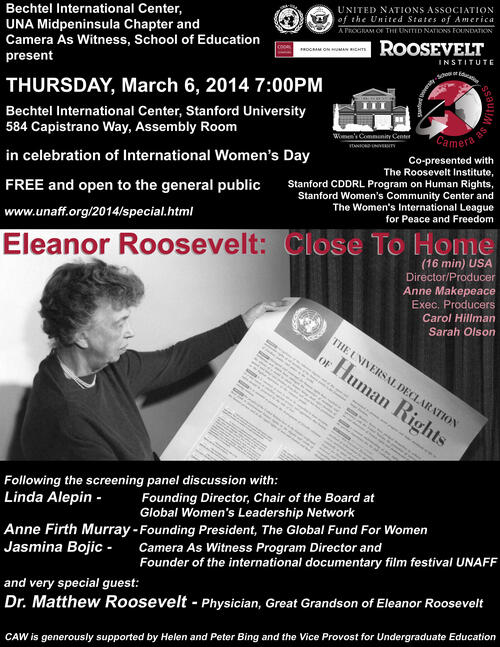
Eleanor Roosevelt: Close to Home is an overview of the inspirational life of Eleanor Roosevelt and highlights her dedication as champion of social justice and racial equality. The film introduces viewers to Val-Kill, the home of this extraordinary American who became a world leader in human rights and creator of the Universal Declaration of Human Rights. The remarkable modesty, independence and humanitarian leadership that made Eleanor Roosevelt the "First Lady of the World" are reflected in the Cottage's rooms, furnishings and surroundings. No other place allows visitors to connect with, rediscover and appreciate anew this woman whose influence is still so widely felt.

Following the screening, there will be a panel discussion.

This event is co-presented with the CDDRL Program on Human Rights, Roosevelt Institute, Stanford Women's Community Center and Women's International League for Peace and Freedom and sponsored by the Bechtel International Center, UNA Midpeninsula Chapter and Camera As Witness, Stanford Graduate School of Education in celebration of International Women's Day. 

Bechtel International Center
Assembly Room
Stanford University
584 Capistrano Way

Linda Alepin Founding Director, Chair of the Board Speaker Global Women's Leadership Network
Anne Firth Murray Founding President Speaker The Global Fund For Women
Jasmina Bojic Camera As Witness Program Director and Founder of the international documentary film festival UNAFF Speaker
Dr. Matthew Roosevelt Physician Speaker Great Grandson of Eleanor Roosevelt
Conferences
-

**** PLEASE NOTE CHANGE OF LOCATION****

Abstract
The Internet makes lives better, around the world, in ways people couldn't have imagined not even a decade ago.  It sparks prosperity, inspires dissent, improves education, and encourages freedom.  But all of the good it does is under threat, largely from governments. He will discuss where those threats are coming from, and the critical importance for us all that we overcome them.

David Drummond joined Google in 2002, initially as vice president of corporate development. Today as senior vice president and chief legal officer, he leads Google’s global teams for legal, government relations, corporate development (M&A and investment projects) and new business development (strategic partnerships and licensing opportunities).

David was first introduced to Google in 1998 as a partner in the corporate transactions group at Wilson Sonsini Goodrich and Rosati, one of the nation’s leading law firms representing technology businesses. He served as Google’s first outside counsel and worked with Larry Page and Sergey Brin to incorporate the company and secure its initial rounds of financing. During his tenure at Wilson Sonsini, David worked with a wide variety of technology companies to help them manage complex transactions such as mergers, acquisitions and initial public offerings.


Image

Law School
Room 190

David C. Drummond Senior Vice President, Corporate Development and Chief Legal Officer Speaker Google, Inc
Seminars
-

*This event is free and open to the public.*


PANELISTS

Don Emmerson - Director of the Southeast Asia Forum, Shorenstein Asia-Pacific Research Center; Affiliated Scholar, Abbasi Program in Islamic Studies; Affiliated Faculty, CDDRL

Erik Jensen - Professor of the Practice of Law, Stanford Law School; Senior Advisor for Governance and Law, The Asia Foundation; Senior Research Scholar, CDDRL; Director, Rule of Law Program, Stanford Law School

Norman Naimark - Director of the Stanford Global Studies Division; Professor of History

Diane H. Steinberg (Panel Chair) - Visiting Scholar at Stanford's Program on Human Rights, Center on Democracy, Development, and the Rule of Law (CDDRL)


Image

 
The Act of Killing visits former Indonesian death squad killers who wreaked havoc in 1965 and 1966 in the aftermath of Indonesia's military coup and yet have never been held accountable for slaughtering between 200,000 to 2 million people in a genocide often forgotten.  The dramatic reenactments of the murders in the documentary catalyze an unexpected emotional journey for Anwar Congo from arrogance to regret as he confronts for the first time in his life the full implications of what he has done.
 
The Act of Killing is an award-winning documentary film directed by Joshua Oppenheimer with co-director Christine Cynn and and an anonymous co-director from Indonesia. It is a Danish-British-Norwegian co-production, presented by Final Cut for Real in Denmark and produced by Signe Byrge Sørensen. It was recently nominated for an Academy Award for Best Documentary Feature.

"Director Joshua Oppenheimer has made a documentary in which he interviews the leaders of Indonesian death squads, who were responsible, collectively, for the deaths of millions of Communists, leftists and ethnic Chinese in 1965 and 1966. But he doesn't just interview them. He has them re-enact their crimes and even invites them to write, perform and film skits dramatizing their murders." Mick LaSalle, San Francisco Chronicle, 8/8/2013
 
"The Act of Killing is a bold reinvention of the documentary form, as well as an astounding illustration of man's infinite capacity for evil." Rene Rodriguez, The Miami Herald, 8/15/2013
 
After the screening of the  Director's Cut of The Act of Killing (160 minutes), there will be a thirty-minute panel discussion.
 
For more information regarding the film, please visit: http://theactofkilling.com/.
 
This event is presented and sponsored by Stanford Global Studies, CDDRL's Program on Human Rights, and the Vice Provost of Undergraduate Education.

Cubberley Auditorium

Conferences
-

The third annual Hana-Stanford Conference on Korea for U.S. Secondary School Teachers takes place this summer, from July 28 to 30, at Stanford. It will bring together secondary school educators from across the United States as well as a cadre of educators from Korea for intensive and lively sessions on a wide assortment of Korean studies-related topics ranging from U.S.-Korea relations to history, and religion to popular culture. In addition to scholarly lectures, the teachers will take part in curriculum workshops and receive numerous classroom resources developed by Stanford Program on International and Cross-Cultural Education (SPICE).

During the conference, the Sejong Korean Scholars Program (SKSP), a distance-learning program on Korea, will also honor high school students for their exceptional performance in the SKSP program. The finalists will be chosen based on their final research papers, and their overall participation and performance in the online course. The SKSP honorees will be presenting their research essays at the conference. The SKSP program is generously supported by the Korea Foundation

For details of the application procedures for the teachers, please visit the SPICE website.

A video clip from the conference held in 2013 is available.

Paul Brest Hall West
555 Salvaterra Walk
Stanford University

Conferences
-

Education is critical to economic and social development. There has been substantial progress in improving education in developing countries, but there are still considerable challenges ahead. In recent years, improvements in enrollment worldwide have slowed down, increasing by only two per cent between 2004 and 2009. Moreover, it is important for children not only to enroll in schools but to also complete their schooling. Although the international community has focused predominately on getting children into school, it is just as important to ensure that children are able to learn and acquire new skills when they do enter classrooms. What works in getting children into school in developing countries, keeping them there, and ensuring that they learn whilst there? Drawing on systematic review evidence, Howard White shows that most interventions intended to get children into school do work, as do those to improve learning outcomes. Some, of course, work better than others.


Howard White leads the International Initiative for Impact Evaluation (3ie),which funds impact evaluations and systematic reviews that generate evidence on what works in development programs and why. He is Managing Editor of the Journal of Development Studies and the Journal of Development Effectiveness.


This seminar is part of the new INTERNATIONAL EDUCATION INITIATIVE, a project co-sponsored by the Freeman Spogli Institute, the Rural Education Action Project, the Stanford Graduate School of Education, and the Center for Education Policy Analysis

CISAC Conference Room

Howard White Speaker
Seminars

Previous research has produced highly conflicting results on differences in intertemporal preferences with age. Some studies report increased patience with age, others increased impulsivity, and still other a non-linear relationship. These have collected fMRI data from 28 subjects engaged in an intertemporal choice task in an effort to help resolve this conflict using neuroscience data. Half of the subjects were age 20-29 and the other half were 70-79, with both groups matched for education and relative socioeconomic status.

Background: Cancer is the second leading cause of death in the United States and disproportionately affects elderly patient populations. Many describe poor quality of life and experience, unnecessary suffering, and treatment options with little benefit. Additionally, many elderly patients with cancer also are less likely to receive a full diagnosis or engage in shared-decision making. No studies have evaluated the influence of health coaches and shared-decision making tools on patient and caregiver experiences and receipt of goal concordant care.

-

By any measure, China’s economy and defense budget are second only to those of the United States. Yet tremendous uncertainties persist concerning China’s military development and national trajectory, and areas with greater information available often conflated misleadingly. Fortunately, larger dynamics elucidate both areas. Particularly since the 1995-96 Taiwan Strait Crisis, China has made rapid progress in aerospace and maritime development, greatly facilitating its military modernization. The weapons and systems that China is developing and deploying fit well with Beijing’s geostrategic priorities. Here, distance matters greatly: after domestic stability and border control, Beijing worries most about its immediate periphery, where its unresolved disputes with neighbors and outstanding claims lie primarily in the maritime direction. Accordingly, while it would vastly prefer pressuring concessions to waging war, China is already capable of threatening potential opponents’ military forces should they intervene in crises over islands and maritime claims in the Yellow, East, and South China Seas and the waterspace and airspace around them. Far from mainland China, by contrast, it remains ill-prepared to protect its own forces from robust attack. Fortunately for Beijing, the non-traditional security focus of its distant operations makes conflict unlikely; remedying their vulnerabilities would be difficult and expensive. Despite these larger patterns, critical unknowns remain concerning China’s economic development, societal priorities, industrial efficiency, and innovation capability. Dr. Erickson will examine these and related issues to probe China’s development trajectory and future place in the international system. 


The views expressed by Dr. Erickson are his alone, and do not represent the policies or estimates of any organization with which he is affiliated.


Dr. Andrew S. Erickson is an Associate Professor in the Strategic Research Department at the U.S. Naval War College and a core founding member of the department’s China Maritime Studies Institute (CMSI). He is an Associate in Research at Harvard University’s John King Fairbank Center for Chinese Studies (2008-). Erickson also serves as an expert contributor to the Wall Street Journal’s China Real Time Report (中国实时报), for which he has authored or coauthored 25 articles. In spring 2013, he deployed in the Pacific as a Regional Security Education Program scholar aboard USS Nimitz (CVN68), Carrier Strike Group 11.

Erickson received his Ph.D. and M.A. in international relations and comparative politics from Princeton University and graduated magna cum laude from Amherst College with a B.A. in history and political science. He has studied Mandarin in the Princeton in Beijing program at Beijing Normal University’s College of Chinese Language and Culture and Japanese language, politics, and economics in the year-long Associated Kyoto Program at Doshisha University.

Erickson’s research, which focuses on Asia-Pacific defense, international relations, technology, and resource issues, has been published widely in English- and Chinese-language edited volumes and in such peer-reviewed journals as China QuarterlyAsian SecurityJournal of Strategic StudiesOrbisAsia Policy (forthcoming January 2014), and China Security; as well as in Foreign Affairs, The National InterestThe American InterestForeign PolicyJoint Force QuarterlyChina International Strategy Review (published in Chinese-language edition, forthcoming in English-language edition January 2014), and International and Strategic Studies Report (Center for International and Strategic Studies, Peking University). Erickson has also published annotated translations of several Chinese articles on maritime strategy. His publications are available at <www.andrewerickson.com> and <www.chinasignpost.com>.

This event is co-sponsored with CEAS and is part of the China under Xi Jinping series.

Philippines Conference Room

Andrew Erickson Associate in Research Speaker John King Fairbank Center for Chinese Studies, Harvard University
Seminars
Subscribe to Education