This article was written by Dr. Bert Bower, Curriculum Developer for the SPICE Latin America Project and later Founder and CEO of Teachers’ Curriculum Institute, the nation’s preeminent provider of K–12 experiential social studies materials.This is the fifth of several articles—focusing on the 50-year history of SPICE—that will be posted this year. In its early years, SPICE comprised several separate area-focused projects.
Congratulations to SPICE on 50 years of providing the nation’s schools with the most global-minded, engaging curriculum ever created. I had the pleasure of working as a curriculum developer with SPICE for 12 years, from 1976 to 1998. It was for me, as it has been for countless other educators, a truly life-changing experience.
At age 19, I transferred to Stanford and soon found myself attached to the Latin America Project of SPICE. Dr. David Grossman, Founding Director of SPICE, encouraged me to create a curriculum unit centered around a village in highland Guatemala where I had served as an Amigos de las Americas volunteer. David guided me in creating my first piece of curriculum and then encouraged me to present it at the California Council for the Social Studies. It proved to be wildly popular.
I soon discovered that teachers were hungry for materials that engaged their students and challenged them to take a global perspective. That was exactly what SPICE offered. Working with Dr. Grossman and the SPICE staff, I learned to create curriculum unlike anything offered by other companies or organizations. SPICE staff created lessons that taught students to write in Chinese, to simulate entering and interacting with others in a global village, and to travel down the Nile River. I was amazed at how lessons like these delighted and challenged students.
My years with SPICE taught me to embrace innovation in everything I developed. Imagine teaching the conquest of Mexico from multiple perspectives. Or using in-person interviews with villagers in a small Mexican town to drive home a heartfelt lesson on the hows and whys of out-migration. Or teaching about Latin America by analyzing and “stepping into” modern art from throughout the region. These lessons were as impactful in the classroom as they were exciting to teach.
Really, the most important thing I learned from Dr. Grossman and the SPICE staff was a true joie de vivre when it came to curriculum development. We had so much fun creating curriculum. Staff meetings were always insightful and filled with laughter. Close friendships were the norm at our workshops. Deep learning and global enlightenment were the celebrated outcomes of our work.
This sense of learning, wonderment, and lively esprit de corps has stayed with me ever since I left SPICE—and, as a result, has touched tens of thousands of others. Happy Birthday, SPICE!
Celebrating SPICE’s 50th: SPICE’s Africa Project, 1982–1985
Professor Emeritus Larry Becker reflects on the early years of SPICE’s Africa Project and how his experience with SPICE enriched and informed his academic journey and teaching practice.
For Pita Limjaroenrat, Thailand’s liberal icon and “almost prime minister,” the experience of being banned from politics following his decisive 2023 general election win has only strengthened the calling to fight for democracy in his country.
Thailand’s distinctive power structure – an entrenched alliance among the monarchy, the military, and economic monopolies – has repeatedly undermined and dismantled democratic forces’ attempts to challenge the dominance of unelected institutions. “This is a systematic issue that if I don't stand up for, then it's going to happen to my daughter's generation and my granddaughter's generation,” Pita says.
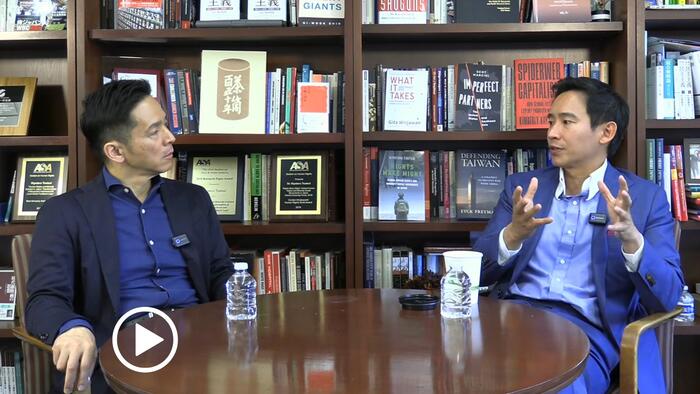
Joining APARC Director Kiyoteru Tsutsui on the latest episode of the APARC Briefing video series, Pita reflects on his journey, shares lessons in leadership and resilience, and discusses the forward-looking vision that continues to define his commitment to contribute to the conversation on Thailand’s future.
The APARC Briefing interview followed a fireside chat with Pita, Thailand at a Crossroads, hosted by APARC’s Southeast Asia Program, where he examined Thai politics and Southeast Asian regional dynamics.
A pathway to power is always there as long as you still have that fire in you and people give you the mandate.
Pita Limjaroenrat
The People’s Mandate
In May 2023, Pita led the Move Forward Party (MFP) to win the most seats in Thailand’s general election on a platform of progressive reform. He was poised to lead the country, but a court injunction and parliamentary maneuvering halted his path to the prime ministership. In August 2024, the Thai Constitutional Court disbanded the MFP and banned Pita from politics for ten years. He may still face a lifetime ban. Rather than retreating, however, Pita has reframed his political setback as a summons to a larger mission.
To compartmentalize, find purpose in adversity, and manage anxiety, Pita proactively maps out worst-case scenarios, he revealed. “Once I have that down on paper, I stop worrying,” he said. Having anticipated the possibility of being blocked from power, the event, when it happened, was not a personal shock but the activation of a pre-analyzed outcome. This mindset allows him to see his ban from office as a reversible obstacle in a long-term struggle, citing the comebacks of leaders like Brazil’s President Lula da Silva.
Politics is a ball that could turn either way, Pita believes. “If there's enough mandate, if there's enough calling from the people that they want me to govern and they want me to run again, whatever legal procedure that is done to me can be reversed. A pathway to power is always there as long as you still have that fire in you and people give you the mandate,” he argues.
Pita’s leadership philosophy is rooted in a life spent bridging divides. Describing himself as a “jack of all trades,” he recalled how, as a child, he moved easily between being a bookworm and taking on leadership roles in school and basketball. He traces this identity back to his upbringing, which included a middle-class childhood in Bangkok, formative years at an all-boys school in rural New Zealand, and an education and professional experiences in both the public and private sectors, with degrees earned from Harvard’s Kennedy School and MIT’s Sloan School of Management.
“That became who I am,” he stated, outlining his unique proposition to Thai voters. “Someone who understands international markets and rural areas. Someone who's middle class, who understands people who are well off and people who are struggling [...] Someone who understands both the private side and public side because he prepared himself that way.”
This dual expertise, he argued, is crucial for effective governance. He noted the fundamental difference in objectives between the two sectors. “The goal of public service is service. The goal of the private sector is profitability,” he said. “Just because you're a successful businessman doesn't make you a successful politician.”
He recounted how his political calling was ignited in the wake of the 2004 Indian Ocean tsunami, when, as a management consultant, he worked on a tourism recovery strategy for Thailand. The intellectual challenge of balancing complex public needs, like national energy security, sparked a passion that private-sector work couldn't match.
Always follow your heart, but take your brain with you.
Pita Limjaroenrat
From Campaign to Campus
Now a Senior Democracy Fellow at Harvard Kennedy School, Pita channels his experiences into mentoring a new generation of leaders. He teaches a class on running for public office in developing countries, hosts workshops, and holds “private office hours” for students committed to entering public service, helping them craft their first campaign strategies. It is a way of “turning reality into a textbook” for others.
He also remains a keen observer of global affairs, characterizing the current U.S.-China relationship as a “managed rivalry” or “competitive coexistence,” where deep distrust is checked by the understanding that a full-fledged decoupling would be “economic suicide” for both sides. He sees Southeast Asia as a central and crucial bloc of “swing states” that must leverage its position to determine its own future without being forced to choose sides in the competition between the world’s two greatest powers.
When asked for his message to young people, Pita’s advice is a blend of passion and pragmatism. “Always follow your heart, but take your brain with you,” he urged. For those with aspirations to tackle the world’s crises and pressing social challenges, he stressed the importance of pairing that fire with a concrete plan.
“It's up to you whether you find your North Star, improve your skills to have a plan to get there,” he concluded.
Pita clearly articulates what he wants: a more just and democratic Thailand. Even from outside the halls of political power, he is methodically working on his plan to get there. “I can wait for my time, and I will come back stronger, more vigorous, more capable, and more relevant.”
Read More
News
Pita Limjaroenrat Strategizes a Path Forward for Thailand
Banned from political office but unbowed, the Thai pro-democracy leader revisited Stanford to analyze the recent electoral defeat of his progressive party, weigh in on regional tensions in Southeast Asia and Thailand’s geopolitical balancing act, and consider the prospects for the country’s future and his political comeback.
Weaponized Corruption, Extreme Wealth, and Democratic Reordering: Insights from Asia
Speaking on the APARC Briefing video series, University of Chicago sociologist Kimberly Kay Hoang examines the architecture of global capital and how corruption discourse is transforming governance and political order in Asia and the United States.
Singapore-Based Investigative Journalist Shibani Mahtani Wins 2026 Shorenstein Journalism Award for Excellence in Asia-Pacific Coverage
Sponsored by Stanford University’s Shorenstein Asia-Pacific Research Center, the 25th annual Shorenstein Journalism Award honors Mahtani for her exemplary investigations into the erosion of democracy in Hong Kong and China's growing global influence.
Speaking on the latest episode of the APARC Briefing series, the Thai democracy champion opens up about his upbringing, offers insights from his newfound role in social activism, and shares why he continues to hold hope for reform in Thailand.
Applications are now open for the Fall 2026 session of the Stanford University Scholars Program for Japanese High School Students (also known as “Stanford e-Japan”). The course will run from the end of September 2026 through March 2027, with an application deadline of August 16, 2026.
Stanford e-Japan is offered by the Stanford Program on International and Cross-Cultural Education (SPICE), Stanford University. Stanford e-Japan is generously supported by the Yanai Tadashi Foundation, Tokyo, Japan.
Stanford e-Japan Fall 2026 session (September 2026 to March 2027) Application period: July 1 to August 16, 2026
All applications must be submitted at https://spicestanford.smapply.io/prog/stanford_e-japan/ via the SurveyMonkey Apply platform. Applicants and recommenders will need to create a SurveyMonkey Apply account to proceed. Students who are interested in applying to the online course are encouraged to begin their applications early.
Accepted applicants will engage in an intensive study of U.S. society and culture and U.S.–Japan relations. Leading scholars and experts from Stanford University and across the United States provide web-based lectures and engage students in live discussion sessions.
For more information about Stanford e-Japan, please visit stanfordejapan.org.
Why Stanford e-Japan Still Matters to Me after Five Years
Yuto Kimura, a 2021 Stanford e-Japan Award Winner and 2026 graduate of Waseda University, reflects on the enduring takeaways from his experience in Stanford e-Japan.
Eikei University of Hiroshima (EUH) is a liberal arts institution dedicated to fostering solutions- and impact-driven leaders who create social value in today’s world. Its goal is to cultivate practical skills for solving real-world issues through active learning, international perspectives, and interdisciplinary education. SPICE’s Social Entrepreneurship course, developed and taught by Dr. Mariko Yang-Yoshihara, is an intensive program that reflects the university’s objectives by helping students recognize and address social issues through a human-centred approach. Having taken the course twice, first as a student and later as a student assistant, I gained valuable skills, perspectives, and knowledge from both experiences.
The key learnings acquired this year placed greater emphasis on interdisciplinary exchange, sharing, and combining perspectives on social issues. The course instituted an exchange between liberal arts students at EUH and STEM students at Oslo Metropolitan University (Oslomet) in Norway. The EUH students identified human-centred social issues related to technology-based themes found within Hiroshima and shared with the Oslomet students, and the Oslomet students provided solutions or prototypes in response to these problems, with a discussion exchange that was held online toward the conclusion of the course.
I found this exchange to be very interesting and engaging, even with my role as a student assistant in this course. The difference in perspectives between liberal arts students and STEM students was quite evident during this discussion, especially through the concepts and factors emphasized in the assigned theme by both groups of students. Due to vast differences in class sizes, we, the Eikei students, were required to review multiple prototypes submitted by the Oslomet student groups. Initially, all of the prototypes provided for my group’s theme seemed similar, but my perspective significantly changed after communicating and discussing with the Oslomet student groups during the online exchange. Their overview of prototypes shared similarities from an external point of view, but their features, emphasis, and priorities were quite different. This differentiation only became evident during the interactive session through the exchange of viewpoints between students from both universities.
A cultural comparison between the two universities was also a key observation. The exchange of participants’ views on the feasibility of said prototypes within Norwegian and Japanese societies was intriguing to observe through a thorough comparison of social aspects in both countries, particularly governmental assistance, hierarchical structures, and the focus of the prototype. This further highlighted the contrasts in the same target demographics across both countries, leading to the realization that the same prototype may not have the same impact on both societies.
Another important note was the difference in priority and emphasis between the assigned theme and problem statement for the liberal arts students and the STEM students. There was a clear distinction in focus areas between the two universities. The EUH students solely prioritized the human-centred aspect of the provided theme, while the Oslomet students, on the other hand, targeted the technological aspect. It was quite intriguing to witness STEM students and liberal arts students trying to understand each other’s perspectives on the same situation.
Interestingly, rather than observing two major groups of students taking part in this course, I noticed three different groups. The first group is the Norwegian students who had never been to Japan, who viewed the problem statement based in Hiroshima from an external perspective. The second group consists of native Japanese students currently living in Hiroshima who viewed the problem statement from an internal perspective. The third group was international students (non-Japanese students studying at Eikei, including myself) who are also currently living in Hiroshima but viewed the problem statement from a pseudo internal-external perspective. All three groups had differing opinions and thought processes, which led to a significantly interactive and dynamic session. I was able to perceive the importance of having people with differing experiences and cultures participate in a discussion, as it progressively leads to a more adaptable and inclusive long-term approach towards achieving a common objective.
Additionally, my experiences in this course resonated with my own experience as the president of the international student organization club at our university. Oftentimes, while having meetings with Academic Affairs and International Affairs at our university regarding new initiatives, changes, or plans, I always aim to gather various opinions and concerns of my international peers, representing their needs and concerns as well. These concerns or opinions are quite varied, since the international student community has students who come from different regions of the world, resulting in a wide range of perspectives. When these varied concerns are addressed, it encourages developing solutions that aim at supporting a diverse community.
Chhavvi Anilkumar reflects on her experience in the course, Social Entrepreneurship | Photo courtesy of Chhavvi Anilkumar
This course has given me important insights and perspectives that I am sure will continue to shape my views in the short- as well as the long-term future. As a person interested in diversity and multiculturalism, this course’s experience considerably strengthened my understanding of how social structures and different experiences shape the perspectives of an individual. I believe this insight will assist me in interacting with a diverse range of people in a more inclusive manner, especially when creating solutions or strategies that can cater to various demographic groups.
Facilitating such interactive sessions, observing, and understanding the differences between the given prototypes reinforces more than just the value of collaborating with individuals coming from other backgrounds. Including different groups to participate in a situation or problem with their differing perspectives and skills increases the potential of having an adaptable solution idea that could further positively impact more than just the targeted audience. Hence, courses such as Social Entrepreneurship play a significant role in encouraging and fostering collaborative initiatives and approaches that lead to developing unique, adaptable, and successful solutions.
SPICE's course on Social Entrepreneurship with Eikei University of Hiroshima is one of SPICE’s local student programs in Japan.
Behind Every Action is a “Why”: A Journey of Academic and Personal Growth in Human-Centered Design
Renz Kayle Roble Arayan, an undergraduate student at Eikei University of Hiroshima, reflects on his experience in the SPICE course, Social Entrepreneurship.
As we celebrate our achievements today, I want to take a moment to thank the people who made this journey possible. To our families, spouses, and supporters who stood beside us through the highs and the lows — thank you. To the MIP program team, as well as the mentors across campus who guided us throughout our time here — thank you. To the staffers who served us food, took out the trash, and cleaned off the whiteboards — none of this would have been possible without you. And finally, to this cohort: I am so thankful for the support that we gave one another every single day. I appreciate it all more than words can say.
Fellas, we have come a long way. And while I could talk about our journey for hours, I'll spare you — and instead organize my remarks in a way that's very familiar to us all: problem identification, solutions development, and implementation. That’s right guys, I’m leaning all the way in, welcome to our final, final session of Policy Change Studio.
First up: problem identification. From the moment I walked into MIP bootcamp and looked around at this illustrious cohort, it was not hard to identify many problems. For starters — how could I possibly compete with Howie, Elena, Kylie, and Funmibi, all of whom somehow managed to look incredible no matter the weekday. Or how I would ever tell apart the two Chris's — both serving in the Army, both starting families, and both completely inseparable from one another.
And I'm sure many of you had your own questions. Nik was wondering what it would look like to lead the Stanford soccer team while managing his graduate studies. RJ, faced with Stanford’s strict housing policy, was trying to figure out how he could possibly live without his two wiener dogs by his side. Malou, ambitious as ever, had already begun her first Gordian Knot Innovation scholar and was wondering how quickly she would adapt to Stanford's research environment. And Jen was quietly waiting to see how long it would take for someone to realize her husband was attending our rival school, UC Berkeley.
As I looked around at my amazing set of classmates, one key question came to mind : who did I want to be during this chapter of my life?
Tyler Smith
MIP Class of 2026
For some of us, the challenge was navigating a career transition. for others, it was getting back into the rhythm of school — and let's just say Chonira's Economics course did not make that learning curve a gentle one.
I had some of these questions too and many others. And as I looked around at my amazing set of classmates, one key question came to mind : who did I want to be during this chapter of my life?
As our first quarter kicked into full steam, we began developing solutions quickly.
Our solution to surviving Chonira's rigorous Economics homework was to build our own little supply chain in the basement of Green Library, where finishing a problem would move you to the next table until you made it through the assignment. Conversely, we learned that to survive Alain’s class… ask Gaby. RJ discovered he could substitute the company of his wiener dogs with his cohort, and became the regular host of our after-class lunches at Arbuckle. That's really where we started to bond.
We all started to laugh more, with Funmbi's infectious laugh becoming something of a soundtrack to our class experience. We took trips to Sausalito and Napa Valley. We celebrated each other's wins, especially in athletics — whether it was Ella's incredible mountain biking treks or Yukiko finishing a 10K all the way in Japan. My title as the baby of the cohort was quickly overtaken by actual babies — Chris's — followed by Christian's, and now we have one more MIP baby on the way. We made time for each other, whether it be Ran's occasional tea gatherings, Humzah’s SF professional happy hour, or Santiago who made it his mission to include us all in the various traditions at the GSB.
Of course, it wasn't all laughs, things did get intense. McFaul dinners were always entertaining — partly for the great food, and partly because you knew the spiciest part of our political conversations would soon appear on McFaul's Substack. A heated race for International Policy Student Association President ended in a military coup, resulting in a dictatorship that lasted until approximately April 2026 — when Haolie's manifesto was finally taken down from the MIP common space. And I'm fairly certain Shin-Haeng and Elena are still debating who received the shiniest wedding ring by the end of the program.
But through all of it we grew together, and the passion and full presence of my cohort gave me an answer to my own question about who I needed to be here.
It was through Kylie, a phenomenal writer who spent her days challenging the proliferation of weapons of mass destruction, who also found her outlet by merging her love of filmmaking with nuclear activism. It was Tennyson, who balanced helping to educate he next generation of political science students with scriptwriting and dramatic arts. It was Malou — learning two languages, and serving as an awarded resident advisor — who still found time to take salsa classes, which, for the record, she did not need. It was Shin-Haeng, the diplomat who could tell you everything about everyone in this cohort, who almost never missed a class unless it was to slip out for golf lessons.
It was Sophia, who by guiding her capstone team through Ukraine, letting the resilience and spirit of her people speak for itself all while exploring local municipal bond financing. It was Amit, whose studies in economics gave us a lifeline in our first quarter, also showing no mercy to his classmates on the pickleball court. And it was Humzah — a natural convener— hosting events that bridged our program with the School of Business, a task that made sense for him because that man could sell you on anything.
After graduation, Tyler Smith will travel to Nairobi, Kenya, to work with a local company on a digital infrastructure project through the Stanford SEED Program. | Meghan Moura
Through these examples and many others, people brought their full selves to the table. And what that taught me was that no matter who I wanted to become or where I wanted to go, I didn't have to lose myself in the process. It inspired me to think differently, to take the less obvious path, to lean into the unfamiliar.
And now, as we approach the end of our program, we can see how far that openness has taken us.
In classic Stanford fashion, the curious and endearing Cosima channeled her love of geopolitics and public service into founding a startup. Luke is now a Second Lieutenant — a remarkable achievement that is only slightly overshadowed by completing the Bay to Breakers 12K two years in a row. We have colleagues who have published research, attended conferences, and made a real impact, and folks like Funmibi who can do all of that and still find the time to immediately post it on social media.
And last but not least, our community has only grown — from dual-degree students like Ashraf whose summer highlight included working with investment bankers, to the meet-cutes and the marriages of Humzah, Khalifa, Shin-Haeng, and Elena, whose partners have become honorary members of our graduating class.
And so, we arrive at the final phase: implementation.
These two years have not been all sunshine and rainbows. Uncertainties around visa situations continue to affect some of us even as we walk across this stage. Sudden policy changes left contracts unfulfilled, causing real disruption to our plans and our lives. And across the world, things have not been much smoother. We have been confronted with war, genocide, even geoeconomic fragmentation.
For many of us, this may not have been the world we expected to step back into. But if there is something I want to leave with our cohort — and I promise it is the most earnest piece of advice I can offer — it's this: keep doing what you're doing.
Don’t let the weight of the world we are entering stop you from showing up as your full self. The work you do may sometimes feel thankless — but each of you are planting seeds. And the most powerful thing about this cohort is that none of the seeds we plant look the same. From the diplomat on her way to an unforeseen country in Latin America, the political activist trying out tech startup scene, and even to the Special Forces Officer who is already road-tripping to his next posting — these turns from the expected path are not distractions from your impact, they are your impact. They are what makes your contribution to this world yours and no one else's.
This may not have been the world we expected to step back into. But keep doing what you're doing. Don’t let the weight of the world we are entering stop you from showing up as your full self.
Tyler Smith
MIP Class of 2026
So, despite how uncertain things may feel, I want to ask each of you to hold onto what made you, you. Continue to bring your unique lens to every room you enter. Think differently. Ask the uncomfortable question. Take the less-traveled path. And continue to shine — not because the world will always reward you for it, but because that light is yours to give.
As I conclude my capstone presentation, I want to take a moment to thank my family and friends for supporting me every step of the way. To my mother, who sat by my side after long days of work to help teach me how to multiply, thank you for your patience and your love. To my father, who after long days as a mechanic still made sure to dress me in my Sunday best every week— thank you for your dedication and your sacrifice. To my grandmother, whose stories of Cuba first sparked my curiosity about the world beyond my own — thank you for planting that seed.
And to this cohort — for every laugh shared, every piece of advice given, every memory made — thank you.
Please join me in congratulating the Stanford MIP graduating class of 2026.
Read More
News
AI Expert Jerry Kaplan Prompts MIP Graduates to Take Action, Fix Things, and Make the World a Better Place
Kaplan, a technologist and entrepreneur, encouraged the graduates of the Ford Dorsey Master’s in International Policy Class of 2026 to move forward with action in the face of challenging times.
Stanford FSI Graduate Students Tackle Global Policy Challenges Through Hands-on Fieldwork
Students in the Ford Dorsey Master's in International Policy program traveled across the globe to work on policy projects addressing AI safety, climate change, public trust in local government, and more.
Nik White ('26) is a student in the Ford Dorsey Master's in International Policy (MIP) specializing in Cyber Policy and Security. Before coming to Stanford, Nik captained the soccer team at Harvard University where he earned his bachelor's degree in psychology. He is originally from Port Moody, British Columbia, Canada.
Tyler Smith encouraged his fellow graduates from the Ford Dorsey Master's in International Policy to approach their futures in true Stanford style: by identifying problems, developing solutions, and implementing a course of action forward.
Introduction to Issues in International Security is a collaboration between the Center for International Security and Cooperation (CISAC) and the Stanford Program on International and Cross-Cultural Education (SPICE). Five CISAC scholars are featured in accessible video lectures that aim to introduce high school students to issues in international security and increase awareness of career opportunities available in the field. These scholars are Dr. Kevin Bustamante, Professor Martha Crenshaw, the Honorable Rose Gottemoeller, Professor Norman Naimark, and Dr. Megan Palmer. Free discussion guides, developed by Irene Bryant and Greg Francis of SPICE, are available for each of the lectures in this series.
For the fifth year since 2022, Dr. Ignacio Ornelas Rodriguez introduced the lectures and lessons in the discussion guides to high school students. This year the students were from Los Gatos, San Jose, Salinas, and Watsonville. The course culminated in a symposium on May 21, 2026 that was organized by Sabrina Ishimatsu. Three student groups had the opportunity to present their research projects to CISAC scholars, Dr. Harold Trinkunas, Dr. Kevin Bustamante, and Dr. Xunchao Zhang.
The students’ research projects focused on the following topics:
What is Race?
Biosecurity
Analyzing Terrorist Incidents and Terrorism and Counterterrorism
The scholars provided extremely useful feedback on the students’ research projects and asked thought-provoking questions. Students from the 2022, 2023, 2024, and 2025 cohorts have commented on how the course taught by Ornelas Rodriguez and the feedback and questions from the CISAC scholars have helped them not only gain knowledge about international security but also to prepare for college.
During this year’s symposium, the students were also very fortunate to listen to words of encouragement from Harvard undergraduate Alexandra Arguello and Stanford undergraduate Brianna Jimenez, 2022 and 2025 alumni, respectively, of the course taught by Ornelas Rodriguez. They also offered the following reflections for this article:
Dr. Ornelas’s class helped prepare me for Harvard by giving me an early foundation in international security, global affairs, and the kind of critical analysis that college-level academia demands. The course taught me to engage complex issues with intellectual curiosity, connect global events to lived experiences, and ask stronger research questions. At Harvard, that preparation allowed me to approach courses in international law, comparative politics, global education, and Latin American studies with greater confidence and purpose. In many ways, the class was my first serious introduction to the academic interests that continue to shape my studies and my goal of becoming an attorney working with international populations.—Alexandra Arguello
Dr. Ornelas’s class prepared me as a first-generation student for the academic rigor and fast-paced environment at Stanford by giving me the opportunity to learn about complex topics, develop potential solutions, and explore research-based questions. Through this experience, I gained fundamental skills and knowledge that continues to help me succeed both academically and personally. As a future physician, this class provided me with critical insight on how international security impacts health, access, and care. The class has greatly impacted my journey at Stanford, and my purpose as I pursue higher education.—Brianna Jimenez
Ornelas Rodriguez closed the symposium by extending his praise for the 2026 cohort which exceeded his expectations and commended them for adding his class to their already busy academic lives.
Local High School Students Connect with CISAC Security Experts—the Honorable Rose Gottemoeller, Professor Norman Naimark, Dr. Harold Trinkunas, and Visiting Research Scholar Xunchao Zhang—and former Secretary of Defense Leon Panetta
Students from San Jose and Salinas Valley—taught by Dr. Ignacio Ornelas Rodriguez—met on May 22, 2025 for the fourth annual International Security Symposium.
Top row, left to right: Ignacio Ornelas Rodriguez, Gary Mukai, Harold Trinkunas, Xunchao Zhang; second row, left to right: Kevin Bustamante, Sabrina Ishimatsu, Irene Bryant, Alexandra Arguello; third row, left to right: Brianna Aaliyah Jimenez, Ethan Zheng, Anna Espinoza-Vargas, Christopher Delgado Rodriguez; fourth row, left to right: Clara Cohen, Giselle Mercado, Yitzel Moreno Santos, Valeria Gonzalez, Emma Estrada, Ty Settle
All News button
1
Subtitle
Students from Los Gatos, San Jose, Salinas, and Watsonville—taught by Dr. Ignacio Ornelas Rodriguez—met on May 21, 2026 for the fifth annual International Security Symposium.
The Center on Democracy, Development and the Rule of Law proudly congratulates its 2026 graduating class of honors students on their outstanding original research conducted under CDDRL's Fisher Family Honors Program. Among those graduating are Marco Widodo, a political science major and coterminal M.A. candidate in International Policy, who has won a Firestone Medal for his research on the voter responses to democratic backsliding in Indonesia, and Shayla Fitzsimmons-Call, an International Relations major, who is the winner of the CDDRL Outstanding Thesis Award for her research on how autocrats respond to electoral defeat.
Marco Widodo presents his award-winning thesis in a CDDRL research seminar on June 4, 2026. | Nora Sulots
The Firestone Medal for Excellence in Undergraduate Research recognizes Stanford's top 10% of honors theses in the social sciences, science, and engineering among graduating seniors. Marco’s thesis is entitled, “When Democracy Counts: Testing the Demand-Side Micrologics of Backsliding with Evidence from Indonesia.” It poses the question, do Indonesian citizens fail to punish democratic backsliding at the ballot box? Over more than a decade of democratic decline, Indonesian voters have shown remarkably little alarm, continuing to reward leaders associated with democratic erosion while professing support for democracy. This thesis investigates the demand-side foundations of that puzzle, probing whether the content of democracy might itself be the problem. To pinpoint precisely where and how the accountability chain breaks down, Marco fielded an original nationally-representative survey experiment in February 2026 with Indikator Politik Indonesia (N = 1,566), randomly assigning Indonesian respondents to one of three definitions of democracy — electoral, liberal, or substantive — and tracking their responses across four hypothetical scenarios. To measure treatment comprehension and experimental manipulation, he scored open-ended responses using a novel multi-model LLM coding ensemble. Combined, this empirical design enabled him to discriminate between two candidate diagnoses of conceptual failure: that Indonesian citizens hold conceptions of democracy that simply diverge from those of scholars (the divergent conceptions argument), or that “democracy” itself carries too little evaluative content to differentiate governance failures of different kinds (the thinness argument). Ultimately, the evidence points overwhelmingly in support of the latter interpretation — that for many Indonesian citizens, “democracy” functions less as a thick descriptive concept than as a thin term of approval whose application tracks perceived governance quality. The divergent conceptions hypothesis, meanwhile, yields a robust null across thirteen specifications. In this era of backsliding, the conceptual thinning of “democracy” carries severe implications for the validity of cross-comparative survey research, for the elite strategies that exploit the term’s elasticity, and for the resilience of democracy in Indonesia and beyond.
Shayla Fitzsimmons-Call presents her award-winning thesis in a CDDRL research seminar on June 4, 2026. | Nora Sulots
Shayla’s thesis is entitled “Bound by the Ballot? Autocratic Compliance After Electoral Defeat.” When autocrats lose elections, what determines whether they comply with the electorate's judgment? And if they resist, what determines whether they succeed? Despite the frequency and consequences of autocratic electoral crises, electoral compliance decisions remain undertheorized. To address this gap, Shayla proposes a two-stage theory of incumbent compliance. At Stage 1, pre-election structural conditions — military control, elite unity, and international vulnerability — determine whether resistance is viable. At Stage 2, activated only if resistance occurs, two reactive forces — mass mobilization and activated international pressure — become salient. Drawing on an original dataset of elections held in autocratic regimes between 1970 and 2018, the results partially support and partially challenge this theory. While structural weakness reliably precludes resistance, structural strength does not reliably cause it; among cases where resistance occurs, high, cohesive international pressure emerges as the most consistent determinant of whether incumbents ultimately exit. This thesis posits that compliance is best understood as a process shaped by forces operating at different moments, and that this temporal distinction has both implications for how scholars and international actors understand and respond to electoral crises in electoral autocracies.
Honoring a Legacy of Community Building
Zoe Savellos, a Stanford graduate and member of CDDRL’s Fisher Family Honors Class of 2018, passed away in 2025 at the age of 29. She is remembered by those who knew her as brilliant, generous, and deeply committed to others. To honor her memory and the spirit she brought to the CDDRL community, the center has established the Zoe Savellos Memorial Award for Community Building.
“Zoe’s palpable passion for her thesis research and to make a genuine difference in the world inspired a sense of optimism and confidence in our CDDRL cohort to dream bigger and push through when we didn’t think we could,” shared her friend and classmate Kelsey Page ‘18. “As I struggled toward the thesis deadline, Zoe not only helped me with last-minute formatting questions long after she had completed her own thesis, but also brought me a blazer for my presentation when I forgot one. Zoe enthusiastically counting down the minutes to the completion of my thesis so we could celebrate together is just one example of how she placed shared joy over individual accomplishment — she was everyone's biggest cheerleader.”
Left: Marin Callaway, Zoe Savellos, and Steve Stedman at CDDRL's 2018 Honors Luncheon. Right: Zoya Fasihuddin | Images courtesy of Steve Stedman and Zoya Fasihuddin
Presented annually within CDDRL’s Fisher Family Honors Program, the award will recognize a student selected by their peers for their meaningful contributions to the strength of the honors cohort. The class of 2026 has selected Zoya Fasihuddin, an Economics major also studying Human Rights, as the first recipient of this award.
“I'm so honored, and this is entirely a reflection of the cohort we all got to be a part of, as well as Steve and María’s leadership,” shared Zoya. “While I didn't have the privilege of knowing Zoe, everything that’s been shared about her in terms of her warmth and empathy is exactly the kind of person I aspire to be.”
The cohort experience is central to the Honors Program. Students engage deeply with one another’s work and navigate the challenges of independent research together. The Zoe Savellos Memorial Award for Community Building recognizes the important role students play in shaping that experience and honors the individual whose support, enthusiasm, and community-building spirit help create a more connected and meaningful collective experience.
The Class of 2026
Marco, Shayla, and Zoya are part of a cohort of 12 graduating CDDRL honors students who have spent the past year working in consultation with CDDRL-affiliated faculty members and attending honors research workshops to develop their thesis projects. The theses this year covered topics as wide-ranging as democratic resilience and authoritarian elections, feminist mobilization in Pakistan, Indigenous reunification and identity in Oklahoma, net neutrality and regulatory politics, economic protectionism, collective memory in Spain, and the role of retired military leaders in American elections.
"We could not be prouder of this cohort of seniors in the Fisher Family Honors Program and the theses they produced," shared María Ignacia Curiel, a Research Scholar at CDDRL who co-teaches the Honors Program alongside Stephen Stedman. "Born from a year of scholarly perseverance and camaraderie, these projects genuinely advance our understanding of democracy, development, and the rule of law around the world."
In addition to the Firestone Medal, CDDRL Outstanding Thesis Award, and the Zoe Savellos Memorial Award for Community Building, members of the Class of 2026 have received several other honors heading into graduation:
Anagali Duncan received the 2026 Lloyd W. Dinkelspiel Award, which recognizes distinctive contributions to undergraduate education and the quality of student life.
Emma Wang and Marco Widodo are among the newest members elected to the Phi Beta Kappa academic honors society.
Anagali Duncan, Dani Gonzalez-Gaubecka, Emma Wang, Lila Batcheller, Lorraine Cioffi, and Rachel Owens have all received the Award of Excellence. Designed to recognize the top 10% of the class, this award honors graduating seniors who have demonstrated a sincere commitment to the university through involvement, leadership, and extraordinary Stanford spirit.
CDDRL's Fisher Family Honors Program trains students from any academic department at Stanford to write a policy-relevant research thesis with global impact on a subject related to democracy, development, and the rule of law. Honors students participate in research methods workshops, attend Honors College in Washington, D.C., connect to the CDDRL research community, and write their thesis in close consultation with a faculty advisor to graduate with a certificate of honors in democracy, development, and the rule of law.
Explore the rest of the thesis topics of the Fisher Family Honors Program Class of 2026 below:
Anagali Duncan
Nora Sulots
Ben Kinder
Nora Sulots
Dani González-Gaubeka
Nora Sulots
Emma Wang
Nora Sulots
Garry Piepenbrock
Nora Sulots
Lila Batcheller
Nora Sulots
Lorraine Cioffi
Nora Sulots
Rachel Owens
Nora Sulots
Sakshi Umrotkar
Nora Sulots
Zoya Fasihuddin
Nora Sulots
Anagali Duncan
Flames of Unity; Diverging Sovereignties
Photo by:
Nora Sulots
Ben Kinder
Partisan Asymmetry in Strategic Discrimination
Photo by:
Nora Sulots
Dani González-Gaubeka
A Pact to Forget and the Fight to Remember: The Shifting Landscape of Democratic Memory Politics in Spain
Photo by:
Nora Sulots
Emma Wang
The Fourth Branch Under Pressure: Net Neutrality and the Politics of Independent Regulation
Photo by:
Nora Sulots
Garry Piepenbrock
Toward a Theory of the Evolution of the Global Political Economy: Exploring the Effect of Varieties of Capitalism on Democracy and Sustainability
Photo by:
Nora Sulots
Lila Batcheller
The Endorsement Wars: Retired Flag Officers in American Elections
Photo by:
Nora Sulots
Lorraine Cioffi
Harki Identity Evolution after Algerian Independence: Political Speech and Media Perspectives in France
Photo by:
Nora Sulots
Rachel Owens
Running the Authoritarian Gauntlet: Opposition Victory in Venezuela’s 2024 Election
Photo by:
Nora Sulots
Sakshi Umrotkar
Charting Pathways to Economic Protectionism: How Income Constrains Access to Protectionism
Photo by:
Nora Sulots
Zoya Fasihuddin
Presence, Protest, and Public Space: The Strategic Evolution of Feminist Mobilization in Pakistan
Photo by:
Nora Sulots
Read More
News
Announcing the 2026 Cuthbertson, Dinkelspiel, and Gores award winners
CDDRL graduating senior Anagali Duncan, 2026 Dinkelspiel Award winner, is among ten members of the campus community recognized for excellence in teaching, service, and academics.
Marco Widodo receives a Firestone Medal, Shayla Fitzsimmons-Call wins CDDRL's Outstanding Thesis Award, and Zoya Fasihuddin is named the inaugural recipient of the Zoe Savellos Memorial Award for Community Building.
Date Label
In Brief
Marco Widodo received a 2026 Firestone Medal for his thesis on why voters often fail to punish democratic backsliding, drawing on original survey research in Indonesia.
Shayla Fitzsimmons-Call earned CDDRL’s Outstanding Thesis Award for her research on how autocrats respond to electoral defeat and the conditions that shape electoral compliance.
CDDRL established the Zoe Savellos Memorial Award for Community Building, honoring the late alumna’s legacy; the inaugural award was presented to Zoya Fasihuddin, selected by her peers for strengthening the honors cohort.
The Fisher Family Honors Program Class of 2026 produced original research on topics ranging from democratic resilience and authoritarian elections to feminist mobilization in Pakistan, Indigenous reunification in Oklahoma, net neutrality, economic protectionism, and collective memory in Spain.
This year marks the 10th anniversary of the Stanford e-Tottori Program, a milestone that provides an opportunity to reflect on a decade of learning, cross-cultural exchange, and partnership between Stanford University and Tottori Prefecture.
Launched in 2016, Stanford e-Tottori was the first regional program in Japan developed by SPICE. The program was created through a partnership between SPICE and the Tottori Prefectural Board of Education with the goal of helping high school students in Tottori engage in global issues, deepen their understanding of the United States and U.S.–Japan relations, and strengthen their English communication skills.
When the program began, none of us could have imagined that it would still be thriving 10 years later. Over the past decade, approximately 250 students from across Tottori Prefecture have participated in the program. Through weekly assignments, online discussions, virtual classroom sessions, guest lectures, and independent research projects, students have explored topics ranging from education and entrepreneurship to sustainability, diversity, leadership, and U.S.–Japan relations.
Having taught every cohort since the program’s founding, I have had the privilege of working with an extraordinary group of students. Each year, I am impressed by their curiosity, thoughtfulness, and willingness to engage with complex issues. Although students enter the program with varying levels of English proficiency and different academic interests, they consistently demonstrate a desire to learn, challenge themselves, and better understand perspectives beyond their own.
One of the defining features of the program has been the students’ final research projects. At the end of each course, students select a topic of personal interest, conduct independent research, and present their findings in English. Over the years, they have investigated subjects as diverse as artificial intelligence, environmental sustainability, education systems, cultural identity, social welfare, entrepreneurship, history, and international relations. These presentations have provided students with opportunities not only to strengthen their research and communication skills but also to share their passions and interests with others.
The success of Stanford e-Tottori also helped to lay the foundation for SPICE’s broader expansion of regional programs throughout Japan. What began as SPICE’s first regional program has grown into a network of educational partnerships that now serve students in prefectures and cities across the country. Today, SPICE offers regional programs in Fukuoka, Hiroshima, Oita, Tottori, and Yamaguchi prefectures, as well as in the cities of Kagoshima, Kawasaki, and Kobe.
Education is ultimately about people, and one of the greatest rewards of teaching Stanford e-Tottori has been the opportunity to learn from and work with so many talented students, teachers, and colleagues in both Japan and the United States.
One of the greatest joys of the program has been seeing students experience California and Stanford University firsthand. Each year, two top-performing students are invited to Stanford as honorees in recognition of their outstanding achievement in the course. During their visits, students participate in award ceremonies, tour the Stanford campus, meet Stanford faculty and staff, and connect with fellow students from other SPICE regional programs.
These visits have also provided opportunities for students to glimpse into American high school life firsthand. Over the years, I have had the pleasure of accompanying students to local schools, where they have attended classes and met with American students. I am especially grateful to local educators, including Yoko Sase of The Nueva School in Hillsborough and Matt Hall of Gunn High School in Palo Alto, who have generously welcomed our students into their classrooms and school communities.
The Stanford e-Tottori Program would not exist without the vision, dedication, and support of many individuals and organizations. I am especially grateful to Takeshi Homma, whose passion for education, entrepreneurship, and international exchange helped inspire the creation of the program 10 years ago. Since its inception, Homma-san has remained a steadfast supporter, generously sharing his experiences and insights with students through annual guest lectures on entrepreneurship, innovation, and global citizenship.
I would also like to express my sincere appreciation to Governor Shinji Hirai for his longstanding commitment to international education and global engagement. His support of educational exchange between Tottori and Stanford has helped create opportunities for hundreds of students to broaden their horizons and develop a deeper understanding of the United States and U.S.–Japan relations.
I am deeply grateful to the Tottori Prefectural Board of Education for its partnership and commitment to providing meaningful international educational opportunities for students. Over the years, I have had the pleasure of working with many dedicated educators and teacher consultants whose efforts have been essential to the program’s success, including Koji Tsubaki, Takuya Fukushima, Tomoya Minohara, Shuichi Hata, Natsu Odahara, and Satoru Hamahashi. Their enthusiasm, professionalism, and unwavering support have helped make the Stanford e-Tottori Program a rewarding experience for students throughout Tottori Prefecture.
As I reflect on the past 10 years, what stands out most are not the individual lessons, assignments, or presentations, but the relationships that have developed through the program. Education is ultimately about people, and one of the greatest rewards of teaching Stanford e-Tottori has been the opportunity to learn from and work with so many talented students, teachers, and colleagues in both Japan and the United States.
As Stanford e-Tottori enters its second decade, I am excited to see what the future holds. I look forward to continuing to learn alongside future generations of students and to strengthening the bonds of friendship and understanding that have connected Stanford and Tottori over the past 10 years.
Congratulations to all of the students, educators, and partners who have been part of the Stanford e-Tottori story. Thank you for making the past 10 years such a remarkable journey.
This article was written by Dr. Larry Becker, Africa Project Coordinator at SPICE, 1982–1985, and Professor Emeritus of Geography at Oregon State University in Corvallis. This is the fourth of several articles—focusing on the 50-year history of SPICE—that will be posted this year. In its early years, SPICE comprised several separate area-focused projects.
Happy 50th birthday to SPICE! Those 50 years are a testament to the enduring value of the program and its ability to change with the times.
While enrolled in the Stanford Teacher Education Program (STEP) in 1982, I took David Grossman’s Global Education course and learned about the work of SPICE. It felt like a comfortable fit and welcome program following my upbringing in the integrated Berkeley public schools and undergraduate degree in geography. After the course, David approached me about the SPICE Africa Project Coordinator position. The coordinator at the time, Nebby Crawford, was leaving. Two years earlier, I had spent a summer in Mali with Operation Crossroads Africa. I gave a presentation at the Bay Area Global Education Program (BAGEP) Africa Summer Institute for teachers, plunging into the SPICE world of in-service teacher education at age 23.
Over the next three years, I had the privilege of working with the SPICE team, Stanford African Studies faculty and students, Bay Area K–12 teachers, and a network of African Studies outreach coordinators around the country. At the time, the Africa Project Coordinator position was partly funded by the Title VI Joint Center for African Studies at Stanford and U.C. Berkeley. I thus was exposed to rich academic African Studies educational resources while representing SPICE at annual conferences. I also established working relationships with members of the Stanford African Students Association. Graduate students from various countries contributed to the Summer Institute on Africa, visited precollegiate classrooms, and reviewed supplementary curriculum SPICE units that we developed with K–12 teachers.
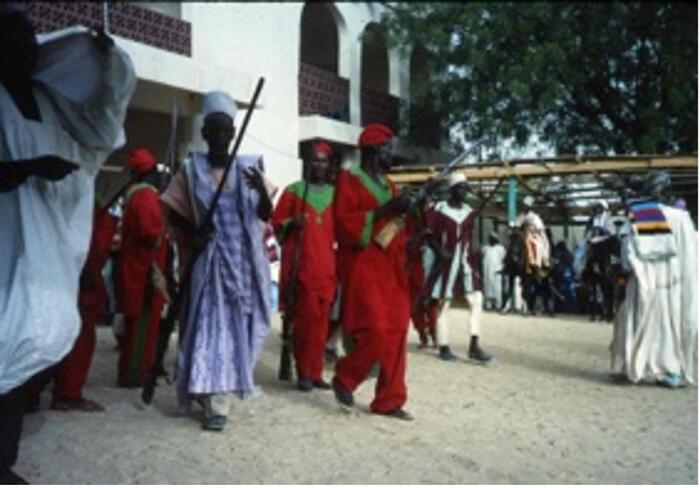
In the summer of 1984, I co-led a U.S. Department of Education-funded summer education trip for teachers to Nigeria. Together with co-leader, Dr. Faye McNair-Knox—with a background in Hausa linguistics and community organizing in East Palo Alto—we navigated a country recently under military rule with an overvalued currency on a limited budget. As the group travelled from a festival in the Gumel Emirate near the Niger border south to the metropolis of Lagos on the Gulf of Guinea, we stayed at university campuses where Bay Area teachers were exposed to Nigeria’s rich culture through professors from a variety of fields, local leaders, and artists. (Photo below of the Emir of Gumel’s entourage at the end of Ramadan, June 1984, in what is now Jigawa State, Nigeria, as seen during a summer education trip for teachers; courtesy of Larry Becker.)
Image
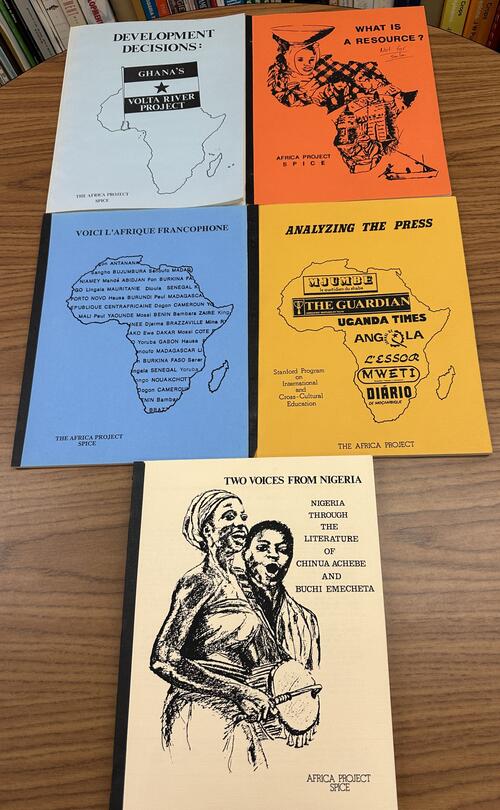
By the time I left SPICE, the Africa Project had five curriculum units: Analyzing the Press (1985), Development Decisions: Ghana’s Volta River Project (1985), What Is a Resource? (1985), Two Voices from Nigeria: Nigeria through the Literature of Chinua Achebe and Buchi Emecheta by Nigeria trip participants Lyn Reese and Rick Clarke (1985), and Voici l’Afrique Francophone with Foster City French teacher Joan Henley (1986).
Image
Enriched by the work at SPICE, I completed a PhD in geography with research on agrarian change in Mali at the University of London’s School of Oriental and African Studies (SOAS) and a postdoc at the Africa Rice Center in Cote d’Ivoire. I had a university career teaching geography, notably large enrollment world regional geography courses, that greatly benefited from what I learned while at SPICE.
Over the years of teaching about Africa in the U.S., I saw how attention to the context, identity, and positionality of the instructor and students contributes to successful classroom strategies and curriculum development. My SPICE experience provided a base for understanding this evolving pedagogy. In touch with SPICE colleagues years later, former colleague Steve Thorpe contributed to a seminar series that I led at Oregon State University aimed at globalizing courses throughout the campus. The ideas of SPICE carry on in familiar ways in new teaching settings!
Laurie Yokoyama Becker, Larry Becker, and SPICE Founding Director David Grossman in Kaneohe, Hawaii, in May 2026. | Photo courtesy of Larry Becker
All News button
1
Subtitle
Professor Emeritus Larry Becker reflects on the early years of SPICE’s Africa Project and how his experience with SPICE enriched and informed his academic journey and teaching practice.
In rural China, there is an urgent need for investment and innovative approaches for addressing adolescent mental health issues. This embedded mixed-methods study examines the effectiveness of a social-emotional learning (SEL) program in rural primary schools across China and the factors affecting compliance among teachers delivering the program. Pre- and post-intervention surveys assessed its effect on 2027 students in 49 schools, and 38 teachers were interviewed during the intervention. Results show that SEL courses improved student mental health. Some teachers reported increased workload and lack of support, while others noted the importance of mental health education and positive student outcomes. Performance incentives and the positive perceptions of SEL among teachers were crucial for effective delivery, though workload and lack of support often limited commitment. Overall, enhancing rural students' well-being through SEL programs requires raising awareness for SEL among teachers and building institutional support.