Economic Affairs
News Type
Blogs
Date
Paragraphs

BY SCOTT ROZELLE, HEATHER RAHIMI, HUAN WANG AND EVE DILL

COVID-19 lockdowns have major impacts on migrant workers and supply chains that depend on them. Scott Rozelle and his team find that the lockdowns in China were successful in protecting rural areas from COVID infections, but that the cost was severe: Poor rural households cut down on education, nutrition, and health expenditures and lost around $100 billion in migrant worker wages.—Johan Swinnen, series co-editor and IFPRI Director General.

Read the full blog post here to learn about REAP's village-level survey of the impact of COVID-19 control measures on rural China. 

Hero Image
reap 2013 woman in rural home Jonathan Willis
All News button
1
Paragraphs

The U.S. dollar exchange rate clears the global market for dollar-denominated safe assets. We find that shifts in the demand and supply of safe dollar assets are important drivers of variation in the dollar exchange rate, bond yields, and other global financial variables. An increase in the convenience yield that foreign investors derive from holding safe dollar assets causes the dollar to appreciate, and incentivizes foreign debtors to tilt their issuance towards dollar-denominated instruments. U.S. monetary policy also affects the dollar exchange rate through its impact on the supply of safe dollar assets and the convenience yield. Interest rate spreads with foreign countries are not sufficient statistics to gauge the impact of the stance of U.S. monetary policy on currency markets. The U.S. Treasury basis, which measures the yield on an actual U.S. Treasury minus the yield on an equivalent synthetic U.S. Treasury constructed from a foreign bond, provides a direct measure of the global scarcity of dollar safe assets.

All Publications button
1
Publication Type
Journal Articles
Publication Date
Journal Publisher
SSRN
Authors
Arvind Krishnamurthy
Paragraphs

Systemic risk arises when shocks lead to states where a disruption in financial intermediation adversely affects the economy and feeds back into further disrupting financial intermediation. We present a macroeconomic model with a financial intermediary sector subject to an equity capital constraint. The novel aspect of our analysis is that the model produces a stochastic steady state distribution for the economy, in which only some of the states correspond to systemic risk states. The model allows us to examine the transition from "normal" states to systemic risk states. We calibrate our model and use it to match the systemic risk apparent during the 2007/2008 financial crisis. We also use the model to compute the conditional probabilities of arriving at a systemic risk state, such as 2007/2008. Finally, we show how the model can be used to conduct a macroeconomic "stress test" linking a stress scenario to the probability of systemic risk states.

All Publications button
1
Publication Date
Journal Publisher
American Economic Association
Authors
Arvind Krishnamurthy
Number
11:4
Paragraphs

Time preferences may explain public opinion about a wide range of long-term policy problems whose costs and benefits will be realized in the distant future. However, mass publics may discount these costs and benefits because they are later or because they are more uncertain. Standard methods to elicit individual-level time preferences tend to conflate attitudes toward risk and time and are susceptible to social desirability bias. A potential solution relies on a costly lab-experimental method, convex time budgets (CTB). We present and experimentally validate an affordable version of this approach for implementation in mass surveys. We find that the theoretically preferred CTB patience measure predicts attitudes toward a local, delayed investment problem but fails to predict support for more complex, future-oriented policies. These results have implications for studying the mass politics of dynamic policy problems.

All Publications button
1
Publication Type
Journal Articles
Publication Date
Journal Publisher
SSRN
Authors
Paragraphs

Many international policy problems, including climate change, have been characterized as global public goods. We adopt this theoretical framework to identify the baseline determinants of individual opinion about climate policy. The model implies that support for climate action will be increasing in future benefits, their timing, and the probability that a given country's contribution will make a difference while decreasing in expected costs. Utilizing original surveys in France, Germany, the United Kingdom, and the United States, we provide evidence that expected benefits, costs, and the probability of successful provision as measured by the contribution of other nations are critical for explaining support for climate action. Notably, we find no evidence that the temporality of benefits shapes support for climate action. These results indicate that climate change may be better understood as a static rather than a dynamic public goods problem and suggest strategies for designing policies that facilitate climate cooperation.

All Publications button
1
Publication Type
Journal Articles
Publication Date
Journal Publisher
SSRN
Authors
Authors
Callista Wells
News Type
News
Date
Paragraphs

The Stanford Center at Peking University (SCPKU), the Center on Democracy, Development and the Rule of Law (CDDRL), and the APARC China Program jointly hosted a workshop on China’s Belt and Road Initiative (BRI) in early March. The workshop, held on March 2 and 3, welcomed researchers from around the world with expertise in the Initiative. Unfortunately, because of the rapidly developing health emergency related to the coronavirus, participants from not only China, but also Japan, were prevented from attending. As described by Professor Jean Oi, founding director of SCPKU and the China Program, and Professor Francis Fukuyama, director of CDDRL and the Ford Dorsey Master's in International Policy, who co-chaired the workshop, the meeting aimed to provide a global perspective on the BRI, consolidate knowledge on this opaque topic, and determine the best method and resources for future research.  

The workshop began with presentations from several of the invited guests. Dr. Atif Ansar from the University of Oxford’s Saïd Business School kicked off the first day by describing not only the tremendous opportunity that the BRI presents to developing economies, but also the serious pitfalls that often accompany colossal infrastructure projects. Pointing out the poor returns on investment of mega infrastructure projects, Ansar examined the frequest cost and schedule overruns, random disasters, and environmental degradation that outweigh the minimal benefits that they generally yield. China’s own track record from domestic infrastructure projects does little to mitigate fear of these risks, Ansar claimed. In response, he urged professional management of BRI investments, institutional reforms, and intensified deployment of technology in BRI projects. Dr. Ansar was followed by Dr. Xue Gong of the S. Rajaratnam School of International Studies, Nanyang Technological University, Singapore. Dr. Gong’s analysis centered on the extent to which China’s geopolitical motivations influenced its outward foreign direct investments (OFDI). Although her research was still in the early stages, her empirical analysis of China’s OFDI inflows into fifty BRI recipient countries from 2007-2018 nevertheless revealed that geopolitical factors often outweigh economic factors when it comes to China’s OFDI destinations.

Image
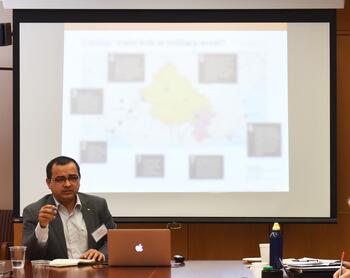
Amit Bhandari of Gateway House: Indian Council on Global Relations presents his research at the Belt and Road Workshop.
Participants then heard presentations from Amit Bhandari of Gateway House: Indian Council on Global Relations and Professor Cheng-Chwee Kuik of the National University of Malaysia. Mr. Bhandari’s talk focused on Chinese investments in India’s six neighboring countries, which tend to center more on energy rather than connectivity projects. He first found that the investments are generally not economical for the host countries because they come with high costs and high interest rates. Secondly, he argued that these projects often lacked a clear economic rationale, appearing instead to embed a geopolitical logic not always friendly to India. Professor Kuik, by contrast, provided a counterexample in his analysis of BRI projects in Southeast Asia. He described how, in Southeast Asia, host countries’ reception of the BRI has varied substantially; and how various stakeholders, including states, sub-states and other entities, have used their leverage to shape outcomes more or less favorable to themselves. Kuik’s analysis injected complexity into the often black-and-white characterizations of the BRI. He highlighted the multidimensional dynamics that play out among local and state-level players in pursuit of their goals, and in the process of BRI implementation.

Professor Curtis J. Milhaupt and Scholar-in-Residence Jeffrey Ball, both at Stanford Law School, followed with individual presentations on the role of State-Owned Enterprises (SOEs) in the BRI and the emissions impact of the BRI on climate change, respectively. Professor Milhaupt  characterized Chinese SOEs as both geopolitical and commercial actors, simultaneously charged with implementing Party policies and attaining corporate profits. Chinese SOEs are major undertakers of significant overseas BRI projects, acting not only as builders but also as investors, partners, and operators. This situation, Milhaupt asserted, carries significant risks for SOEs because these megaprojects often provide dismal returns, have high default rates, and can trigger political backlash in their localities. Milhaupt highlighted the importance of gathering firm-level data on businesses actually engaged in BRI projects to better infer geostrategic, financial, or other motivations. Jeffrey Ball turned the discussion to carbon emissions from BRI projects and presented preliminary findings from his four-country case studies. He concluded that, on aggregate, the emissions impact of the BRI is still “more brown than green.” Twenty-eight percent of global carbon emissions may be accounted for by BRI projects, Ball asserted, underscoring the importance of the BRI to the future of global climate change.

The day concluded with presentations by  Michael Bennon, Managing Director at the Stanford Global Projects Center, and Professor David M. Lampton, Oksenberg-Rohlen Fellow at the Freeman Spogli Institute for International Studies. Bennon first presented findings from two empirical case studies of BRI projects and then went on to describe how the BRI is now practically the “only game in town” for infrastructure funding for developing countries. Lengthy environmental review processes at Western multilateral banks have turned the World Bank, for example, from a lending bank into a “knowledge bank,” he argued. He also highlighted that, in general, economic returns on BRI projects for China are very poor, even though recipient countries may accrue macroeconomic benefits from these projects. Finally, Professor Lampton turned the discussion back to Southeast Asia, where China is currently undertaking massive cross-border high-speed rail projects through eight ASEAN countries. He described how each host country had varying capacity to negotiate against its giant neighbor, and how the sequential implementation of these cross-border rail projects also had varying impacts on the negotiating positions of these host countries. BRI played out differently in each country, in other words, eliciting different reactions, push-backs and negotiated terms.

The second day of the workshop was dedicated to working toward a collaborative approach to future BRI research. The group discussed the key gaps in the existing research, including how to know what China’s true intentions are, how to measure those intentions, who the main players and their interests in both China and the host countries are, and even what the BRI is, exactly. Some cautioned that high-profile projects may not be representative of the whole. Participants brainstormed about existing and future sources of data, and stressed the importance of diversifying studies and seeking empirical evidence.

Hero Image
Participants in the Belt and Road Initiative Workshop at Stanford University, March 2-3, 2020.
All News button
1
Authors
Callista Wells
News Type
News
Date
Paragraphs

President Xi Jinping’s tenure has been marked by growing state influence over all spheres of governance in China, including a marked tightening of control over the economy.

Curtis Milhaupt, the William F. Baxter-Visa International Professor of Law at Stanford Law School, addressed the hardening of Party controls over Chinese corporate governance. His lecture to the China Program on February 6 was based on research conducted by Milhaupt in collaboration with Yu-Hsin Lin of City University of Hong Kong, and examined the expanding role of the Chinese Communist Party (CCP) within both state-owned enterprises (SOEs) and privately-owned enterprises (POEs). The influence of the CCP within these enterprises, Milhaupt says, is not as straightforward as it might seem.

Milhaupt posits that the level of control exercised by the CCP on SOEs is lower than one might generally expect. At the same time, the CCP exercises a surprisingly higher level of control over POEs than we would typically assume. To draw these conclusions, Milhaupt uses a set of ten model provisions deemed to be dangjian, or “party-building,” measures that were developed and released by the Central Committee of the CCP. From data compiled between 2015 and 2018 from the charters of publicly-listed companies, Milhaupt shows that 10% of SOEs chose not to adopt any of the provisions distributed by the Central Committee. Meanwhile, 6% of POEs had at least a low level of adoption, despite the fact that the provisions were not directed at them. The reason for such variation, according to Milhaupt, can be explained by the characteristics of the provisions, the SOEs, and the POEs.

Image
Photo of Curtis Milhaupt speaking
Milhaupt breaks the measures into three distinct groups: personnel-related, decision-making, and symbolic. Nearly every corporation that amended its charter adopted the symbolic provisions. As the name suggests, these generally did not require any substantial or meaningful change on the enterprises’ parts. There was a steep drop-off, however, in the level of adoption for the other two types. Only 58% of SOEs who amended their charters adopted the more intrusive, decision-making provisions. Similarly, only 52% of such SOEs adopted the personnel-related provisions. The numbers were even lower for POEs, with only 25% of POEs who amended their charters adopting the decision-making provisions, and only 16% adopting the personnel-related provisions.

Which enterprises adopted which provisions was highly correlated to those enterprises’ characteristics. SOEs were far more likely to amend their charters if they had direct state shareholding, but less likely to amend if they had large non-state shareholders, were further down in the state-ownership chain, or were cross-listed on international stock exchanges. POEs followed a similar structure, with enterprises being more likely to adopt provisions the more politically connected they were or the more direct state shareholding they had.

It remains unclear how the government can actually enforce the dangjian policy, and how these policies will affect the enterprises that adopt it. Despite the official rhetoric behind the dangjian policy, with claims that greater loyalty to the Party will lead to more economic success, Milhaupt expresses doubts:

“What’s [the danajian policy] going to mean for firm performance? Certainly, from a . . . straightforward economics or corporate governance perspective, one would not be optimistic that infiltrating corporations with political influence is going to do good things for firm performance.”

Milhaupt also has concerns about how the strategy will impact international investment, noting the already high levels of suspicion surrounding Chinese motivations: “This [emphasis on loyalty to the Party] would certainly seem to add fuel to the fire, and heighten concerns or suspicions with respect to Chinese outbound economic activity.” As SOEs and POEs continue to navigate both domestic and international markets with their amended charters, the future feasibility of the CCP’s reassertions over the economy is far from certain.

Hero Image
Pedestrians walk past a Madrid branch of the Industrial and Commercial Bank of China (ICBC), one of the largest state-owned enterprises in China.
Jasper Juinen / Getty Images News
All News button
1
Authors
Thomas Fingar
Jean C. Oi
News Type
Commentary
Date
Paragraphs

This is the second part of a series leading up to the publication of Fateful Decisions. You can read the first installment here.

In the last forty years, China has reemerged as a tremendous geopolitical, economic, and technological power on the world stage. But the easy phases of China’s quest for wealth and influence are over, argue Shorenstein APARC Fellow Thomas Fingar and China Program Director Jean Oi in a new article published by The Washington Quarterly.

In this piece, drawing on the findings and insights of contributors to their forthcoming edited volume Fateful Decisions: Choices That Will Shape China’s Future (Stanford University Press, available May 2020), Fingar and Oi outline the daunting array of difficult challenges China now faces and explain why its future depends on the policy choices its leaders make in what will be seen as a watershed moment.

An excerpt from their article is available below. For the full version, visit The Washington Quarterly and download the PDF.


From, “China’s Challenges: Now it Gets Much Harder”

Some years ago, one of us had a running partner who wanted a bigger challenge than the dozens of marathons he had completed. When asked to describe his first 50-mile race, he replied, “The first 30 miles weren’t bad, but after that it got really hard.” China is approaching the metaphorical 30-mile mark in its developmental marathon. The challenges it encountered and managed effectively during the past 40 years were not easy, but they pale in comparison to those looming on the horizon. The way ahead will be more difficult, less predictable, and highly contingent on the content and efficacy of complex policy choices. The easy phases of China’s quest for wealth and power are over.

We begin with this cautionary note because so much of the new narrative about China’s rise posits capabilities and evolutionary trajectories that we find implausible. That China has done well in the past does not assure that it will do equally well (or better) in the future. That the Leninist party-state system adopted in the 1950s has proven sufficiently agile to manage the easier phases of modernization does not assure that it will be equally adept at meeting the more difficult challenges of a country being transformed by past successes and demographic change. The number, magnitude, and complexity of these challenges do not foreordain that China will stagnate, fail, or fall apart, but they do raise serious questions about the putative inevitability of China’s continued rise and displacement of the United States. China’s future is neither inevitable nor immutable; its further evolution will be shaped by internal economic and social developments, the international system, and above all, the policy choices of party leaders facing a daunting array of difficult challenges.

[Like what you're reading? Sign up for our newsletters to receive more stories like this.] 

We refer to China’s current approach as “back to the future” because it seeks to resuscitate institutions, methods, and rationales adopted in the 1950s and shelved during the period of reform and rapid modernization. We do not know why party leaders decided that it is in their — and thus China’s — interest to curtail or reverse policies that facilitated sustained growth and rapid improvement of living standards and China’s international image, but speculate that they hope doing so will buy time before incurring the risks (and for the elite, the costs) of fundamental reform.

Beijing has announced a number of very ambitious goals such as moving into the ranks of highly-developed countries by the centenary of the PRC in 2049, achieving global preeminence in key technologies like robotics and artificial intelligence, providing urban social benefits to most citizens, and building a number of green megacities. The likelihood of achieving all of the proclaimed goals is nil, but China will make substantial progress on some of them. It is impossible to predict which will succeed, which will fail, and which will flounder, but we can anticipate a mix of all three outcomes. Whatever the precise mix, it is likely to produce a China that is less prosperous and less powerful than predicted by the predominant narrative about where China is headed. Whether China’s leaders will risk tackling the difficult reforms that remain or continue to embrace key and thus far counterproductive structures and methods from the past remains to be seen.  Whether the party-state system is able to maintain acceptable levels of growth and public satisfaction under the new conditions is also uncertain. The only certainty is that China can no longer ride the wave that helped along its economic growth and resultant capabilities for at least ten reasons.

Read the full text of this article via The Washington Quarterly.

Hero Image
Quote from Thomas Fingar and Jean Oi from, "China's Challeges: Now It Gets Much Harder"
All News button
1
-

Many observers, and many investors, believe that young people are especially likely to produce the most successful new firms. Integrating administrative data on​ firms, workers, and owners, we study startups systematically in the U.S. and find​ that successfull entrepreneurs are middle-aged, not young. The mean age at​ founding for the 1-in-1,000 fastest growing new ventures is 45.0. The findings are​ similar when considering high-technology sectors, entrepreneurial hubs, and​ successful firm exits. Prior experience in the specific industry predicts much greater​ rates of entrepreneurial success. These findings strongly reject common hypotheses​ that emphasize youth as a key trait of successful entrepreneurs.

Speaker:

Image
dsc 0355 javier miranda

Javier Miranda, Principal Economist, Economy-Wide Statistics Division, US Census Bureau

Bio:

Javier Miranda is Principal Economist at the U.S. Census Bureau where he began his career in 1998. Javier received his Ph.D. in Economics from American University in 2004. Previous to joining the Census Javier was a research consultant at the World Bank and the Urban Institute. Javier has published papers in the areas of industrial organization, technological change, job creation, entrepreneurship and firm financing. Among his publications are articles in the American Economic Review, Journal of Economic Literature, American Economic Journal Macroeconomics, Review of Economic and Statistics, IMF Review, World Bank Economic Review, Journal of Business Valuation and Economic Loss, NBER Macroeconomics Annual, and multiple books and chapters.  Javier received the Director's Award for Innovation (2007) and the U.S. Department of Commerce Bronze Medal (2011). His contributions to data infrastructure are notable. Javier Miranda is responsible for the development of the Longitudinal Business Database and the Business Dynamics Statistics and is the Synthetic Longitudinal Business Database v3. Together with the USPTO Javier has led the development the Business Dynamics Statistics of Innovative Firms a longitudinal database of firms, patents, and inventors. Javier Miranda is also President of the Board of SEM an adult education and job readiness program designed to address the root causes of poverty, illiteracy, and violence in Washington DC.

Advisory on Novel Coronavirus (COVID-19)

In accordance with university guidelines, if you (or a spouse/housemate) have returned from travel to mainland China or South Korea in the last 14 days, we ask that you DO NOT come to campus until 14 days have passed since your return date and you remain symptom-free. For more information and updates, please refer to the Stanford Environmental Health & Safety website: https://ehs.stanford.edu/news/novel-coronavirus-covid-19.


Javier Miranda, Principal Economist, Economy-Wide Statistics Division, US Census Bureau
Seminars
Subscribe to Economic Affairs